Introduction to Salesforce in 2026
Learning Salesforce in 2026 represents one of the most valuable investments you can make in your technology career. As the world’s #1 Customer Relationship Management (CRM) platform, Salesforce continues to dominate the market with over 150,000 companies relying on its ecosystem for business operations.
At RizeX Labs, we understand that learning Salesforce in 2026 requires a structured approach that combines fundamental knowledge with hands-on experience. Whether you’re a complete beginner or transitioning from another technology platform, this comprehensive roadmap will guide you through every step of your Salesforce journey.
The Salesforce ecosystem has evolved significantly, and in 2026, new AI-powered features, enhanced automation capabilities, and expanded development frameworks make it more powerful than ever. This guide will help you navigate these innovations while building a solid foundation.
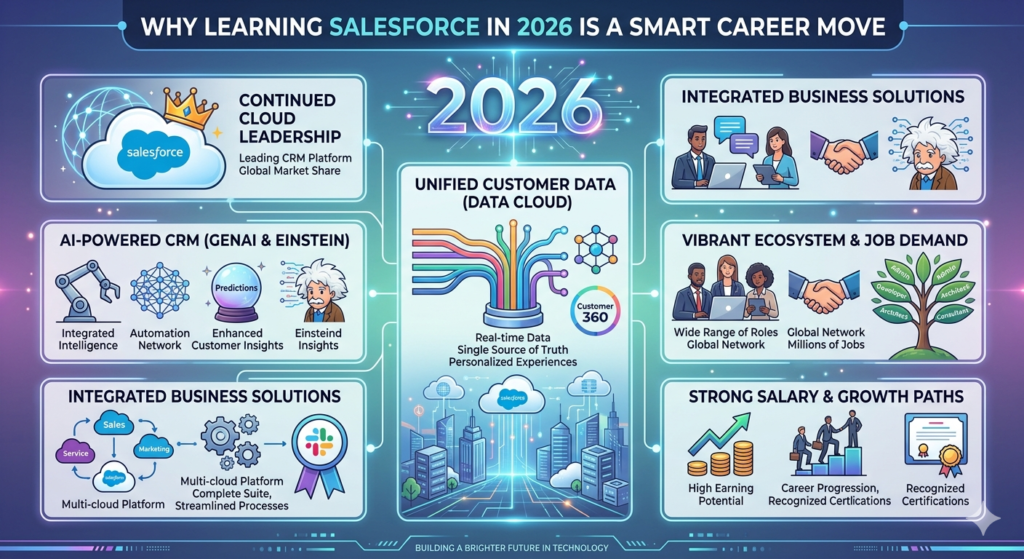
Why Learning Salesforce in 2026 is a Smart Career Move
Market Demand and Salary Potential
According to Salesforce’s Economic Impact Report, the Salesforce ecosystem will create 9.3 million jobs and $1.6 trillion in business revenues by 2026. The average salary for Salesforce professionals ranges from $80,000 to $150,000+ depending on expertise level.
AI-Enhanced Career Opportunities
The Salesforce learning roadmap 2026 incorporates AI-specialized roles:
- AI Administrator: $85,000-$115,000 annually
- Agentforce Specialist: $95,000-$135,000 annually
- Salesforce Developer: $110,000-$160,000 annually
- Data Cloud Architect: $140,000-$200,000+ annually
Low Code, High Impact
Despite incorporating advanced AI, the 2026 Salesforce platform remains accessible to non-programmers through enhanced low-code/no-code capabilities, making this Salesforce learning roadmap 2026 achievable for anyone committed to learning.
Remote-First Opportunities
By 2026, 78% of Salesforce positions are fully remote, offering unparalleled flexibility and global opportunities regardless of your location.
Versatility Across Industries
Learning Salesforce in 2026 opens doors across multiple sectors including:
- Healthcare and Life Sciences
- Financial Services
- Retail and E-commerce
- Manufacturing
- Non-profit Organizations
- Technology Companies
Future-Proof Technology Skills
Salesforce continuously innovates with AI integration (Einstein AI), automation tools, and cloud-based solutions, ensuring your skills remain relevant for years to come.
Understanding the Salesforce Ecosystem
What is Salesforce?
Salesforce is a cloud-based Customer Relationship Management (CRM) platform that helps businesses manage customer interactions, sales processes, marketing campaigns, and service operations from a single unified platform.
Key Salesforce Products
- Sales Cloud: Manages sales processes, leads, and opportunities
- Service Cloud: Customer service and support management
- Marketing Cloud: Digital marketing automation platform
- Commerce Cloud: E-commerce solutions
- Experience Cloud: Immersive, AI-customized digital experiences
- Data Cloud: Real-time customer data platform powering all clouds
- Analytics Cloud (Tableau CRM): Data visualization and analytics
Prerequisites Before You Start
Before beginning your journey of learning Salesforce in 2026, ensure you have:
Technical Prerequisites
- Basic understanding of databases and data relationships
- Familiarity with cloud computing concepts
- Fundamental knowledge of business processes
- Basic HTML/CSS knowledge (for development track)
Soft Skills Requirements
- Problem-solving mindset
- Attention to detail
- Communication skills for understanding business requirements
- Willingness to continuously learn
Tools You’ll Need
- A computer with stable internet connection
- Salesforce Developer Edition account (free)
- Trailhead account for learning modules
- Code editor (VS Code recommended for developers)
Complete Salesforce Learning Roadmap
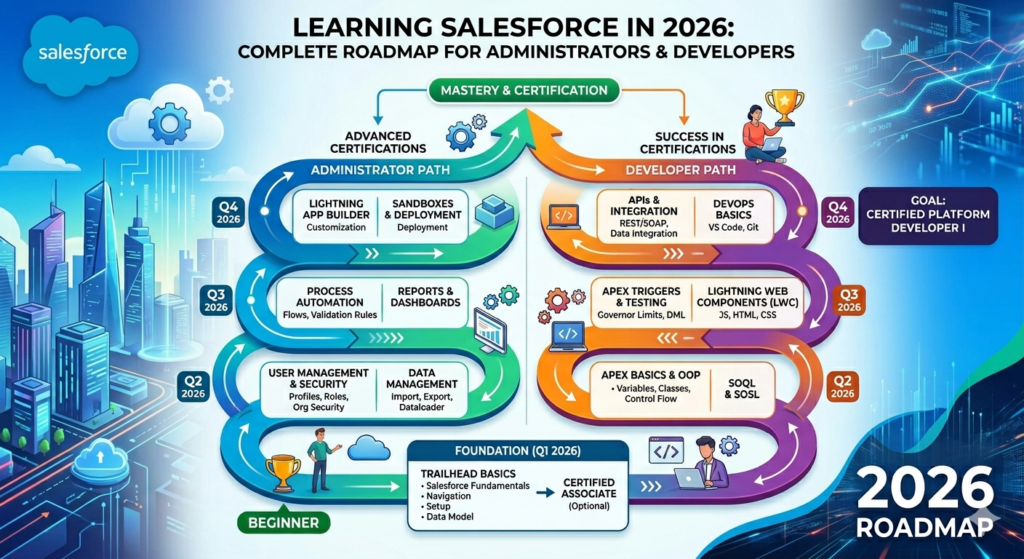
Phase 1: Salesforce Basics and Foundation (Weeks 1-4) {#phase-1}
Image Alt Text: Salesforce basics foundation course for beginners learning Salesforce in 2026
The foundation phase of learning Salesforce in 2026 focuses on understanding core concepts and platform navigation.
Week 1-2: Understanding Salesforce Fundamentals
What is Salesforce?
Start by understanding Salesforce as a cloud-based CRM platform that helps businesses manage customer relationships, sales processes, and service operations.
Key Concepts to Learn:
- Salesforce Architecture and Multi-tenant environment
- Understanding Objects, Fields, and Records
- Standard vs. Custom Objects
- Relationships (Lookup, Master-Detail, Many-to-Many)
- Salesforce User Interface Navigation
Recommended Trailhead Modules:
- Salesforce Platform Basics
- Data Modeling
- CRM for Lightning Experience
Week 3-4: Data Management and Security
Data Management Skills:
- Importing and exporting data using Data Import Wizard
- Understanding Data Loader for bulk operations
- Data validation and quality maintenance
- Duplicate management strategies
Security Fundamentals:
- Organization-Wide Defaults (OWD)
- Role Hierarchy
- Sharing Rules
- Profiles and Permission Sets
- Field-Level Security
Hands-on Practice:
Create a Developer Edition org and practice creating custom objects, fields, and implementing basic security settings. This practical experience is crucial when learning Salesforce in 2026.
Phase 2: Mastering Salesforce Administrator Skills (Weeks 5-12)
Image Alt Text: Salesforce Administrator certification roadmap 2026
Learning Salesforce in 2026 as an administrator requires mastering configuration, automation, and user management.
Week 5-6: Automation Tools
Workflow Rules and Process Builder:
- Creating automated field updates
- Email alerts and task creation
- Time-based workflow actions
- Understanding Process Builder for complex automation
Flow Builder (Priority in 2026):
Flow Builder has become the primary automation tool. Focus on:
- Screen Flows for guided user experiences
- Record-Triggered Flows
- Scheduled Flows
- Auto-launched Flows
- Integration with Einstein AI recommendations
Week 7-8: Reports and Dashboards
Reporting Mastery:
- Standard and Custom Report Types
- Tabular, Summary, Matrix, and Joined Reports
- Filtering and grouping data
- Report formulas and calculations
- Scheduling and distribution
Dashboard Creation:
- Component types (charts, gauges, metrics, tables)
- Dashboard filters and dynamic dashboards
- Mobile dashboard optimization
- Dashboard performance best practices
Week 9-10: Service Cloud and Sales Cloud
Sales Cloud Essentials:
- Lead and Opportunity Management
- Sales Processes and Path
- Product and Price Books
- Forecasting and Quota Management
- Einstein Opportunity Scoring (new in 2026)
Service Cloud Fundamentals:
- Case Management
- Service Console customization
- Omni-Channel routing
- Knowledge Base creation
- Einstein Case Classification
Week 11-12: Lightning Experience and App Builder
Lightning App Builder:
- Creating custom Lightning Pages
- Understanding components and templates
- Dynamic actions and forms
- Mobile app customization
- Lightning Web Components basics
User Experience Optimization:
- Page layout customization
- Record types and business processes
- Custom buttons and links
- Action and action layouts
Practice Project:
Build a complete application for a fictional company including custom objects, automation, reports, and dashboards. Document your learning Salesforce in 2026 journey through this project.
Phase 3: Advanced Salesforce Development (Weeks 13-24)
Image Alt Text: Salesforce developer learning path and programming guide 2026
For those serious about learning Salesforce in 2026 as developers, this phase covers programming and advanced customization.
Week 13-15: Apex Programming Fundamentals
Apex Basics:
- Apex syntax and data types
- Collections (Lists, Sets, Maps)
- Control flow statements
- Object-Oriented Programming in Apex
- SOQL and SOSL queries
Advanced Apex:
- Triggers and trigger frameworks
- Batch Apex for bulk processing
- Queueable Apex
- Scheduled Apex
- Asynchronous processing
Week 16-18: Visualforce and Lightning Web Components
Visualforce Pages:
- MVC architecture in Visualforce
- Standard and custom controllers
- Visualforce components
- JavaScript integration
- PDF generation
Lightning Web Components (LWC) – Priority for 2026:
LWC has become the standard for UI development:
- JavaScript ES6+ fundamentals
- HTML templates and CSS styling
- Component lifecycle hooks
- Event handling and communication
- Data services and wire adapters
- Integration with Salesforce data
Week 19-20: Integration and APIs
Salesforce Integration Patterns:
- REST API fundamentals
- SOAP API usage
- Bulk API for large data volumes
- Streaming API for real-time updates
- Platform Events
External Integrations:
- Callouts to external services
- Named Credentials and authentication
- Middleware platforms overview
- API security best practices
Week 21-22: Advanced Development Topics
Development Best Practices:
- Governor Limits and bulkification
- Test classes and code coverage
- Debug logs and debugging techniques
- Error handling strategies
- Performance optimization
DevOps and Version Control:
- Git and GitHub basics
- Salesforce DX and CLI
- Scratch orgs and source control
- Continuous Integration/Continuous Deployment (CI/CD)
- Package development
Week 23-24: AI and Einstein Platform
Learning Salesforce in 2026 must include AI capabilities:
- Einstein Analytics (Tableau CRM)
- Einstein Prediction Builder
- Einstein Bots
- Einstein Vision and Language
- Custom AI model integration
Capstone Development Project:
Create a comprehensive solution incorporating Apex, LWC, integrations, and AI features. This project will showcase your expertise in learning Salesforce in 2026.
Certification Roadmap for 2026
Image Alt Text: Salesforce certification path 2026 for administrators and developers
Certifications validate your learning Salesforce in 2026 journey:
Administrator Track Certifications
1. Salesforce Certified Administrator (After Week 12)
- Cost: $200
- Prerequisites: None
- Passing Score: 65%
- Focus Areas: Configuration, data management, security, automation
2. Salesforce Certified Advanced Administrator (After 6 months experience)
- Cost: $200
- Prerequisites: Salesforce Administrator certification
- Focus Areas: Advanced automation, analytics, extending custom apps
Developer Track Certifications
1. Salesforce Certified Platform App Builder (After Week 16)
- Cost: $200
- Prerequisites: None recommended
- Focus Areas: Data modeling, Lightning App Builder, business logic
2. Salesforce Certified Platform Developer I (After Week 20)
- Cost: $200
- Prerequisites: None
- Focus Areas: Apex, Visualforce, testing, debugging
3. Salesforce Certified Platform Developer II (After 1 year development experience)
- Cost: $400
- Prerequisites: Platform Developer I
- Focus Areas: Advanced Apex, integration patterns, design patterns
Specialized Certifications to Consider
- JavaScript Developer I (for LWC specialists)
- Marketing Cloud Developer
- CPQ Specialist
- Industries certifications (Healthcare, Financial Services)
Certification Study Tips:
- Use Focus on Force practice exams
- Join study groups on Salesforce Trailblazer Community
- Complete all relevant Trailhead modules
- Practice with hands-on scenarios in Developer Edition
Essential Resources and Tools for Learning Salesforce in 2026
Official Salesforce Resources
Trailhead – Salesforce’s free learning platform
- Interactive modules and projects
- Hands-on challenges
- Superbadges for practical validation
- Access Trailhead here
Salesforce Documentation
- Comprehensive guides for all features
- API reference documentation
- Release notes for new features
Community and Support
Trailblazer Community
- Forums for asking questions
- Local user groups and events
- Success Community for peer support
Salesforce Stack Exchange
- Technical Q&A platform
- Visit Stack Exchange
RizeX Labs Exclusive Resources
At RizeX Labs, we provide:
- Customized learning paths
- One-on-one mentorship programs
- Real-world project opportunities
- Interview preparation workshops
- Career guidance for Salesforce professionals
Development Tools
- Visual Studio Code with Salesforce Extensions
- Salesforce CLI for command-line operations
- Workbench for API testing
- ORGanizer for org documentation
- Salesforce Inspector browser extension
Career Opportunities After Learning Salesforce in 2026
Learning Salesforce in 2026 opens numerous career paths:
Entry-Level Positions (0-2 years)
Salesforce Administrator
- Salary Range: $60,000 – $85,000
- Responsibilities: User management, configuration, basic automation
- Growth Path: Senior Admin, Business Analyst
Junior Salesforce Developer
- Salary Range: $65,000 – $90,000
- Responsibilities: Apex development, basic integrations, Lightning components
- Growth Path: Senior Developer, Technical Architect
Mid-Level Positions (2-5 years)
Salesforce Business Analyst
- Salary Range: $80,000 – $110,000
- Responsibilities: Requirements gathering, solution design, stakeholder management
Salesforce Developer
- Salary Range: $90,000 – $130,000
- Responsibilities: Complex customizations, integrations, technical design
Senior-Level Positions (5+ years)
Salesforce Technical Architect
- Salary Range: $130,000 – $180,000+
- Responsibilities: Enterprise architecture, multiple cloud solutions, governance
Salesforce Consultant
- Salary Range: $100,000 – $160,000+
- Responsibilities: Implementation strategy, best practices, client advisory
Alternative Career Paths
- Freelance Consultant: $75-$200/hour
- Salesforce Trainer/Instructor: $70,000 – $120,000
- Solution Architect: $140,000 – $200,000+
- Product Owner: $110,000 – $150,000
Job Search Resources:
- Salesforce Talent Alliance
- LinkedIn Salesforce Jobs
- Indeed and Glassdoor
- RizeX Labs Career Portal
Common Challenges When Learning Salesforce in 2026 and How to Overcome Them
Challenge 1: Information Overload
Solution: Follow this structured roadmap, focus on one topic at a time, and use RizeX Labs’ curated learning paths.
Challenge 2: Lack of Hands-on Experience
Solution: Create multiple Developer Edition orgs, build practice projects, and seek internship opportunities.
Challenge 3: Keeping Up with Updates
Solution: Subscribe to release readiness resources, join early adopter programs, and maintain a continuous learning mindset.
Challenge 4: Understanding Business Context
Solution: Study different industries, understand CRM workflows, and engage with business users to learn their challenges.
Challenge 5: Certification Exam Preparation
Solution: Use practice exams, join study groups, complete superbadges, and maintain consistent study habits.
Future Trends in Salesforce for 2026 and Beyond
Learning Salesforce in 2026 means staying ahead of these trends:
AI and Machine Learning Integration
- Enhanced Einstein capabilities
- Predictive analytics across all clouds
- Automated code generation assistants
- Natural language query interfaces
Low-Code/No-Code Evolution
- More powerful Flow Builder features
- Advanced Lightning App Builder capabilities
- Citizen developer enablement
- Reduced dependency on traditional coding
Industry-Specific Solutions
- Deeper vertical specialization
- Pre-built industry workflows
- Compliance and regulatory automation
- Healthcare, Financial Services, Manufacturing focus
Enhanced Mobile Experience
- Mobile-first design approaches
- Offline capabilities expansion
- Progressive Web Apps (PWA) support
- Voice-activated commands
Sustainability and ESG Features
- Carbon footprint tracking
- Sustainability Cloud enhancements
- ESG reporting capabilities
- Green technology initiatives
Conclusion
Learning Salesforce in 2026 is an investment in a future-proof, lucrative, and fulfilling career. This comprehensive roadmap provides you with a structured path from complete beginner to expert-level Salesforce professional.
Whether you choose the Administrator track, Development path, or a combination of both, the key to success lies in consistent practice, continuous learning, and real-world application of your knowledge.
At RizeX Labs, we’re committed to supporting your Salesforce journey with:
- Expert mentorship programs
- Hands-on project opportunities
- Career placement assistance
- Community support and networking
Start your learning Salesforce in 2026 journey today by creating your free Developer Edition org and completing your first Trailhead module. Remember, every Salesforce expert started exactly where you are now.
Next Steps:
- Create your Salesforce Developer Edition account
- Sign up for Trailhead
- Join the RizeX Labs community for exclusive resources
- Download our free Salesforce Learning Tracker
- Connect with us on LinkedIn for daily tips and updates
Ready to transform your career? Start learning Salesforce in 2026 with RizeX Labs today!
Quick Summary
Learning Salesforce in 2026: Quick Overview Learning Timeline: 6-12 months for comprehensive mastery through a structured 24-week roadmap. Career Potential: 9.3 million jobs in the Salesforce ecosystem; salaries from $60K-$200K+ depending on experience. Learning Path: Weeks 1-4: Fundamentals, data management, security Weeks 5-12: Admin skills (automation, reports, Lightning) Weeks 13-24: Development (Apex, LWC, APIs, AI) Key 2026 Focus Areas: Lightning Experience (Classic deprecated) Flow Builder automation Lightning Web Components Einstein AI integration Salesforce DX/DevOps Essential Certifications: Administrator (start here) Advanced Admin/App Builder Platform Developer I & II Cost: Free to learn (Trailhead, Developer Edition). Certifications: $200-400 each. Best Resources: Trailhead (official platform) Developer Edition orgs RizeX Labs mentorship Trailblazer Community Who Should Learn: Career changers, IT professionals, business analysts, developers, students seeking future-proof tech careers—no prior tech experience required for Admin track. Bottom Line: Learning Salesforce in 2026 offers a lucrative, future-proof career with minimal financial investment. Start with free resources, follow the structured roadmap, earn certifications, and join a thriving global community. Next Step: Create your free Developer Edition account at developer.salesforce.com and begin your first Trailhead module today.