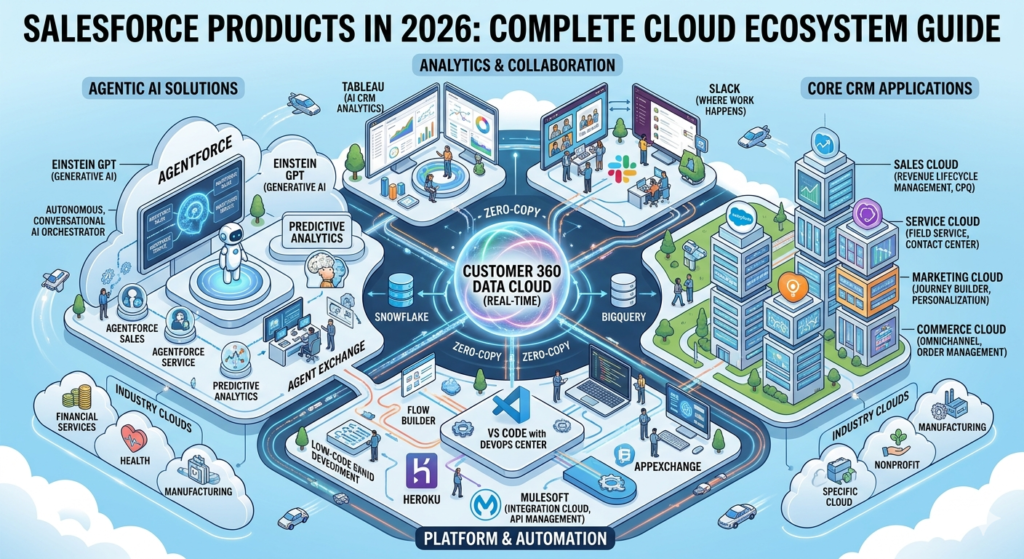
Introduction to Salesforce Products in 2026 :
The Salesforce ecosystem in 2026 represents the most comprehensive Customer Relationship Management (CRM) platform portfolio ever assembled. With over 300,000 customers worldwide and a market valuation exceeding $300 billion, Salesforce Products in 2026 continue to revolutionize how enterprises manage customer relationships across every touchpoint.
At RizeX Labs, we understand that navigating the diverse landscape of Salesforce Products in 2026 can be challenging. Each product is designed to solve specific business challenges, yet they integrate seamlessly within the Salesforce ecosystem. This comprehensive guide explores the top Salesforce Products in 2026, their features, use cases, and strategic implementation approaches.
The evolution of Salesforce Products in 2026 has been marked by:
- AI Integration: Einstein AI embedded across all products
- Industry Focus: Vertical-specific solutions
- Sustainability Features: ESG and environmental tracking
- Enhanced Mobile: Progressive Web App (PWA) capabilities
- Real-time Collaboration: Slack native integration
What Are Salesforce Products?
Salesforce Products in 2026 refer to the suite of cloud-based enterprise applications designed to manage customer relationships, sales processes, service operations, marketing campaigns, and business data analytics. Unlike traditional software, Salesforce Products in 2026 operate on a multi-tenant cloud architecture, meaning multiple organizations share the same infrastructure while maintaining complete data isolation.
Core Characteristics of Salesforce Products in 2026
Cloud-Based Architecture
All Salesforce Products in 2026 run on secure cloud servers, eliminating the need for on-premise installation or IT infrastructure management.
Scalability
Salesforce Products in 2026 scale automatically with your business growth, from startups to Fortune 500 enterprises.
Security
Enterprise-grade security with compliance certifications including SOC 2, ISO 27001, and industry-specific standards.
Integration Capabilities
Salesforce Products in 2026 integrate seamlessly with third-party applications through APIs, MuleSoft, and pre-built connectors.
Einstein AI
Advanced artificial intelligence embedded in Salesforce Products in 2026 for predictive analytics, automation, and intelligent recommendations.
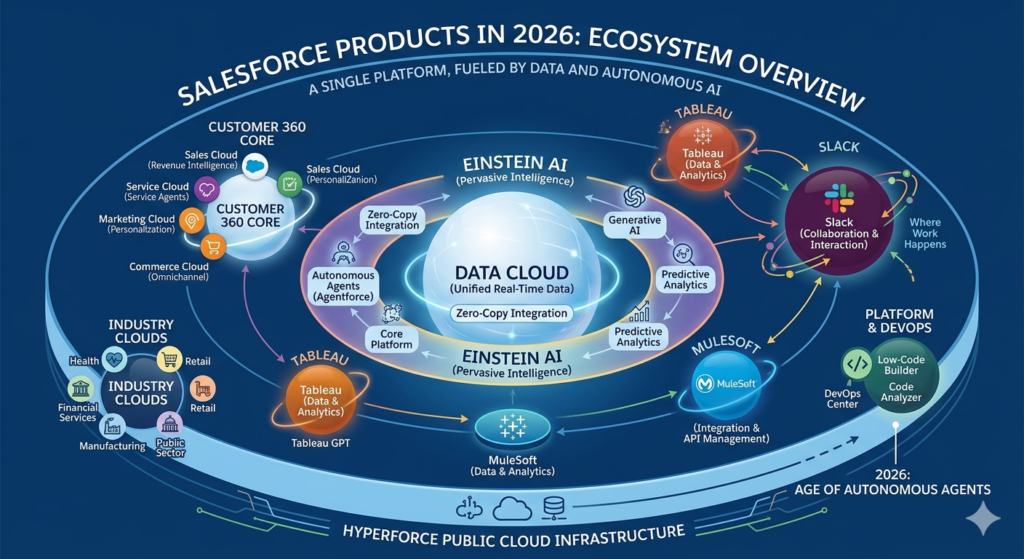
Top 10 Salesforce Products in 2026
1. Sales Cloud
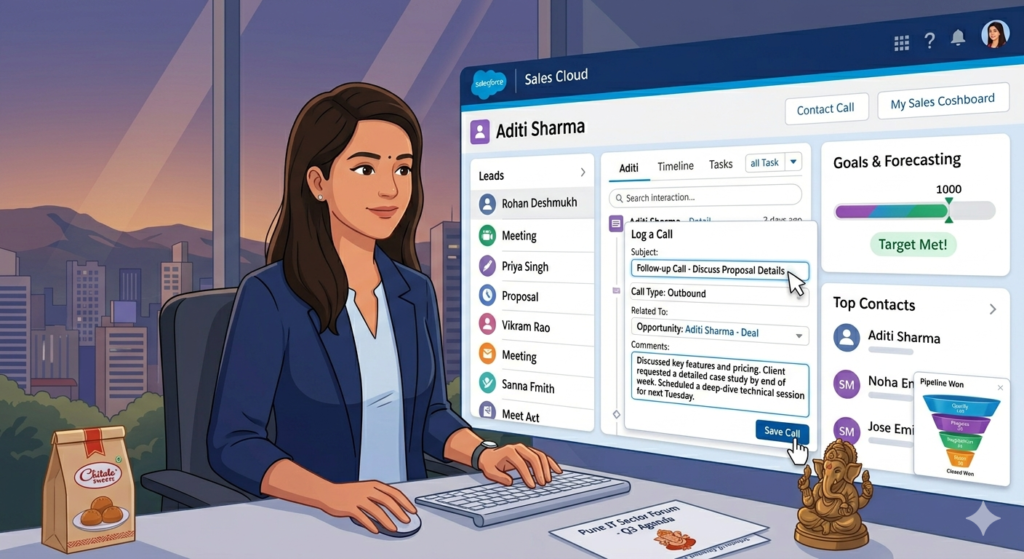
Sales Cloud remains the flagship Salesforce Product in 2026, designed specifically for sales teams to manage leads, opportunities, and accounts efficiently.
Key Features:
- Lead Management and Scoring
- Opportunity Management with Pipeline Visibility
- Account and Contact Management
- Sales Path and Process Automation
- Einstein Opportunity Scoring (AI-powered)
- Mobile Sales Console
- Collaboration Tools
- Quote-to-Cash (CPQ Integration)
- Real-time Dashboards and Reports
- Territory Management
Use Cases for Sales Cloud:
- B2B Sales Organizations
- Enterprise Account Management
- Sales Forecasting and Pipeline Analysis
- Multi-channel Sales Operations
- Global Sales Team Coordination
- Complex Deal Management
Benefits:
- Increased sales velocity by 30-40%
- Improved forecast accuracy
- Higher win rates through AI recommendations
- Better team collaboration
- Real-time visibility into sales pipeline
Pricing in 2026:
- Essentials: $75/user/month
- Professional: $155/user/month
- Enterprise: $300/user/month
- Unlimited: $500/user/month
Integration with Other Salesforce Products in 2026:
Sales Cloud integrates seamlessly with Einstein Analytics for deeper insights and Slack for team collaboration.
2. Service Cloud

Service Cloud is the premier Salesforce Product in 2026 for customer service and support operations, handling millions of customer interactions daily.
Key Features:
- Multi-channel Support (Phone, Email, Chat, Social)
- Omni-Channel Routing
- Service Console Customization
- Case Management and Resolution
- Knowledge Base and Self-Service
- Einstein Case Classification
- Service Cloud Voice Integration
- Community Cloud for Self-Service
- Service Level Agreements (SLAs)
- Advanced Scheduling and Capacity Planning
Use Cases for Service Cloud:
- Customer Support Centers
- IT Help Desk Operations
- Healthcare Patient Support
- Financial Services Client Services
- Retail Customer Care
- Technical Support Organizations
Benefits:
- 50% reduction in average handle time
- 40% improvement in customer satisfaction
- Faster issue resolution
- Reduced support costs
- 24/7 multichannel availability
Pricing in 2026:
- Service Cloud Professional: $165/user/month
- Service Cloud Enterprise: $330/user/month
- Service Cloud Unlimited: $500/user/month
Advanced Service Cloud Features:
- Einstein Response Recommendations
- Automatic Case Deflection
- Sentiment Analysis Integration
- Real-time Agent Guidance
3. Commerce Cloud
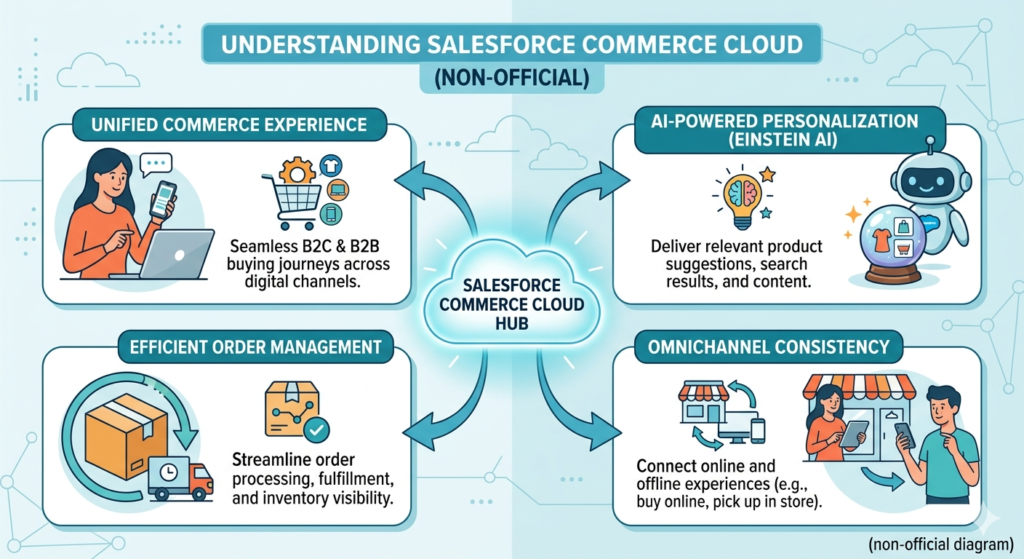
Commerce Cloud is the leading Salesforce Product in 2026 for B2C and B2B ecommerce enterprises managing online sales channels.
Key Features:
- Storefront Customization
- Product Information Management (PIM)
- Shopping Cart and Checkout Optimization
- Inventory Management
- Order Management System (OMS)
- Personalization Engine (AI-powered)
- Customer Data Integration
- Mobile-first Shopping Experience
- Promotion and Discount Management
- SEO and Site Performance Tools
Use Cases for Commerce Cloud:
- B2C Retail Operations
- B2B Marketplace Management
- Multi-brand ecommerce
- Direct-to-Consumer (D2C) Brands
- Global ecommerce Operations
- Subscription Management
Benefits:
- 35-50% increase in average order value
- 25% improvement in conversion rates
- Personalized shopping experiences
- Faster time-to-market for new products
- Reduced operational costs
Pricing in 2026:
- Commerce Cloud Professional: $2,000-$5,000/month
- Commerce Cloud Enterprise: Custom pricing
- Add-on services: Personalization, Order Management
AI-Powered Features:
- Product Recommendations
- Predictive Analytics
- Behavioral Analysis
- Dynamic Content Personalization
4. Marketing Cloud
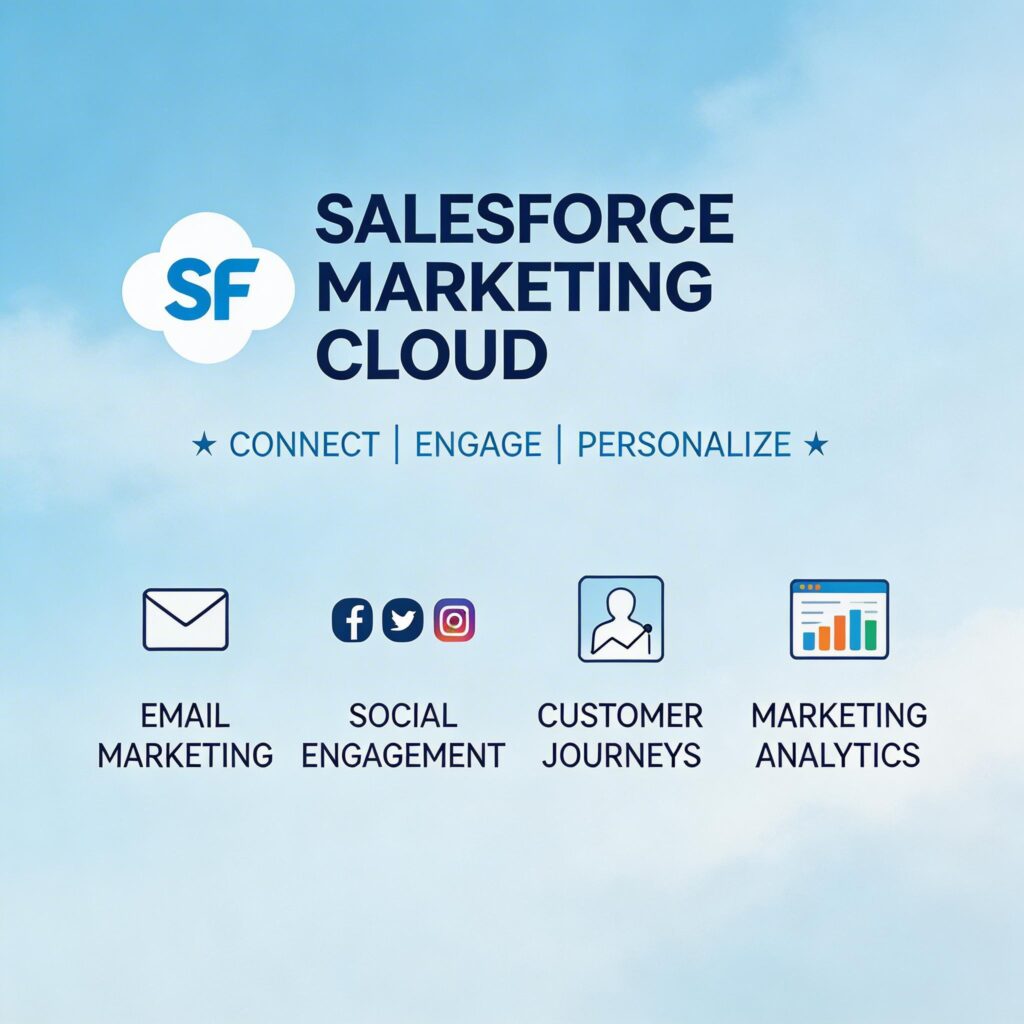
Marketing Cloud is the sophisticated Salesforce Product in 2026 for enterprise marketing automation and customer engagement.
Key Features:
- Email Marketing and Automation
- Journey Builder for Customer Journeys
- Audience Studio for Segmentation
- Content Builder and Library
- Social Studio for Social Management
- Advertising Studio
- SMS and Push Notifications
- Customer Data Platform (CDP)
- Analytics and Attribution
- Einstein Engage (AI recommendations)
Use Cases for Marketing Cloud:
- Multi-channel Campaign Management
- Customer Journey Orchestration
- Email Marketing at Scale
- Lead Nurturing and Scoring
- Customer Retention Programs
- Event Marketing
- Personalized Communications
Benefits:
- 40% increase in email engagement rates
- 50% faster campaign deployment
- Improved customer retention by 30%
- Better marketing ROI tracking
- Unified customer view
Pricing in 2026:
- Marketing Cloud Standard: $1,250/month
- Marketing Cloud Professional: $4,000-$8,000/month
- Marketing Cloud Premier: Custom pricing
- Einstein Engagement Frequency: Add-on pricing
Marketing Cloud Integration:
Works seamlessly with Salesforce CRM for unified customer view and automated lead management.
5. Einstein Analytics
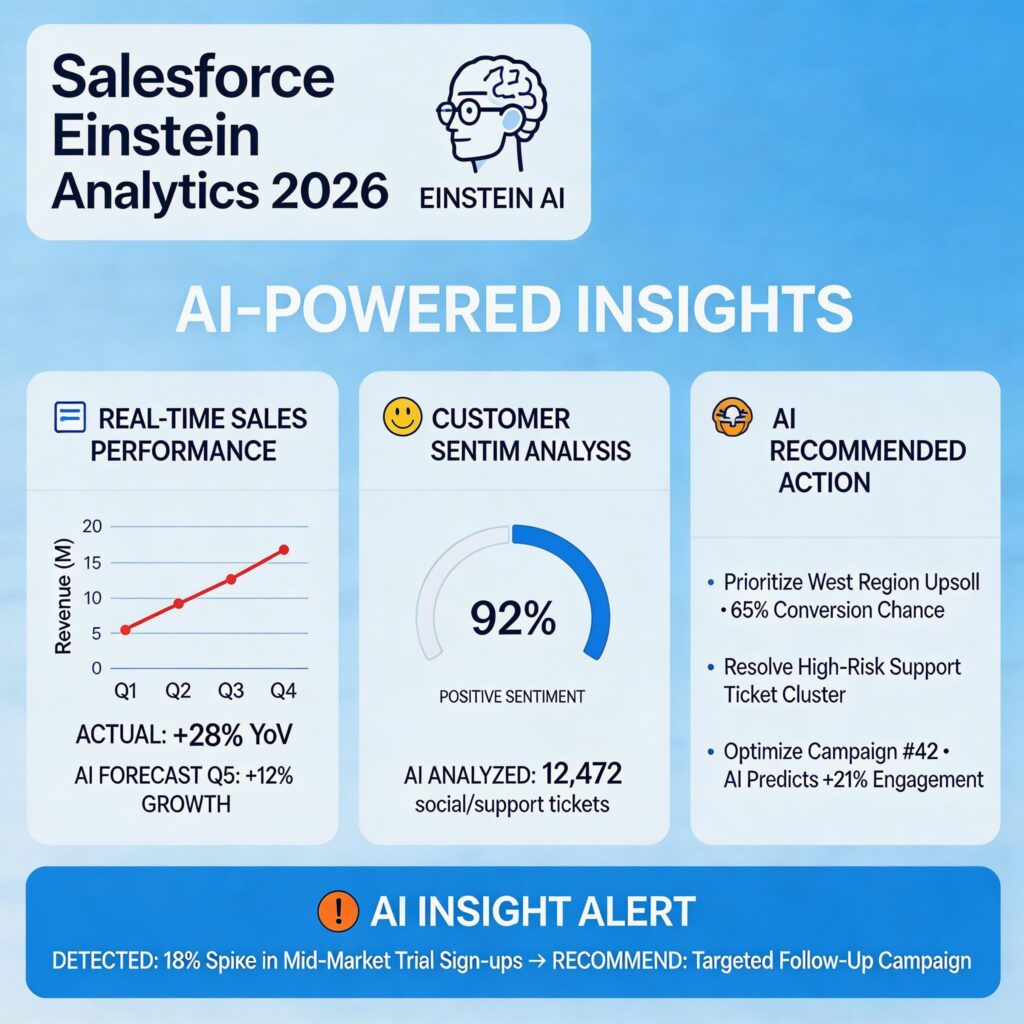
Einstein Analytics is the advanced Salesforce Product in 2026 for AI-driven business analytics and data exploration.
Key Features:
- AI-powered Insights (Automatic discovery)
- Predictive Analytics
- Dashboard and Visualization Tools
- Natural Language Queries
- Mobile-optimized Analytics
- Data Integration from Multiple Sources
- Anomaly Detection
- Recommended Actions
- Augmented Intelligence
- Real-time Monitoring
Use Cases for Einstein Analytics:
- Sales Performance Analytics
- Customer Lifetime Value Prediction
- Churn Risk Identification
- Revenue Forecasting
- Marketing Campaign Analysis
- Operational Efficiency Monitoring
- Financial Performance Tracking
Benefits:
- 60% faster insight discovery
- 45% better forecast accuracy
- Actionable recommendations
- Data democratization across organization
- Reduced time for manual reporting
Pricing in 2026:
- Einstein Analytics Plus: $50/month (5 users)
- Einstein Analytics Growth: $300/month (unlimited users)
- Custom Analytics Cloud: Enterprise pricing
Einstein AI Capabilities:
- Automatic Anomaly Detection
- Predictive Scoring
- Smart Pattern Recognition
- Natural Language Processing
6. Tableau CRM
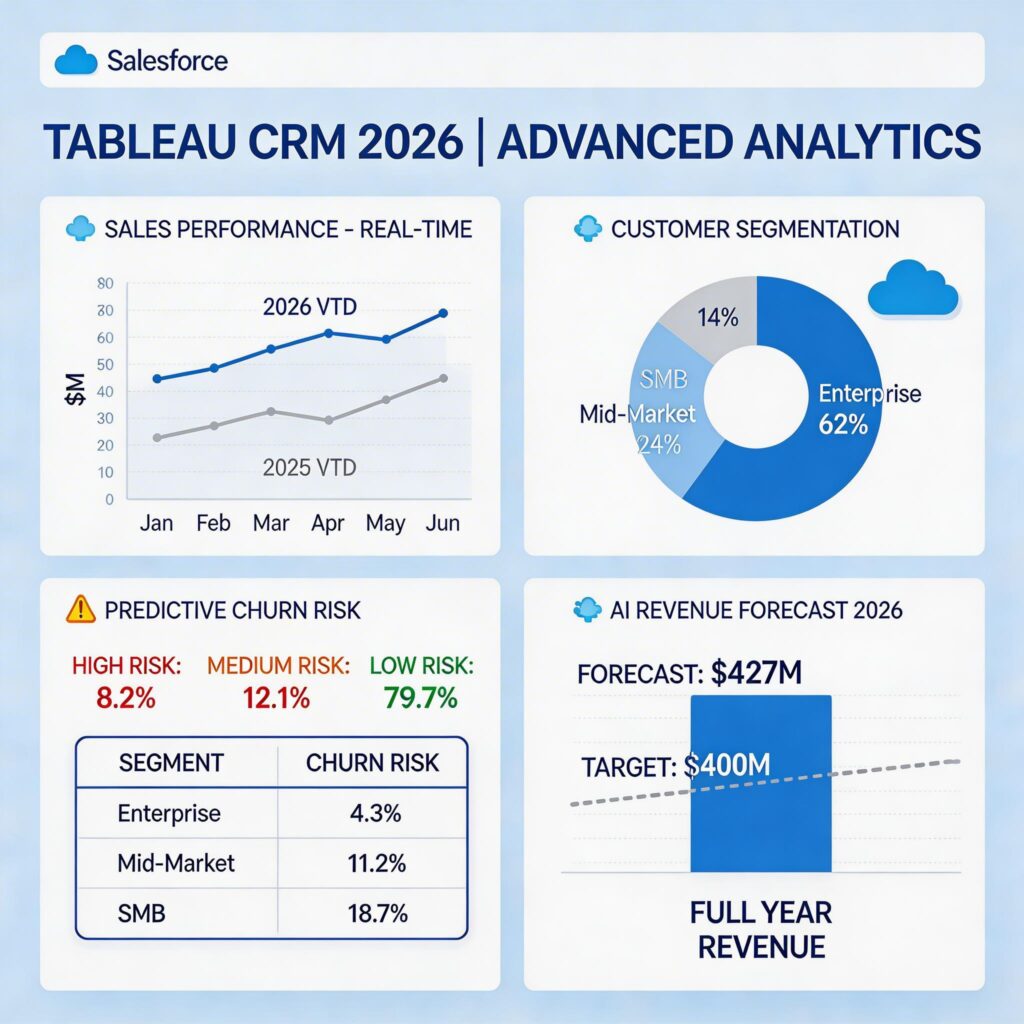
Tableau CRM (formerly Einstein Analytics) is the premier Salesforce Product in 2026 for embedded analytics within Salesforce applications.
Key Features:
- Embedded Analytics in Salesforce
- Pre-built Templates for Industries
- Self-service Analytics
- Collaborative Dashboards
- Mobile Analytics
- Real-time Data Updates
- Advanced Visualizations
- AI-powered Insights
- Predictive Models
- Custom Analytics Development
Use Cases for Tableau CRM:
- Sales Leadership Analytics
- Service Quality Monitoring
- Marketing Performance Tracking
- Financial Operations Visibility
- Customer Success Metrics
- Executive Dashboards
Benefits:
- Faster decision-making (real-time insights)
- Improved data literacy across teams
- Reduced dependency on IT for reports
- Better strategic alignment
- Enhanced business outcomes
Pricing in 2026:
- Tableau CRM Plus: Included with Sales/Service Cloud
- Tableau CRM Growth: $500/month
- Einstein Analytics Premium: Custom pricing
Tableau Integration:
Native integration with Salesforce CRM eliminates data synchronization delays.
7. Salesforce Platform
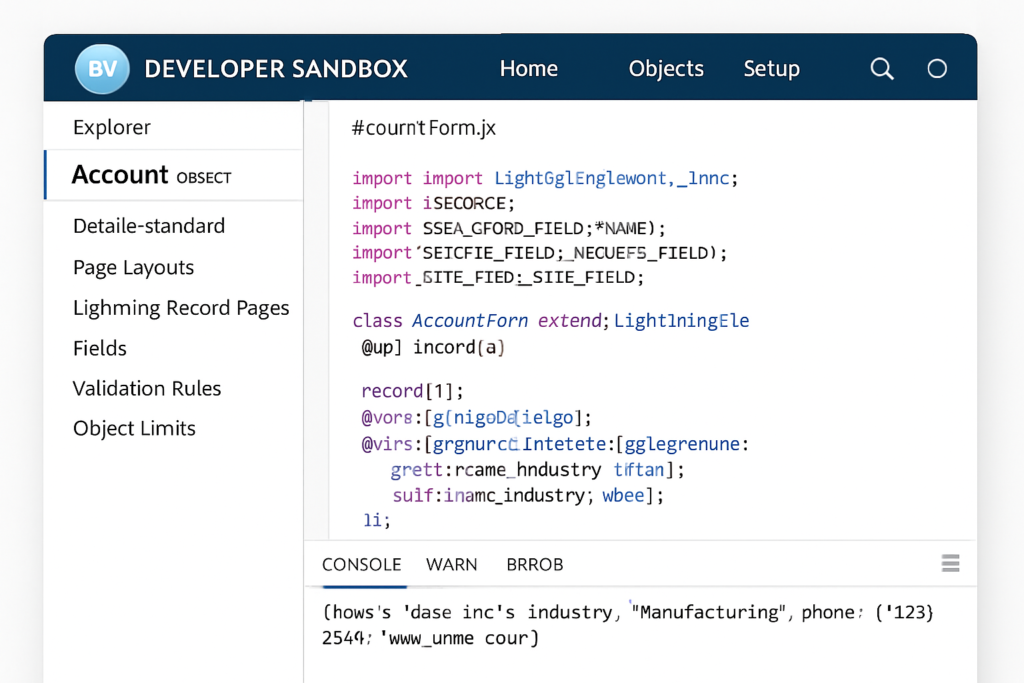
Salesforce Platform is the foundational Salesforce Product in 2026 enabling low-code and pro-code development of custom applications.
Key Features:
- Low-Code Development with Flow Builder
- Apex Programming Language
- Lightning Web Components (LWC)
- API Framework
- Database (Data Model)
- Security and Governance
- Developer Tools and IDE
- Testing Frameworks
- Deployment and Version Control
- AI Builder for Custom AI Models
Use Cases for Salesforce Platform:
- Custom Application Development
- Business Process Automation
- Legacy System Migration
- Industry-specific Solutions
- Internal Tool Development
- Integration Hubs
- Citizen Developer Enablement
Benefits:
- 70% faster development cycles
- Reduced dependency on external developers
- Enterprise security built-in
- Scalable infrastructure
- Cost-effective customization
Pricing in 2026:
- Platform Starter: $50/user/month
- Platform Plus: $100/user/month
- Platform Premium: Custom pricing
- Developer Edition: Free for development
Low-Code Focus in 2026:
- Enhanced Flow Builder capabilities
- AI Builder democratization
- Increased pre-built components
- No-code process automation
8. Industry Cloud
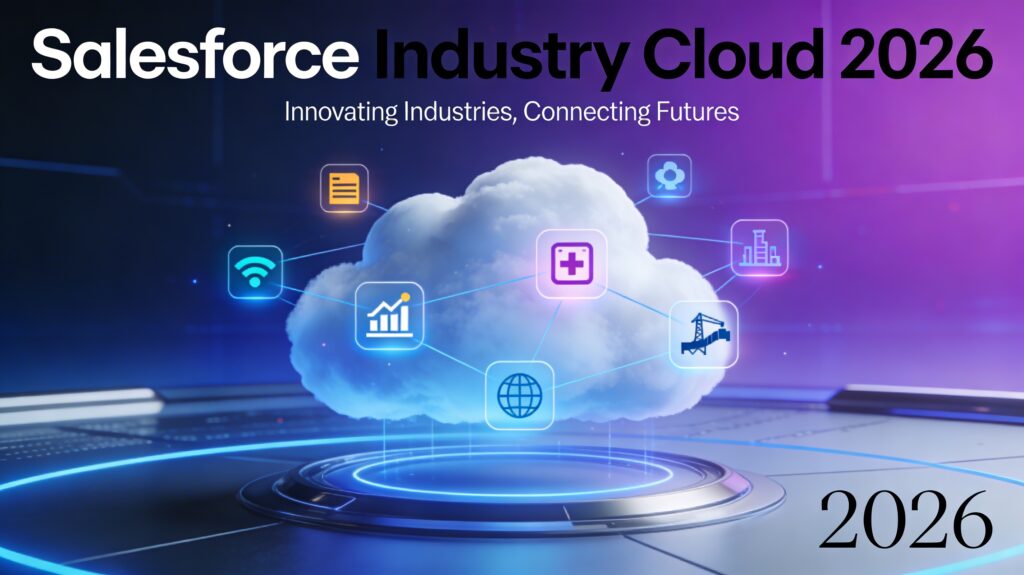
Image Alt Text: Salesforce Industry Cloud 2026 vertical solutions
Industry Cloud represents the specialized Salesforce Products in 2026 designed for specific business verticals with pre-built solutions.
Key Features by Industry:
Healthcare Cloud:
- Patient Records Management
- Appointment Scheduling
- Prescription Management
- Care Team Collaboration
- HIPAA Compliance
- Digital Patient Engagement
Financial Services Cloud:
- Client Relationship Management
- Wealth Management Tools
- Compliance and Regulatory Reporting
- Investment Portfolio Management
- Advisor Productivity Tools
- Anti-Money Laundering (AML)
Manufacturing Cloud:
- Supply Chain Visibility
- Inventory Management
- Production Planning
- Quality Management
- Supplier Relationships
- Sustainability Tracking
Higher Ed Cloud:
- Student Record Management
- Enrollment Management
- Academic Planning
- Faculty Management
- Student Engagement
- Alumni Relations
Benefits:
- Pre-built industry workflows
- Regulatory compliance built-in
- Faster implementation (40% faster)
- Industry best practices embedded
- Vertical-specific analytics
Pricing in 2026:
- Industry Cloud pricing varies by vertical
- Premium features: $50-200/user/month
- Specialized modules: Add-on pricing
Industry Cloud Expansion:
Salesforce continues expanding Industry Clouds to include Real Estate, Telecommunications, and Public Sector verticals.
9. Slack Integration
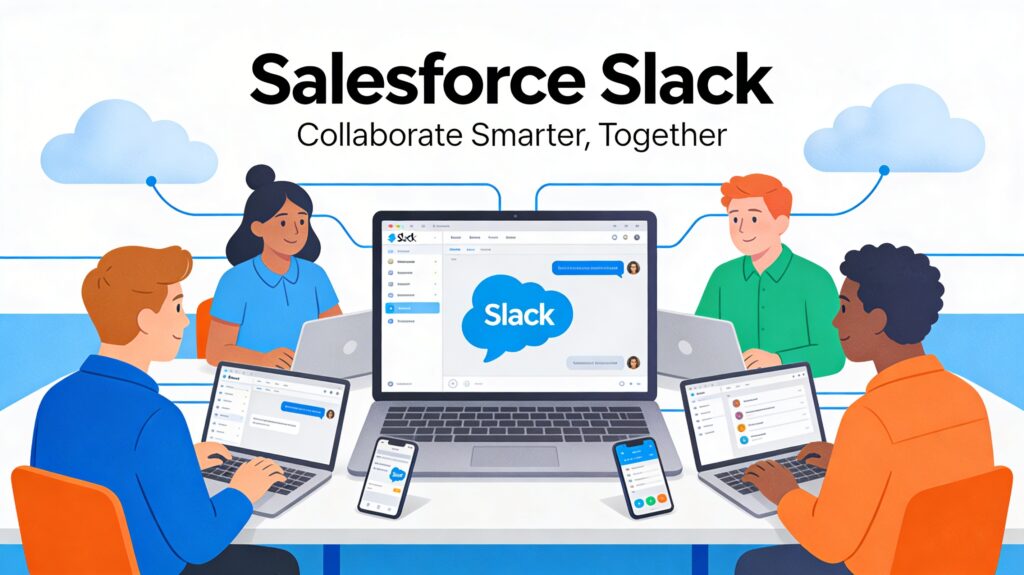
Slack integration represents the breakthrough Salesforce Product in 2026 for unified communication and CRM-enabled collaboration.
Key Features:
- Native Slack Channel Integration
- CRM Data Access from Slack
- Automated Notifications and Alerts
- Workflow Automation
- Bot Automation with CRM Data
- Record Sharing and Collaboration
- Task Creation from Slack
- Email Integration
- Einstein AI Recommendations in Slack
- Revenue Insights in Slack Channels
Use Cases for Slack Integration:
- Sales Team Collaboration
- Deal Status Updates
- Customer Issue Resolution
- Marketing Campaign Management
- Leadership Visibility
- Real-time Alerts
- Remote Team Coordination
Benefits:
- 40% reduction in meeting time
- Faster decision-making
- Improved employee engagement
- Unified communication hub
- Context-aware notifications
Pricing in 2026:
- Slack Pro: $8-12.50/user/month
- Salesforce + Slack Bundle: Custom pricing
- CRM Integration: Included with Salesforce license
Strategic Value:
Slack has become central to Salesforce’s vision of connected, intelligent enterprises where CRM data flows naturally into team workflows.
10. MuleSoft
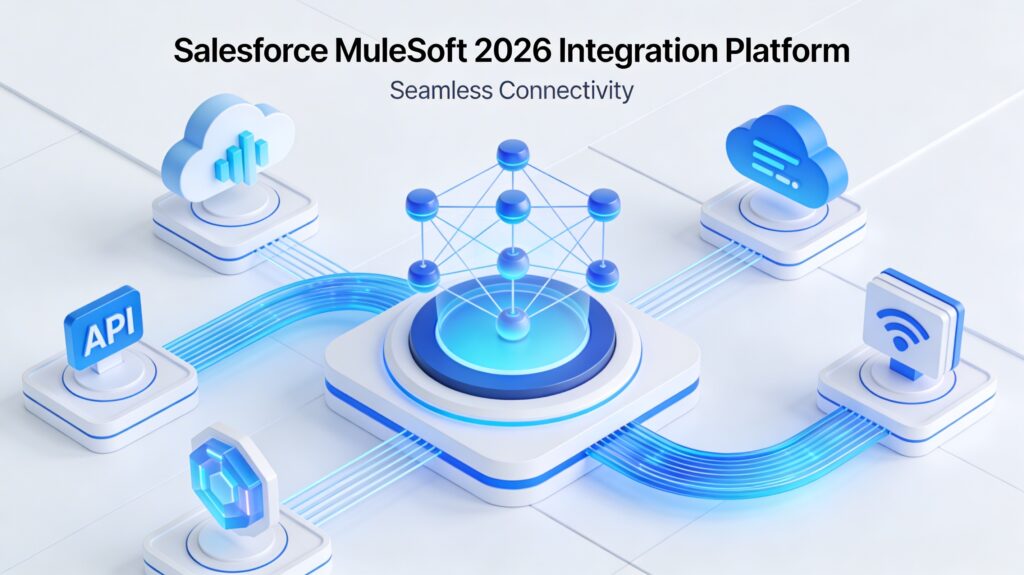
MuleSoft is the enterprise integration Salesforce Product in 2026 connecting Salesforce with legacy systems and third-party applications.
Key Features:
- Integration Platform as a Service (iPaaS)
- Pre-built Connectors (500+)
- API Management
- Data Synchronization
- Workflow Automation
- Real-time Data Integration
- Security and Governance
- Monitoring and Analytics
- API Development Tools
- Event-Driven Architecture
Use Cases for MuleSoft:
- Legacy System Integration
- Multi-Cloud Integration
- Data Synchronization
- API Development and Deployment
- ERP Integration (SAP, Oracle, NetSuite)
- Third-party SaaS Integration
- Complex Business Process Automation
Benefits:
- 50% faster integration delivery
- Reduced integration costs by 40%
- Improved data consistency
- Enhanced security and compliance
- Agile integration approach
Pricing in 2026:
- Integration Enterprise: $2,500/month
- Integration Enterprise Plus: $4,500/month
- API Management: Add-on pricing ($500-2,000/month)
- Flex Gateway: Consumption-based pricing
Integration Patterns:
- Point-to-Point Integrations
- Hub-and-Spoke Architecture
- Event-Driven Architecture
- API-Led Connectivity
Emerging Salesforce Products in 2026 {#emerging}
Image Alt Text: Emerging Salesforce Products in 2026 innovations
Genie (Customer Data Cloud)
Genie is the revolutionary Salesforce Product in 2026 providing real-time customer data unification.
Features:
- Real-time Customer Profile
- 360-degree Customer View
- Event-based Data Ingestion
- Unified Customer Identity
- Privacy-first Data Architecture
Impact:
- Eliminates data silos
- Enables hyper-personalization
- Real-time personalization engine
- Privacy compliance (GDPR, CCPA)
Agentforce
Agentforce represents the next generation of Salesforce Products in 2026 offering autonomous AI agents.
Capabilities:
- Autonomous Agents for Customer Service
- AI-powered Sales Agents
- Knowledge-based Decision Making
- Natural Language Conversations
- 24/7 Availability
Use Cases:
- Customer Support Automation
- Sales Lead Qualification
- Customer Onboarding
- FAQ Resolution
- Appointment Scheduling
Data Cloud
Data Cloud is the foundational Salesforce Product in 2026 for enterprise data management.
Features:
- Unified Data Platform
- Real-time Data Processing
- Advanced Data Governance
- Compliance Management
- Data Quality Tools
- Predictive Analytics
Salesforce Products Comparison Chart
| Product | Primary Use | Best For | Pricing |
| Sales Cloud | Sales Management | B2B/Enterprise Sales | $75-500/user/month |
| Service Cloud | Customer Support | Support Centers | $165-500/user/month |
| Commerce Cloud | eCommerce | B2C/Retail | $2,000-10,000+/month |
| Marketing Cloud | Marketing Automation | Multi-channel Campaigns | $1,250-8,000+/month |
| Einstein Analytics | Business Analytics | Data-driven Insights | $50-300/month |
| Tableau CRM | Embedded Analytics | Sales/Service Analytics | Included-500/month |
| Platform | Custom Development | Enterprise Apps | $50-100/user/month |
| Industry Cloud | Vertical Solutions | Healthcare/Finance/Mfg | $50-200/user/month |
| Slack Integration | Team Collaboration | Communication Hub | $8-12.50/user/month |
| MuleSoft | System Integration | Legacy System Connection | $2,500-4,500/month |
How to Choose the Right Salesforce Products in 2026
Step 1: Assess Your Business Needs
Questions to Consider:
- What customer relationship challenges are you facing?
- Which departments need CRM solutions?
- Do you require ecommerce capabilities?
- What integration requirements do you have?
- What is your budget for Salesforce implementation?
Step 2: Evaluate Your Organization
Organizational Factors:
- Company size and growth plans
- Current technology stack
- Technical capabilities
- Regulatory requirements
- Industry-specific needs
- Geographic distribution
Step 3: Map Business Processes
- Identify key customer touchpoints
- Document current workflows
- Identify automation opportunities
- Determine data requirements
- Outline reporting needs
Step 4: Create a Roadmap
Phase Approach:
- Phase 1: Core CRM (Sales or Service Cloud)
- Phase 2: Integration (MuleSoft if needed)
- Phase 3: Analytics (Einstein Analytics/Tableau CRM)
- Phase 4: Specialized Products (Industry Cloud, Commerce Cloud)
- Phase 5: Advanced Features (Slack, Data Cloud, Agentforce)
Step 5: Consider TCO
Total Cost of Ownership includes:
- License costs
- Implementation services
- Training and change management
- Ongoing support and maintenance
- Customization and development
- Integration costs
Implementation Best Practices for Salesforce Products in 2026
Change Management Strategy
- Executive Sponsorship
- Secure leadership commitment
- Allocate adequate resources
- Set clear success metrics
- User Communication
- Regular updates and transparency
- Address concerns and feedback
- Highlight benefits and ROI
- Training Programs
- Role-based training modules
- Hands-on workshops
- Continuous support and documentation
Data Migration Best Practices
- Audit current data quality
- Implement data cleansing
- Create detailed mapping documents
- Test migration in sandbox first
- Establish data governance
- Monitor post-migration accuracy
Customization Strategy
- Use standard features first
- Minimize custom development
- Leverage ecosystem apps
- Plan for future updates
- Document all customizations
- Maintain configuration control
Integration Planning
- Map all integration points
- Choose integration patterns (MuleSoft, APIs)
- Build comprehensive integration layer
- Plan for data synchronization
- Implement monitoring and alerts
- Test all integration scenarios
Governance Framework
- Establish Salesforce governance board
- Define approval processes
- Implement security policies
- Create naming conventions
- Maintain documentation
- Regular compliance audits
ROI and Business Impact of Salesforce Products in 2026
Quantifiable Benefits
Sales Improvement:
- 25-30% increase in win rates
- 40-50% faster sales cycles
- 35% improvement in forecast accuracy
- 20-25% increase in revenue per sales rep
Customer Service Enhancement:
- 50% reduction in average handle time
- 40% improvement in CSAT scores
- 35% decrease in customer churn
- 60% faster issue resolution
Operational Efficiency:
- 70% reduction in manual data entry
- 40% improvement in process efficiency
- 50% faster time-to-market
- 30% reduction in operational costs
Financial Impact:
- Average ROI: 300-400% over 3 years
- Payback period: 6-12 months
- Productivity gains: $100K-$500K+ annually
- Cost savings: $50K-$200K+ annually
Success Metrics
Organizations implementing Salesforce Products in 2026 should track:
- Customer acquisition cost (CAC)
- Customer lifetime value (CLV)
- Revenue per employee
- Customer satisfaction (CSAT/NPS)
- System adoption rates
- Return on investment (ROI)
- Time-to-value achievement
Future of Salesforce Products in 2026 and Beyond
AI-Driven Evolution
The future of Salesforce Products in 2026 emphasizes autonomous operations:
- Agentforce Expansion: AI agents handling complex tasks
- Predictive Intelligence: Forecasting business outcomes
- Autonomous Workflows: Self-optimizing processes
- Natural Language Interfaces: Query data naturally
Industry-Specific Innovation
- Expanded Industry Clouds: New vertical solutions
- Pre-built Workflows: Industry best practices
- Compliance Automation: Regulatory requirement management
- Vertical Analytics: Industry-specific insights
Enhanced Integration
- Unified Data Platform: Single customer view across all systems
- Real-time Synchronization: Instant data updates
- API-first Architecture: Modern integration patterns
- Composable Commerce: Flexible system architecture
Sustainability Features
Salesforce Products in 2026 increasingly include:
- Carbon Tracking: Measure environmental impact
- ESG Reporting: Environmental, Social, Governance compliance
- Sustainable Practices: Green technology initiatives
- Supply Chain Transparency: Ethical sourcing tracking
RizeX Labs Support for Salesforce Products in 2026
At RizeX Labs, we specialize in helping organizations navigate the complex landscape of Salesforce Products in 2026. Our services include:
- Strategic Consulting: Identify the right Salesforce Products in 2026 for your business
- Implementation Services: Expert guidance through deployment
- Customization and Development: Tailored solutions leveraging Salesforce Products in 2026
- Training and Enablement: Comprehensive programs to maximize adoption
- Ongoing Support: Continuous optimization and enhancement
Ready to transform your business with Salesforce Products in 2026? Contact RizeX Labs today for a free consultation!
Quick Summary
Salesforce Products in 2026 represent the most comprehensive, integrated, and innovative CRM platform available in the market. Whether you're focusing on sales excellence, customer service mastery, ecommerce leadership, or marketing automation, Salesforce Products in 2026 provide the tools, intelligence, and ecosystem to drive business success. The landscape of Salesforce Products in 2026 has evolved from standalone applications to an interconnected ecosystem powered by Einstein AI, unified data platforms, and autonomous agents. Organizations that strategically implement the right combination of Salesforce Products in 2026 consistently achieve