
Introduction: Transforming Insurance Operations with Salesforce FSC
The insurance industry is undergoing one of the most significant transformations in its history. Rising customer expectations, increasing regulatory complexity, growing competition from insurtech startups, and the rapid advancement of digital technology are forcing traditional insurance companies to rethink how they operate, serve customers, and manage their businesses. Insurance customers today expect the same level of personalized, digital-first service they receive from leading consumer technology companies. They want instant policy information, fast claims processing, proactive communication, and advisors who genuinely understand their complete insurance needs.

Traditional insurance systems were built for a different era. Legacy policy administration platforms, disconnected claims management systems, and generic CRM tools simply cannot deliver the integrated, intelligent, and personalized experiences that modern insurance customers demand. Insurance companies find themselves trapped between outdated technology infrastructure and rapidly evolving customer expectations, struggling to bridge a gap that grows wider every year.
The Insurance App in Financial Services Cloud provides a powerful solution to this challenge. Salesforce Financial Services Cloud delivers a purpose-built insurance CRM platform that brings together policy management, claims processing, household relationship mapping, agent productivity tools, omni-channel client engagement, and compliance management into a single unified digital environment. This is not a generic CRM adapted for insurance. It is a platform that speaks the language of insurance, understands the structure of insurance relationships, and supports the specific workflows that insurance professionals rely on every day.
In this comprehensive guide, we will explore everything you need to know about the Insurance App in Financial Services Cloud. Whether you are a Salesforce professional, an FSC consultant, an insurance industry executive, or a beginner learning about Financial Services Cloud, this guide will give you a thorough understanding of what the Insurance App is, how it works, what it can do for your organization, and how to implement it successfully.
What is the Insurance App in Financial Services Cloud?
Definition and Overview
The Insurance App in Financial Services Cloud is a specialized CRM application built within the Salesforce Financial Services Cloud ecosystem, designed specifically to meet the unique needs of insurance companies, agencies, brokers, and agents. It provides a comprehensive digital workspace that enables insurance professionals to manage the complete client lifecycle from initial prospect engagement through policy issuance, ongoing servicing, claims management, and renewal.
Unlike standard CRM platforms that treat insurance like any other sales process, the Insurance App in Financial Services Cloud is built on a financial-services-specific data model that accurately represents the complex relationships between clients, policies, claims, households, agents, and brokers. This purpose-built foundation means that insurance organizations can begin delivering value quickly without the months of custom development that generic CRM implementations typically require.
The Insurance App supports multiple lines of insurance including personal lines such as auto, home, and life insurance, as well as commercial lines including property, casualty, liability, and specialty coverage. This flexibility makes FSC suitable for carriers, agencies, brokers, and managing general agents across the full spectrum of the insurance industry.
Why Salesforce Provides Insurance-Specific FSC Features
Salesforce recognized early that the financial services industry, including insurance, has unique requirements that generic CRM platforms cannot adequately address. Insurance relationships are fundamentally different from typical sales relationships. A policyholder is not just a customer who has made a purchase. They are a long-term relationship partner whose needs evolve over time, whose household circumstances change, and whose loyalty must be continuously earned through excellent service and relevant coverage.
Salesforce developed the Insurance App in Financial Services Cloud to address these unique dynamics. By building insurance-specific objects, workflows, and data models directly into the platform, Salesforce enables insurance organizations to deploy a purpose-built solution that reflects how insurance actually works rather than forcing insurance processes into a generic sales framework.
Key Features of Insurance App in Financial Services Cloud
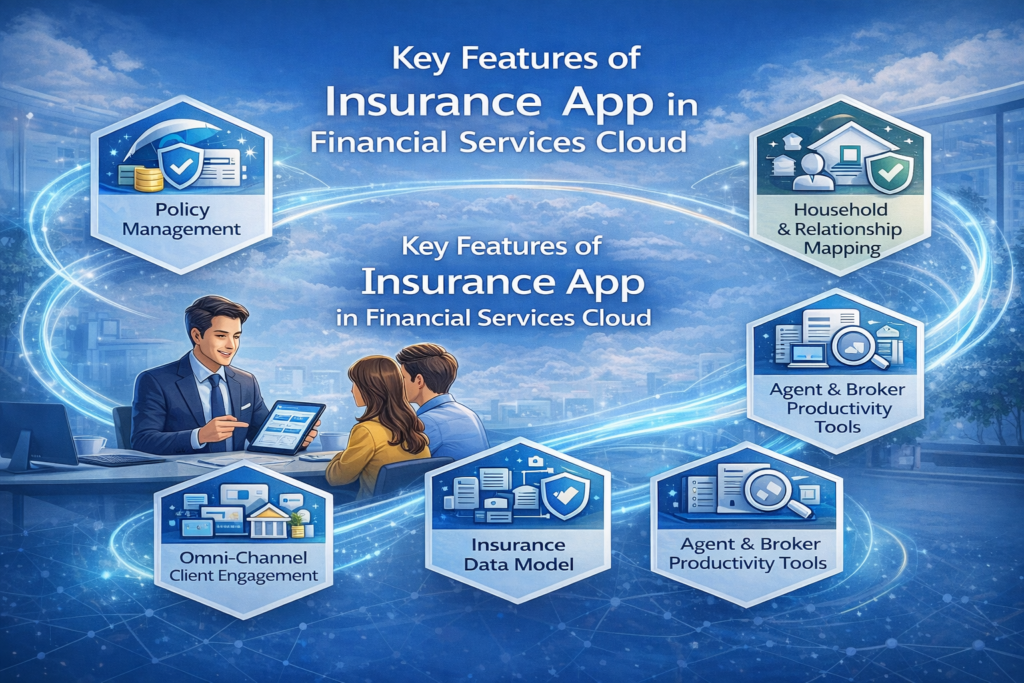
Policy Management
Policy management is at the heart of every insurance operation, and the Insurance App in Financial Services Cloud provides comprehensive policy management capabilities that give agents, brokers, and service representatives instant access to complete policy information.
Policy management features include:
- Complete policy record management capturing policy type, coverage details, premium amounts, payment schedules, effective dates, and renewal dates
- Multi-policy client view showing all policies held by a client or household in a single consolidated screen
- Policy status tracking across the complete lifecycle from quote through issuance, active coverage, renewal, and cancellation
- Coverage detail management including limits, deductibles, endorsements, riders, and exclusions
- Premium payment tracking with payment history, upcoming payment alerts, and lapse prevention notifications
- Renewal management workflows that automatically alert agents and clients when policies approach renewal dates
- Policy document storage with centralized access to declarations pages, certificates of insurance, and policy documents
For example, when a client calls to ask about their home insurance coverage, a service representative using the Insurance App in Financial Services Cloud can instantly pull up all policy details, coverage limits, deductible information, and payment status without putting the customer on hold or searching through multiple systems.
Claims Management
Claims management is one of the most critical and complex aspects of insurance operations. The Insurance App in Financial Services Cloud provides structured claims management capabilities that improve processing speed, accuracy, and customer communication.
Claims management features include:
- First notice of loss capture through guided digital intake processes that collect all required information consistently
- Claims status tracking from initial filing through investigation, adjustment, and settlement
- Claims assignment and routing to appropriate adjusters based on claim type, complexity, and location
- Document collection management for supporting documentation including photos, police reports, medical records, and repair estimates
- Communication tracking with claimants, adjusters, vendors, and third parties throughout the claims process
- Claims history visibility showing all past and current claims for a client or household
- Settlement and payment tracking to monitor claim resolution and payment status
Household and Relationship Mapping
Insurance relationships rarely involve a single individual. Households make insurance decisions collectively, and understanding the complete household insurance picture is essential for providing comprehensive coverage recommendations and exceptional service.
The Household and Relationship Mapping feature in the Insurance App in Financial Services Cloud enables insurance professionals to:
- Group household members including spouses, dependents, and other family members into logical household units
- View all household policies across every line of coverage in a single consolidated household view
- Identify coverage gaps within the household where members may be underinsured or uninsured
- Map complex relationships including business entities, trusts, and other insured parties connected to the household
- Coordinate multi-policy servicing to ensure consistent and comprehensive service across all household insurance needs
- Enable cross-generational relationship management for families with complex insurance structures
Omni-Channel Client Engagement
Modern insurance customers interact with their insurers across multiple channels including phone, email, web portals, mobile apps, social media, and in-person visits. The Insurance App in Financial Services Cloud supports true omni-channel client engagement:
- Unified communication history capturing all client interactions regardless of channel in a single chronological record
- Email and phone integration for seamless communication directly from the FSC platform
- Web-to-case functionality that converts online inquiries and service requests into trackable cases automatically
- Customer portal integration enabling self-service access to policy information, claims status, and payment management
- Automated communication workflows that trigger relevant messages based on policy events, claims milestones, and renewal dates
Agent and Broker Productivity Tools
Insurance agents and brokers are the primary drivers of revenue in most insurance organizations. The Insurance App in Financial Services Cloud provides powerful productivity tools that enable agents and brokers to work more efficiently and serve more clients effectively:
- Activity management with task tracking, calendar integration, and automated follow-up reminders
- Lead and opportunity management for tracking new business prospects through the sales pipeline
- Quote and proposal tracking to monitor quoting activity and conversion rates
- Referral management for tracking client referrals and agent-to-agent or agent-to-specialist handoffs
- Performance dashboards showing key metrics including policies written, premiums, renewal rates, and cross-sell conversions
- Mobile access enabling agents to access client information and manage activities from anywhere
Insurance Data Model in FSC
The Insurance App in Financial Services Cloud is built on a specialized data model that accurately represents insurance industry relationships and structures. Key data model components include:
- Insurance Policy object for tracking all policy-level information
- Coverage object for capturing individual coverage components within a policy
- Claims object for managing the complete claims lifecycle
- Insurance Producer object for tracking agent and broker relationships
- Household object for grouping family and group insurance relationships
- Financial Account object for linking insurance policies to broader financial relationships
- Interaction Summary object for capturing complete client communication history
Integration with Core Insurance Systems
The Insurance App in Financial Services Cloud is designed to work alongside existing insurance technology infrastructure rather than replacing it. Integration capabilities include:
- Policy administration system integration for real-time policy data synchronization
- Claims management system integration for current claims status and history
- Billing system integration for premium payment tracking and collection management
- Rating engine integration for quote generation and premium calculation
- Document management system integration for centralized access to policy documents
- Regulatory reporting system integration for compliance data submission
Benefits of Using Insurance App in Financial Services Cloud
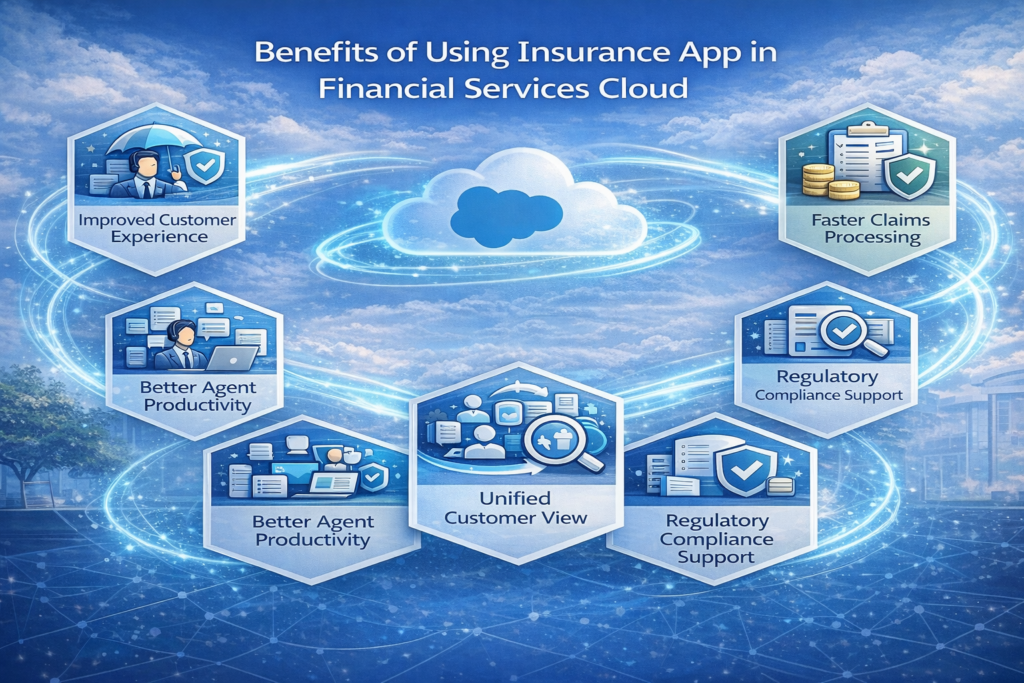
Improved Customer Experience
The Insurance App in Financial Services Cloud dramatically improves customer experience by giving every agent, broker, and service representative instant access to complete client information. Customers no longer need to repeat their information every time they call. Service representatives can answer questions immediately, resolve issues faster, and communicate proactively about policy changes, renewal dates, and claims status.
Faster Claims Processing
Claims processing speed is one of the most important drivers of customer satisfaction in insurance. The Insurance App streamlines claims workflows through guided intake processes, automatic assignment routing, structured documentation collection, and automated status communications. Faster claims processing reduces customer frustration, improves loyalty, and reduces operational costs associated with prolonged claims cycles.
Better Agent Productivity
By consolidating all client information, policy data, activity management, and communication tools into a single platform, the Insurance App in Financial Services Cloud eliminates the productivity drain of toggling between multiple systems. Agents spend less time on administrative tasks and more time building client relationships and writing new business.
Unified Customer View
The 360-degree customer view provided by the Insurance App gives every member of the insurance team a complete understanding of each client’s insurance portfolio, household relationships, claims history, communication preferences, and service history. This unified view enables more informed interactions, more relevant recommendations, and more consistent service across all touchpoints.
Regulatory Compliance Support
Insurance is one of the most heavily regulated industries globally. The Insurance App in Financial Services Cloud supports regulatory compliance through comprehensive audit trail maintenance, enforced workflow controls, required disclosure tracking, document retention management, and regulatory reporting capabilities. These features help insurance organizations meet their compliance obligations consistently and efficiently.
Personalized Policy Recommendations
Einstein Analytics within the Insurance App in Financial Services Cloud analyzes client data, household profiles, and behavioral patterns to generate personalized policy recommendations. These intelligent recommendations help agents identify cross-selling and upselling opportunities, suggest coverage enhancements, and proactively address coverage gaps before clients experience losses.
Insurance App Data Model in Financial Services Cloud
Understanding the data model is essential for anyone implementing or configuring the Insurance App in Financial Services Cloud. The FSC insurance data model is built around several core objects and their relationships:
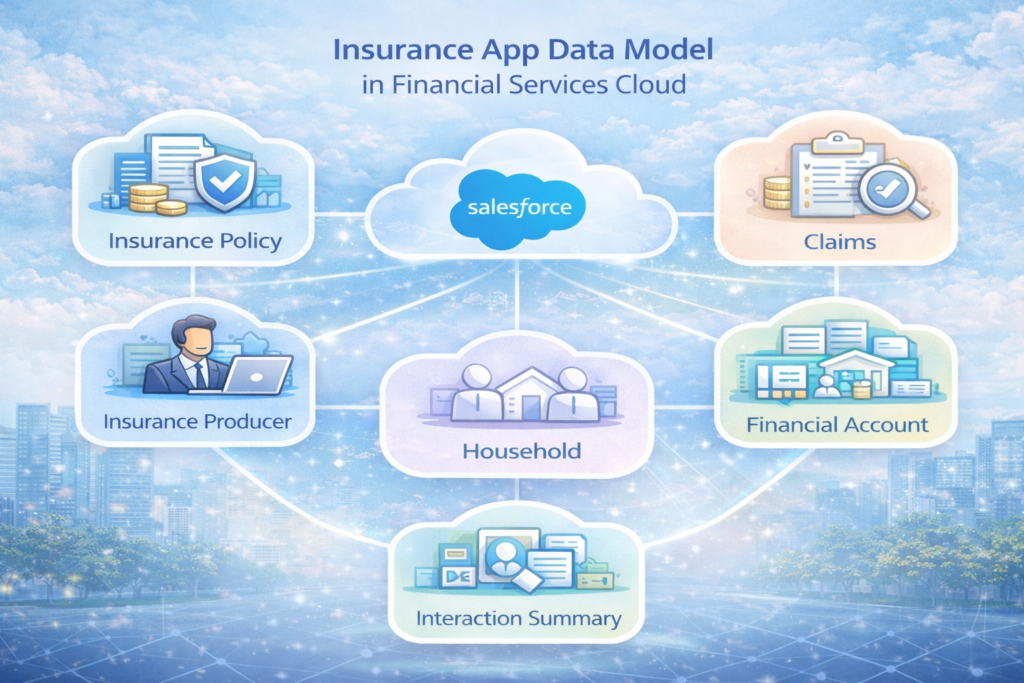
Insurance Policy is the central object that captures all policy-level information including policy number, type, carrier, effective date, expiration date, premium, and status. Policies are linked to individual clients and households.
Coverage records capture the specific coverage components within each policy including coverage type, limits, deductibles, and premiums. Multiple coverage records can be linked to a single policy record.
Claims records track the complete claims lifecycle from first notice of loss through settlement. Claims are linked to specific policies and include details about the loss event, involved parties, assigned adjuster, and settlement status.
Insurance Producer records capture agent and broker information including licensing details, appointment status, and production metrics. Producers are linked to client records and policy records.
Household groups related individuals and their associated policies, enabling the consolidated household view that is essential for comprehensive insurance relationship management.
Financial Account links insurance policies to the broader financial relationship context, enabling wealth management and banking teams to understand the complete financial picture of shared clients.
Interaction Summary captures all advisor-client communications including meeting notes, phone call summaries, and follow-up actions, creating a comprehensive communication history.
The relationships between these objects create a rich, interconnected data structure that accurately reflects the complexity of real-world insurance relationships and enables the powerful capabilities of the Insurance App in Financial Services Cloud.
Real-World Use Cases of Insurance App in Financial Services Cloud
Use Case 1 – Insurance Agent Managing Client Policies
An independent insurance agent managing a book of three hundred personal lines clients uses the Insurance App in Financial Services Cloud to maintain complete client profiles and policy records. When renewal season arrives, the agent uses automated renewal workflows to identify clients approaching renewal, generate pre-renewal review tasks, and send personalized renewal communications. The result is a more organized, proactive renewal process that reduces policy lapses and identifies opportunities to review and enhance client coverage.
Use Case 2 – Claims Team Processing Requests
A claims team at a regional property and casualty insurer uses the Insurance App in Financial Services Cloud to manage the complete claims lifecycle. When a new claim is reported, the system automatically creates a claims record, assigns it to the appropriate adjuster based on claim type and location, and sends an acknowledgment to the claimant. Throughout the claims process, automated status updates keep the claimant informed, reducing inbound status inquiries and improving customer satisfaction scores.
Use Case 3 – Customer Service Representative Support
A customer service representative at a large insurance carrier receives a call from a policyholder asking about a recent billing change. Using the Insurance App in Financial Services Cloud, the representative instantly accesses the customer’s complete profile including all active policies, recent payment history, billing changes, and prior interaction records. The representative resolves the inquiry in under two minutes without transferring the call, delivering an exceptional service experience that builds customer loyalty.
Use Case 4 – Cross-Selling Additional Insurance Products
A life insurance agent uses household management views in the Insurance App in Financial Services Cloud to identify clients who have life insurance but no disability income protection or long-term care coverage. Einstein Analytics surfaces these coverage gaps as cross-sell opportunities. The agent initiates targeted outreach to discuss comprehensive protection planning, converting coverage gap analysis into meaningful client conversations that result in additional policy sales and stronger overall client relationships.
Insurance App vs Standard Salesforce Sales Cloud
| Aspect | Standard Sales Cloud | Insurance App in FSC |
|---|---|---|
| Data Model | Generic leads and opportunities | Insurance-specific policies, claims, and coverage objects |
| Policy Management | Not available natively | Purpose-built policy management |
| Claims Management | Not available | Structured claims lifecycle management |
| Household View | Not available | Built-in household grouping and aggregation |
| Insurance Producer | Not available | Dedicated producer management object |
| Coverage Tracking | Manual workarounds required | Native coverage object with full detail |
| Compliance Tools | Basic audit capabilities | Insurance-specific compliance workflows |
| Client View | Basic contact information | Complete 360-degree insurance client profile |
| Renewal Management | Custom development required | Automated renewal workflow templates |
| Cross-Sell Intelligence | Manual identification | Einstein-powered coverage gap analysis |
| Integration | Custom API development | Pre-built insurance system connectors |
| Implementation Time | 12 to 18 months typically | 3 to 6 months achievable |
| Industry Updates | Generic platform updates | Insurance-specific feature releases |
| Regulatory Support | Generic capabilities | Insurance regulatory compliance features |
Best Practices for Implementing Insurance App in Financial Services Cloud
Requirement Gathering
Before beginning implementation of the Insurance App in Financial Services Cloud, conduct thorough requirements gathering with all stakeholder groups including agents, brokers, claims teams, service representatives, compliance officers, and technology teams. Understand current pain points, desired outcomes, and specific business processes that need to be supported. Document requirements clearly and prioritize them by business impact and implementation complexity.
Data Migration Planning
Data migration is consistently one of the most challenging aspects of FSC implementation. Begin by conducting a comprehensive audit of existing data across all source systems. Identify data quality issues, inconsistencies, and gaps that need to be addressed before migration. Map source system data to FSC objects carefully and establish data validation rules. Plan for a parallel operation period and conduct thorough post-migration data validation before decommissioning legacy systems.
Security and Compliance Setup
Insurance data is highly sensitive and subject to strict regulatory requirements. Configure FSC security carefully using profiles, permission sets, sharing rules, and field-level security to ensure appropriate data access controls. Implement encryption for sensitive data fields. Document security configuration for regulatory examination purposes and establish regular security review processes.
Automation with Flows
Identify high-impact automation opportunities and implement them using Salesforce Flow automation tools. Priority automation candidates include renewal notification workflows, claims assignment routing, coverage gap alert generation, compliance task creation, and communication trigger workflows. Thoroughly test all automation before go-live to ensure accuracy and reliability.
Integration Strategy
Develop a comprehensive integration strategy that connects the Insurance App in Financial Services Cloud with core insurance systems including policy administration, claims management, billing, and rating platforms. Prioritize integrations by business value and technical complexity. Use MuleSoft where available for enterprise-grade integration capabilities. Establish data synchronization schedules and error handling protocols to ensure reliable ongoing data flow.
Challenges in Insurance FSC Implementation
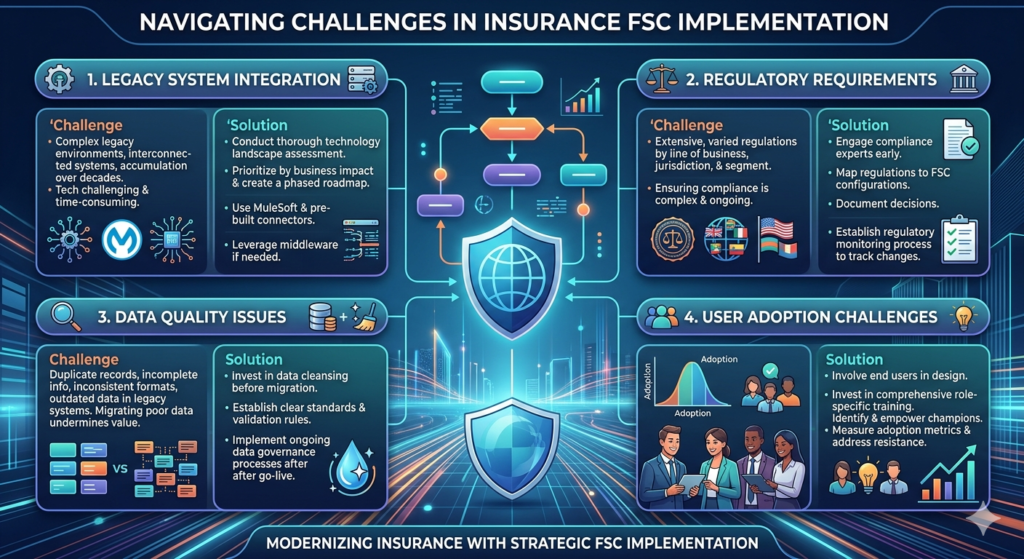
Legacy System Integration
Challenge: Most insurance organizations have complex legacy technology environments with multiple interconnected systems that have accumulated over decades. Integrating these legacy platforms with FSC can be technically challenging and time-consuming.
Solution: Conduct a thorough technology landscape assessment before implementation begins. Prioritize integrations by business impact and develop a phased integration roadmap. Use MuleSoft for complex integration scenarios and leverage pre-built FSC connectors where available. Consider middleware solutions for particularly complex legacy system integration requirements.
Regulatory Requirements
Challenge: Insurance is subject to extensive and varied regulatory requirements that differ by line of business, jurisdiction, and market segment. Ensuring that FSC implementation meets all applicable regulatory requirements is a complex and ongoing challenge.
Solution: Engage compliance experts with deep insurance regulatory knowledge during the requirements gathering and design phases. Map specific regulatory requirements to FSC configuration options and document all compliance-related decisions. Establish a regulatory monitoring process to track changes in applicable regulations and update FSC configuration accordingly.
Data Quality Issues
Challenge: Insurance organizations often have years or decades of accumulated data quality issues in legacy systems including duplicate records, incomplete information, inconsistent formats, and outdated data. Migrating poor quality data to FSC undermines the value of the new platform.
Solution: Invest in data cleansing before migration rather than hoping to fix data quality issues after go-live. Establish clear data quality standards and validation rules. Implement data governance processes to maintain data quality on an ongoing basis after go-live.
User Adoption Challenges
Challenge: Insurance professionals who have worked with existing systems for years may resist adopting a new platform, particularly if they perceive it as adding complexity to their workflow rather than simplifying it.
Solution: Involve end users in the design and configuration process from the beginning to build ownership and ensure the system reflects their actual needs. Invest in comprehensive role-specific training. Identify and empower champions within each user group to support peers during the transition. Measure adoption metrics and address resistance proactively with additional support and training.
The Future of Insurance on Salesforce FSC
Artificial Intelligence in Insurance
Artificial intelligence is rapidly transforming every aspect of insurance operations. Within the Insurance App in Financial Services Cloud, Einstein AI capabilities are enabling intelligent underwriting support, fraud detection, claims triage automation, and personalized coverage recommendations. As AI capabilities continue to advance, the intelligence embedded in FSC will become an increasingly powerful competitive differentiator for insurance organizations.
Predictive Claims Analysis
Predictive analytics within the Insurance App in Financial Services Cloud will increasingly enable insurers to anticipate claims before they occur, identify fraud patterns early, optimize claims reserves, and predict claims outcomes with greater accuracy. These predictive capabilities will reduce losses, improve reserving accuracy, and enable more proactive risk management strategies.
Hyper-Personalization
The future of insurance customer experience is hyper-personalization, where every interaction, recommendation, and communication is tailored to the specific needs, preferences, and circumstances of each individual client. The Insurance App in Financial Services Cloud is building toward this future through increasingly sophisticated client profiling, behavioral analytics, and AI-powered recommendation engines that enable truly individualized insurance experiences at scale.
Automation Trends
Process automation within the Insurance App in Financial Services Cloud will continue to advance, with increasingly sophisticated workflow automation, straight-through processing for routine transactions, automated underwriting for standard risks, and AI-powered claims settlement for minor losses. These automation trends will dramatically reduce operational costs while improving speed and consistency across all insurance processes.
About RizeX Labs
At RizeX Labs, we specialize in delivering cutting-edge Salesforce solutions, including Insurance App implementations within Salesforce Financial Services Cloud (FSC). Our expertise combines deep technical knowledge, industry best practices, and real-world implementation experience to help insurance organizations streamline policy management, improve customer service, and accelerate digital transformation.
We empower organizations to transform their insurance operations—from siloed legacy systems to unified, intelligent insurance platforms that enhance agent productivity, improve claims handling, and ensure regulatory compliance.
Internal Linking Opportunities:
External Linking Opportunities:
- Salesforce official website
- Salesforce Financial Services Cloud overview
- Salesforce Insurance Solutions
- Salesforce Help Documentation
- Salesforce AppExchange
- Insurance Industry Insights
Quick Summary
Insurance App in Financial Services Cloud (FSC) is a specialized solution designed to help insurers manage policyholder relationships, streamline claims processes, and deliver personalized insurance services through a unified CRM platform. By leveraging Salesforce FSC, insurance providers can centralize customer data, manage policies efficiently, and automate service workflows.
With the Insurance App, organizations can improve agent productivity, enhance claims management, ensure regulatory compliance, and deliver superior customer experiences. As the insurance industry continues to evolve digitally, implementing Insurance App in FSC has become essential for insurers seeking operational efficiency and competitive advantage.
Quick Summary
The Insurance App in Financial Services Cloud is a purpose-built CRM solution developed by Salesforce specifically for insurance carriers, agencies, brokers, and independent agents. Built on the Salesforce Financial Services Cloud platform, it provides powerful tools including policy management, claims management, household relationship mapping, omni-channel client engagement, agent productivity tools, compliance tracking, and integration with core insurance systems. The platform gives insurance professionals a complete 360-degree view of every client and their complete insurance portfolio from a single unified screen, enabling faster claims processing, personalized policy recommendations, improved agent productivity, stronger regulatory compliance, and deeper long-term client relationships that drive sustainable business growth. The platform provides comprehensive features including complete policy management across multiple lines of insurance, structured claims lifecycle management from first notice of loss through settlement, household and relationship mapping for multi-policy client management, omni-channel client engagement across phone, email, web, and mobile channels, agent and broker productivity tools for activity and opportunity management, and robust compliance tracking through enforced workflow automation and comprehensive audit trail maintenance.