
Introduction OF FSC
Salesforce Financial Services Cloud (FSC) represents a specialized customer relationship management (CRM) solution developed specifically for organizations operating within the financial services sector. Built on the Salesforce platform, FSC extends standard CRM functionalities by incorporating industry-specific data models, features, and workflows tailored to address the unique requirements of financial institutions. This comprehensive platform enables financial professionals to manage complex client relationships, streamline operational processes, and deliver personalized services while maintaining regulatory compliance.
While the core features of Salesforce Financial Services Cloud (FSC) focus on client management, goal tracking, and financial data modeling, the platform also includes several advanced capabilities that make it a complete enterprise-grade solution for modern financial institutions.
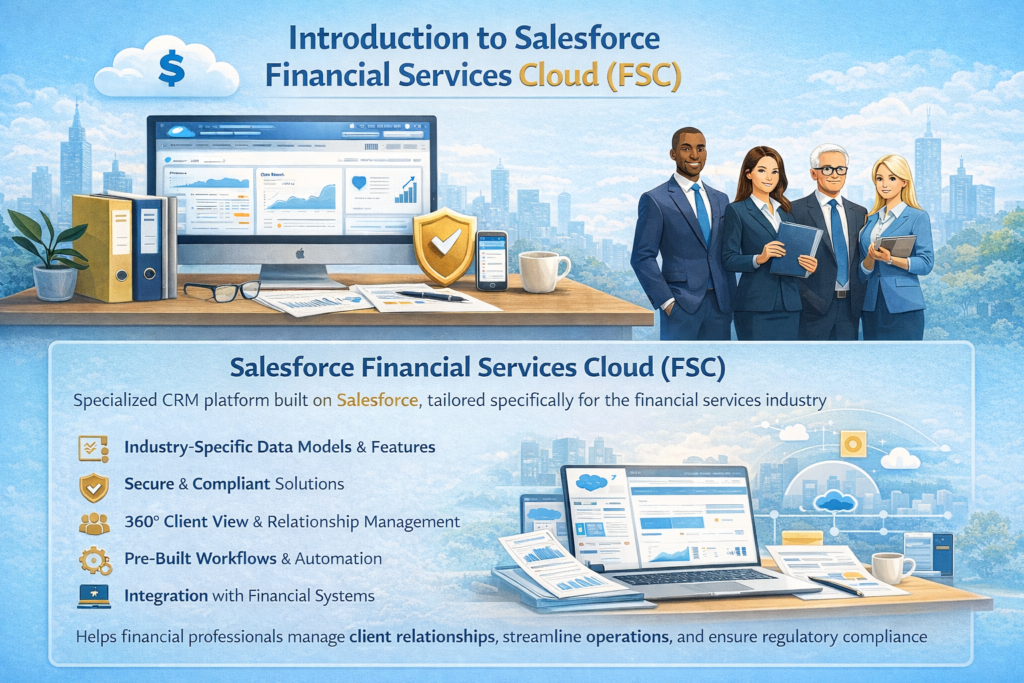
Furthermore, FSC supports seamless collaboration across teams and departments. Financial services often involve multiple stakeholders such as advisors, loan officers, compliance teams, and customer service representatives. FSC enables these teams to work together on a unified platform, ensuring that everyone has access to consistent and up-to-date information. This improves communication, reduces duplication of effort, and enhances the overall customer experience.
Understanding FSC has become increasingly essential for Salesforce professionals, particularly those seeking roles within financial services organizations or aiming to specialize in industry-specific Salesforce implementations.
Overview of Financial Services Cloud (FSC)
Financial Services Cloud (FSC) is an industry-specific solution built on the Salesforce Customer 360 platform. It is designed to meet the unique needs of financial service providers such as wealth management firms, retail banks, private banks, insurance companies, and commercial banking institutions.
Unlike a traditional CRM, FSC provides a unified framework that brings together all customer information in one place, creating a complete 360-degree view of clients. In the financial industry, customer data is usually scattered across multiple systems like banking platforms, loan management tools, and insurance applications. FSC solves this problem by consolidating all data into a single system, helping financial professionals better understand and serve their clients.
Another key strength of FSC is its ability to manage complex relationships. It allows organizations to track households, family members, business entities, and financial advisors in a structured way. This is especially useful in wealth management, where clients often have multiple accounts, investments, and financial goals linked to different people and institutions.
FSC also supports industry-specific data models such as financial accounts, goals, and holdings, enabling advisors to get deeper insights into a client’s financial situation. With built-in automation and AI capabilities, FSC helps streamline processes like onboarding, loan approvals, and customer service, improving efficiency and reducing manual work.
Overall, FSC empowers financial institutions to deliver personalized, data-driven, and compliant services, making it an essential platform in the modern financial ecosystem.
Core Characteristics
- Industry-Specific Data Model: FSC incorporates specialized objects and relationships designed explicitly for financial services operations such as households, financial accounts, goals, and financial holdings.
- Salesforce Platform Foundation: Leverages core Salesforce capabilities including security, automation, AI, mobile functionality, and scalable cloud infrastructure.
- Pre-Configured Components: Provides ready-to-use features addressing common financial services use cases such as client onboarding, relationship management, and financial planning.
- Compliance-Ready Architecture: Includes built-in features supporting regulatory requirements, audit trails, data privacy, and secure access control.
- Integration Capabilities: Facilitates seamless connectivity with third-party financial systems, core banking platforms, insurance systems, and external data providers.
- Additional Core Characteristics
- 360-Degree Customer View:
- FSC consolidates all customer information including accounts, transactions, relationships, goals, and interactions into a single unified profile, enabling better decision-making and personalized service.
- Relationship Intelligence:
- It provides advanced relationship mapping that helps organizations understand connections between individuals, households, businesses, and advisors, improving advisory accuracy and service delivery.
- Goal-Based Financial Planning:
- FSC supports tracking of client financial goals such as retirement planning, education funding, and wealth creation with real-time progress monitoring.
- Automation and Workflow Efficiency:
- Built-in automation tools like Salesforce Flow help streamline repetitive processes such as onboarding, loan processing, and service request handling.
- AI-Powered Insights:
- With Einstein AI capabilities, FSC provides predictive analytics, next-best-action recommendations, and customer behavior insights to improve engagement and sales opportunities.
- Scalability and Flexibility:
- FSC is highly scalable and can be customized to meet the needs of small financial firms as well as large global enterprises.
- Omnichannel Engagement:
- Supports interaction across multiple channels such as mobile apps, email, chat, and in-person meetings, ensuring consistent customer experience.
- Role-Based Access Control:
- Ensures secure and controlled data access based on user roles, departments, and hierarchy within the organization.
- Real-Time Data Synchronization:
- Keeps customer data updated across integrated systems in real time, ensuring accuracy and consistency across all touchpoints.
Primary Users
- Financial Advisors and Wealth Managers
- Relationship Managers and Bankers
- Insurance Agents and Brokers
- Client Service Representatives
- Compliance and Operations Teams
Business Need for FSC in the Financial Industry
The financial services industry faces distinct operational challenges that generic CRM platforms cannot adequately address. FSC emerged to resolve these specific business requirements.
Key Business Drivers
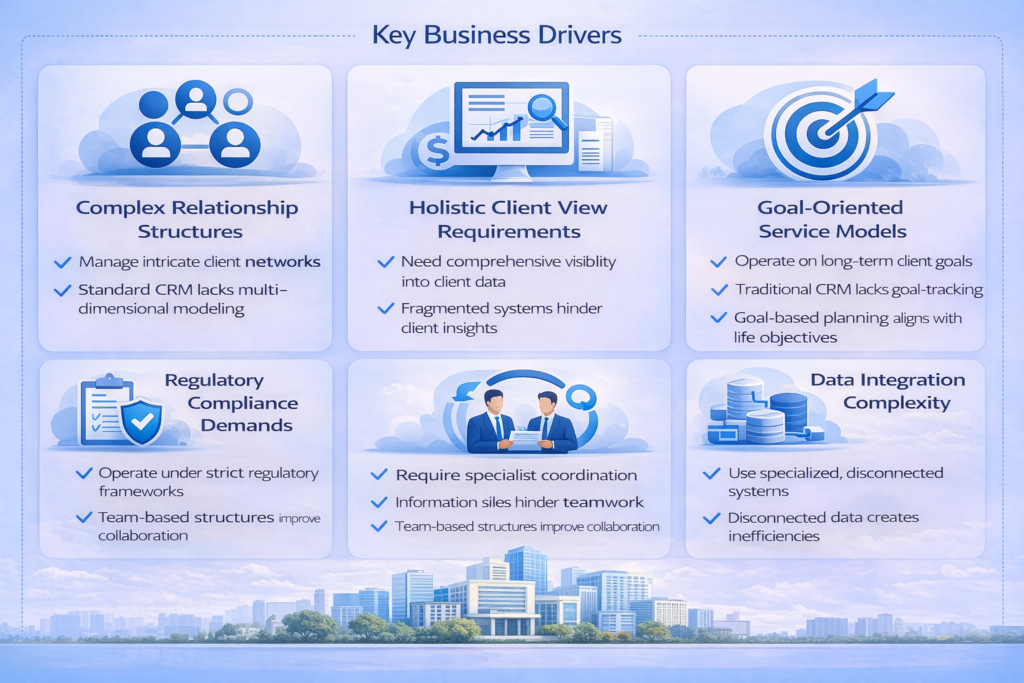
Complex Relationship Structures
- Financial institutions manage intricate networks involving individuals, households, businesses, and intermediaries
- Standard CRM systems lack the capability to effectively represent and navigate these multi-dimensional relationships
- FSC provides specialized relationship modeling to capture and utilize these complex connections
Holistic Client View Requirements
- Financial professionals require comprehensive visibility into client assets, liabilities, goals, and life events
- Fragmented data across multiple systems prevents effective client service and advisory capabilities
- Centralized client information enables informed decision-making and personalized service delivery
Goal-Oriented Service Models
- Financial services operate on long-term client objectives rather than transactional interactions
- Traditional CRM focuses on opportunity and case management without goal-tracking mechanisms
- Goal-based planning capabilities align service delivery with client life objectives
Regulatory Compliance Demands
- Financial institutions operate under strict regulatory frameworks requiring detailed documentation and audit trails
- Compliance management requires systematic tracking of interactions, recommendations, and client decisions
- Built-in compliance features reduce regulatory risk and administrative burden
Collaborative Service Delivery
- Complex financial products often require coordination among specialists, advisors, and support teams
- Information silos prevent effective collaboration and consistent client experiences
- Team-based account structures facilitate seamless collaboration and information sharing
Data Integration Complexity
- Financial institutions utilize specialized systems for portfolio management, trading, policy administration, and core banking
- Disconnected systems create operational inefficiencies and incomplete client views
- Integration capabilities enable unified data access and streamlined workflows
Financial Service Cloud Key Feature
Financial Services Cloud delivers comprehensive functionality specifically designed for financial services operations.
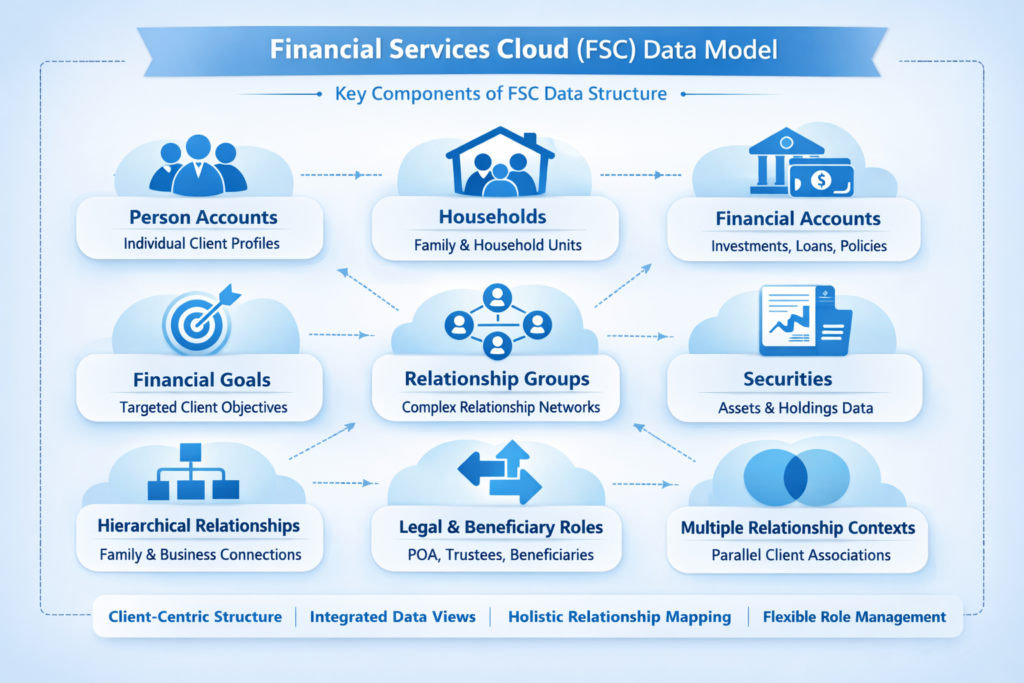
1. Financial Services Data Model
Specialized Objects and Relationships
- Person Accounts: Represent individual consumers with combined contact and account attributes
- Households: Group related individuals and financial accounts into family units
- Financial Accounts: Track investment accounts, insurance policies, loans, deposits, and credit facilities
- Financial Goals: Document and monitor client objectives with target amounts and timeframes
- Securities: Maintain information about financial instruments and holdings
Relationship Groups
- Visualize and manage complex networks of relationships
- Define relationship types (family member, business partner, beneficiary, power of attorney)
- Navigate hierarchical and lateral relationship structures
- Support multiple concurrent relationship contexts
2. Client Relationship Management
360-Degree Client View
- Consolidated display of client information, relationships, accounts, and interactions
- Customizable interface presenting relevant data based on user role and context
- Real-time data synchronization across integrated systems
- Historical interaction tracking and activity timeline
Household Management
- Aggregate wealth and holdings across household members
- Manage shared financial goals and planning scenarios
- Coordinate service delivery across family units
- Analyze household-level opportunities and risks
3. Goal-Based Planning
Financial Goal Tracking
- Define multiple concurrent goals per client or household
- Configure goal categories (retirement, education, estate planning, major purchase)
- Monitor progress against target amounts and dates
- Visualize achievement likelihood and funding gaps
Action Plans
- Create standardized task sequences for common processes
- Automate task assignment based on roles and workflows
- Track completion status and milestone achievement
- Ensure consistent execution of best practices
4. Event Management and Alerts
Life Event Tracking
- Capture significant client events (marriage, birth, career change, inheritance)
- Trigger service workflows based on event types
- Identify planning opportunities arising from life transitions
- Maintain comprehensive client life history
Intelligent Alerts
- Configure rule-based notifications for client, market, or portfolio events
- Distribute alerts to appropriate team members based on responsibilities
- Prioritize alerts by urgency and impact
- Track alert resolution and follow-up actions
5. Collaboration Tools
Team-Based Service Models
- Define account teams with specific roles and responsibilities
- Control data visibility based on team membership and role hierarchy
- Enable internal collaboration through Salesforce Chatter
- Coordinate activities across specialists and support functions
Referral Management
- Track internal referrals between advisors and specialists
- Monitor referral conversion and revenue attribution
- Analyze referral patterns and network effectiveness
- Incentivize cross-functional collaboration
6. Analytics and Reporting
Pre-Built Dashboards
- Client portfolio summaries and asset allocation views
- Performance metrics for advisors and teams
- Pipeline and opportunity tracking
- Service level and activity reporting
Einstein Analytics Integration
- Advanced analytics capabilities for predictive insights
- Next best action recommendations
- Client segmentation and profiling
- Risk scoring and opportunity identification
7. Compliance and Security
Audit Trail Capabilities
- Comprehensive logging of data access and modifications
- Interaction documentation and recommendation tracking
- Approval workflow history and decision records
- Report generation for regulatory submissions
Role-Based Access Control
- Granular permission management aligned with organizational structure
- Field-level security for sensitive financial information
- Sharing rules supporting complex visibility requirements
- Encryption for data at rest and in transit
8. Mobile Functionality
Mobile Application
- Full-featured mobile access to client information
- Activity logging and task management from any location
- Document access and sharing capabilities
- Offline functionality for uninterrupted productivity
Key Industries Using Salesforce Financial Services Cloud (FSC)
Salesforce Financial Services Cloud, commonly referred to as financial service cloud, is widely used across different sectors of the financial industry to manage customer relationships, streamline operations, and deliver personalized services. Each industry leverages financial service cloud differently based on its business model and customer requirements. The major industries include retail banking, wealth management, insurance, and commercial banking.
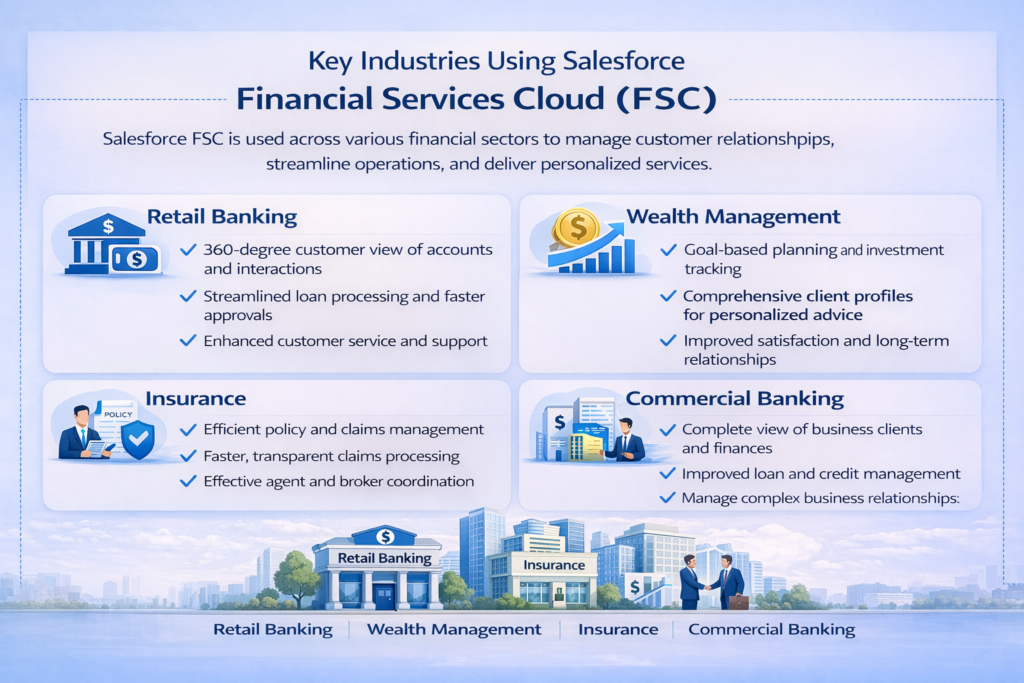
1. Retail Banking
Retail banking focuses on serving individual customers and households. It includes daily financial services like savings, deposits, loans, credit cards, and mortgages.
With Salesforce Financial Services Cloud , banks can connect all customer information into a single unified profile.
🔹 How FSC is used in Retail Banking:
- Customer 360 View
- Combines accounts, transactions, loans, cards, and service requests
- Gives bank employees a complete financial picture of the customer
- Loan Lifecycle Management
- Tracks loan application → verification → approval → disbursement
- Helps reduce manual paperwork and processing delays
- Customer Service Management
- Service requests (case management) are tracked centrally
- Faster resolution of banking issues (ATM card block, failed transactions, etc.)
- Cross-sell & Upsell Opportunities
- Suggests products like credit cards, fixed deposits, insurance based on customer behavior
🔹 Real Example:
If a customer has a salary account + credit card + home loan, FSC connects all these and helps the bank understand:
Loan eligibility for future products
Credit risk
Spending behavior
2. Wealth Management
Wealth management is focused on high-net-worth individuals (HNI clients). The goal is to grow wealth through investments, financial planning, and advisory services.
🔹 How FSC is used in Wealth Management:
- Goal-Based Planning
- Retirement planning, child education, buying property
- Each goal has target amount + timeline tracking
- Portfolio Management
- Tracks stocks, mutual funds, bonds, insurance investments
- Shows performance and risk level in real time
- Client Relationship Management
- Advisors get complete view of client family, income, assets, liabilities
- Helps in personalized advisory services
- Household View
- Combines entire family’s wealth into one profile
- Useful for joint financial planning
🔹 Real Example:
A wealth advisor can see:
“Invest 20% in mutual funds + 10% in bonds for retirement goal”
Client income + investments + risk profile
and suggest:
3. Insurance
Insurance companies use FSC to manage policy lifecycle, claims, and customer engagement in a structured way.
🔹 How FSC is used in Insurance:
- Policy Management
- Tracks insurance policies (life, health, vehicle, property)
- Renewal reminders and premium tracking
- Claims Management
- End-to-end claim process tracking
- From claim request → verification → approval → settlement
- Agent & Broker Management
- Manages insurance agents and distribution partners
- Tracks performance and commissions
- Customer Onboarding
- Captures customer risk profile before policy creation
- Suggests suitable insurance products
🔹 Real Example:
If a customer files a health insurance claim:
Updates customer status in real time
FSC tracks hospital documents
Approves claim workflow
4. Commercial Banking
Commercial banking focuses on businesses, SMEs, and large enterprises, not individual customers.
🔹 How FSC is used in Commercial Banking:
- Business Relationship Management
- One company can have multiple accounts, branches, and stakeholders
- FSC connects all business entities in one view
- Corporate Loan Management
- Tracks business loans, credit limits, repayment schedules
- Helps in risk evaluation before approving loans
- Credit Exposure Tracking
- Shows total financial exposure of a business across all products
- Helps avoid over-lending
- Multi-Stakeholder View
- Business owner, CFO, directors all mapped in relationship model
🔹 Real Example:
A company applying for a ₹50 crore loan:
FSC helps relationship manager see everything in one dashboard
Bank checks:
Existing loans
Cash flow
Credit history
Conclusion
Salesforce Financial Services Cloud (FSC) is more than just a CRM—it is a transformative platform designed to meet the complex needs of the financial services industry. By combining a powerful data model, automation, analytics, and compliance-ready features, FSC enables organizations to deliver highly personalized and efficient client experiences.
From managing complex relationships and financial goals to ensuring regulatory compliance and seamless collaboration, FSC empowers financial institutions to operate smarter and faster. It helps bridge the gap between fragmented systems and unified client insights, allowing advisors and teams to make informed decisions and build stronger, long-term relationships.
As the financial industry continues to evolve with increasing customer expectations and regulatory demands, adopting Financial Services Cloud is no longer optional—it is a strategic necessity for organizations aiming to stay competitive, scalable, and client-focused in the digital era.
Salesforce Financial Services Cloud (FSC) is transforming industries like retail banking, wealth management, insurance, and commercial banking. It provides a unified platform to manage complex data, improve operational efficiency, and deliver personalized customer experiences.
By leveraging financial service cloud, organizations can enhance decision-making, ensure compliance, and stay competitive in today’s digital financial ecosystem.
About RizeX Labs
At RizeX Labs, we specialize in delivering cutting-edge Salesforce solutions, including Financial Services Cloud (FSC) implementations for banking, wealth management, and insurance organizations.
Our expertise combines deep technical knowledge, industry best practices, and real-world implementation experience to help financial institutions streamline operations, enhance client relationships, and ensure regulatory compliance.
We empower organizations to transform their financial service processes—from fragmented and manual systems to intelligent, automated workflows that drive efficiency, personalization, and growth.
Internal Linking Opportunities:
- Link to your Salesforce course page:
https://rizexlabs.com/salesforce-admin-and-development-training
External Linking Opportunities:
- Salesforce official website: https://www.salesforce.com/
- Financial Services Cloud overview: https://www.salesforce.com/products/financial-services-cloud/overview/
- Salesforce Help (FSC documentation): https://help.salesforce.com/
- Salesforce AppExchange (FSC apps): https://appexchange.salesforce.com/
- Banking & Financial insights (Gartner, McKinsey, etc.)
- Wealth Management trends and reports
Quick Summary
Financial Services Cloud (FSC) is a powerful industry-specific CRM solution that enables financial institutions to manage client relationships more effectively and deliver personalized financial services. By leveraging FSC, organizations can unify client data, automate workflows, and gain a complete 360-degree view of customer financial profiles.
With FSC, businesses can improve advisor productivity, ensure regulatory compliance, and enhance collaboration across teams. As financial services organizations continue to evolve, adopting FSC becomes essential for delivering client-centric experiences and achieving long-term growth.
Quick Summary
Salesforce Financial Services Cloud (FSC) is an industry-specific CRM for banks, insurance, and wealth management firms. It provides a 360-degree customer view by unifying financial data, relationships, and goals in one platform. With AI, automation, and strong compliance features, FSC helps financial institutions improve customer experience, streamline operations, and make better data-driven decisions.