Price Management within Salesforce Revenue Cloud is a comprehensive solution that empowers organizations to create, manage, and optimize their pricing strategies with precision and agility. As a core component of Revenue Cloud, it enables businesses to handle complex pricing scenarios while maintaining consistency across all sales channels, ensuring every quote reflects your current pricing strategy and business rules.
What is Price Management?
Price Management in Salesforce Revenue Cloud is an intelligent pricing engine that allows organizations to define, configure, and automate their pricing models directly within the Salesforce ecosystem. It serves as the central hub for all pricing-related activities, from simple list prices to sophisticated multi-dimensional pricing structures. This capability eliminates manual pricing errors, reduces quote-to-cash cycle times, and ensures pricing compliance across your entire organization.
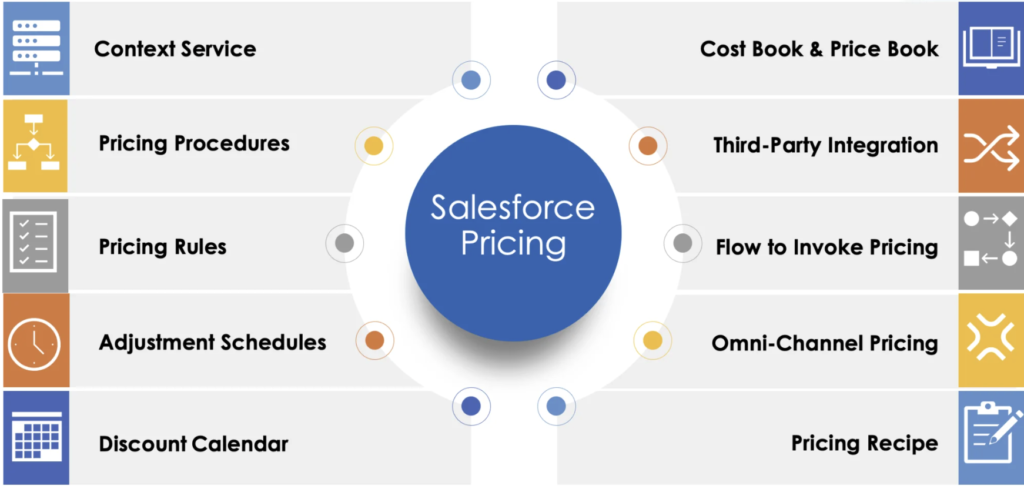
Key Features
1. Flexible Price Books
Create multiple price books tailored to different markets, regions, customer segments, or product lines. Price books can be configured for:
- Standard pricing across all customers
- Regional or geographic-specific pricing
- Customer segment pricing (enterprise, mid-market, SMB)
- Channel partner pricing
- Time-bound promotional pricing
2. Multi-Dimensional Pricing
Handle complex pricing scenarios with ease through:
- Volume-Based Pricing: Automatically apply tiered discounts based on quantity thresholds
- Time-Based Pricing: Configure different rates for various time periods (monthly, quarterly, annually)
- Usage-Based Pricing: Support consumption-based models with flexible rating structures
- Cost-Plus Pricing: Dynamically calculate prices based on cost margins
- Competitive Pricing: Adjust pricing based on market conditions
3. Dynamic Pricing Rules
Build sophisticated pricing logic using point-and-click configuration:
- Conditional pricing based on product combinations
- Customer-specific pricing agreements
- Promotional discounts with automatic expiration
- Cross-sell and upsell pricing incentives
- Bundle and package pricing optimization
4. Price Waterfall Management
Gain complete visibility into how final prices are calculated through:
- Base price establishment
- Discount stacking and sequencing
- Tax calculations
- Promotional adjustments
- Final net price transparency
5. Automated Price Calculations
Eliminate manual errors and speed up the quoting process with:
- Real-time price calculations during quote generation
- Automated discount application based on predefined rules
- Instant price updates when products or quantities change
- Guided selling with price recommendations
6. Contract-Based Pricing
Manage long-term customer relationships effectively:
- Store negotiated prices at the account level
- Track contract pricing commitments
- Automatically apply contracted rates to eligible customers
- Manage price guarantees and escalation clauses
- Support multi-year pricing agreements
7. Price Approval Workflows
Maintain pricing governance with configurable approval processes:
- Set discount thresholds requiring management approval
- Multi-level approval hierarchies
- Exception pricing requests and approvals
- Audit trails for all pricing decisions
- Automated notifications and escalations
8. Currency Management
Support global operations seamlessly:
Consolidated reporting across currencies
Multi-currency support with real-time conversion
Localized pricing for different markets
Currency-specific price books
Exchange rate management
Understanding Pricing Procedures in Revenue Cloud
The Pricing Procedure in Salesforce Revenue Cloud is the strategic framework that orchestrates how prices are calculated from initial quote to final invoice. It serves as the intelligent rulebook that governs every pricing decision, ensuring consistency, accuracy, and compliance across your entire revenue lifecycle.
What is a Pricing Procedure?
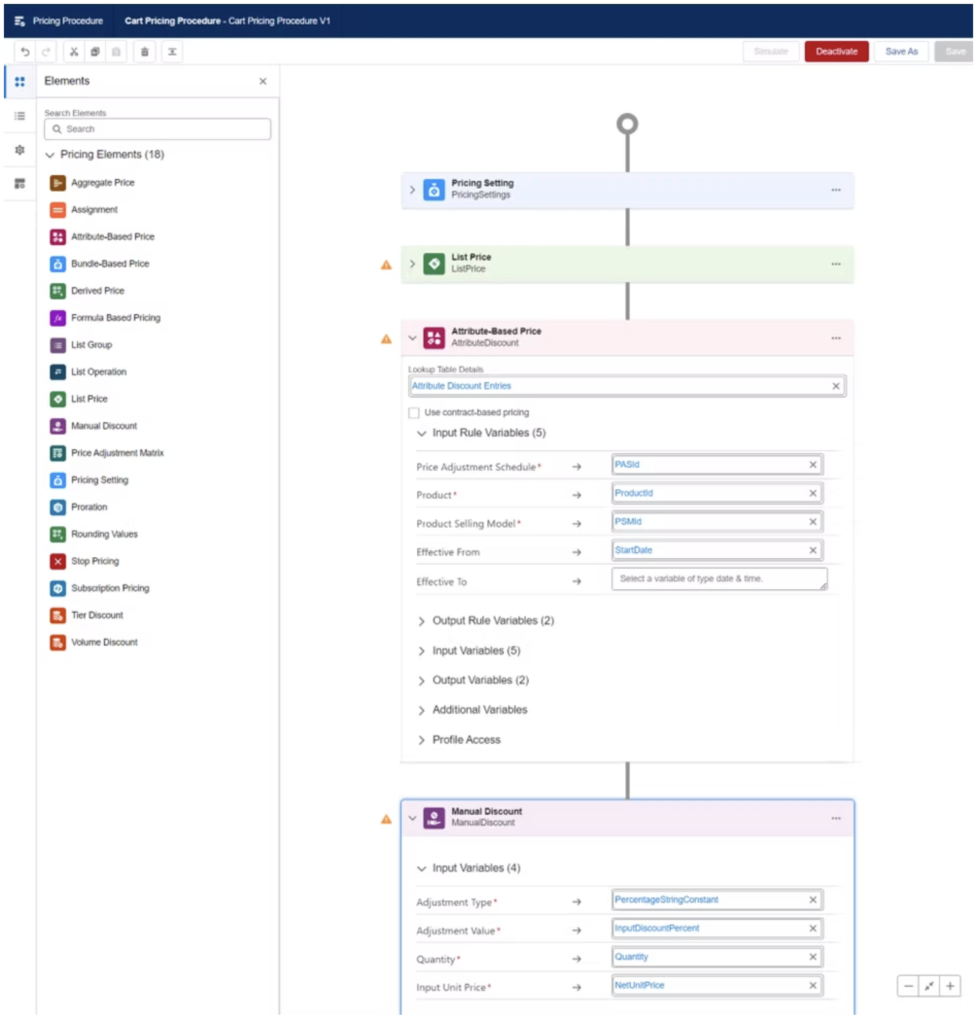
The Pricing Procedure in Salesforce Revenue Cloud defines the structured sequence of steps used to calculate the final price of a product or service. It acts as the backbone of the pricing engine, ensuring that every price is derived consistently by applying a predefined set of pricing elements such as base price, adjustments, discounts, taxes, and surcharges in a logical order.
At its core, the pricing procedure standardizes how pricing rules are executed during the quote lifecycle. Instead of relying on manual calculations or disconnected logic, organizations can configure a step-by-step pricing flow that automatically determines the final net price in real time. This ensures accuracy, transparency, and alignment with business policies across all transactions.
How Pricing Procedures Work
The Sequential Pricing Flow
A typical pricing procedure begins with establishing the base price from the relevant price book. From there, it sequentially applies pricing rules such as customer-specific discounts, volume-based incentives, promotional adjustments, and contractual pricing terms. Additional components like taxes, fees, or regional adjustments can also be incorporated before arriving at the final price presented to the customer.
The Pricing Waterfall
The pricing procedure operates through what’s known as a “pricing waterfall” – a cascading series of calculations where each step builds upon the previous one:
- Base Price Determination – Retrieves the list price from the appropriate price book
- Customer-Specific Pricing – Applies negotiated contract prices or account-level pricing
- Volume Discounts – Calculates quantity-based tiered pricing
- Promotional Discounts – Applies time-bound promotional offers
- Manual Discounts – Incorporates sales rep discretionary discounts (within approved limits)
- Partner/Channel Discounts – Adds channel-specific pricing adjustments
- Surcharges – Applies additional fees (rush orders, customization, etc.)
- Tax Calculation – Computes applicable taxes based on jurisdiction
- Net Price – Delivers the final customer-facing price
Each step in this procedure is configurable, allowing businesses to design pricing flows that match their exact requirements.
Key Components of Pricing Procedures
1. Pricing Elements
Pricing elements are the individual building blocks within a procedure. Each element represents a specific type of pricing adjustment:
- Base Price – Foundation price from price books
- Absolute Discounts – Fixed dollar/currency amount reductions
- Percentage Discounts – Percentage-based price reductions
- Surcharges – Additional fees or charges
- Tax Components – Sales tax, VAT, GST calculations
- Subtotals – Interim calculation points for reference
- Conditions – Logic-based pricing triggers
2. Calculation Sequence
The order in which elements are applied is critical. For example:
- A 10% discount applied before a $50 discount yields a different result than the reverse
- Volume discounts typically apply before promotional discounts
- Taxes are usually calculated on the net price after all discounts
Revenue Cloud allows precise control over this sequencing to ensure mathematically correct and business-appropriate calculations.
3. Condition Types
Conditions determine when and how pricing elements are triggered:
- Customer Conditions – Based on account attributes, customer tier, or segment
- Product Conditions – Triggered by specific products or product combinations
- Quantity Conditions – Activated at certain volume thresholds
- Date Conditions – Time-based pricing (seasonal, promotional periods)
- Contract Conditions – Applied based on active agreements
- Geographic Conditions – Region or territory-specific pricing
4. Pricing Formulas
Advanced pricing procedures can incorporate custom formulas for complex calculations:
Matrix pricing based on multiple variables
Cost-plus pricing with dynamic margin calculations
Competitive pricing adjustments based on market data
Bundle pricing with cross-product dependencies
Usage-based pricing with tiered rating structures
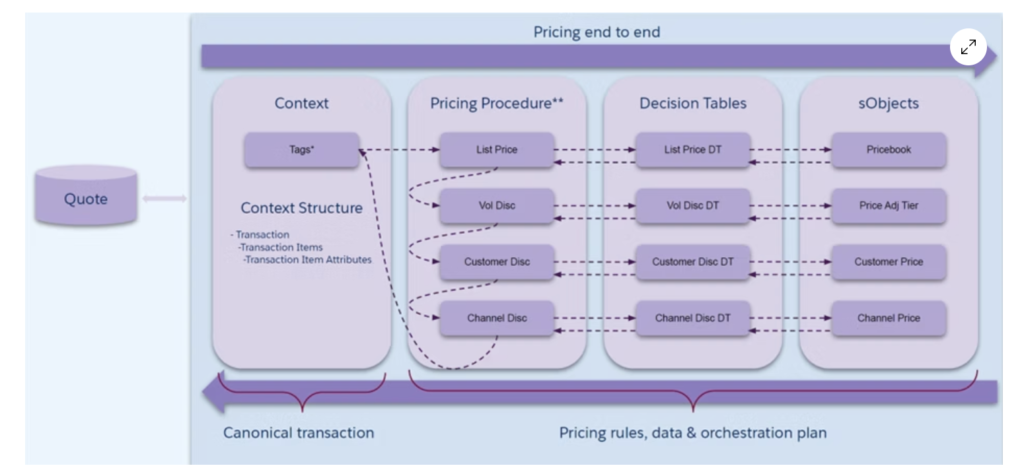
Pricing End-to-End Flow
Key Benefits
Increased Revenue and Margin Protection
- Eliminate pricing leakage through consistent application of pricing rules
- Optimize discounting strategies to protect margins
- Identify and capitalize on upsell and cross-sell opportunities
- Ensure all negotiated prices are captured and applied correctly
Accelerated Sales Cycles
- Reduce quote generation time from hours to minutes
- Empower sales teams with instant, accurate pricing
- Minimize back-and-forth for pricing approvals
- Enable sales reps to configure complex quotes with confidence
Enhanced Pricing Strategy Control
- Centralize all pricing data in one unified platform
- Implement sophisticated pricing strategies without custom code
- Quickly adapt pricing to market conditions or competitive pressures
- Test and roll out new pricing models efficiently
Improved Operational Efficiency
- Reduce administrative overhead in pricing management
- Eliminate manual spreadsheet-based pricing processes
- Decrease pricing errors and quote rejections
- Free up finance and operations teams for strategic initiatives
Greater Pricing Transparency
- Full visibility into how prices are calculated
- Clear audit trails for compliance and governance
- Real-time reporting on pricing performance
- Data-driven insights for pricing optimization
Seamless Integration
- Native Salesforce platform integration with CRM data
- Single source of truth for customer and pricing information
- Unified quote-to-cash process
- Bi-directional data flow with ERP and billing systems
Scalability and Flexibility
- Easily handle growing product catalogs and customer bases
- Support for multiple business models (subscription, one-time, usage-based)
- Configure new pricing strategies without technical resources
- Adapt to changing business requirements quickly
Operational Benefits of Automated Pricing Procedures
From an operational standpoint, the automation provided by pricing procedures significantly reduces errors and accelerates quote generation. Sales teams benefit from real-time, system-driven pricing, while finance and operations teams gain confidence that all pricing policies are being consistently enforced.
Speed and Efficiency Gains
- Quote Generation Time: Reduced from hours to minutes
- Pricing Accuracy: 99%+ accuracy vs. manual calculations
- Sales Productivity: Reps spend more time selling, less time calculating
- Approval Cycles: Streamlined with automated routing
- Configuration Complexity: Handled seamlessly by the system
Error Reduction
- Eliminates manual calculation mistakes
- Prevents incorrect discount stacking
- Ensures tax accuracy across jurisdictions
- Avoids pricing inconsistencies between quotes
- Reduces revenue leakage from pricing errors
Scalability
- Supports thousands of products without performance degradation
- Handles complex multi-line quotes efficiently
- Manages high quote volumes during peak periods
- Adapts to business growth without system limitations
- Enables global expansion with regional pricing variations
Flexible Configuration for Diverse Business Models
One of the key strengths of the pricing procedure is its flexibility. Businesses can configure multiple procedures tailored to different products, markets, or sales scenarios. For example, a subscription-based offering may follow a different pricing flow compared to a one-time product sale. This modular approach allows organizations to support diverse pricing strategies while maintaining centralized control.
Multiple Pricing Procedures by Scenario
Organizations can create distinct procedures for:
- Product Type – Hardware vs. software vs. services vs. subscriptions
- Sales Channel – Direct sales, partner channels, e-commerce, marketplace
- Customer Segment – Enterprise, mid-market, SMB, government, education
- Geography – Different regions with unique regulatory or market requirements
- Transaction Type – New business, renewals, upsells, amendments
Industry-Specific Pricing Procedures
Manufacturing:
- Raw material cost fluctuations
- Volume commitments and rebates
- Configured product pricing
- Freight and logistics charges
SaaS/Technology:
- Subscription tier pricing
- User-based vs. usage-based models
- Feature add-on pricing
- Overage charges
Telecommunications:
- Service bundling
- Usage tiers and overages
- Device financing
- Promotional lock-in periods
Professional Services:
- Resource-based pricing (hourly rates by skill level)
- Project milestones
- Retainer pricing
- Travel and expense allowances
Use Cases
B2B Manufacturing: Manage complex pricing for thousands of SKUs across different customer tiers, regions, and volume commitments.
SaaS Companies: Implement subscription-based pricing with various plans, add-ons, and usage-based components.
Distribution: Handle channel partner pricing, rebates, and volume incentives while maintaining margin targets.
Professional Services: Create custom pricing for project-based engagements with resource-based and value-based components.
Telecommunications: Support complex pricing for bundled services, usage-based charges, and promotional offers.
Getting Started
Implementing Price Management in Salesforce Revenue Cloud typically involves:
- Price Strategy Workshop: Define your pricing models, rules, and approval processes
- Price Book Configuration: Set up your product catalog with base prices and price books
- Rules Engine Setup: Configure pricing rules, discounts, and automated calculations
- Approval Workflow Design: Establish governance with appropriate approval hierarchies
- User Training: Enable sales and operations teams to leverage new capabilities
- Continuous Optimization: Monitor pricing performance and refine strategies
Why Choose RizeX Labs for Price Management Implementation?
At RizeX Labs, we bring deep expertise in Salesforce Revenue Cloud implementations with a specialized focus on Price Management optimization. Our team helps you:
- Design optimal pricing architectures that support your unique business models
- Migrate legacy pricing data accurately and efficiently
- Configure complex pricing rules without unnecessary customization
- Integrate with existing systems for seamless data flow
- Train your teams to maximize adoption and value realization
- Provide ongoing optimization as your business evolves
Our proven methodology ensures your Price Management implementation delivers measurable ROI from day one, with improved quote accuracy, faster sales cycles, and protected margins.
Conclusion
The pricing procedure is the engine that powers accurate, consistent, and strategic pricing in Salesforce Revenue Cloud. By automating complex calculations, enforcing governance, and providing real-time transparency, pricing procedures elevate pricing from a tactical function to a strategic differentiator.
Whether you’re implementing Revenue Cloud for the first time or optimizing existing configurations, thoughtfully designed pricing procedures are essential to maximizing your investment and achieving revenue growth objectives.
About RizeX Labs
RizeX Labs is a leading Salesforce consulting and training provider specializing in Revenue Cloud implementations. We help organizations design and optimize advanced pricing strategies using Salesforce Price Management. Our expertise combines deep platform knowledge, real-world implementation experience, and strategic guidance to enable businesses to achieve accurate, scalable, and revenue-driven pricing models.
Internal Linking Opportunities:
- Link to your Salesforce course page: https://rizexlabs.com/salesforce-admin-and-development-training
External Linking Opportunities:
- Salesforce Revenue Cloud overview: https://www.salesforce.com/products/revenue-cloud/
- Salesforce CPQ documentation: https://help.salesforce.com/
- Salesforce Trailhead (learning platform): https://trailhead.salesforce.com/
Quick Summary
Price Management in Salesforce Revenue Cloud enables organizations to centralize and automate pricing strategies across products, customers, and channels. It supports complex pricing models such as volume-based, subscription, and contract pricing while ensuring consistency and compliance. With real-time calculations, dynamic pricing rules, and approval workflows, businesses can reduce errors, accelerate sales cycles, and protect margins. This makes Price Management a critical capability for organizations looking to scale efficiently and drive revenue growth through smarter pricing decisions.
Frequently Asked Questions
- What is Price Management in Salesforce Revenue Cloud?
Price Management in Salesforce Revenue Cloud is a centralized pricing engine that allows businesses to define, automate, and control pricing strategies. It ensures accurate and consistent pricing across all sales channels by applying rules, discounts, and pricing logic in real time during the quote-to-cash process. - How do pricing procedures work in Salesforce Revenue Cloud?
Pricing procedures follow a structured sequence to calculate the final price. They start with a base price and apply discounts, promotions, contract pricing, taxes, and surcharges step by step. This “pricing waterfall” ensures that every component is applied in the correct order, resulting in accurate and compliant pricing. - What are the key benefits of using Price Management?
Price Management helps organizations reduce pricing errors, accelerate sales cycles, and protect profit margins. It enables automated pricing, improves operational efficiency, ensures compliance with pricing policies, and provides full transparency into how prices are calculated. - Can Salesforce Revenue Cloud handle complex pricing models?
Yes, Salesforce Revenue Cloud supports complex pricing models such as subscription-based, usage-based, volume-based, and contract pricing. It also allows businesses to configure dynamic pricing rules, multi-currency pricing, and customer-specific agreements, making it suitable for diverse industries and business models.
Quick Summary
Price Management in Salesforce Revenue Cloud enables organizations to centralize and automate pricing strategies across products, customers, and channels. It supports complex pricing models such as volume-based, subscription, and contract pricing while ensuring consistency and compliance. With real-time calculations, dynamic pricing rules, and approval workflows, businesses can reduce errors, accelerate sales cycles, and protect margins. This makes Price Management a critical capability for organizations looking to scale efficiently and drive revenue growth through smarter pricing decisions.