
In today’s fast-evolving digital economy, businesses are no longer operating in linear sales cycles. Instead, they are navigating complex, multi-channel, subscription-driven revenue models that require agility, precision, and real-time decision-making. This is where Dynamic Revenue Orchestration (DRO) comes into play.
Dynamic Revenue Orchestration refers to the strategic coordination of pricing, sales, billing, and revenue processes across the entire customer lifecycle—powered by data, automation, and intelligent workflows. Rather than treating revenue operations as siloed functions, DRO unifies them into a cohesive, adaptive system that responds dynamically to customer behavior and market conditions.
At the forefront of enabling DRO is Salesforce Revenue Cloud—a comprehensive platform designed to streamline and optimize the entire quote-to-cash lifecycle. By integrating key revenue functions, Salesforce Revenue Cloud empowers organizations to deliver seamless customer experiences while maximizing revenue potential.
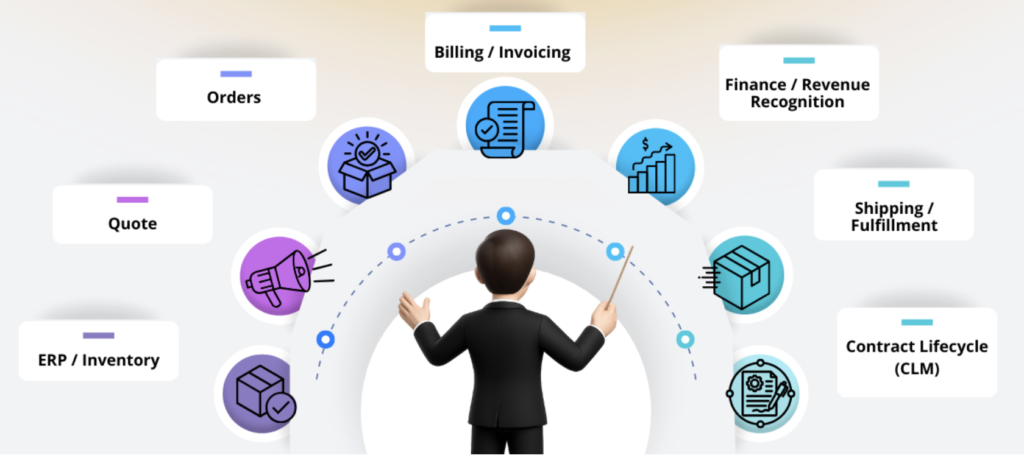
Core Components of DRO in Salesforce Revenue Cloud
Salesforce Revenue Cloud provides the foundation for Dynamic Revenue Orchestration through a tightly integrated suite of tools that manage every stage of the revenue lifecycle. These components work together to ensure consistency, accuracy, and scalability.
1. Configure, Price, Quote (CPQ)
CPQ enables sales teams to configure complex product offerings, apply dynamic pricing rules, and generate accurate quotes quickly. With DRO, CPQ becomes more than a quoting tool—it acts as a real-time pricing engine that adapts to customer segments, contract terms, and market dynamics.
2. Billing and Invoicing
Salesforce Billing ensures that once a deal is closed, invoicing and payment processes are automated and aligned with the agreed terms. This reduces errors, accelerates cash flow, and provides transparency across financial operations.
3. Subscription Management
Modern businesses increasingly rely on subscription-based models. Salesforce Revenue Cloud allows organizations to manage subscriptions, renewals, amendments, and usage-based pricing with ease—making it a critical component of DRO.
4. Revenue Recognition
Accurate revenue recognition is essential for compliance and financial reporting. Salesforce integrates revenue recognition capabilities that align with accounting standards, ensuring that revenue is recognized correctly over time.
5. Data and Automation
At the heart of DRO lies data. Salesforce Revenue Cloud leverages real-time data from across the customer journey—sales interactions, usage patterns, billing history—to drive intelligent automation. Workflow automation reduces manual intervention, while AI-driven insights help teams make informed decisions quickly.
Benefits of Implementing DRO with Salesforce Revenue Cloud
Adopting Dynamic Revenue Orchestration within Salesforce Revenue Cloud delivers a range of strategic and operational benefits.
Improved Revenue Forecasting Accuracy
By consolidating data from sales, finance, and customer interactions, DRO provides a single source of truth for revenue forecasting. This leads to more accurate predictions and better strategic planning.
Enhanced Customer Lifetime Value
DRO enables businesses to tailor pricing, offers, and engagement strategies based on customer behavior and preferences. This personalization increases customer satisfaction and drives long-term value.
Streamlined Quote-to-Cash Processes
Traditional quote-to-cash processes are often fragmented and error-prone. Salesforce Revenue Cloud unifies these processes, reducing cycle times and improving operational efficiency.
Increased Sales Agility and Responsiveness
With dynamic pricing and real-time insights, sales teams can respond quickly to changing customer needs and market conditions. This agility is crucial in competitive environments.
Better Understanding of Revenue Streams
DRO provides visibility into different revenue streams—one-time sales, subscriptions, usage-based billing—allowing businesses to optimize their revenue mix and identify growth opportunities.
Use Cases and Examples
To better understand the impact of DRO, let’s explore a couple of practical scenarios where businesses leverage Salesforce Revenue Cloud effectively.
Use Case 1: Managing Complex Pricing Models
A technology company offering bundled products and services often struggles with pricing complexity. With DRO enabled by Salesforce Revenue Cloud, the company can:
- Configure customized product bundles in CPQ
- Apply dynamic pricing rules based on customer tier and contract length
- Automatically generate accurate quotes
This not only reduces errors but also shortens the sales cycle, allowing the company to close deals faster while maintaining pricing consistency.
Use Case 2: Optimizing Subscription Renewals
A SaaS provider relies heavily on subscription renewals for revenue growth. Using DRO, the company can:
- Track customer usage and engagement data
- Identify at-risk accounts before renewal
- Trigger automated renewal workflows with personalized offers
By proactively managing renewals, the company increases retention rates and maximizes recurring revenue.
Future of DRO and Salesforce Revenue Cloud
As businesses continue to evolve toward digital-first and subscription-based models, the importance of Dynamic Revenue Orchestration will only grow.
Emerging Trends
- AI-Driven Revenue Optimization: Artificial intelligence will play a larger role in predicting customer behavior, optimizing pricing, and identifying upsell opportunities.
- Usage-Based and Hybrid Pricing Models: Companies are increasingly adopting flexible pricing structures that require dynamic orchestration.
- Real-Time Revenue Insights: The demand for instant visibility into revenue performance will drive further innovation in analytics and reporting.
Salesforce Revenue Cloud’s Position
Salesforce Revenue Cloud is well-positioned to support these trends. With its deep integration across the Salesforce ecosystem, continuous innovation in AI (such as Einstein), and robust automation capabilities, it provides a scalable platform for future-ready revenue strategies.
Moreover, its ability to unify customer data across sales, service, and finance functions makes it a powerful enabler of truly dynamic, end-to-end revenue orchestration.
Advanced DRO Capabilities: Decomposition, Orchestration, Jeopardy Management, and Fallout Management
To fully realize the value of Dynamic Revenue Orchestration, organizations must go beyond core quote-to-cash processes and embrace advanced operational capabilities. Within Salesforce Revenue Cloud, four critical pillars—Decomposition, Orchestration, Jeopardy Management, and Fallout Management—play a key role in ensuring seamless execution across complex revenue workflows.
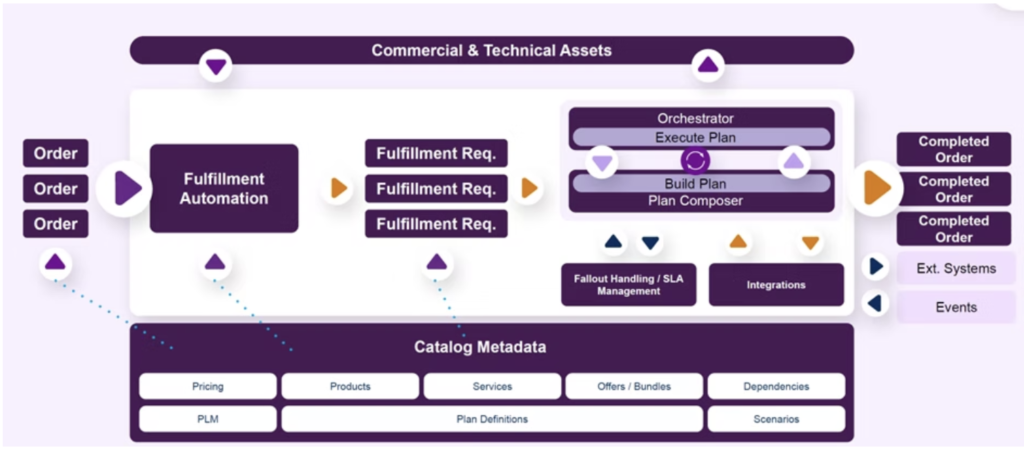
Decomposition: Breaking Down Complexity into Actionable Units
Decomposition is the process of breaking down a high-level customer order or contract into smaller, manageable components that can be executed independently across systems and teams.
In modern enterprises, especially those offering bundled products or services (e.g., hardware + software + services), a single deal may involve multiple fulfillment paths. Decomposition enables:
- Granular execution: Each component of an order (product delivery, service activation, subscription setup) is handled separately but tracked collectively.
- System alignment: Different backend systems (ERP, provisioning, logistics) receive only the relevant portions of the order.
- Parallel processing: Tasks can be executed simultaneously, reducing fulfillment time.
Within Salesforce Revenue Cloud, decomposition ensures that complex deals don’t become operational bottlenecks. Instead, they are intelligently split into orchestrated workflows that maintain consistency while improving speed and accuracy.
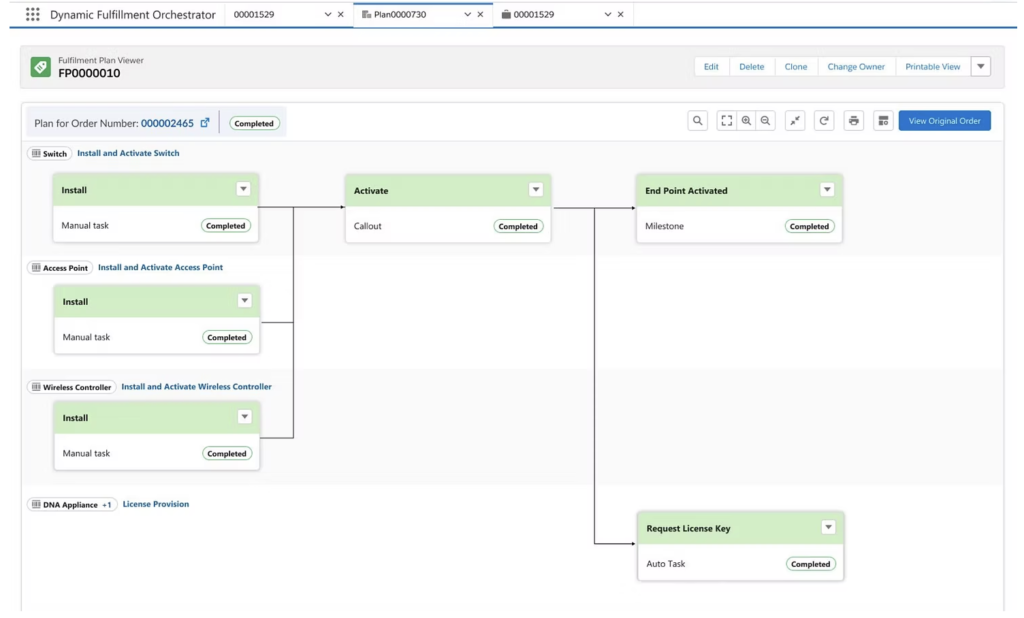
Orchestration: Coordinating End-to-End Revenue Processes
Orchestration is the engine that coordinates all moving parts of the revenue lifecycle. It ensures that every decomposed task is executed in the right sequence, by the right system, at the right time.
Think of orchestration as the “conductor” of the revenue process—it aligns sales, finance, operations, and service teams around a unified workflow.
Key capabilities include:
- Workflow automation: Triggering actions such as approvals, provisioning, invoicing, and notifications based on predefined rules.
- Cross-system integration: Seamlessly connecting Salesforce with external systems (e.g., billing platforms, inventory systems).
- Real-time visibility: Providing stakeholders with a live view of order status and progress.
With orchestration, businesses can eliminate manual handoffs and reduce delays, ensuring a smooth and consistent customer experience from quote to fulfillment.
Jeopardy Management: Proactively Identifying and Resolving Risks
In complex revenue operations, delays and risks are inevitable—but they don’t have to derail the entire process. Jeopardy Management focuses on identifying potential issues before they escalate.
A “jeopardy” situation occurs when a task or milestone is at risk of missing its expected timeline or outcome. Salesforce Revenue Cloud enables proactive management of such scenarios through:
- Real-time monitoring: Tracking SLAs, task progress, and dependencies across workflows.
- Automated alerts: Notifying relevant stakeholders when a task is at risk.
- Escalation mechanisms: Triggering corrective actions, such as reassigning tasks or prioritizing critical steps.
For example, if a service activation step is delayed due to a dependency on inventory availability, the system can flag the issue early and alert the operations team. This proactive approach minimizes disruptions and ensures commitments to customers are met.
Fallout Management: Handling Exceptions and Failures Efficiently
While Jeopardy Management focuses on prevention, Fallout Management deals with resolution. It addresses situations where a process has already failed or deviated from the expected path.
Fallout scenarios can include:
- Failed provisioning requests
- Billing errors
- Integration failures between systems
- Incomplete or incorrect order data
Salesforce Revenue Cloud provides structured mechanisms to handle these exceptions:
- Centralized error tracking: Capturing and categorizing fallout events for visibility and analysis.
- Guided resolution workflows: Providing step-by-step processes for teams to resolve issues and consistently.
- Reprocessing capabilities: Allowing failed transactions to be corrected and re-executed without starting from scratch.
Effective fallout management ensures that errors do not result in lost revenue or poor customer experiences. Instead, they become manageable exceptions within a controlled system.
Bringing It All Together
When combined, these four capabilities transform revenue operations:
- Decomposition ensures complexity is manageable.
- Orchestration ensures everything runs in sync.
- Jeopardy Management ensures risks are addressed early.
- Fallout Management ensures failures are resolved effectively.
Together, they enable organizations to deliver on the promise of Dynamic Revenue Orchestration—creating a resilient, adaptive, and efficient revenue engine powered by Salesforce Revenue Cloud.
For businesses dealing with high transaction volumes, complex product structures, or multi-system environments, these capabilities are not optional—they are essential for scaling revenue operations with confidence.
Conclusion
Dynamic Revenue Orchestration represents a fundamental shift in how businesses manage and optimize their revenue operations. By breaking down silos and leveraging real-time data, DRO enables organizations to become more agile, customer-centric, and efficient.
Salesforce Revenue Cloud serves as a comprehensive platform that brings this vision to life—integrating CPQ, billing, subscription management, and analytics into a unified ecosystem.
For organizations looking to stay competitive in a rapidly changing market, adopting DRO within Salesforce Revenue Cloud is not just an operational improvement—it’s a strategic imperative.
About RizeX Labs
RizeX Labs is a leading IT training and consulting organization focused on empowering professionals and businesses with next-generation technologies like Salesforce, ServiceNow, and Revenue Cloud solutions. With a strong emphasis on practical learning and real-world implementation, RizeX Labs helps organizations and individuals stay ahead in today’s competitive digital landscape.
Dynamic Revenue Orchestration (DRO) is a modern approach to managing the entire revenue lifecycle by connecting sales, pricing, billing, and customer data into a unified system. Instead of operating in silos, DRO enables businesses to dynamically adapt their revenue strategies based on real-time insights, customer behavior, and market changes.
With platforms like Salesforce Revenue Cloud, organizations can seamlessly orchestrate complex quote-to-cash processes, automate workflows, and deliver personalized customer experiences—making revenue operations more efficient, scalable, and intelligent.
At RizeX Labs, we focus on helping professionals understand and implement DRO concepts using Salesforce Revenue Cloud, bridging the gap between theoretical knowledge and hands-on expertise required in real-world business scenarios.
Internal Linking Opportunities:
- Link to your Salesforce course page: https://rizexlabs.com/salesforce-admin-and-development-training
External Linking Opportunities:
- Salesforce official website: https://www.salesforce.com/
- Salesforce Revenue Cloud overview: https://www.salesforce.com/products/revenue-cloud/overview/
- Salesforce CPQ documentation: https://help.salesforce.com/
- Revenue operations insights (Gartner, McKinsey, etc.)
Quick Summary
Dynamic Revenue Orchestration is rapidly becoming a must-have strategy for businesses aiming to streamline and optimize their revenue processes. With the power of Salesforce Revenue Cloud, companies can unify sales, billing, and subscription management into a single, automated ecosystem.
Through expert-led training and practical implementation support, RizeX Labs enables professionals to build in-demand skills in Revenue Cloud and DRO, helping them unlock new career opportunities while assisting organizations in achieving scalable and predictable revenue growth.