
Introduction
Retail banking has transformed significantly in the digital era. Customers now expect personalized services, instant support, seamless onboarding, and omnichannel banking experiences. Traditional systems often fail to meet these expectations because they store customer data in silos, lack automation, and do not provide relationship-based visibility.
This is where Retail Banking in Salesforce Financial Services Cloud becomes a game-changer.
Built on the powerful Salesforce platform, Financial Services Cloud (FSC) is a specialized CRM designed for banks, credit unions, mortgage providers, and financial institutions. It helps retail banks manage customer relationships, automate processes, improve compliance, and deliver highly personalized banking experiences.
In this blog, we will explore how Retail Banking in Salesforce Financial Services Cloud works, its features, implementation process, real-world use cases, benefits, and why it is becoming the preferred CRM solution for modern retail banks.
What is Retail Banking?
Retail banking refers to banking services provided directly to individual consumers rather than businesses or corporations. These services include:
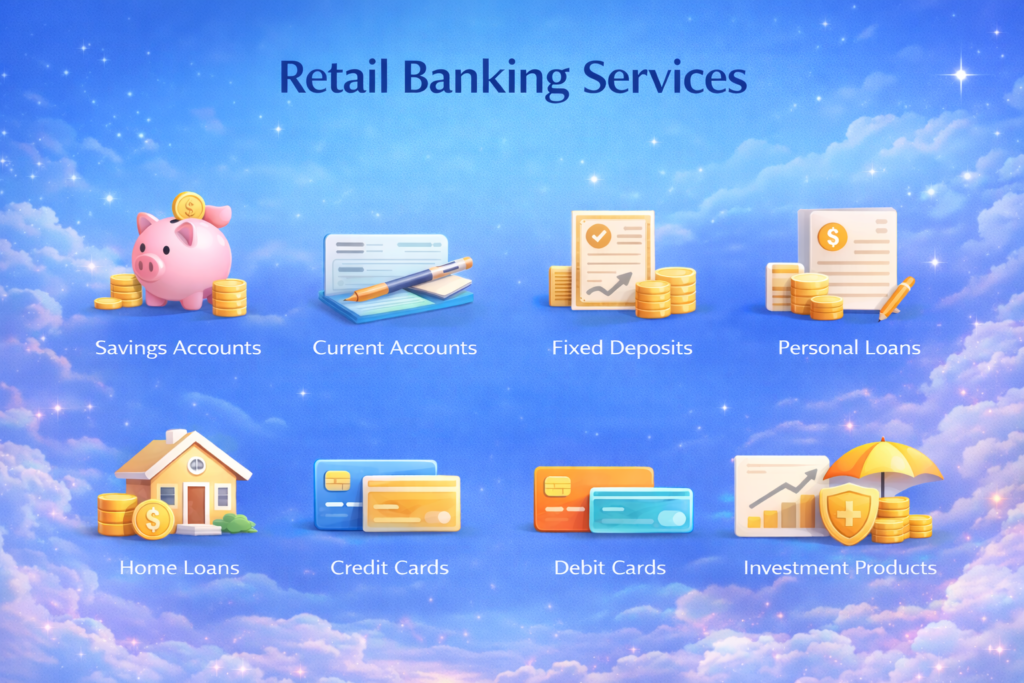
- Savings Accounts
- Current Accounts
- Fixed Deposits
- Personal Loans
- Home Loans
- Credit Cards
- Debit Cards
- Investment Products
- Insurance Products
Retail banks focus on building long-term relationships with customers while offering financial products tailored to their needs.
Why CRM is Important in Retail Banking
Modern customers expect banks to:
- Understand their financial needs
- Provide personalized offers
- Resolve issues quickly
- Offer digital self-service
- Maintain secure interactions
- Deliver omnichannel support
Without a robust CRM, banks struggle to:
- Track customer interactions
- Manage relationship data
- Cross-sell effectively
- Automate service requests
- Ensure compliance
This is why many financial institutions adopt Retail Banking in Salesforce Financial Services Cloud.
What is Salesforce Financial Services Cloud (FSC)?
Salesforce Financial Services Cloud is an industry-specific CRM platform built for financial institutions. It extends standard Salesforce capabilities with financial data models, automation tools, compliance support, and customer relationship management tailored for banking.
It helps banks:
- Create unified customer profiles
- Manage household and relationship structures
- Track financial accounts
- Automate workflows
- Improve advisor and banker productivity
- Deliver personalized banking experiences
How Financial Services Cloud Supports Retail Banking
Unified Customer View
FSC consolidates all customer data into a single 360-degree profile including:
- Personal details
- Financial accounts
- Household members
- Interaction history
- Opportunities
- Service requests
- Relationship managers
This enables bankers to understand customers completely before interacting.
Relationship-Based Banking
Retail banking is not just account-based; it is relationship-based.
FSC helps banks:
- Link family members
- Map joint account holders
- Track guarantors/co-applicants
- Understand financial dependencies
- View household wealth and exposure
Automation and Workflow Management
Banks can automate repetitive tasks such as:
- KYC verification
- Document collection
- Loan approval routing
- Follow-up reminders
- Escalation processes
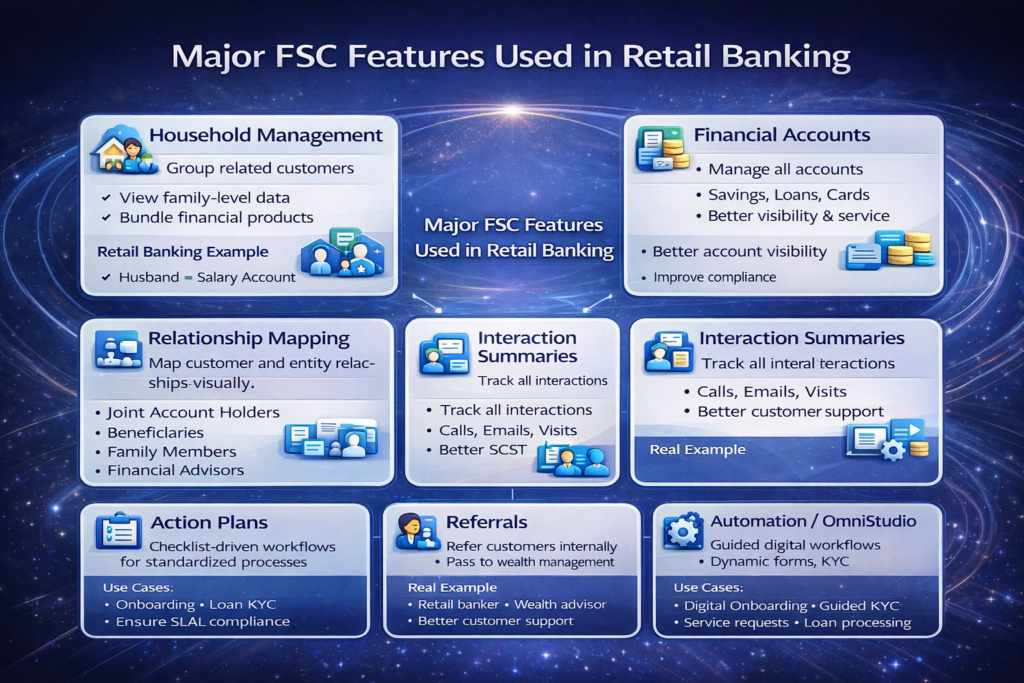
Major FSC Features Used in Retail Banking
Financial Services Cloud (FSC) is designed specifically for banking workflows, and its features are built to handle real-world retail banking complexity—relationships, compliance, financial data, and customer journeys. Let’s break each feature properly 👇
1. Household Management
What It Is
Household Management in FSC groups multiple related individuals into a single financial unit (household).
Instead of treating customers individually, FSC allows banks to view them as part of a family or relationship network.
Retail Banking Example
A typical household may include:
- Husband → Salary Account
- Wife → Savings + Insurance
- Child → Education Savings
- Joint Home Loan
- Family Insurance Policies
👉 FSC links all of these into one household record.
How It Works in FSC
- Uses Account & Contact relationships
- Defines roles (e.g., spouse, child, guardian)
- Links all financial accounts to the household
Benefits
- Complete family-level financial view
- Identify cross-sell opportunities
- Better wealth management insights
- Stronger relationship-based banking
Real Impact
Instead of selling products individually, banks can offer:
👉 “Family Banking Packages”
2. Financial Accounts
What It Is
Financial Accounts in FSC store all customer financial products in a structured and standardized format.
Supported Account Types
- Savings Accounts
- Current Accounts
- Loan Accounts
- Credit Cards
- Fixed Deposits
- Investment Accounts
How It Works
Each financial account is:
- Linked to customer
- Linked to household
- Tracked with balances, status, and ownership
Benefits
- Single source of truth for financial data
- Real-time visibility into customer portfolio
- Improved servicing and support
- Better advisory capabilities
Real Example
A banker can instantly see:
👉 Customer has:
- ₹5L savings
- ₹10L home loan
- ₹2L investments
→ Suggest better financial planning.
3. Relationship Mapping
What It Is
Relationship Mapping provides a visual representation of relationships between customers and entities.
Used For
- Joint Account Holders
- Beneficiaries
- Guarantors
- Family Members
- Financial Advisors
How It Works
- Displays connections in a graph/diagram format
- Shows influence and dependencies
Benefits
- Understand decision-making hierarchy
- Identify key influencers
- Improve underwriting decisions
- Strengthen compliance
Real Example
In a loan case:
👉 Guarantor + Applicant relationship is clearly visible
👉 Risk assessment becomes easier
4. Interaction Summaries
What It Is
Interaction Summaries capture and store every interaction between the bank and the customer.
Includes
- Calls
- Meetings
- Emails
- Branch Visits
- Complaint History
How It Works
- Automatically logs interactions
- Allows manual notes by bankers
- Stores timeline of customer engagement
Benefits
- Complete communication history
- Personalized customer experience
- Avoid repetition of queries
- Better team collaboration
Real Example
Customer calls today:
👉 Agent sees previous complaint
👉 Resolves faster without asking again
5. Action Plans
What It Is
Action Plans are predefined task-based workflows for standard banking processes.
Use Cases
- Customer onboarding
- Loan processing
- KYC completion
- Account opening
How It Works
- Step-by-step task checklist
- Assigned to different users
- Tracks progress and deadlines
Benefits
- Standardized operations
- Better task visibility
- SLA compliance
- Reduced human errors
Real Example
Loan process:
👉 Step 1: Document collection
👉 Step 2: Credit check
👉 Step 3: Approval
All tracked automatically.
6. Referrals
What It Is
Referrals allow internal teams to pass customers to other departments for additional services.
Example
- Retail banker → Wealth Management
- Loan team → Insurance team
- Branch → Investment advisor
How It Works
- Create referral record
- Assign to relevant team
- Track conversion
Benefits
- Improved collaboration
- Increased cross-selling revenue
- Better customer handling
Real Example
High-income customer:
👉 Referred to wealth advisor
👉 Bank sells investment products
7. Automation / OmniStudio
What It Is
OmniStudio is Salesforce’s low-code automation and digital interaction framework.
Core Components
- OmniScripts → Guided forms
- FlexCards → UI display
- DataRaptors → Data integration
- Integration Procedures → Backend logic
Use Cases
- Dynamic onboarding forms
- Loan eligibility calculation
- Guided KYC process
- Service request workflows
Benefits
- Reduced manual work
- Faster processing
- Seamless digital experience
- Scalable workflows
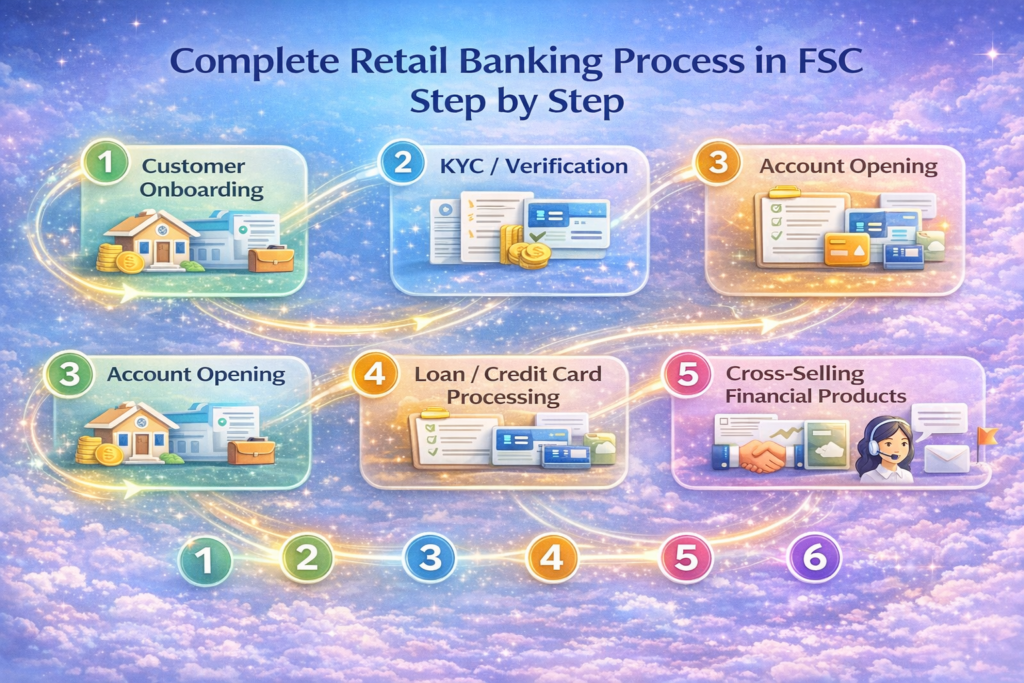
Complete Retail Banking Process in FSC Step by Step
1. Customer Onboarding
Process
When a customer visits branch or digital portal:
- Create Person Account / Contact
- Capture demographic information
- Add household relationship
- Collect required documents
FSC Support
- OmniStudio guided forms
- Action Plans for onboarding tasks
- Automated document checklist
2. KYC / Verification
Process
Verify:
- Identity Proof
- Address Proof
- PAN / Tax ID
- Income Documents
FSC Support
- KYC task tracking
- Integration with verification systems
- Automated approval routing
3. Account Opening
Process
Customer opens:
- Savings Account
- Fixed Deposit
- Current Account
FSC Support
- Financial Account creation
- Product association
- Approval workflows
4. Loan / Credit Card Processing
Process
- Capture loan application
- Assess eligibility
- Collect documents
- Underwrite application
- Approve / Reject
FSC Support
- Loan object management
- Application workflows
- Credit check integrations
- Approval automation
5. Cross-Selling Financial Products
Process
Based on customer profile:
- Offer Credit Cards
- Insurance
- Investments
- Loans
FSC Support
- Einstein recommendations
- Relationship insights
- Opportunity management
6. Customer Service Management
Process
Manage:
- Complaints
- Service Requests
- Card Block Requests
- Address Changes
FSC Support
- Case Management
- Omni-Channel Routing
- SLA Tracking
Real-World Retail Banking Use Cases in Financial Services Cloud (FSC) – Detailed
1. Personalized Loan Offers
In traditional banking, loan offers are mostly generic. But with FSC, banks can move to data-driven, personalized loan targeting.
How it works:
FSC continuously tracks customer financial behavior such as:
- Salary credits
- Account balance trends
- Spending patterns
- Existing liabilities
Using this data, the system identifies:
- Eligible customers
- Creditworthiness
- Loan capacity
How FSC Helps:
- Tracks salary deposits automatically
- Uses AI (Einstein) for credit insights
- Triggers targeted loan campaigns
- Creates opportunities for sales teams
Real Example:
A customer receiving ₹80,000/month salary regularly:
👉 FSC detects stability
👉 Suggests pre-approved personal loan
👉 Bank sends personalized offer via app/email
Business Impact:
- Higher conversion rates
- Reduced marketing cost
- Better customer experience
2. Household-Based Product Bundling
Retail banking is not just about individuals—it’s about families (households).
FSC allows banks to group related customers into a Household View.
How it works:
- Link family members
- Track combined financial data
- Understand overall wealth and needs
How FSC Helps:
- Household relationship mapping
- Combined financial insights
- Cross-selling at family level
Example Scenario:
Family includes:
- Father → Salary account
- Mother → Savings + insurance
- Child → Student
👉 Bank creates bundle:
- Premium family account
- Education savings plan
- Family insurance policy
Business Impact:
- Increased product penetration
- Higher customer lifetime value
- Stronger customer relationships
3. Credit Card Upgrade Journey
Instead of random upgrades, FSC enables behavior-based credit card upgrades.
How it works:
FSC monitors:
- Monthly spending
- Payment behavior
- Credit utilization
Trigger Conditions:
- High spending → Eligible for premium card
- Consistent repayment → Low risk customer
How FSC Helps:
- Tracks transaction patterns
- Uses AI for upgrade recommendations
- Automates upgrade offers
Example:
Customer spends ₹1 lakh/month on card:
👉 FSC identifies premium eligibility
👉 Suggests upgrade to Platinum card
👉 Offer sent automatically
Business Impact:
- Increased revenue from premium cards
- Better customer satisfaction
- Reduced manual effort
4. Mortgage Cross-Selling
Mortgage (home loan) is one of the biggest opportunities for cross-selling.
When a customer applies for a home loan, FSC helps banks offer multiple related products.
How it works:
FSC captures:
- Loan application data
- Customer profile
- Financial needs
Cross-Sell Opportunities:
- 🏠 Home Insurance
- 💰 Savings Plans
- 📈 Investment Advisory
- 🛡️ Life Insurance
How FSC Helps:
- Identifies relevant products
- Suggests next best actions
- Creates cross-sell opportunities
- Tracks conversion
Example:
Customer applies for home loan:
👉 FSC triggers:
- Insurance recommendation
- Investment planning offer
- Savings account upgrade
Business Impact:
- Higher revenue per customer
- Better financial planning services
- Improved customer trust
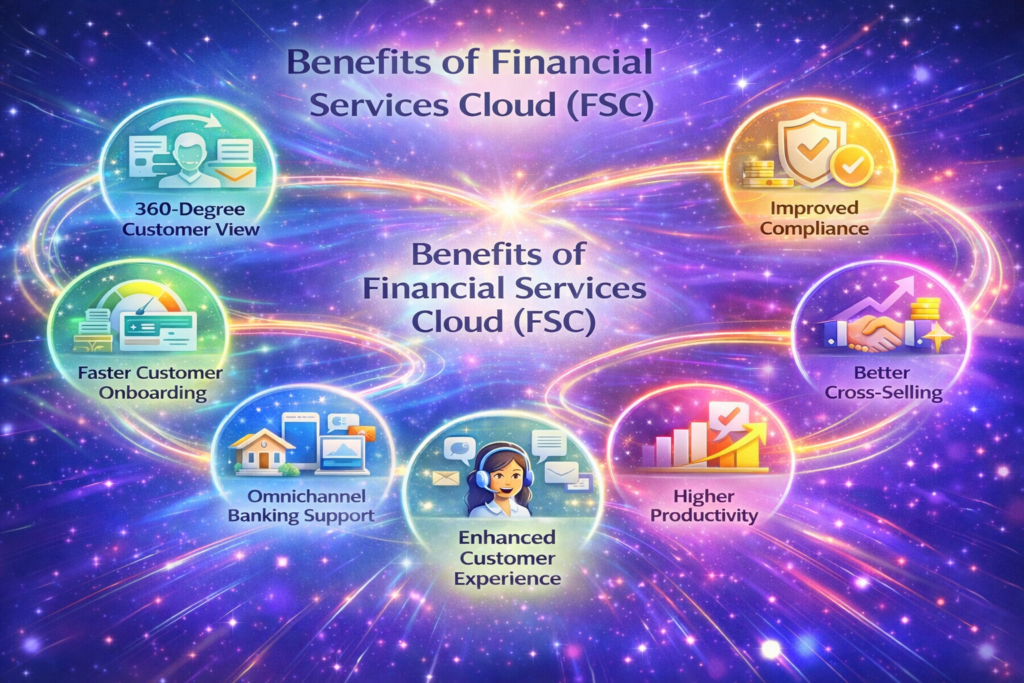
Benefits of Using Financial Services Cloud for Retail Banking
1. 360-Degree Customer View
Financial Services Cloud provides a complete unified view of the customer on a single platform.
Instead of scattered data across multiple systems, FSC brings everything together:
- Personal details
- Financial accounts
- Transaction history
- Interactions
- Relationships (family, advisors, etc.)
Why it matters:
Bankers no longer need to switch systems. They can:
- Understand customer needs instantly
- Offer personalized solutions
- Improve decision-making
👉 Example:
A relationship manager can see savings, loans, and investments of a customer in one dashboard.
2. Faster Customer Onboarding
Traditional onboarding is slow and paperwork-heavy. FSC simplifies and automates this process.
How FSC helps:
- Digital forms using OmniStudio
- Pre-built onboarding workflows
- Automated document collection
- Real-time verification
Result:
- Faster account opening
- Reduced manual effort
- Better customer experience
👉 Example:
Customer onboarding time reduces from days → minutes/hours.
3. Improved Compliance
Compliance is a big headache in banking (KYC, AML, audits).
FSC provides built-in compliance support:
Key features:
- KYC tracking
- Audit logs
- Approval workflows
- Document management
Benefits:
- Reduced compliance risk
- Easy regulatory reporting
- Full audit trail
👉 Example:
Every customer interaction and document is recorded automatically.
4. Better Cross-Selling
FSC enables intelligent cross-selling using customer insights.
How it works:
- Analyze customer data
- Identify financial needs
- Recommend relevant products
Powered by:
- Einstein AI
- Relationship insights
- Behavioral data
Benefits:
- Increased revenue
- Higher conversion rates
- Personalized offers
👉 Example:
Offer:
- Credit card → salary account holder
- Insurance → loan customer
5. Higher Productivity
FSC automates repetitive tasks so employees can focus on value-added work.
Automation includes:
- Data entry
- Workflow approvals
- Notifications
- Task assignments
Impact:
- Less manual work
- Faster processing
- Better efficiency
👉 Example:
Loan approvals that used to take days can now be processed automatically.
6. Enhanced Customer Experience
Modern customers expect:
- Fast service
- Personalized interaction
- Consistent experience
FSC delivers all three.
How:
- Interaction history tracking
- Personalized recommendations
- Unified customer view
Result:
- Better engagement
- Higher satisfaction
- Increased loyalty
👉 Example:
Customer doesn’t need to repeat issues—agent already knows context.
7. Omnichannel Banking Support
Customers today interact through multiple channels.
FSC ensures a seamless omnichannel experience.
Supported Channels:
- 🏦 Branch
- 📱 Mobile App
- 🌐 Website
- 📞 Call Center
- 👨💼 Relationship Managers
Key Advantage:
All interactions are:
- Connected
- Synced in real-time
- Accessible to all teams
👉 Example:
Customer starts request on mobile → continues in branch → finishes via call center (no data loss).
Traditional Banking CRM vs FSC
| Feature | Traditional Banking CRM | Salesforce FSC |
|---|---|---|
| Customer View | Limited / Siloed | 360-Degree Unified View |
| Industry Data Model | Generic | Banking-Specific |
| Household Management | Not Native | Native |
| Financial Account Tracking | Custom Build Required | Pre-Built |
| Relationship Mapping | Limited | Advanced |
| Automation | Basic | Advanced with OmniStudio |
| Compliance Tracking | Manual | Automated |
| Scalability | Limited | Highly Scalable |
| Integration | Difficult | API-Driven |
| Personalization | Low | High |
Why Banks Choose Retail Banking in Salesforce Financial Services Cloud
Banks adopt FSC because it helps them:
- Modernize legacy systems
- Digitize banking journeys
- Improve customer retention
- Increase product penetration
- Enhance advisor productivity
- Support digital transformation initiatives
Best Practices for Implementing Retail Banking in FSC
Define Clear Business Processes
Document onboarding, servicing, lending, and sales processes.
Use Standard FSC Objects First
Avoid unnecessary customization.
Leverage OmniStudio for Guided Experiences
Build dynamic forms and workflows.
Integrate Core Banking Systems
Connect FSC with:
- CBS
- Loan Origination Systems
- KYC Providers
- Credit Bureau APIs
Train Bank Staff Properly
Ensure adoption through role-based training.ompetitive success.
Future of Retail Banking with Salesforce Financial Services Cloud
The future of retail banking is increasingly digital, personalized, and data-driven. Financial institutions are moving away from traditional branch-centric models toward omnichannel customer experiences powered by intelligent CRM platforms.
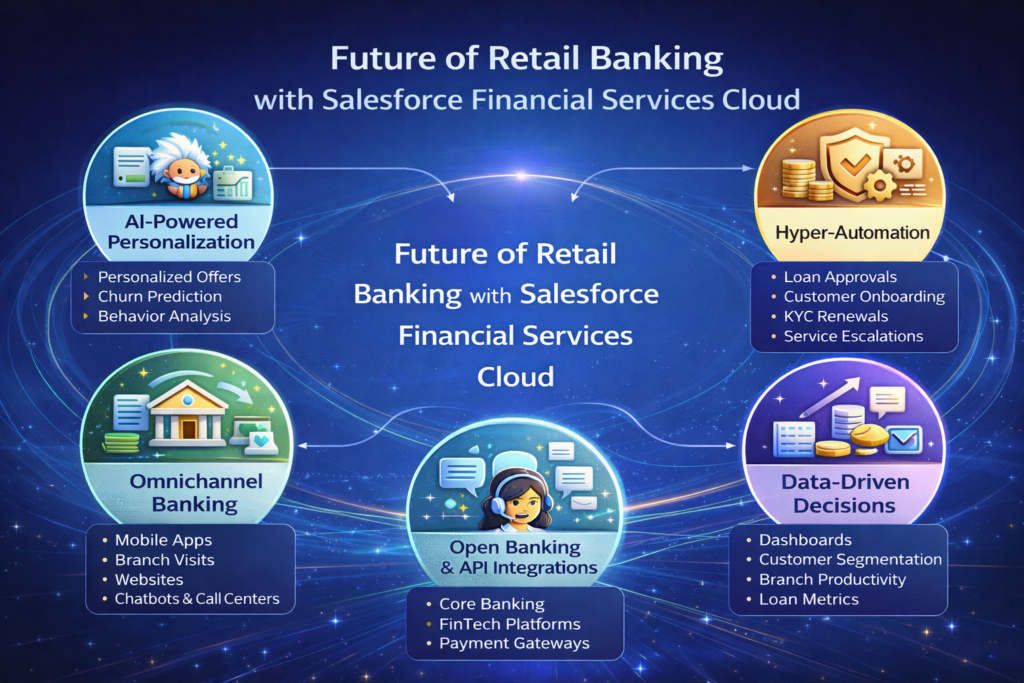
Retail Banking in Salesforce Financial Services Cloud positions banks for this future by enabling:
AI-Powered Personalization
Banks can use Salesforce Einstein AI to:
- Recommend personalized financial products
- Predict customer churn
- Identify next best offers
- Analyze spending and behavior patterns
Hyper-Automation of Banking Processes
With OmniStudio and Flow, banks can automate:
- Loan approvals
- Customer onboarding
- KYC renewals
- Service escalations
- Product recommendation journeys
Omnichannel Banking Experiences
Customers can interact through:
- Mobile Banking Apps
- Branch Visits
- Websites
- WhatsApp / Chatbots
- Call Centers
All interactions remain synced in FSC.
Data-Driven Decision Making
Banking leaders gain dashboards and reports for:
- Product Performance
- Customer Segmentation
- Branch Productivity
- Loan Conversion Rates
- Customer Satisfaction Metrics
Open Banking & API Integrations
FSC supports integration with:
- Core Banking Systems
- FinTech Platforms
- Credit Bureaus
- KYC Providers
- Payment Gateways
This enables a connected digital banking ecosystem.
Why This Matters
Banks that adopt FSC today are better prepared for:
- Digital Transformation
- Competitive Differentiation
- Regulatory Changes
- Customer Retention
- Revenue Growth
Conclusion
Retail Banking in Salesforce Financial Services Cloud is transforming how financial institutions manage customer relationships, streamline banking operations, and deliver personalized financial services.
With specialized banking capabilities such as Household Management, Financial Accounts, Relationship Mapping, Automation, and OmniStudio, FSC empowers banks to move beyond traditional CRM systems and create intelligent, customer-centric banking experiences.
As customer expectations continue to rise, adopting a modern CRM like FSC is no longer optional—it is essential for retail banks seeking growth, efficiency, and digital transformation.
Whether your bank wants to improve onboarding, automate loan processing, increase cross-selling, or deliver exceptional customer service, Retail Banking in Salesforce Financial Services Cloud provides the platform needed to achieve those goals.
About RizeX Labs
At RizeX Labs, we specialize in delivering advanced Salesforce solutions, including Financial Services Cloud (FSC) implementations for banking and financial institutions. Our expertise combines deep technical knowledge, industry best practices, and real-world implementation experience to help organizations modernize retail banking operations and enhance customer engagement.
We empower financial institutions to transform their retail banking processes—from traditional, siloed systems to connected, automated, and customer-centric digital banking experiences powered by Salesforce FSC.
Internal Linking Opportunities
External Linking Opportunities
- Salesforce official website
- Financial Services Cloud overview
- Salesforce Help Documentation
- Salesforce AppExchange
Quick Summary
Retail Banking in Financial Services Cloud enables banks and financial institutions to manage customer relationships, financial accounts, onboarding, and service operations on a unified CRM platform. By leveraging Salesforce FSC, banks can automate workflows, gain a 360-degree customer view, and deliver personalized banking experiences across channels.
With FSC, retail banks can streamline onboarding, improve compliance, automate KYC and loan processes, enhance cross-selling opportunities, and strengthen long-term customer relationships. As banking becomes increasingly digital, implementing Financial Services Cloud is essential for delivering modern, scalable, and customer-centric retail banking services.
Quick Summary
Retail Banking in Salesforce Financial Services Cloud is a specialized CRM platform purpose-built for retail banking institutions. Unlike generic CRM solutions, Salesforce Financial Services Cloud provides a financial-services-specific data model, pre-built industry objects, and banking-specific workflows that align directly with how retail banks operate.The platform offers powerful features designed specifically for retail banking including Household Management that groups family members and aggregates financial data, Financial Account Tracking for all banking products, Relationship Mapping for complex customer networks, Interaction Summaries for capturing conversation details, Action Plans for structured process management, Referrals for cross-department handoffs, and OmniStudio Automation for digitizing complex banking workflows. Financial Services Cloud for Retail Banking supports the complete customer lifecycle including customer onboarding, KYC and identity verification, account opening, loan and credit card processing, intelligent cross-selling, and customer service management. The platform integrates seamlessly with existing core banking systems through MuleSoft and pre-built API connectors.