
Meta Description: Salesforce Sales Cloud vs Health Cloud comparison for healthcare businesses. Expert analysis, real implementation insights, and decision framework for CRM consultants and healthcare startups.
Introduction: Why This CRM Comparison Actually Matters
Most CRM comparison articles rehash the same feature lists you can find on Salesforce’s website. This isn’t that article.
If you’re a healthcare startup founder choosing between Salesforce Sales Cloud and Health Cloud, you’re not just selecting software—you’re making a strategic bet that will impact your patient acquisition costs, operational efficiency, compliance posture, and scalability for the next 3-5 years. If you’re a CRM consultant advising clients, the wrong recommendation doesn’t just cost credibility; it costs your client hundreds of thousands in implementation expenses and lost opportunity.
The truth? Both platforms can work for healthcare businesses. But one will work significantly better depending on your business model, regulatory requirements, patient engagement strategy, and growth trajectory.
At RizeX Labs, we’ve implemented both platforms across healthcare organizations ranging from telehealth startups to multi-specialty medical groups. We’ve seen Health Cloud implementations that were overkill and expensive. We’ve also witnessed Sales Cloud deployments that became compliance nightmares requiring costly mid-stream pivots.
This guide cuts through the marketing and gives you the decision-making framework you actually need—grounded in real implementation experience, not theoretical comparisons.
The Fundamental Architecture Difference That Changes Everything
Before diving into features, understand this critical distinction that most comparisons gloss over:
Sales Cloud is a horizontal CRM platform designed for B2B and B2C sales processes across any industry. It’s built on a contact-account-opportunity model optimized for deal progression.
Health Cloud is a vertical industry solution built on top of Sales Cloud, specifically architected around the provider-payer-patient ecosystem with healthcare data models that reflect clinical and care coordination workflows.
What This Actually Means for Your Implementation
When you purchase Health Cloud, you’re not getting a completely different platform—you’re getting Sales Cloud plus healthcare-specific data models, pre-configured processes, and industry components. This has three immediate implications:
- Licensing costs: Health Cloud is significantly more expensive per user (typically 40-60% premium over Sales Cloud Enterprise Edition)
- Implementation complexity: Health Cloud offers more out-of-box healthcare functionality, but also requires deeper configuration understanding
- Technical debt: If you start with Sales Cloud and later need Health Cloud capabilities, migration is possible but expensive and disruptive
The decision point isn’t just “which has better features”—it’s “which architectural foundation aligns with our five-year strategic roadmap.”
The Core Data Model Divide: Why This Determines Everything Downstream
Sales Cloud: The Contact-Account-Opportunity Trinity
Sales Cloud’s data architecture centers on:
- Leads → potential customers before qualification
- Contacts/Accounts → qualified individuals and organizations
- Opportunities → potential deals with stages, probability, and revenue forecasting
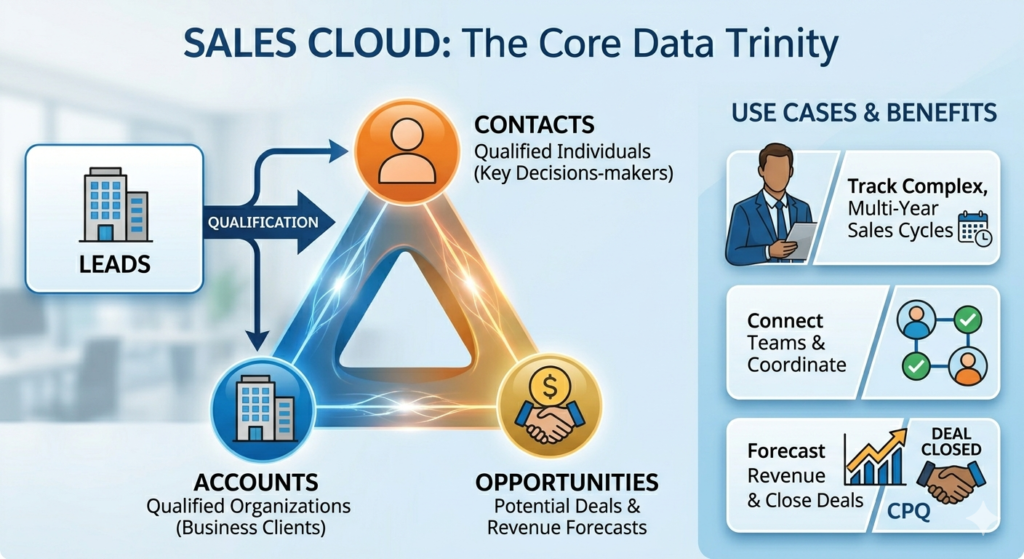
This works beautifully for:
- Medical device sales organizations
- Healthcare software vendors
- Pharmaceutical commercial teams
- Healthcare staffing firms
- Diagnostic equipment distributors
Real-world example: A medical imaging equipment company we worked with used Sales Cloud to track a complex 18-month sales cycle across hospital procurement committees. They needed opportunity splitting (multiple reps), complex approval workflows, and integration with their CPQ (Configure-Price-Quote) system. Sales Cloud handled this elegantly without healthcare-specific baggage.
Health Cloud: The Patient-Provider-Payer Ecosystem
Health Cloud introduces fundamentally different objects:
- Care Plans → structured treatment protocols
- Care Teams → multi-disciplinary provider groups coordinating care
- Clinical Service Requests → orders, referrals, and authorizations
- Health Timeline → longitudinal patient health events
- EHR Integration Framework → HL7 FHIR-ready data models
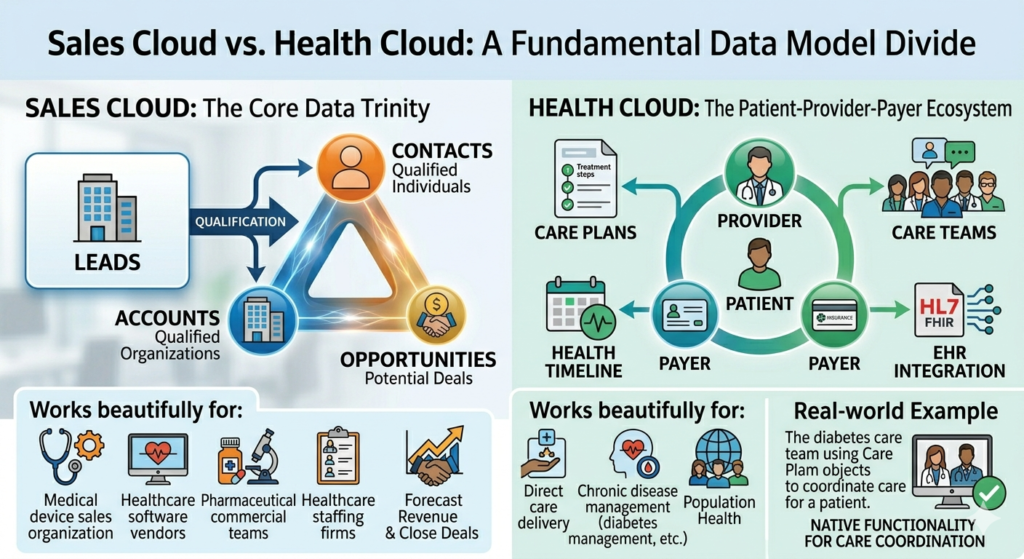
This architecture shines for:
- Direct patient care delivery organizations
- Care coordination platforms
- Chronic disease management programs
- Population health initiatives
- Patient navigation services
- Telehealth platforms treating ongoing conditions
Real-world example: A diabetes care management startup needed to coordinate between endocrinologists, dietitians, health coaches, and patients while tracking glucose readings, medication adherence, and care plan milestones. Health Cloud’s care team and care plan objects made this native functionality versus the extensive customization required in Sales Cloud.
The Detailed Feature Comparison: Beyond the Marketing Brochure
| Capability | Sales Cloud | Health Cloud | Winner |
|---|---|---|---|
| Patient/Contact 360° View | Standard contact record with custom fields | Patient card with integrated health timeline, medications, conditions | Health Cloud |
| Care Coordination | Requires significant customization using custom objects and flows | Native care plans, care teams, tasks with role-based assignment | Health Cloud |
| Sales Pipeline Management | Native opportunity stages, forecasting, pipeline analytics | Available (inherits from Sales Cloud) but not primary use case | Sales Cloud |
| Referral Management | Manual customization needed | Built-in clinical service requests with status tracking | Health Cloud |
| HIPAA Compliance Features | Platform is HIPAA-compliant; requires proper BAA and configuration | Platform compliant + healthcare-specific audit trails and consent management | Health Cloud |
| EHR Integration | Custom API integration required | HL7 FHIR adapters and pre-built healthcare data models | Health Cloud |
| Provider Network Management | Requires custom account hierarchy setup | Native provider relationship structures | Health Cloud |
| Lead Scoring & Nurturing | Advanced Einstein AI scoring, engagement tracking | Available but less sophisticated for marketing-qualified leads | Sales Cloud |
| Quote & Contract Management | Native CPQ integration, contract lifecycle management | Basic functionality; not core strength | Sales Cloud |
| Patient Engagement Tools | Email/SMS via Marketing Cloud; custom portal development | Health-specific patient portals, secure messaging templates | Health Cloud |
| Utilization & Outcomes Tracking | Requires extensive customization | Health metrics tracking, risk stratification tools | Health Cloud |
| Implementation Cost | $50K-$150K typical range for mid-market | $150K-$400K+ typical range for comparable organization | Sales Cloud |
| Licensing Cost (per user/year) | $125-$300 depending on edition | $225-$400+ for equivalent user type | Sales Cloud |
| Time to Value | 3-6 months for standard deployment | 6-12 months given healthcare complexity | Sales Cloud |
Use Case Analysis: Who Should Choose What (And Why)
Clear Sales Cloud Scenarios
1. Medical Device & Equipment Sales
If your revenue model is transactional sales to healthcare providers (not patient care), Sales Cloud is the obvious choice. You need opportunity management, quote generation, and channel partner management—not care plans.
Decision trigger: If you measure success in “deals closed” and “revenue per rep,” you’re a Sales Cloud organization.
2. Healthcare SaaS & Technology Vendors
Selling software to hospitals, clinics, or payers requires robust opportunity tracking, territory management, and marketing automation integration. Health Cloud’s patient-centric features add cost without value.
Warning sign: We’ve seen healthcare IT vendors incorrectly choose Health Cloud because they operate “in healthcare.” Unless you’re delivering clinical care, this is usually the wrong call.
3. Pharmaceutical Commercial Operations
Sales Cloud handles HCP (Healthcare Professional) targeting, sample management, and compliance-governed rep interactions better than Health Cloud when your business model is product sales, not care delivery.
Implementation insight: Pharmaceutical companies typically layer Veeva (industry-specific CRM built on Salesforce) on top of Sales Cloud rather than using Health Cloud.
4. Healthcare Staffing & Recruitment
Placing nurses, physicians, and allied health professionals is a sales and recruiting operation, not care delivery. Sales Cloud’s candidate tracking and client management capabilities align perfectly.
Clear Health Cloud Scenarios
1. Virtual Care & Telemedicine Platforms
If you’re managing ongoing patient relationships, coordinating between specialists, and tracking clinical outcomes, Health Cloud’s care coordination features justify the investment.
Real example: A mental health teletherapy platform needed to manage therapist-patient matching, track session notes (securely), coordinate with psychiatrists for medication management, and monitor patient-reported outcomes. Health Cloud’s care team and care plan infrastructure made this dramatically simpler than customizing Sales Cloud.
2. Chronic Disease Management Programs
Diabetes management, cardiac rehabilitation, oncology navigation—any longitudinal care program benefits from Health Cloud’s timeline view, risk stratification, and care plan adherence tracking.
ROI insight: One diabetes management client reduced care coordinator workload by 30% using Health Cloud’s automated care task generation versus their previous Sales Cloud custom solution.
3. Accountable Care Organizations (ACOs) & Value-Based Care
When reimbursement depends on population health outcomes, quality measures, and care coordination documentation, Health Cloud’s analytics and reporting align with your business model.
Regulatory consideration: ACO reporting requirements (MSSP, Next Gen) often require data structures that Health Cloud supports natively.
4. Patient Navigation & Care Coordination Services
Helping patients navigate complex healthcare journeys—cancer treatment, transplant coordination, rare disease management—maps directly to Health Cloud’s designed workflows.
5. Home Health & Hospice Organizations
Managing care teams visiting patients, coordinating with attending physicians, and tracking care plan compliance requires Health Cloud’s multi-stakeholder coordination tools.
The Gray Area: When Either Could Work (Decision Framework)
Some healthcare businesses sit in the ambiguous middle:
Scenario: Specialty pharmacy or infusion center
- Sales Cloud argument: Patient acquisition is transactional; focus on physician referral relationships
- Health Cloud argument: Ongoing therapy management requires care coordination
Decision framework:
- Revenue model: If >70% revenue comes from initial patient acquisition, lean Sales Cloud
- Average patient lifetime: <6 months → Sales Cloud; >12 months → Health Cloud
- Care coordination complexity: Single provider → Sales Cloud; multi-disciplinary teams → Health Cloud
- Regulatory documentation needs: Minimal → Sales Cloud; extensive outcome tracking → Health Cloud
RizeX Labs recommendation: For gray-area scenarios, start with Sales Cloud Enterprise and build a healthcare-specific customization roadmap. This gives you 70% of Health Cloud’s value at 50% of the cost for organizations not yet at scale. Plan for Health Cloud migration once you exceed 50,000 active patients or expand into value-based contracts.
The Compliance & Security Dimension
HIPAA Compliance: Not a Differentiator
Both platforms are HIPAA-compliant when properly configured. Salesforce will sign a Business Associate Agreement (BAA) for both products. The platform-level security controls (encryption, audit trails, access controls) are identical.
Critical mistake we see: Organizations choosing Health Cloud solely for “better HIPAA compliance.” This is not accurate. Both require proper implementation of:
- Field-level encryption for sensitive data
- Role-based access controls
- Audit trail configuration
- Data retention policies
- Incident response procedures
Where Health Cloud Actually Differs on Compliance
1. Healthcare-specific consent management
Health Cloud includes consent tracking objects designed for clinical consent workflows (treatment consent, data sharing authorizations, research participation). Sales Cloud requires custom development.
2. Pre-configured audit requirements
Health Cloud’s patient timeline and care activity logging are designed with clinical documentation requirements in mind, making compliance audits simpler.
3. Data segregation models
Health Cloud’s architecture makes it easier to implement data access restrictions required for 42 CFR Part 2 (substance use disorder records) and other sensitive healthcare data.
Bottom line: If your compliance burden includes detailed clinical consent management and specialized healthcare privacy rules beyond basic HIPAA, Health Cloud provides meaningful compliance infrastructure advantage. For standard HIPAA-governed businesses, both platforms are equivalent when properly implemented.
Integration Ecosystem Considerations
EHR Integration: The Hidden Implementation Cost
Sales Cloud EHR integration:
- Requires custom API development for each EHR (Epic, Cerner, Athena, etc.)
- Typically $50K-$150K per EHR integration for bidirectional data flow
- Ongoing maintenance as EHR vendors update APIs
- Data mapping entirely custom
Health Cloud EHR integration:
- HL7 FHIR data models align with modern EHR standards
- Pre-built MuleSoft accelerators for major EHRs reduce custom development
- Healthcare data exchange patterns built into platform
- Still requires significant configuration, but starting from healthcare-native foundation
Real cost comparison (medium-sized practice):
- Sales Cloud + custom Epic integration: $180K initial, $30K annual maintenance
- Health Cloud + Epic FHIR integration: $120K initial, $20K annual maintenance
The integration advantage partially offsets Health Cloud’s higher licensing costs for EHR-dependent organizations.
Other Critical Integrations
Marketing automation: Sales Cloud integrates more seamlessly with Salesforce Marketing Cloud and Pardot for patient acquisition marketing campaigns.
Billing systems: Neither has native medical billing integration; both require custom connectivity to RCM (Revenue Cycle Management) systems.
Analytics platforms: Health Cloud has better pre-built connections to Tableau CRM for healthcare-specific dashboards (readmission risk, care gaps, population health metrics).
The Total Cost of Ownership Reality Check
Let’s model two realistic scenarios with actual cost transparency:
Scenario A: 50-Person Specialty Clinic (Direct Care Delivery)
Sales Cloud Implementation:
- Licenses: 30 users × $200/user/year = $6,000/year
- Implementation: $80,000 (includes custom care coordination objects)
- EHR integration: $120,000 (one-time)
- Annual maintenance/enhancements: $35,000
- 5-year TCO: $455,000
Health Cloud Implementation:
- Licenses: 30 users × $350/user/year = $10,500/year
- Implementation: $150,000 (native healthcare objects, less customization)
- EHR integration: $75,000 (FHIR-based, simpler)
- Annual maintenance/enhancements: $25,000
- 5-year TCO: $402,500
Winner: Health Cloud (saves ~$50K over 5 years while providing better healthcare-native functionality)
Scenario B: Medical Device Manufacturer, 200 Sales Reps
Sales Cloud Implementation:
- Licenses: 200 users × $150/user/year = $30,000/year
- Implementation: $120,000 (territory management, opportunity tracking)
- CPQ integration: $60,000
- Annual maintenance: $40,000
- 5-year TCO: $530,000
Health Cloud Implementation:
- Licenses: 200 users × $300/user/year = $60,000/year
- Implementation: $180,000 (unnecessary healthcare features configured)
- CPQ integration: $60,000
- Annual maintenance: $45,000
- 5-year TCO: $765,000
Winner: Sales Cloud (saves $235K over 5 years; Health Cloud features unused)
The insight: For patient care organizations with EHR integration needs, Health Cloud’s TCO is often competitive despite higher licensing. For healthcare-adjacent sales organizations, Sales Cloud wins decisively.
Implementation Realities: What the Salesforce Partners Won’t Tell You
Sales Cloud Implementation Pitfalls in Healthcare
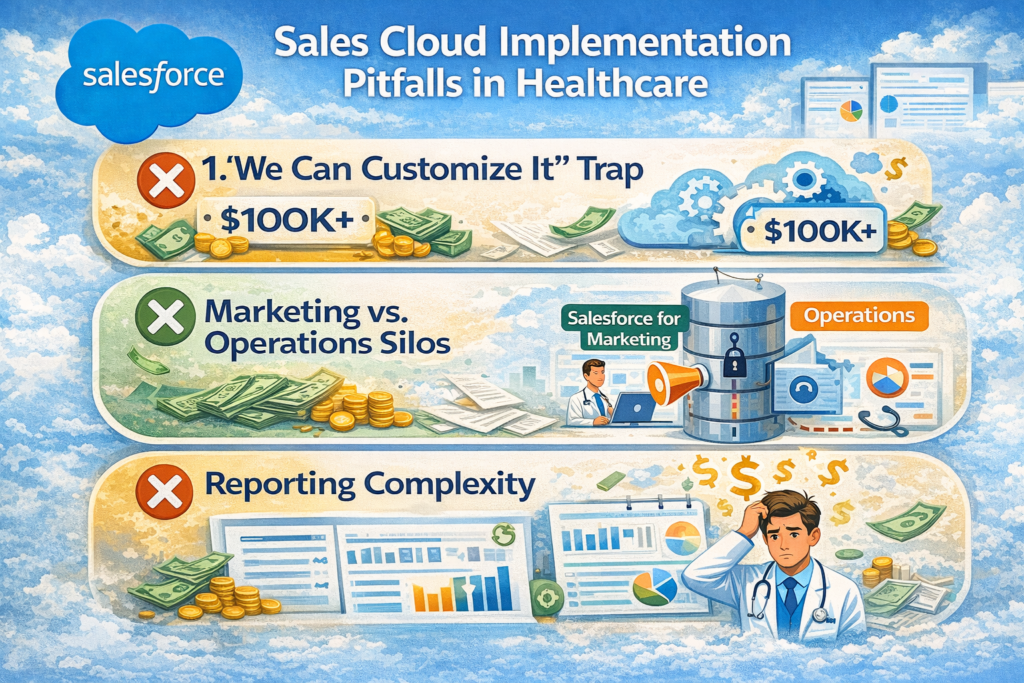
1. The “We Can Customize It” Trap
Yes, you can build care plans in Sales Cloud using custom objects. We’ve done it. But you’ll spend $100K+ recreating functionality Health Cloud provides out-of-box, and your version will be harder to upgrade and maintain.
When customization makes sense: If you need care coordination for <20% of your patient population, limited customization on Sales Cloud beats full Health Cloud deployment.
2. Marketing vs. Operations Mismatch
Sales Cloud excels at patient acquisition workflows but struggles with operational care delivery. Organizations often end up with “Salesforce for marketing” and separate systems for care operations—creating data silos.
3. Reporting Complexity
Healthcare outcome reporting (readmission rates, care gaps, risk scores) requires extensive custom report types and dashboards in Sales Cloud. Budget 20-30% more implementation time for reporting versus Health Cloud.
Health Cloud Implementation Pitfalls
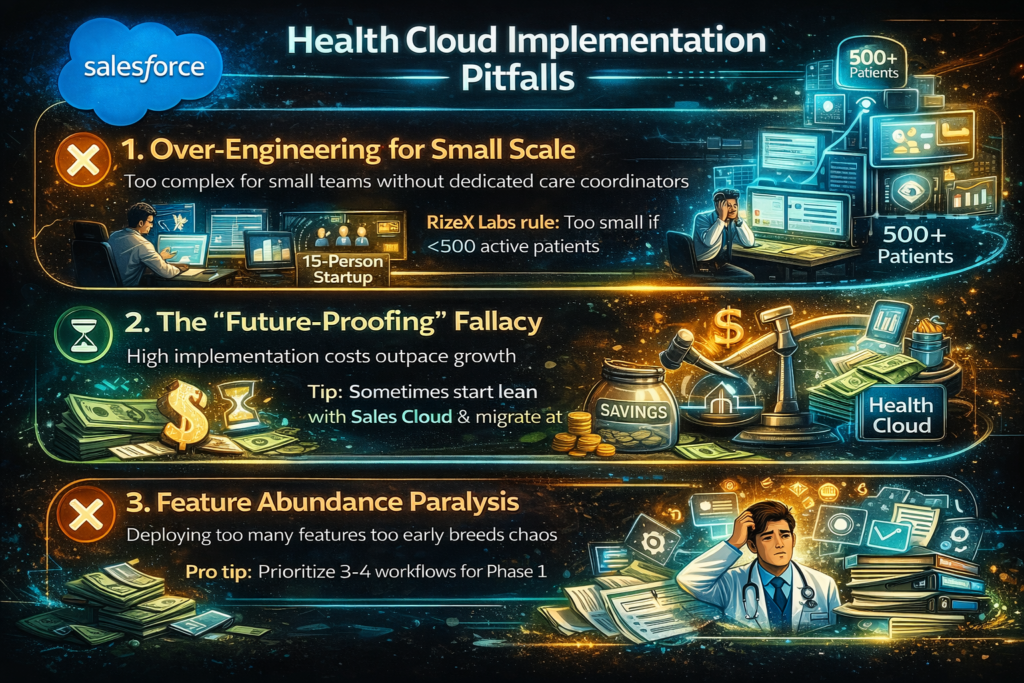
1. Over-Engineering for Small Scale
Health Cloud’s robust care coordination features can overwhelm small teams. We’ve seen 15-person startups struggle with Health Cloud’s complexity when Sales Cloud would have sufficed until they reached 500+ active patients.
RizeX Labs rule of thumb: If you don’t have dedicated care coordinators as distinct from sales/patient acquisition roles, you’re probably too small for Health Cloud.
2. The “Future-Proofing” Fallacy
Clients often choose Health Cloud because they “plan to expand into care coordination.” But implementation costs consume capital needed for growth. Sometimes, starting lean with Sales Cloud and migrating at scale is smarter financially.
3. Feature Abundance Paralysis
Health Cloud includes so many healthcare-specific features that implementation can balloon in scope. Successful deployments ruthlessly prioritize Phase 1 functionality.
Best practice: Implement only 3-4 core workflows in Phase 1 (typically: patient intake, care team assignment, care plan creation, clinical task management). Resist configuring every available feature.
The Decision Matrix: Your Strategic Framework
Use this prioritization framework to guide your decision:
Choose Sales Cloud If:
✅ Your business model is transactional sales (devices, software, services to healthcare providers)
✅ Patient/customer lifetime is <6 months
✅ You don’t coordinate care between multiple providers
✅ Your team is <50 people and capital is constrained
✅ Marketing automation and lead nurturing are critical (patient acquisition focus)
✅ You need robust CPQ and contract management
✅ Your primary KPIs are sales velocity, pipeline value, and conversion rates
Choose Health Cloud If:
✅ You deliver direct patient care services
✅ Average patient engagement exceeds 12 months
✅ You coordinate between multiple care team members (physicians, nurses, therapists, etc.)
✅ You’re managing chronic disease populations
✅ EHR integration is mission-critical
✅ You operate under value-based contracts or ACO models
✅ Your primary KPIs include clinical outcomes, care gaps, and quality measures
✅ Regulatory reporting extends beyond basic HIPAA (HEDIS, MSSP, etc.)
Consider a Phased Approach If:
🔄 You’re a high-growth startup with evolving business model
🔄 Current patient volume is <5,000 but projected to exceed 50,000 in 24 months
🔄 You’re transitioning from fee-for-service to value-based care models
🔄 You have complex requirements spanning both sales and care coordination
Phased strategy: Start with Sales Cloud Enterprise, implement core workflows, then migrate to Health Cloud when you reach scale thresholds (typically when care coordination costs exceed Health Cloud premium licensing costs).
Industry-Specific Recommendations
For Healthcare Startups
Stage 1 (Pre-revenue to $1M ARR):
- Sales Cloud is almost always the right choice
- Focus on patient acquisition, not operational sophistication
- Conserve capital for product development and market validation
Stage 2 ($1M-$5M ARR):
- Evaluate based on business model clarity
- If care coordination is your core value proposition → Health Cloud
- If technology/service delivery is product → likely still Sales Cloud
Stage 3 ($5M+ ARR):
- Health Cloud becomes economically viable for care delivery models
- Data architecture decisions have long-term strategic implications
- Consider Health Cloud if you’re raising significant capital and scaling care operations
For Established Healthcare Organizations
Multi-specialty Medical Groups:
Health Cloud—you need care coordination, population health management, and EHR integration from day one.
Specialty Pharmacies:
Nuanced decision based on reimbursement model:
- Primarily buy-and-bill → Sales Cloud
- Significant specialty medication therapy management → Health Cloud
Diagnostic Laboratories:
Sales Cloud for physician outreach and specimen tracking; Health Cloud only if you’re expanding into longitudinal disease monitoring programs.
Durable Medical Equipment (DME) Providers:
Sales Cloud unless you’re providing ongoing patient support services (respiratory therapy, diabetes education) that require care coordination.
CRM Consultant’s Implementation Checklist
Pre-Implementation Assessment Questions
Before recommending either platform, ensure you’ve thoroughly investigated:
Business Model Questions:
- What percentage of revenue comes from new patient acquisition vs. existing patient services?
- What is average patient lifetime value and engagement duration?
- Do you bill fee-for-service or operate under value-based contracts?
- Who are your customers—patients, providers, payers, or combination?
Operational Questions:
- How many distinct roles interact with patients/customers?
- Do you coordinate care between multiple internal and external providers?
- What systems currently manage patient/customer data?
- What are your EHR integration requirements (read-only, bidirectional, real-time)?
Regulatory & Compliance Questions:
- What healthcare privacy regulations apply (HIPAA, 42 CFR Part 2, state-specific)?
- What clinical quality measures must you report?
- What patient consent workflows are legally required?
Technical Questions:
- What is your Salesforce maturity level (new to platform vs. existing users)?
- Do you have in-house Salesforce admins/developers?
- What is your integration architecture tolerance (simple vs. complex)?
Financial Questions:
- What is your total budget (licensing + implementation)?
- What is your time-to-value requirement?
- Can you absorb 6-12 month implementation timeline?
Red Flags That Indicate Wrong Platform Choice
Red flags for Sales Cloud in healthcare:
- ❌ Client uses terms like “care coordination” and “care plans” constantly
- ❌ Multiple stakeholders involved in every patient interaction
- ❌ Success metrics focus on clinical outcomes, not just acquisition
- ❌ Existing EHR integration is mission-critical requirement
- ❌ Value-based contract reimbursement model
Red flags for Health Cloud:
- ❌ Primary KPIs are pipeline value and sales quotas
- ❌ Customer interactions are primarily transactional
- ❌ No multi-provider care coordination needed
- ❌ Small team (<25 people) with limited budget
- ❌ Heavy emphasis on marketing automation and lead nurturing
Migration Considerations: Moving Between Platforms
Sales Cloud → Health Cloud Migration
This is the more common migration path as organizations scale from patient acquisition focus to comprehensive care delivery.
Migration complexity: Moderate to High
Key steps:
- Data model mapping: Translate custom Sales Cloud objects to Health Cloud native objects (Contacts → Patients, Custom Care Plans → Standard Care Plans)
- Preserve historical data: Maintain audit trail and historical patient interactions
- Parallel operation period: Run both systems briefly to validate data integrity
- User retraining: Health Cloud workflows differ significantly from Sales Cloud
Typical timeline: 4-6 months for organizations with <100,000 patient records
Typical cost: $80K-$200K depending on customization extent
When it makes sense:
- Patient population exceeds 50,000 active patients
- Care coordination becomes core business function (>30% of staff time)
- Value-based contracts require sophisticated outcome tracking
- EHR integration costs on Sales Cloud exceed Health Cloud premium
Health Cloud → Sales Cloud Migration
Less common but occurs when organizations realize they over-engineered for their actual needs.
Migration complexity: Moderate
Reasons we’ve seen:
- Startup pivoted from care delivery to healthcare SaaS product
- Organization realized they’re a sales operation, not care delivery
- Costs unsustainable for actual feature utilization
Warning: This typically indicates a flawed initial requirements analysis. Proper upfront assessment should prevent this scenario.
The Role of Artificial Intelligence: Einstein Across Both Platforms
Both Sales Cloud and Health Cloud leverage Salesforce Einstein AI, but with different optimization focuses.
Sales Cloud Einstein Capabilities
Lead Scoring: Predicts which patient/customer inquiries are most likely to convert, optimizing acquisition spend.
Opportunity Insights: Forecasts deal close probability and identifies at-risk opportunities.
Activity Capture: Automatically logs emails and calendar events, reducing administrative burden for sales teams.
Next Best Action: Recommends optimal follow-up actions based on historical conversion patterns.
Best for: Organizations focused on patient/customer acquisition efficiency and revenue optimization.
Health Cloud Einstein Capabilities
Risk Stratification: Identifies high-risk patients likely to have adverse events or high utilization.
Care Gap Identification: Flags patients missing preventive services or treatment protocol steps.
Care Recommendations: Suggests evidence-based interventions based on patient conditions and history.
Readmission Prediction: Forecasts which patients are at high risk for hospital readmission.
Best for: Organizations focused on population health management, quality outcomes, and value-based care.
AI Investment Considerations
Einstein features require additional licensing costs ($50-$75/user/month for advanced features). Evaluate ROI based on:
Sales Cloud AI ROI drivers:
- Increased conversion rates (typically 10-20% improvement)
- Reduced sales cycle length
- Improved rep productivity
Health Cloud AI ROI drivers:
- Reduced hospital readmissions (typically $5K-$15K cost savings per prevented readmission)
- Improved quality metric performance (bonus payments under value-based contracts)
- Care coordinator efficiency gains
RizeX Labs perspective: Einstein capabilities often justify their cost, but only after core platform adoption is mature. Phase these in 6-12 months post-implementation, not Day 1.
Future-Proofing Your Decision: Platform Evolution Trends
Salesforce Platform Evolution
Salesforce’s strategic direction provides clues about future capabilities:
Sales Cloud trajectory:
- Deeper marketing automation integration (Marketing Cloud convergence)
- Enhanced B2C commerce capabilities (Consumer Goods Cloud overlap)
- Slack integration for collaborative selling
- Revenue Intelligence capabilities (formerly Tableau CRM)
Health Cloud trajectory:
- Expanded clinical data model support (FHIR R4 and beyond)
- Enhanced patient engagement tools (mobile-first experiences)
- Deeper integration with MuleSoft for health information exchange
- Population health analytics expansion
- Consumerization features (patient portals, self-service scheduling)
Industry Trend Implications
Trend 1: Healthcare Consumerization
Patients increasingly behave like retail consumers. Both platforms are adding consumer engagement features, but Sales Cloud’s B2C capabilities may have edge for patient acquisition.
Trend 2: Interoperability Mandates
Federal regulations (21st Century Cures Act) require data exchange. Health Cloud’s FHIR-native approach positions it better for compliance.
Trend 3: Value-Based Care Expansion
As fee-for-service declines, health outcome tracking becomes critical. Health Cloud’s care management infrastructure aligns with this trend.
Trend 4: Virtual Care Permanence
Telehealth is now permanent healthcare fixture. Health Cloud’s care coordination fits virtual care models better than Sales Cloud’s transactional approach.
Strategic implication: If you’re making a 5-year platform decision today, consider which trends most impact your business model. Value-based care organizations should weight toward Health Cloud; patient acquisition-focused businesses toward Sales Cloud.
Conclusion: Making the Strategic CRM Choice That Defines Your Trajectory
The Salesforce Sales Cloud vs Health Cloud decision is not primarily a feature comparison—it’s a strategic business model alignment question.
The fundamental question isn’t “which has better features?”
It’s: “Which platform’s core architecture reflects how our business actually creates value?”
If you create value by acquiring customers and closing deals—whether those customers are patients, healthcare providers, or institutions—Sales Cloud’s opportunity-centric architecture fits your operational reality. You’ll achieve faster time-to-value, lower total cost of ownership, and better alignment with how your team actually works.
If you create value by coordinating longitudinal care and improving health outcomes—managing patients across episodes of care, coordinating multi-disciplinary teams, and optimizing for quality metrics—Health Cloud’s care-centric architecture mirrors your operational workflow. The higher investment pays dividends in reduced customization, better regulatory alignment, and operational efficiency.
The Three Decision Principles We Apply at RizeX Labs
1. Optimize for your current business model, but plan for the adjacent possible
Don’t choose Health Cloud because you might someday do care coordination. Choose it when care coordination is already a core function consuming significant resources. However, if your strategic plan includes transition to value-based care within 24 months, factor that into total cost of ownership calculations.
2. Implementation costs often exceed licensing costs
The $10,000 annual licensing difference between Sales Cloud and Health Cloud for a 30-person team is real—but it’s dwarfed by $50K-$100K differences in implementation costs based on wrong-fit customization requirements. Choose the platform that requires less bespoke development to match your workflows.
3. The best CRM is the one your team actually uses
Health Cloud’s sophistication can overwhelm small teams, leading to low adoption and failed implementations. Sales Cloud’s simplicity can frustrate care coordinators lacking tools they need, leading to shadow IT and data fragmentation. Match platform complexity to organizational maturity.
Final Recommendations by Stakeholder
For Healthcare Startup Founders:
Start with Sales Cloud unless care coordination is your core product from Day 1. Conserve capital, prove product-market fit, then invest in Health Cloud infrastructure when you’re scaling proven operations. The migration path exists—don’t prematurely optimize.
For Established Healthcare Organizations:
If you deliver direct patient care, Health Cloud’s ROI justifies the investment at scale (typically >10,000 active patients). If you sell to healthcare organizations, Sales Cloud unless you have specific care coordination requirements.
For CRM Consultants:
Conduct rigorous business model analysis before platform recommendation. Resist client pressure to “implement Health Cloud because we’re in healthcare.” The wrong choice damages your reputation and client outcomes. Use the decision framework in this guide to pressure-test assumptions.
For Business Decision-Makers:
This CRM decision has 5-year implications and six-figure cost impacts. Invest in proper requirements analysis—ideally with consultants who have actual implementation experience in both platforms (not just sales engineers). The $20K-$30K you spend on thorough assessment saves $200K+ in wrong-fit implementation costs.
Your Next Steps: Turning Insight Into Action
If you’re leaning toward Sales Cloud:
- Document your patient/customer acquisition process and sales cycle stages
- Identify integration requirements (marketing automation, EHR read-only data, billing systems)
- Map future care coordination needs (if any) and timeline
- Engage Salesforce partner with healthcare vertical experience
If you’re leaning toward Health Cloud:
- Document care coordination workflows and care team roles
- Specify EHR integration requirements (unidirectional vs. bidirectional, data elements)
- Identify quality reporting and outcome tracking needs
- Engage Salesforce partner with Health Cloud implementation experience (not just certification)
If you’re still uncertain:
- Complete the decision matrix assessment in this guide
- Calculate 5-year TCO for both platforms based on realistic user counts and implementation scope
- Conduct platform demos focused on your actual workflows, not generic demonstrations
- Consider engaging an independent healthcare CRM consultant for platform-agnostic assessment
How RizeX Labs Can Help
At RizeX Labs, we’ve implemented both Salesforce Sales Cloud and Health Cloud across diverse healthcare organizations—from telehealth startups to multi-specialty medical groups. Our approach prioritizes business outcomes over platform features.
Our Healthcare CRM Services:
- Strategic Platform Assessment: Unbiased Sales Cloud vs Health Cloud evaluation based on your business model
- Implementation & Customization: Both platforms, with healthcare industry expertise
- EHR Integration: HL7 FHIR and legacy integration experience across major EHR vendors
- Optimization & Training: Maximizing adoption and ROI post-implementation
- Migration Services: Sales Cloud to Health Cloud transitions for scaling organizations
Our differentiation: We tell you what you need to hear, not what you want to hear. If Sales Cloud is right for your organization, we’ll recommend it even though Health Cloud implementations generate higher fees. Our reputation is built on successful outcomes, not maximizing project scope.
Ready to make the strategic CRM decision that defines your healthcare organization’s trajectory?
Contact RizeX Labs for a complimentary 45-minute platform assessment consultation. We’ll review your business model, operational workflows, and strategic objectives—then provide honest guidance on which platform aligns with your success path.
Visit www.rizexlabs.com/healthcare-crm-consultation or email healthcare@rizexlabs.com to schedule your assessment.
About RizeX Labs
At RizeX Labs, we specialize in delivering industry-focused Salesforce solutions, including both Salesforce Sales Cloud and Salesforce Health Cloud. Our expertise combines deep technical knowledge, healthcare domain understanding, and real-world implementation experience to help organizations choose the right CRM strategy aligned with their business goals.
We help businesses move beyond generic CRM adoption by selecting and implementing the right cloud—whether it’s optimizing sales pipelines or transforming patient care delivery through intelligent, data-driven systems.
Internal Links:
- Salesforce Admin & Development Training
- Remote Patient Monitoring (RPM) in Salesforce Health Cloud: Transforming Connected Healthcare Delivery
- How to Use AI in Salesforce Health Cloud for Predictive Patient Care (Einstein + Real Use Cases)
- New Releases in Salesforce Health Cloud Spring ’26: What Healthcare Organizations Need to Know
- How to Customize Salesforce Health Cloud Using Lightning Web Components (LWC) for Healthcare Use Cases
- 30 Essential Questions About Salesforce Health Cloud Answered: Beginner to Advanced Guide
- Salesforce Sales Cloud vs Health Cloud: The Strategic CRM Decision That Defines Your Healthcare Business Trajectory
- Using Salesforce Health Cloud for Insurance & Claims Coordination: Beyond the Hospital Walls
External Links:
- Salesforce Official Website
- Salesforce Health Cloud Overview
- Salesforce Revenue Cloud Overview
- Salesforce AppExchange (CLM tools)
- Salesforce CPQ Documentation
Quick Summary
Choosing between Salesforce Sales Cloud and Health Cloud is not a technical decision—it’s a strategic one that directly impacts how your organization operates, scales, and delivers value. Sales Cloud is built for managing leads, opportunities, and revenue pipelines, making it ideal for businesses focused on sales performance and customer acquisition.
On the other hand, Health Cloud is purpose-built for healthcare, offering a 360-degree patient view, care coordination tools, and compliance-focused features. If your goal is to improve patient outcomes, streamline care delivery, and handle sensitive health data, Health Cloud is the right choice.
The reality is simple: using the wrong cloud will slow you down. Sales-driven organizations need Sales Cloud. Healthcare-driven organizations need Health Cloud. Trying to force one into the role of the other leads to inefficiency, poor user adoption, and long-term operational issues.
