
Introduction: Understanding IT Asset Management in the ServiceNow Ecosystem
In today’s rapidly evolving digital landscape, organizations are investing heavily in technology infrastructure to maintain competitive advantages. However, managing these technological assets—from hardware and software to cloud subscriptions—has become increasingly complex. This is where IT Asset Management (ITAM) emerges as a critical business function that can make or break an organization’s operational efficiency and financial health.
IT Asset Management represents the systematic approach to governing and optimizing the procurement, deployment, maintenance, utilization, and disposal of software and hardware assets within an organization. When implemented correctly, ITAM provides complete visibility into asset lifecycles, ensures license compliance, reduces unnecessary spending, and mitigates security risks associated with unknown or unmanaged assets.
ServiceNow, as the leading enterprise platform for digital workflows, has revolutionized how organizations approach ITAM. The ServiceNow ITAM application provides a unified platform that brings together asset discovery, license management, contract administration, and compliance tracking into a single, automated workflow. Organizations leveraging ServiceNow for their ITAM initiatives typically experience 25-30% cost savings on software licensing alone, while significantly reducing compliance risks and improving operational efficiency.
For IT professionals, mastering ServiceNow’s ITAM capabilities has become essential for career advancement. Whether you’re preparing for a job interview, certification exam, or simply looking to enhance your understanding of asset management practices, this comprehensive guide provides the insights you need to succeed.
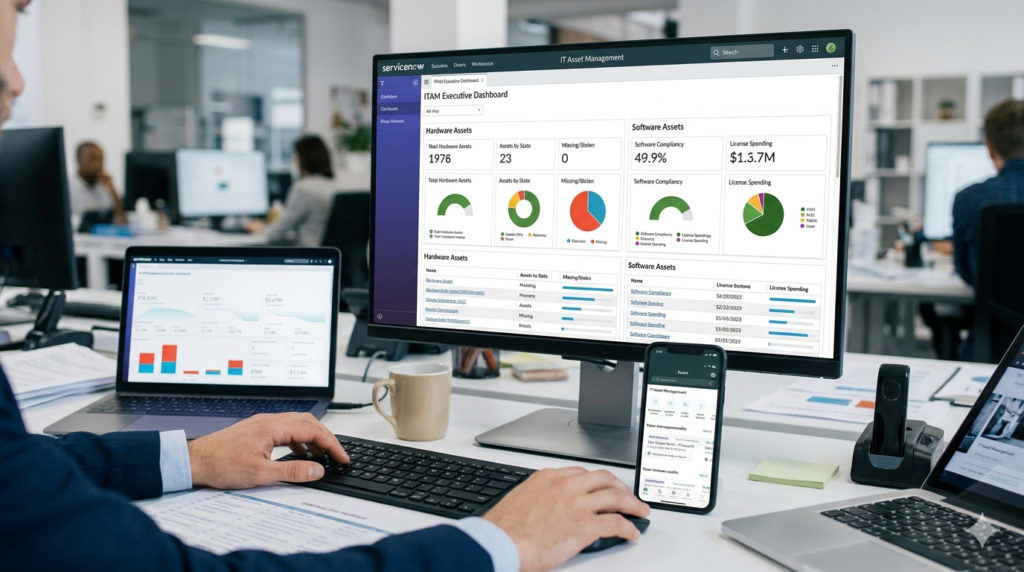
Why ITAM Matters: The Business Case for Effective Asset Management
Before diving into our interview questions, it’s crucial to understand why organizations prioritize ITAM and why employers seek professionals with these specialized skills. Companies face significant financial penalties for software license non-compliance, with some audits resulting in millions of dollars in unexpected costs. Beyond compliance, effective asset management helps organizations:
- Optimize spending by eliminating redundant licenses and identifying underutilized assets
- Enhance security through complete visibility into all hardware and software assets
- Improve decision-making with accurate asset data and comprehensive reporting
- Streamline operations by automating asset lifecycle processes
- Support strategic planning with reliable data on technology investments and utilization
Now, let’s explore the top 25 interview questions that will help you demonstrate your ServiceNow ITAM expertise.
Foundational ITAM Interview Questions (Beginner Level)
1. What is ITAM, and how does it differ from Configuration Management (CMDB)?
Answer: IT Asset Management focuses on the financial and contractual aspects of IT assets throughout their lifecycle—from procurement through disposal. ITAM tracks ownership, costs, licenses, warranties, and compliance-related information. The Configuration Management Database (CMDB), on the other hand, focuses on the technical and operational aspects, tracking configuration items (CIs), their relationships, and dependencies for service delivery and incident management.
In ServiceNow, these two disciplines are complementary and integrated. ITAM data feeds into the CMDB to provide a complete picture—ITAM answers “What do we own, what does it cost, and are we compliant?” while CMDB answers “What do we have, how is it configured, and how does it support our services?”
Real-world example: When a company purchases 100 Microsoft Office licenses, ITAM tracks the purchase order, contract terms, cost per license, and compliance status. The CMDB tracks which specific computers have Office installed, which versions are running, and how those computers support business services.
2. What are the core modules within ServiceNow ITAM?
Answer: ServiceNow ITAM consists of several interconnected modules:
- Hardware Asset Management (HAM): Manages physical assets like servers, computers, mobile devices, and networking equipment
- Software Asset Management (SAM): Tracks software installations, licenses, and compliance
- Contract Management: Handles vendor contracts, renewals, and service level agreements
- License Management: Specifically manages software license rights, allocations, and compliance positions
- Asset Repository: Central database storing all asset information
- Procurement: Manages the asset acquisition process
- Expense Lines: Tracks costs associated with assets throughout their lifecycle
These modules work together to provide comprehensive asset visibility and management capabilities within the ServiceNow platform.
3. Explain the asset lifecycle in ServiceNow ITAM.
Answer: The asset lifecycle in ServiceNow follows these stages:
- Request/Requisition: Asset need is identified and requested
- Procurement: Purchase order is created and asset is ordered
- Receiving: Physical receipt and initial data entry
- In Stock: Asset is in inventory awaiting deployment
- Deployed: Asset is assigned to a user or location and in active use
- In Maintenance: Asset undergoes repairs or maintenance
- Retired: Asset is removed from service
- Disposed: Asset is physically disposed of through approved channels
ServiceNow automates transitions between these states and triggers workflows at each stage, such as automatically creating CIs when assets move to “Deployed” status or initiating disposal workflows when assets reach end-of-life.
Best practice: Organizations should establish clear criteria for each lifecycle transition and automate notification and approval workflows to maintain asset data accuracy.
4. What is the difference between an asset model and an asset in ServiceNow?
Answer: An asset model (stored in the Product Model table – cmdb_model) represents the manufacturer’s product specification—essentially the “template” for a type of asset. It includes information like manufacturer, model number, specifications, and default warranty terms.
An asset (stored in the Asset table – alm_asset) represents a specific individual instance of that model that the organization owns. It includes unique details like serial number, purchase date, assigned user, location, and cost.
Example: The “Dell Latitude 7420” is an asset model. The specific laptop with serial number “ABC123” that was purchased on January 15, 2023, for $1,500 and assigned to John Smith is an asset.
This relationship allows for efficient data management—common specifications are stored once at the model level, while unique information is stored at the individual asset level.
5. How does ServiceNow discover assets automatically?
Answer: ServiceNow employs multiple discovery methods:
- ServiceNow Discovery: Agentless tool that scans the network to identify devices, their configurations, and installed software
- Service Mapping: Discovers application dependencies and service relationships
- Integration with third-party tools: Connects with specialized discovery tools like Microsoft SCCM, Flexera, or Snow
- Cloud Management: Discovers cloud-based assets from AWS, Azure, and other cloud platforms
- Agent-based discovery: Uses lightweight agents installed on endpoints for comprehensive software inventory
Discovered information automatically populates the CMDB and creates/updates asset records, providing near real-time visibility into the IT environment. This automated discovery is fundamental to maintaining accurate asset data without manual intervention.
Intermediate ITAM Interview Questions
6. Explain software license compliance and how ServiceNow calculates it.
Answer: Software license compliance ensures an organization’s software usage doesn’t exceed purchased license entitlements. Non-compliance can result in substantial financial penalties, legal issues, and reputational damage.
ServiceNow calculates compliance through these steps:
- License Rights: Counts purchased/entitled licenses from contracts and purchase orders
- License Allocation: Tracks how licenses are assigned or consumed
- Software Installations: Discovers actual software installations across the environment
- Reconciliation: Compares installations against rights using reconciliation rules
- Compliance Position: Calculates whether the organization is compliant, over-deployed, or has unused licenses
The compliance calculation considers different licensing models (per-device, per-user, concurrent, processor-based, etc.) and applies the appropriate counting methodology.
Real-world scenario: If a company purchases 500 Adobe Acrobat licenses but discovery shows 650 installations, ServiceNow flags a -150 compliance position, alerting the team to either purchase additional licenses or remove unauthorized installations before an audit.
7. What are normalization and reconciliation in SAM?
Answer: Normalization is the process of standardizing discovered software names into recognized, consistent product names. Discovery tools often find varied names for the same software (e.g., “Adobe Acrobat DC,” “Acrobat Reader DC,” “Adobe Acrobat Pro”). Normalization maps these variants to a single authoritative product name using normalization rules and publisher data.
Reconciliation compares normalized software installations against purchased license entitlements to determine compliance positions. It matches installations to licenses using defined rules that understand different licensing metrics and models.
ServiceNow provides both out-of-box normalization data (covering thousands of publishers and products) and allows custom rules for proprietary or niche software.
Best practice: Regularly review and refine normalization rules, especially after major discovery runs, to ensure accurate compliance calculations. Incorrect normalization can lead to false compliance alerts or missed violations.
8. How do you handle software license models in ServiceNow?
Answer: ServiceNow supports various software licensing models:
- Named User: License tied to a specific individual
- Concurrent User: License for a specific number of simultaneous users
- Device/Node Locked: License tied to specific hardware
- Processor-based: License based on CPU count or cores
- Capacity-based: License based on storage, transactions, or other metrics
- Enterprise Agreement: Organization-wide licenses with specific terms
Each model requires different configuration:
- Define the license model on the software model record
- Configure appropriate reconciliation rules
- Set up compliance calculations specific to that licensing type
- Create allocation rules if applicable
Example: For concurrent licenses, ServiceNow needs to track peak simultaneous usage rather than total installations. This requires integration with software metering tools or usage analytics to accurately measure compliance.
9. Explain the relationship between contracts and assets in ServiceNow.
Answer: Contracts and assets have a many-to-many relationship in ServiceNow. A single contract can cover multiple assets, and an asset may be governed by multiple contracts (e.g., hardware warranty, software license, maintenance agreement).
Key relationship aspects:
- Contract lines: Detail specific products or services within a contract
- Asset association: Links individual assets to relevant contract lines
- License rights: Contracts create license entitlements that govern software compliance
- Financial tracking: Contract costs flow to associated assets
- Renewal management: Contract expiration triggers workflows for asset-related decisions
ServiceNow automatically associates assets to contracts based on rules, purchase orders, or manual assignment, ensuring proper tracking of warranties, support agreements, and license terms.
Practical application: When a server’s warranty contract approaches expiration, ServiceNow can automatically create a task to review renewal options, generate cost analysis comparing renewal versus replacement, and route approvals based on asset value and criticality.
10. What are asset models and how do they support ITAM processes?
Answer: Asset models serve as templates that standardize asset data and streamline asset management. Beyond basic product information, models in ServiceNow support:
- Default values: Pre-populate fields like warranty length, depreciation schedules, and asset categories
- Financial data: Standard costs, useful life, and residual value
- Compliance tracking: Associated software licenses and compliance requirements
- Workflow automation: Trigger specific processes based on model type
- Reporting accuracy: Enable meaningful aggregation and analysis
Well-maintained model data dramatically improves data quality and reduces manual entry errors when creating new asset records.
Best practice: Establish a governed process for creating new models, including required approval and data validation. Implement a regular review cycle to update models as products evolve or are discontinued.

Advanced ITAM Interview Questions
11. How would you implement a complete SAM process for Microsoft products in ServiceNow?
Answer: Implementing Microsoft SAM requires a comprehensive approach:
Phase 1: Discovery and Data Collection
- Deploy Discovery to identify all Microsoft installations
- Configure Microsoft-specific discovery patterns for Office, Windows Server, SQL Server, etc.
- Integrate with Microsoft Configuration Manager (SCCM) if available
- Set up cloud discovery for Office 365 and Azure services
Phase 2: Normalization
- Leverage ServiceNow’s Microsoft normalization library
- Create custom rules for any unique Microsoft deployments
- Map all discovered variants to authoritative Microsoft product names
Phase 3: License Management
- Import all Microsoft agreements (Enterprise Agreements, CSP, Volume Licensing)
- Configure license rights for each product and licensing program
- Set up appropriate license models (user, device, subscription, etc.)
- Configure downgrade rights and Software Assurance benefits
Phase 4: Reconciliation
- Create reconciliation rules matching Microsoft’s licensing terms
- Account for virtualization rights and density licensing
- Configure compliance calculations for complex products like SQL Server
- Set up regular reconciliation schedules
Phase 5: Optimization
- Implement license harvesting workflows for departing employees
- Create reports identifying underutilized licenses
- Establish true-up processes for Enterprise Agreements
- Build dashboards showing compliance positions and optimization opportunities
Real-world challenge: Microsoft’s complex licensing rules (especially for virtualization and cloud hybrid scenarios) require deep understanding of licensing terms. Organizations should consider Microsoft SAM certification for their ITAM team and potentially engage specialized consultants for initial implementation.
12. Describe how to configure and optimize the software reconciliation engine.
Answer: The reconciliation engine compares discovered installations against license entitlements. Optimization involves:
Configuration:
- Reconciliation rules: Define how installations match to licenses (user-based, device-based, etc.)
- Matching criteria: Set conditions for installation-to-license associations
- Exclusions: Configure legitimate installations that shouldn’t count (developer licenses, virtual appliances)
- Scheduling: Set appropriate reconciliation frequency balancing accuracy and system performance
Optimization strategies:
- Incremental processing: Process only changed data rather than full reconciliation
- Prioritization: Reconcile high-risk/high-value software more frequently
- Performance tuning: Adjust batch sizes and processing windows
- Rule refinement: Continuously improve rules based on false positives/negatives
Best practice: Start with out-of-box rules for common software, then progressively customize based on your organization’s specific licensing agreements. Document all custom rules thoroughly for audit purposes.
Example: A global organization might reconcile critical enterprise software (Oracle, SAP) daily, standard applications weekly, and low-risk software monthly, optimizing both accuracy and system performance.
13. How do you manage software assets in virtual and cloud environments?
Answer: Virtual and cloud environments present unique ITAM challenges:
Virtual Environment Management:
- Configure discovery to identify hypervisors and virtual machines
- Track VM lifecycle (creation, movement, deletion)
- Apply appropriate licensing rules (processor-based, VM-specific)
- Monitor VM sprawl and orphaned instances
- Account for high availability and disaster recovery configurations
Cloud Asset Management:
- Integrate with cloud provider APIs (AWS, Azure, GCP)
- Implement automated discovery of cloud resources
- Track cloud subscriptions and consumption-based licensing
- Monitor SaaS applications and user entitlements
- Establish cloud cost allocation and chargeback processes
Key considerations:
- Many vendors have specific licensing rules for virtual environments
- Cloud resources require near real-time discovery due to rapid provisioning
- FinOps integration helps optimize cloud spending
- Shadow IT detection becomes critical for SaaS proliferation
Implementation approach: Use ServiceNow’s Cloud Management plugins alongside ITAM to provide comprehensive visibility. Implement tagging strategies for cloud resources to enable accurate cost allocation and governance.
14. What strategies would you employ for managing software license optimization?
Answer: License optimization balances compliance with cost efficiency:
Harvesting and Reallocation:
- Implement automated workflows to reclaim licenses from departing employees
- Identify inactive installations for removal
- Establish a license pool for reallocation
- Create self-service request processes for license assignment
Right-sizing:
- Analyze actual usage versus licensed capacity
- Identify users with premium licenses who only need basic functionality
- Downgrade over-licensed users when appropriate
- Negotiate with vendors for more appropriate licensing models
Compliance-driven optimization:
- Eliminate over-deployment to avoid audit exposure
- Consolidate vendors to improve negotiating leverage
- Identify maintenance on unused software for cancellation
- Implement software approval workflows to prevent unnecessary purchases
Analytics and reporting:
- Build executive dashboards showing license utilization
- Create alerts for compliance risks and optimization opportunities
- Develop business cases for licensing model changes
- Track optimization savings and ROI
Real-world example: A financial services company used ServiceNow to discover that 40% of their Adobe Creative Cloud licenses were inactive for over 90 days. By implementing a harvesting workflow and moving to a smaller license pool with checkout/check-in processes, they reduced annual Adobe costs by $180,000 while maintaining user satisfaction.
15. How do you handle software audit defense using ServiceNow ITAM?
Answer: ServiceNow ITAM provides critical capabilities for audit defense:
Preparation:
- Maintain continuous compliance monitoring (don’t wait for audit notices)
- Ensure discovery runs comprehensively across all environments
- Document reconciliation methodologies and assumptions
- Create audit-ready reports showing compliance positions
- Maintain historical data demonstrating ongoing compliance efforts
Audit Response:
- Quickly generate installation and license reports
- Provide evidence of license purchases (contracts, POs, invoices)
- Document license allocation and usage policies
- Show normalization and reconciliation rules
- Demonstrate good-faith compliance management
Documentation:
- Export audit trail of asset and license changes
- Provide proof of license compliance at audit notification date
- Show remediation actions for any compliance gaps
- Document license management processes and controls
Best practices:
- Conduct internal self-audits using the same methodologies vendors use
- Address compliance gaps immediately
- Maintain relationships with software vendors
- Consider SAM tool certification from major publishers (Oracle, IBM, SAP)
- Document everything—ServiceNow’s audit logging capabilities are invaluable
Scenario: When a major software publisher sends an audit notice, organizations with mature ServiceNow ITAM implementations can typically respond within days with comprehensive compliance documentation, often resulting in minimal audit findings and avoiding costly settlements.
16. Explain integration patterns between ITAM and other ServiceNow applications.
Answer: ITAM integrates deeply with other ServiceNow modules:
CMDB Integration:
- Assets automatically create CIs when deployed
- CI relationships inform asset dependencies
- Service mapping shows asset business impact
- Asset data enhances CMDB accuracy
ITSM Integration:
- Incident management accesses asset information
- Problem management identifies assets with recurring issues
- Change management validates changes against asset data
- Request management facilitates asset provisioning
Procurement/Financial Management:
- Purchase orders create asset records
- Cost tracking from procurement through disposal
- Depreciation schedules update financial records
- Expense lines track total cost of ownership
Risk and Compliance:
- Vulnerable software identification
- Compliance violation tracking
- Risk scoring based on asset criticality
- Policy compliance monitoring
Implementation approach: Use ServiceNow’s out-of-box integration points and data models to maintain consistency. Customize integrations carefully, ensuring changes don’t break upgrade paths.
Example workflow: A security vulnerability is discovered in a specific software version. ServiceNow automatically identifies all assets with that software, creates risk records, generates incidents for remediation, tracks patching through change management, and validates compliance through subsequent discovery runs—all within integrated workflows.
17. How do you approach ITAM for mobile devices and BYOD environments?
Answer: Mobile and BYOD asset management requires specialized approaches:
Mobile Device Management (MDM) Integration:
- Integrate ServiceNow with MDM platforms (Intune, AirWatch, MobileIron)
- Automatically import mobile device inventory
- Track mobile applications and licenses
- Monitor device compliance with corporate policies
BYOD Considerations:
- Distinguish between corporate-owned and personal devices
- Track only corporate data/applications on personal devices
- Manage corporate software licenses on BYOD devices
- Implement appropriate disposal/offboarding processes
Key challenges:
- Higher asset turnover rates than traditional hardware
- Multiple device types and operating systems
- Carrier contracts and data plans
- Application licensing across platforms
Governance framework:
- Define BYOD policies clearly in ServiceNow
- Implement approval workflows for device purchases
- Track cellular contracts and costs separately
- Create dashboards showing mobile asset costs and trends
Best practice: Establish clear data classification policies that dictate which device types can access specific data categories, enforcing these policies through integrated MDM and ITAM processes.
18. What are the key metrics and KPIs for measuring ITAM program effectiveness?
Answer: Effective ITAM programs track multiple categories of metrics:
Financial Metrics:
- Software license cost avoidance/savings
- Hardware total cost of ownership
- License optimization savings
- Avoided audit penalties
- Contract savings from negotiation leverage
Compliance Metrics:
- Software compliance percentage
- Number of compliance violations
- Time to remediation for violations
- License utilization rates
- Audit readiness score
Operational Metrics:
- Asset data accuracy
- Time to provision new assets
- Asset lifecycle stage distribution
- Discovery coverage percentage
- Retired asset processing time
Process Metrics:
- ITAM process maturity scores
- User satisfaction with asset services
- Automation percentage
- Data quality scores
- Integration completeness
Dashboard implementation: Create executive dashboards focusing on financial impact, compliance dashboards for risk management, and operational dashboards for ITAM teams. Use ServiceNow’s Performance Analytics for trending and predictive analytics.
Example: An organization might set a KPI to maintain 95% software compliance, reduce software costs by 15% annually through optimization, and achieve 90% asset data accuracy—all measurable through ServiceNow reporting.
19. How would you design a hardware asset refresh program in ServiceNow?
Answer: A comprehensive refresh program involves:
Planning Phase:
- Identify assets approaching end-of-life based on age, warranty expiration, or condition
- Calculate total cost of ownership for current assets
- Develop replacement budget projections
- Prioritize replacements based on business criticality and condition
Automation:
- Create scheduled jobs identifying refresh candidates
- Automatically generate replacement requests
- Route approvals based on cost thresholds
- Trigger procurement workflows
Execution:
- Track new asset orders and delivery
- Schedule deployment and user communications
- Manage data migration and user setup
- Process old asset retirement and disposal
Financial tracking:
- Calculate disposal value for old assets
- Track refresh program costs
- Measure cost avoidance from preventive replacement
- Report on refresh program ROI
Workflow example:
- ServiceNow identifies laptops over 4 years old
- System creates refresh candidates with business case data
- Department managers review and approve replacements
- Approved items flow to procurement
- Received assets trigger deployment workflows
- Deployed assets prompt old asset retirement
- Retired assets enter secure disposal process
Best practice: Implement predictive analytics to identify assets likely to fail before they do, enabling proactive replacement and minimizing business disruption.
20. Describe your approach to ITAM data quality management.
Answer: Data quality is fundamental to ITAM effectiveness:
Data Quality Framework:
- Accuracy: Data correctly represents reality
- Completeness: All required fields contain values
- Consistency: Data aligns across integrated systems
- Timeliness: Data is current and updated appropriately
- Validity: Data conforms to defined formats and rules
Implementation strategies:
- Automated discovery: Reduces manual entry errors
- Data validation rules: Prevent invalid data entry
- Mandatory fields: Ensure critical information is captured
- Regular audits: Identify and remediate data quality issues
- Integration integrity: Maintain consistency across connected systems
Quality metrics:
- Percentage of assets with complete data
- Discovery accuracy rates
- Reconciliation confidence scores
- User-reported data issues
- Asset data age distribution
Governance:
- Assign data stewards for asset domains
- Implement data quality scorecards
- Create remediation workflows for quality issues
- Train users on data quality importance
- Review data quality metrics in regular governance meetings
Example: Implement automated validation that flags assets over $5,000 missing contract information, automatically creating tasks for ITAM analysts to research and update, ensuring critical financial information remains complete.
Scenario-Based ITAM Interview Questions
21. Your organization is planning a merger/acquisition. How would you approach ITAM for the combined entity?
Answer: M&A scenarios present complex ITAM challenges requiring strategic planning:
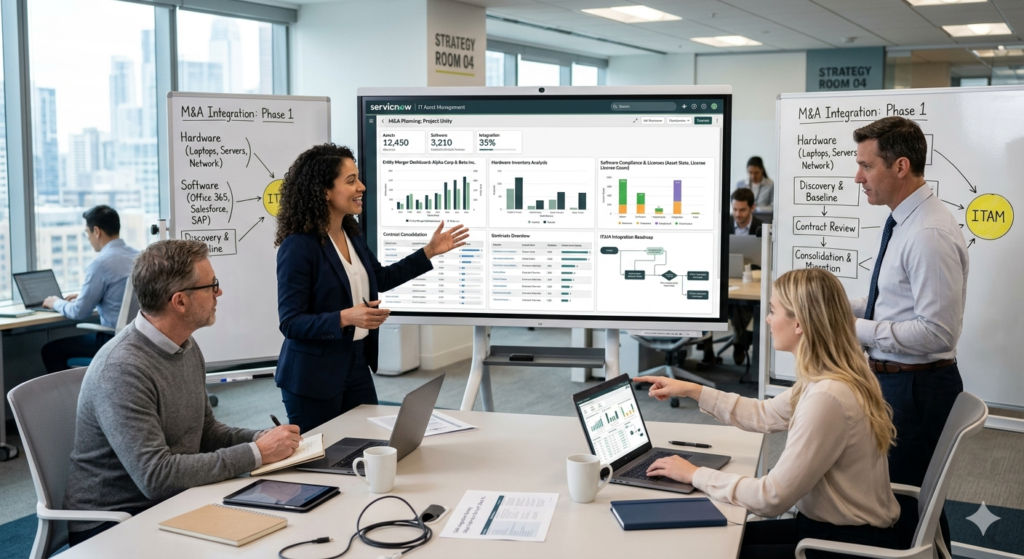
Pre-merger assessment:
- Conduct asset inventory of target organization
- Identify software licensing models and contracts
- Assess license transferability and assignment rights
- Evaluate ITAM process maturity
- Calculate integration costs and risks
Due diligence:
- Review software compliance positions (potential liabilities)
- Identify shadow IT and unsanctioned software
- Assess contract obligations and termination clauses
- Evaluate hardware refresh needs
- Identify consolidation opportunities
Integration planning:
- Develop asset data migration strategy
- Plan license consolidation and optimization
- Negotiate with vendors for combined agreements
- Standardize on asset models and categories
- Create unified ITAM processes
Execution:
- Import acquired company’s asset data
- Reconcile duplicate software licenses
- Implement unified discovery across combined infrastructure
- Consolidate vendor relationships
- Standardize asset lifecycle processes
Post-merger optimization:
- Identify redundant licenses for elimination
- Negotiate enterprise agreements for combined entity
- Implement unified ITAM governance
- Train staff on standardized processes
- Track integration savings
Real-world challenge: Software contracts often have change-of-control clauses that can void pricing or require renegotiation. Early engagement with strategic vendors can preserve favorable terms or create leverage for improved agreements.
22. How would you address a situation where discovery shows significant software over-deployment right before a vendor audit?
Answer: This crisis scenario requires immediate, structured response:
Immediate actions (Days 1-3):
- Validate discovery accuracy—verify it’s not false positives
- Quantify the compliance gap precisely
- Assess financial exposure from over-deployment
- Freeze new installations of affected software
- Engage executive leadership and legal team
Investigation (Days 3-7):
- Identify root causes (shadow IT, lack of controls, license miscounting)
- Review licensing agreement terms for remediation options
- Determine if installation rights versus usage rights matter
- Identify genuinely unused installations for removal
- Consider if downgrade rights or bundled licenses apply
Remediation (Days 7-30):
- Uninstall software from users who don’t require it
- Implement license checkout workflow if supported
- Purchase additional licenses if necessary
- Document remediation actions with evidence
- Implement controls to prevent recurrence
Vendor engagement:
- Consider proactive disclosure with remediation plan
- Negotiate settlement if over-deployment remains
- Request audit delay to complete remediation
- Provide evidence of good-faith compliance efforts
- Discuss alternative licensing models
Long-term prevention:
- Implement software approval workflows
- Create automated compliance monitoring
- Establish regular self-audits
- Provide user training on license compliance
- Implement technical controls preventing unauthorized installation
Key principle: Demonstrating active compliance management and good-faith efforts typically results in better audit outcomes than attempting to hide or minimize issues.
23. Design an ITAM strategy for a company transitioning from capital expenditure to cloud-based operational expenditure models.
Answer: The shift to OpEx cloud models fundamentally changes ITAM approaches:
Traditional ITAM challenges:
- Tracking capital assets through multi-year depreciation
- Managing perpetual software licenses
- Hardware refresh cycles
- On-premise infrastructure management
Cloud/OpEx model requirements:
- Subscription and consumption tracking
- Multi-cloud asset visibility
- SaaS license management
- Variable monthly costs
- Automated resource provisioning
Implementation strategy:
Phase 1: Hybrid visibility
- Extend discovery to cloud platforms
- Integrate with cloud provider APIs
- Implement SaaS management module
- Track hybrid licensing (on-premise + cloud)
- Create unified asset repository
Phase 2: FinOps integration
- Implement cloud cost allocation
- Create chargeback/showback mechanisms
- Track resource tagging and attribution
- Monitor optimization opportunities
- Establish cloud budget controls
Phase 3: License transformation
- Migrate perpetual to subscription licenses
- Implement license assignment automation
- Track subscription renewals
- Manage license right-sizing
- Monitor SaaS application adoption
Phase 4: Process evolution
- Shift from procurement-focused to consumption-focused workflows
- Implement continuous optimization
- Create cloud governance policies
- Automate resource lifecycle management
- Establish cloud cost anomaly detection
Metrics evolution:
- Traditional: Cost per asset, depreciation, compliance percentage
- Cloud-focused: Cost per user, utilization rates, cloud waste, subscription optimization
Example: An organization might implement ServiceNow’s SaaS License Management alongside traditional ITAM, creating workflows that automatically provision cloud licenses, monitor usage, and reclaim inactive licenses—treating licenses as dynamic resources rather than static purchases.
24. How would you build an ITAM business case to secure executive support and funding?
Answer: Effective ITAM business cases connect asset management to business outcomes:
Financial justification:
- Cost avoidance: License optimization savings (typically 15-30% of software spend)
- Audit protection: Avoided penalties from compliance violations
- Negotiation leverage: Better vendor agreements from accurate data
- Reduced waste: Elimination of unused assets and licenses
- Operational efficiency: Reduced manual processes through automation
Quantification approach:
- Calculate current state costs (labor, tools, compliance risks)
- Estimate software optimization potential (benchmark 20-25% savings)
- Project audit risk exposure (industry average settlement costs)
- Calculate operational efficiency gains (time saved through automation)
- Subtract implementation and operating costs
- Project 3-year ROI and payback period
Risk mitigation value:
- Compliance risk reduction
- Security vulnerability visibility
- Audit readiness
- Shadow IT elimination
- License position certainty
Strategic alignment:
- Support digital transformation initiatives
- Enable cloud migration strategies
- Improve IT service delivery
- Enhance vendor management
- Provide data for strategic planning
Presentation approach:
- Executive summary with bottom-line impact
- Current state pain points with business impact
- Proposed solution and implementation approach
- Financial analysis with conservative assumptions
- Risk analysis (implementation and status quo)
- Quick wins demonstrating early value
Example business case: “Current software audit risk exposure: $2.5M. Annual software waste from unused licenses: $800K. ITAM implementation cost: $500K. Year one savings: $1.2M. Three-year ROI: 340%. Payback period: 5 months.”
25. Describe how you would mature an organization’s ITAM capabilities from reactive to proactive/optimized.
Answer: ITAM maturity progression follows defined stages:
Level 1: Reactive (Current state for many organizations)
- Characteristics: Asset management only during emergencies, incomplete inventory, manual processes
- Challenges: Audit exposure, budget overruns, compliance uncertainty
- First steps: Implement basic discovery, centralize asset data in ServiceNow, establish baseline inventory
Level 2: Aware
- Goals: Complete asset visibility, basic process definition
- Implementation: Deploy comprehensive discovery, create asset lifecycle workflows, implement contract management
- Timeline: 3-6 months
- Metrics: Inventory accuracy >85%, discovery coverage >90%
Level 3: Defined
- Goals: Standardized processes, automated workflows, compliance monitoring
- Implementation: Establish reconciliation processes, implement software compliance monitoring, create standard operating procedures
- Timeline: 6-12 months
- Metrics: Software compliance >95%, process documentation complete, automated workflows for common tasks
Level 4: Managed
- Goals: Proactive management, optimization focus, predictive capabilities
- Implementation: Implement license optimization programs, create predictive analytics, establish governance frameworks
- Timeline: 12-18 months
- Metrics: 20%+ cost optimization, proactive compliance management, executive reporting
Level 5: Optimized
- Goals: Continuous improvement, strategic asset management, business value delivery
- Implementation: AI/ML for optimization recommendations, integrated FinOps, strategic vendor management
- Timeline: 18-24 months
- Metrics: Industry-leading efficiency, strategic business partner status, innovation driver
Progression strategy:
- Assess current maturity level honestly
- Set realistic improvement targets
- Secure executive sponsorship
- Celebrate and communicate wins
- Continuously refine processes
- Invest in team capability development
Success factors: Executive support, adequate resources, change management, tool capabilities, skilled team, and sustained organizational commitment.
ITAM Best Practices and Implementation Tips
Establishing Strong ITAM Governance
Effective asset management requires clear governance structures. Establish an ITAM steering committee with representatives from IT, finance, procurement, legal, and security. Define clear roles and responsibilities—who owns asset data, who approves purchases, who manages compliance.
Create comprehensive ITAM policies covering acceptable use, software installation approval, asset disposal, and compliance requirements. Document these policies in ServiceNow’s knowledge base for easy reference and ensure all employees receive appropriate training.
Maintaining Data Quality
Asset data quality determines ITAM program effectiveness. Implement automated discovery as your primary data source, supplemented by integration with procurement, HR, and facilities systems. Configure validation rules preventing incomplete or invalid data entry.
Schedule regular data quality audits, assign data stewards to remediate issues, and create metrics tracking data completeness and accuracy. Remember: garbage in, garbage out—poor data quality undermines all ITAM processes.
Optimizing License Compliance
Don’t wait for vendor audits to address compliance. Implement continuous compliance monitoring with automated alerts for violations. Conduct quarterly self-audits using vendor-recommended methodologies.
For high-risk publishers (Oracle, IBM, SAP, Microsoft), consider engaging specialized SAM consultants to validate your compliance positions. Document your compliance processes thoroughly—demonstrating good-faith management efforts improves audit outcomes significantly.
Automation and Efficiency
Leverage ServiceNow’s workflow capabilities to automate repetitive tasks: asset provisioning, license assignment, compliance checking, contract renewal notifications, and disposal processes. Automation reduces errors, improves consistency, and allows staff to focus on strategic activities.
Create self-service capabilities where appropriate—enable users to request software through the service catalog, with automated approval routing and license provisioning. This improves user experience while maintaining governance.
Integration Strategy
ITAM doesn’t operate in isolation. Integrate with procurement for purchase order flow, HR for employee onboarding/offboarding, facilities for location tracking, and security for vulnerability management. Each integration enhances data accuracy and process efficiency.
Use ServiceNow’s Integration Hub or REST APIs for connections to external systems. Document all integrations and establish monitoring to detect failures quickly.
Preparing for Your ITAM Interview: Final Tips
Technical Preparation
- Hands-on experience: If possible, access a ServiceNow instance (personal developer instance is free) and practice ITAM configurations
- Documentation review: Study ServiceNow ITAM documentation and release notes for latest capabilities
- Certification: Consider pursuing ServiceNow Certified Implementation Specialist – ITAM credential
- Industry knowledge: Understand major software vendor licensing programs and common compliance issues
Behavioral Preparation
ITAM roles require both technical expertise and business acumen. Prepare examples demonstrating:
- Problem-solving in complex compliance situations
- Stakeholder management and communication
- Project management and implementation experience
- Process improvement and optimization initiatives
- Change management in process transformation
Questions to Ask Interviewers
Demonstrate your expertise by asking insightful questions:
- “What ITAM maturity level is the organization currently at, and where do you want to be?”
- “What are your biggest ITAM challenges—compliance, optimization, or data quality?”
- “How is ITAM integrated with other IT service management processes?”
- “What software publishers represent the highest risk or cost?”
- “What does success look like for this role in the first 90 days?”
Conclusion: Mastering ITAM for Career Success
IT Asset Management has evolved from a back-office compliance function to a strategic capability delivering substantial business value. Organizations leveraging ServiceNow for ITAM gain unprecedented visibility into their technology assets, optimize spending, ensure compliance, and make data-driven decisions about technology investments.
For IT professionals, ITAM expertise opens doors to rewarding career opportunities. The questions and answers in this guide provide a comprehensive foundation for interview success, whether you’re pursuing roles as an ITAM analyst, SAM specialist, ServiceNow consultant, or IT asset manager.
Remember that successful ITAM professionals combine technical platform knowledge with business acumen, understanding not just how ServiceNow works, but why asset management matters to organizational success. They communicate effectively with both technical teams and business stakeholders, translating asset data into actionable insights and strategic recommendations.
About RizeX Labs
RizeX Labs is a leading ServiceNow implementation and training partner, helping organizations maximize their technology investments and professionals advance their careers. Our team of certified experts brings decades of combined experience in IT Service Management, IT Asset Management, and ServiceNow platform optimization.
Whether you’re an individual seeking to enhance your skills or an organization looking to implement or optimize ServiceNow ITAM, RizeX Labs provides the expertise, training, and support you need for success.
Connect with us:
- Website: Contact RizeX Labs for expert guidance
- Training Programs
- Blog: Read more ServiceNow insights and best practices
Have questions about ServiceNow ITAM that weren’t covered here? Leave a comment below or contact our team directly. We’re committed to supporting your ITAM journey every step of the way.
Quick Summary
This comprehensive guide explores the top 25 ITAM interview questions for ServiceNow professionals, covering foundational concepts through advanced implementation scenarios. ITAM (IT Asset Management) combines financial, contractual, and operational oversight of technology assets, delivering 25-30% cost savings and significant compliance risk reduction when properly implemented in ServiceNow. The questions progress from basic concepts (asset lifecycle, modules, discovery) through intermediate topics (license compliance, reconciliation, virtual environments) to advanced scenarios (mergers/acquisitions, audit defense, maturity progression). Key success factors include strong data quality management, comprehensive discovery coverage, automated compliance monitoring, and integration with procurement, finance, and ITSM processes. ServiceNow ITAM professionals are in high demand with competitive salaries ($60K-$160K+ depending on experience), making certification and hands-on experience valuable career investments. The guide emphasizes practical application, real-world scenarios, and best practices essential for both interview success and effective ITAM program implementation.
