Revenue operations have evolved far beyond basic CRM tracking and spreadsheet forecasting. Today’s revenue leaders face unprecedented complexity: configuring thousands of product SKUs, managing dynamic pricing across multiple markets, forecasting with accuracy in volatile conditions, and ensuring compliance across intricate billing cycles.
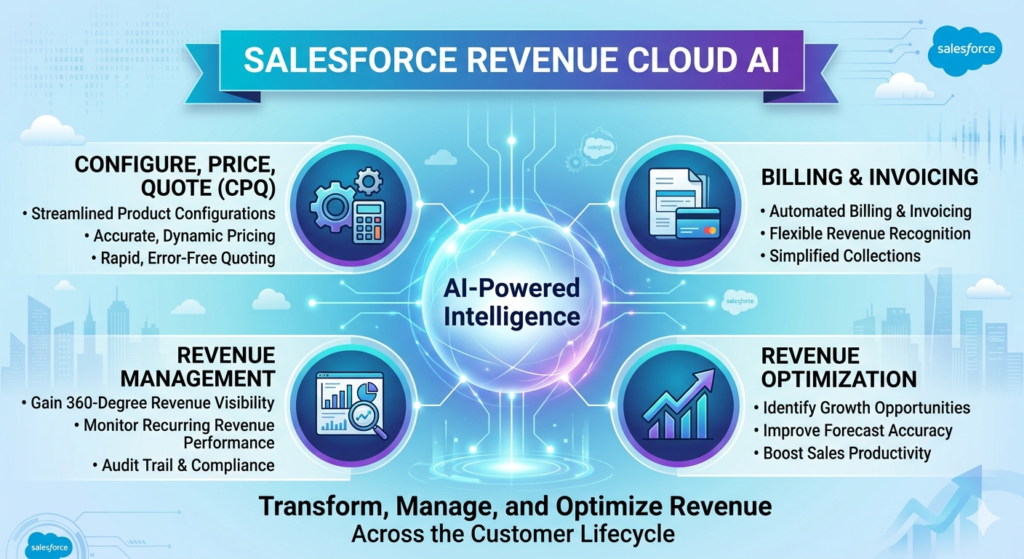
Enter Salesforce Revenue Cloud AI—a game-changing combination of Configure, Price, Quote (CPQ), Billing, and artificial intelligence that transforms how businesses generate, manage, and optimize revenue.
Salesforce Revenue Cloud, powered by Einstein AI, doesn’t just automate workflows—it learns from your data, predicts outcomes, recommends optimal actions, and continuously improves revenue performance. For organizations managing complex B2B sales cycles, subscription models, or usage-based pricing, AI in Revenue Cloud represents the difference between reactive revenue management and proactive revenue intelligence.
This comprehensive guide explores how Einstein AI use cases apply specifically to Revenue Cloud, covering predictive scoring, intelligent pricing optimization, forecasting accuracy, automated recommendations, and billing insights. We’ll examine real-world implementations across industries and provide actionable steps to deploy AI in your revenue operations.
Whether you’re a Salesforce administrator, RevOps leader, or business decision-maker evaluating Salesforce automation capabilities, this article delivers practical insights you can implement immediately.
Understanding Salesforce Einstein: The AI Engine Behind Revenue Cloud
What Is Salesforce Einstein?
Salesforce Einstein is the integrated artificial intelligence layer built directly into the Salesforce platform. Rather than requiring separate AI tools or data exports, Einstein operates natively within your Salesforce environment, analyzing your CRM data, transaction history, customer behaviors, and market patterns to deliver actionable intelligence.
For Revenue Cloud specifically, Einstein provides:
- Predictive analytics that forecast deal outcomes, renewal probabilities, and revenue trends
- Prescriptive recommendations that guide sales teams toward optimal configurations and pricing
- Automated workflows that reduce manual tasks and accelerate quote-to-cash cycles
- Anomaly detection that identifies billing irregularities, revenue leakage, and compliance risks
- Natural language processing for conversational analytics and voice-activated insights
Why AI Matters in Revenue Operations
Traditional revenue management relies heavily on historical data and human judgment. While experience matters, it introduces variables:
- Inconsistent pricing across sales representatives and regions
- Forecast inaccuracy based on gut feelings rather than data patterns
- Missed opportunities because reps can’t identify optimal upsell moments
- Revenue leakage from manual billing errors and contract compliance gaps
- Slow quote cycles due to complex configuration processes
AI in CPQ and broader Revenue Cloud eliminates these inefficiencies by:
- Learning continuously from every transaction, interaction, and outcome
- Scaling expertise across your entire sales organization
- Removing bias from pricing and forecasting decisions
- Identifying patterns invisible to human analysis
- Operating in real-time at speeds impossible for manual processes
Key AI Capabilities in Salesforce Revenue Cloud
Let’s explore the specific AI functionalities that transform Revenue Cloud from a transaction platform into a revenue intelligence system.
1. Predictive Lead and Opportunity Scoring
Einstein Opportunity Scoring analyzes historical win/loss data to assign probability scores to every opportunity in your pipeline. Rather than relying on subjective rep assessments, Einstein examines factors like:
- Engagement frequency and recency
- Deal size relative to customer profile
- Competitive presence indicators
- Buyer committee composition
- Historical conversion patterns for similar deals
- Time-in-stage velocity
Business Impact:
- Prioritized pipeline focus: Sales teams concentrate on high-probability opportunities
- Accurate forecasting: Revenue predictions based on data, not optimism
- Early risk identification: Spot deals trending downward before they stall
- Personalized coaching: Managers receive insights on why deals score low
Implementation in Revenue Cloud:
Einstein Opportunity Insights integrates directly with CPQ workflows, alerting reps when high-scoring opportunities are ready for quoting or when low-scoring deals require intervention before configuration begins.
2. Intelligent Pricing Optimization
Pricing complexity multiplies in modern B2B environments—volume discounts, regional variations, competitive positioning, customer lifetime value considerations, and margin targets all factor into optimal pricing.
Einstein Pricing Recommendations analyzes:
- Historical deal pricing and discount patterns
- Win rates at various price points
- Competitive intelligence data
- Customer segment profitability
- Product bundle performance
- Seasonal and market trend variables
Key Features:
- Dynamic discount guidance: Einstein suggests optimal discount ranges that maximize both win probability and margin
- Competitive price positioning: AI identifies when your pricing is outside competitive norms for specific product categories
- Bundle optimization: Recommends product combinations with highest attach rates and customer satisfaction
- Price floor enforcement: Flags when discounting threatens profitability thresholds
Business Impact:
- Improved win rates without sacrificing margin
- Pricing consistency across sales teams and geographies
- Reduced approval cycles when reps stay within AI-recommended parameters
- Revenue optimization through data-driven pricing strategies
3. Predictive Revenue Forecasting
Traditional forecasting relies on pipeline stages and rep-submitted predictions—a methodology notoriously prone to error. Einstein Forecasting transforms this process through:
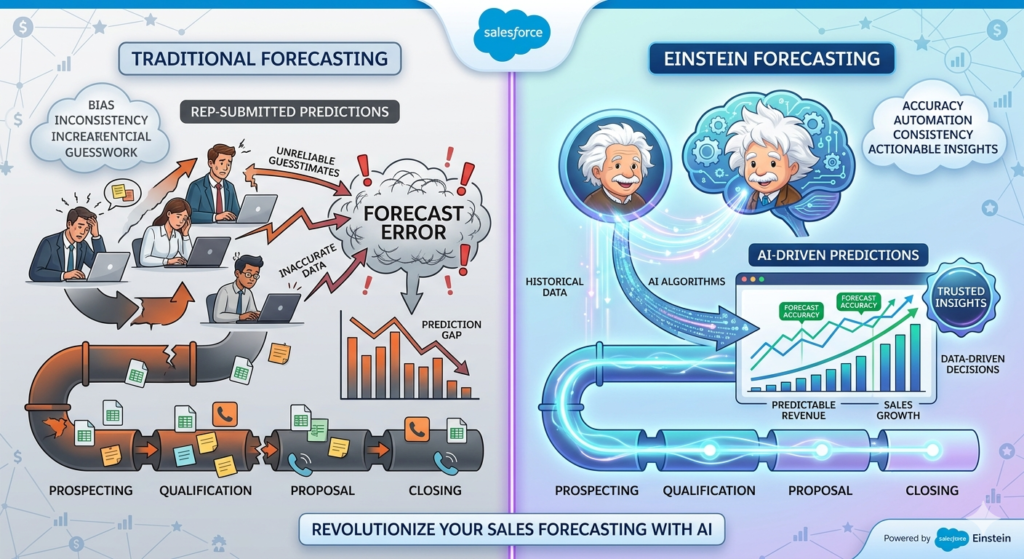
Multi-variable predictive modeling that considers:
- Historical booking patterns and seasonality
- Current pipeline health and velocity metrics
- Product-specific conversion rates
- Sales team capacity and performance trends
- Economic and market indicators
- Renewal rates and churn predictions
Automated adjustments that update forecasts as:
- Opportunities progress or regress through stages
- New data becomes available (emails, meetings, proposal sends)
- External market conditions shift
- Competitive landscapes change
Business Impact:
- Forecast accuracy improvements of 15-30% reported by Salesforce customers
- Resource planning confidence for operations, finance, and executive teams
- Risk mitigation through early identification of revenue gaps
- Strategic agility with real-time forecast updates versus monthly cycles
4. Automated Product Configuration and Recommendations
Complex product catalogs overwhelm sales teams. A technology vendor might offer hundreds of SKUs with intricate compatibility rules, compliance requirements, and optimal use case pairings.
Einstein Product Recommendations addresses this through:
Intelligent guided selling:
- Asks contextual questions about customer needs
- Filters thousands of options to relevant configurations
- Explains why specific products fit customer requirements
- Prevents invalid configurations before errors occur
Cross-sell and upsell intelligence:
- Analyzes purchase patterns to identify complementary products
- Recognizes optimal timing for expansion conversations
- Suggests bundles with highest customer satisfaction scores
- Calculates incremental revenue potential for each recommendation
Industry-specific logic:
Manufacturing companies use this for complex equipment configurations with technical dependencies. Software companies leverage it for licensing models, user tiers, and feature add-ons. Healthcare organizations apply it to medical device packages with regulatory compliance requirements.
Business Impact:
- Reduced quote errors and rework cycles
- Increased deal size through intelligent upselling
- Faster quote generation with AI-guided configuration
- Improved customer fit leading to higher satisfaction and retention
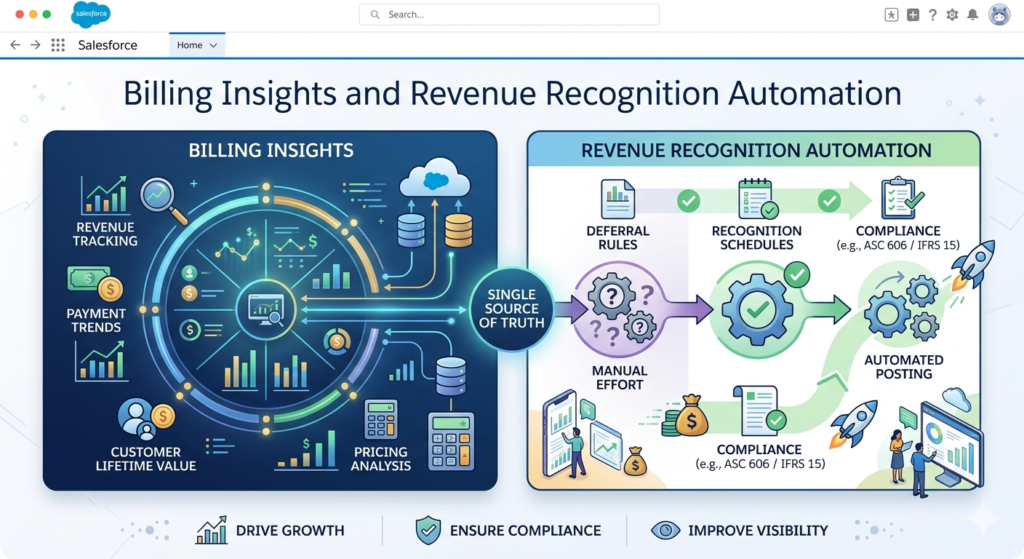
5. Billing Insights and Revenue Recognition Automation
Revenue leakage often hides in billing processes—missed usage charges, incorrect contract terms, failed payment captures, and revenue recognition errors.
Einstein Analytics for Billing provides:
Anomaly detection:
- Identifies unusual billing patterns requiring investigation
- Flags discrepancies between contracted terms and actual billing
- Detects failed payment attempts requiring follow-up
- Monitors usage-based billing for accuracy
Revenue recognition intelligence:
- Automates complex revenue recognition rules (ASC 606, IFRS 15)
- Predicts monthly recurring revenue (MRR) and annual recurring revenue (ARR) trends
- Identifies revenue acceleration or deceleration patterns
- Provides drill-down analytics on recognition timing
Renewal predictions:
- Scores renewal probability based on usage patterns, support tickets, engagement metrics
- Recommends optimal renewal pricing and terms
- Identifies at-risk subscriptions requiring proactive outreach
- Calculates customer lifetime value predictions
Business Impact:
- Reduced revenue leakage from billing errors
- Compliance confidence with automated revenue recognition
- Improved cash flow through proactive renewal management
- Customer retention via early at-risk identification
Real-World Use Cases: AI in Salesforce Revenue Cloud Across Industries
Theory matters, but implementation drives results. Here are detailed use cases showing how organizations leverage Salesforce Revenue Cloud AI to solve specific business challenges.
Use Case 1: Manufacturing – Intelligent Equipment Configuration
Company Profile: Global industrial equipment manufacturer with 5,000+ SKUs, complex engineering specifications, and regional regulatory variations.
Challenge:
Sales engineers spent 8-12 hours configuring custom equipment quotes, frequently creating invalid combinations that required engineering review and revision. Quote accuracy issues led to margin erosion, delivery delays, and customer dissatisfaction.
Einstein AI Solution:
Configuration intelligence:
- Einstein guided selling asks about application requirements (load capacity, environmental conditions, safety standards)
- AI filters compatible components based on engineering rules and physics constraints
- System prevents invalid configurations (incompatible voltage requirements, weight distribution issues)
- Recommends optimal configurations based on similar successful deployments
Pricing optimization:
- Einstein analyzes historical deal data to recommend competitive pricing for specific configuration types
- Dynamic pricing adjusts based on current material costs, production capacity, and competitive landscape
- AI identifies when custom requests justify premium pricing versus standard discounting
Results:
- Quote time reduced from 10 hours to 90 minutes
- Configuration errors decreased 87%
- Average deal size increased 23% through intelligent upselling
- Win rates improved 18% with optimized pricing
Revenue Cloud Components Used: CPQ with Einstein Product Recommendations, Einstein Pricing, CPQ Configuration Rules
Use Case 2: SaaS Technology – Predictive Renewal Management
Company Profile: Enterprise software provider with $200M ARR, 3,500 customers, complex multi-year subscription agreements.
Challenge:
Renewal rates varied dramatically across account executives (62%-91%), with limited visibility into at-risk accounts until renewal conversations began. Revenue operations team couldn’t accurately forecast quarterly ARR or identify proactive intervention opportunities.
Einstein AI Solution:
Renewal scoring:
- Einstein analyzes product usage patterns, support ticket sentiment, user adoption trends, and engagement metrics
- Assigns renewal probability scores 180 days before contract expiration
- Identifies specific risk factors (declining usage, support complaints, competitive evaluation signals)
- Triggers automated workflows for customer success intervention
Pricing intelligence:
- AI recommends renewal pricing based on customer value realization, market positioning, and competitive benchmarks
- Identifies upsell opportunities (additional users, premium features, new modules)
- Suggests optimal contract terms (multi-year commitments, annual vs. monthly billing)
Forecasting accuracy:
- Einstein Forecasting combines renewal scores with expansion pipeline for accurate ARR predictions
- Real-time forecast adjustments as customer health scores change
- Scenario modeling for pricing strategy impacts on retention rates
Results:
- Renewal rate increased from 78% to 89%
- Forecast accuracy improved from 68% to 94%
- Proactive intervention reduced churn by $8.2M annually
- Expansion revenue increased 34% through intelligent upselling
Revenue Cloud Components Used: Salesforce Billing, Einstein Renewal Prediction, Einstein Forecasting, Einstein Opportunity Scoring
Use Case 3: Telecommunications – Dynamic Pricing for B2B Services
Company Profile: National telecommunications provider serving mid-market and enterprise customers with customized network solutions.
Challenge:
Pricing inconsistency across sales territories created margin variation of 15-40% for similar service packages. Competitive markets required dynamic pricing strategies, but manual processes couldn’t respond fast enough. Discount approval workflows delayed quotes by 3-7 days.
Einstein AI Solution:
Competitive pricing intelligence:
- Einstein ingests market data, win/loss analytics, and competitive intelligence
- Recommends pricing positions based on customer segment, geography, competitive landscape
- Adjusts recommendations in real-time as market conditions shift
- Identifies when premium pricing is justified by service differentiation
Automated approvals:
- AI-recommended pricing within data-driven guardrails receives automatic approval
- Discount requests outside parameters include Einstein’s analysis of win probability impact
- Approval workflows prioritize based on deal value and probability scoring
Customer-specific optimization:
- Einstein analyzes customer profitability, payment history, and relationship value
- Recommends retention pricing for at-risk high-value customers
- Identifies price-insensitive segments where margins can expand
Results:
- Margin consistency improved, reducing variation to 8-12% across territories
- Quote-to-signature time decreased from 12 days to 3 days
- Win rates increased 22% with optimized competitive pricing
- Overall margin improvement of 4.7% while maintaining competitiveness
Revenue Cloud Components Used: CPQ, Einstein Pricing, Einstein Approval Recommendations, Einstein Analytics
Use Case 4: Professional Services – Resource Optimization and Project Pricing
Company Profile: Management consulting firm with 800 consultants, project-based revenue model, complex resource allocation challenges.
Challenge:
Project pricing relied on partner intuition about resource requirements and duration, leading to frequent scope creep, budget overruns, and margin erosion. Resource allocation was manual, resulting in underutilized consultants and project delays.
Einstein AI Solution:
Project scoping intelligence:
- Einstein analyzes historical projects with similar characteristics (industry, scope, client size)
- Predicts resource requirements, timeline estimates, and risk factors
- Recommends pricing based on actual delivery costs versus initial estimates
- Identifies scope elements frequently causing overruns
Resource matching:
- AI matches consultant skills, availability, and past performance to project requirements
- Predicts utilization rates and identifies potential capacity constraints
- Recommends staffing models that optimize both delivery quality and profitability
Real-time project health:
- Einstein monitors time tracking, expense patterns, and milestone progress
- Flags projects trending toward budget overruns before critical thresholds
- Recommends intervention strategies based on successful past recoveries
Results:
- Project margin predictability improved 41%
- Resource utilization increased from 67% to 82%
- Scope-related margin erosion decreased 53%
- Client satisfaction scores improved due to better resource matching
Revenue Cloud Components Used: CPQ for project quoting, Einstein Analytics, custom AI models for resource optimization
Practical Steps to Get Started with AI in Revenue Cloud
Understanding capabilities and use cases is valuable—implementing them delivers results. Here’s your roadmap to deploying Salesforce Revenue Cloud AI.
Step 1: Assess Your Data Foundation
Einstein AI’s effectiveness depends directly on data quality and volume. Before enabling AI features:
Audit your data quality:
- Completeness: Are opportunity fields consistently populated? (industry, deal size, close date, stage, products)
- Accuracy: Do historical win/loss classifications reflect reality?
- Standardization: Are pick-list values consistent? (industry categories, loss reasons, product families)
- Historical depth: Einstein requires sufficient historical data (typically 6-12 months minimum, preferably 2+ years)
Action items:
- Run Salesforce data quality reports identifying gaps
- Implement data governance policies for consistent field population
- Clean historical data before enabling AI features
- Establish ongoing data quality monitoring
Step 2: Define Clear Business Objectives
AI shouldn’t be implemented simply because it’s available. Start with specific business problems:
Revenue growth objectives:
- Increase average deal size by X%
- Improve win rates in competitive situations by Y%
- Accelerate sales cycles by Z days
Operational efficiency goals:
- Reduce quote generation time
- Decrease quote error rates
- Minimize discount approval cycle times
Forecasting accuracy targets:
- Improve forecast accuracy to X% confidence level
- Reduce variance between forecasted and actual revenue
Customer retention metrics:
- Increase renewal rates
- Reduce churn in specific customer segments
- Improve expansion revenue capture
Action items:
- Document 3-5 priority business objectives
- Establish baseline metrics for each objective
- Identify which Einstein features address each objective
- Set realistic improvement targets (10-30% improvements are typical initial goals)
Step 3: Enable and Configure Einstein Features
Salesforce offers various Einstein capabilities within Revenue Cloud. Prioritize based on your objectives:
For pricing optimization:
- Enable Einstein Pricing Recommendations
- Configure pricing guardrails and approval workflows
- Train the model on historical deal data
- Test recommendations in sandbox environment before production deployment
For forecasting improvement:
- Activate Einstein Forecasting
- Define forecast categories and timeframes
- Configure confidence intervals
- Compare Einstein forecasts against traditional methods initially
For opportunity management:
- Enable Einstein Opportunity Scoring
- Configure factors that influence scoring (can be customized beyond defaults)
- Create pipeline views filtered by score thresholds
- Establish playbooks for different score ranges
For product configuration:
- Implement Einstein Product Recommendations
- Map product relationships and compatibility rules
- Configure guided selling question flows
- Test configuration logic across common scenarios
Action items:
- Work with your Salesforce administrator or partner (like RizeX Labs)
- Start with one feature aligned to your top priority objective
- Pilot in controlled environment before full rollout
- Establish feedback mechanisms from early users
Step 4: Train Your Team
AI adoption fails when teams don’t understand, trust, or utilize the capabilities.
Training components:
Conceptual understanding:
- How Einstein analyzes data and generates recommendations
- Why AI recommendations sometimes differ from intuition (and when to trust each)
- Limitations of AI (not magic, dependent on data quality)
Practical application:
- Where Einstein insights appear in workflows (opportunity pages, CPQ processes, dashboards)
- How to interpret scores, recommendations, and confidence levels
- When to override AI suggestions and how to provide feedback
Change management:
- Emphasize AI as augmentation, not replacement of sales expertise
- Celebrate early wins and share success stories
- Address concerns transparently (job security, decision autonomy)
Action items:
- Develop role-specific training (sales reps vs. managers vs. operations)
- Create quick-reference guides for common scenarios
- Establish “Einstein champions” within teams
- Schedule regular check-ins during early adoption phase
Step 5: Monitor, Measure, and Optimize
AI models improve through continuous learning and refinement.
Monitoring activities:
Track adoption metrics:
- How frequently are reps viewing Einstein insights?
- What percentage of quotes use AI recommendations?
- Are certain teams/individuals ignoring AI features?
Measure business impact:
- Compare actual results against baseline metrics
- Track leading indicators (quote time, configuration errors)
- Monitor lagging indicators (win rates, average deal size, forecast accuracy)
Gather qualitative feedback:
- What do users find most valuable?
- Where do AI recommendations seem inaccurate?
- What additional insights would be helpful?
Optimization actions:
- Retrain models as new data accumulates
- Refine configuration rules based on user feedback
- Adjust pricing guardrails as market conditions evolve
- Expand to additional features after initial success
Action items:
- Create Einstein performance dashboard
- Schedule monthly review meetings
- Establish feedback channels for continuous improvement
- Document lessons learned for organization-wide sharing
Expert Tips for Maximizing AI in Revenue Cloud
Based on implementations across hundreds of organizations, here are insider insights to accelerate your success:
Tip 1: Start Small, Scale Fast
The temptation to enable every Einstein feature simultaneously is strong—resist it. Organizations that achieve fastest ROI:
- Select one high-impact use case (typically pricing optimization or opportunity scoring)
- Pilot with a specific team or product line (not entire organization initially)
- Achieve measurable success (documented improvement in key metrics)
- Leverage success stories to drive broader adoption
- Expand systematically to additional features and teams
Tip 2: Combine AI with Human Expertise
Einstein performs optimally when augmenting—not replacing—human judgment:
- Use AI for data-intensive tasks (analyzing thousands of data points, identifying patterns)
- Rely on human expertise for context (unusual customer situations, strategic relationships)
- Create feedback loops where reps can indicate when AI recommendations miss contextual factors
- Document override patterns to identify where models need refinement
Tip 3: Invest in Data Governance
“Garbage in, garbage out” applies emphatically to AI:
- Establish field population standards (required fields, pick-list governance)
- Implement validation rules preventing poor quality data entry
- Create data steward roles responsible for ongoing quality
- Regular data hygiene initiatives to clean historical information
- Monitor data quality dashboards as leading indicators of AI effectiveness
Tip 4: Integrate AI Across Revenue Operations
Einstein’s value multiplies when insights flow across your quote-to-cash process:
- Connect CPQ pricing recommendations with contract terms in Billing
- Link opportunity scoring with resource allocation in Professional Services Automation
- Integrate renewal predictions with customer success workflows
- Flow Einstein insights to external systems (ERP, financial planning, business intelligence platforms)
Tip 5: Customize Thoughtfully
Salesforce provides extensive customization capabilities—use judiciously:
- Start with out-of-box models before customization
- Document business justification for custom prediction factors
- Test custom models against standard versions to validate improvement
- Avoid over-fitting (creating models so specific they don’t generalize)
- Partner with experts (RizeX Labs specializes in Revenue Cloud AI customization)
Tip 6: Establish Einstein Governance
As AI becomes embedded in revenue operations, governance prevents chaos:
- Document when to use which Einstein features
- Define override protocols (when and how to deviate from AI recommendations)
- Establish model refresh schedules (how frequently to retrain with new data)
- Create approval workflows for customization requests
- Assign ownership for each Einstein capability (who’s responsible for optimization)
Tip 7: Plan for Continuous Evolution
AI capabilities expand rapidly. Maintain strategic awareness:
- Monitor Salesforce release notes for new Einstein features
- Participate in Salesforce communities to learn peer implementations
- Attend Dreamforce and industry events to understand roadmap
- Engage specialized partners (like RizeX Labs) who track AI innovation
- Budget for ongoing optimization (not one-time implementation)
Overcoming Common Challenges
Implementation rarely proceeds without obstacles. Here’s how to address typical challenges:
Challenge 1: “Our data isn’t ready for AI”
Reality check: Perfect data doesn’t exist. The question is whether your data is sufficient for AI value.
Solutions:
- Start with features requiring less historical data (Einstein Opportunity Scoring works with 6 months)
- Implement data quality improvements in parallel with AI pilot
- Use data quality scores to establish improvement roadmap
- Consider data enrichment services for missing information
Challenge 2: “Our sales team is resistant to AI”
Reality check: Change management challenges are human, not technical.
Solutions:
- Involve sales representatives in pilot selection and design
- Emphasize AI as tool empowering them (faster quotes, better pricing intelligence)
- Share specific examples of revenue impact (deals won with AI recommendations)
- Address job security concerns directly and transparently
- Celebrate early adopters and quantify their success
Challenge 3: “Einstein recommendations don’t match our business reality”
Reality check: AI models require tuning to your specific business context.
Solutions:
- Verify data quality in fields influencing recommendations
- Check whether unusual historical patterns are skewing models
- Customize prediction factors to emphasize business-relevant variables
- Provide explicit feedback through Salesforce mechanisms
- Partner with experts who can diagnose model performance issues
Challenge 4: “We can’t measure AI ROI”
Reality check: Measurement requires establishing baselines before implementation.
Solutions:
- Document pre-AI metrics (quote times, win rates, forecast accuracy, average deal size)
- Create control groups (teams using AI vs. traditional methods)
- Track both leading indicators (adoption rates) and lagging indicators (revenue impact)
- Use Salesforce reporting to isolate AI-influenced opportunities
- Calculate opportunity cost of not using AI (competitive disadvantage)
The Future of AI in Revenue Operations
Salesforce continues aggressive investment in AI capabilities. Understanding emerging trends positions you for competitive advantage:
Conversational AI and Revenue Cloud
Einstein GPT represents the next frontier—natural language interfaces for revenue operations:
- Voice-activated quoting: “Create a quote for Acme Corp based on their last renewal, adding the premium support package”
- Conversational analytics: “Why did our win rate decline last quarter in the manufacturing vertical?”
- Automated follow-up generation: AI-drafted emails based on opportunity stage and customer context
- Contract intelligence: Natural language summaries of complex agreements, risk identification
Autonomous Revenue Processes
Future iterations will move from recommendations to autonomous execution:
- Self-optimizing pricing that adjusts in real-time based on market conditions
- Automatic renewals for high-confidence customers with AI-generated expansion offers
- Predictive inventory allocation for hardware/license pools based on pipeline intelligence
- Autonomous billing corrections where AI identifies and fixes errors without human intervention
Cross-Cloud Intelligence
Einstein insights will increasingly flow across Salesforce clouds:
- Marketing Cloud campaigns triggered by Revenue Cloud churn predictions
- Service Cloud escalations informed by renewal risk scores
- Commerce Cloud B2B pricing synchronized with CPQ intelligence
- Tableau CRM unified analytics across entire customer journey
Industry-Specific AI Models
Salesforce is developing pre-trained AI models for specific industries:
- Healthcare: Compliance-aware pricing, provider network optimization
- Financial Services: Regulatory-compliant product recommendations, risk-based pricing
- Manufacturing: Supply chain-aware quoting, engineering constraint validation
- Media: Advertising inventory optimization, audience-based pricing
Conclusion: From Revenue Management to Revenue Intelligence
The evolution from basic CPQ to AI-powered Revenue Cloud represents more than technological advancement—it’s a fundamental transformation in how organizations approach revenue operations.
Traditional revenue management was reactive, inconsistent, and limited by human processing capacity. Salesforce Revenue Cloud AI enables proactive, data-driven, scalable revenue intelligence that:
✅ Empowers every sales representative with insights previously available only to top performers
✅ Optimizes pricing dynamically based on countless variables impossible for manual analysis
✅ Predicts revenue outcomes with accuracy that enables confident strategic planning
✅ Identifies opportunities and risks before they appear in traditional reporting
✅ Automates complex processes while maintaining compliance and consistency
✅ Continuously improves through machine learning from every transaction
The organizations achieving competitive advantage today aren’t simply using Salesforce Revenue Cloud—they’re leveraging Einstein AI to transform revenue operations into a strategic capability.
Whether you’re managing complex B2B sales cycles, subscription businesses, usage-based pricing models, or intricate billing scenarios, AI capabilities exist today to drive measurable improvement in quote accuracy, cycle times, win rates, forecast precision, and margin optimization.
The question isn’t whether AI will transform revenue operations—it’s whether your organization will lead or follow that transformation.
Ready to Transform Your Revenue Operations with AI?
RizeX Labs specializes in Salesforce Revenue Cloud implementations that maximize AI capabilities for measurable business impact. Our expert consultants have deployed Einstein AI across industries, delivering:
- 20-40% improvements in forecast accuracy
- 50-70% reductions in quote generation time
- 15-30% increases in average deal size
- Win rate improvements of 10-25%
Our comprehensive Revenue Cloud AI services include:
- Strategic assessment identifying highest-value AI use cases for your business
- Data readiness evaluation and remediation roadmap
- Einstein configuration and customization tailored to your revenue processes
- Change management and training ensuring rapid team adoption
- Ongoing optimization maximizing ROI as AI capabilities evolve
About RizeX Labs
RizeX Labs: We’re Pune’s leading IT training institute specializing in emerging technologies and Salesforce career development. Our Salesforce programs combine expert instruction, practical experience, and job placement support to transform aspiring professionals into industry-ready talent for Salesforce Revenue Cloud and CPQ jobs.
Internal Linking Opportunities:
External Linking Opportunities:
- Salesforce Revenue Cloud official website
- Salesforce Trailhead Learning platform
- Salesforce Developer Portal
Quick Summary
Salesforce Revenue Cloud is a high-demand career path in 2026, offering specialized roles like CPQ Specialist, Billing Consultant, RevOps Analyst, and Solutions Architect. Professionals can start with the CPQ Specialist certification, gain hands-on experience with Einstein AI features, and grow into strategic roles with salaries increasing significantly as expertise in AI-driven forecasting and pricing improves. The platform is essential for B2B scaling, subscription management, and complex quote-to-cash automation, making it a future-proof career option.