
If you’re a marketer looking to level up your career or a professional exploring the marketing technology landscape, you’ve likely encountered two powerhouse platforms: Salesforce Marketing Cloud (SFMC) and HubSpot. Both dominate the marketing automation space, but they cater to different audiences, offer distinct features, and—most importantly for your career—open different professional doors.
The question “Salesforce Marketing Cloud vs HubSpot: which should I learn?” isn’t just about comparing features. It’s about understanding which platform aligns with your career goals, salary expectations, and learning style. Whether you’re a marketing coordinator eyeing a promotion, a career-switcher exploring tech roles, or a freelancer building your service portfolio, choosing the right platform to master can significantly impact your professional trajectory.
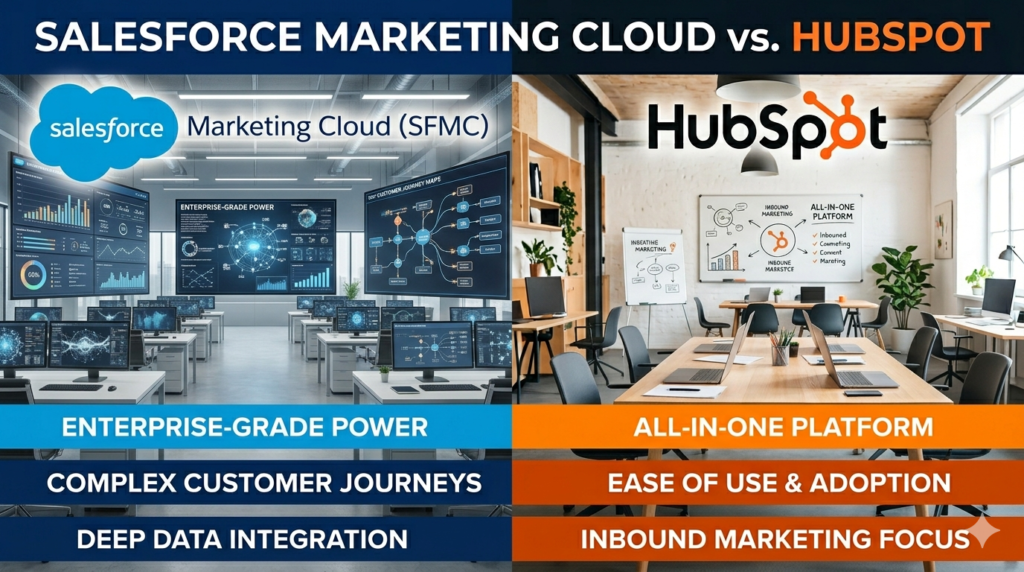
In this comprehensive guide, we’ll dissect both platforms across multiple dimensions—features, usability, career opportunities, salary potential, and learning curve. By the end, you’ll have a clear roadmap for making an informed decision about which platform deserves your time and investment.
Let’s dive into the SFMC vs HubSpot career showdown.
Understanding the Platforms: A Quick Overview
What is Salesforce Marketing Cloud?
Salesforce Marketing Cloud is an enterprise-grade marketing automation platform designed for large organizations with complex, multi-channel marketing needs. As part of the Salesforce ecosystem, SFMC integrates seamlessly with Salesforce CRM and offers robust tools for email marketing, mobile messaging, social media advertising, customer journey mapping, and data management.
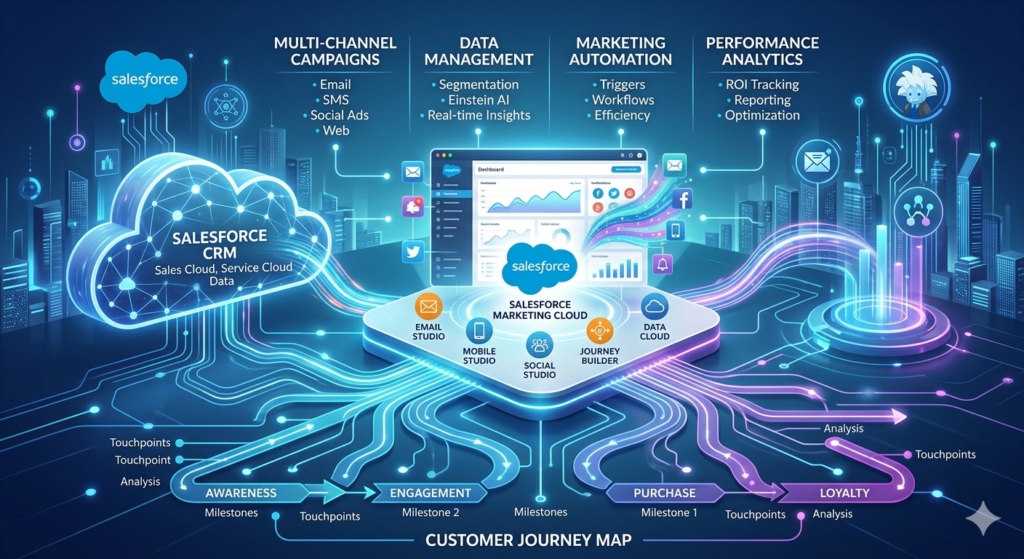
SFMC is built for marketers who need to:
- Manage millions of customer records
- Create sophisticated, multi-touch customer journeys
- Leverage advanced segmentation and personalization
- Coordinate campaigns across email, mobile, social, and web
- Integrate marketing data with sales and service teams
Key Modules Include:
- Email Studio
- Journey Builder
- Audience Builder
- Mobile Studio
- Social Studio
- Advertising Studio
- Datorama (analytics)
- Interaction Studio (real-time personalization)
What is HubSpot?
HubSpot is an all-in-one inbound marketing, sales, and customer service platform designed with user-friendliness at its core. Built initially for small-to-medium businesses (SMBs), HubSpot has evolved to serve enterprise clients while maintaining its accessible, intuitive interface.
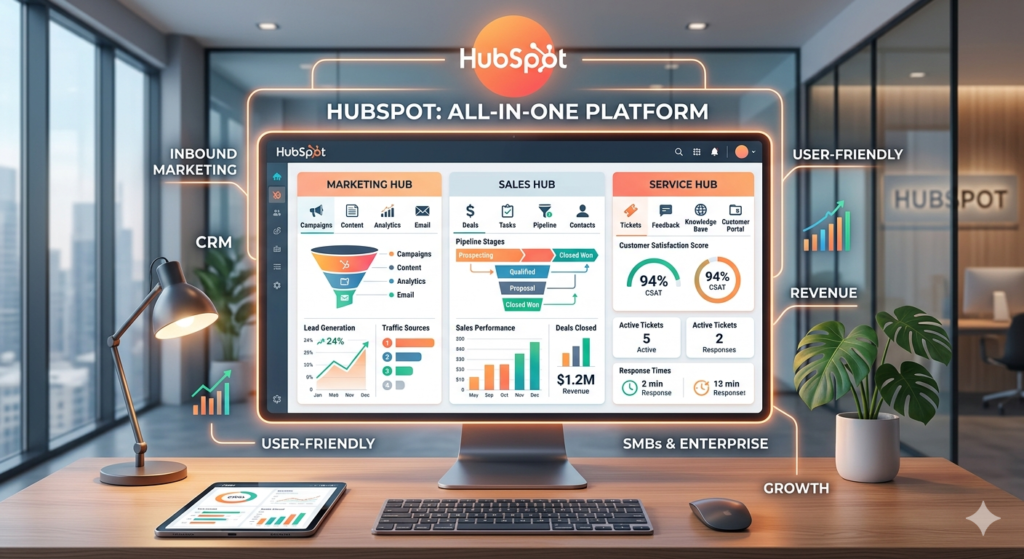
HubSpot attracts marketers who want to:
- Implement inbound marketing strategies
- Manage content marketing and SEO
- Nurture leads through the sales funnel
- Track the entire customer lifecycle in one platform
- Get started quickly without extensive technical training
Key Hubs Include:
- Marketing Hub
- Sales Hub
- Service Hub
- CMS Hub
- Operations Hub
The fundamental difference? SFMC is a specialized marketing powerhouse within a larger ecosystem, while HubSpot is a comprehensive business growth platform with marketing at its center.
Feature Comparison: SFMC vs HubSpot
Email Marketing Capabilities
Salesforce Marketing Cloud:
- Advanced email creation using HTML or drag-and-drop Content Builder
- AMPscript for dynamic content personalization
- Sophisticated send-time optimization
- Sender Authentication Package (SAP) for deliverability
- Triggered sends based on complex data scenarios
- Extensive A/B testing capabilities
HubSpot:
- Intuitive drag-and-drop email builder
- Smart content for personalization
- A/B testing functionality
- Email health monitoring and deliverability tools
- Template marketplace for quick starts
- Mobile optimization built-in
Winner: SFMC for complexity and scale; HubSpot for ease of use and speed to market.
Automation and Journey Building
Salesforce Marketing Cloud:
- Journey Builder offers enterprise-level automation with unlimited complexity
- Data Extensions for sophisticated audience segmentation
- Einstein AI for predictive analytics and send-time optimization
- Cross-channel orchestration (email, SMS, push, advertising)
- API-triggered journeys for real-time personalization
HubSpot:
- Workflow automation with visual interface
- Lead scoring and nurturing sequences
- Branch logic for conditional paths
- Integration with sales and service activities
- Easier setup for standard marketing funnels
Winner: SFMC for multi-channel complexity; HubSpot for straightforward automation.
CRM Integration
Salesforce Marketing Cloud:
- Native integration with Salesforce Sales Cloud
- Marketing Cloud Connect for data synchronization
- Seamless handoff between marketing and sales teams
- Requires configuration and sometimes custom development
HubSpot:
- Built-in CRM included in the platform
- No integration needed—everything lives in one system
- Automatic activity logging and attribution
- Sales and marketing alignment out-of-the-box
Winner: HubSpot for simplicity; SFMC for those already invested in Salesforce ecosystem.
Analytics and Reporting
Salesforce Marketing Cloud:
- Datorama for advanced marketing analytics and AI-powered insights
- Custom report building with SQL queries
- Einstein Analytics integration
- Attribution modeling across channels
- Requires technical skill to maximize value
HubSpot:
- Intuitive dashboards and reporting
- Attribution reports (contact create, revenue, multi-touch)
- Custom report builder with visual interface
- Real-time campaign performance tracking
- Accessible to non-technical users
Winner: SFMC for depth and customization; HubSpot for accessibility.
Content Management and SEO
Salesforce Marketing Cloud:
- Limited content management capabilities
- CloudPages for landing pages
- Not designed as a content marketing platform
- Requires integration with external CMS
HubSpot:
- Full-featured CMS Hub included
- Blogging platform with SEO recommendations
- Content strategy tools and topic clusters
- On-page SEO optimization built-in
- Social media publishing and monitoring
Winner: HubSpot by a landslide—content marketing is in its DNA.
Pricing Transparency
Salesforce Marketing Cloud:
- Custom pricing based on contact volume and modules
- Typically starts around $1,250/month for basic package
- Enterprise implementations can reach six figures annually
- Less transparent—requires sales consultation
HubSpot:
- Transparent tiered pricing (Free, Starter, Professional, Enterprise)
- Marketing Hub Professional starts around $800/month
- Enterprise plans scale with features and contacts
- Clear pricing published on website
Winner: HubSpot for pricing clarity and accessibility.
Ease of Use and Learning Curve
User Interface and Experience
Salesforce Marketing Cloud:
The SFMC interface can feel overwhelming for newcomers. With multiple studios (Email Studio, Journey Builder, Audience Builder, etc.), navigating the platform requires understanding how different modules interconnect. The learning curve is steep, especially for marketers without technical backgrounds.
Challenges include:
- Understanding data model and Data Extensions
- Learning AMPscript or SSJS for advanced personalization
- Configuring Marketing Cloud Connect
- Mastering SQL for audience segmentation
- Navigating between multiple studio interfaces
Average time to proficiency: 3-6 months with structured training; 6-12 months through self-learning.
HubSpot:
HubSpot’s interface prioritizes user experience. The platform follows intuitive navigation patterns, with helpful tooltips, in-app guidance, and a comprehensive knowledge base. Most marketers can become productive within days or weeks.
User-friendly aspects:
- Unified interface across all hubs
- Visual workflow builders
- Pre-built templates and playbooks
- In-app Academy content
- Minimal technical requirements
Average time to proficiency: 2-4 weeks for basic competency; 2-3 months for advanced features.
Technical Requirements
SFMC: Requires or benefits from knowledge of:
- HTML/CSS for email templates
- SQL for data segmentation
- AMPscript for dynamic content
- JavaScript for advanced customization
- API integration concepts
HubSpot: Minimal technical requirements:
- Basic understanding of marketing concepts
- No coding required for standard use
- HubL (HubSpot’s templating language) only for advanced customization
- API knowledge helpful but not essential
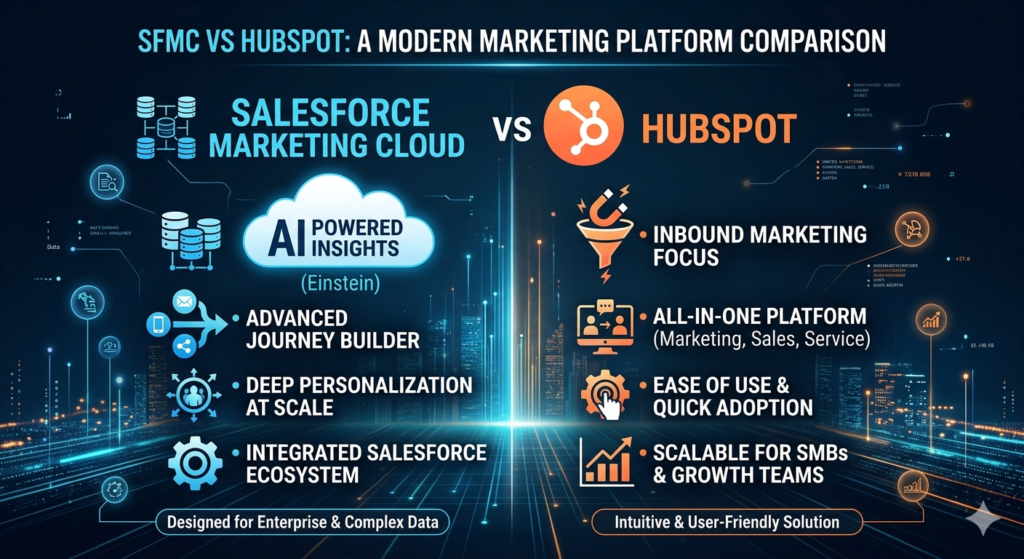
Verdict: HubSpot is significantly more accessible for non-technical marketers, while SFMC rewards technical depth with greater customization capabilities.
Career Opportunities: SFMC vs HubSpot Career Paths
Job Market Demand
Salesforce Marketing Cloud:
The demand for SFMC professionals has grown steadily, driven by enterprise digital transformation initiatives. According to recent job market data:
- Job postings: Over 5,000+ SFMC-specific roles listed on major job boards quarterly
- Growth trajectory: 15-20% year-over-year increase in SFMC job listings
- Company size: Predominantly enterprise organizations (Fortune 500, global brands)
- Industries: Retail, financial services, healthcare, technology, automotive
Common SFMC job titles:
- Salesforce Marketing Cloud Consultant
- SFMC Email Developer
- Marketing Cloud Administrator
- Marketing Automation Specialist (SFMC)
- Digital Marketing Manager (SFMC)
- Marketing Cloud Architect
- CRM Marketing Manager
HubSpot:
HubSpot’s market presence continues to expand, particularly in the SMB and mid-market segments:
- Job postings: Over 8,000+ HubSpot-related roles quarterly
- Growth trajectory: 20-25% year-over-year increase
- Company size: Wide range from startups to mid-market to enterprise
- Industries: SaaS, digital agencies, professional services, e-commerce, education
Common HubSpot job titles:
- HubSpot Administrator
- Inbound Marketing Specialist
- Marketing Operations Manager (HubSpot)
- Growth Marketing Manager
- Digital Marketing Strategist
- Marketing Automation Manager
- HubSpot Consultant/Partner
Market Analysis: HubSpot shows slightly higher overall job volume due to broader adoption across company sizes, while SFMC opportunities are concentrated in enterprise environments with specialized needs.
Freelance and Consulting Opportunities
Salesforce Marketing Cloud:
SFMC expertise opens lucrative consulting opportunities:
- Hourly rates: $75-200+ per hour depending on expertise and specialization
- Project types: Implementation, migration, optimization, training
- Demand drivers: Complexity requires external expertise; internal talent shortage
- Partnership programs: Salesforce Partner ecosystem offers structured paths
Considerations:
- Requires deeper technical expertise
- Longer, more complex projects
- Higher barrier to entry
- Certification highly valued
HubSpot:
HubSpot consulting presents accessible freelance opportunities:
- Hourly rates: $50-150+ per hour
- Project types: Setup, optimization, content strategy, training, ongoing management
- Demand drivers: SMBs prefer outsourced expertise over full-time hires
- Partnership programs: HubSpot Solutions Partner Program with tiered benefits
Considerations:
- Lower barrier to entry
- More abundant smaller projects
- Strong agency ecosystem
- Broader service offering potential (strategy + execution)
Verdict: Both platforms offer strong consulting opportunities, with SFMC commanding higher rates for specialized expertise and HubSpot providing more accessible entry points and volume.
Geographic Opportunities
Salesforce Marketing Cloud:
- Strong presence in major tech hubs (San Francisco, New York, Chicago, Austin)
- Significant demand in global financial centers (London, Toronto, Singapore)
- Remote opportunities available but often require prior SFMC experience
HubSpot:
- Distributed opportunity across regions and company sizes
- Strong remote work culture (HubSpot’s remote-friendly approach influences market)
- Particularly strong in startup ecosystems and digital-first industries
Salary Potential: What Can You Earn?
Entry-Level Positions (0-2 years experience)
Salesforce Marketing Cloud:
- Marketing Cloud Administrator: $55,000-75,000
- Junior Email Developer: $50,000-70,000
- Marketing Automation Coordinator: $52,000-68,000
HubSpot:
- HubSpot Administrator: $45,000-60,000
- Marketing Coordinator (HubSpot): $42,000-58,000
- Inbound Marketing Specialist: $48,000-62,000
Entry-level advantage: SFMC edges ahead by $5,000-15,000 on average.
Mid-Level Positions (3-5 years experience)
Salesforce Marketing Cloud:
- Marketing Cloud Consultant: $80,000-120,000
- SFMC Developer: $85,000-125,000
- Marketing Automation Manager: $75,000-105,000
- Marketing Cloud Specialist: $75,000-100,000
HubSpot:
- HubSpot Consultant: $65,000-95,000
- Marketing Operations Manager: $70,000-100,000
- Growth Marketing Manager: $75,000-110,000
- Senior Marketing Specialist: $68,000-92,000
Mid-level advantage: SFMC maintains $10,000-25,000 premium for specialized roles.
Senior-Level Positions (5+ years experience)
Salesforce Marketing Cloud:
- Marketing Cloud Architect: $120,000-180,000+
- Senior SFMC Consultant: $110,000-160,000
- Director of Marketing Operations: $130,000-190,000
- Principal Marketing Cloud Engineer: $140,000-200,000+
HubSpot:
- Senior HubSpot Consultant: $90,000-140,000
- Director of Marketing Operations: $115,000-165,000
- VP of Marketing (HubSpot-centric): $130,000-200,000+
- Principal Marketing Strategist: $105,000-155,000
Senior-level advantage: SFMC technical roles command 15-25% premium; strategic roles comparable.
Additional Compensation Factors
Certifications impact:
- SFMC certified professionals earn 10-20% more than non-certified counterparts
- HubSpot certifications are free and widely held, creating less differentiation
- Multiple Salesforce certifications can boost compensation significantly
Industry impact:
- Financial services and healthcare pay premium for SFMC skills (15-25% above average)
- SaaS and technology companies often pay premium for HubSpot expertise (10-20% above average)
Company size impact:
- Enterprise SFMC roles typically offer higher base + better benefits
- HubSpot roles at high-growth startups may offer equity compensation
The SFMC vs HubSpot Career Decision Framework
Choose Salesforce Marketing Cloud if you:
Prefer technical depth over breadth
- Enjoy learning coding languages and technical systems
- Want to specialize in a high-demand enterprise tool
- Are comfortable with complexity and technical documentation
Target enterprise career opportunities
- Aspire to work at Fortune 500 companies or global brands
- Value structured corporate environments
- Want exposure to large-scale marketing operations
Seek higher earning potential
- Willing to invest time for higher long-term compensation
- Interested in technical consulting or architecture roles
- Value specialized expertise over generalist knowledge
Already invested in Salesforce ecosystem
- Work at a company using Salesforce CRM
- Have or plan to pursue other Salesforce certifications
- See synergies with Sales Cloud, Service Cloud, etc.
Enjoy problem-solving and optimization
- Like building complex customer journeys
- Interested in data modeling and SQL
- Thrive on optimizing intricate systems
Choose HubSpot if you:
Value speed to productivity
- Want to become job-ready quickly (weeks vs. months)
- Prefer intuitive interfaces over technical complexity
- Need immediate ROI on your learning investment
Prefer holistic marketing approach
- Interested in content marketing, SEO, and inbound methodology
- Want to manage entire customer lifecycle (marketing + sales + service)
- Value strategic thinking alongside tactical execution
Target diverse career opportunities
- Want flexibility across company sizes (startup to enterprise)
- Interested in remote work opportunities
- Prefer broader job market with more openings
Have entrepreneurial aspirations
- Considering freelance or agency work
- Want to serve SMB clients or startups
- Interested in building your own marketing consultancy
Come from non-technical background
- Studied communications, business, or liberal arts
- Limited coding or database experience
- Prefer visual interfaces and guided workflows
The Hybrid Approach: Why Not Both?
For ambitious marketers, learning both platforms sequentially can create powerful career optionality:
Suggested Path 1: HubSpot → SFMC
- Start with HubSpot to build foundational marketing automation knowledge
- Gain confidence and early career traction
- Transition to SFMC when seeking enterprise roles or higher compensation
Suggested Path 2: SFMC → HubSpot
- Dive deep into SFMC if you have technical aptitude
- Add HubSpot to expand consulting service offerings
- Serve both enterprise and mid-market clients
Timeframe consideration: Becoming proficient in both platforms typically requires 12-18 months of focused learning and practical application.
Learning Resources and Certification Paths
Salesforce Marketing Cloud Learning Path
Official Salesforce Resources:
- Trailhead: Salesforce’s free learning platform with SFMC trails
- Marketing Cloud Certification: Email Specialist, Consultant, Developer certifications
- Certification costs: $200 per exam; $100 for retakes
- Hands-on practice: 30-day free trial; Trailhead Playground
Recommended Certifications:
- Marketing Cloud Email Specialist (entry-level, $200)
- Marketing Cloud Consultant (professional-level, $200)
- Marketing Cloud Developer (technical specialist, $200)
Third-Party Resources:
- RizeX Labs (comprehensive SFMC courses with hands-on projects)
- MarketingCloudTutorials.com
- SFMC.co community and resources
- LinkedIn Learning courses
Estimated investment: $500-2,000 for courses + certifications
HubSpot Learning Path
Official HubSpot Resources:
- HubSpot Academy: Completely free comprehensive training
- HubSpot Certifications: All certifications are free
- Software access: Free CRM and limited Marketing Hub features
- Community: Active HubSpot Community forums
Recommended Certifications:
- HubSpot Marketing Software Certification (free)
- Inbound Marketing Certification (free)
- Content Marketing Certification (free)
- Email Marketing Certification (free)
- HubSpot CMS for Developers (free, for technical users)
Third-Party Resources:
- RizeX Labs (advanced HubSpot strategy and implementation)
- LinkedIn Learning
- Udemy courses
- YouTube tutorials and channels
Estimated investment: $0-500 (free certifications; optional paid courses for deeper training)
Time Investment Comparison
Becoming job-ready with SFMC: 3-6 months of dedicated study (10-15 hours/week)
Becoming job-ready with HubSpot: 4-8 weeks of focused learning (10-15 hours/week)
Real-World Use Cases and Career Stories
SFMC Success Story: From Marketing Coordinator to SFMC Architect
Sarah’s Journey:
Sarah started as a marketing coordinator at a retail company using basic email tools. When her company migrated to Salesforce Marketing Cloud, she volunteered to be a power user. Over 18 months, she:
- Completed Email Specialist and Consultant certifications
- Learned SQL and AMPscript through Trailhead and practice
- Built complex customer journeys for her company’s loyalty program
- Transitioned to a Marketing Cloud Administrator role (+$15K salary)
- After 3 years total SFMC experience, moved to a consulting firm as an SFMC Architect ($135K salary)
Key takeaway: Technical depth in SFMC created specialized expertise with significant compensation growth.
HubSpot Success Story: From Career-Switcher to Marketing Agency Owner
Michael’s Journey:
Michael transitioned from teaching to marketing at age 32 with no technical background. He chose HubSpot because:
- Free certifications reduced financial barriers
- Intuitive interface matched his learning style
- Strong job market for HubSpot skills in his mid-sized city
His path:
- Completed 6 HubSpot certifications in 2 months while still teaching
- Landed Marketing Specialist role at local agency ($52K)
- Managed 5 HubSpot client accounts
- After 2 years, started his own HubSpot consulting practice
- Now serves 12 SMB clients with $140K annual revenue
Key takeaway: HubSpot’s accessibility enabled quick career pivot and entrepreneurial opportunity.
Pro Tips for Maximizing Your Learning Investment
For SFMC Learners:
Start with Email Studio before Journey Builder
Master one module thoroughly before expanding to others. Email Studio provides foundational understanding of SFMC’s data model.
Practice SQL from day one
Data Extensions and SQL queries are core to SFMC. Free SQL courses (SQLBolt, Mode Analytics SQL Tutorial) build critical skills.
Join the SFMC community early
The SFMC community (SFMC.co, Reddit r/salesforce, Trailblazer Community) offers invaluable peer support and real-world problem-solving.
Build a portfolio project
Create sample campaigns, journeys, and email templates to demonstrate capabilities to employers, even before landing your first SFMC role.
Consider the certification path strategically
Email Specialist certification first; add Consultant certification after 6-12 months of hands-on experience for maximum career impact.
For HubSpot Learners:
Complete the certification bundle
Since HubSpot certifications are free, complete Marketing Software, Inbound, and Email certifications as a package to demonstrate comprehensive knowledge.
Use the free CRM extensively
Create a mock company with sample contacts, deals, and campaigns. Hands-on practice accelerates learning and provides portfolio material.
Focus on strategy, not just tools
HubSpot rewards strategic thinking. Study inbound methodology, buyer personas, and customer journey mapping alongside technical skills.
Join HubSpot User Groups (HUGs)
Local and virtual HubSpot User Groups connect you with practitioners, potential employers, and clients.
Consider Solutions Partner Program
For those interested in consulting, HubSpot’s Solutions Partner Program offers training, resources, and client referrals.
Universal Tips for Both Platforms:
Document your learning journey
- Create blog posts or LinkedIn articles about what you’re learning
- Build social proof and demonstrate thought leadership
- Improve retention through teaching others
Seek hands-on experience quickly
- Volunteer for non-profits (Catchafire, LinkedIn Volunteers)
- Offer free initial setup to small businesses for portfolio building
- Seek internships or junior roles to gain practical experience
Network actively
- Connect with professionals on LinkedIn
- Attend virtual and in-person marketing technology events
- Join relevant Slack communities and Facebook groups
Stay current with platform updates
- Both platforms release quarterly updates
- Follow official blogs and release notes
- Continuous learning maintains your competitive edge
The Verdict: Which Platform Should You Learn?
After examining features, career paths, earning potential, and learning curves, here’s the bottom-line guidance:
Learn Salesforce Marketing Cloud if:
- You have technical aptitude or willingness to develop it
- You target enterprise-level career opportunities
- Higher long-term earning potential outweighs steeper learning curve
- You’re already in or targeting the Salesforce ecosystem
- You value specialized expertise over generalist skills
Best for: Technical-minded marketers, those targeting enterprise roles, career-focused professionals willing to invest 6-12 months for long-term payoff.
Learn HubSpot if:
- You want to become job-ready quickly (4-8 weeks)
- You prefer intuitive, user-friendly platforms
- You value broad marketing knowledge (content, SEO, social, automation)
- You’re interested in SMB, startup, or agency environments
- You’re exploring entrepreneurial or freelance opportunities
Best for: Career-switchers, non-technical marketers, those seeking rapid skill development, professionals targeting diverse company sizes and industries.
The Strategic Recommendation:
For most marketers beginning their automation journey, start with HubSpot. Its accessible learning curve, free certifications, and broad job market create faster ROI on your learning investment. Once you’ve established foundational marketing automation competency, assess whether adding SFMC expertise aligns with your evolving career goals.
For marketers already in technical roles or enterprise environments, SFMC offers a direct path to specialized, high-compensation positions that reward depth over breadth.
The ideal scenario? Gain proficiency in one platform, secure employment, then expand your toolkit. Multi-platform expertise creates maximum career optionality and earning potential.
Conclusion: Your Career, Your Choice
The Salesforce Marketing Cloud vs HubSpot debate isn’t about identifying a universal “winner”—it’s about aligning platform expertise with your unique career aspirations, learning preferences, and professional circumstances.
Both platforms offer robust career opportunities in the expanding marketing technology landscape. SFMC provides specialized enterprise expertise with premium compensation for those willing to invest in technical depth. HubSpot offers accessible, comprehensive marketing knowledge with diverse opportunities across company sizes and industries.
Your decision should balance:
- Time horizon: Quick results vs. long-term specialization
- Learning style: Technical complexity vs. intuitive accessibility
- Career target: Enterprise specialist vs. versatile generalist
- Financial considerations: Upfront investment vs. rapid job market entry
- Personal interests: Technical problem-solving vs. strategic marketing
The marketing technology landscape continues evolving rapidly, but one constant remains: platforms are tools, and your ability to drive marketing results matters more than which specific platform you’ve mastered. Choose the platform that energizes your learning journey, aligns with your career vision, and opens doors to opportunities that excite you.
About RizeX Labs
At RizeX Labs, we specialize in helping aspiring marketers and professionals build careers in high-demand marketing technologies like Salesforce Marketing Cloud and HubSpot.
Our training programs combine hands-on projects, real-world use cases, and career-focused mentorship to help you transition into roles such as marketing automation specialist, CRM marketer, and digital marketing strategist.
Whether you’re a beginner or looking to upskill, we provide the right roadmap to help you succeed in today’s competitive marketing landscape.
Internal Linking Opportunities
- Link to RizeX Labs Salesforce Marketing Cloud course page:
Salesforce Marketing Cloud Training – RizeX Labs - Link to HubSpot training page:
HubSpot Marketing Certification Training – RizeX Labs - Link to digital marketing career roadmap blog:
Digital Marketing Career Path Guide – RizeX Labs
External Linking Opportunities
- Salesforce official website
- HubSpot official website
- Salesforce learning platform (Trailhead)
- HubSpot Academy (free certifications)
