
Introduction: Let’s Kill the Myths First
Open YouTube right now. Search “learn Salesforce” and you will find thumbnails screaming at you. “Get a Salesforce job in 30 days!” “Zero to hero in 2 weeks!” “Earn ₹15 LPA without coding!” These thumbnails are designed to get clicks. They are not designed to tell you the truth.
Let us be honest right from the first paragraph. If you are sitting here in 2026, wondering how long to learn Salesforce, you deserve a real answer. Not a marketing pitch. Not a coaching institute’s sales page. A real, practical, no-nonsense answer based on what actually happens in the Indian job market.
Here are the myths we need to destroy before we go any further.
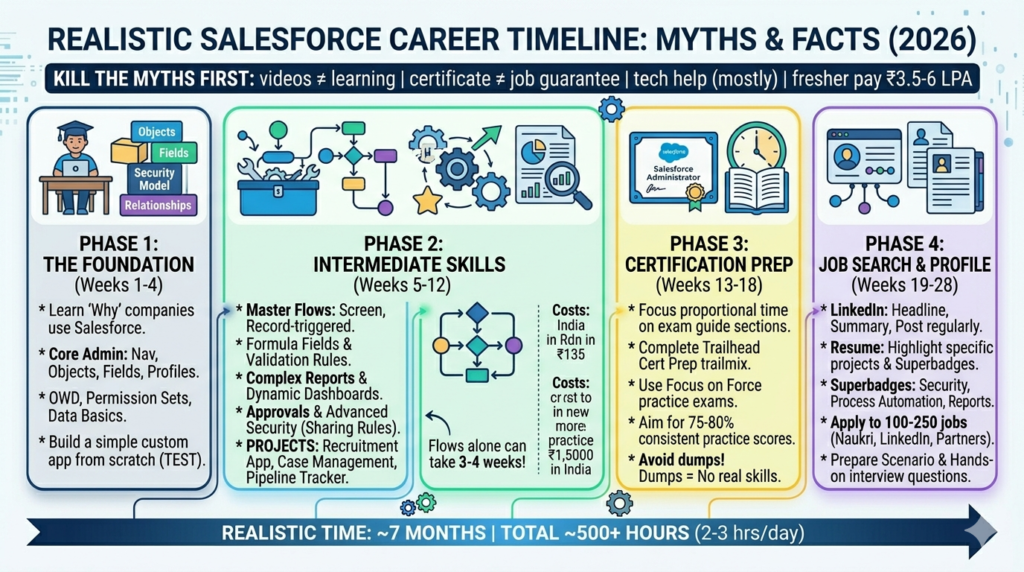
Myth 1: You can learn Salesforce in 2-4 weeks.
No, you cannot. You can watch videos for 2-4 weeks. Watching videos and actually learning are two completely different activities. Learning means you can open a Salesforce org, build something from scratch without following a tutorial, and explain what you built to another person. That does not happen in 2 weeks.
Myth 2: Salesforce Admin certification guarantees a job.
It does not. Not in 2026. Not in India. The certification is necessary, but it is not sufficient. Thousands of people clear the Salesforce Administrator exam every single month across India. The certificate alone does not separate you from the crowd. What separates you is your hands-on skills, your ability to speak confidently about what you have built, and your understanding of real business scenarios.
Myth 3: You do not need any technical background.
This is half true. You do not need to be a software engineer. But if you have zero understanding of how databases work, zero understanding of basic logic, and zero experience with any kind of technology tool, your learning curve will be steeper. It is still possible, but pretending the curve does not exist is dishonest.
Myth 4: Salesforce freshers easily get ₹6-10 LPA jobs.
Some do. Most do not start there. The average fresher Salesforce Admin salary in India in 2026 ranges from ₹3.5 LPA to ₹6 LPA, depending on the city, the company, and your skill level. The ₹8-10 LPA numbers you see online are either for developers with experience, for candidates in metro cities with strong interview skills, or simply exaggerated.
Now that we have cleared the air, let us get into the real timeline.
Phase 1: Understanding the Basics (Weeks 1-4)
This is the phase where most people either build a strong foundation or set themselves up for months of confusion later.
What You Need to Learn in This Phase
- What Salesforce actually is and why companies use it
- The difference between Salesforce Admin, Developer, and Consultant roles
- Navigating the Salesforce interface (Lightning Experience)
- Understanding objects, fields, records, and relationships
- Standard objects: Accounts, Contacts, Leads, Opportunities
- Page layouts, record types, and compact layouts
- Basic security model: profiles, permission sets, roles, OWD
- Data management basics: import, export, data loader concepts
How Long This Actually Takes
If you are studying 2-3 hours daily with focused effort, this phase takes about 3-4 weeks. Not because the concepts are difficult. They are not. It takes this long because Salesforce has its own vocabulary, its own way of organizing things, and you need time to let it sink in.
If you rush through this phase by binge-watching a 12-hour YouTube playlist over a weekend, you will feel like you understand everything. Then you will open a blank Salesforce org and realize you remember nothing. Do not do this to yourself.
What You Should Be Doing (Not Just Watching)
Sign up for a free Salesforce Developer Edition org from the first day. Every single concept you learn, practice it immediately. Do not move to the next topic until you can do the current one without looking at the tutorial.
Here is a simple test for whether you have actually learned the basics: Can you create a custom application in Salesforce with custom objects, fields, relationships, page layouts, and proper security settings without following any guide? If yes, move to Phase 2. If no, you are not done with Phase 1.
Realistic Time: 3-4 weeks (at 2-3 hours/day)
Phase 2: Intermediate Skills and Hands-On Practice (Weeks 5-12)
This is the phase where real learning happens. And this is the phase where most people quit or start drifting.
What You Need to Learn in This Phase
- Automation tools: Flows (Screen Flows, Record-Triggered Flows, Scheduled Flows, Autolaunched Flows)
- Validation rules and formula fields (in depth, not just basic ones)
- Approval processes
- Reports and dashboards (including joined reports, cross filters, dynamic dashboards)
- Advanced security: sharing rules, manual sharing, territory management basics
- Email templates, email alerts, and notification builder
- AppExchange apps and managed packages
- Data quality and duplicate management
- Understanding of Salesforce editions and licensing (yes, this matters in real jobs)
- Change management and sandbox concepts
- Basic understanding of Sales Cloud and Service Cloud processes
Why This Phase Takes Longer Than You Expect
Flows alone can take 3-4 weeks to truly understand. Salesforce has retired Workflow Rules and Process Builder. In 2026, Flow is the primary automation tool, and it is powerful but complex. You need to build multiple flows, break them, debug them, and rebuild them.
Reports and dashboards sound boring. In real jobs, they are what clients and managers care about most. You will spend more time building reports in an actual Salesforce Admin job than almost anything else. Learn them deeply.
The mistake people make in this phase is treating it as another video-watching exercise. This phase is about building. You should be spending 60-70% of your time inside Salesforce, actually clicking, configuring, testing, and breaking things.
Projects You Should Build in This Phase
- A complete recruitment tracking application — with custom objects for Job Postings, Candidates, Interviews, and Offers. Build automation using Flows to move candidates through stages, send email notifications, and update dashboards.
- A customer complaint management system — with Cases, Escalation rules, Entitlements, SLA tracking, and automated assignment.
- A sales pipeline tracker — using Opportunities, Products, Price Books, and Quotes with proper reports showing pipeline by stage, by owner, and by region.
These are not optional. In interviews, you will be asked “What have you built in Salesforce?” If your answer is “I practiced on Trailhead,” you will not stand out. If your answer includes specific projects with specific automation logic, you will.
Realistic Time: 6-8 weeks (at 2-3 hours/day)
Phase 3: Certification Preparation (Weeks 13-18)
Now we get to the certification question. Let us talk about which certification, when to take it, and how long the preparation actually takes.
Which Certification First?
Salesforce Administrator (CRT-211) — this is non-negotiable. In 2026, this is still the entry-level certification that every employer in India looks for. Do not skip it. Do not go straight to Platform Developer I thinking it will get you a higher salary. Get the Admin cert first.
After Admin, your second certification should depend on your career direction:
- If going toward development: Platform App Builder, then Platform Developer I
- If going toward admin/consulting: Platform App Builder, then Sales Cloud Consultant or Service Cloud Consultant
But for the purpose of getting your first job, Salesforce Administrator is the one.
How to Prepare (The Method That Actually Works)
- Study the official exam guide. Salesforce publishes an exam guide for every certification. Download it. Read the weightage of each section. Focus your study time proportionally.
- Use Trailhead. Complete the “Prepare for Your Salesforce Administrator Credential” trailmix. It is free and it is directly aligned with the exam.
- Use Focus on Force or a similar exam prep resource. The practice exams from Focus on Force are widely considered the closest to the actual exam. They cost money (around $20-30), but they are worth it.
- Take at least 5-6 full-length practice exams. You should be consistently scoring 75-80% on practice tests before booking the real exam. The passing score is 65%, but if you are scoring 66% on practice tests, you are not ready. Practice tests are slightly easier than the real thing.
- Review every wrong answer. Do not just check the correct option. Read the explanation. Understand why the other options are wrong.
Common Certification Mistakes
- Booking the exam too early because you feel motivated. Motivation is not preparation.
- Relying only on brain dumps. Salesforce has been actively combating dump sites. The questions change frequently. Dumps give you a false sense of readiness and, more importantly, they teach you nothing for actual job scenarios.
- Ignoring sections you find boring (like data management or reports). These sections carry significant weight on the exam.
Exam Logistics in India (2026)
- Online proctored exam: Available through Webassessor. You take it from home. Make sure you have a stable internet connection, a clean desk, and a government ID.
- Testing center exam: Available in major cities (Bangalore, Hyderabad, Pune, Mumbai, Delhi, Chennai). Book at least 2 weeks in advance.
- Cost: The Salesforce Administrator exam costs $200 (approximately ₹17,000-18,000 in 2026). Retake costs $100. This is not cheap. Prepare properly so you do not waste money on retakes.
Realistic Time: 4-6 weeks of dedicated preparation (at 2-3 hours/day)
Phase 4: Job Preparation and Application (Weeks 19-28)
Here is where the Salesforce learning timeline collides with reality. You have learned the platform, built projects, and earned your certification. Now you need a job. This phase is where most people underestimate the time and effort required.
Building Your Profile for the Indian Job Market
1. LinkedIn Optimization
Your LinkedIn profile is your resume in 2026. Most Salesforce hiring in India happens through LinkedIn, either through recruiters searching for candidates or through job postings.
- Headline should include: “Certified Salesforce Administrator | [Your specialization/interest]”
- Summary should clearly state what you can do, not what you want. Employers do not care about your dreams. They care about what you bring to their team.
- Add your Trailhead profile link and your Salesforce certification verification link.
- Post about Salesforce regularly. Share what you are learning. Share tips. Engage with the Salesforce community.
2. Resume for Salesforce Roles
Your resume needs to reflect Salesforce skills prominently. If you are transitioning from another career, restructure your resume to lead with Salesforce skills and projects, not your previous unrelated experience.
Include:
- Certification details with credential ID
- Trailhead Ranger/badges count (if impressive)
- Project descriptions with specific details (what you built, what tools you used, what business problem it solved)
- Any Salesforce-related volunteering or pro-bono work
3. Trailblazer Community Profile
Salesforce has one of the strongest professional communities in the tech world. In India, there are active Trailblazer Community Groups in most major cities. Attend meetups. Online or offline. Network with people already working in Salesforce. Many job referrals happen through community connections.
4. Superbadges on Trailhead
Superbadges are hands-on challenges on Trailhead that test your ability to solve real-world scenarios. They are difficult, and that is the point. Having 3-4 Superbadges on your profile signals to employers that you can actually do the work, not just pass a multiple-choice exam.
Complete at minimum:
- Security Specialist Superbadge
- Process Automation Specialist Superbadge
- Reports & Dashboards Specialist Superbadge
- Business Administration Specialist Superbadge
The Job Application Grind
Let us be brutally honest about the job application process for Salesforce freshers in India in 2026.
The market reality:
- Salesforce adoption in India is growing rapidly. More companies are implementing Salesforce than ever before.
- But the number of people entering the Salesforce ecosystem has also exploded. Competition for fresher roles is fierce.
- Most companies prefer candidates with at least 6 months to 1 year of experience. This creates the classic catch-22 for freshers.
- Consulting companies (Deloitte, Accenture, Cognizant, Infosys, Wipro, TCS) hire Salesforce freshers in batches, but often through campus drives or specific hiring programs.
- Smaller Salesforce consulting partners (boutique firms) are often the best entry point for freshers. They offer more hands-on experience and are more willing to hire based on potential.
Where to apply:
- LinkedIn Jobs (filter for “Salesforce Administrator” in India)
- Naukri.com (still dominant in Indian hiring)
- Salesforce-specific job boards: Mason Frank, Salesforce Ben jobs page
- Direct applications on websites of Salesforce consulting partners
- Salesforce’s own careers page (they hire in India regularly)
- Community referrals (this is more effective than cold applications)
How many applications to expect before landing a job:
For a fresher in India with certification and projects, expect to send 100-250 applications over 6-10 weeks before getting meaningful interview calls. This is normal. Do not panic at week 3 when you have sent 50 applications and heard nothing.
Interview Preparation
Salesforce interviews in India typically have three components:
1. Scenario-based questions:
“A sales manager wants to restrict their team from seeing opportunities owned by other teams. How would you configure this?”
You need to know the platform deeply enough to think through these scenarios live. This comes from practice, not from memorizing answers.
2. Hands-on assessment:
Many companies now give a practical test where you need to build something in a Salesforce org within a time limit (usually 60-90 minutes). This is where your project experience pays off.
3. Behavioral/HR round:
Standard questions about teamwork, communication, and why Salesforce. Prepare for these. Do not wing them.
Realistic Time for Job Search: 6-10 weeks (while continuing to learn and build)
The Complete Timeline Comparison Table
This is the table you actually need. How long to learn Salesforce depends entirely on your effort level, and here is what that looks like in practice:
| Phase | Serious Learner (3-4 hrs/day, disciplined) | Average Learner (1.5-2 hrs/day, mostly consistent) | Casual Learner (sporadic, unfocused) |
|---|---|---|---|
| Phase 1: Basics | 2-3 weeks | 4-5 weeks | 8-10 weeks |
| Phase 2: Intermediate + Projects | 5-6 weeks | 8-10 weeks | 16-20 weeks |
| Phase 3: Certification Prep | 3-4 weeks | 5-6 weeks | 10-12 weeks |
| Phase 4: Job Prep + Applications | 6-8 weeks | 8-12 weeks | 16-24 weeks |
| Total Time to Job Offer | 4-5 months | 6-8 months | 12-16 months (if ever) |
Let us be clear about the “Casual Learner” column. These numbers assume the person eventually gets serious. If someone stays casual and unfocused throughout, they may never reach the point of being Salesforce job ready. This is not said to be harsh. It is said to save you from wasting a year and then blaming the platform or the market.
Important Notes on This Table
- The “Serious Learner” timeline of 4-5 months is achievable but demands genuine discipline. This means daily practice, no skipping weekends, building projects, and treating this like a part-time job.
- The “Average Learner” timeline of 6-8 months is what most people realistically experience. Life gets in the way. Some weeks you study less. Some topics take longer than expected. This is normal and fine.
- These timelines assume you are learning Salesforce Administration. If you want to go into Salesforce Development (Apex, LWC, Visualforce), add 3-6 months to each timeline for the development-specific learning.
Common Mistakes Beginners Make (And How They Destroy Your Timeline)
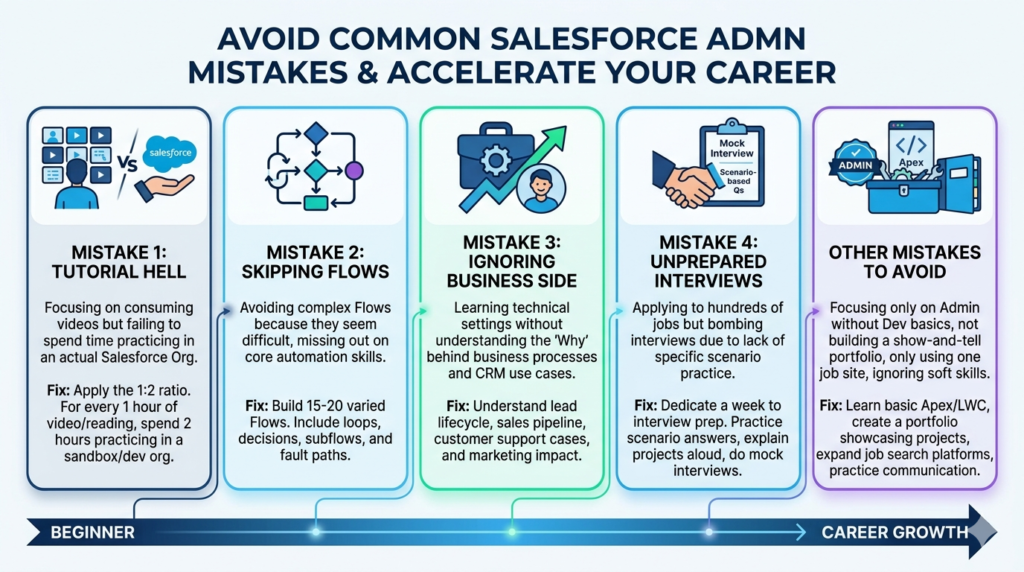
Mistake 1: Tutorial Hell
You watch one complete Salesforce Admin course. Then you watch another one. Then a third one. You now have 100+ hours of video consumed and you feel knowledgeable. But you have barely spent 10 hours actually working inside Salesforce.
This is tutorial hell, and it is the number one reason people take 12 months to learn what should take 5-6 months.
Fix: For every 1 hour of video/reading, spend 2 hours practicing. This ratio is non-negotiable.
Mistake 2: Skipping Flows Because They Are Hard
Flows are complex. They require logical thinking. Many beginners skip them or do the absolute minimum. This is career suicide. In 2026, Flow is the backbone of Salesforce automation. Every single Salesforce Admin job will require you to build and debug Flows.
Fix: Build at least 15-20 different Flows. Not just simple ones. Build Flows that involve loops, decision elements, subflows, and fault paths. Build Flows that you are not sure you can build. That is where learning happens.
Mistake 3: Ignoring the Business Side
Salesforce is a business tool. If you learn only the technical configuration without understanding why businesses use CRM, you will struggle in interviews and on the job.
Understand concepts like:
- Lead-to-Opportunity conversion process
- Sales pipeline management
- Customer support case lifecycle
- Marketing campaign tracking
Fix: Read Salesforce customer success stories. Understand what business problems Salesforce solves. When you build practice projects, always start with “What is the business problem?” not “What Salesforce feature should I practice?”
Mistake 4: Applying to Jobs Without Preparing for Interviews
Sending applications is easy. Preparing for interviews is hard. Many freshers apply to 200 jobs, get 5 interview calls, and bomb all 5 because they never practiced answering scenario-based questions.
Fix: Before you start applying, spend at least one full week on interview preparation. Practice explaining your projects out loud. Practice answering “How would you configure…” questions. Do mock interviews with friends who are also learning Salesforce.
Mistake 5: Only Learning Admin When Developer Skills Add Massive Value
This might sound contradictory to earlier advice, but hear the nuance. You should get your Admin certification first. However, if you want to seriously accelerate your employability and salary, learning basic Apex (Salesforce’s programming language) and Lightning Web Components (LWC) makes you dramatically more valuable.
You do not need to become a full developer. But an Admin who can write basic Apex triggers, simple LWC components, and understand SOQL queries is worth 1.5-2x more in the market than a pure Admin.
Fix: After clearing Admin certification, spend 4-6 weeks on Apex basics and LWC fundamentals. This is a high-ROI investment in your career.
Mistake 6: Not Building a Portfolio
In 2026, saying “I am Salesforce certified” is like saying “I have a degree.” It is expected, not differentiating. What differentiates you is showing what you have built.
Fix: Create a portfolio document or a personal blog/website showcasing:
- 3-4 detailed project write-ups with screenshots
- Your Flows with explanations of the business logic
- Your dashboards and what insights they provide
- Your Superbadge completions
- Any community contributions (answered questions, blog posts, meetup participation)
Mistake 7: Restricting Yourself to One Job Platform
Many freshers apply only on Naukri or only on LinkedIn. This limits your exposure. In the Indian Salesforce ecosystem, many jobs are filled through referrals, community networks, and direct approaches to consulting partners.
Fix: Use every channel simultaneously. LinkedIn, Naukri, Indeed, Glassdoor, direct company websites, community groups, Twitter (X), Salesforce-specific job boards, and personal networking.
Mistake 8: Ignoring Soft Skills and Communication
This is especially relevant in India, where many Salesforce roles involve working with international clients (US, UK, Australia). Your technical skills might be excellent, but if you cannot communicate clearly in English, articulate solutions, and present your work confidently, you will lose out to candidates who can.
Fix: Practice explaining Salesforce concepts in simple English. Record yourself and listen back. Join English communication groups if needed. This is not about accent. It is about clarity and confidence.
Actionable Tips to Speed Up the Process
Here are specific, practical actions you can take to compress your Salesforce learning timeline without cutting corners on quality.
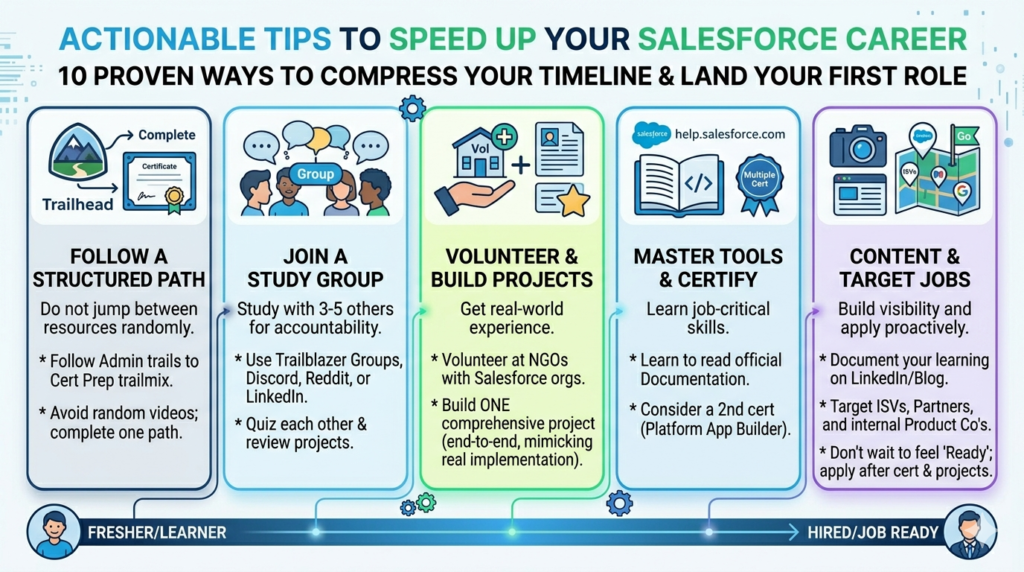
Tip 1: Follow a Structured Learning Path
Do not jump randomly between YouTube videos from different creators. Pick one structured path and follow it completely before supplementing with other resources.
Recommended free structured paths for 2026:
- Trailhead: “Admin Beginner” → “Admin Intermediate” → “Admin Advanced” trails
- Salesforce Admin Certification Prep trailmix on Trailhead
- FocusOnForce study guides (paid but worth it)
Tip 2: Join a Study Group
Find 3-5 people who are also learning Salesforce. Study together. Hold each other accountable. Quiz each other. Review each other’s projects. This dramatically accelerates learning and keeps you from quitting during tough weeks.
Where to find study groups:
- Trailblazer Community Groups (online and city-specific)
- Salesforce Discord servers
- LinkedIn Salesforce learning groups
- Reddit r/salesforce community
Tip 3: Volunteer Your Salesforce Skills
Salesforce has a program where nonprofits get free Salesforce licenses. Many of these nonprofits need help configuring their orgs. Volunteer to help them.
This gives you:
- Real-world experience to put on your resume
- References from a real organization
- Practical problems to solve (not textbook scenarios)
- A genuinely impressive talking point in interviews
Search for opportunities on Salesforce.org or reach out to local NGOs directly.
Tip 4: Build One End-to-End Project That Mimics a Real Implementation
Instead of building 10 small disconnected exercises, build one comprehensive project that simulates an actual Salesforce implementation. Include:
- Requirements gathering (write fictional requirements)
- Data model design
- Security configuration
- Automation with Flows
- Reports and dashboards
- User training documentation (yes, write actual training docs)
This single project will teach you more about being Salesforce job ready than 50 Trailhead badges.
Tip 5: Learn to Read Salesforce Documentation
Trailhead is great for learning concepts. But in a real job, you will constantly reference the official Salesforce documentation (help.salesforce.com). Start reading documentation now. It is dense, but learning to navigate it is a professional skill that will serve you every day on the job.
Tip 6: Stay Updated on Salesforce Releases
Salesforce releases major updates three times a year (Spring, Summer, Winter). Each release brings new features, changes existing ones, and sometimes retires old functionality. Follow the release notes. Understand what is new. Mention recent features in interviews to show you are current.
Tip 7: Get a Second Certification Before or During Your Job Search
If time and budget allow, getting the Platform App Builder certification in addition to the Administrator certification significantly improves your profile. The overlap between the two is about 40-50%, so the incremental effort is manageable. Having two certifications as a fresher puts you ahead of the majority of applicants.
Tip 8: Create Content About Your Learning Journey
Start a LinkedIn series or a blog documenting what you are learning. This serves multiple purposes:
- It reinforces your own learning
- It builds your professional visibility
- It demonstrates initiative and communication skills to potential employers
- It connects you with others in the Salesforce ecosystem who might refer you to opportunities
You do not need to be an expert to create content. “Today I learned about sharing rules and here is how they work” is perfectly valuable content.
Tip 9: Target the Right Companies
For your first Salesforce role in India, target these types of companies:
- Salesforce Consulting Partners (Boutique): Companies like Absyz, Girikon, CloudMasonry, Cynoteck, QR Solutions, etc. These smaller firms are often more willing to hire and train freshers.
- Large IT Services Companies: Deloitte, Accenture, Cognizant, Infosys, Wipro, TCS all have significant Salesforce practices. They hire freshers, but usually through structured programs.
- Product Companies Using Salesforce: Many Indian startups and mid-size companies use Salesforce internally. They hire Salesforce Admins to manage their own org. These roles are often less competitive than consulting roles.
- Salesforce ISV Partners: Companies that build products on the Salesforce platform. They often need people who understand the platform deeply.
Tip 10: Do Not Wait Until You Feel “Ready”
You will never feel 100% ready. If you have completed your certification, built projects, and prepared for interviews, start applying. You will learn from rejection. Each failed interview teaches you what to study next. Waiting until you feel perfectly ready is a form of procrastination.
What About Different Starting Points?
Your background matters. Let us address how the timeline shifts based on where you are starting from.
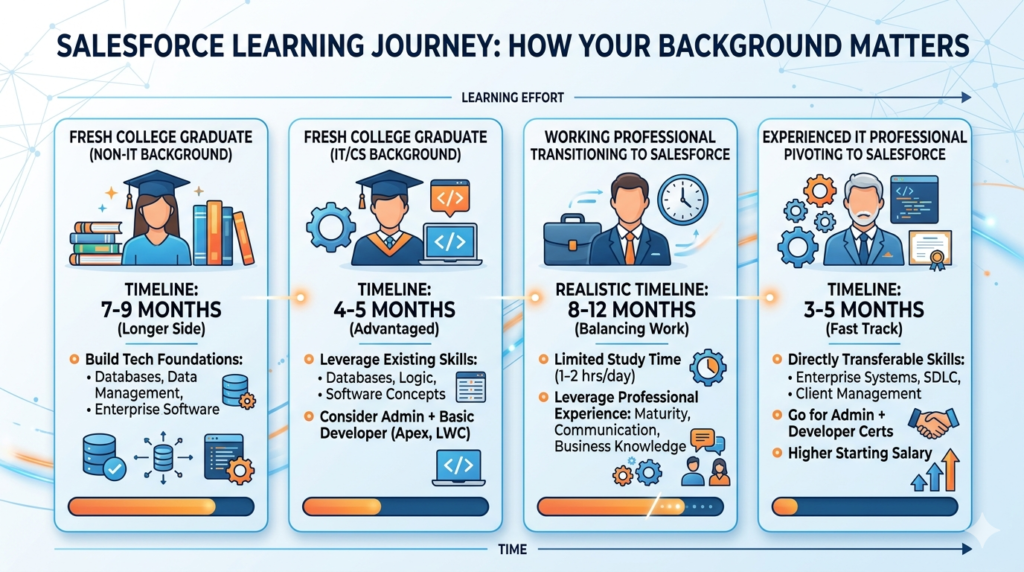
Fresh College Graduate (Non-IT Background)
If you have a degree in commerce, arts, science, or any non-IT field, you can absolutely transition to Salesforce. Your timeline will be on the longer side of the “Average Learner” column (7-9 months) because you need to build foundational technology comfort alongside Salesforce-specific skills.
Focus areas for you: Spend extra time understanding database concepts, basic data management, and how enterprise software works in general.
Fresh College Graduate (IT/CS Background)
You have an advantage. You already understand databases, logic, and software concepts. Your timeline can match the “Serious Learner” column (4-5 months) if you apply consistent effort. Consider learning both Admin and basic Developer skills from the start, as your CS background makes Apex and LWC more accessible.
Working Professional Transitioning to Salesforce
If you are currently working in another role (non-Salesforce IT, BPO, banking, sales, etc.) and learning Salesforce on the side, your realistic timeline is 8-12 months. This is because you have limited daily study time (likely 1-2 hours on weekdays after work) and you need to manage the job transition carefully.
Your advantage: You have professional experience. Employers value maturity, communication skills, and business understanding. Position your previous experience as complementary to Salesforce, not separate from it.
Experienced IT Professional Pivoting to Salesforce
If you have years of experience in Java, .NET, SAP, or another enterprise technology, your transition can be fast (3-5 months). Your understanding of enterprise systems, SDLC, and client management is directly transferable. Go directly for both Admin and Developer certifications. You can command higher salaries from the start due to your overall experience.
The Money Question: What Can You Realistically Earn?
Since we are being honest, let us talk about actual fresher salaries for Salesforce roles in India in 2026.
| Role | Company Type | City Tier | Realistic Salary Range |
|---|---|---|---|
| Salesforce Admin (Fresher) | Boutique Consulting Partner | Tier 1 (Bangalore, Hyderabad, Pune) | ₹3.5 – 5.5 LPA |
| Salesforce Admin (Fresher) | Large IT Services | Tier 1 | ₹4 – 6 LPA |
| Salesforce Admin (Fresher) | Product Company (Internal Admin) | Tier 1 | ₹4 – 6.5 LPA |
| Salesforce Admin (Fresher) | Any | Tier 2 (Jaipur, Indore, Chandigarh, etc.) | ₹2.5 – 4 LPA |
| Salesforce Developer (Fresher with Admin + Dev certs) | Consulting Partner | Tier 1 | ₹5 – 8 LPA |
| Salesforce Admin (1-2 years experience) | Any | Tier 1 | ₹6 – 10 LPA |
These numbers are based on actual job postings and community-reported salaries. They are not aspirational. They are real.
The good news: Salesforce salaries grow quickly with experience. A Salesforce professional with 3-5 years of experience and multiple certifications can realistically earn ₹12-25 LPA in India. The entry salary might not be jaw-dropping, but the growth trajectory is strong.
A Word About Paid Training Institutes
India has dozens of Salesforce training institutes charging ₹15,000 to ₹60,000 for their courses. Are they worth it?
Honest answer: It depends on you.
If you are self-disciplined and can learn independently: Save your money. Everything you need is available free on Trailhead, YouTube (channels like SalesforceHulk, Amit Singh, SFDCFacts Academy), and the official Salesforce documentation. The only thing worth paying for is Focus on Force exam prep ($20-30) and the exam fee itself ($200).
If you genuinely struggle with self-study and need structure: A paid course can provide accountability, deadlines, and peer interaction. But choose carefully. Check reviews on LinkedIn and community forums, not just the institute’s website. Ask for placement records with verifiable details. Be skeptical of “100% placement guarantee” claims.
If an institute promises a job guarantee: Be very cautious. Most job guarantee programs have fine print that makes the “guarantee” meaningless. Read the terms carefully. Some require you to accept any job they offer, even if it is unrelated to Salesforce or pays ₹2 LPA.
What Makes Someone Truly Salesforce Job Ready?
After all the learning, practicing, and certifying, what does Salesforce job ready actually look like? Here is the checklist:
Technical Skills:
- Can build a complete Salesforce application from scratch (objects, fields, relationships, page layouts, apps)
- Can configure security model appropriately (profiles, permission sets, OWD, sharing rules, role hierarchy)
- Can build complex Flows (record-triggered, screen, scheduled, with loops and decision logic)
- Can create advanced reports and dashboards (joined reports, cross filters, dynamic dashboards, report formulas)
- Can manage data (import, export, data loader, duplicate management)
- Can explain the difference between various automation tools and when to use each
- Understands sandbox types and deployment basics
- Has earned at least the Salesforce Administrator certification
Business Skills:
- Understands CRM concepts and why businesses use them
- Can translate a business requirement into a Salesforce configuration
- Understands the lead-to-cash process
- Can explain Salesforce concepts to non-technical stakeholders
Professional Skills:
- Has a polished LinkedIn profile with Salesforce focus
- Has a portfolio of 3-4 detailed projects
- Can articulate what they have built and why
- Has participated in the Trailblazer community
- Can communicate clearly and professionally
- Has practiced for scenario-based interview questions
If you can check off all of these, you are genuinely ready for the job market. If you are missing several items, you have more work to do, regardless of what certifications you hold.
The Psychological Reality Nobody Talks About
Learning Salesforce is a marathon, not a sprint. Along the way, you will experience:
Weeks 2-3: Excitement. Everything is new. You are learning fast. You feel smart.
Weeks 4-6: Confusion. Concepts start getting complex. Flows do not work. You are not sure you understand relationships properly. Self-doubt creeps in.
Weeks 7-10: The Plateau. You feel like you are not making progress. Others on LinkedIn seem to be ahead of you. You consider quitting.
Weeks 11-14: Breakthrough. Concepts start connecting. You build something complex and it works. Confidence returns.
Weeks 15-18: Certification anxiety. The exam feels high-stakes (₹17,000 is not small money). You oscillate between feeling prepared and terrified.
Weeks 19-28: Job search frustration. Rejections pile up. You wonder if this was worth it.
This emotional rollercoaster is completely normal. Every Salesforce professional in India, including the ones earning ₹30+ LPA today, went through some version of this. The ones who succeeded are simply the ones who did not quit during the hard phases.
Conclusion: The Realistic Final Timeline
Let us bring it all together.
If you are asking “how long to learn Salesforce and get a job in India in 2026,” here is the honest answer:
For a focused, disciplined learner: 4-6 months from zero to job offer.
For an average learner with reasonable consistency: 6-9 months from zero to job offer.
For someone who is inconsistent or distracted: 12-18 months, if it happens at all.
These timelines are not arbitrary. They are based on the actual experience of thousands of Salesforce professionals who have gone through this journey in India. They account for learning time, practice time, certification preparation, and the job search grind.
The Salesforce learning timeline is not about being fast. It is about being thorough. Rushing through the learning phases to get certified quickly often results in failing interviews and extending the overall timeline. Taking the time to build real skills, create genuine projects, and prepare properly for the job market is what actually gets you hired.
Salesforce is a genuinely rewarding career path. The technology is powerful, the ecosystem is supportive, the community is welcoming, and the career growth is excellent. But it demands real effort, consistent practice, and honest self-assessment.
No one is going to hand you a Salesforce job because you watched a YouTube playlist and passed a certification exam. But if you put in the work, build real skills, engage with the community, and approach the job search strategically, you will find opportunities. India’s Salesforce market is growing, and there is real demand for people who are genuinely competent on the platform.
Being Salesforce job ready is not about reaching a finish line. It is about being good enough to add value from day one, and then continuing to learn every single day on the job.
Start today. Be consistent. Be honest with yourself about your progress. And give it the time it deserves
About RizeX Labs
At RizeX Labs, we specialize in delivering cutting-edge Salesforce solutions, helping individuals and businesses build strong CRM foundations. Our focus is on practical, job-oriented training that bridges the gap between theoretical knowledge and real-world implementation.
We guide learners from zero experience to job-ready professionals through structured learning paths, real-time projects, and industry-relevant skills.
Internal Links:
- Salesforce Field Service Lightning (FSL): Overview, Features & Career Scope
- How Long Does It Take to Learn Salesforce and Get a Job? Honest Timeline (India, 2026)
- How to Get Your First Salesforce Job with Zero Experience in India: The 2026 Reality Check
- How to Use Salesforce Reports & Dashboards: A Beginner’s Practical Guide
- Salesforce Trailhead vs Paid Training: Which Is Better for Getting a Job in India (2026)?
- Top Companies Hiring Salesforce Professionals in Pune in 2026: Your Complete Career Guide
- Salesforce Flows vs Apex: When Should You Use Code vs No-Code Automation?
- Salesforce Nonprofit Cloud: Features, Use Cases, and Career Opportunities (2026 Guide)
- Salesforce Net Zero Cloud: What It Is and Why It’s the Next Green Career Niche (2026 Guide)
- Salesforce Slack Integration: How It Works and What Developers Need to Know
- Salesforce Named Credentials: What They Are and How to Use Them Safely
- Salesforce Deployment Best Practices: Change Sets vs Salesforce CLI vs Gearset
External Links:
McKinsey Sales Growth Reports
Gartner Sales Automation Insights
