
The digital transformation of business-to-business (B2B) commerce has accelerated dramatically over the past few years. Companies that once relied on traditional sales methods—phone calls, email chains, and in-person meetings—are now embracing digital platforms to streamline their operations and meet evolving customer expectations.
At the forefront of this revolution stands Salesforce B2B Commerce Cloud, a powerful platform designed to help businesses create seamless, personalized buying experiences for their corporate clients.
Whether you’re a student exploring career options, a professional looking to upskill, or a business leader evaluating commerce solutions, understanding Salesforce B2B Commerce Cloud is becoming increasingly valuable. This comprehensive guide will walk you through everything you need to know about this platform, its architecture, key features, and the exciting career opportunities it presents in 2026 and beyond.
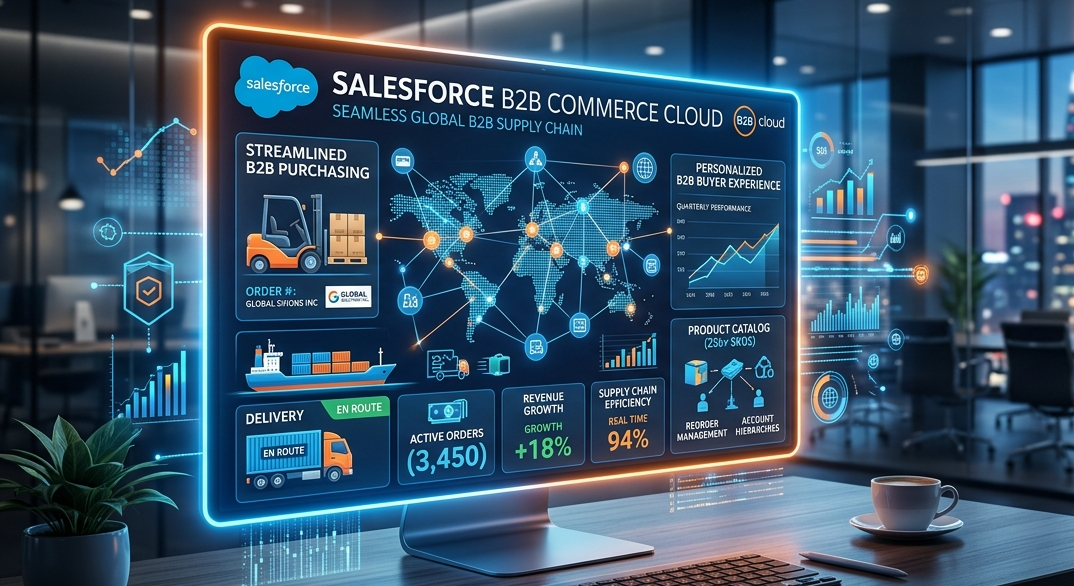
By the end of this article, you’ll have a clear understanding of why Salesforce B2B Commerce Cloud matters in today’s digital economy and how you can leverage this knowledge to advance your career or business goals.
Overview of Salesforce B2B Commerce Cloud
What is Salesforce B2B Commerce Cloud?
Salesforce B2B Commerce Cloud is an enterprise-level e-commerce platform specifically designed for business-to-business transactions. Unlike B2C (business-to-consumer) platforms that focus on individual shoppers, B2B Commerce Cloud addresses the unique complexities of corporate purchasing.
This platform enables manufacturers, distributors, and wholesalers to create sophisticated digital storefronts where their business customers can browse products, place bulk orders, manage contracts, and access personalized pricing—all within a unified digital experience.
The Evolution of B2B Commerce
Traditional B2B sales processes were notoriously complicated, involving multiple stakeholders, complex approval workflows, and lengthy negotiation cycles. Salesforce recognized these pain points and built a solution that digitizes these processes while maintaining the flexibility B2B relationships require.
The platform integrates seamlessly with Salesforce CRM, allowing businesses to maintain a 360-degree view of their customers across sales, service, and commerce touchpoints. This integration is what sets Salesforce B2B Commerce Cloud apart from standalone e-commerce solutions.
Who Uses Salesforce B2B Commerce Cloud?
The platform serves a diverse range of industries:
- Manufacturing companies selling equipment, parts, and supplies to other businesses
- Wholesale distributors managing complex product catalogs and pricing structures
- Healthcare suppliers providing medical equipment and supplies to hospitals and clinics
- Technology companies offering hardware, software, and services to enterprise clients
- Food and beverage distributors managing restaurant and retail supply chains
These organizations choose Salesforce B2B Commerce Cloud because it handles the intricacies of B2B transactions that generic e-commerce platforms simply cannot support.
The Salesforce Commerce Ecosystem
Salesforce B2B Commerce Cloud exists within a larger ecosystem that includes:
- Salesforce B2C Commerce Cloud: For direct-to-consumer sales
- Salesforce Order Management: For fulfillment orchestration
- Salesforce CPQ: For configure-price-quote workflows
- Salesforce CRM: For customer relationship management
This interconnected ecosystem allows businesses to create unified commerce experiences across all channels and customer types.
Architecture of Salesforce B2B Commerce Cloud
Understanding the architecture of Salesforce B2B Commerce Cloud is essential for anyone looking to work with or implement the platform. Let’s break down its technical foundation.

Platform Foundation
Salesforce B2B Commerce Cloud is built on two primary architectures, depending on the version:
B2B Commerce on Lightning Experience (the newer architecture) runs natively on the Salesforce Platform, leveraging Lightning Web Components and Apex. This version provides tighter integration with Salesforce CRM and other Salesforce clouds.
B2B Commerce (Legacy/CloudCraze) was originally built on a separate technology stack and later integrated into Salesforce. While still supported, Salesforce is encouraging migration to the Lightning-based version.
Core Architectural Components
1. Commerce Store
The digital storefront layer where buyers interact with products, pricing, and ordering functions. This is built using customizable templates and components.
2. Product Catalog Management
A robust system for organizing products into categories, managing attributes, and maintaining product information across multiple channels.
3. Pricing Engine
Handles complex pricing scenarios including:
- Volume-based pricing tiers
- Contract-specific pricing
- Promotional discounts
- Customer-specific negotiated rates
4. Shopping Cart and Checkout
Manages multi-line orders, saved carts, quick order entry, and approval workflows required for B2B purchases.
5. Account Management
Provides buyer account hierarchies, multiple shipping addresses, payment methods, and user permission structures.
6. Integration Layer
APIs and connectors that link the commerce platform with:
- ERP systems (SAP, Oracle, Microsoft Dynamics)
- Payment gateways
- Shipping and logistics providers
- Tax calculation services
- Inventory management systems
Data Model Architecture
The platform uses Salesforce’s standard and custom objects to store commerce data:
- Accounts and Contacts: Customer and user information
- Products and Price Books: Catalog and pricing data
- Orders and Order Items: Transaction records
- Carts: Active shopping sessions
- Custom Objects: Business-specific data requirements
This object-based architecture allows for extensive customization while maintaining data integrity and relationship mapping.
Front-End Architecture
The user interface is built using:
- Lightning Web Components (LWC): Modern JavaScript framework for building UI components
- Visualforce: Legacy page framework (in older implementations)
- Experience Cloud: The platform that hosts the storefront sites
- Responsive Design Templates: Mobile-first design patterns
Security Architecture
Security is multi-layered:
- User Authentication: SSO, SAML, OAuth 2.0 support
- Profile and Permission Sets: Granular access control
- Sharing Rules: Organization-wide defaults and record-level security
- Field-Level Security: Control access to sensitive data fields
- Platform Encryption: Data encryption at rest and in transit
Integration Architecture Patterns
Common integration patterns include:
- Real-time integration: Using REST/SOAP APIs for immediate data sync
- Batch integration: Scheduled data imports/exports for bulk operations
- Event-driven architecture: Platform Events and Change Data Capture for real-time notifications
- Middleware solutions: MuleSoft, Dell Boomi for complex integration scenarios
Understanding this architecture is crucial for developers, administrators, and solution architects working with salesforce B2B commerce cloud.
Key Features of Salesforce B2B Commerce Cloud
The platform offers a comprehensive suite of B2B commerce features designed to handle the complexities of corporate purchasing. Let’s explore the most impactful capabilities.

1. Personalized Buyer Experiences
Unlike one-size-fits-all e-commerce, B2B Commerce Cloud delivers tailored experiences:
- Account-specific catalogs: Show only products relevant to each buyer
- Custom pricing: Display negotiated prices unique to each customer relationship
- Personalized recommendations: AI-powered product suggestions based on purchase history
- Saved lists and quick order: Enable repeat purchasing with minimal clicks
- Role-based permissions: Different users see different features based on their role
2. Complex Product Catalogs
B2B commerce features include sophisticated catalog management:
- Support for thousands or even millions of SKUs
- Product variants and configurations
- Product bundles and kits
- Related products and cross-sell opportunities
- Rich product content including specifications, documents, and videos
- Multi-dimensional categorization for easy navigation
3. Advanced Pricing and Promotions
The pricing engine handles B2B complexity:
- Volume pricing: Tiered pricing based on quantity purchased
- Contract pricing: Custom negotiated rates for specific customers
- Price books: Multiple price lists for different customer segments
- Promotional discounts: Time-based sales and special offers
- Price visibility rules: Show or hide pricing based on customer status
- Currency support: Multi-currency transactions for global businesses
4. Flexible Ordering Capabilities
Streamlined ordering processes for B2B efficiency:
- Quick order forms: CSV upload for bulk ordering
- Reorder functionality: One-click reordering from past purchases
- Shopping cart management: Save carts for later, create multiple carts
- Order templates: Pre-configured orders for regular purchases
- Scheduled orders: Set up recurring orders automatically
5. Account and User Management
Sophisticated structures that mirror real-world B2B relationships:
- Account hierarchies: Parent-child account relationships
- Multiple buyer users: Many users per company account
- Approval workflows: Multi-step order approval processes
- Budget controls: Spending limits and purchase restrictions
- Multiple ship-to addresses: Different delivery locations per order
- Payment methods: Multiple payment options including terms and credit
6. Self-Service Portal
Empowering buyers to manage their own accounts:
- Order history and tracking
- Invoice access and payment history
- Case creation and support ticket tracking
- Document library access (specifications, safety data sheets)
- Account profile management
- Returns and exchanges initiation
7. Mobile-Responsive Design
Modern B2B buyers expect mobile functionality:
- Fully responsive storefronts
- Native mobile app capabilities
- Mobile-optimized checkout
- On-the-go order placement
- Sales rep mobile ordering tools
8. Search and Navigation
Powerful search capabilities for large catalogs:
- Faceted search: Filter by multiple attributes simultaneously
- Type-ahead suggestions: Predictive search as users type
- Search synonyms: Find products even with different terminology
- Recently viewed items: Easy access to previously browsed products
- Smart navigation: AI-powered category suggestions
9. Integration Capabilities
Seamless connection with business systems:
- Native Salesforce CRM integration
- ERP integration (inventory, orders, invoicing)
- Payment gateway integration
- Shipping and logistics integration
- Tax calculation service integration
- Marketing automation platform connections
10. Analytics and Reporting
Data-driven insights for business optimization:
- Commerce dashboards in Salesforce
- Order analytics and trends
- Customer behavior tracking
- Product performance metrics
- Abandoned cart reporting
- Custom report creation
11. AI-Powered Features
Einstein AI capabilities enhance the experience:
- Einstein Product Recommendations: Suggest relevant products
- Einstein Search: Improved search relevance and results
- Einstein Analytics: Advanced commerce insights
- Predictive ordering: Suggest reorder timing based on patterns
These B2B commerce features collectively create a powerful platform that transforms how businesses sell to other businesses.
Benefits for Businesses
Implementing Salesforce B2B Commerce Cloud delivers significant advantages across multiple dimensions of business operations.
Increased Sales and Revenue
Expanded Market Reach: A digital storefront operates 24/7, allowing customers to place orders anytime, anywhere. This removes geographical and time-zone constraints.
Higher Average Order Values: Product recommendations, easy reordering, and visible cross-sell opportunities encourage larger purchases.
Faster Sales Cycles: Self-service ordering reduces the time from product discovery to purchase completion, accelerating revenue realization.
New Customer Acquisition: A professional digital presence attracts customers who prefer online purchasing, expanding your addressable market.
Operational Efficiency
Reduced Manual Processing: Automated order capture eliminates data entry errors and frees staff from repetitive tasks.
Lower Cost to Serve: Self-service capabilities reduce the burden on customer service and sales teams.
Streamlined Workflows: Integration with ERP and other systems creates straight-through processing from order to fulfillment.
Better Resource Allocation: Sales representatives can focus on strategic relationships rather than order-taking.
Enhanced Customer Experience
Convenience: Customers can research, compare, and purchase on their own schedule without waiting for sales rep availability.
Transparency: Real-time inventory visibility, order tracking, and account information build trust.
Consistency: Standardized processes ensure every customer receives the same high-quality experience.
Personalization: Tailored catalogs, pricing, and recommendations make customers feel valued.
Data-Driven Decision Making
Customer Insights: Understanding buying patterns, preferences, and behaviors enables better business decisions.
Inventory Optimization: Sales data helps optimize stock levels and reduce carrying costs.
Performance Metrics: Clear visibility into what’s working and what’s not guides continuous improvement.
Forecasting Accuracy: Historical data improves demand planning and resource allocation.
Scalability and Growth
Handle Volume: The platform scales to support business growth without requiring proportional increases in staff.
Geographic Expansion: Easily add new markets, languages, and currencies as you expand globally.
Product Line Extensions: Adding new products or categories requires no infrastructure changes.
Acquisition Integration: Merge acquired companies’ products and customers into a unified platform.
Competitive Advantage
Modern Customer Expectations: Meeting digital-first buyer preferences prevents customer attrition to more tech-savvy competitors.
Differentiation: Superior digital experiences become a competitive differentiator in commodity markets.
Innovation Platform: Continuous platform enhancements from Salesforce keep you at the forefront of commerce technology.
Agility: Rapidly respond to market changes, launch promotions, and test new business models.
Integration Benefits
Unified Customer View: Integration with Salesforce CRM provides complete visibility into customer relationships across sales, service, and commerce.
Consistent Data: Single source of truth eliminates data silos and reconciliation challenges.
Process Automation: Workflows can span commerce, CRM, and ERP systems for end-to-end automation.
Ecosystem Advantages: Leverage the entire Salesforce ecosystem including Marketing Cloud, Service Cloud, and more.
These benefits explain why businesses across industries are investing in salesforce B2B commerce cloud as a strategic initiative rather than merely a technology implementation.

Career Scope in Salesforce Commerce
The rapid adoption of Salesforce B2B Commerce Cloud has created a booming job market for professionals with relevant skills. Let’s explore the career opportunities in this exciting field.
Why Salesforce Commerce Careers Are Promising
Growing Demand: As more businesses digitize their B2B sales processes, the need for skilled Salesforce Commerce professionals continues to rise.
Limited Talent Pool: Relatively few professionals have specialized B2B Commerce Cloud expertise, creating favorable supply-demand dynamics.
Attractive Compensation: Specialized skills command premium salaries in the job market.
Career Progression: Multiple career paths from technical to functional roles offer diverse opportunities.
Future-Proof Skills: Digital commerce is not a passing trend—it’s the future of business transactions.
Key Roles in Salesforce Commerce
1. Salesforce Commerce Cloud Developer
Responsibilities:
- Build and customize storefront experiences using Lightning Web Components
- Develop backend logic using Apex
- Create integrations with ERP, payment, and shipping systems
- Implement custom features and functionality
- Optimize platform performance
- Debug and resolve technical issues
Required Skills:
- JavaScript, HTML, CSS proficiency
- Apex programming
- Lightning Web Components (LWC)
- REST/SOAP API development
- Version control (Git)
- Salesforce platform knowledge
Salary Range (2026): $85,000 – $145,000 annually (varies by location and experience)
2. Salesforce Commerce Cloud Administrator
Responsibilities:
- Configure products, pricing, and catalogs
- Manage user accounts and permissions
- Set up and maintain storefronts
- Create and manage promotions
- Handle day-to-day platform administration
- Train users and create documentation
Required Skills:
- Salesforce administration fundamentals
- Commerce Cloud configuration
- Data management
- User management
- Security and access control
- Business process understanding
Salary Range (2026): $70,000 – $110,000 annually
3. Salesforce Commerce Cloud Consultant
Responsibilities:
- Analyze business requirements
- Design commerce solutions
- Configure platform to meet business needs
- Lead implementation projects
- Provide strategic guidance
- Train client teams
Required Skills:
- Deep B2B commerce knowledge
- Salesforce platform expertise
- Business analysis capabilities
- Project management
- Stakeholder communication
- Industry-specific knowledge
Salary Range (2026): $95,000 – $160,000 annually
4. Salesforce Commerce Cloud Architect
Responsibilities:
- Design end-to-end commerce solutions
- Create integration architectures
- Establish technical standards and best practices
- Lead complex implementations
- Conduct technical reviews
- Mentor development teams
Required Skills:
- Advanced Salesforce platform knowledge
- Enterprise architecture expertise
- Integration patterns and technologies
- Security and scalability considerations
- Multiple Salesforce clouds experience
- Leadership capabilities
Salary Range (2026): $130,000 – $200,000+ annually
5. Salesforce Commerce Business Analyst
Responsibilities:
- Gather and document business requirements
- Create user stories and process flows
- Bridge business and technical teams
- Conduct gap analysis
- Facilitate workshops and discovery sessions
- Define testing scenarios
Required Skills:
- Business analysis methodology
- Commerce processes understanding
- Salesforce ecosystem knowledge
- Requirements documentation
- Stakeholder management
- Analytical thinking
Salary Range (2026): $75,000 – $125,000 annually
6. Salesforce Commerce Project Manager
Responsibilities:
- Plan and execute commerce implementations
- Manage project timelines, budgets, and resources
- Coordinate cross-functional teams
- Mitigate risks and resolve issues
- Report project status to stakeholders
- Ensure successful delivery
Required Skills:
- Project management methodologies (Agile, Waterfall)
- Salesforce implementation experience
- Resource management
- Risk management
- Communication and leadership
- Vendor management
Salary Range (2026): $90,000 – $140,000 annually
Essential Skills for Salesforce Commerce Career
To succeed in a salesforce commerce career, develop these core competencies:
Technical Skills:
- Salesforce platform fundamentals
- Commerce Cloud-specific configuration
- Programming languages (JavaScript, Apex)
- Web technologies (HTML, CSS)
- API and integration knowledge
- Data modeling and management
Business Skills:
- E-commerce best practices
- B2B sales processes
- Customer experience design
- Project management
- Change management
- Industry-specific knowledge
Soft Skills:
- Problem-solving
- Communication
- Collaboration
- Adaptability
- Continuous learning mindset
- Customer focus
Certifications That Boost Your Career
Salesforce offers certifications that validate your expertise:
1. Salesforce Certified B2B Commerce Developer
- Validates development skills
- Covers customization and implementation
- Requires hands-on experience
2. Salesforce Certified B2B Commerce Administrator
- Focuses on configuration and management
- Covers catalog, pricing, and user management
- Entry-level certification
3. Salesforce Certified Application Architect
- Advanced certification
- Demonstrates solution design expertise
- Highly valued in the market
4. Salesforce Certified Platform Developer I & II
- Foundation for development roles
- Covers Apex, LWC, and platform capabilities
- Prerequisite for specialized certifications
5. Salesforce Certified Administrator
- Fundamental certification
- Essential for any Salesforce role
- Entry point for career advancement
How to Start Your Salesforce Commerce Career
Step 1: Build Foundation Knowledge
- Complete Salesforce Trailhead modules (free online learning)
- Focus on core Salesforce concepts first
- Progress to Commerce-specific trails
Step 2: Get Hands-On Experience
- Sign up for a free Salesforce Developer Edition org
- Practice building simple storefronts
- Experiment with configuration and customization
Step 3: Earn Certifications
- Start with Salesforce Administrator certification
- Progress to B2B Commerce Administrator
- Consider developer or consultant paths based on interest
Step 4: Gain Real-World Experience
- Look for entry-level positions or internships
- Contribute to open-source Salesforce projects
- Offer to help small businesses with their Salesforce needs
- Take on freelance projects
Step 5: Specialize and Advance
- Choose a specific area (development, architecture, consulting)
- Pursue advanced certifications
- Build industry expertise
- Network with Salesforce community
Salary Trends in 2026
Salaries for Salesforce Commerce professionals continue to trend upward:
Entry Level (0-2 years experience): $65,000 – $90,000
Mid-Level (3-5 years experience): $90,000 – $130,000
Senior Level (6-10 years experience): $120,000 – $170,000
Expert Level (10+ years experience): $150,000 – $220,000+
Factors affecting compensation:
- Geographic location (major tech hubs pay premium)
- Industry sector (some industries pay more)
- Company size (enterprise companies typically pay more)
- Certification level
- Specialization (architects and specialists earn more)
- Remote vs. on-site (geographic arbitrage opportunities)
Remote Work Opportunities
The Salesforce ecosystem has embraced remote work:
- Many positions are fully remote
- Global opportunities without relocation
- Freelance and contract work abundant
- Salesforce partner network offers flexibility
This flexibility makes salesforce commerce career paths accessible to professionals regardless of location.
Future Trends in Salesforce B2B Commerce (2026 and Beyond)
Understanding where the platform is headed helps you prepare for future opportunities and stay ahead of the curve.
1. AI and Machine Learning Integration
Artificial intelligence will become deeply embedded in commerce experiences:
Predictive Ordering: AI will anticipate when customers need to reorder based on consumption patterns, automatically suggesting or even placing orders.
Dynamic Pricing: Machine learning algorithms will optimize pricing in real-time based on demand, inventory levels, competitor pricing, and customer behavior.
Conversational Commerce: AI-powered chatbots and voice assistants will handle increasingly complex queries, order placement, and customer service.
Visual Search: Image recognition will allow buyers to photograph a product and find it or similar items in the catalog.
Intelligent Recommendations: Einstein AI will deliver hyper-personalized product suggestions that drive conversion and basket size.
2. Headless Commerce Architecture
The separation of front-end presentation from back-end commerce logic:
API-First Design: Commerce capabilities exposed through robust APIs enable businesses to deliver commerce experiences anywhere—mobile apps, IoT devices, partner portals, and emerging channels.
Flexibility: Organizations can choose their preferred front-end technology while leveraging Salesforce’s powerful commerce engine.
Omnichannel Consistency: Same commerce logic powers all touchpoints, ensuring consistent business rules and data.
Future-Proofing: As new devices and interfaces emerge, headless architecture allows rapid adaptation.
3. Composable Commerce
Building commerce solutions from best-of-breed components:
Modular Approach: Select specific capabilities from different vendors and compose them into a unified solution.
MuleSoft Integration: Salesforce’s integration platform enables seamless connection of diverse systems.
Flexibility: Replace or upgrade individual components without full platform replacement.
Innovation Speed: Adopt new capabilities faster by swapping components rather than waiting for monolithic platform updates.
4. Enhanced B2B Self-Service
Expanding self-service capabilities to reduce friction:
Advanced Configurators: Visual product configuration tools for complex, customizable products.
Self-Service Returns and Exchanges: Complete returns process without contacting support.
Credit Applications: Online credit application and approval processes.
Contract Management: Self-service contract creation, negotiation, and renewal.
Dispute Resolution: Automated systems for handling invoice discrepancies and claims.
5. Sustainability and Ethical Commerce
Growing focus on responsible business practices:
Carbon Footprint Tracking: Display environmental impact of orders and shipping options.
Sustainable Product Badges: Highlight eco-friendly products and suppliers.
Circular Economy Support: Facilitate product returns for recycling or refurbishment.
Supply Chain Transparency: Visibility into sourcing and manufacturing practices.
ESG Reporting: Commerce data feeding into environmental, social, and governance reporting.
6. Account-Based Commerce Experiences
Deeper integration of sales and commerce:
Guided Selling: Sales reps assist customers through complex purchases within the commerce platform.
Collaborative Buying: Multiple stakeholders from buyer and seller organizations collaborating in the platform.
Joint Business Planning: Shared goals and planning tools integrated into commerce experiences.
Automated Replenishment: Vendor-managed inventory programs where suppliers automatically fulfill based on consumption data.
7. Advanced Analytics and Insights
Data-driven commerce optimization:
Prescriptive Analytics: Not just what happened, but what actions to take next.
Customer Lifetime Value Prediction: Identify high-value accounts and optimize resources accordingly.
Churn Prediction: Early warning systems for at-risk customer relationships.
Price Optimization: AI-driven recommendations for optimal pricing strategies.
Merchandising Insights: Data-driven product placement and promotional strategies.
8. Integration with Emerging Technologies
Connecting commerce with innovation:
Internet of Things (IoT): Connected devices automatically ordering supplies when needed (e.g., industrial equipment ordering replacement parts).
Blockchain: Enhanced supply chain transparency and verification of authenticity.
Augmented Reality: Virtual product visualization before purchase (especially for equipment and machinery).
5G Connectivity: Faster, richer commerce experiences on mobile devices.
9. Global Commerce Expansion
Supporting worldwide business:
Multi-Currency and Tax Complexity: Sophisticated handling of global tax regulations and currency fluctuations.
Localization: Language, cultural, and regulatory adaptations for different markets.
Cross-Border Trade Compliance: Automated handling of import/export regulations.
Regional Payment Methods: Support for local payment preferences worldwide.
10. Industry-Specific Solutions
Vertical-focused commerce capabilities:
Manufacturing: Integration with production scheduling and materials planning.
Healthcare: Compliance with healthcare regulations and specialized ordering workflows.
Distribution: Advanced logistics and warehouse integration.
High-Tech: Complex product configurations and licensing management.
Preparing for These Trends
To stay relevant in your salesforce commerce career:
Continuous Learning: Dedicate time to learning new features and capabilities as they’re released.
Hands-On Experimentation: Practice with new features in sandbox environments.
Community Engagement: Participate in Salesforce community events, forums, and user groups.
Broad Skill Development: Develop T-shaped skills—deep expertise in commerce plus broad knowledge of related areas like AI, analytics, and integration.
Industry Specialization: Consider developing expertise in specific industries to differentiate yourself.
The future of Salesforce B2B Commerce Cloud is bright, filled with innovation that will transform how businesses buy and sell.
Conclusion
Salesforce B2B Commerce Cloud represents a fundamental shift in how businesses conduct commerce with each other. Moving beyond traditional sales models, it delivers the digital, personalized, and efficient experiences that modern B2B buyers expect.
For businesses, the platform offers a pathway to increased sales, operational efficiency, better customer experiences, and sustainable competitive advantage. The comprehensive B2B commerce features—from complex pricing to account hierarchies to seamless integrations—address the unique challenges of business-to-business transactions.
For professionals and job seekers, the Salesforce Commerce ecosystem presents exceptional career opportunities. The growing demand for specialized skills, attractive compensation, diverse role options, and future-proof technology make this an excellent field to enter or advance within. Whether you’re drawn to development, consulting, administration, or architecture, there’s a salesforce commerce career path suited to your interests and strengths.
The architecture of Salesforce B2B Commerce Cloud—built on the robust Salesforce Platform with native CRM integration, powerful APIs, and modern front-end frameworks—provides the technical foundation for building sophisticated commerce solutions that scale with business growth.
Looking ahead to 2026 and beyond, emerging trends like AI integration, headless architecture, composable commerce, and sustainability focus will create even more opportunities for innovation and professional growth. Those who invest in building their Salesforce Commerce skills today will be well-positioned to capitalize on these future developments.
Taking the Next Step
If you’re a student or early-career professional, start your journey today:
- Complete free Salesforce Trailhead modules
- Sign up for a Developer Edition org to practice
- Pursue your first certification
- Join Salesforce community groups
- Look for entry-level opportunities or internships
If you’re an experienced professional looking to transition:
- Leverage your existing business or technical skills
- Identify how your current expertise applies to commerce
- Invest in targeted certifications
- Network with Salesforce professionals
- Consider contractor roles to gain experience
If you’re a business leader evaluating the platform:
- Assess your current B2B commerce capabilities
- Identify gaps and opportunities
- Consult with Salesforce partners
- Plan a phased implementation approach
- Invest in training for your team
The digital transformation of B2B commerce is not slowing down—it’s accelerating. Salesforce B2B Commerce Cloud sits at the center of this transformation, enabling businesses to meet modern buyer expectations while creating fulfilling, well-compensated career opportunities for skilled professionals.
The question isn’t whether to engage with this ecosystem, but how quickly you can position yourself or your business to benefit from it. The opportunities are substantial, the timing is right, and the resources to get started are readily available.
Welcome to the future of B2B commerce. Your journey starts now.
About RizeX Labs
About RizeX Labs: We’re Pune’s leading IT training institute specializing in emerging technologies like Salesforce, ServiceNow, and cloud-based platforms. Our Salesforce Commerce programs combine expert-led training, real-world projects, and placement support to help learners build industry-ready skills in Salesforce B2B Commerce Cloud and launch successful tech careers.
Internal Links:
- Salesforce Admin & Development Training
- Salesforce Apex Triggers: Beginner’s Guide with Real-Time Examples
- Salesforce Lightning Web Components (LWC) vs Aura: Which Should You Learn First
External Links
- Salesforce official website
- Salesforce Commerce Cloud overview
- Salesforce Trailhead (learning platform)
- Salesforce Developer documentation