The demand for Salesforce professionals in India has witnessed exponential growth over the past few years, with leading IT giants like TCS, Infosys, and Wipro actively recruiting skilled talent to serve their global clientele. Whether you’re a fresh graduate eager to launch your career or an experienced professional looking to pivot into the Salesforce ecosystem, cracking a Salesforce interview at TCS, Infosys, or Wipro can be your ticket to a rewarding and lucrative career path.
Indian MNCs have become major Salesforce implementation partners, handling enterprise-level projects for Fortune 500 companies across the globe. This has created thousands of opportunities for Salesforce jobs in India MNC organizations, making it one of the most sought-after skill sets in the IT industry today. However, landing these positions requires more than just basic Salesforce knowledge—it demands strategic preparation, understanding company-specific interview processes, and demonstrating both technical expertise and soft skills.
In this comprehensive guide, we’ll walk you through everything you need to know to successfully navigate the Salesforce MNC interview process at India’s top three IT companies. From preparation strategies tailored to each organization to insider tips that can give you a competitive edge, this blog post will equip you with actionable insights to ace your interviews and launch or advance your Salesforce career.
Understanding the Salesforce Opportunity Landscape in TCS, Infosys, and Wipro
Why These MNCs Are Investing Heavily in Salesforce
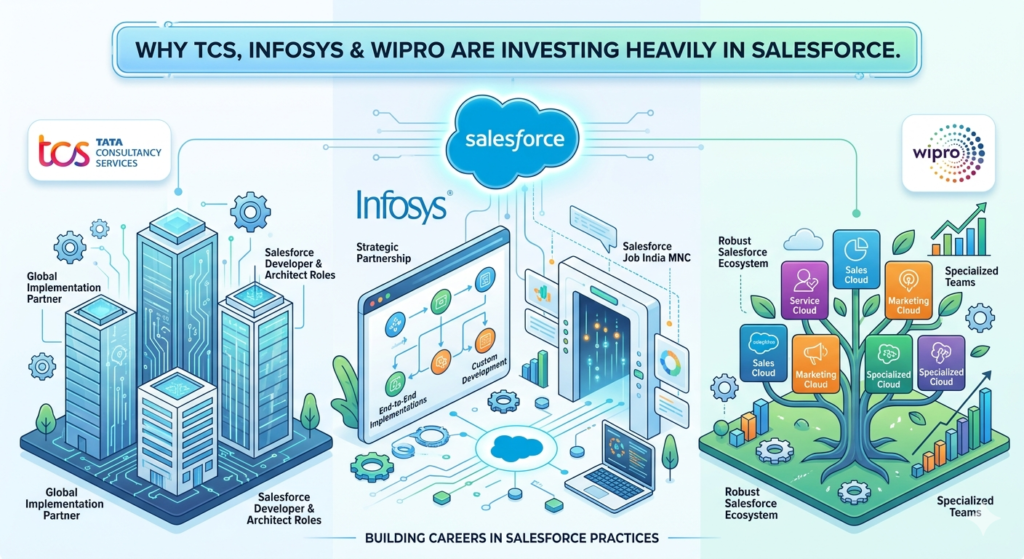
Before diving into interview preparation, it’s essential to understand why TCS, Infosys, and Wipro are actively building their Salesforce practices:
TCS (Tata Consultancy Services) has established itself as one of Salesforce’s largest global implementation partners, with dedicated Salesforce practice areas serving clients across industries. The company regularly hires both freshers and experienced professionals for roles ranging from Salesforce Developer to Solution Architect.
Infosys has made significant investments in its Salesforce capabilities through its strategic partnership with Salesforce, creating numerous Salesforce job India MNC opportunities. The company focuses on end-to-end implementations, custom development, and managed services.
Wipro has built a robust Salesforce ecosystem with specialized teams for different Salesforce clouds (Sales Cloud, Service Cloud, Marketing Cloud, etc.), creating diverse career paths for professionals at various experience levels.
Roles and Career Progression
These organizations typically hire for the following Salesforce roles:
- Salesforce Administrator (Freshers to 2 years experience)
- Salesforce Developer (1-5 years experience)
- Salesforce Consultant (2-6 years experience)
- Technical Lead (5-8 years experience)
- Solution Architect (8+ years experience)
Understanding which role you’re applying for helps you tailor your preparation for the Salesforce MNC interview accordingly.
Company-Specific Preparation Strategies
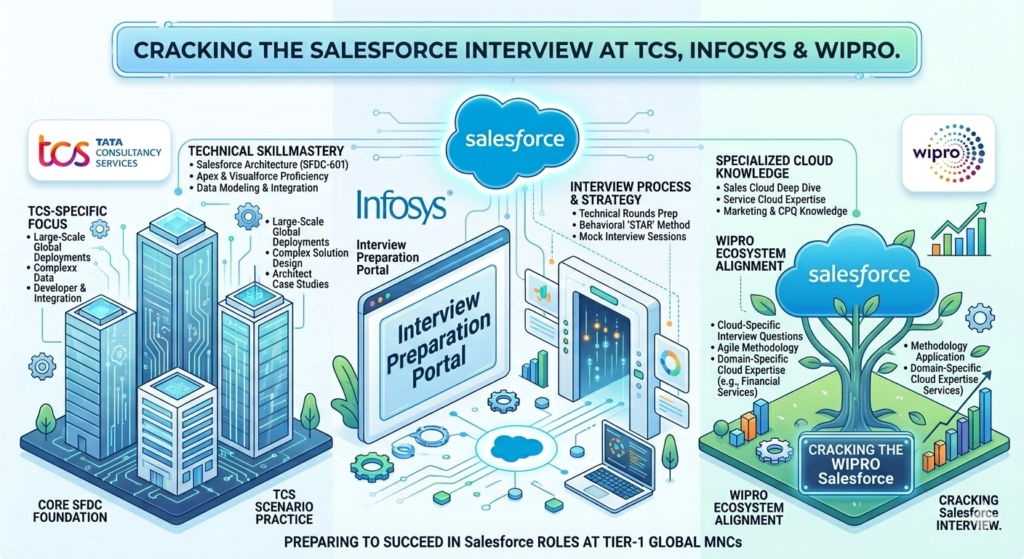
Cracking the TCS Salesforce Interview
TCS follows a structured interview process that typically includes multiple rounds:
Interview Structure at TCS
- Initial Screening Round: HR preliminary assessment and basic aptitude test
- Technical Round 1: Core Salesforce knowledge and hands-on problem-solving
- Technical Round 2: Advanced concepts, scenario-based questions
- HR Round: Cultural fit, communication skills, and salary negotiation
TCS-Specific Preparation Tips
Focus on Fundamentals: TCS places significant emphasis on foundational knowledge. Ensure you have a solid grasp of:
- Salesforce architecture and multi-tenant environment
- Object relationships (Master-Detail, Lookup, Junction objects)
- Security model (OWD, Sharing Rules, Profiles, Permission Sets)
- Data management and governor limits
- Apex basics and triggers
Project-Based Questions: TCS interviewers often ask candidates to describe real-world scenarios. Prepare to discuss:
- Projects you’ve worked on (even if they’re practice projects)
- Challenges you faced and how you solved them
- Why you chose particular Salesforce features for specific requirements
TCS Values Alignment: Research TCS’s core values and be ready to demonstrate how your approach to problem-solving aligns with their culture of innovation and client-centricity.
Certification Emphasis: For Salesforce interview TCS Infosys Wipro preparation, note that TCS particularly values certified professionals. Having at least the Salesforce Administrator certification significantly boosts your chances.
Navigating the Infosys Salesforce Interview
Infosys has a slightly different interview approach that emphasizes both technical depth and business understanding.
Interview Structure at Infosys
- Online Assessment: Coding test and Salesforce-specific MCQs
- Technical Interview 1: In-depth technical discussion on Salesforce
- Technical Interview 2: System design and integration scenarios
- HR Interview: Behavioral questions and compensation discussion
Infosys-Specific Preparation Tips
Business Acumen: Infosys values candidates who understand not just the technology but also how Salesforce drives business value. Be prepared to:
- Explain how Salesforce features translate to business benefits
- Discuss ROI considerations for Salesforce implementations
- Demonstrate knowledge of different industry solutions
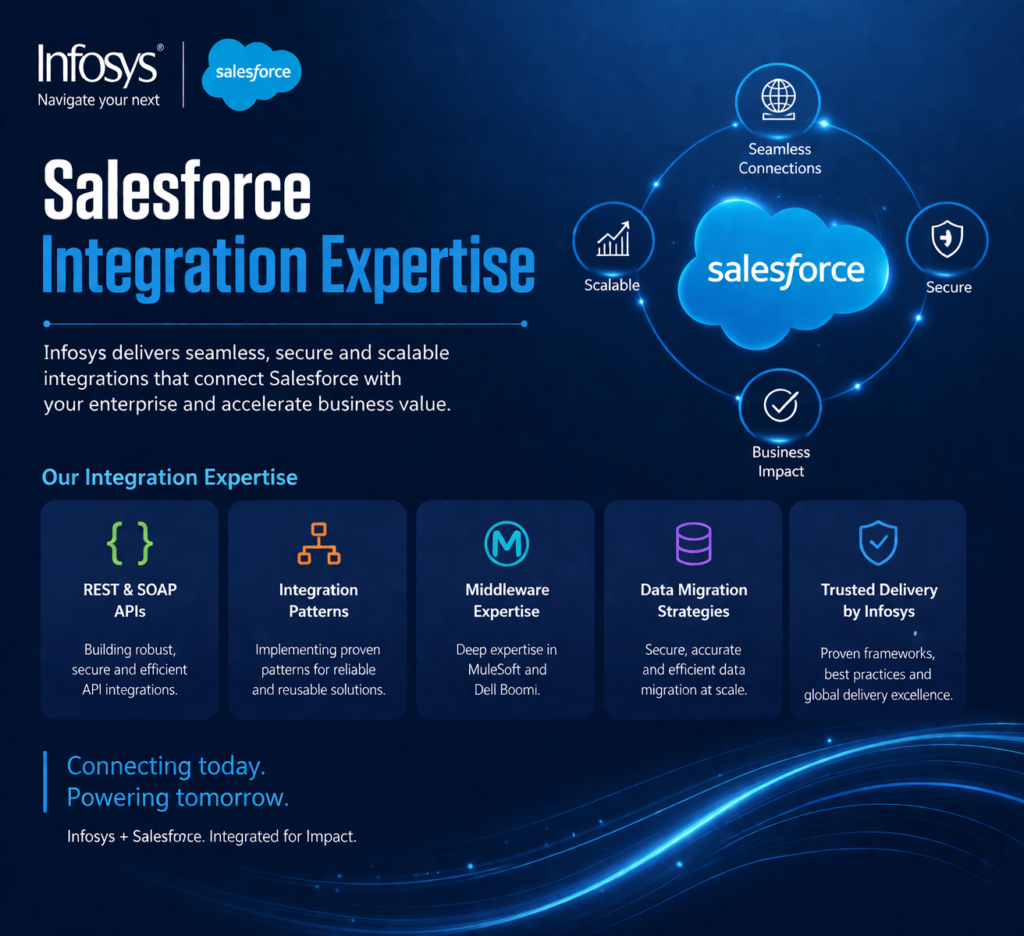
Integration Expertise: Infosys frequently works on complex integration projects. Strengthen your knowledge in:
- REST and SOAP APIs
- Integration patterns
- Middleware tools (MuleSoft, Dell Boomi)
- Data migration strategies
Problem-Solving Approach: Infosys interviewers often present hypothetical business scenarios and expect you to design solutions. Practice the approach of:
- Clarifying requirements
- Identifying constraints
- Proposing multiple solutions
- Justifying your recommended approach
Communication Skills: As Infosys works extensively with international clients, they place high importance on clear, professional communication. Practice explaining technical concepts in simple terms.
Succeeding in the Wipro Salesforce Interview
Wipro’s interview process is known for being comprehensive and occasionally more rigorous than the other two.
Interview Structure at Wipro
- Written Test: Aptitude, Salesforce basics, and logical reasoning
- Technical Round 1: Salesforce declarative and programmatic features
- Technical Round 2: Advanced development, best practices, and optimization
- Managerial Round: Project management scenarios and leadership potential
- HR Round: Final discussion on expectations and offer
Wipro-Specific Preparation Tips
Hands-On Experience: Wipro strongly emphasizes practical experience. Before your Salesforce MNC interview:
- Build a Developer Edition org with multiple custom applications
- Create a portfolio of projects you can showcase
- Be ready for live coding or configuration exercises
Best Practices and Optimization: Wipro interviews often include questions on:
- Governor limits and how to work within them
- Bulkification of code
- Performance optimization techniques
- Security best practices
Cloud-Specific Knowledge: Wipro has specialized teams for different Salesforce clouds. If you’re applying for a specific cloud role:
- Sales Cloud: Master opportunity management, forecasting, CPQ
- Service Cloud: Understand case management, knowledge base, omni-channel
- Marketing Cloud: Learn journey builder, email studio, data extensions
- Commerce Cloud: Familiarize yourself with B2C/B2B commerce fundamentals
Leadership Potential: Even for junior roles, Wipro assesses leadership potential. Prepare examples that demonstrate:
- Initiative and ownership
- Ability to mentor or help others
- Process improvement suggestions
- Handling difficult situations
Common Salesforce Interview Questions Across TCS, Infosys, and Wipro
For Freshers and Entry-Level Candidates
Foundational Concepts:
- What is Salesforce, and why is it considered a leading CRM platform?
- Expected answer should cover cloud-based architecture, customization capabilities, ecosystem, and market leadership
- Explain the difference between Role and Profile in Salesforce.
- Demonstrate understanding of security model components
- What are the different types of relationships in Salesforce?
- Lookup, Master-Detail, Many-to-Many (Junction Objects), Hierarchical
- What are governor limits, and why do they exist?
- Explain multi-tenant architecture and resource sharing
- Describe the Order of Execution in Salesforce.
- This is a frequently asked question in Salesforce interview TCS Infosys Wipro processes
- What is the difference between workflow rules and process builder?
- Discuss use cases and migration to Flow
- Explain the different ways to deploy metadata in Salesforce.
- Change sets, ANT Migration Tool, Salesforce CLI, packages
- What are the different types of Apex triggers?
- Before insert, before update, after insert, after update, before delete, after delete, after undelete
- How does the sharing model work in Salesforce?
- OWD, sharing rules, manual sharing, Apex sharing
- What is the difference between a sandbox and production environment?
- Purpose, data, refreshing, types of sandboxes
For Experienced Professionals
Advanced Technical Questions:
- How would you design a solution for a complex business requirement with multiple objects and approval processes?
- Demonstrates solution design capabilities
- Explain your approach to handling governor limit issues in a batch class processing millions of records.
- Shows understanding of bulk processing and optimization
- How do you implement platform events vs. traditional integration patterns?
- Tests knowledge of modern Salesforce integration approaches
- Describe a challenging project you worked on and how you overcame technical obstacles.
- Reveals problem-solving skills and experience depth
- How would you migrate data from a legacy system to Salesforce while maintaining data integrity?
- Data migration strategy and best practices
- Explain the use cases where you would use asynchronous Apex (future, queueable, batch, scheduled).
- Understanding of concurrent processing
- How do you implement test classes with proper code coverage and meaningful assertions?
- Quality of testing approach
- What strategies do you use for Lightning component development and optimization?
- Modern UI development expertise
- How do you approach designing a scalable architecture for a high-volume transaction system?
- Enterprise architecture knowledge
- Explain your experience with CI/CD in Salesforce development.
- Modern DevOps practices
Scenario-Based Questions Common in MNC Interviews
- A client wants to restrict users from deleting certain records based on specific criteria. How would you implement this?
- Expected approaches: Validation rules, triggers, or a combination
- Design a solution where Account Executives should only see opportunities in their territory, but managers should see their entire team’s opportunities.
- Tests understanding of territory management and sharing rules
- A batch job is hitting governor limits. How would you troubleshoot and resolve this?
- Demonstrates optimization and problem-solving skills
- How would you handle a requirement where email notifications should be sent based on complex business logic that changes frequently?
- Shows understanding of when to use code vs. configuration
- A client needs real-time synchronization between Salesforce and an external ERP system. What approach would you recommend?
- Integration architecture knowledge
Resume and Certification Tips for Landing Salesforce MNC Interviews
Crafting a Winning Salesforce Resume
Your resume is your first opportunity to make an impression. For Salesforce job India MNC applications, follow these guidelines:
For Freshers:
Highlight Relevant Skills:
- List all Salesforce certifications prominently
- Include relevant coursework, training programs, or bootcamps
- Mention projects completed during learning (even if not professional)
- Showcase any internships or academic projects involving CRM or cloud technologies
Structure Your Resume:
- Objective Statement: Clear, specific to Salesforce and the company
- Certifications: Dedicated section near the top
- Skills: Categorize into declarative, programmatic, and soft skills
- Projects: Detailed descriptions with technologies used and outcomes achieved
- Education: Include relevant academic achievements
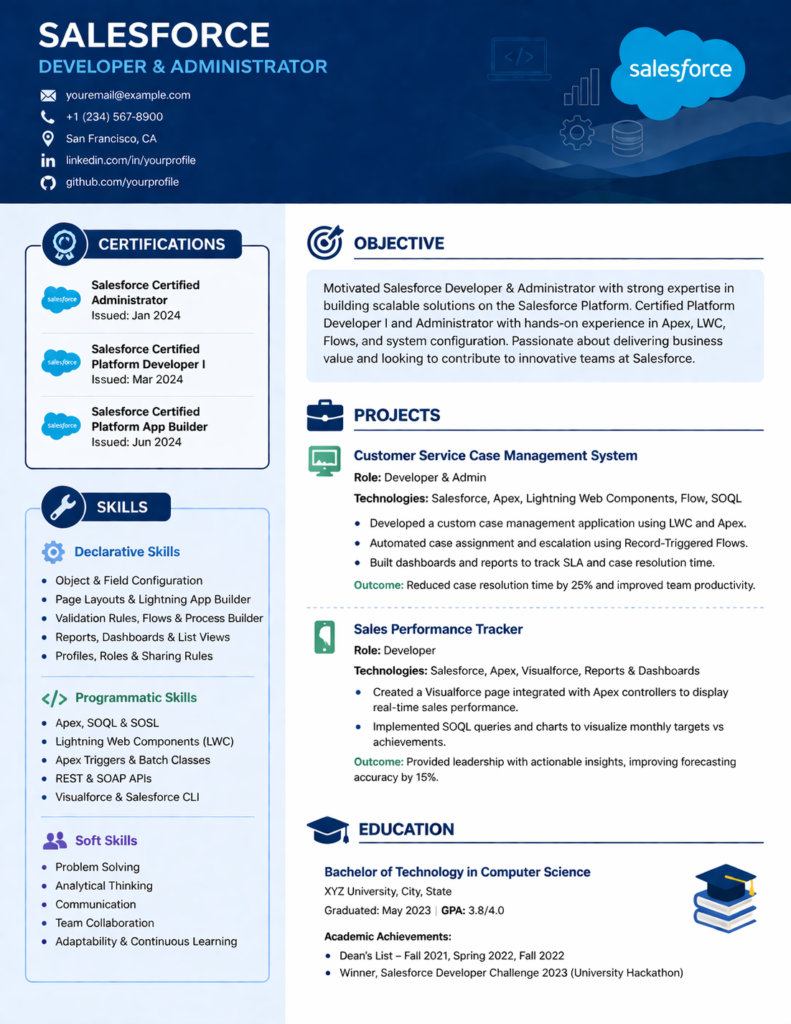
Sample Project Description:
“Developed a custom recruitment management application in Salesforce Developer Edition featuring automated candidate tracking, email notifications using workflows, custom reports and dashboards for hiring metrics, and integration with external job boards using REST API.”
For Experienced Professionals:
Emphasize Achievements:
- Use metrics wherever possible (e.g., “Implemented automation that reduced manual processing time by 40%”)
- Highlight successful project deliveries and client satisfaction
- Mention team leadership or mentoring experiences
- Include any pre-sales or client-facing activities
Quantify Your Impact:
- “Designed and implemented Sales Cloud solution for 500+ users across 15 countries”
- “Optimized Apex code reducing page load time by 60%”
- “Led migration of 2 million records from legacy CRM to Salesforce with 99.9% data accuracy”
Technology Stack:
Create a detailed skills section covering:
- Salesforce Clouds (Sales, Service, Marketing, Commerce, etc.)
- Development (Apex, LWC, Aura, Visualforce)
- Integration (REST, SOAP, MuleSoft, etc.)
- Tools (Salesforce CLI, VS Code, Workbench, Data Loader)
- Methodologies (Agile, Scrum, DevOps)
Certification Strategy for MNC Interviews
Certifications significantly improve your chances in Salesforce interview TCS Infosys Wipro processes.
For Freshers – Recommended Certification Path:
- Start with Salesforce Certified Administrator (Essential)
- Most MNCs require this as a minimum
- Covers fundamental knowledge across the platform
- Opens doors to entry-level positions
- Add Platform App Builder (Highly Recommended)
- Demonstrates ability to build custom applications
- Relatively easier to achieve after Administrator
- Shows commitment to the Salesforce career path
- Consider Advanced Administrator or Platform Developer I (Bonus)
- Sets you apart from other freshers
- Shows initiative and deeper knowledge
- May qualify you for higher compensation
For Experienced Professionals – Advanced Certifications:
- Specialized Cloud Certifications
- Sales Cloud Consultant
- Service Cloud Consultant
- Marketing Cloud Email Specialist
- Choose based on your specialization
- Development Track
- Platform Developer I (Foundation)
- Platform Developer II (Advanced)
- JavaScript Developer I (For Lightning focus)
- Architecture Track (For senior positions)
- Application Architect
- System Architect
- Data Architect
- Sharing and Visibility Architect
Pro Tip: TCS, Infosys, and Wipro often have internal requirements for certification numbers based on team targets. Having multiple certifications makes you more valuable and can lead to faster career progression.
Trailhead and Continuous Learning
Beyond certifications, actively maintain your Trailhead profile:
- Aim for Ranger or Double Star Ranger status
- Complete relevant Superbadges that demonstrate hands-on skills
- Join and contribute to the Salesforce community
- Mention your Trailhead profile on your resume with your rank
Insider Tips to Stand Out in Salesforce MNC Interviews
Pre-Interview Preparation Tactics
1. Research the Company’s Salesforce Practice
Before your Salesforce MNC interview, investigate:
- Recent Salesforce-related press releases or case studies from the company
- Their Salesforce partnership tier and specializations
- Client success stories they’ve published
- Their approach to digital transformation
This knowledge allows you to speak specifically about why you want to join their Salesforce team, not just any company.
2. Build a Personal Salesforce Brand
- Create a LinkedIn profile highlighting Salesforce skills with relevant keywords
- Share Salesforce articles or insights regularly
- Connect with Salesforce professionals from these MNCs
- Participate in Salesforce community events or user groups
3. Practice with Real Scenarios
Set up mock interview sessions focusing on:
- Live coding or configuration demonstrations
- Whiteboard system design exercises
- Explaining technical concepts to non-technical audiences
- Behavioral questions using the STAR method (Situation, Task, Action, Result)
During the Interview: Strategies That Work
1. Demonstrate Problem-Solving Approach, Not Just Answers
When asked a technical question:
- Ask clarifying questions before jumping to solutions
- Think aloud to show your thought process
- Consider multiple approaches and discuss trade-offs
- Acknowledge limitations or areas where you’d need to research further
Example:
Instead of: “I would use a trigger for that.”
Better approach: “Let me understand the requirements better. Is this a one-time occurrence or recurring? How many records might be affected? Based on that, I’m considering a few approaches: a workflow if it’s simple, Process Builder for moderate complexity, or a properly bulkified trigger if we need advanced logic. Given governor limits and maintainability, I’d recommend…”
2. Show Business Acumen Alongside Technical Skills
MNCs value professionals who understand business impact:
- Relate technical features to business outcomes
- Discuss ROI, user adoption, and change management
- Show awareness of different industry requirements
- Demonstrate understanding of stakeholder management
3. Be Honest About Knowledge Gaps
If you don’t know something:
- Admit it professionally: “I haven’t worked directly with that feature yet, but I understand the concept is…”
- Show willingness to learn: “That’s an area I’m planning to explore in my next certification study”
- Demonstrate how you’d find the answer: “I would check the Salesforce documentation and Trailhead modules for that”
Honesty builds trust and shows self-awareness, which are highly valued in Salesforce job India MNC environments.
4. Prepare Thoughtful Questions for Interviewers
Always have 3-5 questions ready:
- “What does a typical Salesforce project lifecycle look like in your team?”
- “What opportunities are there for certification support and continuous learning?”
- “How does your Salesforce practice handle work-life balance during critical project phases?”
- “What’s the team structure, and how do junior and senior members collaborate?”
- “What exciting Salesforce technologies or clouds is your practice focusing on?”
These questions show genuine interest and help you evaluate if the company is right for you.
Post-Interview Follow-Up
1. Send a Thank-You Email
Within 24 hours:
- Thank the interviewer for their time
- Briefly reiterate your interest and fit for the role
- Reference a specific discussion point from the interview
- Keep it concise and professional
2. Continue Learning
While waiting for results:
- Work on any knowledge gaps identified during the interview
- Complete relevant Trailhead modules
- Build additional projects for your portfolio
3. Stay Connected
- Connect with interviewers on LinkedIn (if appropriate)
- Continue engaging with company content
- Follow up professionally if you haven’t heard back within the stated timeframe
Common Mistakes to Avoid in Salesforce MNC Interviews
Technical Mistakes
1. Over-Relying on Coding When Configuration Would Suffice
A common trap in Salesforce interview TCS Infosys Wipro processes is immediately suggesting code-based solutions. Remember the Salesforce principle: “Click, Not Code.”
Mistake: “I would write a trigger to update these related records.”
Better: “First, I’d check if this can be accomplished with standard features like workflow rules, process builder, or Flow. If those can’t handle the complexity or governor limits become an issue, then I’d consider a properly bulkified trigger.”
2. Ignoring Governor Limits
Discussing solutions without considering governor limits shows lack of production-level thinking:
- Always mention bulkification when discussing triggers
- Consider query limits when designing solutions with multiple objects
- Discuss async processing for large data volumes
3. Unclear or Verbose Communication
Especially critical for MNCs with global clients:
- Avoid using too much technical jargon without context
- Structure your answers with clear beginning, middle, and end
- Practice explaining complex concepts simply
4. Not Testing Knowledge Claims
If you list a skill on your resume, be prepared for in-depth questions about it. Avoid:
- Exaggerating experience levels
- Claiming expertise in areas you’ve only read about
- Listing technologies you’ve used minimally
Behavioral and Soft Skills Mistakes
1. Speaking Negatively About Previous Employers or Projects
Even when discussing challenges:
- Frame problems as learning opportunities
- Focus on how you handled difficult situations professionally
- Avoid blaming others or being overly critical
2. Failing to Demonstrate Cultural Fit
Research each company’s values:
- TCS emphasizes innovation and sustainability
- Infosys focuses on continuous learning and agility
- Wipro highlights diversity and social responsibility
Show how your values align during the interview.
3. Not Asking for Clarification
When faced with unclear questions:
- Always ask for clarification rather than guessing
- Confirm your understanding before answering
- This demonstrates careful listening and thoroughness
4. Appearing Desperate or Disinterested
Balance enthusiasm with professionalism:
- Show genuine interest in the Salesforce ecosystem
- Be excited about the opportunity without appearing desperate
- Maintain confident body language and engagement
Resume and Application Mistakes
1. Generic Resumes
Tailor your resume for each application:
- Highlight relevant experience for the specific role
- Use keywords from the job description
- Adjust your objective statement for each company
2. Certification Without Understanding
Having certifications is valuable, but be ready to:
- Discuss what you learned from each certification
- Apply certification knowledge to real scenarios
- Explain why you chose specific certifications for your career path
3. Typos and Formatting Issues
Thoroughly proofread:
- Use consistent formatting throughout
- Check for spelling and grammatical errors
- Ensure contact information is current and professional
Success Stories: Learning from Those Who’ve Made It
From Fresher to Salesforce Professional at TCS
Priya’s Journey:
Priya, a recent B.Tech graduate with no prior work experience, successfully landed a Salesforce Administrator role at TCS. Her strategy:
- Certification Focus: Completed Administrator and Platform App Builder certifications while in final year
- Practical Projects: Built three full applications in Developer Edition demonstrating different Salesforce capabilities
- Community Engagement: Actively participated in Salesforce Saturday events and local user groups
- Interview Preparation: Practiced 100+ interview questions and created a portfolio to showcase during interviews
Key Takeaway: For freshers targeting Salesforce job India MNC positions, certifications combined with demonstrable projects create a compelling profile even without professional experience.
Career Transition at Infosys
Rajesh’s Path:
Rajesh, a Java developer with 4 years of experience, transitioned to Salesforce at Infosys:
- Leveraged Transferable Skills: Highlighted his Java background when discussing Apex
- Strategic Learning: Focused on integration scenarios where his development background was an advantage
- Certification Acceleration: Obtained Admin, Platform App Builder, and Platform Developer I within 6 months
- Internal Opportunities: Applied through Infosys’s internal job portal leveraging company familiarity
Key Takeaway: Career changers should emphasize transferable skills and show how their previous experience adds unique value to Salesforce projects.
Building Your Long-Term Salesforce Career in MNCs
Career Progression Paths
Understanding potential career growth helps you prepare better for Salesforce MNC interview discussions about long-term goals:
Technical Track:
Administrator → Developer → Technical Lead → Technical Architect → Distinguished Architect
Functional Track:
Functional Consultant → Senior Consultant → Solution Architect → Principal Architect
Management Track:
Team Member → Team Lead → Project Manager → Delivery Manager → Practice Head
Hybrid Path:
Many successful Salesforce professionals combine technical and functional expertise, becoming versatile assets to their organizations.
Continuous Learning and Growth
To thrive in TCS, Infosys, or Wipro’s Salesforce practices:
1. Stay Updated with Salesforce Releases
- Salesforce releases three times annually (Spring, Summer, Winter)
- Review release notes for your area of focus
- Test new features in your Developer Edition org
2. Pursue Advanced Certifications
- MNCs often sponsor certification costs and provide study time
- Each certification increases your market value
- Aim for specialization in specific clouds or architecture
3. Contribute to the Community
- Answer questions on Salesforce Stack Exchange or Trailblazer Community
- Write blog posts about solutions you’ve implemented
- Speak at user groups or community events
- Mentor junior team members
4. Build Cross-Functional Skills
- Learn about agile methodologies
- Develop project management capabilities
- Improve client-facing and presentation skills
- Understand industry-specific business processes
Conclusion: Your Action Plan for Salesforce MNC Interview Success
Cracking a Salesforce interview at TCS, Infosys, or Wipro is an achievable goal with the right preparation strategy. Whether you’re a fresher taking your first steps into the Salesforce ecosystem or an experienced professional looking to join a prestigious MNC, success comes from a combination of technical expertise, strategic preparation, and effective communication.
Your 30-Day Action Plan
Week 1: Foundation Building
- Complete or review Salesforce Administrator certification materials
- Set up a Developer Edition org and build a sample application
- Review fundamental concepts: object relationships, security model, automation tools
- Research the specific MNC you’re targeting and their Salesforce practice
Week 2: Technical Deep Dive
- Study advanced topics relevant to your target role
- Practice coding in Apex and building Lightning components
- Complete relevant Superbadges on Trailhead
- Build a portfolio project demonstrating end-to-end solution design
Week 3: Interview Preparation
- Practice answering common interview questions (from this guide)
- Conduct mock interviews with peers or mentors
- Prepare your STAR stories for behavioral questions
- Refine your resume and ensure it’s tailored to the role
Week 4: Final Polish
- Review the company’s recent Salesforce projects and news
- Prepare thoughtful questions for your interviewers
- Practice explaining technical concepts in simple terms
- Review your certifications and be ready to discuss what you learned
Key Takeaways
- Certifications Matter: For Salesforce job India MNC applications, certifications are often mandatory and always advantageous
- Hands-On Experience is Critical: Build real projects, not just theoretical knowledge
- Company-Specific Preparation: TCS, Infosys, and Wipro each have unique interview styles and cultural values
- Communication is as Important as Technical Skills: MNCs value professionals who can explain technical concepts to diverse stakeholders
- Demonstrate Business Acumen: Show that you understand how Salesforce drives business value, not just how it works technically
- Be Authentic: Honesty about knowledge gaps, combined with willingness to learn, builds trust
- Continuous Learning is Essential: The Salesforce ecosystem evolves rapidly; show commitment to staying current
Final Motivation
The Salesforce ecosystem is thriving in India, with TCS, Infosys, and Wipro at the forefront of major implementations worldwide. These organizations offer not just jobs, but career paths with immense growth potential, exposure to cutting-edge technologies, and opportunities to work on transformative projects for global clients.
Your Salesforce MNC interview is not just a test of what you know today, but a conversation about your potential to grow and contribute. Approach it with confidence built on solid preparation, genuine curiosity about the platform, and enthusiasm for solving business problems through technology.
Remember, every Salesforce expert you admire today once sat where you are now, preparing for their first interview. With dedication, strategic preparation using this guide, and a genuine passion for the Salesforce ecosystem, you can join the ranks of successful Salesforce professionals at India’s leading MNCs.
About RizeX Labs
We’re Pune’s leading IT training institute specializing in emerging technologies like Salesforce and cloud computing. At RizeX Labs, we empower aspiring professionals with hands-on Salesforce training, real-world projects, and expert mentorship.
Our mission is to help learners crack interviews at top Indian MNCs like TCS, Infosys, and Wipro by building strong technical foundations, real-time problem-solving skills, and interview readiness.
Internal Links:
- Salesforce Admin & Development Training
- Salesforce Apex Triggers: Beginner’s Guide with Real-Time Examples
- Salesforce Lightning Web Components (LWC) vs Aura: Which Should You Learn First
External Links
- Salesforce official website
- Salesforce Trailhead (learning platform)
- Salesforce Developer documentation
Quick Summary
Cracking a salesforce interview TCS Infosys Wipro requires more than just theoretical knowledge. Candidates must focus on strong fundamentals, hands-on project experience, certifications, and real-world problem-solving skills. Top Indian MNCs like TCS, Infosys, and Wipro look for professionals who can not only understand Salesforce concepts but also apply them in real business scenarios. While TCS emphasizes fundamentals, Infosys focuses on business use cases and integrations, and Wipro evaluates practical knowledge and optimization techniques. The best strategy is to combine: Strong core Salesforce knowledge Practical project experience Certifications like Salesforce Administrator Mock interview practice By following a structured preparation plan and staying consistent, you can successfully land a salesforce job in India MNCs and build a long-term career in the Salesforce ecosystem.