
The Salesforce Administrator certification is often marketed as a golden ticket to six-figure salaries and instant career transformation. Let’s cut through the noise.
The reality? A Salesforce Certified Admin in India can earn anywhere from ₹3.5 lakhs to ₹15 lakhs per annum, and that massive range isn’t arbitrary—it’s determined by specific, measurable factors that most career advice blogs conveniently skip over.
If you’re researching Salesforce admin salary India expecting a simple number, you’re asking the wrong question. The certification alone doesn’t determine your paycheck. Your experience level, technical skill depth, the company you work for, your negotiation skills, and your location do.
This guide provides an unvarnished look at Salesforce Administrator salaries in India for 2026, backed by actual hiring data, not recruiter marketing speak.
The Real Numbers: Salesforce Admin Salary Breakdown by Experience
Here’s what Salesforce Administrators actually earn in India across different experience levels in 2026:
| Experience Level | Salary Range (INR per annum) | Median Salary | Skills Expected |
|---|---|---|---|
| 0-1 Year (Entry Level) | ₹3.5L – ₹6L | ₹4.5L | Basic admin tasks, user management, basic configuration |
| 1-3 Years (Junior Admin) | ₹5L – ₹9L | ₹7L | Custom objects, workflows, reports, dashboards, basic automation |
| 3-5 Years (Mid-Level Admin) | ₹8L – ₹13L | ₹10.5L | Advanced automation, Lightning Experience, integrations, data migration |
| 5-8 Years (Senior Admin) | ₹12L – ₹18L | ₹15L | Complex integrations, org strategy, multiple clouds, team leadership |
| 8+ Years (Lead/Architect path) | ₹16L – ₹25L+ | ₹20L | Solution architecture, multiple certifications, pre-sales, consulting |
Important Context:
These figures represent in-hand annual compensation including base salary and standard performance bonuses. They exclude equity, which is relevant for product startups but rare for pure admin roles.
Entry-level salaries haven’t changed dramatically in the past two years despite certification volume increasing. The market has matured—employers now differentiate between “certified on paper” and “production-ready.”
Location-Specific Salary Breakdown
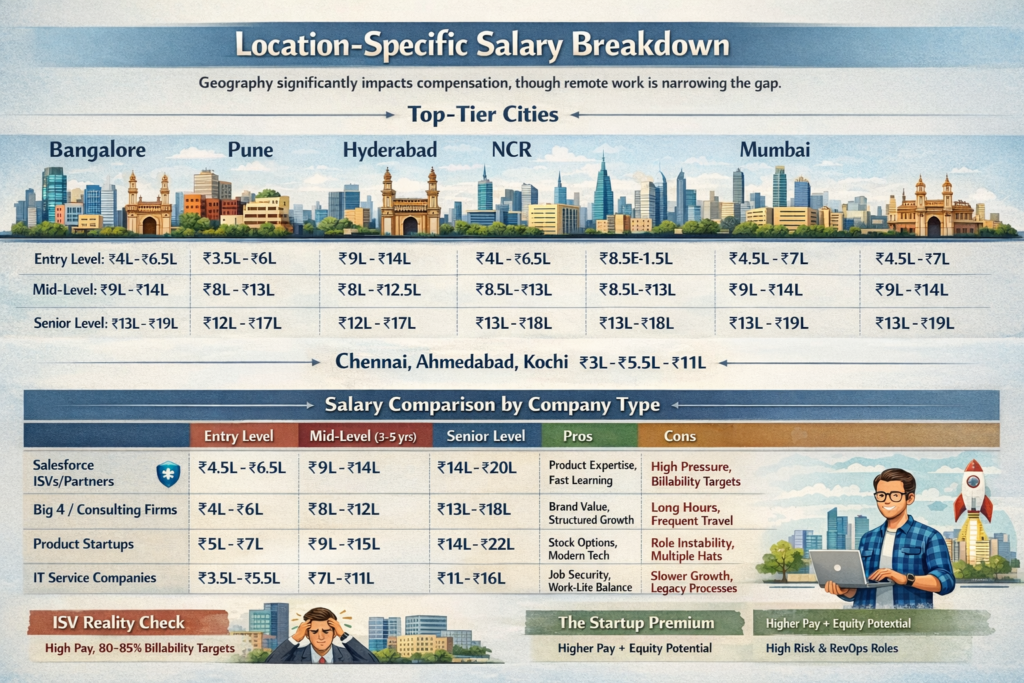
Geography significantly impacts compensation, though remote work is narrowing the gap.
Top-Tier Cities
Bangalore:
- Entry Level: ₹4L – ₹6.5L
- Mid-Level (3-5 years): ₹9L – ₹14L
- Senior Level: ₹13L – ₹19L
Bangalore hosts the highest concentration of Salesforce ISVs, consulting firms, and implementation partners. The competition is fierce, but opportunities are abundant.
Pune:
The Salesforce certified admin salary Pune landscape sits slightly below Bangalore but offers better cost-of-living ratios:
- Entry Level: ₹3.5L – ₹6L
- Mid-Level (3-5 years): ₹8L – ₹13L
- Senior Level: ₹12L – ₹17L
Pune has emerged as a significant Salesforce hub with major consulting firms like Accenture, Deloitte, and Cognizant maintaining large Salesforce practices. Several product companies with Salesforce implementations also operate here.
What makes Pune interesting for Salesforce admins:
- Lower living costs compared to Bangalore (typically 20-30% less)
- Growing number of direct client opportunities (not just consulting)
- Established tech ecosystem with good networking opportunities
- Less competition for mid-level roles compared to Bangalore
Hyderabad:
- Entry Level: ₹3.5L – ₹6L
- Mid-Level: ₹8L – ₹12.5L
- Senior Level: ₹12L – ₹17L
Strong captive centers and shared services hubs. Microsoft’s presence has created a cloud-savvy talent pool.
NCR (Delhi/Gurgaon/Noida):
- Entry Level: ₹4L – ₹6.5L
- Mid-Level: ₹8.5L – ₹13L
- Senior Level: ₹13L – ₹18L
Dominated by consulting firms and enterprise clients. Salaries reflect higher living costs.
Mumbai:
- Entry Level: ₹4.5L – ₹7L
- Mid-Level: ₹9L – ₹14L
- Senior Level: ₹13L – ₹19L
BFSI sector dominance means stable opportunities but often conservative tech adoption.
Tier-2 Cities
Chennai, Ahmedabad, Kochi:
- Entry Level: ₹3L – ₹5.5L
- Mid-Level: ₹7L – ₹11L
- Senior Level: ₹11L – ₹15L
Growing markets with improving opportunities, especially for remote positions that pay metro-area salaries.
Company Type: Where You Work Matters More Than You Think
The type of company employing you creates salary variations of 40-60% for the same experience level.
Salary Comparison by Company Type
| Company Type | Entry Level | Mid-Level (3-5 yrs) | Senior Level | Pros | Cons |
|---|---|---|---|---|---|
| Salesforce ISVs/Partners | ₹4.5L – ₹6.5L | ₹9L – ₹14L | ₹14L – ₹20L | Direct product exposure, fast learning | High pressure, billability targets |
| Big 4/Consulting Firms | ₹4L – ₹6L | ₹8L – ₹12L | ₹13L – ₹18L | Brand value, structured growth | Long hours, frequent travel |
| Product Startups | ₹5L – ₹7L | ₹9L – ₹15L | ₹14L – ₹22L | Stock options, modern tech stack | Role instability, wearing multiple hats |
| IT Service Companies | ₹3.5L – ₹5.5L | ₹7L – ₹11L | ₹11L – ₹16L | Job security, work-life balance | Slower growth, legacy processes |
| Enterprise In-House Teams | ₹4L – ₹6.5L | ₹8.5L – ₹13L | ₹13L – ₹19L | Focused domain expertise, stability | Limited Salesforce exposure breadth |
Reality Check on ISV Partners:
Salesforce implementation partners (like Persistent, LTI, Apphilon) often pay premium salaries but expect consultancy-level commitment. Billability targets of 80-85% are standard. If you’re not client-facing 40+ hours weekly, you’ll feel the pressure.
The Startup Premium (and Risk):
Product startups using Salesforce for their sales operations may offer higher base salaries plus equity. However, admin roles here often blend into RevOps, requiring SQL, APIs, and data analysis skills beyond traditional admin scope. The equity is usually worthless unless you join a later-stage, funded startup.
Key Factors That Actually Affect Your Salary
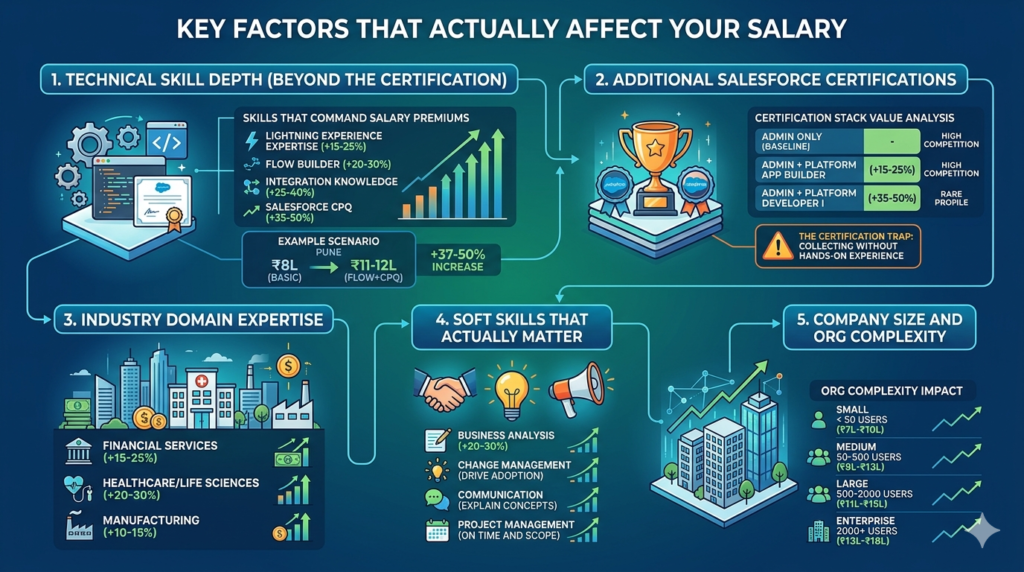
1. Technical Skill Depth (Beyond the Certification)
The Admin certification proves you can pass a multiple-choice exam. Production environments require deeper expertise.
Skills that command salary premiums:
| Skill Category | Impact on Salary | Why It Matters |
|---|---|---|
| Lightning Experience Expertise | +15-25% | Most orgs are migrating; few admins are truly proficient |
| Flow Builder (Process Automation) | +20-30% | Replaces workflow rules; complex logic implementation |
| Integration Knowledge (APIs, Middleware) | +25-40% | Connects Salesforce to external systems; high-demand skill |
| Data Migration & Quality Management | +15-25% | Critical for implementations; few do it well |
| Lightning Web Components (Basic) | +30-45% | Bridges admin to developer; rare combination |
| Salesforce CPQ | +35-50% | Specialized, complex, high-value for sales operations |
| Einstein Analytics/Tableau CRM | +25-35% | Data visualization and advanced analytics |
Example scenario:
A 3-year experienced admin in Pune earning ₹8L with basic admin skills could jump to ₹11-12L by adding Flow Builder expertise and completing two CPQ implementations. That’s a 37-50% increase for 6-9 months of focused skill development.
2. Additional Salesforce Certifications
More certifications signal commitment but don’t automatically translate to higher pay unless they match market demand.
Certification Stack Value Analysis:
| Certification Combination | Salary Multiplier | Market Demand |
|---|---|---|
| Admin only | Baseline | High competition |
| Admin + Advanced Admin | +5-10% | Limited differentiation |
| Admin + Platform App Builder | +15-25% | Strong demand; shows technical depth |
| Admin + Sales/Service Cloud | +10-20% | Domain specialization; consulting advantage |
| Admin + CPQ Specialist | +30-50% | Niche; high-value projects |
| Admin + Marketing Cloud | +25-40% | Different ecosystem; less competition |
| Admin + Platform Developer I | +35-50% | Bridges gap to development; rare profile |
The certification trap:
Collecting certifications without hands-on implementation experience creates a resume that looks impressive but performs poorly in technical interviews. One admin with 4 certifications and no real project work will lose out to another with 1 certification and 3 complex implementations every time.
3. Industry Domain Expertise
Salesforce implementations vary wildly by industry. Deep domain knowledge commands premium compensation.
Industry-Specific Salary Premiums:
- Financial Services (BFSI): +15-25% premium (regulatory complexity, compliance requirements)
- Healthcare/Life Sciences: +20-30% premium (HIPAA, specialized clouds, limited talent pool)
- Manufacturing: +10-15% premium (complex B2B processes, CPQ integration)
- Retail/E-commerce: Baseline (standard implementations)
- Non-profit: -10-20% discount (budget constraints, simpler requirements)
4. Soft Skills That Actually Matter
Technical skills get you interviews. These skills get you offers and promotions:
Business Analysis: Understanding client requirements and translating them to Salesforce configuration. Admins who ask “why” instead of just implementing “what” earn 20-30% more.
Change Management: Rolling out new features without user rebellion. Organizations pay premium for admins who can drive adoption, not just build features.
Communication: Explaining technical concepts to non-technical stakeholders. The admin who can present to C-suite executives is promoted to lead roles faster.
Project Management: Delivering implementations on time and scope. Even without formal PM certification, admins who manage timelines and stakeholders earn significantly more.
5. Company Size and Salesforce Org Complexity
Managing a 10-user org versus a 5,000-user multi-cloud org are different jobs entirely.
Org Complexity Impact:
| Org Size | User Count | Typical Salary Range (3-5 years exp) | Complexity Factors |
|---|---|---|---|
| Small | < 50 users | ₹7L – ₹10L | Single instance, basic automation |
| Medium | 50-500 users | ₹9L – ₹13L | Multiple teams, moderate customization |
| Large | 500-2000 users | ₹11L – ₹15L | Multiple clouds, integrations, governance |
| Enterprise | 2000+ users | ₹13L – ₹18L | Global rollouts, complex security, multiple orgs |
The Reality Check: Debunking Common Salary Myths
Myth 1: “Get certified and earn ₹8 LPA immediately”
Reality: Entry-level certified admins with zero experience typically start at ₹3.5-5L, not ₹8L. The ₹8L figure represents 2-3 years of experience with multiple successful implementations.
Training institutes market aspirational numbers because it sells courses. The job market pays for demonstrated capability.
Myth 2: “Salesforce admins are in such high demand you can pick your salary”
Reality: Demand exists for experienced, skilled admins. The market is saturated with freshly-certified candidates who struggle to find their first role.
In 2026, major job portals show 15-20 candidates applying per entry-level admin position in metros. For senior roles (5+ years), the ratio inverts—often 3-4 open positions per qualified candidate.
Myth 3: “Remote work means you can earn Bangalore salaries from tier-2 cities”
Reality: Partially true but nuanced. Many companies now offer location-adjusted remote salaries—typically 80-90% of metro rates for tier-2 city residents.
However, fully remote positions with pure consulting firms or product companies often pay metro-equivalent salaries regardless of location. The key is targeting the right employers.
Myth 4: “Salesforce admin salaries double every 2 years”
Reality: Exponential growth happens in the 0-5 year range if you’re strategic. From ₹4L to ₹8L in 2 years is achievable with job switches and skill additions. From ₹8L to ₹16L in the next 2 years is unrealistic unless you transition to specialized consulting or architecture roles.
Post 5 years, growth stabilizes to 15-25% annually unless you shift into leadership or specialized technical tracks.
Myth 5: “Certifications alone justify salary hikes”
Reality: Certifications without corresponding project experience don’t move the needle much in current-company negotiations. They’re powerful during job switches when combined with demonstrated implementations.
If you get Platform App Builder certified but never built a custom app in production, expect minimal salary impact. Use new certifications as leverage during external opportunities, not internal reviews.
Career Growth Path: Beyond the Admin Role
Salesforce Administrator is rarely a terminal role. Understanding growth trajectories helps salary planning.
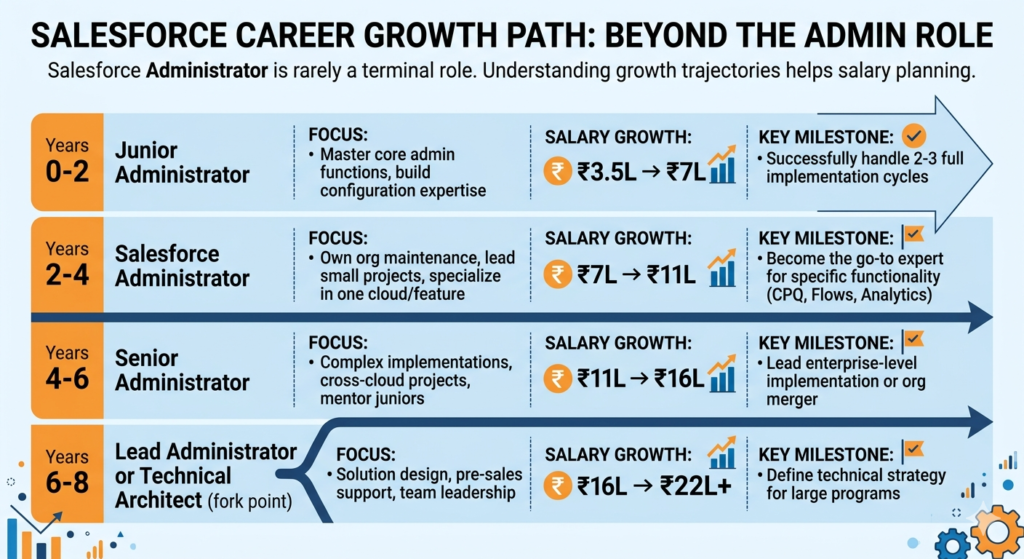
Typical Career Progression
Years 0-2: Junior Administrator
- Focus: Master core admin functions, build configuration expertise
- Salary Growth: ₹3.5L → ₹7L
- Key Milestone: Successfully handle 2-3 full implementation cycles
Years 2-4: Salesforce Administrator
- Focus: Own org maintenance, lead small projects, specialize in one cloud/feature
- Salary Growth: ₹7L → ₹11L
- Key Milestone: Become the go-to expert for specific functionality (CPQ, Flows, Analytics)
Years 4-6: Senior Administrator
- Focus: Complex implementations, cross-cloud projects, mentor juniors
- Salary Growth: ₹11L → ₹16L
- Key Milestone: Lead enterprise-level implementation or org merger
Years 6-8: Lead Administrator or Technical Architect (fork point)
- Focus: Solution design, pre-sales support, team leadership
- Salary Growth: ₹16L → ₹22L+
- Key Milestone: Define technical strategy for large programs
Alternative Growth Tracks
Path 1: Technical Specialist → Developer → Technical Architect
Admins with development aptitude can transition to Platform Developer roles. This path typically offers 30-40% salary jump during transition and ₹25-35L potential at senior levels.
Required skills: Apex, Lightning Web Components, JavaScript, advanced integration patterns
Path 2: Functional Specialist → Solution Architect → Enterprise Architect
Focus on business processes and solution design rather than code. Consulting-heavy path with strong communication requirements.
Salary potential: ₹22-40L at enterprise architect level
Path 3: RevOps/Sales Operations Specialist
Leverage Salesforce admin skills in revenue operations roles at product companies. Often requires additional skills in SQL, data analysis, and broader tech stack.
Salary potential: ₹18-30L at senior RevOps roles in funded startups
Path 4: Consulting → Independent Consultant
After 6-8 years, experienced admins sometimes go independent, working on contract implementations.
Earning potential: ₹2,500 – ₹8,000 per day (roughly ₹6-20L annually for 200 billable days)
Risks: Inconsistent pipeline, self-employment overhead, no benefits
Location Deep-Dive: Salesforce Certified Admin Salary Pune
Since Pune represents a significant Salesforce talent market, here’s detailed compensation intelligence specific to this city.
Pune Market Characteristics (2026)
Major Employers:
- Accenture (large Salesforce practice)
- Cognizant Technology Solutions
- Persistent Systems
- LTI Mindtree
- Mphasis
- Multiple ISV partners and smaller consulting firms
Entry-Level Market:
The Salesforce certified admin salary Pune for freshers (0-1 year) ranges ₹3.5-5.5L in 2026. The lower end applies to mass-recruiter IT services firms, while boutique Salesforce implementation partners and product companies offer the higher end.
What affects your entry-level offer in Pune:
- Engineering degree from Tier-1 college: +₹0.5-1L over average
- Prior internship with Salesforce exposure: +₹0.5-1.5L
- Trailhead badges (500+) + real project demos: +₹0.5-1L
- Multiple certifications (Admin + App Builder): +₹1-1.5L
Mid-Level Market (3-5 years):
Pune’s sweet spot. The ₹8-13L range has substantial opportunities. Experienced admins find less competition here than Bangalore, making it easier to secure roles at the higher end of the range.
Factors for maximizing mid-level salary in Pune:
- Domain specialization (BFSI, Healthcare): Premium of ₹1.5-2.5L over generalist roles
- Client-facing experience: Pune consulting firms value admins who’ve handled direct client interactions
- Full-cycle implementation experience: Led at least one project from requirements to go-live
- Integration expertise: Pune has strong demand for admins who can handle Mulesoft, Dell Boomi, or custom API integrations
Senior-Level Market (5+ years):
Senior Salesforce admin positions in Pune (₹12-17L range) often require:
- Managing offshore-onsite models
- Pre-sales support (solution presentations, effort estimation)
- Team leadership (mentoring 2-4 junior admins)
- Multiple cloud expertise (Sales + Service or Sales + CPQ)
Pune vs. Bangalore Salary Comparison (Same Experience):
| Experience | Pune Range | Bangalore Range | Difference |
|---|---|---|---|
| 0-1 year | ₹3.5-5.5L | ₹4-6.5L | 10-15% lower |
| 3-5 years | ₹8-13L | ₹9-14L | 8-12% lower |
| 5-8 years | ₹12-17L | ₹13-19L | 8-12% lower |
Cost of Living Adjusted Advantage:
While absolute salaries are 8-15% lower in Pune, the cost of living (especially housing) is 25-35% lower than Bangalore. This creates a real income advantage for Pune-based Salesforce admins.
Example:
- ₹11L salary in Pune with ₹15,000/month housing cost
- ₹12L salary in Bangalore with ₹25,000/month housing cost
The Pune professional has higher disposable income despite lower absolute salary.
Pune Job Market Trends (2026)
Growing Demand Areas:
- Manufacturing sector implementations (Pune’s industrial ecosystem)
- CPQ specialists for B2B companies
- Field Service Lightning (manufacturing and utilities focus)
Remote Work Impact:
Pune-based admins increasingly access roles with Bangalore or NCR-based employers at metro-equivalent salaries. However, many positions still require quarterly travel or hybrid arrangements.
Actionable Strategies to Increase Your Salesforce Admin Salary
Enough data. Here’s what actually works to increase compensation.
For Entry-Level Admins (0-2 years)
1. Build a Portfolio, Not Just Certifications
Create a free Developer Edition org and build:
- A custom sales pipeline app with automation
- A complete case management system with escalation flows
- Integration between Salesforce and Google Sheets using APIs
- Custom reports and dashboards solving a real business problem
Why it works: Demonstrates actual capability beyond memorizing exam answers. Include these in your resume with GitHub repos of your configuration (use tools like Salesforce CLI to version control).
Time investment: 40-60 hours over 2-3 months
Salary impact: Converts ₹4L offers to ₹5.5-6L offers
2. Target the Right First Employer
Your first Salesforce job determines your trajectory for 3-4 years.
Optimal path: Aim for Salesforce implementation partners (even at slightly lower salary) over general IT service companies. You’ll gain diverse project exposure that accelerates learning.
Sub-optimal path: Joining a large enterprise in a pure admin role with limited Salesforce complexity. Growth stagnates after 12-18 months.
3. Volunteer for Salesforce Non-Profits
Power of Us program offers free licenses to non-profits. Many need admin help.
Value: Real-world experience, reference, portfolio project, networking
Commitment: 5-10 hours monthly for 6 months
For Mid-Level Admins (2-5 years)
1. Develop a Niche Specialization
Choose one high-demand area and become the expert:
CPQ Track:
- Get CPQ Specialist certification
- Complete 2-3 CPQ implementations (volunteer for these projects)
- Expected salary jump: ₹8L → ₹12-14L within 18 months
Integration Track:
- Learn REST/SOAP API basics
- Get comfortable with Postman, integration patterns
- Complete Platform Developer I certification
- Expected salary jump: ₹8L → ₹11-13L within 12 months
Lightning Migration Track:
- Master Lightning Experience, Lightning App Builder
- Learn Lightning Web Components basics
- Position yourself as migration specialist
- Expected salary jump: ₹9L → ₹12-14L within 15 months
2. Change Jobs Strategically
Brutal truth: External moves generate 25-40% salary increases. Internal promotions yield 10-15%.
Optimal timing: Every 24-30 months for years 2-6 of your career
How to maximize offer:
- Never disclose current salary (illegal for employers to mandate in many states)
- Research market rates for your skill combination
- Have competing offers or be genuinely willing to stay in current role
- Negotiate total compensation, not just base salary
3. Contribute to Salesforce Community
Activities that build your brand:
- Write technical blog posts (Medium, personal blog)
- Answer questions on Salesforce Stack Exchange
- Present at local Salesforce user groups
- Create YouTube tutorials on advanced admin topics
Direct salary impact: Minimal immediately, but builds reputation leading to inbound opportunities
Time to impact: 6-12 months of consistent contribution
For Senior Admins (5+ years)
1. Transition to Architecture or Leadership
Pure admin roles plateau around ₹16-18L. Breaking past requires role evolution.
Architecture path:
- Get Application Architect certification
- Lead solution design on 2-3 complex programs
- Develop pre-sales skills (RFP responses, solution presentations)
Salary target: ₹20-28L
Leadership path:
- Manage team of 4-6 admins/developers
- Own P&L for practice (if in consulting)
- Develop business development skills
Salary target: ₹22-30L + variable compensation
2. Consider Product Companies Over Services
Senior admins in product companies often earn 20-30% more than consulting equivalents, with better work-life balance.
Trade-off: Narrower Salesforce exposure (single org) vs. broader business impact
Target companies: SaaS startups in Series B+ funding stages, established tech companies with Salesforce-powered sales operations
3. Build Your Exit Options
At senior levels, maintain these:
- Active LinkedIn with regular posts
- Relationship with 2-3 specialist recruiters
- Annual market rate calibration (interview even when not job hunting)
- Updated portfolio of implementations led
Goal: Negotiate from position of strength, not desperation
The Salary Negotiation Playbook
Most Salesforce admins leave ₹1-3L on the table through poor negotiation. Here’s the framework that works.
During Job Search
1. Never Reveal Current Salary First
Weak response: “I currently make ₹9L and looking for ₹11L”
Strong response: “I’m evaluating opportunities in the ₹12-14L range based on my experience with CPQ implementations and the scope of this role”
2. Anchor High (But Credibly)
If current salary is ₹9L, asking for ₹20L destroys credibility. Asking for ₹13-14L with justification works.
Justification elements:
- Specific skills matching their requirements
- Comparable market rates (use Ambition Box, Glassdoor data)
- Value you’ll deliver in first 90 days
3. Negotiate Beyond Base Salary
Components to discuss:
- Sign-on bonus (especially when leaving unvested benefits)
- Performance bonus structure
- Learning & certification budget
- Remote work flexibility
- Notice period buyout
Example: If they’re firm on ₹12L base but you wanted ₹13L, negotiate ₹2L sign-on bonus (₹1L after 6 months, ₹1L after 12 months). Effective first-year compensation: ₹14L.
During Annual Reviews
1. Document Your Value
Maintain a running log of:
- Projects delivered (timelines, business impact)
- Process improvements implemented
- Cost savings generated
- Additional skills/certifications acquired
2. Frame as Business Case, Not Personal Need
Weak: “I’ve been here 2 years and haven’t gotten a significant raise”
Strong: “I’ve expanded my role significantly—now handling CPQ implementations that previously required external consultants at ₹3L per project. I’ve completed three this year, saving ₹9L while raising our implementation quality. I’d like to discuss compensation that reflects this expanded scope.”
3. Have Your BATNA Ready
BATNA = Best Alternative To Negotiated Agreement
If pushing for ₹15L and company offers ₹12L, your options:
- Accept and plan job search in 12 months
- Counter with ₹14L and non-salary benefits
- Decline and pursue external offers
The key: Never negotiate without being genuinely willing to walk away.
Future Outlook: Salesforce Admin Salary Trends (2026-2028)
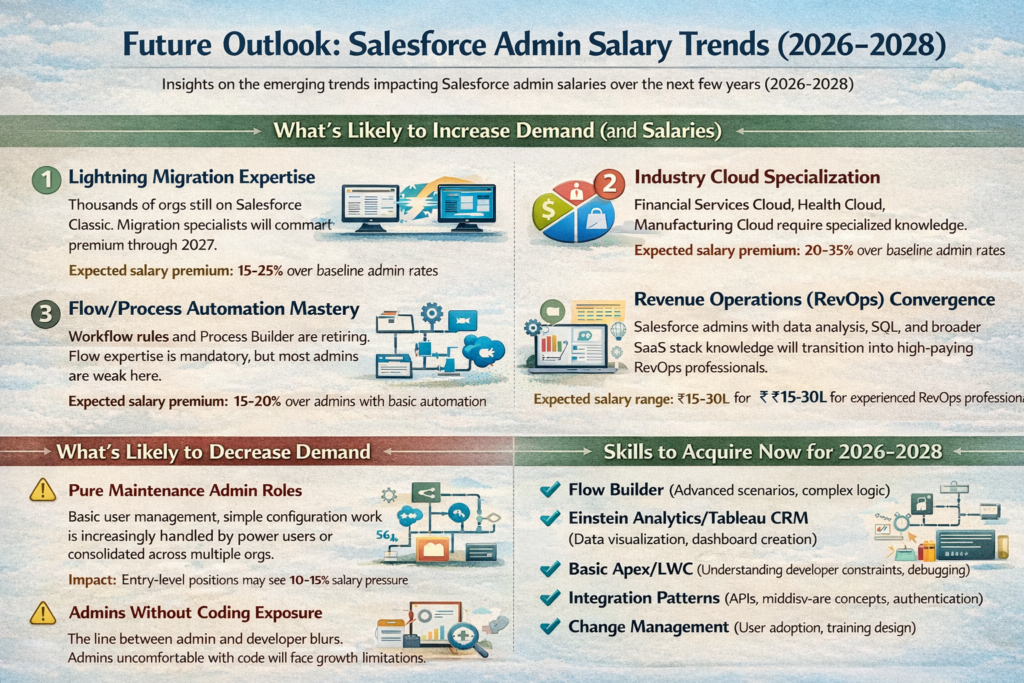
What’s Likely to Increase Demand (and Salaries)
1. Lightning Migration Expertise
Thousands of orgs still on Salesforce Classic. Migration specialists will command premium through 2027.
Expected salary premium: 15-25% over baseline admin rates
2. Industry Cloud Specialization
Financial Services Cloud, Health Cloud, Manufacturing Cloud require specialized knowledge.
Expected salary premium: 20-35% over general admin rates
3. Flow/Process Automation Mastery
Workflow rules and Process Builder are retiring. Flow expertise is mandatory, but most admins are weak here.
Expected salary premium: 15-20% over admins with basic automation knowledge
4. Revenue Operations (RevOps) Convergence
Salesforce admins with data analysis, SQL, and broader SaaS stack knowledge will transition into high-paying RevOps roles.
Expected salary range: ₹15-30L for experienced RevOps professionals
What’s Likely to Decrease Demand
1. Pure Maintenance Admin Roles
Basic user management, simple configuration work is increasingly handled by power users or consolidated across multiple orgs.
Impact: Entry-level positions may see 10-15% salary pressure
2. Admins Without Coding Exposure
The line between admin and developer blurs. Admins uncomfortable with code will face growth limitations.
Impact: Salary ceiling stagnates around ₹12-14L regardless of years of experience
Skills to Acquire Now for 2026-2028
Based on current market signals:
- Flow Builder (Advanced scenarios, complex logic)
- Einstein Analytics/Tableau CRM (Data visualization, dashboard creation)
- Basic Apex/LWC (Understanding developer constraints, debugging)
- Integration Patterns (APIs, middleware concepts, authentication)
- Change Management (User adoption, training design)
Conclusion: The Real Equation for Salesforce Admin Earnings
Your Salesforce admin salary in India isn’t determined by a single factor. It’s a function of:
Salary = (Base Experience) × (Skill Multiplier) × (Location Factor) × (Company Type Factor) × (Negotiation Factor)
Where:
- Base Experience = Your years of relevant experience
- Skill Multiplier = 1.0 (basic admin) to 1.8 (specialized expertise like CPQ + integrations)
- Location Factor = 0.7 (tier-2 cities) to 1.0 (Bangalore/Mumbai)
- Company Type Factor = 0.8 (IT services) to 1.3 (product startups/consulting firms)
- Negotiation Factor = 0.9 (poor negotiation) to 1.2 (strong negotiation)
The bottom line for 2026:
A freshly certified Salesforce Admin in India will start around ₹3.5-5.5L. Whether you’re at ₹15L or stuck at ₹8L in five years depends entirely on the choices you make regarding skill development, employer selection, and career positioning.
The certification opens doors. Your technical depth, business acumen, and strategic career moves determine which doors—and what’s behind them.
The Salesforce admin salary India question doesn’t have a single answer. The Salesforce certified admin salary Pune isn’t a fixed number. They’re ranges influenced by specific, controllable factors.
Stop looking for the magic number. Start building the skill combination and career trajectory that commands the number you want.
The market rewards competence, specialized expertise, and value delivery—not certifications and tenure. Build accordingly.
Internal Links:
- Salesforce Field Service Lightning (FSL): Overview, Features & Career Scope
- How Long Does It Take to Learn Salesforce and Get a Job? Honest Timeline (India, 2026)
- How to Get Your First Salesforce Job with Zero Experience in India: The 2026 Reality Check
- How to Use Salesforce Reports & Dashboards: A Beginner’s Practical Guide
- Salesforce Trailhead vs Paid Training: Which Is Better for Getting a Job in India (2026)?
- Top Companies Hiring Salesforce Professionals in Pune in 2026: Your Complete Career Guide
- Salesforce Flows vs Apex: When Should You Use Code vs No-Code Automation?
- Salesforce Nonprofit Cloud: Features, Use Cases, and Career Opportunities (2026 Guide)
- Salesforce Net Zero Cloud: What It Is and Why It’s the Next Green Career Niche (2026 Guide)
- Salesforce Slack Integration: How It Works and What Developers Need to Know
- Salesforce Named Credentials: What They Are and How to Use Them Safely
- Salesforce Deployment Best Practices: Change Sets vs Salesforce CLI vs Gearset
External Links:
McKinsey Sales Growth Reports
Gartner Sales Automation Insights
