
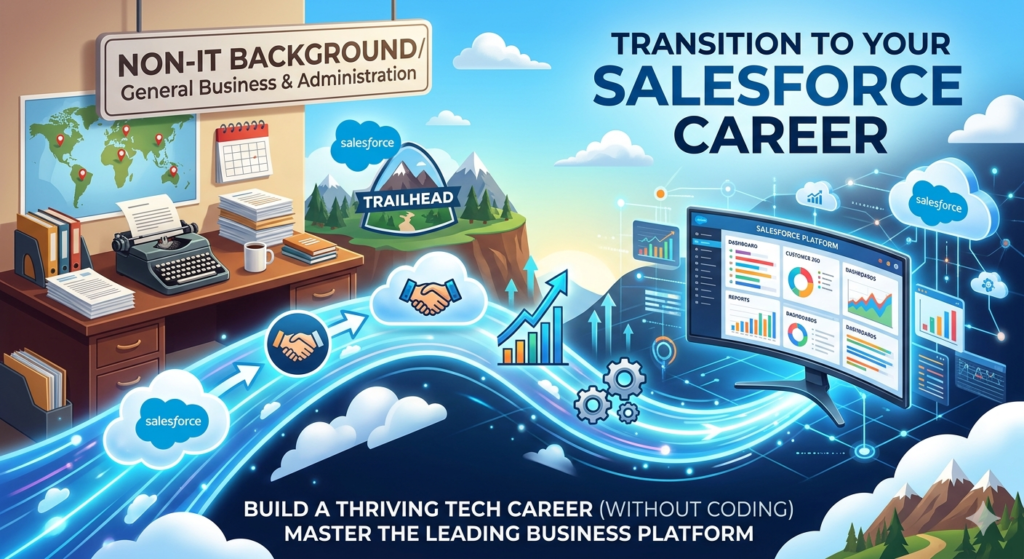
Non IT to Salesforce career — is it really possible? If you are a BBA graduate staring at job listings wondering if your degree will ever get you a seat at the tech table, the answer is a confident YES. Whether you are a civil engineer frustrated with slow career growth, or a commerce student watching your IT-background friends land six-figure salaries while you are still stuck in entry-level roles — this guide is written specifically for you.
If you have ever Googled “how to switch to IT without coding” or “tech jobs for non-IT graduates,” you are not alone — and more importantly, you are not out of options.
Here is the truth that most career counselors won’t tell you: You don’t need a computer science degree to build a thriving career in technology. The fastest-growing segment of the tech industry today isn’t about writing complex code — it’s about implementing, customizing, and managing powerful business platforms. And one platform dominates this space above all others.
That platform is Salesforce.
In this comprehensive guide, we at RizeX Labs will walk you through everything you need to know about making the leap from a non IT to Salesforce career — including a realistic, actionable 6-month roadmap that thousands of career switchers have already used to land their first tech job.
Why the Salesforce Career Path Makes Sense for Non-IT Professionals
Before we dive into the roadmap, let’s address the elephant in the room: Why Salesforce specifically?
The Numbers Don’t Lie
- Salesforce is the world’s #1 CRM (Customer Relationship Management) platform, used by over 150,000 companies globally.
- According to IDC research, the Salesforce economy is projected to generate 9.3 million jobs and $1.6 trillion in new business revenues by 2026.
- The average salary for a Salesforce Administrator in India ranges from ₹4 LPA to ₹12 LPA for freshers, scaling to ₹25+ LPA with experience.
- In the US, entry-level Salesforce roles start at $60,000–$80,000 per year.
- There are consistently more Salesforce job openings than certified professionals to fill them.
This talent gap is your opportunity.
Why Non-IT Backgrounds Are Actually an Advantage
Here’s something surprising: your non-IT background might actually make you a better Salesforce professional than someone who only knows how to code.
Salesforce work is fundamentally about understanding business processes — how sales teams work, how customer service operates, how marketing campaigns are managed. If you’ve studied commerce, business administration, or even worked in fields like banking, healthcare, retail, or logistics, you already understand these workflows at a deeper level than a fresh computer science graduate.
The most successful Salesforce professionals combine:
- Business domain knowledge (which you likely already have)
- Salesforce technical skills (which you’ll learn)
- Communication and problem-solving skills (which you’ve been developing your whole life)
Understanding Salesforce: What Is It and What Do Salesforce Professionals Do?
What Is Salesforce?
Salesforce is a cloud-based CRM platform that helps businesses manage their relationships with customers. Think of it as the central nervous system of a company’s sales, marketing, service, and operations teams. It tracks every customer interaction, automates business processes, generates reports, and integrates with hundreds of other business tools.
Key Salesforce Roles You Can Target as a Fresher
| Role | What You Do | Average Starting Salary (India) |
|---|---|---|
| Salesforce Administrator | Configure and manage Salesforce for businesses | ₹4–8 LPA |
| Salesforce Developer | Build custom solutions using Apex & LWC | ₹5–10 LPA |
| Salesforce Business Analyst | Bridge gap between business and tech | ₹5–9 LPA |
| Salesforce Consultant | Advise clients on Salesforce implementation | ₹6–12 LPA |
| Salesforce QA Tester | Test Salesforce implementations | ₹4–7 LPA |
For career changers from non-IT backgrounds, the Salesforce Administrator and Business Analyst roles are the most accessible entry points.
Benefits of Choosing Salesforce as a Career
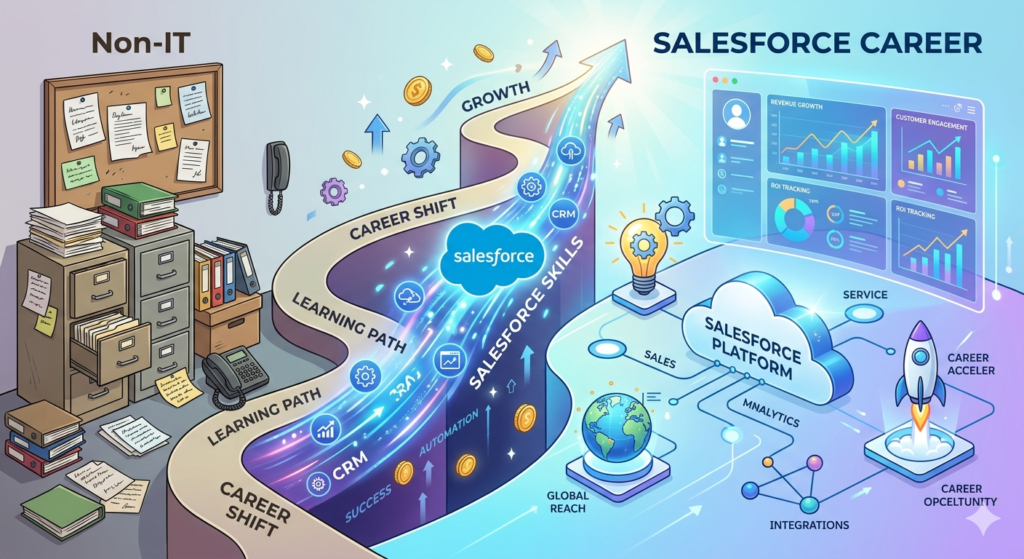
Here’s why a career change to Salesforce is one of the smartest professional moves you can make in 2024:
1. No Coding Required to Start
The Salesforce Administrator role is primarily a point-and-click configuration role. You don’t need to write complex code. You use Salesforce’s built-in tools to set up processes, automate workflows, create reports, and manage users — all through a visual interface.
2. Industry-Recognized Certifications
Salesforce offers a globally recognized certification program. The Salesforce Certified Administrator (SCA) certification is respected by employers worldwide and acts as a clear signal that you know your stuff — regardless of your educational background.
3. Free Learning Resources
Salesforce provides Trailhead — a completely free, gamified learning platform where you can learn everything from scratch. You don’t need to invest in expensive courses to get started.
4. Clear Career Progression
The Salesforce ecosystem offers a well-defined career ladder:
Admin → Senior Admin → Consultant → Architect → Solution Architect
5. Remote Work Opportunities
Salesforce skills are in demand globally, which means remote and hybrid work opportunities are abundant.
6. Growing Demand Across Industries
Every industry — healthcare, finance, retail, education, manufacturing, real estate — uses Salesforce. Your domain knowledge from your previous field becomes a competitive advantage.
7. Supportive Community
The Salesforce Ohana (Hawaiian for “family”) is one of the most welcoming professional communities in tech. User groups, forums, and mentorship programs make it easier for beginners to get guidance.
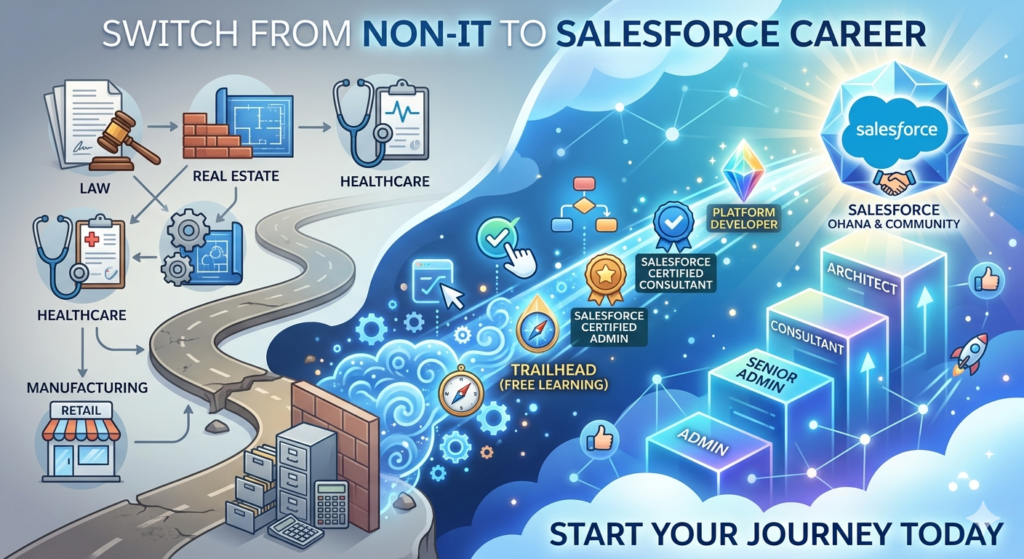
Your 6-Month Roadmap: From Non-IT to Salesforce Career
This is the heart of this guide. Whether you’re a Salesforce fresher still figuring out where to start, or someone who’s been thinking about this for months but hasn’t taken the first step, this roadmap will give you a clear, week-by-week direction.
Important Note: This roadmap assumes you’re dedicating 3–4 hours per day to learning. If you’re currently working full-time, 2 hours per day is still enough — just extend the timeline by 2–3 months. Progress over perfection.
Month 1: Build Your Foundation (Weeks 1–4)
Goal: Understand Salesforce basics and the CRM ecosystem
This month is about orientation. Don’t rush. Many career changers make the mistake of jumping straight into certification dumps without understanding why things work the way they do.
Week 1: Understand the CRM World
What to do:
- Research what CRM means and why businesses use it
- Watch YouTube videos on “What is Salesforce” and “Salesforce for beginners”
- Read about the different Salesforce Clouds: Sales Cloud, Service Cloud, Marketing Cloud
- Create your free Salesforce Trailhead account at trailhead.salesforce.com
- Begin the “Salesforce Platform Basics” trail on Trailhead
Milestone: You should be able to explain what Salesforce does and why companies use it — in simple English.
Week 2: Explore the Salesforce Interface
What to do:
- Activate your free Salesforce Developer Org (a practice environment you can use forever)
- Navigate through the Salesforce interface: Objects, Fields, Records, Tabs
- Complete the “Admin Beginner” trail on Trailhead
- Learn about standard objects: Accounts, Contacts, Leads, Opportunities, Cases
Milestone: You can log into your Developer Org and navigate the basic modules confidently.
Week 3: Data Model and Security Basics
What to do:
- Learn about custom objects and custom fields
- Understand record types and page layouts
- Study Salesforce security model: Profiles, Permission Sets, Roles, Sharing Rules
- Complete the “Data Modeling” and “Salesforce Security” modules on Trailhead
Milestone: You understand how data is structured in Salesforce and how access is controlled.
Week 4: Automation Fundamentals
What to do:
- Learn about Process Builder (legacy), Flows, and Workflow Rules
- Complete the “Flow Basics” module on Trailhead
- Build your first simple Flow in your Developer Org
- Watch practical tutorials on automation use cases
Milestone: You’ve built at least one working automation in your personal Developer Org.
Month 2: Go Deeper — Core Admin Skills (Weeks 5–8)
Goal: Master the core Salesforce Administrator skill set
Week 5: Sales Cloud Deep Dive
What to do:
- Learn the complete Sales Cloud process: Lead → Opportunity → Quote → Order
- Study Lead Management: Lead Assignment Rules, Lead Queues, Lead Conversion
- Practice setting up an Opportunity pipeline in your Developer Org
- Complete “Sales Cloud Basics” on Trailhead
Week 6: Service Cloud and Cases
What to do:
- Study Service Cloud: Cases, Queues, Escalation Rules, Entitlements
- Learn about Email-to-Case and Web-to-Case setup
- Complete “Service Cloud Basics” on Trailhead
- Practice creating Case Management configurations in your org
Week 7: Reports and Dashboards
What to do:
- Learn to create Tabular, Summary, Matrix, and Joined Reports
- Build dynamic dashboards with charts and filters
- Practice creating business reports that stakeholders would actually find useful
- Complete the “Reports & Dashboards” trail on Trailhead
Pro Tip: Reports and dashboards are one of the most-tested areas in the Admin certification exam. Master this section.
Week 8: Data Management
What to do:
- Learn about Salesforce data import/export tools: Data Loader, Data Import Wizard
- Study data quality concepts: Duplicate rules, matching rules, validation rules
- Practice importing and exporting CSV data in your Developer Org
- Complete the “Data Management” module on Trailhead
Month 2 Milestone: You have hands-on experience with all core Admin functions. Start identifying real-world use cases from business scenarios.
Month 3: Certification Preparation (Weeks 9–12)
Goal: Prepare for and pass the Salesforce Certified Administrator exam
The Salesforce Certified Administrator exam is your first major credential and the most important milestone for non-IT to Salesforce career switchers. It proves to employers that you have verified, standardized skills.
Week 9: Study the Official Exam Guide
What to do:
- Download the official Salesforce Certified Administrator Exam Guide from Trailhead
- Understand the exam weightage:
- Configuration and Setup: 20%
- Object Manager and Lightning App Builder: 20%
- Sales and Marketing Applications: 12%
- Service and Support Applications: 11%
- Productivity and Collaboration: 7%
- Data and Analytics Management: 14%
- Workflow/Process Automation: 16%
- Create a study plan based on your weak areas
Week 10: Practice Tests and Gap Analysis
What to do:
- Take a full-length practice test (use Focus on Force, Salesforce Ben mock tests, or Whizlabs)
- Analyze your weak areas and revisit those topics
- Join Salesforce Trailblazer Community forums and read Q&A threads
- Watch YouTube exam prep videos
Week 11: Intensive Revision
What to do:
- Revisit all major topics through Trailhead modules
- Create flashcards for concepts you keep forgetting
- Take 2–3 more practice tests and aim for 75%+ consistently
- Join study groups on LinkedIn or Reddit
Week 12: Take the Exam
What to do:
- Schedule your exam (online proctored or at a testing center)
- Review exam-day tips: Read questions carefully, eliminate obviously wrong answers
- Take the exam!
Month 3 Milestone: You are a Salesforce Certified Administrator. 🎉
The exam costs approximately $200 USD (or ₹15,000–18,000 INR). Many training programs, including those at RizeX Labs, help students prepare comprehensively to pass on the first attempt.
Month 4: Build Real-World Projects and Portfolio (Weeks 13–16)
Goal: Create a portfolio that demonstrates practical skills to employers
This is the month that separates candidates who get hired from those who don’t. A certification alone isn’t enough — employers want to see that you can apply your skills to real business problems.
Week 13: Build Project #1 — Sales CRM Setup
Project Idea: Imagine a small software company called “TechStart Solutions.” Set up their complete Salesforce environment including:
- Custom fields and object customization
- Lead assignment rules for regional sales teams
- Opportunity stages tailored to their sales process
- Custom reports and a sales performance dashboard
Document this project with screenshots and explanations.
Week 14: Build Project #2 — Customer Service Portal
Project Idea: Set up a Service Cloud configuration for a fictional e-commerce company:
- Case management with priority-based routing
- Email-to-Case integration
- SLA rules and escalation policies
- Service performance dashboards
Week 15: Build Project #3 — Process Automation
Project Idea: Create a complex Flow that:
- Automatically sends a welcome email when a new Lead is created
- Assigns a follow-up task to the sales rep
- Updates the Lead Status based on activity
- Creates a reminder when an Opportunity hasn’t been updated in 7 days
Week 16: Create Your Portfolio
What to do:
- Document all three projects with clear descriptions, screenshots, and business context
- Upload projects to a personal website (use Wix, WordPress, or GitHub Pages — free options exist)
- Create a dedicated LinkedIn profile highlighting your Salesforce certification and projects
- Write a blog post on LinkedIn or Medium explaining one of your projects
Month 4 Milestone: You have a professional portfolio with 3 documented Salesforce projects.
Month 5: Expand Skills and Start Job Hunting (Weeks 17–20)
Goal: Learn additional skills and actively apply for jobs
Week 17: Learn Salesforce Flow Deeply
Go beyond basic automation:
- Record-Triggered Flows
- Screen Flows
- Scheduled Flows
- Subflows
Salesforce Flow has replaced most legacy automation tools, and deep Flow knowledge makes you significantly more hireable.
Week 18: Introduction to Salesforce Developer Concepts (Optional but Recommended)
Even as an Admin, basic developer knowledge helps:
- Learn HTML and CSS basics (free on W3Schools)
- Understand what Apex is (even if you don’t write it)
- Learn about APIs and integrations at a conceptual level
- Study Lightning App Builder and Lightning Components
Week 19: Soft Skills and Interview Preparation
This week is critical for non-IT career changers:
- Practice explaining why you switched careers confidently and positively
- Prepare your Salesforce story: How you learned, what you built, what excites you
- Research common Salesforce interview questions (both technical and behavioral)
- Practice scenario-based questions: “How would you handle this business requirement?”
Week 20: Aggressive Job Applications
What to do:
- Update your resume with your certification, projects, and skills
- Apply on: LinkedIn, Naukri.com, Indeed, Salesforce job boards, Glassdoor
- Apply to both direct companies and Salesforce partner companies (implementation partners hire the most freshers)
- Connect with Salesforce professionals on LinkedIn and ask for referrals
- Attend virtual and in-person Salesforce User Group meetings
Month 5 Milestone: Resume submitted to at least 50 companies. Active networking underway.
Month 6: Interview, Negotiate, and Land the Job (Weeks 21–24)
Goal: Convert interviews into job offers
Week 21-22: Interview Preparation Deep Dive
Technical Questions to Prepare:
- Explain the difference between a Profile and a Permission Set
- What is a Record Type and when would you use it?
- How does Salesforce’s sharing model work?
- What is a Flow and how does it differ from a Workflow Rule?
- How would you handle data migration in Salesforce?
- Explain the difference between Lookup and Master-Detail relationships
Behavioral Questions to Prepare:
- “Tell me about yourself” (craft a compelling career transition story)
- “Why do you want to work in Salesforce after a non-IT background?”
- “Describe a time you learned something complex quickly”
- “How do you handle a situation where stakeholder requirements are unclear?”
Week 23: Mock Interviews and Refinement
- Do mock interviews with peers, mentors, or career counselors
- Record yourself answering questions and review your communication clarity
- Ask for feedback and refine your answers
- Prepare thoughtful questions to ask interviewers
Week 24: Offer Negotiation and Onboarding
- When you receive an offer, don’t be afraid to negotiate respectfully
- Research market rates for your location and experience level
- Accept the offer, complete onboarding formalities, and celebrate — you did it!
Month 6 Milestone: Your first Salesforce job offer. 🚀
Skills Required for a Salesforce Career
Technical Skills
| Skill | Importance Level |
|---|---|
| Salesforce Administration | Essential |
| Salesforce Flow & Automation | Essential |
| Reports & Dashboards | Essential |
| Data Management | Very Important |
| Lightning App Builder | Very Important |
| Basic Apex & LWC (Conceptual) | Good to Have |
| Integration Basics | Good to Have |
| AppExchange Knowledge | Good to Have |
Soft Skills (Often Underrated, Always Critical)
- Communication: You’ll work with business stakeholders who don’t speak “tech.” Being able to translate between business needs and technical solutions is invaluable.
- Problem-Solving: Every Salesforce implementation is a unique puzzle. Analytical thinking is key.
- Attention to Detail: A small misconfiguration can affect hundreds of users. Precision matters.
- Project Management Basics: Understanding Agile methodology and being able to prioritize tasks is a major plus.
- Continuous Learning Mindset: Salesforce releases three major updates per year. You must stay current.
- Stakeholder Management: Understanding what users actually need versus what they say they want is an art.
Tools and Platforms to Learn Salesforce
Free Learning Platforms
1. Salesforce Trailhead (trailhead.salesforce.com)
The official, free, gamified learning platform. Absolutely essential. Start here on Day 1 and never stop using it.
2. Salesforce Developer Org
Your free, personal Salesforce practice environment. Build everything here.
3. YouTube
Channels like Salesforce Hulk, Sfdcpanther, and Official Salesforce YouTube are goldmines.
4. Salesforce Trailblazer Community
An official forum where you can ask questions, find mentors, and connect with other learners.
5. FocusOnForce.com
Excellent free and paid study guides and practice exams for Salesforce certifications.
Paid but Worth-It Platforms
6. Udemy
Courses by instructors like Mike Wheeler and Salesforce Ben. Often on sale for ₹400–₹600.
7. Pluralsight
More structured Salesforce learning paths for serious learners.
8. RizeX Labs Salesforce Training Program
Structured mentorship, live project experience, and job placement support — designed specifically for non-IT career changers.
Community and Networking Tools
- LinkedIn: Essential for job hunting and networking
- Salesforce Ohana Slack Groups: Active communities for Q&A
- Reddit r/salesforce: Surprisingly helpful for real-world advice
- Local Salesforce User Groups: Search on Trailhead for groups near you
Tips to Land Your First Job as a Salesforce Fresher
Getting your first Salesforce job is the hardest part — after that, the career grows naturally. Here are battle-tested strategies:
1. Target Salesforce Implementation Partners First
Companies like Accenture, Deloitte, Cognizant, Capgemini, and hundreds of smaller Salesforce partner firms hire freshers constantly. They’ll train you while paying you. Check the Salesforce AppExchange Partner directory to find implementation partners in your region.
2. Apply for Internships and Volunteer Projects
Even unpaid or low-paid Salesforce experience on your resume is worth its weight in gold. Look for nonprofits using Salesforce (many do, through the Salesforce.org Nonprofit program) and offer to help them with their admin work.
3. Optimize Your LinkedIn Profile
- Mention “Salesforce Certified Administrator” in your headline
- Use keywords: “Salesforce Admin,” “CRM,” “Sales Cloud,” “Flow Builder”
- Add your Trailhead profile link and certification badges
- Post content about what you’re learning — it shows initiative
4. Get Active in the Salesforce Community
Attend Salesforce User Group meetings in your city. These events are where hiring managers and senior professionals meet. One genuine connection at a user group event is worth 100 cold applications.
5. Apply in Bulk, Follow Up Strategically
Apply to 10–15 positions per day. Use LinkedIn Easy Apply where possible. Send a personalized follow-up message to the recruiter 5–7 days after applying. Most candidates don’t follow up — doing so already sets you apart.
6. Highlight Your Domain Knowledge
If you have a background in finance, mention your understanding of financial services Salesforce use cases. Healthcare background? Highlight your familiarity with patient management workflows. Your domain expertise + Salesforce skills = unique value proposition.
7. Consider Trailhead Superbadges
Superbadges are advanced, scenario-based challenges on Trailhead that demonstrate applied knowledge. Earning 2–3 relevant Superbadges significantly boosts your credibility with employers.
Common Mistakes to Avoid
Learning from others’ mistakes is the fastest shortcut to success. Here are the most common pitfalls we see at RizeX Labs:
Mistake 1: Studying Without Hands-On Practice
Reading about Salesforce without building in your Developer Org is like reading a driving manual without touching the steering wheel. Every concept you learn, replicate it in your org immediately.
Mistake 2: Relying Only on Certification Without Building Projects
A certification with no portfolio is weak. Employers want to see evidence of applied skills. Build projects. Document them. Show your work.
Mistake 3: Ignoring the Community
The Salesforce Ohana community is one of the most powerful career acceleration tools available — and most beginners completely ignore it. Engage regularly.
Mistake 4: Giving Up After Rejection
Most career changers apply to 50–100+ positions before landing their first role. Rejection is data, not judgment. Refine your approach and keep going.
Mistake 5: Not Having a Clear Career Story
When interviewers ask why you switched from a non-IT background, a vague answer kills your chances. Craft a compelling, honest narrative about your transition. Practice it until it flows naturally.
Mistake 6: Skipping Soft Skills Development
Technical skills get you the interview. Soft skills get you the job. Many technically competent candidates lose jobs to less technical but more communicative candidates.
Mistake 7: Waiting Until “Ready” to Apply
There’s no perfect moment. Apply while you’re still learning Month 5 materials. The interview process itself teaches you what you need to know.
Mistake 8: Underestimating the Salesforce Admin Certification
Some people try to jump straight to Developer certifications thinking it makes them more marketable. Start with Admin. It’s the foundation of everything, and it’s what most entry-level roles actually require.
What Career Changers from Non-IT Backgrounds Actually Achieve
To make this real, here are the types of stories we see repeatedly at RizeX Labs:
The Commerce Graduate who spent two years in data entry switched to Salesforce Administration after 5 months of focused learning. First job: Salesforce Admin at a mid-sized IT company, ₹5.5 LPA. Two years later: Senior Admin at an MNC, ₹11 LPA.
The Mechanical Engineer bored with site visits and low pay transitioned to Salesforce Business Analysis, leveraging his strong analytical skills and understanding of manufacturing processes. He now works as a Salesforce Consultant for manufacturing clients — his domain expertise is literally his superpower.
The BBA Graduate who couldn’t find relevant jobs for two years became a Salesforce Admin in 6 months and is now three years into her Salesforce career, recently promoted to Junior Consultant.
These aren’t exceptional cases. They’re what happens when ordinary people follow an extraordinary plan consistently.
Conclusion: Your Salesforce Career Starts Today
Making the shift from a non-IT to Salesforce career isn’t a leap of faith — it’s a calculated decision backed by data, market demand, and thousands of success stories. The Salesforce ecosystem has opened its doors to people from every background imaginable: commerce, humanities, engineering branches outside IT, hospitality, education, and beyond.
You don’t need a perfect background. You need a plan, consistency, and the right support.
The 6-month roadmap we’ve laid out here is not theoretical — it’s built from the real journeys of career changers who sat exactly where you are right now, doubting themselves, wondering if they were too late, and asking whether this was really possible.
It is possible. And it’s possible for you.
The Salesforce economy needs 9.3 million professionals. There are nowhere near enough trained people to fill those roles. The gap is waiting for you to fill it.
About RizeX Labs
We’re Pune’s leading IT training institute specializing in career transitions and emerging technologies like Salesforce. At RizeX Labs, we bridge the gap between non-IT backgrounds and the tech industry through hands-on training, industry-recognized certifications, and expert mentorship. Our 6-month specialized programs are designed to transform beginners into job-ready Salesforce Professionals with the technical confidence and business acumen needed to excel in the global Salesforce economy.
Internal Links:
- Salesforce Admin & Development Training
- Salesforce Career Change in India: A Comprehensive Guide for 2026
- Salesforce Flows vs. Apex Triggers: Which Automation Tool to Use?
