
The Salesforce ecosystem continues to be one of the most dynamic and rewarding career landscapes in the technology industry. As we move through 2026, the demand for certified Salesforce professionals shows no signs of slowing down. According to IDC, the Salesforce economy is projected to generate millions of new jobs worldwide, and certified professionals consistently earn higher salaries than their non-certified counterparts. Whether you’re a complete beginner exploring a career pivot or an experienced professional looking to level up your credentials, understanding the Salesforce certifications list 2026 is your first step toward making a strategic career decision.
But here’s the challenge: Salesforce currently offers more than 40 certifications across multiple role-based tracks. With so many options, the question isn’t just “Should I get certified?” — it’s “Which certification should I get first, and how do I build a meaningful credential roadmap?”
In this comprehensive guide, we’ll break down every certification category, help you identify the best Salesforce cert for your unique situation, provide a clear career roadmap, and share proven tips to pass your exams on the first attempt. By the end of this post, you’ll have absolute clarity on where to start and how to progress.
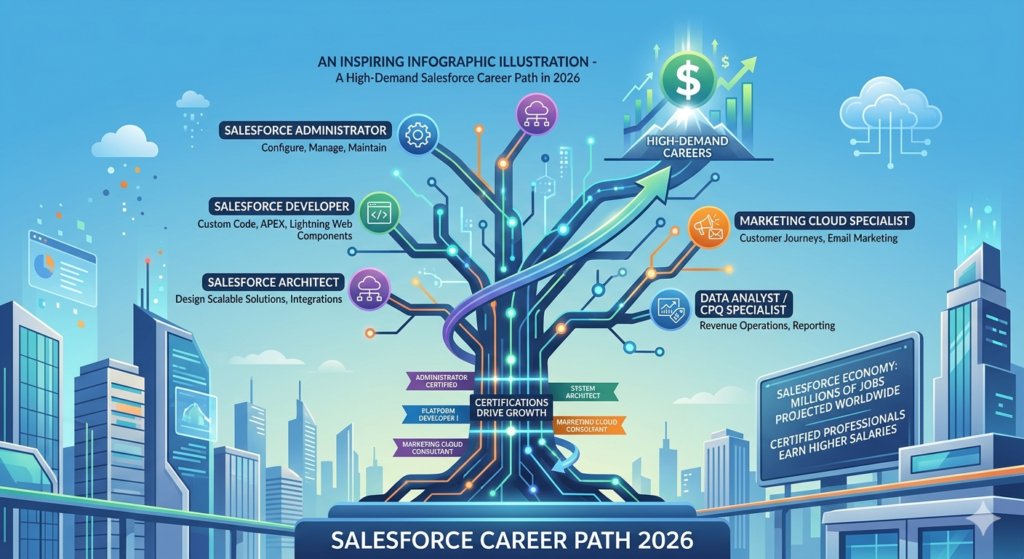
Why Salesforce Certifications Matter in 2026
Before diving into the full list, let’s address a foundational question: why do Salesforce certifications matter so much?
Industry Recognition and Credibility
Salesforce certifications are globally recognized credentials that validate your skills and knowledge. They signal to employers, clients, and peers that you’ve met Salesforce’s rigorous standards. In a competitive job market, certifications can be the differentiator that lands you an interview or earns you a promotion.
Higher Earning Potential
Certified Salesforce professionals consistently earn more than their non-certified peers. According to multiple salary surveys, a Salesforce Admin certification holder can expect to earn between $75,000 and $110,000 annually in the United States, while advanced certifications like Salesforce Architect can push salaries well beyond $170,000.
Growing Ecosystem Demand
Salesforce continues to expand its product suite with innovations in AI (Einstein GPT and Agentforce), Data Cloud, Industry Clouds, and more. Each new product creates demand for specialists, and certifications are the fastest way to prove your expertise in these emerging areas.
Career Flexibility
The Salesforce ecosystem spans industries — healthcare, financial services, retail, manufacturing, nonprofit, and government. A Salesforce certification doesn’t lock you into one vertical; it opens doors across the global economy.
Salesforce Certifications List 2026 — The Complete Categorized Breakdown
Salesforce organizes its certifications into several role-based categories. Below is the complete Salesforce certifications list 2026, organized to help you understand each track and identify where you fit.
1. Administrator Certifications
Administrator certifications are designed for professionals who configure and manage Salesforce platforms. These are among the most popular certifications and serve as the foundation for many Salesforce careers.
Salesforce Certified Administrator
This is the entry-level certification and one of the most sought-after credentials in the ecosystem. It validates your ability to configure Salesforce, manage users, ensure data quality, build reports and dashboards, and automate business processes using tools like Flow Builder. The Salesforce Admin certification is widely regarded as the gateway credential for anyone entering the Salesforce world.
- Exam Format: 65 multiple-choice questions
- Passing Score: 65%
- Time Allotted: 105 minutes
- Recommended Experience: 6+ months of hands-on Salesforce experience
- Ideal For: Career changers, recent graduates, business analysts transitioning into Salesforce
Salesforce Certified Advanced Administrator
This certification is for experienced administrators who have mastered advanced platform features. It covers complex security models, advanced formulas, process automation at scale, app management, and data management strategies. This cert demonstrates that you can handle enterprise-level Salesforce implementations.
- Exam Format: 60 multiple-choice questions
- Passing Score: 65%
- Ideal For: Admins with 2-5 years of experience looking to advance into senior admin or platform manager roles
2. Developer Certifications
Developer certifications validate your ability to build custom applications on the Salesforce platform using Apex, Visualforce, Lightning Web Components, and integration tools.
Salesforce Certified Platform Developer I (PD1)
The Salesforce Developer certification at the Platform Developer I level is the starting point for developers. It tests your knowledge of Apex programming, SOQL/SOSL queries, Lightning Web Components, data modeling, and testing best practices. This cert proves you can write clean, efficient code on the Salesforce platform.
- Exam Format: 65 multiple-choice questions
- Passing Score: 65%
- Time Allotted: 110 minutes
- Ideal For: Developers new to Salesforce, computer science graduates, Java/JavaScript developers transitioning to the Salesforce platform
Salesforce Certified Platform Developer II (PD2)
This advanced developer certification goes much deeper into complex business logic, integration architecture, advanced Apex design patterns, performance optimization, and testing frameworks. The exam includes a multiple-choice component and may include scenario-based questions that test practical problem-solving skills.
- Passing Score: 63%
- Ideal For: Experienced Salesforce developers with 2+ years of hands-on coding experience
3. Consultant Certifications
Consultant certifications are designed for professionals who implement Salesforce solutions for clients or internal teams. These certifications combine technical knowledge with business acumen and solution design skills.
Sales Cloud Consultant
Validates your ability to design and implement Sales Cloud solutions, including lead management, opportunity management, forecasting, territory management, and sales productivity features.
Service Cloud Consultant
Focuses on designing customer service solutions using Service Cloud, including case management, Knowledge, Omni-Channel routing, entitlements, and service console configuration.
Experience Cloud Consultant
Tests your ability to build and manage Experience Cloud sites (formerly Community Cloud), including partner portals, customer communities, and self-service sites.
Field Service Consultant
Covers the design and implementation of Salesforce Field Service, including work orders, scheduling optimization, mobile workforce management, and dispatcher console configuration.
Education Cloud Consultant
Designed for professionals implementing Salesforce solutions in educational institutions, covering student lifecycle management, recruitment, admissions, and advising.
Nonprofit Cloud Consultant
Validates expertise in implementing Salesforce for nonprofit organizations, including fundraising, program management, constituent engagement, and grant management.
OmniStudio Consultant
Focuses on designing and building guided digital experiences using OmniStudio tools like FlexCards, OmniScripts, DataRaptors, and Integration Procedures.
Each consultant certification typically requires:
- 60-65 multiple-choice questions
- 62-68% passing score
- Prior hands-on implementation experience
4. Architect Certifications
Architect certifications represent the pinnacle of the Salesforce certification hierarchy. They validate your ability to design enterprise-level solutions that are scalable, secure, and aligned with business objectives.
Salesforce Certified Platform App Builder
While sometimes grouped with admin certifications, the Platform App Builder credential validates your ability to design, build, and deploy custom applications using the declarative (no-code/low-code) capabilities of the Salesforce platform. It covers data modeling, user interface design, business logic, and app deployment.
- Exam Format: 60 multiple-choice questions
- Passing Score: 63%
- Ideal For: Admins evolving into app builders, business analysts, or anyone bridging the gap between admin and developer roles
Salesforce Certified Data Architect
Focuses on designing data models, managing large data volumes, implementing data migration strategies, and ensuring data quality across Salesforce implementations.
Salesforce Certified Sharing and Visibility Architect
Validates your expertise in designing secure access models, including org-wide defaults, sharing rules, role hierarchies, and territory-based access patterns.
Salesforce Certified Integration Architect
Tests your ability to design integration solutions connecting Salesforce with external systems using REST/SOAP APIs, middleware platforms, and event-driven architectures.
Salesforce Certified Identity and Access Management Architect
Covers single sign-on (SSO), OAuth flows, multi-factor authentication, identity providers, and connected app security configurations.
Salesforce Certified Development Lifecycle and Deployment Architect
Focuses on application lifecycle management, version control strategies, CI/CD pipelines, environment management, and governance frameworks.
Salesforce Certified B2B Solution Architect
Validates your ability to design end-to-end solutions for complex B2B business scenarios, integrating multiple Salesforce clouds and external systems.
Salesforce Certified B2C Solution Architect
Similar to B2B but focused on business-to-consumer solutions, including Commerce Cloud, Marketing Cloud, and Service Cloud integration.
Salesforce Certified Application Architect
An umbrella credential earned by passing both the Data Architect and Sharing and Visibility Architect exams.
Salesforce Certified System Architect
Earned by passing the Integration Architect and Identity and Access Management Architect exams.
Salesforce Certified Technical Architect (CTA)
The most prestigious certification in the entire Salesforce ecosystem. The CTA requires passing a review board where you present a solution design to a panel of Salesforce experts. Fewer than a few hundred professionals worldwide hold this credential, and CTAs are among the highest-paid professionals in the ecosystem, often earning $200,000 or more annually.
5. Marketing Certifications
Marketing Cloud Account Engagement Specialist (formerly Pardot Specialist)
Validates B2B marketing automation expertise, including lead nurturing, scoring models, email marketing, landing pages, and reporting within Account Engagement.
Marketing Cloud Administrator
Focuses on managing Marketing Cloud accounts, including user management, data configuration, security settings, and platform administration.
Marketing Cloud Email Specialist
Tests knowledge of email marketing best practices, content creation, data management, subscriber management, and email deliverability within Marketing Cloud.
Marketing Cloud Developer
Validates advanced technical skills including AMPscript, Server-Side JavaScript, SQL queries within Marketing Cloud, and API-based integrations.
Marketing Cloud Intelligence Specialist
Covers marketing analytics, data visualization, campaign performance measurement, and reporting using Marketing Cloud Intelligence (formerly Datorama).
6. Commerce Certifications
Salesforce Certified B2C Commerce Developer
Validates your ability to develop and customize B2C Commerce (formerly Commerce Cloud Digital) storefronts using SFRA (Storefront Reference Architecture), ISML templates, and Commerce Cloud APIs.
Salesforce Certified B2C Commerce Architect
An advanced certification focused on designing scalable, high-performance e-commerce solutions for B2C businesses.
7. AI and Data Certifications (New for 2025-2026)
Salesforce has introduced several new certifications reflecting its investment in artificial intelligence and data-driven solutions.
Salesforce Certified AI Associate
An entry-level certification that validates foundational understanding of AI concepts, ethical AI practices, and how AI is applied within the Salesforce platform, including Einstein features and Agentforce.
Salesforce Certified AI Specialist
A more advanced credential that tests your ability to implement AI solutions within Salesforce, including Einstein Prediction Builder, Einstein Bots, prompt engineering for Einstein GPT, and Agentforce agent configuration.
Salesforce Certified Data Cloud Consultant
Validates your expertise in implementing Salesforce Data Cloud, including data ingestion, identity resolution, segmentation, activation, and integration with other Salesforce products.
8. CPQ Specialist Certification
Salesforce Certified CPQ Specialist
Focuses on Salesforce CPQ (Configure, Price, Quote), covering product configuration, pricing rules, quote generation, advanced approvals, and contract management. This certification is especially valuable for professionals working in sales operations and revenue operations.
9. MuleSoft Certifications
Since Salesforce acquired MuleSoft, these certifications have become part of the broader Salesforce ecosystem.
MuleSoft Certified Developer – Level 1
Validates your ability to design, build, and manage APIs and integrations using the Anypoint Platform.
MuleSoft Certified Developer – Level 2
An advanced certification covering complex integration patterns, error handling, and performance optimization.
MuleSoft Certified Integration Architect – Level 1
Focuses on designing enterprise integration architectures using MuleSoft’s Anypoint Platform.
10. Tableau Certifications
Tableau, also part of the Salesforce family, offers its own certification track:
Tableau Desktop Specialist
An entry-level certification covering fundamental Tableau Desktop functionality.
Tableau Certified Data Analyst
Validates your ability to analyze data, create visualizations, and share insights using Tableau.
Tableau Server Certified Associate
Focuses on Tableau Server administration and management.
Beginners vs. Experienced Professionals — Choosing Your Path
One of the most common mistakes people make when exploring the Salesforce certifications list 2026 is choosing a certification that doesn’t match their experience level. Here’s how to make the right choice based on where you are in your career.
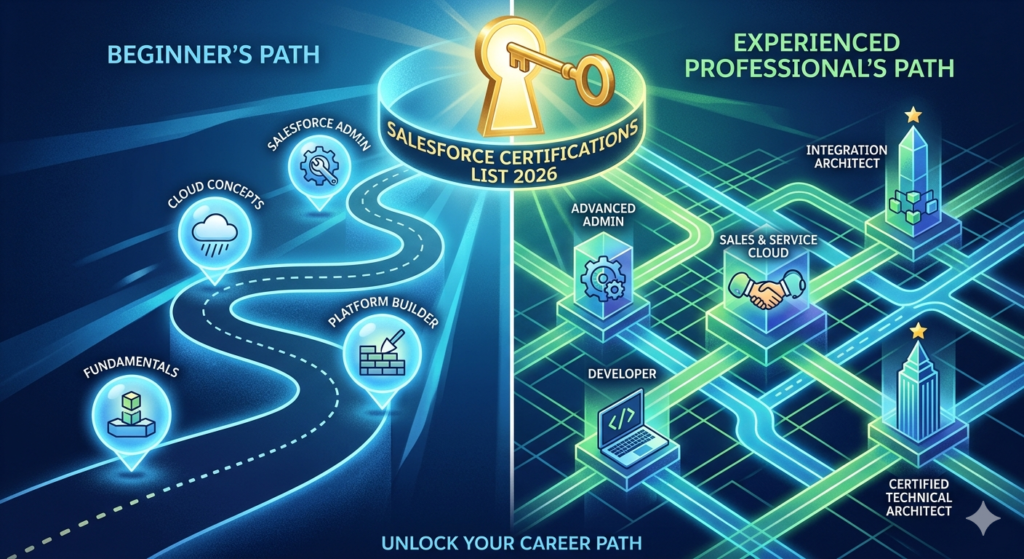
If You’re a Complete Beginner
You’re new to Salesforce and possibly new to the tech industry. You may be coming from a non-technical background — perhaps you’ve worked in sales, customer service, education, marketing, or another field entirely. Here’s your recommended starting point:
Start with: Salesforce Certified Administrator
The Salesforce Admin certification is universally recommended as the first certification for beginners, and for good reason:
- No prerequisites required — You don’t need prior Salesforce experience or another certification to sit for this exam.
- Broad foundational knowledge — The admin cert covers the entire platform at a foundational level, giving you context for every other certification you might pursue later.
- Highest job demand — Salesforce Administrator is consistently one of the most in-demand roles in the ecosystem.
- Accessible learning resources — Trailhead (Salesforce’s free learning platform) offers extensive modules specifically designed for admin cert preparation.
- No coding required — The admin certification is entirely focused on declarative (point-and-click) platform capabilities, making it accessible to non-technical professionals.
Alternative starting point for beginners interested in AI:
The Salesforce Certified AI Associate is another excellent entry-level option in 2026, especially if you’re interested in the rapidly growing AI segment of the ecosystem. It requires no prior Salesforce experience and provides a foundational understanding of AI within the Salesforce context.
If You Have Some Technical Experience
You’re a developer with experience in Java, JavaScript, Python, or another programming language, and you want to transition into the Salesforce ecosystem. Or perhaps you’ve been working with another CRM platform and want to switch to Salesforce.
Start with: Salesforce Certified Platform Developer I
The Salesforce Developer certification (Platform Developer I) is your gateway into the technical side of the Salesforce ecosystem. If you already understand programming fundamentals like variables, loops, conditional logic, and object-oriented programming, you’ll find the transition to Apex relatively smooth.
However, even experienced developers should consider also earning the Salesforce Certified Administrator credential. Understanding the declarative capabilities of the platform makes you a more well-rounded developer and helps you make better architectural decisions about when to use code versus configuration.
If You’re an Experienced Salesforce Professional
You’ve been working in the Salesforce ecosystem for a few years, you already hold one or more certifications, and you want to advance your career.
Consider:
- Consultant certifications (Sales Cloud, Service Cloud, or Industry Clouds) if you’re moving into implementation consulting
- Advanced Administrator if you want to deepen your admin expertise
- Platform Developer II if you’re an experienced developer
- Architect certifications if you’re targeting senior technical roles
- Data Cloud Consultant or AI Specialist if you want to specialize in emerging technologies
Best Salesforce Certification to Start With in 2026
After analyzing job market data, salary trends, learning curve accessibility, and career progression potential, our recommendation for the best Salesforce cert to start with in 2026 is:
🏆 Salesforce Certified Administrator
Here’s a detailed breakdown of why this remains the gold standard starting certification:
Job Market Demand:
Salesforce Administrator roles continue to be the most frequently posted Salesforce positions on major job boards. Every organization that uses Salesforce needs at least one administrator, and many need teams of administrators. The demand spans every industry and geography.
Salary Potential:
Entry-level Salesforce Administrators with certification can expect starting salaries between $65,000 and $85,000. With 2-3 years of experience, that number often climbs to $90,000-$120,000. Senior administrators and those with additional certifications can earn even more.
Career Progression:
The Admin certification opens multiple career paths. From here, you can branch into:
- Advanced Administration
- Business Analysis
- Solution Architecture
- Consulting
- Platform Development (with additional training)
- Salesforce Management
- Product Ownership
Learning Accessibility:
Salesforce provides Trailhead — a completely free, gamified learning platform — with hundreds of hours of admin-focused content. Additionally, the community around admin certification is the largest and most supportive in the ecosystem, with countless study groups, YouTube channels, blogs, and mentorship opportunities.
Foundation for Everything Else:
Almost every other Salesforce certification builds upon knowledge covered in the Admin cert. Understanding data models, security, automation, and reporting is fundamental to every Salesforce role.
Runner-Up: Salesforce Certified AI Associate
If you’re looking for a certification that positions you at the cutting edge of the Salesforce ecosystem, the AI Associate certification is an excellent alternative starting point. As Salesforce continues to embed AI capabilities across its entire product suite with Einstein and Agentforce, professionals with AI credentials will be increasingly valuable.
Runner-Up: Platform App Builder
For those who want to bridge the gap between administration and development, the Platform App Builder is an outstanding second or even first certification. It focuses on building applications using declarative tools and is slightly more technical than the Admin cert without requiring any coding knowledge.
Salesforce Career Roadmap 2026
Understanding how certifications fit into a larger career plan is essential. Below are four recommended career roadmaps based on different professional goals.
Roadmap 1: The Administrator Track
Year 1:
Salesforce Certified Administrator → Entry-level Admin role → Gain hands-on experience
Year 2:
Platform App Builder → Advanced Administrator → Mid-level Admin or Senior Admin role
Year 3+:
Consultant certification (Sales Cloud or Service Cloud) → Move into Lead Admin, Salesforce Manager, or Business Analyst role
Potential Earnings Trajectory: $70K → $95K → $120K → $140K+
Roadmap 2: The Developer Track
Year 1:
Salesforce Certified Administrator (foundation) + Platform Developer I → Junior Salesforce Developer role
Year 2:
Platform Developer II → Mid-level Developer role → Start exploring integration patterns and Lightning Web Components
Year 3+:
Integration Architect or Data Architect → Senior Developer or Technical Lead role
Potential Earnings Trajectory: $80K → $110K → $140K → $170K+
Roadmap 3: The Consultant Track
Year 1:
Salesforce Certified Administrator → Platform App Builder → Entry-level Consultant or Business Analyst role
Year 2:
Sales Cloud Consultant + Service Cloud Consultant → Functional Consultant role at a Salesforce partner
Year 3+:
Additional Industry Cloud certifications + Experience Cloud Consultant → Senior Consultant or Solution Architect
Potential Earnings Trajectory: $75K → $100K → $130K → $160K+
Roadmap 4: The Architect Track (Long-term Goal)
Years 1-2:
Administrator → Platform Developer I → Platform App Builder
Years 3-4:
Data Architect → Sharing and Visibility Architect → Application Architect (earned by passing both)
Years 5-6:
Integration Architect → Identity and Access Management Architect → System Architect (earned by passing both)
Year 7+:
Salesforce Certified Technical Architect (CTA) — the ultimate goal
Potential Earnings Trajectory: $80K → $120K → $160K → $200K+
Tips to Pass Salesforce Certification Exams
Earning a Salesforce certification requires genuine preparation and study. Here are proven strategies that successful candidates use to pass their exams on the first attempt.
1. Start with Trailhead — But Don’t Stop There
Salesforce Trailhead is an incredible free resource with structured learning paths (called Trailmixes) for every certification. Complete the official Trailmix for your target certification, but understand that Trailhead alone is rarely sufficient to pass an exam. It provides foundational knowledge, but you’ll need to supplement it with additional study materials.
2. Study the Official Exam Guide
Every Salesforce certification has an official exam guide that outlines exactly which topics are covered and their relative weight on the exam. Download this guide and use it as your study roadmap. If the exam guide says “Security and Access” accounts for 15% of the exam, make sure you’ve dedicated proportional study time to that topic.
3. Get Hands-On Experience
This cannot be overstated. Theoretical knowledge alone will not get you through a Salesforce exam. Sign up for a free Salesforce Developer Edition org or a Trailhead Playground and practice everything you learn. Build reports, create flows, configure security settings, write Apex triggers — whatever applies to your target certification. The exams are scenario-based, and they test your ability to apply knowledge, not just recall it.
4. Use Practice Exams Strategically
Practice exams are one of the most valuable study tools available. They help you:
- Identify knowledge gaps
- Get comfortable with the question format
- Build confidence
- Practice time management
Reliable practice exam sources include:
- Salesforce’s official practice exams (available on Trailhead)
- Focus on Force — widely regarded as one of the best practice exam providers
- Salesforce Ben — offers study guides and practice questions
Warning: Avoid braindump sites that claim to offer “real exam questions.” Using these materials is a violation of Salesforce’s certification agreement and can result in your certifications being revoked. More importantly, memorizing answers without understanding concepts will hurt you in real-world roles.
5. Join Study Groups and Communities
The Salesforce community (often called the “Ohana”) is one of the most welcoming and supportive tech communities in the world. Take advantage of:
- Trailblazer Community Groups — local and virtual groups that host study sessions
- Salesforce Ben — articles, guides, and career advice
- Reddit (r/salesforce) — active community with study tips and career discussions
- LinkedIn Salesforce groups — networking and knowledge sharing
- Certification Days — free, official Salesforce-led webinars that cover exam topics
6. Create a Study Schedule and Stick to It
Most successful candidates study for 4-8 weeks before taking a certification exam, dedicating 1-3 hours per day. Create a study schedule that maps out which topics you’ll cover each week, aligned with the exam guide’s content outline.
Sample 6-Week Study Plan for Admin Certification:
| Week | Topics |
|---|---|
| 1 | Organization setup, user management, platform overview |
| 2 | Object and field management, data modeling, relationships |
| 3 | Security and access: profiles, permission sets, sharing rules, OWD |
| 4 | Automation: Flow Builder, approval processes, workflow rules |
| 5 | Reports, dashboards, analytics, data management |
| 6 | Review weak areas, practice exams, final review |
7. Understand the “Salesforce Way”
Salesforce exams test you on best practices as defined by Salesforce — not necessarily what you might do in your specific organization. For example, if a question asks about the best way to automate a process, the answer is almost always Flow Builder (not Apex code), because Salesforce promotes declarative-first development. Understanding Salesforce’s recommended approaches and best practices is critical.
8. Read Questions Carefully
Salesforce exam questions are often scenario-based and can be lengthy. Read each question carefully, paying attention to qualifiers like “best,” “most efficient,” “minimum effort,” and “first step.” These words are clues that narrow down the correct answer.
9. Manage Your Time During the Exam
You’ll have roughly 90-110 minutes for 60-65 questions, giving you about 1.5-2 minutes per question. If you encounter a difficult question, flag it and move on. Complete the easier questions first, then return to flagged questions with your remaining time.
10. Maintain Your Certifications
Salesforce certifications require annual maintenance through Trailhead maintenance modules. These modules are released three times per year (aligned with Salesforce’s release cycle) and must be completed to keep your certifications active. Set calendar reminders and complete them promptly — they’re typically short and free.
Common Mistakes to Avoid
As you pursue your certifications, be aware of these common pitfalls:
Collecting Certifications Without Experience
Having ten certifications but no practical experience is a red flag for employers. Certifications should validate and complement your hands-on skills, not replace them. Focus on gaining real-world experience alongside your certification pursuits.
Skipping the Admin Certification
Even if you’re a developer or aspiring architect, the Admin certification provides essential platform knowledge that informs everything else you do. Many hiring managers expect all Salesforce professionals to hold (or at least understand the content of) the Admin cert, regardless of their role.
Choosing Certifications Based on Salary Alone
While architect certifications command the highest salaries, jumping straight to architect-level exams without foundational experience and certifications is a recipe for failure. Follow a logical progression that builds knowledge incrementally.
Not Practicing in a Real Org
Reading documentation and watching videos isn’t enough. You need to build things in Salesforce to truly understand how the platform works. Take advantage of free Developer Edition orgs and Trailhead Playgrounds.
Ignoring Soft Skills
Technical certifications are important, but soft skills — communication, problem-solving, stakeholder management, and business analysis — are equally valued by employers. The most successful Salesforce professionals combine technical expertise with strong interpersonal skills.
Conclusion
The Salesforce certifications list 2026 is extensive, and that’s actually great news — it means there’s a certification path for virtually every career goal and experience level. Whether you’re drawn to administration, development, consulting, architecture, marketing, AI, or data analytics, there’s a credential that validates your expertise and accelerates your career growth.
For the vast majority of professionals entering the Salesforce ecosystem, the Salesforce Admin certification remains the single best starting point. It offers the broadest foundation, the highest job demand, and the most accessible learning path. From there, you can specialize based on your interests, strengths, and career aspirations.
If you’re a developer at heart, the Salesforce Developer certification (Platform Developer I) is your natural next step after building your admin foundation. If you’re excited about emerging technology, explore the AI Associate and Data Cloud certifications. If you’re building toward a long-term vision of becoming a Salesforce Architect, start mapping out your multi-year roadmap today.
The key is to start. Don’t get paralyzed by the number of options. Pick the certification that aligns with where you are today, create a study plan, leverage the incredible free resources available through Trailhead and the Salesforce community, and commit to earning your first credential. Every Salesforce expert started with a single certification. Your journey to finding the best Salesforce cert for your career begins with that first step.
The Salesforce ecosystem rewards those who invest in their growth. In 2026 and beyond, certified professionals will continue to be in high demand, commanding competitive salaries and enjoying meaningful career opportunities across industries worldwide. Your certification journey starts now — and the Salesforce community is ready to welcome you.
About RizeX Labs
We’re Pune’s leading IT training institute specializing in emerging technologies like Salesforce and cloud architecture. At RizeX Labs, we help professionals navigate the complex Salesforce Certifications List 2026 through hands-on labs, exam-focused mentorship, and real-world project simulations. Our programs are strategically designed to transform ambitious learners into certified, job-ready professionals equipped to lead in the global Salesforce economy.
Internal Links:
- Salesforce Admin & Development Training
- Salesforce Platform Developer I (PDI) Exam Prep Guide
- Career Change in India: Transitioning to Salesforce in 2026
- Salesforce AI Associate vs. AI Specialist: Where to Start?
