
Introduction: Why Salesforce Marketing Cloud Is the Career Move You Shouldn’t Miss in 2026
Salesforce Marketing Cloud is one of the world’s most powerful digital marketing platforms. It helps businesses automate, personalize, and scale their marketing campaigns with extraordinary precision. From Fortune 500 companies to fast-growing startups, organizations across every industry are investing heavily in SFMC to connect with their customers more meaningfully.
And here’s the thing — someone has to run all of that. That someone could be you.
In 2026, the demand for skilled SFMC professionals is at an all-time high. Companies are actively searching for people who can configure journeys, build automation workflows, write AMPscript, manage data, and strategize campaigns. But the talent pool still hasn’t caught up with that demand — which means now is arguably the best time to build a Salesforce Marketing Cloud career.
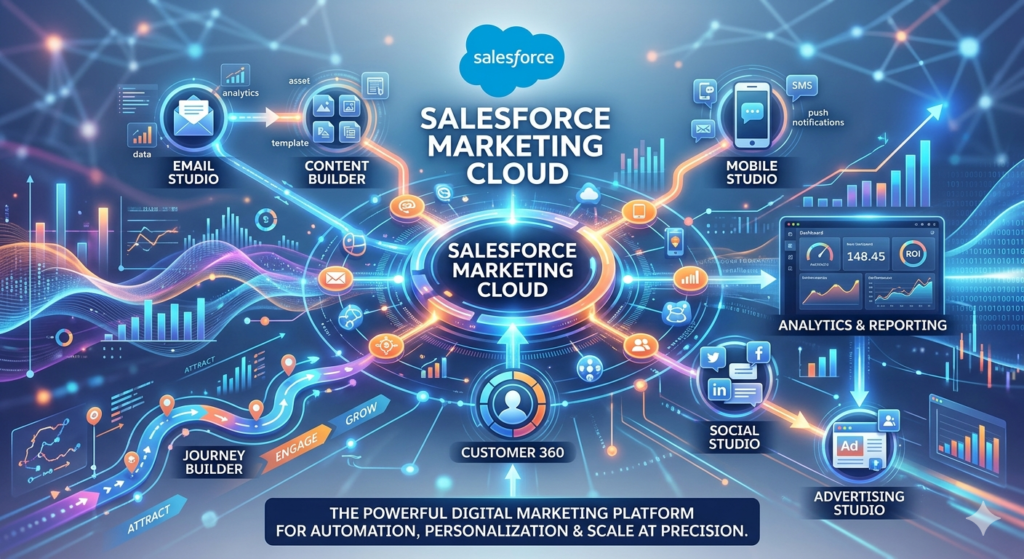
Whether you’re a fresh graduate exploring your options, a digital marketer looking to level up, or an IT professional wanting to pivot into a high-paying niche — this guide will walk you through everything you need to know about building a rewarding SFMC career path in 2026.
Let’s dive in.
What Is Salesforce Marketing Cloud?
Before we talk careers, let’s make sure we’re on the same page about what Salesforce Marketing Cloud actually is.
Salesforce Marketing Cloud is a comprehensive customer engagement platform built on top of the Salesforce ecosystem. It enables marketers to:
- Design and execute email campaigns
- Build customer journeys across multiple channels
- Automate marketing workflows
- Segment audiences and personalize content
- Analyze campaign performance with advanced analytics
SFMC is made up of several powerful studios and builders, including:
- Email Studio — Create and send targeted email campaigns
- Journey Builder — Map out personalized, multi-step customer journeys
- Automation Studio — Schedule and automate marketing activities
- Mobile Studio — Reach customers via SMS and push notifications
- Social Studio — Manage social media listening and publishing
- Advertising Studio — Run data-driven paid ad campaigns
- Analytics Builder — Generate reports and dashboards
- Interaction Studio (now Personalization) — Real-time personalization across touchpoints
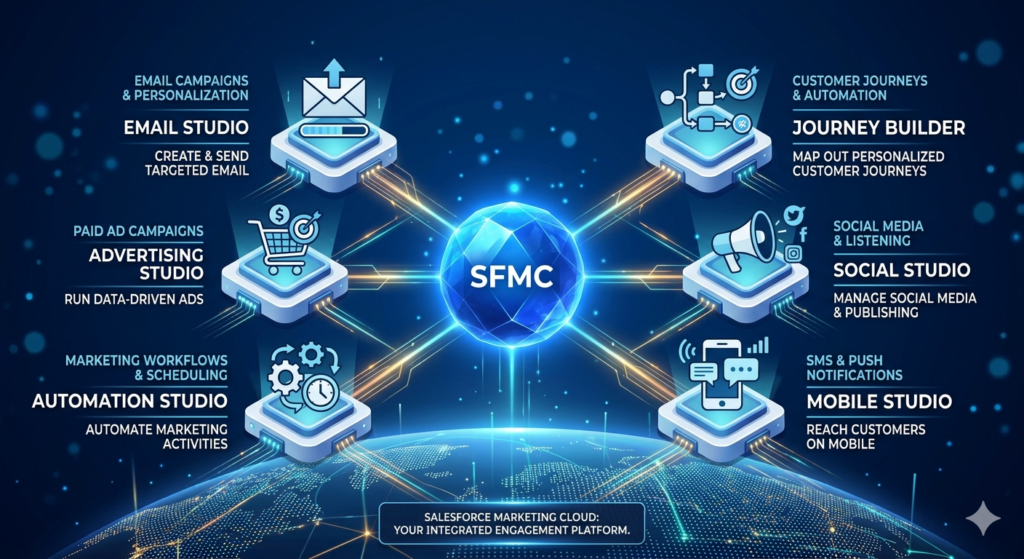
Together, these tools make SFMC one of the most feature-rich platforms in the marketing technology (MarTech) world.
Industries Actively Using SFMC
The beauty of Salesforce Marketing Cloud is that it’s industry-agnostic. Companies of every size and sector use it:
- Retail & E-Commerce — Abandoned cart emails, loyalty programs, product recommendations
- Banking & Finance — Onboarding journeys, fraud alerts, cross-sell campaigns
- Healthcare — Patient communication, appointment reminders, wellness campaigns
- Telecom — Renewal notifications, upsell journeys, customer retention
- Travel & Hospitality — Booking confirmations, loyalty rewards, personalized offers
- Education — Admission journeys, student engagement, alumni outreach
- Technology — SaaS onboarding, trial-to-paid conversion, churn prevention
This cross-industry demand is one major reason why an SFMC career offers such strong job security and growth potential.
What Is a Salesforce Marketing Cloud Career?
A Salesforce Marketing Cloud career sits right at the intersection of technology and marketing. It’s not purely a developer role, and it’s not purely a marketing role — it blends both worlds in a way that makes it uniquely valuable.
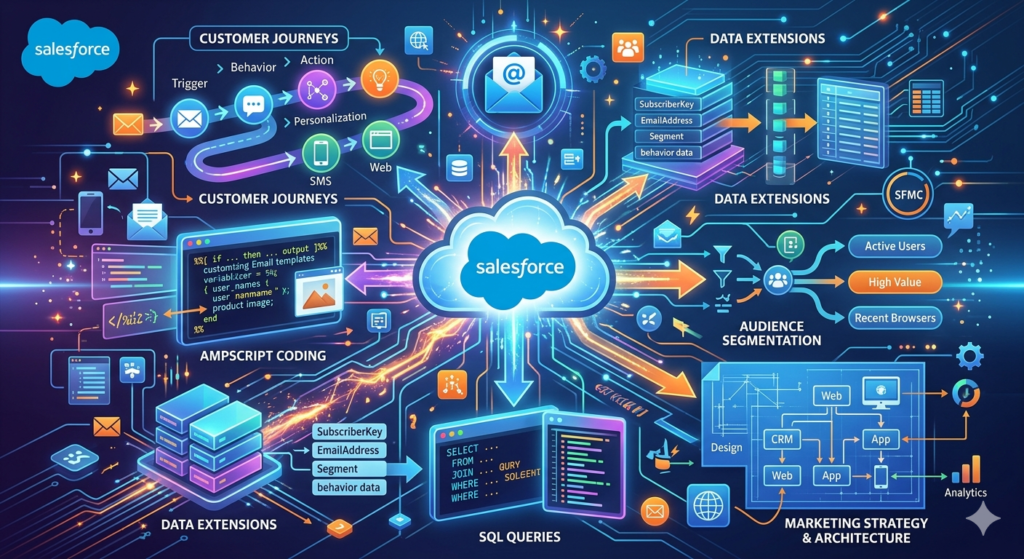
As an SFMC professional, you could be:
- Configuring complex customer journeys that trigger personalized emails based on user behavior
- Writing AMPscript code to dynamically customize email content
- Managing data extensions and audience segmentation
- Building SQL queries to extract and transform data
- Consulting clients on marketing automation strategy
- Designing the overall architecture of a brand’s marketing technology stack
The SFMC ecosystem is broad, which means your SFMC career path can take many different directions — from hands-on technical roles to strategic consulting and management positions.
SFMC Career Path: From Beginner to Expert
One of the most exciting aspects of a Salesforce Marketing Cloud career is that there’s a clear progression from entry level all the way to senior leadership. Let’s break down each stage.
Entry-Level SFMC Roles
1. Email Marketing Specialist / SFMC Executive
This is typically where most people begin their SFMC journey. As an Email Marketing Specialist or SFMC Executive, you’re learning the fundamentals of the platform while contributing to live campaigns.
Typical responsibilities include:
- Building and scheduling email campaigns in Email Studio
- Managing subscriber lists and data extensions
- Running A/B tests on subject lines and content
- Monitoring deliverability metrics (open rates, click rates, bounce rates)
- Supporting senior team members in campaign execution
Who is this role for?
Fresh graduates with a marketing background, digital marketing executives looking to specialize, or IT professionals making a lateral move into MarTech.
2. Marketing Cloud Executive / Associate Consultant
A slight step up from the specialist role, this position involves a broader understanding of SFMC tools and may include working directly with clients or internal stakeholders to gather requirements.
Typical responsibilities include:
- Assisting in Journey Builder configurations
- Setting up basic Automation Studio workflows
- Supporting data management tasks
- Creating reports in Analytics Builder
Mid-Level SFMC Roles
3. SFMC Consultant
This is where careers often accelerate significantly. An SFMC Consultant is someone who can independently handle end-to-end SFMC implementations or campaign management. They understand not just the “how” but also the “why” behind marketing decisions.
Typical responsibilities include:
- Gathering business requirements and translating them into technical solutions
- Designing and building multi-step journeys in Journey Builder
- Writing AMPscript for dynamic content personalization
- Configuring integrations with Salesforce CRM and external platforms
- Conducting user training and workshops
- Advising clients on best practices and optimization strategies
4. Marketing Automation Specialist
This role is more technically focused and revolves around building scalable, efficient automation workflows that reduce manual effort and improve campaign consistency.
Typical responsibilities include:
- Building complex Automation Studio workflows (file imports, SQL queries, sends)
- Managing data architecture and data extensions
- Writing and optimizing SQL queries for segmentation
- Troubleshooting automation failures
- Working with IT teams on API integrations
5. SFMC Developer
For those with a stronger coding background, the SFMC Developer role involves deeper technical work including custom scripting, API development, and front-end email development.
Typical responsibilities include:
- Writing advanced AMPscript and SSJS (Server-Side JavaScript)
- Developing responsive HTML email templates
- Using REST and SOAP APIs for custom integrations
- Building custom activities in Journey Builder
- Managing Marketing Cloud Connect with Salesforce CRM
Advanced / Senior SFMC Roles
6. Senior SFMC Consultant / Marketing Cloud Manager
At this level, you’re leading projects, managing teams, and acting as a subject matter expert. You’re not just executing — you’re strategizing.
Typical responsibilities include:
- Leading end-to-end SFMC implementation projects
- Managing a team of SFMC executives and consultants
- Defining marketing automation strategy for clients or the organization
- Overseeing data governance and compliance (GDPR, CAN-SPAM)
- Reporting to C-suite stakeholders on campaign performance
7. Salesforce Marketing Cloud Architect
This is the pinnacle of the technical SFMC career path. An SFMC Architect designs the entire marketing technology ecosystem for large enterprises.
Typical responsibilities include:
- Designing enterprise-level SFMC architectures
- Making decisions on data models, business unit structures, and integrations
- Evaluating and recommending complementary tools and platforms
- Leading technical discovery workshops with enterprise clients
- Mentoring senior consultants and developers
- Holding Salesforce Certified Marketing Cloud Architect credentials
SFMC Roles and Responsibilities: A Deeper Look
Understanding SFMC roles and responsibilities at a granular level can help you figure out exactly where your interests and strengths align. Let’s go tool by tool.
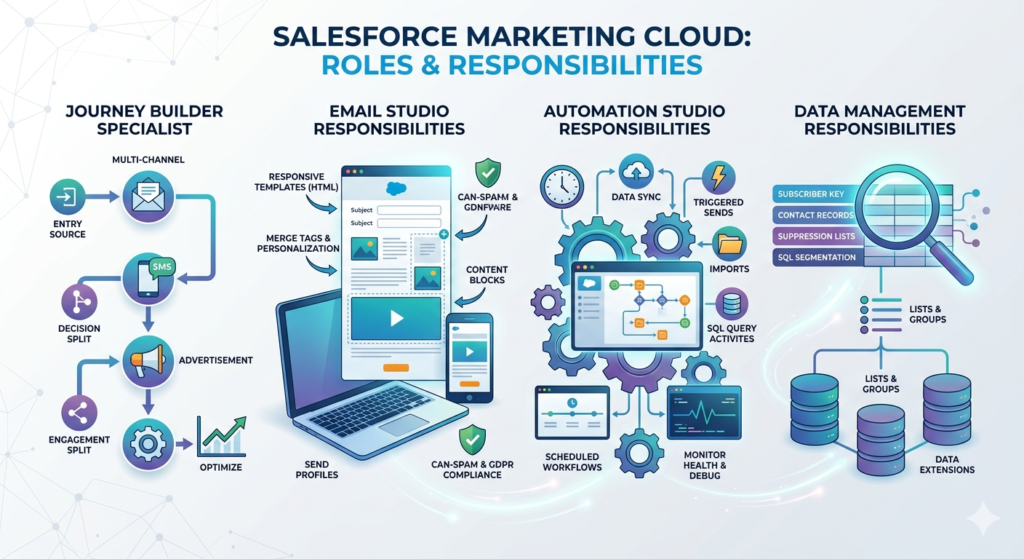
Journey Builder Specialist Responsibilities
Journey Builder is arguably SFMC’s most powerful feature. Professionals working with it are responsible for:
- Designing multi-channel, multi-step customer journeys (email, SMS, push, ads)
- Setting up entry sources (data extensions, Salesforce objects, API events)
- Configuring decision splits, engagement splits, and random splits
- Scheduling journey refreshes and managing journey versions
- Monitoring journey performance and optimizing based on data
Email Studio Responsibilities
- Building responsive email templates using HTML and drag-and-drop builders
- Personalizing emails using merge tags and dynamic content
- Managing content blocks and shared content
- Setting up sender profiles, delivery profiles, and reply mail management
- Ensuring CAN-SPAM and GDPR compliance in all email sends
Automation Studio Responsibilities
- Building scheduled and triggered automation workflows
- Configuring file import activities, SQL query activities, and filter activities
- Setting up send automation (triggered sends, scheduled sends)
- Monitoring automation health and debugging errors
- Coordinating with data teams for seamless data flow
Data Management Responsibilities
- Designing and managing data extensions
- Building and managing lists, groups, and publication lists
- Setting up subscriber key strategies
- Managing contact records and suppression lists
- Writing SQL queries for advanced segmentation
Key Skills Required for an SFMC Career
To succeed in a Salesforce Marketing Cloud career, you need a mix of technical expertise, marketing acumen, and soft skills. Here’s a complete breakdown.
Technical Skills
1. AMPscript
AMPscript is SFMC’s proprietary scripting language used to personalize email content dynamically. It’s one of the most in-demand skills for SFMC professionals.
2. SQL (Structured Query Language)
SQL is used extensively in Automation Studio for creating queries that segment data, filter audiences, and transform records in data extensions.
3. HTML & CSS
Building responsive, well-designed email templates requires a solid understanding of HTML and CSS — especially considering how emails render across different email clients.
4. SSJS (Server-Side JavaScript)
Used for more complex scripting tasks in cloud pages and automation activities.
5. REST & SOAP APIs
Understanding how to work with SFMC’s APIs is critical for integrations with external systems, custom journey activities, and real-time triggered messaging.
6. Data Modeling
Knowing how to design efficient data extensions, set up relationships between data objects, and manage large volumes of customer data is foundational.
7. Marketing Cloud Connect
Understanding how to integrate SFMC with Salesforce CRM (Sales Cloud or Service Cloud) is a highly valued technical skill.
Marketing Skills
1. Campaign Strategy
Understanding the “why” behind campaigns — customer segmentation, funnel stages, conversion goals — makes you far more effective as an SFMC professional.
2. Audience Segmentation
The ability to think logically about how to divide audiences based on behavior, demographics, purchase history, and engagement levels.
3. Email Marketing Best Practices
Knowledge of deliverability, spam laws, list hygiene, and engagement metrics.
4. A/B Testing
Understanding how to design statistically valid tests and interpret results.
5. Customer Journey Mapping
The ability to visualize and design multi-touchpoint experiences that guide customers through their lifecycle.
Soft Skills
- Analytical Mindset — You’ll regularly review data and make decisions based on metrics
- Problem-Solving — Debugging automations and troubleshooting journey failures requires logical thinking
- Communication — Whether you’re working with clients or internal stakeholders, explaining technical concepts clearly is essential
- Attention to Detail — A single wrong character in AMPscript can break an entire campaign
- Project Management — Managing timelines, deliverables, and stakeholder expectations becomes increasingly important as you grow in your career
Marketing Cloud Salary in India: What to Expect in 2026
Let’s talk numbers — one of the most searched topics for anyone exploring an SFMC career. The good news? Marketing cloud salary in India is genuinely competitive compared to other IT and digital marketing roles.
Entry-Level (0–2 Years Experience)
- Role: Email Marketing Specialist, SFMC Executive
- Annual Salary Range: ₹3.5 LPA – ₹6.5 LPA
- Monthly Take-Home (Approximate): ₹25,000 – ₹50,000
At this stage, you’re building your foundation. Freshers with relevant certifications can command salaries at the higher end of this range.
Mid-Level (2–5 Years Experience)
- Role: SFMC Consultant, Marketing Automation Specialist, SFMC Developer
- Annual Salary Range: ₹7 LPA – ₹16 LPA
- Monthly Take-Home (Approximate): ₹55,000 – ₹1,20,000
This is where salaries start to reflect the scarcity of skilled SFMC talent. Professionals with certifications and a proven track record can push toward ₹16 LPA or more.
Senior Level (5+ Years Experience)
- Role: Senior SFMC Consultant, Marketing Cloud Manager, SFMC Architect
- Annual Salary Range: ₹18 LPA – ₹40+ LPA
- Monthly Take-Home (Approximate): ₹1,40,000 – ₹3,00,000+
Senior SFMC Architects and Managers at leading IT firms or consultancies can easily breach the ₹40 LPA mark, especially with specialized certifications and experience in large-scale enterprise projects.
Factors That Affect Marketing Cloud Salary in India
1. Experience
Unsurprisingly, years of hands-on SFMC experience is the biggest salary driver. Real-world project exposure consistently commands premium pay.
2. Certifications
Holding one or more Salesforce certifications can add 15–30% to your base salary. Certified professionals are seen as more credible and reliable by employers.
3. Location
Salaries tend to be higher in metro cities like Bengaluru, Mumbai, Hyderabad, and Pune — cities with a high concentration of IT companies and consulting firms. Remote work has also opened doors to global salary benchmarks.
4. Employer Type
Working for a Salesforce consulting partner (e.g., Accenture, Infosys, Capgemini, Deloitte) or a global product company typically pays more than working for a small digital agency.
5. Specialization
Professionals who specialize in technical areas like AMPscript, SSJS, or API integrations often earn more than generalists.
Certifications to Boost Your Salesforce Marketing Cloud Career
Salesforce certifications are the gold standard in the Salesforce ecosystem. They validate your skills, make your resume stand out, and often directly translate to higher pay.
Here are the most important certifications for your SFMC career path:
1. Salesforce Marketing Cloud Email Specialist
- Level: Entry to Mid
- Focus: Email marketing best practices, Email Studio, Content Builder, subscriber management, deliverability
- Best For: Those starting their SFMC journey with a focus on email campaigns
- Exam Format: 60 questions, 90 minutes, 65% passing score
This is often the first certification most SFMC professionals pursue, and for good reason. It provides a solid foundation and signals to employers that you understand the platform and email marketing fundamentals.
2. Salesforce Marketing Cloud Administrator
- Level: Mid
- Focus: Administration, setup, security, data management, mobile messaging, user management
- Best For: Those managing SFMC instances, setting up accounts, and handling day-to-day administration
- Exam Format: 60 questions, 105 minutes, 67% passing score
This certification is ideal if your role involves managing the SFMC platform itself rather than just campaign execution.
3. Salesforce Marketing Cloud Consultant
- Level: Mid to Advanced
- Focus: Discovery, solutioning, implementation, integration, data design, campaign design
- Best For: Consultants and solution architects who work with clients on SFMC implementations
- Exam Format: 60 questions, 105 minutes, 65% passing score
This is widely considered the most valuable SFMC certification in the job market. It demonstrates that you can translate business requirements into technical solutions.
4. Salesforce Marketing Cloud Developer
- Level: Advanced
- Focus: AMPscript, SSJS, APIs, data management, CloudPages
- Best For: Technical professionals focused on custom development and integrations
5. Salesforce Certified Marketing Cloud Architect
- Level: Expert
- Focus: Enterprise architecture, multi-org design, cross-cloud strategy
- Best For: Senior professionals with extensive SFMC and Salesforce CRM experience
Pro Tip: Most SFMC professionals recommend starting with the Email Specialist certification, then progressing to Administrator, and then targeting the Consultant certification. This progression maps well to the natural career path and provides a comprehensive understanding of the platform.
How to Start Your SFMC Career: A Step-by-Step Roadmap
Ready to take action? Here’s a practical roadmap to launch your Salesforce Marketing Cloud career from scratch.
Step 1: Build Your Marketing Foundation
Before diving into SFMC tools, make sure you understand the basics of digital marketing:
- Email marketing principles (open rates, CTR, deliverability)
- Customer segmentation concepts
- Campaign lifecycle management
- Basic data concepts (what is a database, what is a field, what is a record)
Step 2: Get Familiar with the Salesforce Ecosystem
- Create a free Salesforce Trailhead account (trailhead.salesforce.com)
- Complete the “Salesforce Platform Basics” trail
- Explore the “Marketing Cloud Basics” module
- Get comfortable with Salesforce terminology (objects, records, fields, orgs)
Step 3: Dive Into SFMC Core Tools
Focus on learning these tools in this order:
- Email Studio — Start building emails and understanding subscribers
- Content Builder — Learn to create content blocks and templates
- Journey Builder — Build simple journeys with email activities
- Automation Studio — Set up basic automations
- Data Extensions — Learn how data is stored and managed
Step 4: Learn Technical Skills
- SQL — Start with basic SELECT, WHERE, JOIN queries. Practice on free platforms like SQLZoo or Mode Analytics
- AMPscript — Use Salesforce documentation and community resources to learn the basics
- HTML/CSS for Email — Practice building simple responsive email templates
Step 5: Get Certified
- Start with the Marketing Cloud Email Specialist certification
- Use Trailhead, Focus on Force, and practice exams to prepare
- Schedule your exam through Webassessor (Salesforce’s testing platform)
Step 6: Build a Portfolio
- Use a free SFMC developer account (available through Salesforce) to practice
- Document your projects — journeys you’ve built, automations you’ve configured, campaigns you’ve run
- Create case studies even from practice exercises
Step 7: Join the Community
- Follow the Salesforce Trailblazer Community
- Join SFMC-focused LinkedIn groups and forums
- Attend Salesforce World Tour events (many are free to attend virtually)
- Follow SFMC thought leaders on LinkedIn
Step 8: Apply for Entry-Level Roles
- Search for roles like “SFMC Executive,” “Email Marketing Specialist,” “Marketing Cloud Trainee”
- Target Salesforce consulting partners and digital marketing agencies
- Highlight your certifications, Trailhead badges, and any portfolio work
Learning Resources
| Resource | Type | Cost |
|---|---|---|
| Salesforce Trailhead | Interactive learning | Free |
| Focus on Force | Certification prep | Paid |
| SFMC Documentation | Official docs | Free |
| Udemy SFMC Courses | Video courses | Paid |
| YouTube (SFMC tutorials) | Video | Free |
| RizeX Labs | Structured training + mentorship | Check website |
Future Scope of SFMC Careers
If you’re wondering whether investing in an SFMC career is worth it for the long term, here’s what the landscape looks like heading into 2026 and beyond.
Global Demand Is Accelerating
- Salesforce consistently ranks as one of the fastest-growing enterprise software companies in the world
- The global CRM market is projected to surpass $130 billion by 2028, with marketing automation being one of the fastest-growing segments
- Companies of every size are increasing their MarTech budgets, and SFMC remains the platform of choice for enterprise-level marketing
India’s SFMC Market Is Booming
India has become a global hub for Salesforce talent. Here’s why the SFMC career outlook in India is particularly strong:
- IT Services Giants — Companies like TCS, Infosys, Wipro, HCL, Accenture, and Capgemini are expanding their Salesforce practices and actively hiring SFMC professionals
- GCCs (Global Capability Centers) — Multinational corporations are setting up GCCs in India, creating demand for experienced SFMC professionals who can support global campaigns
- Startups and Mid-Size Companies — More Indian companies are adopting Salesforce as they scale, creating demand for mid-market SFMC expertise
- Remote Work Opportunities — Indian SFMC professionals increasingly have access to global job opportunities without relocating
Emerging Trends Shaping SFMC Careers in 2026
1. AI-Powered Marketing
Salesforce’s Einstein AI capabilities are deeply integrated into Marketing Cloud. Professionals who understand how to leverage AI for predictive scoring, content recommendations, and send-time optimization will have a significant edge.
2. Data Cloud Integration
Salesforce Data Cloud (formerly CDP) is becoming central to enterprise marketing strategies. SFMC professionals who understand how Data Cloud integrates with Marketing Cloud will be in exceptionally high demand.
3. Omnichannel Marketing
Brands want seamless experiences across email, SMS, WhatsApp, push notifications, and social media. SFMC professionals who can orchestrate true omnichannel journeys are invaluable.
4. Privacy and Compliance
With increasing data privacy regulations globally (GDPR, India’s DPDP Act), SFMC professionals who understand consent management, suppression strategies, and compliance best practices are increasingly sought after.
5. Marketing Cloud Growth (formerly Pardot)
B2B marketing automation is growing rapidly, and professionals with expertise in both B2B and B2C SFMC are becoming rare and valuable.
Career Longevity
One of the best things about an SFMC career is its longevity and adaptability. As the platform evolves, so do the skills required — meaning continuous learning keeps you relevant and in demand. The Salesforce ecosystem has a culture of ongoing education (Trailhead releases new content constantly) that makes staying current more manageable than in many other tech niches.
How RizeX Labs Can Help You Launch Your SFMC Career
Navigating the SFMC learning journey on your own can feel overwhelming. There’s a lot to learn, certifications to prepare for, and practical skills to build. That’s where having the right support system makes all the difference.
RizeX Labs is a specialized learning and consulting platform designed to help both beginners and professionals fast-track their Salesforce Marketing Cloud careers. Whether you’re just getting started or looking to level up your existing skills, RizeX Labs offers structured programs, hands-on training, and mentorship from real SFMC practitioners who work on live projects every day.
The advantage of learning with experts who live and breathe SFMC is that you don’t just learn the theory — you learn how things actually work in real client environments, what mistakes to avoid, and how to position yourself competitively in the job market.
Conclusion: Your SFMC Career Starts Today
The Salesforce Marketing Cloud career landscape in 2026 is full of opportunity — and the timing couldn’t be better to get started. Demand for skilled SFMC professionals is outpacing supply, salaries are highly competitive, and the career path is clearly defined from entry level all the way to architect.
Here’s a quick recap of what we covered:
- SFMC is a powerhouse platform used across industries worldwide
- The SFMC career path progresses from Email Specialist → Consultant → Manager → Architect
- Key SFMC roles and responsibilities span technical, strategic, and managerial domains
- Marketing cloud salary in India ranges from ₹3.5 LPA at entry level to ₹40+ LPA at senior level
- Certifications like Email Specialist, Administrator, and Consultant significantly boost career prospects
- The future scope is bright, driven by AI, Data Cloud integration, and growing global demand
The most important thing to understand is this: you don’t need to know everything before you start. Every SFMC expert you admire once opened the platform for the first time and felt exactly where you are now. The difference is they took the first step.
About RizeX Labs
We’re Pune’s leading IT training institute specializing in high-demand ecosystems like Salesforce and MarTech. At RizeX Labs, we empower professionals to master complex tools like Salesforce Marketing Cloud through a combination of hands-on technical labs, real-world campaign simulations, and expert mentorship. Our curriculum is specifically designed to transform ambitious learners into job-ready SFMC professionals with the technical depth and strategic mindset required by top global firms.
Internal Links:
- Salesforce Admin & Development Training: A Complete Guide
- Mastering AMPscript: The Key to Salesforce Marketing Cloud Personalization
- Salesforce Career Roadmap 2026: Transitioning from Non-IT to Tech
