
Introduction: Why Salesforce Training Matters in 2026
Pune has quietly become one of India’s biggest hubs for IT training, and Salesforce courses are riding that wave hard. Whether you’re a fresh graduate from SPPU, a working professional looking to switch domains, or someone who’s simply tired of stagnant job roles, Salesforce training in Pune 2026 is being marketed as the golden ticket.

But here’s the reality check: not all Salesforce training institutes in Pune are created equal.
Some promise six-figure salaries within three months. Others throw around terms like “100% placement guarantee” without explaining what that actually means. And then there are hidden costs, vague curricula, and reviews that sound suspiciously like they were written by the institutes themselves.
This blog is different. We’re going to break down everything you need to know about salesforce course fees pune, duration, placement scenarios, actual student reviews, and how to separate genuine training centers from overhyped marketing machines.
If you’re considering Salesforce training in Pune this year, read every section carefully. This isn’t just another promotional article—it’s a practical guide built for real people making real career decisions.
What Exactly is Salesforce? (Quick Primer for Beginners)
Before we dive into training details, let’s get one thing clear: Salesforce isn’t a programming language or a one-size-fits-all software. It’s a Customer Relationship Management (CRM) platform used by companies worldwide to manage sales, customer service, marketing automation, analytics, and application development.
Here’s why it matters:
- Market dominance: Salesforce holds around 23% of the global CRM market share as of 2026
- Job demand: Over 9 million Salesforce-related jobs are projected globally by 2026
- Certification value: Salesforce certifications (like Administrator, Developer, Consultant) carry weight with recruiters
- Low-code advantage: You don’t need to be a hardcore coder to start with Salesforce Admin roles
In Pune specifically, companies ranging from startups in Hinjewadi to established IT firms in Magarpatta are using Salesforce. That creates real demand—but also real competition among job seekers.
Salesforce Course Fees in Pune: What to Actually Expect
Let’s talk money. The salesforce course fees pune vary wildly depending on the institute, course type, and what’s included in the package.
Average Fee Range (2026)
| Course Type | Fees (INR) | Duration |
|---|---|---|
| Salesforce Admin Training | ₹15,000 – ₹30,000 | 4-6 weeks |
| Salesforce Developer Training | ₹25,000 – ₹45,000 | 6-8 weeks |
| Combined Admin + Developer | ₹40,000 – ₹70,000 | 10-12 weeks |
| Advanced Certification Prep | ₹50,000 – ₹1,00,000 | 12-16 weeks |
What’s Typically Included
Most institutes offering salesforce training pune will bundle:
- Classroom or online sessions
- Study material (often PDFs)
- Access to Salesforce Developer/Trailhead accounts
- Mock tests and practice exams
- “Placement assistance” (more on this later)
What’s Usually Extra
- Official Salesforce certification exam fees: ₹15,000+ per attempt
- Re-exam fees: Another ₹15,000 if you fail
- Lab access after course completion: ₹5,000-₹10,000
- One-on-one doubt sessions: Sometimes charged separately
Red Flags in Pricing
Beware institutes that:
- Refuse to give a written fee breakdown
- Add “processing charges” after enrollment
- Promise lifetime support but shut down after six months
- Offer suspiciously low fees (₹5,000-₹8,000) with no clear curriculum
Smart Money Tips
- Compare at least 3-4 institutes physically if possible
- Ask for alumni contacts to verify what they actually paid
- Check if EMI options are available (many do, through third-party finance)
- Calculate total cost including certification exam fees from day one
- Don’t fall for early-bird discounts that pressure you into immediate payment
The sweet spot for decent salesforce classes pune is typically ₹20,000-₹35,000 for admin training with proper hands-on projects. Anything significantly lower might cut corners on labs and trainer quality.
Course Duration: How Long Does It Really Take?
Marketing brochures love to say “Master Salesforce in 4 Weeks!” But let’s ground this in reality.
Typical Training Duration
Classroom/Live Online Courses:
- Salesforce Admin: 30-40 hours of training (spread over 4-6 weeks)
- Salesforce Developer: 40-60 hours (6-8 weeks)
- Platform Developer: 60-80 hours (8-10 weeks)
Self-Paced Online:
- Theoretically flexible, but realistically 2-4 months if done seriously
Weekend Batches:
- Usually 2-3 hours per session, spanning 8-12 weekends
The Actual Learning Timeline
Here’s what most students don’t tell you:
- Weeks 1-2: Getting comfortable with basic navigation and concepts
- Weeks 3-4: Hands-on with workflows, validation rules, reports
- Weeks 5-6: Real project work (if the institute is good)
- Weeks 7-8: Exam preparation and mock tests
- Post-training: 2-4 weeks of self-study before attempting certification
Reality Check: Course Completion ≠ Job Ready
Completing salesforce training pune doesn’t automatically make you job-ready. Most freshers need:
- 30-40 hours of additional self-practice on Trailhead
- At least one certification (Salesforce Admin minimum)
- A decent project portfolio (2-3 real or simulated projects)
- Interview preparation separate from technical training
Good institutes build this into their program. Average ones just finish the syllabus and call it done.
How to Maximize Your Time
- Don’t rush: A 4-week course crammed into weekends won’t give you mastery
- Practice daily: Even 30 minutes on Trailhead makes a difference
- Join study groups: Pune has several Salesforce user groups on LinkedIn
- Set a certification deadline: Gives structure to your learning
- Build while learning: Start creating mini-apps in your developer org from week 2
Placement Reality: Separating Fact from Marketing Fiction
This is where things get murky. Almost every institute advertising Salesforce training in Pune claims “100% placement assistance” or “guaranteed job support.” Let’s decode what that actually means.
What “Placement Assistance” Usually Means
- Resume building workshops
- A list of company contacts (often generic)
- Mock interview sessions
- Sharing your profile with their “hiring partners”
- Email notifications about job openings
What It Doesn’t Mean
- A guaranteed job offer
- Salary negotiation on your behalf
- Legal obligation to get you placed
- Direct interviews with top companies
The Placement Process Reality
Scenario 1: Large Training Institutes
These have tie-ups with service companies (often mass recruiters). They’ll conduct campus-style drives where:
- 50-100 students appear
- 5-10 get offers
- Starting salary: ₹2.5-4.5 LPA
- Roles: Junior Salesforce Admin, Implementation Analyst
Scenario 2: Mid-Sized Quality Institutes
Better trainer quality, smaller batches. They’ll:
- Connect strong performers with actual hiring managers
- Support with referrals if you’ve done well
- Placement rate: 40-60% within 3-6 months
- Salary range: ₹3.5-6 LPA
Scenario 3: Small/Budget Institutes
Minimal actual placement support. You’re mostly on your own after training ends.
Common Placement Myths to Ignore
Myth 1: “100% Placement Guarantee”
Reality: Usually means “we’ll help you apply” not “you’ll definitely get hired”
Myth 2: “Our students get ₹8-12 LPA packages”
Reality: This might be true for 2-3 star performers with prior IT experience, not freshers
Myth 3: “Work with companies like Accenture, TCS, Wipro”
Reality: These companies hire Salesforce people, but usually through their own recruitment, not training institute tie-ups
Myth 4: “Get placed in 30 days”
Reality: For freshers, 3-6 months is realistic if you’re actively applying
What Actually Gets You Placed
Based on interactions with actual Salesforce professionals in Pune:
- Salesforce Admin certification (minimum)
- 2-3 solid projects you can explain in interviews
- Good communication skills (often the deciding factor)
- Active job hunting on Naukri, LinkedIn, AngelList
- Networking through Salesforce Pune meetups
- Realistic salary expectations (freshers: ₹3-5 LPA is standard)
Questions to Ask About Placement
Before enrolling in any salesforce classes pune:
- “Can I speak to 3-4 students from previous batches who got placed?”
- “What’s your actual placement percentage for freshers without IT background?”
- “Do you provide placement support after 6 months, or is there a cutoff?”
- “What companies interviewed your students in the last 6 months?”
- “Is there a minimum attendance or performance requirement for placement assistance?”
If they dodge these questions, that’s your answer.
Student Reviews: Reading Between the Lines
Online reviews are tricky. Institutes incentivize positive reviews, and angry students sometimes leave unfairly harsh ones. Here’s how to read reviews intelligently.
Where to Find Genuine Reviews
Google My Business: Hard to fake, shows reviewer history
Glassdoor/AmbitionBox: Sometimes has reviews from ex-students
LinkedIn: Search for institute name + Salesforce + Pune, see who actually completed courses
Quora/Reddit: Less filtered, more honest opinions
College forums: SPPU students often share experiences
Red Flags in Reviews
- All 5-star reviews with generic praise (“best institute”, “great faculty”)
- Reviews posted on the same day in bulk
- No mention of specific trainers, projects, or course content
- Over-the-top language that sounds like marketing copy
- No constructive criticism whatsoever
Green Flags in Reviews
- Specific trainer names mentioned
- Clear pros AND cons listed
- Details about projects, placement support, lab access
- Realistic outcomes (“got placed after 4 months at ₹4.5 LPA”)
- Responses from institute that address concerns professionally
What to Look for in Reviews
About Trainers:
- Industry experience (not just training experience)
- Ability to explain concepts clearly
- Availability for doubt-solving
- Real-world project exposure they provide
About Infrastructure:
- Lab availability and quality
- Internet speed for cloud-based practice
- Batch sizes (smaller is better—max 15-20)
About Support:
- Responsiveness after course completion
- Quality of study material
- Mock test difficulty level
- Placement team’s actual involvement
Sample Questions to Ask Current Students
Find them on LinkedIn or through the institute:
- “How many hours of hands-on practice did you get?”
- “Did you clear certification in first attempt? If not, what support did you get?”
- “Were the placement companies actually hiring, or just collecting resumes?”
- “Would you recommend this to your friend, honestly?”
- “What would you have done differently in choosing this course?”
Course Content: What Should Actually Be Covered
Not all Salesforce training in Pune covers the same depth. Here’s what a comprehensive curriculum should include.
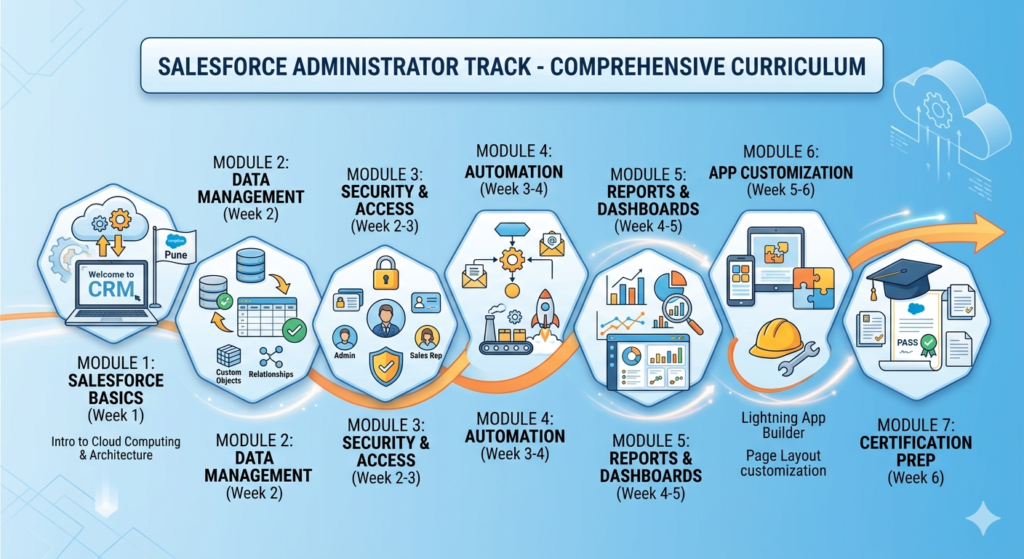
For Salesforce Administrator Track
Module 1: Salesforce Basics (Week 1)
- Introduction to CRM and cloud computing
- Salesforce architecture and data model
- Navigation and user interface
- Hands-on: Creating your first Salesforce org
Module 2: Data Management (Week 2)
- Objects, fields, and relationships
- Data import/export tools
- Data validation and quality
- Hands-on: Building custom objects and fields
Module 3: Security & Access (Week 2-3)
- User management and profiles
- Permission sets and sharing rules
- Role hierarchy and OWD
- Hands-on: Setting up security model for a sample business
Module 4: Automation (Week 3-4)
- Workflow rules and process builder
- Flow Builder basics
- Email alerts and field updates
- Hands-on: Automating a lead conversion process
Module 5: Reports & Dashboards (Week 4-5)
- Report types and formats
- Custom report creation
- Dashboard components
- Hands-on: Building executive dashboard
Module 6: App Customization (Week 5-6)
- Lightning App Builder
- Custom buttons and links
- Page layouts and record types
- Hands-on: Creating a custom recruitment app
Module 7: Certification Preparation (Week 6)
- Mock exams
- Weak area identification
- Exam tips and strategies
- Official certification exam registration guidance
For Salesforce Developer Track
Additional Modules Beyond Admin:
Apex Programming:
- Triggers, classes, and test classes
- SOQL and SOSL queries
- Governor limits and best practices
- Hands-on: Building trigger-based automation
Visualforce:
- Pages, controllers, and components
- Integration with Apex
- Hands-on: Creating custom UI
Lightning Web Components:
- Modern UI framework
- JavaScript fundamentals
- Component communication
- Hands-on: Building reusable components
Integration:
- REST and SOAP APIs
- Callouts and webhooks
- Platform events
- Hands-on: Integrating Salesforce with external system
What’s Often Missing (But Shouldn’t Be)
Many institutes skip or rush through:
- Real-world scenario practice: Solving actual business problems, not just tool navigation
- Debugging skills: How to troubleshoot when things don’t work
- Best practices: Salesforce-specific design patterns and governance
- Soft skills: How to gather requirements, communicate with stakeholders
- Resume and portfolio building: Presenting your work effectively
Questions About Course Content
Before enrolling:
- “Can I see the detailed week-by-week curriculum?”
- “How many hands-on assignments are included?”
- “What projects will I build during the course?”
- “Is the content updated for the latest Salesforce release?”
- “Do you cover Lightning Experience or Classic?” (It should be Lightning)
Online vs Offline Salesforce Training in Pune: Honest Comparison
Post-pandemic, this question matters more than ever. Both have merits and drawbacks.
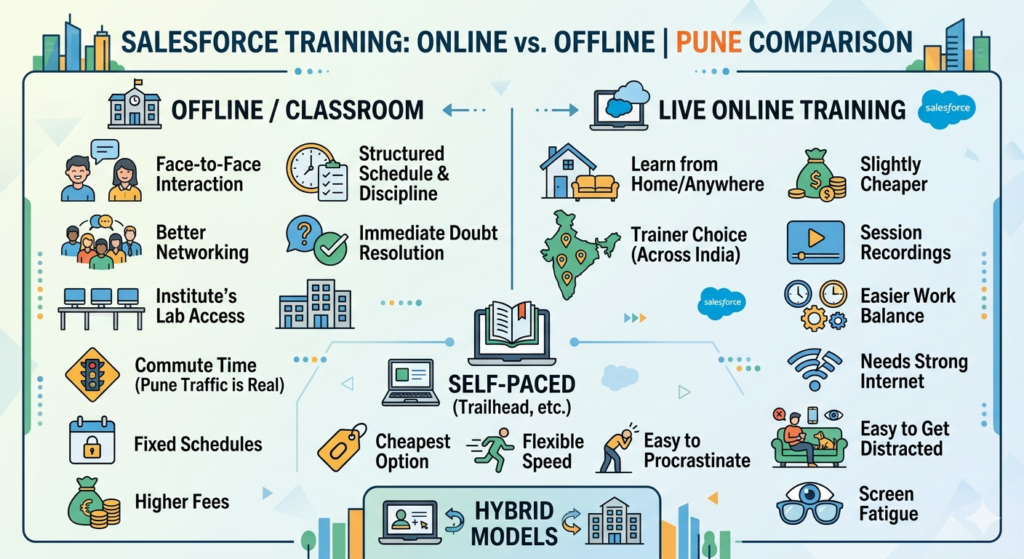
Offline/Classroom Training
Advantages:
- Face-to-face interaction with trainers
- Structured schedule forces discipline
- Better networking with batch mates
- Immediate doubt resolution
- Access to institute’s lab computers
Disadvantages:
- Commute time (Pune traffic is real)
- Fixed schedules (tough for working professionals)
- Higher fees typically
- Limited institute options based on your location
Best for:
- Students with flexible schedules
- People who struggle with self-discipline
- Those who learn better with peer interaction
- Freshers wanting to build a network
Live Online Training
Advantages:
- Learn from home/anywhere
- Usually slightly cheaper
- Can choose trainers from across India
- Session recordings available
- Easier to balance with part-time work
Disadvantages:
- Requires strong internet connection
- Easy to get distracted
- Screen fatigue
- Less personal connection with trainers
- Need your own practice environment
Best for:
- Working professionals
- People in Pune suburbs with long commutes
- Self-motivated learners
- Those balancing multiple commitments
Self-Paced Online (Trailhead, Udemy, etc.)
Advantages:
- Cheapest option (often free)
- Learn at your own pace
- Highest flexibility
- Can skip what you know
Disadvantages:
- No mentor support
- Easy to procrastinate
- No structured projects
- No placement assistance
- Harder to stay motivated
Best for:
- Extremely self-disciplined people
- Those who’ve already worked in IT
- Supplementing other training
- Budget-conscious learners
Hybrid Models
Some progressive institutes offering salesforce training pune now provide:
- Recorded sessions + live doubt-clearing
- Offline exams + online classes
- Weekend offline + weekday online options
This often gives the best of both worlds.
Cost Comparison (Pune, 2026)
| Mode | Average Cost |
|---|---|
| Offline classroom | ₹25,000 – ₹45,000 |
| Live online | ₹18,000 – ₹35,000 |
| Self-paced online | ₹5,000 – ₹15,000 |
| Hybrid | ₹20,000 – ₹40,000 |
How to Choose the Best Salesforce Training Institute in Pune
With 50+ institutes claiming to be the “best salesforce training institute pune,” here’s a practical checklist.
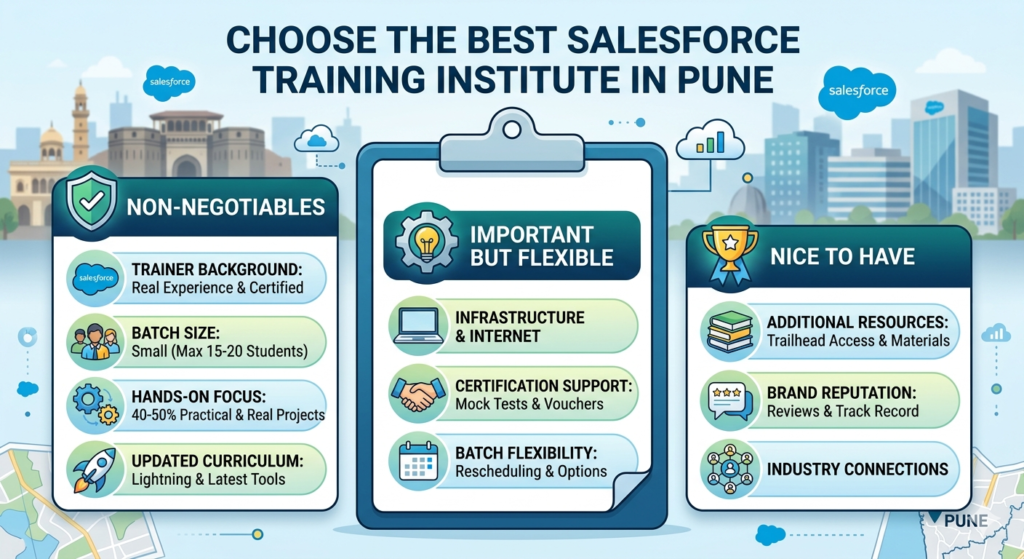
Non-Negotiables
1. Trainer Background
- Should have real implementation/development experience
- Minimum 3-5 years in Salesforce roles
- Preferably certified themselves
- Check LinkedIn profiles; don’t just trust institute claims
2. Batch Size
- Maximum 15-20 students for quality attention
- Smaller batches = more hands-on time
- Ask about current batch strength before enrolling
3. Hands-On Focus
- At least 40-50% practical work
- Individual developer/admin org access
- Real projects, not just demos
4. Updated Curriculum
- Should cover latest Salesforce release
- Focus on Lightning (not Classic)
- Include newer tools like Flow Builder (not just Workflow Rules)
5. Post-Training Support
- At least 3-6 months doubt resolution
- Alumni network or community
- Placement assistance timeline clearly stated
Important but Flexible
6. Infrastructure
- Good if they have a physical lab, but not mandatory if you have a laptop
- Stable internet for online sessions
- Recording availability
7. Certification Support
- Mock tests similar to actual exam difficulty
- Exam voucher included or discounted
- Re-attempt support
8. Flexibility
- Batch rescheduling options
- Missed session coverage
- Weekend/weekday options
Nice to Have
9. Additional Resources
- Access to premium Trailhead modules
- Reference books or materials
- Industry connections for networking
10. Brand Reputation
- Reviews across multiple platforms
- Years in operation (2+ years minimum)
- Trainer retention (same trainers, or constant changes?)
The Visit Checklist
When you visit an institute physically:
- Ask to sit in on a live session for 15-20 minutes
- Talk to current students during break
- Check the actual lab setup
- Ask for alumni contact numbers (call them)
- Get everything in writing—fees, duration, support
- Don’t pay full fees on first visit (take time to decide)
- Compare with at least 2 other institutes
Warning Signs to Walk Away
- Pushy sales tactics or “offer expires today” pressure
- Unwillingness to show you the facility
- No clear refund policy
- Trainers who can’t answer basic Salesforce questions
- Fake certificates or course completion guarantees
- No proper registration or GST invoice
Salesforce Certification: Essential or Optional?
Let’s settle this debate. For anyone completing salesforce classes pune, should you get certified?
Short Answer: Highly Recommended, Almost Essential
Here’s why:
For Freshers:
- Certification is practically mandatory to get interview calls
- Validates your knowledge independently
- Shows commitment to the field
- Levels the playing field against experienced candidates
For Working Professionals:
- Boosts credibility with clients
- Often required for project allocation
- Can justify salary hikes
- Opens consulting opportunities
Which Certification First?
Salesforce Administrator: Start here
- Cost: ₹15,000 per attempt
- Passing score: 65%
- Questions: 60 multiple choice
- Time: 105 minutes
- Difficulty: Moderate with proper preparation
Platform App Builder: Good second certification
- Shows you can build applications
- Similar exam format
- Complements Admin cert well
Platform Developer I: If you’re taking developer track
- Requires programming knowledge
- Opens higher-paying roles
- More technical depth
Certification Exam Realities
Pass rates hover around 60-70% for first-timers from good training institutes.
Common reasons for failure:
- Rushing into exam without adequate self-study
- Not practicing enough on actual Salesforce org
- Relying only on dumps (which rarely work post-2024)
- Poor time management during exam
Preparation tips:
- Complete at least 5-6 full-length mock tests
- Score consistently above 75% before attempting
- Focus on weak areas using Trailhead modules
- Join Salesforce certification study groups in Pune
Is Certification Enough?
No. You also need:
- Portfolio of projects
- Good communication skills
- Understanding of business processes
- Practical problem-solving ability
Think of certification as your entry ticket. Your skills determine how far you go.
Job Market Reality for Salesforce in Pune (2026 Scenario)
Let’s look at what the actual job market looks like for someone completing Salesforce training in Pune this year.
Demand Landscape
High Demand Roles:
- Salesforce Administrator (entry to mid-level)
- Salesforce Developer (with Java/JavaScript background)
- Business Analyst with Salesforce knowledge
- Salesforce Consultant (usually needs 2+ years experience)
Moderate Demand:
- Marketing Cloud specialists
- Sales Cloud implementation experts
- Service Cloud consultants
Low Entry Opportunities:
- Architect roles (need 5+ years)
- Technical Lead positions
Salary Expectations (Realistic Numbers)
Freshers (0-1 year):
- Salesforce Admin: ₹2.5-4.5 LPA
- Junior Developer: ₹3.5-5.5 LPA
- Implementation Analyst: ₹3-4.5 LPA
1-3 Years Experience:
- Senior Admin: ₹5-8 LPA
- Developer: ₹6-10 LPA
- Functional Consultant: ₹6-9 LPA
3+ Years Experience:
- Lead roles: ₹10-18 LPA
- Specialized consultants: ₹12-20 LPA
- Architects: ₹18-30 LPA
Top Hiring Companies in Pune
Direct Employers:
- Tech Mahindra
- Persistent Systems
- Infosys
- Accenture
- Cognizant
Salesforce Partners:
- CloudAnalogy
- Tekdence
- Janbask Digital
- Various boutique implementation partners
Startups and Product Companies:
- Growing number of SaaS startups using Salesforce
- E-commerce companies
- BFSI sector implementations
The Competition Factor
Here’s what you’re up against:
- 500-800 students complete Salesforce training in Pune monthly (rough estimate)
- 60-70% attempt certification
- 40-50% actively job hunt post-training
- 100-150 job openings monthly for entry-level Salesforce roles in Pune
The math isn’t discouraging, but it means you need to stand out.
How to Stand Out
- Multiple certifications: Admin + Platform App Builder makes you more attractive
- Real projects: Even volunteer work for NGOs using Salesforce counts
- Active Trailhead profile: Some recruiters check this
- GitHub portfolio: If you’re a developer, showcase your code
- LinkedIn presence: Post about your learning journey
- Communication skills: Non-negotiable in client-facing roles
Common Mistakes to Avoid
Based on experiences shared by Salesforce professionals who started in Pune:
Mistake 1: Choosing Based on Fees Alone
The cheapest institute usually cuts corners on:
- Trainer quality
- Lab access
- Course depth
- Support duration
Better approach: Calculate value, not just cost
Mistake 2: Skipping Self-Practice
Attending classes isn’t enough. If you’re not putting in 8-10 hours weekly on Trailhead and your dev org, you’ll struggle.
Better approach: Treat Salesforce learning like a part-time job
Mistake 3: Ignoring Soft Skills
Technical knowledge alone won’t get you placed. Salesforce roles often involve:
- Client communication
- Requirement gathering
- Presenting solutions
Better approach: Work on communication parallel to technical training
Mistake 4: Unrealistic Salary Expectations
Expecting ₹8-10 LPA as a fresher will keep you unemployed longer.
Better approach: Start at ₹3.5-5 LPA, prove yourself, jump to better offer within a year
Mistake 5: Not Networking
Salesforce has a strong community culture. Not tapping into it is a missed opportunity.
Better approach: Attend Salesforce Saturday Pune, join LinkedIn groups, participate in Trailblazer community
Mistake 6: Stopping After One Certification
One certification is good. Two or three make you stand out significantly.
Better approach: Plan a certification roadmap for 12-18 months
Mistake 7: Copying Projects from GitHub
Recruiters can tell. And you’ll be exposed in technical interviews.
Better approach: Build original projects, even if simpler. Understand every line of code/configuration.
Alternative Learning Paths Worth Considering
Beyond traditional salesforce training pune institutes, here are other options:
Trailhead (Salesforce’s Free Learning Platform)
Pros:
- Completely free
- Official Salesforce content
- Gamified and engaging
- Self-paced
Cons:
- No mentor support
- Can feel overwhelming for absolute beginners
- No placement assistance
- Requires high self-discipline
Best for: Self-learners, those on tight budgets, supplementing paid training
Online Platforms (Udemy, Coursera, Pluralsight)
Pros:
- Affordable (₹500-5,000)
- Learn from global trainers
- Lifetime access typically
- Can preview before buying
Cons:
- Variable quality
- No direct doubt resolution
- No hands-on labs usually
- No placement support
Best for: Working professionals, those wanting specific module deep-dives
Salesforce Virtual Bootcamps
Occasionally Salesforce itself runs free bootcamps:
Pros:
- Official content
- Free or very low cost
- Industry recognition
Cons:
- Limited seats
- Fixed schedules
- Basic level content
Mentorship Programs
Some experienced Salesforce professionals in Pune offer:
- 1-on-1 mentorship
- Project guidance
- Interview prep
Typical cost: ₹10,000-25,000 for 2-3 months
Worth it if: You want personalized attention and already have basic knowledge
College/University Programs
Some engineering colleges now include Salesforce in their curriculum or offer certifications:
Pros:
- Integrated with degree
- Often subsidized
- Academic credentials
Cons:
- Usually superficial coverage
- Not hands-on enough
- Slow pace
Actionable 30-Day Plan After Enrolling
So you’ve chosen a salesforce training institute in Pune and paid your fees. Now what?
Week 1: Foundation
Goals:
- Understand CRM basics
- Get comfortable with Salesforce interface
- Set up your Trailhead account
- Create your first Developer Edition org
Daily tasks:
- Attend classes/watch sessions: 2 hours
- Self-practice on Trailhead: 1 hour
- Read Salesforce blogs/documentation: 30 minutes
Deliverable: Complete “Salesforce Platform Basics” module on Trailhead
Week 2: Building Blocks
Goals:
- Master object and field creation
- Understand relationships
- Learn data import/export
Daily tasks:
- Classes: 2 hours
- Hands-on practice: 1.5 hours
- Join Salesforce Pune LinkedIn group
- Connect with 5 classmates for study group
Deliverable: Build a simple “Book Library” custom object with relationships
Week 3: Automation & Security
Goals:
- Create workflow rules and process builder flows
- Understand security model
- Build reports
Daily tasks:
- Classes: 2 hours
- Practice automation: 1 hour
- Start mini-project planning
- Watch Salesforce YouTube tutorials: 30 minutes
Deliverable: Automate lead conversion process in your dev org
Week 4: Project & Certification Prep
Goals:
- Complete one end-to-end project
- Take first mock exam
- Identify weak areas
Daily tasks:
- Project work: 2-3 hours
- Mock tests: 1 hour
- Review weak topics: 1 hour
Deliverable: Complete project; Score 60%+ on mock exam
Post-30 Days:
- Continue mock tests until scoring 75%+
- Schedule certification exam
- Start building resume
- Begin applying to jobs even before completing course
FAQ Section
1. Can I learn Salesforce without coding background?
Yes, absolutely. Salesforce Admin roles don’t require coding. However, Developer roles need programming knowledge (Apex is similar to Java).
2. How long to get job after completing salesforce training pune?
Realistic timeline: 1-4 months for freshers actively applying with certification. Working professionals switching domains might take 2-6 months.
3. Is Salesforce a good career in 2026?
Yes, but it’s becoming competitive. Success requires continuous learning, multiple certifications, and keeping up with Salesforce’s three yearly releases.
4. What is the salary after Salesforce course for freshers in Pune?
Typical range: ₹2.5-5 LPA depending on role (Admin vs Developer), company, and your performance in interviews.
5. Should I choose Admin or Developer track?
Admin if: You like business process, analysis, no coding interest
Developer if: You have programming background and want technical depth
Many start with Admin and later add Developer certification.
6. Are online Salesforce classes as good as offline?
Quality online classes with live interaction are comparable. Self-paced online requires more discipline but can work well.
7. How much does Salesforce certification cost?
₹15,000 per certification exam. Some institutes include this in course fees, most don’t.
8. Can I get job without Salesforce certification?
Extremely difficult for freshers. Certification is the first filter in most recruitment processes.
9. Which is the best salesforce training institute pune?
There isn’t one “best” for everyone. Best depends on your budget, schedule, learning style, and location. Use the checklist provided earlier.
10. What after getting Salesforce Admin certification?
- Start applying for jobs
- Build portfolio projects
- Consider Platform App Builder certification
- Join Salesforce community events
- Keep practicing on Trailhead
Final Verdict: Is Salesforce Training in Pune Worth It in 2026?
After breaking down every aspect, here’s the honest assessment:
It’s Worth It If:
✅ You’re willing to put in 15-20 hours weekly for 3-4 months
✅ You have realistic salary expectations (₹3-5 LPA to start)
✅ You choose a quality institute after proper research
✅ You’re committed to getting certified
✅ You understand this is the starting point, not the destination
✅ You’re interested in business processes and customer management
✅ You’re prepared for continuous learning (Salesforce updates thrice yearly)
It’s Probably Not Worth It If:
❌ You’re expecting ₹8-10 LPA offers within 2 months
❌ You want to coast through with minimal effort
❌ You’re choosing the cheapest institute to save ₹5,000-10,000
❌ You think certification alone guarantees a job
❌ You have zero interest in technology or business processes
❌ You’re looking for a “get rich quick” scheme
The Smart Approach
- Research thoroughly: Spend 2 weeks researching before paying any fees
- Budget realistically: ₹30,000-50,000 total including training + certification
- Timeline appropriately: 6-8 months from starting training to getting first job
- Network actively: Join Pune Salesforce communities immediately
- Build portfolio: Create 3-4 projects you can showcase
- Keep learning: Plan next certification within 6-12 months
Salesforce Training Pune 2026: The Market Reality
The market isn’t saturated yet, but it’s no longer the blue ocean it was in 2019-2020. You’ll face competition. You’ll need to be in the top 30-40% of your batch to get decent placement opportunities.
But here’s the good part: Quality Salesforce professionals are still in demand. If you’re good at what you do, communicate well, and continuously upskill, the career trajectory is solid.
Companies are implementing Salesforce across industries—healthcare, education, manufacturing, BFSI, retail. The platform isn’t going away. Jobs exist. But you need to be competent, not just certified.
Best Salesforce Training Institute Pune: Your Checklist
Rather than naming specific institutes (which would be unfair without systematic reviews), use this decision framework:
Give maximum weightage to:
- Trainer’s real-world experience and teaching ability (40%)
- Course content depth and hands-on focus (25%)
- Batch size and individual attention (15%)
- Post-training support quality (10%)
- Alumni placement reality (10%)
Give moderate weightage to:
- Infrastructure and facilities
- Brand name
- Marketing claims
Give minimal weightage to:
- Flashy website
- Promises of guaranteed placement
- Celebrity endorsements
- “Award-winning” claims
The 2026 Salesforce Landscape in Pune
Pune’s advantage:
- Lower cost of living than Bangalore/Mumbai
- Growing startup ecosystem
- Established IT companies
- Good training infrastructure
- Active Salesforce community
Pune’s challenges:
- Heavy competition from Bangalore for top jobs
- Many institutes with varying quality
- Salary slightly lower than Bangalore/NCR
- Fewer pure-play Salesforce companies
Bottom line: Pune is a perfectly good place to start your Salesforce career. It won’t give you every advantage Bangalore might, but it won’t hold you back either if you’re skilled.
Action Steps: What to Do Right Now
If you’re serious about salesforce course fees pune and ready to make a decision:
This Week:
- Shortlist 3-4 institutes based on location, reviews, and fees
- Check their batch schedules and see what fits your timeline
- Join Pune Salesforce groups on LinkedIn and Facebook
- Create Trailhead account and complete one module to see if you like it
- Set aside budget for training + certification (₹35,000-50,000)
Next Week:
- Visit shortlisted institutes physically (or attend demo sessions)
- Talk to current/past students (get contacts from institutes)
- Compare detailed curriculum side by side
- Ask placement-related questions from our earlier list
- Check trainer LinkedIn profiles independently
Before Enrolling:
- Get everything in writing: fees, duration, support period, refund policy
- Read the agreement carefully before signing
- Pay through proper channels with invoice
- Join batch WhatsApp/Telegram group immediately
- Plan your study schedule for next 3-4 months
After Enrolling:
- Complete daily assignments without fail
- Practice on your dev org for 1 hour daily minimum
- Build simple projects from week 2 itself
- Schedule certification exam for 6-8 weeks out
- Start updating LinkedIn with your learning journey
Conclusion: Your Salesforce Journey Starts with the Right Choice
Choosing the right Salesforce training in Pune isn’t about finding the institute with the most Google ads or the fanciest website. It’s about:
- Understanding your learning style and needs
- Being realistic about outcomes and timelines
- Investing in quality training even if it costs a bit more
- Committing to serious self-practice beyond classroom hours
- Building a genuine skill set, not just collecting certificates
The salesforce course fees pune you pay is an investment in your career. Like any investment, it requires:
- Research before committing
- Active management during the process
- Patience before seeing returns
The Salesforce ecosystem is real, growing, and offering legitimate career opportunities. But it rewards those who put in the work, stay current, and develop both technical and soft skills.
The demand exists. The jobs are there. The question is: Are you ready to put in what it takes?
Whether you choose a premium institute in Koregaon Park, a mid-range one in Kothrud, or an online program from home, success will ultimately depend on:
- Your consistency in learning
- Quality of hands-on practice
- Ability to apply concepts to real problems
- Communication and problem-solving skills
- Networking and continuous learning mindset
Salesforce training in Pune 2026 can be your gateway to a solid IT career—but only if you approach it with eyes wide open, realistic expectations, and commitment to excellence.
Choose wisely. Learn deeply. Practice relentlessly. Network actively. And your investment will pay off.
About RizeX Labs
At RizeX Labs, we specialize in delivering industry-focused Salesforce training designed to make students job-ready in real-world environments. Our programs cover Salesforce Admin, Development, and integration concepts with hands-on projects and practical scenarios.
Our training approach combines structured learning, live mentorship, and real-time use cases to help learners build strong technical foundations and confidence. We focus not just on concepts, but on execution—so you’re prepared for interviews, certifications, and actual job roles.
We aim to bridge the gap between theoretical knowledge and industry expectations by providing practical exposure, portfolio-building support, and career guidance.
Internal Links:
- Salesforce Admin course page
Salesforce Flows vs Apex: When Should You Use Code vs No-Code Automation? - Salesforce Nonprofit Cloud: Features, Use Cases, and Career Opportunities (2026 Guide)
- Salesforce Net Zero Cloud: What It Is and Why It’s the Next Green Career Niche (2026 Guide)
- Salesforce Slack Integration: How It Works and What Developers Need to Know
- Salesforce Named Credentials: What They Are and How to Use Them Safely
- Salesforce Deployment Best Practices: Change Sets vs Salesforce CLI vs Gearset
External Links:
McKinsey Sales Growth Reports
Gartner Sales Automation Insights
