
Introduction: The New Era of Intelligent Marketing
Marketing has never been more complex — or more exciting.
In 2026, brands are no longer competing on who has the biggest advertising budget. They’re competing on who understands their customers best, who delivers the right message at the right moment, and who can do all of this at scale without burning out their marketing teams.
That’s exactly where Salesforce SFMC Einstein AI enters the picture.
Salesforce Marketing Cloud (SFMC) has long been one of the most powerful marketing automation platforms on the market. But when you layer Einstein AI on top of it — Salesforce’s proprietary artificial intelligence engine — you transform a sophisticated marketing tool into a genuinely intelligent system capable of predicting behavior, personalizing experiences, and making real-time decisions that would be impossible for even the most talented human marketing team to execute manually.
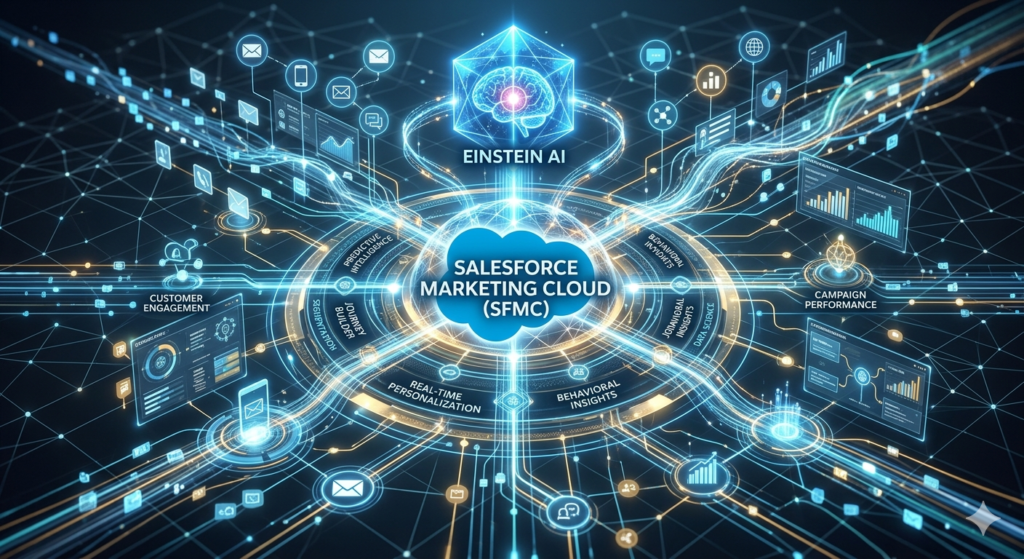
According to Salesforce’s own State of Marketing report, high-performing marketing teams are 2.1x more likely to use AI extensively compared to underperformers. And with Einstein deeply embedded into every corner of the Marketing Cloud ecosystem, businesses that have adopted this combination are already seeing measurable gains in engagement, conversion, and customer loyalty.
This blog explores how Salesforce SFMC Einstein AI works, what it can do for your marketing operations, and why 2026 is the year businesses that haven’t yet embraced AI-driven marketing automation need to make the move — before the gap between them and their competitors becomes unbridgeable.
What Is Salesforce SFMC + Einstein AI?
Understanding Salesforce Marketing Cloud (SFMC)
Salesforce Marketing Cloud is an enterprise-grade, cloud-based marketing automation platform that helps businesses manage and optimize customer communications across every digital channel. Think of it as mission control for your entire marketing operation.
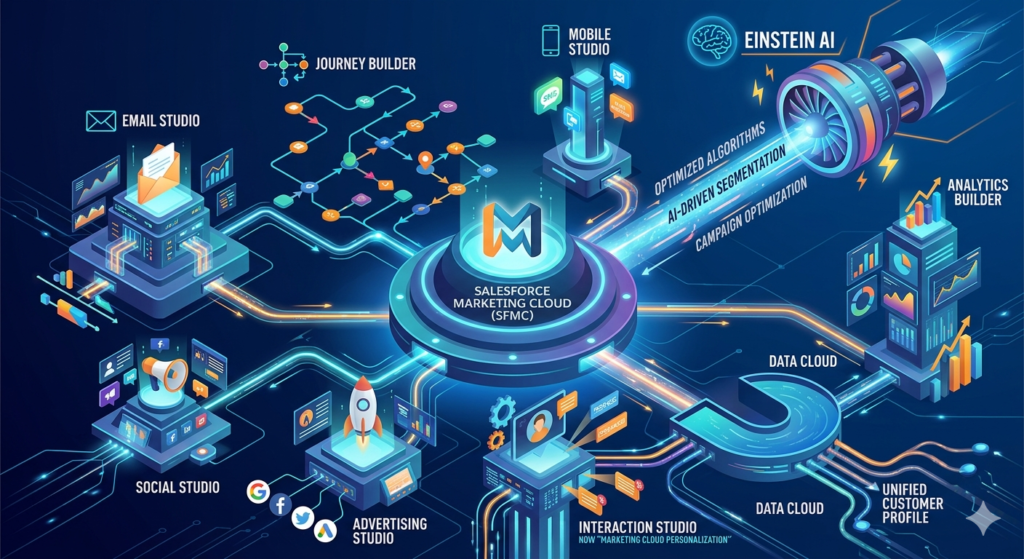
SFMC brings together a suite of tightly integrated tools:
- Email Studio — Design, automate, and personalize email campaigns at scale
- Journey Builder — Map and automate multi-step customer journeys across touchpoints
- Mobile Studio — Engage customers via SMS, push notifications, and in-app messaging
- Social Studio — Listen, publish, and engage across social media channels
- Advertising Studio — Sync CRM data with paid advertising campaigns on Google, Facebook, and beyond
- Interaction Studio (now Marketing Cloud Personalization) — Deliver real-time, one-to-one personalization on your website, app, and email
- Data Cloud (formerly CDP) — Unify customer data from every source into a single, actionable profile
- Analytics Builder — Turn marketing data into clear, actionable insights and reports
On its own, SFMC is already a transformational platform for enterprise marketing teams. But in 2026, running SFMC without Einstein AI is like driving a high-performance sports car in first gear. You’re moving forward, but you’re leaving enormous potential on the table.
What Is Einstein AI?
Einstein AI is Salesforce’s native artificial intelligence layer, built directly into the Salesforce platform — including Marketing Cloud. It’s not a third-party plugin or a bolt-on solution. It’s woven into the fabric of how SFMC operates.
Einstein was introduced by Salesforce back in 2016, but by 2026, it has matured into something genuinely impressive. Powered by machine learning, natural language processing (NLP), predictive analytics, and generative AI capabilities, Einstein operates across the entire Customer 360 ecosystem.
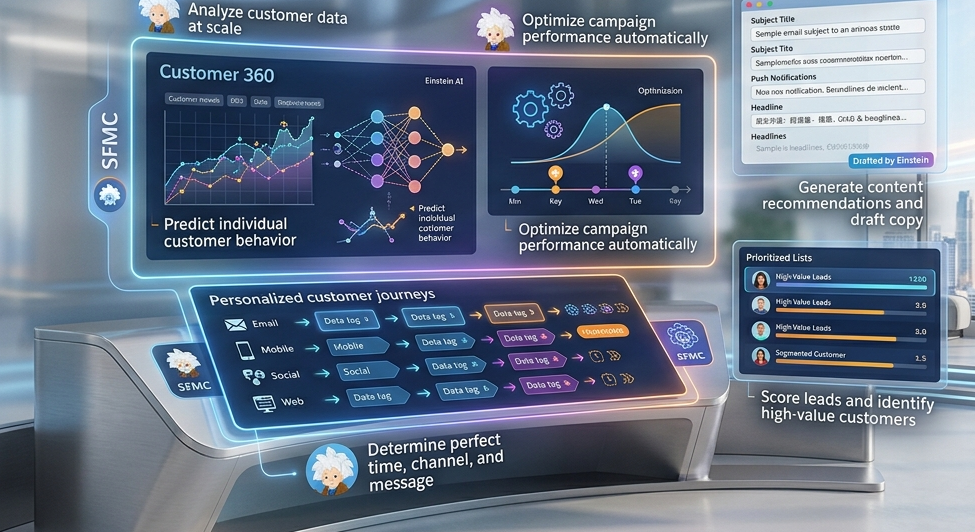
In the context of Marketing Cloud, Einstein AI can:
- Analyze customer data at a scale no human team can match
- Predict individual customer behavior and preferences
- Optimize campaign performance automatically
- Generate content recommendations and even draft copy
- Score leads and identify high-value customers
- Determine the perfect time, channel, and message for every individual
How They Work Together
The magic of Salesforce SFMC Einstein AI comes from how seamlessly these two systems integrate. Einstein doesn’t sit outside of SFMC waiting to be consulted — it operates within every tool, at every stage of the marketing workflow.
When a customer enters a Journey Builder workflow, Einstein is analyzing their behavior in real time and adjusting the path they take. When you’re setting up an email campaign in Email Studio, Einstein is recommending the optimal send time for each individual subscriber. When you’re scoring your marketing leads, Einstein is pulling from thousands of data points to predict who is most likely to convert.
The result is a system where intelligence isn’t an add-on — it’s the operating system.
Key Marketing Cloud AI Features You Need to Know
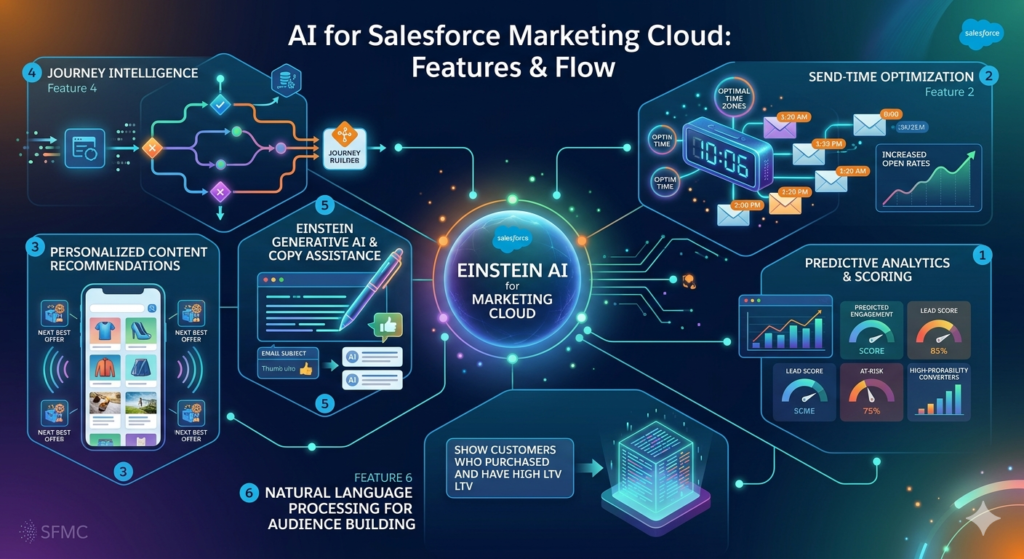
1. Predictive Analytics and Scoring
One of the most powerful marketing cloud AI features is Einstein’s ability to predict future customer behavior based on historical data patterns.
Einstein Engagement Scoring analyzes each subscriber’s email engagement history — opens, clicks, conversions, inactivity — and assigns a score that predicts how likely they are to engage with future campaigns. This allows marketers to:
- Segment audiences based on predicted engagement levels
- Re-engagement campaigns for at-risk subscribers before they churn
- Focus premium resources on high-probability converters
- Avoid wasting budget on audiences unlikely to respond
Einstein Lead Scoring (which bridges Marketing Cloud and Sales Cloud) goes further, predicting which marketing-qualified leads are most likely to convert into customers. Sales teams receive ranked lead lists, allowing them to prioritize outreach with confidence rather than guesswork.
This isn’t just useful — it’s transformational. Companies using predictive lead scoring consistently report improvements in conversion rates, shorter sales cycles, and better alignment between marketing and sales teams.
2. Send-Time Optimization
This is one of Einstein’s most immediately impactful features, and one that marketers tend to fall in love with the moment they see it in action.
Einstein Send-Time Optimization (STO) analyzes each individual subscriber’s history of email engagement to determine the precise time of day — and day of the week — when they are most likely to open and interact with an email.
Instead of sending everyone your weekly newsletter at 9:00 AM Tuesday (because that’s when your last A/B test suggested), Einstein sends each subscriber’s copy at their individual optimal time. One person gets it at 7:30 AM when they’re checking email over coffee. Another gets it at 6:15 PM when they’re winding down for the evening.
The results speak for themselves. Brands using Einstein STO regularly report:
- 15–25% improvements in open rates
- Significant increases in click-through rates
- Better overall campaign ROI without changing a single word of copy
In 2026, sending mass emails at a single scheduled time without STO is increasingly considered a baseline mistake — one that Einstein makes easy to avoid.
3. Personalized Content Recommendations
Einstein Recommendations is a feature that brings Netflix-style personalization to your email campaigns, website experiences, and mobile communications.
By analyzing each customer’s behavior — what they’ve browsed, purchased, clicked, ignored, and abandoned — Einstein builds individual preference profiles that power hyper-relevant content and product recommendations.
For an e-commerce brand, this might mean every customer receives an email newsletter where the featured products are different for each person, automatically selected because they match that individual’s interests and purchasing patterns.
For a B2B company, it might mean blog article recommendations in a nurture email sequence are tailored to each prospect’s industry, role, and documented areas of interest.
This isn’t just personalization in the sense of “Hi, [First Name].” This is genuine one-to-one relevance at scale — something that would require an impossibly large team to execute manually, but that Einstein delivers automatically.
4. Customer Journey Intelligence
Journey Builder is already one of SFMC’s most celebrated tools. It allows marketers to design sophisticated, multi-step customer journeys that respond to individual actions and milestones.
Einstein for Journey Builder elevates this significantly by adding genuine intelligence to journey decisions.
Rather than using static rules (“If the customer opened the email, send them Email B; if they didn’t, send them Email C”), Einstein analyzes each customer’s full behavioral profile and makes dynamic decisions about which path, message, and channel is most likely to drive a positive outcome.
Einstein can also identify which journeys are performing well, which decision points are causing drop-offs, and where the biggest optimization opportunities lie — surfacing insights that would take a data analyst weeks to uncover manually.
5. Einstein Generative AI and Copy Assistance
In 2026, one of the most exciting additions to the einstein for SFMC toolkit is the integration of generative AI capabilities.
Einstein’s generative AI features within Marketing Cloud allow marketers to:
- Draft email subject lines that are predicted to drive high open rates, based on historical performance data
- Generate email body copy from a brief prompt, which can then be refined by the marketing team
- Create content variations for A/B testing without starting from scratch
- Produce audience segment descriptions in plain language, making it easier for non-technical team members to understand who they’re talking to
This doesn’t replace human creativity — great marketing still requires human strategy, brand voice, and creative direction. But it dramatically accelerates production and removes one of the biggest bottlenecks in marketing operations: content creation.
6. Natural Language Processing for Audience Building
Historically, building complex audience segments in a marketing platform required technical knowledge — understanding data structures, writing queries, or working with a developer.
Einstein’s NLP capabilities are changing this. Marketers in 2026 can describe an audience in plain language — “Show me customers who purchased in the last 60 days but haven’t opened an email in 30 days and have a high predicted lifetime value” — and Einstein translates this into the precise data query needed to generate the segment.
This democratizes data access within marketing teams and allows non-technical marketers to move faster and test more ideas without waiting for technical support.
How Einstein for SFMC Powers True Marketing Automation
Beyond Workflows: Automation With Intelligence
Traditional marketing automation is rule-based. You define the rules, you build the logic, and the system executes. If this happens, do that. Wait this many days. Send this email.
This is valuable, but it’s limited. It assumes you can predict every scenario in advance. It treats all customers who trigger the same rule identically. And it requires constant human intervention to update rules as customer behavior and business conditions change.
Einstein for SFMC introduces a fundamentally different model: automation with intelligence.
Instead of following static rules, Einstein observes outcomes, learns from data, and continuously refines its decisions. The system gets smarter over time, not because a human updated the ruleset, but because the AI has been learning from every interaction.
This means your marketing automation isn’t just executing faster — it’s genuinely improving without requiring constant manual optimization.
Real-Time Decision Making
One of the most significant capabilities that Einstein brings to AI marketing automation Salesforce is real-time decision-making at the individual customer level.
When a customer visits your website, Einstein can analyze their behavior in the current session — combined with everything you know from their history — and make instant decisions about:
- What content to display
- Which product recommendations to surface
- Whether to trigger a live chat prompt
- What offer, if any, to show
- Which email to queue for follow-up
This happens in milliseconds. It’s not a batch process that updates overnight — it’s a continuous, real-time intelligence layer that ensures every customer touchpoint is as relevant and effective as possible.
Behavioral Targeting at Scale
Behavioral targeting — the practice of tailoring marketing messages based on specific actions a customer has taken — has been a marketing goal for years. Einstein makes it genuinely scalable.
With SFMC and Einstein working together, behavioral triggers can be defined at a granular level and then managed automatically:
- Cart abandonment triggers a personalized email sequence with the specific abandoned items
- Product page views without purchase trigger a nurture sequence tailored to the viewed category
- High-frequency site visits to pricing pages trigger a sales alert and personalized outreach
- Post-purchase behavior triggers cross-sell recommendations based on purchase history patterns
The difference is that Einstein doesn’t just execute these triggers — it learns which behavioral sequences are most predictive of conversion, continuously refines the targeting criteria, and identifies behavioral patterns that human marketers might never have thought to look for.
Real-World Use Cases: Einstein AI in Action
Use Case 1: Hyper-Personalized Email Campaigns
A retail brand with a database of 2 million subscribers was struggling with declining email engagement. Open rates had dropped below industry average, click-through rates were falling, and unsubscribe rates were creeping up.
After implementing SFMC with Einstein AI, they deployed:
- Einstein Send-Time Optimization to send each subscriber’s email at their individual peak engagement time
- Einstein Content Recommendations to personalize the product showcases in each email
- Einstein Engagement Scoring to segment the database and apply different re-engagement strategies to low-engagement subscribers
The results within 90 days included a 22% improvement in open rates, a 31% improvement in click-through rates, and a measurable reduction in unsubscribes. Revenue from email as a channel increased by 18% without any increase in email frequency or spend.
Use Case 2: Predictive Lead Scoring for B2B Marketing
A B2B software company was generating a high volume of marketing leads but struggling with low conversion rates. Sales teams were spending time on leads that weren’t ready to buy, while genuinely hot prospects sometimes slipped through the cracks.
By implementing Einstein Lead Scoring within SFMC integrated with Sales Cloud, the company:
- Gave sales teams a ranked priority list updated daily based on AI analysis
- Identified that certain content consumption patterns (e.g., multiple white paper downloads + pricing page visits) were strongly predictive of purchase intent
- Triggered automated sales alerts for prospects displaying high-intent behavior
- Built nurture sequences specifically designed for mid-score leads to accelerate their journey
Within two quarters, sales team efficiency improved significantly, and the overall lead-to-opportunity conversion rate increased by 34%.
Use Case 3: Customer Retention and Churn Prevention
A subscription-based business was experiencing higher-than-acceptable churn rates. Traditional reactive approaches — reaching out to customers after they’d already cancelled — weren’t working.
Using Einstein Engagement Scoring and predictive analytics within SFMC, the company identified behavioral signals that reliably preceded cancellation — reduced login frequency, declining feature usage, and disengagement from support resources.
Einstein flagged customers displaying these patterns before they churned, triggering:
- Personalized re-engagement campaigns highlighting underutilized features
- Targeted offers or loyalty incentives for high-value at-risk customers
- Proactive customer success outreach for enterprise accounts
The result was a 27% reduction in churn among the targeted at-risk segment, representing significant retained revenue.
Use Case 4: Cross-Channel Engagement Orchestration
A financial services company wanted to create a seamless, consistent customer experience across email, SMS, mobile app push notifications, and their website — without creating communication overload.
Using SFMC’s Journey Builder with Einstein optimization, they built:
- A unified customer journey that determined the best channel for each individual based on their engagement history
- Frequency optimization to prevent over-communication with customers who had shown sensitivity to high message volumes
- Cross-channel behavioral triggers that recognized when a customer had already engaged through one channel and adjusted the approach on other channels accordingly
The outcome was a more coherent, less intrusive customer experience — and a measurable improvement in cross-product engagement and customer satisfaction scores.
The Benefits of AI Marketing Automation in Salesforce
1. Dramatically Improved ROI
The most direct benefit of AI marketing automation Salesforce is financial. When every campaign is more precisely targeted, every message is sent at the optimal time, and every journey is continuously optimized, marketing spend becomes more efficient. Less waste. More conversion. Higher lifetime customer value.
Einstein ensures that your best marketing ideas are supported by the best possible execution — and that execution improves automatically over time.
2. Superior Customer Experience
Customers in 2026 have finely tuned radar for generic, irrelevant marketing. They ignore it, unsubscribe from it, and form negative associations with brands that repeatedly deliver it.
Einstein’s personalization capabilities allow brands to deliver experiences that feel individually crafted — because, in a meaningful sense, they are. When every email, every recommendation, and every offer feels relevant to the individual receiving it, customer relationships strengthen and brand loyalty grows.
3. Improved Targeting Accuracy
Einstein’s predictive analytics remove the guesswork from audience segmentation. Rather than relying on demographic assumptions or broad behavioral categories, marketers can build segments based on predicted future behavior — who is most likely to purchase, who is at risk of churning, who is ready for an upsell conversation.
This precision translates directly into better campaign performance and more efficient use of marketing resources.
4. Time and Cost Efficiency for Marketing Teams
One of the most tangible day-to-day benefits of SFMC with Einstein is how much time it saves marketing teams on tasks that don’t require human judgment.
- No more manually analyzing engagement data to find optimal send times
- No more building segment queries from scratch
- No more guessing at which content variations to test
- No more manually identifying at-risk customers
Einstein handles these tasks continuously and automatically, freeing marketing teams to focus on strategy, creativity, and the distinctly human work that AI genuinely cannot replace.
5. Alignment Between Marketing and Sales
When Einstein Lead Scoring bridges Marketing Cloud and Sales Cloud, it creates a shared language between marketing and sales teams. Both sides can see the same data, trust the same predictions, and operate with aligned priorities. This resolves one of the most persistent organizational tensions in B2B companies.
Why Businesses Should Adopt Salesforce SFMC Einstein AI in 2026
Competitive Advantage Is Narrowing — Then Will Close
Every month that passes, more of your competitors are implementing AI-driven marketing automation. The window for early-mover advantage is still open in many industries, but it won’t stay open indefinitely.
Businesses that implement Salesforce SFMC Einstein AI now are building institutional knowledge, training data, and optimization history that will compound over time. Their Einstein models will get smarter because they’ve had more time to learn. Their teams will develop deeper expertise. Their workflows will be more refined.
Businesses that wait are not just missing today’s benefit — they’re falling further behind a moving target.
Scalability Without Proportional Cost
One of the most compelling arguments for AI marketing automation is its scalability. A marketing team of 10 people cannot manually personalize communications for 500,000 customers. But Einstein can — and it does so without requiring additional headcount as your customer base grows.
This means the ROI of SFMC with Einstein AI actually improves as your business scales, making it one of the most strategically sound marketing technology investments available.
Data-Driven Marketing as a Culture
Implementing Einstein AI doesn’t just change your tools — it changes how your marketing team thinks and operates. When decisions are informed by AI-generated insights, teams develop a more rigorous, data-driven approach to strategy. Intuition is still valued, but it’s supported and challenged by evidence.
This cultural shift has long-term benefits that extend beyond any individual campaign or quarter.
Challenges and Considerations Before You Implement
Data Quality Is Non-Negotiable
Einstein AI is only as powerful as the data it has to work with. If your customer data is incomplete, siloed, or inconsistent, Einstein’s predictions and recommendations will be unreliable.
Before implementing SFMC with Einstein, businesses should:
- Conduct a thorough audit of existing customer data
- Establish clear data governance policies
- Prioritize integrations that bring data from all relevant sources into a unified customer profile (Salesforce Data Cloud is designed precisely for this)
- Implement data hygiene processes to maintain quality over time
Implementation Complexity Requires Expertise
SFMC is a powerful platform, and implementing it correctly — especially with Einstein AI features fully configured — requires experience and expertise. This isn’t a platform you can deploy effectively by following a setup wizard.
Common implementation mistakes include:
- Failing to properly configure data extensions and relationships
- Underutilizing Journey Builder’s capabilities by building overly simple journeys
- Implementing Einstein features without the underlying data infrastructure to support them
- Neglecting testing and validation before going live
Working with a certified Salesforce partner — like RizeX Labs — ensures that your implementation is built on a solid foundation and that Einstein’s AI features are properly configured to deliver meaningful results from day one.
[Explore our SFMC Implementation Services to learn how RizeX Labs can help you get it right the first time.]
Strategy Still Drives Success
Perhaps the most important consideration of all: Einstein AI amplifies your marketing strategy — it doesn’t replace it.
If your messaging is off-brand, your offers aren’t compelling, or your customer journey has fundamental gaps, Einstein will optimize the execution of a flawed strategy. The results will still be disappointing, just delivered more efficiently.
Successful SFMC + Einstein implementations start with clear strategic thinking:
- Who are we trying to reach?
- What do we want them to do?
- What value are we offering them?
- How does the customer journey need to evolve?
Einstein is most powerful when it’s in service of a well-considered strategy, not a substitute for one.
Ongoing Management and Optimization
AI marketing automation isn’t a “set it and forget it” solution. Einstein’s models improve over time with more data, but marketing teams need to:
- Monitor AI recommendations and performance regularly
- Update journey logic as business conditions change
- Test new approaches and use Einstein’s insights to refine them
- Stay current with new Einstein features as Salesforce continues to evolve the platform
Think of Einstein not as a system you deploy once, but as a collaborative tool that evolves alongside your marketing program.
Conclusion: The Future of Marketing Is Already Here
The combination of Salesforce SFMC Einstein AI represents one of the most significant shifts in marketing technology of the past decade. It’s not just automation — it’s intelligent automation. It’s not just personalization — it’s genuine one-to-one relevance at enterprise scale.
For marketers, the implications are profound. The tedious analytical tasks that consumed hours of every week are now handled by Einstein, continuously and automatically. The guesswork that led to poorly targeted campaigns and wasted budget is replaced by data-driven precision. The siloed customer experiences that frustrated customers and undermined brand loyalty are replaced by coherent, personalized journeys across every channel.
For business leaders, the case is equally compelling. SFMC with Einstein AI is a platform that scales without proportional cost increases, delivers measurable improvements in campaign ROI, and builds competitive advantages that compound over time.
Here’s what we’ve covered:
- SFMC is a comprehensive marketing automation platform covering email, mobile, social, web, and advertising
- Einstein AI is Salesforce’s native AI layer providing prediction, personalization, and optimization across every SFMC tool
- Key features include predictive analytics, send-time optimization, content recommendations, journey intelligence, and generative AI assistance
- Real-world results include double-digit improvements in engagement rates, conversion rates, and customer retention
- Benefits include improved ROI, superior customer experience, targeting accuracy, and marketing team efficiency
- Successful implementation requires clean data, strategic thinking, experienced partners, and ongoing management
The question in 2026 isn’t whether AI will transform marketing automation — it already has. The question is whether your business will lead that transformation or play catch-up.
About RizeX Labs
We’re Pune’s leading IT training institute specializing in high-demand Salesforce clouds and AI-driven automation. At RizeX Labs, we help developers and marketers master the future of the ecosystem—from SFMC Einstein to Data Cloud—through hands-on projects and expert mentorship. Our programs are designed to transform local talent into globally competitive professionals with deep expertise in intelligent marketing automation.
Internal Links:
- Salesforce Marketing Cloud: Beginner’s Guide to Email Studio & Journeys
- Mastering Apex for Salesforce Developers: Triggers, Classes, and Best Practices
- LWC vs. Flow: When to Code and When to Automate in 2026
