
Introduction:
Salesforce Training Programs in India are rapidly gaining traction as businesses and professionals compete to stay relevant in the CRM-driven digital economy. With over 250,000 certified experts and rising global demand, India has become a major hub for Salesforce talent.
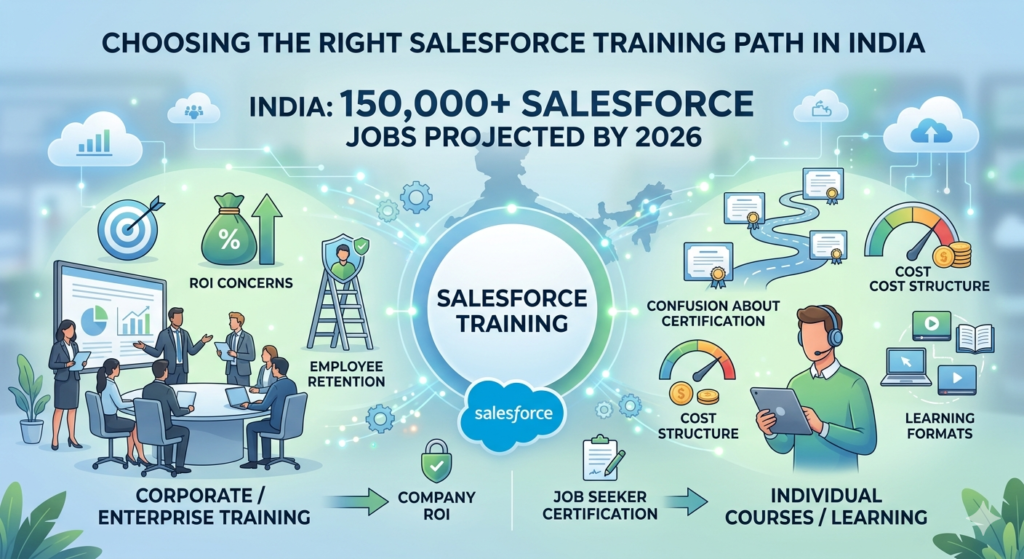
Whether you’re a student planning your career, a working professional aiming to upskill, or an organization looking to train teams, selecting the right training approach is critical. The salesforce training programs india ecosystem offers a wide range of options—from instructor-led classroom sessions in metro cities to flexible online bootcamps and enterprise-grade corporate training solutions.
However, most people face one key challenge: choosing between individual and corporate Salesforce training.
This decision goes beyond cost. It directly impacts your learning efficiency, career growth, and return on investment. Individual learners typically prioritize flexibility and certification-focused training, while companies need structured programs, role-based learning paths, and measurable outcomes.
In this guide, we will break down salesforce training india options and compare corporate vs individual programs across key factors to help you make a smarter, results-driven decision.
Understanding Salesforce Training Landscape in India
What Are Salesforce Training Programs?
Salesforce training programs teach individuals or teams how to use, customize, administer, and develop on the Salesforce platform. These programs range from beginner-level courses covering Salesforce fundamentals to advanced certifications in specialized areas like CPQ, Einstein Analytics, or Integration Architecture.
In India, salesforce training programs india typically fall into these categories:
Certification-focused training: Designed to help you pass specific Salesforce exams (Administrator, Platform Developer, Sales Cloud Consultant, etc.)
Role-based training: Tailored for specific job functions—sales teams, service agents, marketing professionals, developers, or administrators
Project-based learning: Hands-on programs that involve real-world scenarios and practical implementation
Technology-specific modules: Deep dives into specific Salesforce clouds (Service Cloud, Marketing Cloud, Commerce Cloud) or tools (Apex, Lightning, Flow Builder)
The Indian Market Context
India’s Salesforce ecosystem has unique characteristics that influence training choices:
- Cost sensitivity: Training budgets in India are typically 40-60% lower than Western markets
- Certification obsession: Indian employers heavily weight certifications in hiring decisions
- Remote learning adoption: Post-pandemic, 70%+ of training happens virtually
- Quality variance: Wide gap between premium and budget training providers
- Placement linkage: Many individual learners prioritize job placement support
Corporate Salesforce Training Programs
What Is Enterprise Salesforce Training?
Enterprise salesforce training refers to customized training solutions designed for organizations that need to upskill multiple employees simultaneously. These programs align with company-specific Salesforce implementations, business processes, and strategic objectives.
Key Characteristics of Corporate Training
Customization: Training content matches your actual Salesforce org configuration, custom objects, workflows, and business scenarios
Volume-based: Designed for 10-500+ employees across different roles and departments
Business outcome-focused: Tied to measurable KPIs like user adoption rates, data quality, sales productivity, or support ticket resolution times
Vendor engagement: Usually delivered through Salesforce partners, authorized training centers, or in-house L&D teams
Ongoing support: Often includes post-training support, refresher sessions, and office hours
Typical Corporate Training Models
Onsite training: Trainers visit your office premises (common in metros like Bangalore, Mumbai, Pune, Hyderabad)
Virtual instructor-led training (VILT): Live online sessions customized for your team
Hybrid approach: Combination of self-paced modules with live sessions
Train-the-trainer: Internal employees are certified to train others
COE development: Building internal Centers of Excellence with ongoing capability building
Corporate Training Pricing in India
Enterprise packages typically range from ₹1,50,000 to ₹25,00,000+ depending on:
- Number of participants
- Customization depth
- Training duration
- Inclusion of certifications
- Vendor reputation
Per-participant costs decrease significantly with volume, often dropping to ₹8,000-₹25,000 per person for batches of 50+.
Individual Salesforce Training Programs
What Is Individual Salesforce Training?
Individual training programs cater to self-funded learners—students, job seekers, working professionals, and freelancers—who enroll independently rather than through an employer. These salesforce training india options emphasize certification preparation, fundamental skills, and employability.
Key Characteristics of Individual Training
Standardized curriculum: Fixed modules covering certification exam objectives
Flexible scheduling: Weekend batches, evening sessions, and self-paced options to accommodate working professionals
Certification-centric: Primary goal is passing Salesforce certification exams
Job assistance: Many programs offer resume building, interview prep, and placement support
Community access: Networking with peers, study groups, and alumni networks
Typical Individual Training Models
Classroom training: Physical sessions in training centers (common in tier-1 cities)
Online live training: Scheduled virtual classes with instructors
Self-paced learning: Video courses with lifetime access (platforms like Udemy, Coursera, specialized Salesforce training sites)
Bootcamp format: Intensive 4-12 week programs with daily sessions
Mentorship programs: One-on-one guidance combined with course content
Individual Training Pricing in India
Individual programs range from ₹5,000 to ₹80,000 depending on:
- Certification level (Administrator vs Architect)
- Training format (self-paced vs instructor-led)
- Inclusion of exam vouchers
- Placement support
- Trainer credentials
Premium programs with guaranteed placement support command ₹40,000-₹80,000, while self-paced courses start at ₹5,000-₹15,000.
Detailed Comparison: Corporate vs Individual Salesforce Training
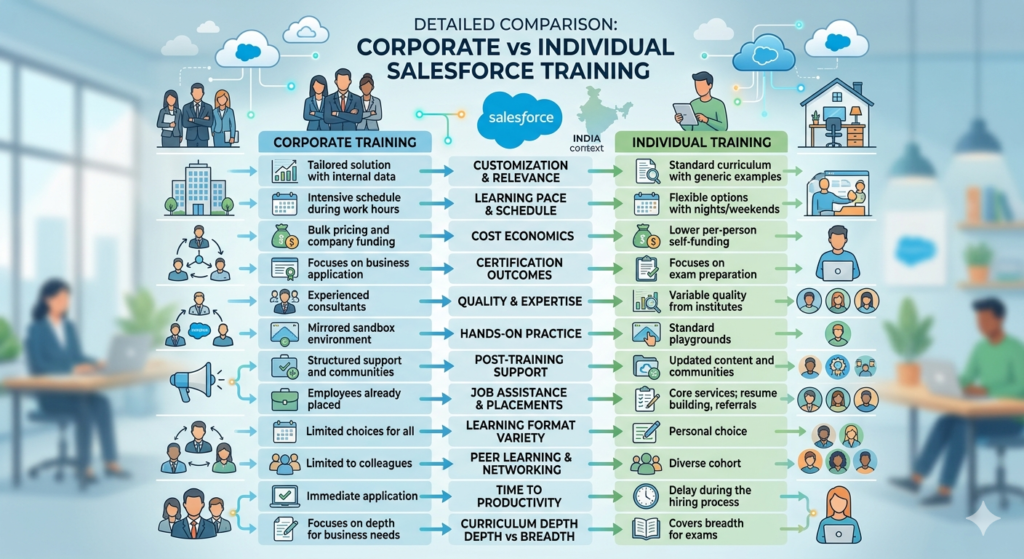
1. Customization and Relevance
Corporate Training:
Content is tailored to your organization’s specific Salesforce implementation. Trainees learn using your actual data structure, custom objects, workflows, and business processes. For example, if you’re a BFSI company using Financial Services Cloud, training focuses on your loan origination process, not generic sales scenarios.
Individual Training:
Follows standardized curriculum based on Salesforce exam objectives. Uses generic examples and demo environments. While comprehensive for certification, it may not address your specific industry or company workflows.
Winner: Corporate (for relevance), Individual (for foundational knowledge)
2. Learning Pace and Schedule
Corporate Training:
Schedule is negotiated based on business needs but must accommodate all participants. Often runs during business hours, which can impact productivity. Typical programs run 2-4 weeks for comprehensive training.
Individual Training:
Maximum flexibility with weekend batches, evening sessions, and self-paced options. Learners choose timing that suits personal schedules. Duration varies from 6 weeks (intensive bootcamps) to 6 months (part-time programs).
Winner: Individual (for flexibility)
3. Cost Economics
Corporate Training:
Higher absolute cost (₹1.5L – ₹25L+ per batch) but lower per-person cost for large teams (₹8K-₹25K per person). Company absorbs the cost, reducing individual financial burden. ROI is measured in business outcomes—improved adoption, faster implementation, better data quality.
Individual Training:
Lower absolute cost (₹5K-₹80K per person) but entirely self-funded. Better for single learners or small groups. ROI is measured in career advancement—salary increases, job opportunities, career transitions.
Winner: Corporate (for cost per learner in bulk), Individual (for single learners)
4. Certification Outcomes
Corporate Training:
Certification is often secondary to business application. Some programs include certification prep, but many focus on operational proficiency. Companies may or may not fund exam fees separately.
Individual Training:
Certifications are the primary objective. Courses are explicitly designed around exam patterns, with practice tests, dumps review, and exam-taking strategies. Most premium programs include exam vouchers.
Winner: Individual (for certification focus)
5. Quality and Expertise
Corporate Training:
Typically delivered by experienced consultants who understand enterprise implementations. Trainers often have 8+ years of real-world Salesforce experience and multiple certifications. Quality control is higher due to company vetting.
Individual Training:
Quality varies dramatically. Premium institutes employ certified experts, while budget providers may use relatively inexperienced trainers. Research and reviews become critical for quality assurance.
Winner: Corporate (more consistent quality)
6. Hands-on Practice
Corporate Training:
Practice happens in sandbox environments that mirror your production org. Exercises involve actual business scenarios you’ll encounter daily. This contextual practice accelerates post-training application.
Individual Training:
Practice occurs in Trailhead playgrounds or generic sandbox environments. Scenarios are theoretical or simplified. While comprehensive, they lack specific business context.
Winner: Corporate (for relevant practice)
7. Post-Training Support
Corporate Training:
Usually includes 30-90 days of post-training support—office hours, email support, refresher sessions, and troubleshooting assistance. Some contracts include ongoing advisory services.
Individual Training:
Support varies. Premium programs offer lifetime access to updated content, community forums, and alumni groups. Budget programs may offer limited or no post-training support.
Winner: Corporate (for structured support), Individual premium programs (for ongoing access)
8. Job Assistance and Placements
Corporate Training:
Not applicable—employees are already placed. Focus is on performance improvement in current roles.
Individual Training:
Major differentiator for many programs. Premium institutes offer resume building, mock interviews, referrals to hiring partners, and active job placement. Placement rates range from 40-85% depending on program quality and market conditions.
Winner: Individual (this is a core offering)
9. Learning Format Variety
Corporate Training:
Format is negotiated—onsite, virtual, or hybrid. Once decided, all participants follow the same format. Limited ability to customize format for individual learning preferences within the team.
Individual Training:
Learners choose their preferred format—classroom, online live, self-paced, or hybrid. Can switch between formats if needed. Maximum accommodation for different learning styles.
Winner: Individual (for format flexibility)
10. Peer Learning and Networking
Corporate Training:
Cohort consists of colleagues from same organization. Excellent for internal collaboration and building shared understanding. Limited exposure to external perspectives and industry practices.
Individual Training:
Diverse cohort from various industries, companies, and backgrounds. Rich networking opportunities. Exposure to different use cases and perspectives. Long-term community building for career growth.
Winner: Individual (for diversity), Corporate (for team alignment)
11. Time to Productivity
Corporate Training:
Participants can immediately apply learnings to their jobs. Productivity gains start within days or weeks of training completion. Direct business impact is measurable quickly.
Individual Training:
Time to productivity depends on getting hired or implementing Salesforce in current role. For job seekers, there may be weeks or months between training completion and first Salesforce role.
Winner: Corporate (for immediate application)
12. Curriculum Depth vs Breadth
Corporate Training:
Deep dive into specific modules relevant to your business. May skip standard features you don’t use. Depth over breadth approach focused on business needs.
Individual Training:
Comprehensive coverage of all exam topics and standard features. Broader understanding of Salesforce capabilities. May include topics not immediately relevant but important for certification.
Winner: Corporate (for depth), Individual (for breadth)
Comparison Table: Corporate vs Individual Salesforce Training
| Parameter | Corporate Training | Individual Training |
|---|---|---|
| Typical Investment | ₹1.5L – ₹25L (entire batch) | ₹5K – ₹80K (per person) |
| Per-Person Cost | ₹8K – ₹25K (at scale) | ₹5K – ₹80K |
| Customization Level | High (org-specific) | Low (standardized) |
| Schedule Flexibility | Medium (group-dependent) | High (self-selected) |
| Primary Goal | Business outcomes & adoption | Certification & employment |
| Training Duration | 2-4 weeks (intensive) | 6 weeks – 6 months |
| Certification Focus | Secondary | Primary |
| Trainer Experience | 8+ years (typically) | Varies (3-15+ years) |
| Hands-on Environment | Mirror of production org | Generic sandbox |
| Post-Training Support | 30-90 days structured | Varies (lifetime to none) |
| Job Placement | Not applicable | Often included (premium programs) |
| Learning Format | Negotiated, uniform for all | Individual choice |
| Peer Diversity | Same organization | Multiple industries |
| Time to Application | Immediate | Delayed (until hired) |
| Content Depth | Deep in relevant areas | Broad across all topics |
| Exam Vouchers | Sometimes included | Often included (premium) |
| Business Context | Your specific processes | Generic scenarios |
| Batch Size | 10-200+ employees | 5-30 learners |
| ROI Measurement | Business metrics | Career advancement |
| Best For | Existing employees | Job seekers, career changers |
Pros and Cons Analysis
Corporate Salesforce Training: Advantages
1. Immediate Business Relevance
Training directly addresses your company’s specific Salesforce instance, workflows, and business processes. Employees learn exactly what they need for their daily jobs, not theoretical knowledge.
2. Team Alignment
Everyone receives consistent training on company standards, naming conventions, data management practices, and business processes. This standardization reduces errors and improves collaboration.
3. Lower Per-Head Cost at Scale
For organizations training 20+ employees, corporate rates offer significant savings compared to individual enrollments. Enterprise discounts can reduce per-person costs by 60-70%.
4. Productivity Integration
Training can be scheduled around business cycles. Sessions can reference actual projects, current challenges, and upcoming implementations, making learning immediately applicable.
5. Quality Assurance
Corporate contracts typically include SLAs, trainer vetting, content review, and performance guarantees. Companies can negotiate trainer qualifications and replacement if quality is unsatisfactory.
6. Measurable Business Outcomes
Training effectiveness can be tied to concrete metrics—user adoption percentages, data quality improvements, reduction in support tickets, faster sales cycles, or improved customer satisfaction scores.
7. Ongoing Relationship
Enterprise training often begins a longer vendor relationship that can include change management, implementation support, and continuous capability building.
Corporate Salesforce Training: Disadvantages
1. Higher Upfront Investment
Initial outlay of ₹1.5L-₹25L+ represents significant budget commitment. ROI depends on successful implementation and employee retention.
2. Scheduling Complexity
Coordinating schedules across departments, time zones (for distributed teams), and business priorities can be challenging. Training may be delayed by months due to scheduling conflicts.
3. Limited Certification Focus
If your goal is getting employees certified (for partner tier requirements, for example), corporate training may not adequately prepare them for exams without supplemental certification-specific prep.
4. Reduced Individual Flexibility
Employees must attend scheduled sessions regardless of personal learning pace. Fast learners may be bored; struggling learners may fall behind.
5. Risk of Poor Attendance
Business urgencies, competing priorities, and lack of individual motivation can lead to poor attendance or half-attention during sessions, wasting training investment.
6. Narrow Skill Development
Highly customized training may limit employees’ understanding of broader Salesforce capabilities, reducing their versatility and marketability.
Individual Salesforce Training: Advantages
1. Certification Optimized
Courses are explicitly designed to help you pass specific exams. Content maps directly to exam objectives, with practice tests, exam tips, and focus on commonly tested topics.
2. Maximum Learning Flexibility
Choose when, where, and how you learn. Switch between formats. Pause and resume. Learn at your own pace. Ideal for working professionals and students with variable schedules.
3. Affordable Entry Point
Starting at ₹5,000, quality Salesforce training is accessible to students and early-career professionals. Self-paced options provide even lower-cost alternatives.
4. Comprehensive Skill Building
Standard curriculum covers all exam topics, giving you broad understanding of Salesforce capabilities. This versatility improves long-term career flexibility.
5. Job Placement Support
Premium programs actively help you get hired—resume optimization, interview preparation, referrals to hiring partners, and sometimes placement guarantees.
6. Diverse Networking
Interact with peers from different industries, companies, and backgrounds. These connections become valuable throughout your career for advice, job referrals, and collaboration.
7. Career Transition Enabler
For professionals wanting to transition from non-tech or different tech roles into Salesforce ecosystem, individual training provides the credential and knowledge needed.
8. Lifetime Learning Access
Many programs offer lifetime access to course updates, reflecting Salesforce’s three annual releases. This ensures your knowledge stays current without additional investment.
Individual Salesforce Training: Disadvantages
1. Self-Funding Burden
Entire cost is borne personally, which can be challenging for students or early-career professionals. ₹40K-₹80K represents significant personal investment.
2. Quality Inconsistency
Market has many low-quality providers with inexperienced trainers, outdated content, or misleading promises. Due diligence through reviews and trial classes is essential.
3. Generic Content
Training uses simplified, theoretical scenarios that may not reflect real-world complexity. Gap between training examples and actual job requirements can be significant.
4. Delayed Application
Knowledge learned may not be applied for weeks or months (until you get hired), leading to skill deterioration. Without regular practice, certifications become credentials without practical ability.
5. Limited Post-Training Support
Budget programs offer minimal support after course completion. When you encounter real-world problems in your first job, you may lack resources for guidance.
6. Placement Uncertainty
Despite claims, most programs cannot guarantee jobs. Placement depends on market conditions, your background, location, and competition. Placement rates are often inflated in marketing materials.
7. Self-Motivation Requirement
Without external accountability, completion rates for self-paced courses are low (typically 15-30%). Requires strong self-discipline and motivation to complete.
Use Cases: When to Choose Which Training Type
Choose Corporate Training When:
Scenario 1: Post-Implementation User Adoption
Your company recently implemented Salesforce (or a new cloud/module). You need to train 50+ sales, service, or marketing users to drive adoption. Corporate training ensures everyone learns your specific configuration, workflows, and best practices.
Scenario 2: Standardization Across Teams
Your Salesforce org has been organically growing with inconsistent usage patterns across regions or departments. Corporate training creates standardized practices, improving data quality and reporting.
Scenario 3: New Business Process Rollout
You’re launching new sales methodology, customer service processes, or marketing automation workflows in Salesforce. Training needs to focus on these specific changes, not generic Salesforce skills.
Scenario 4: Admin/Developer Team Building
You’re building an internal Salesforce Center of Excellence and need to upskill 5-15 employees to become administrators, developers, or solution architects. Corporate programs can create role-specific learning paths.
Scenario 5: Merger or Acquisition Integration
Post-merger, you need to train acquired company’s employees on your Salesforce instance and business processes. Customized training accelerates integration and cultural alignment.
Scenario 6: Compliance and Governance Training
Industry regulations (BFSI, healthcare, pharma) require specific data handling, security, and compliance practices in Salesforce. Customized training ensures regulatory adherence.
Scenario 7: Partner Tier Certification Requirements
Your organization is a Salesforce partner needing to maintain or achieve higher partner tier status. You need bulk certifications for employees. Corporate programs can focus multiple employees on specific certifications.
Choose Individual Training When:
Scenario 1: Career Entry or Transition
You’re a student, recent graduate, or professional from another field wanting to enter the Salesforce ecosystem. Individual training with placement support provides both credential and job access.
Scenario 2: Personal Upskilling
You’re a working professional wanting to add Salesforce skills to your resume for career advancement, lateral moves, or increased marketability. Self-funded training shows initiative and commitment.
Scenario 3: Certification-Specific Preparation
You have Salesforce experience but need structured preparation for specific certification exams (Platform Developer II, Application Architect, etc.). Individual certification-focused training is most efficient.
Scenario 4: Freelance/Consulting Career
You want to work as an independent Salesforce consultant or freelancer. Individual training provides foundation, and certifications serve as credentials for client acquisition.
Scenario 5: Small Business Owner/Entrepreneur
Your startup or small business uses Salesforce. Rather than hiring expensive consultants, you want to learn to configure and manage it yourself. Individual training is cost-effective.
Scenario 6: Geographic Constraints
You’re in a tier-2 or tier-3 city without access to quality corporate training providers. Online individual training from reputed institutes in metro cities gives you access to quality education.
Scenario 7: Employer Won’t Sponsor Training
Your current employer uses Salesforce but won’t fund training. You need skills to perform your job better or transition roles. Self-funded individual training fills this gap.
Scenario 8: Specific Certification Collection
You’re building a portfolio of Salesforce certifications for career advancement. Individual certification-specific courses are more efficient than broad corporate programs.
How to Choose: Decision-Making Framework
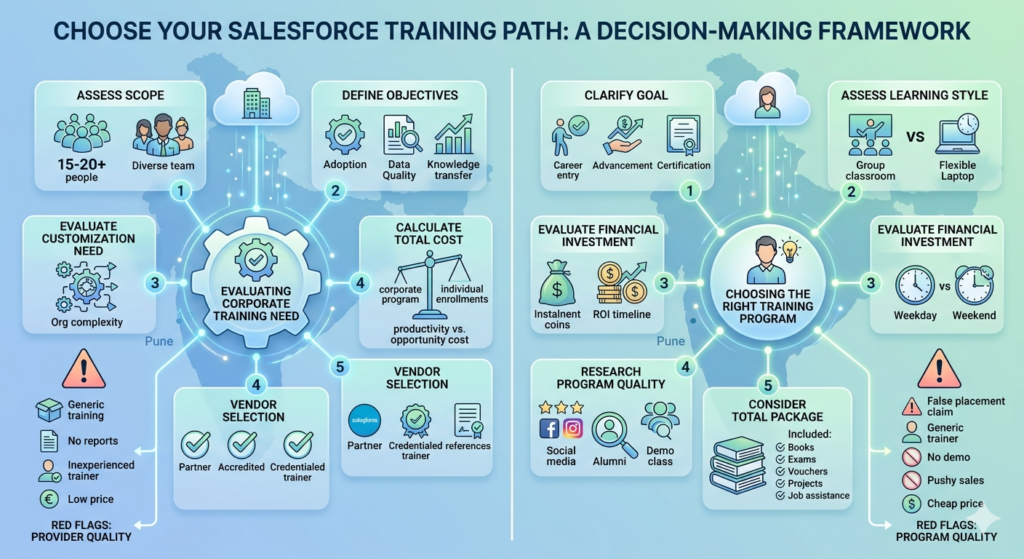
For Companies: Evaluating Corporate Training Need
Step 1: Assess Training Scope
- How many employees need training? (Break-even typically occurs at 15-20+ employees)
- Are they in similar roles or diverse functions?
- What’s the urgency timeline?
Step 2: Define Training Objectives
- Is this for new Salesforce rollout or existing system improvement?
- Are business outcomes (adoption, data quality) or certifications the priority?
- Do you need ongoing capability building or one-time knowledge transfer?
Step 3: Evaluate Customization Need
- How complex is your Salesforce implementation?
- Do you have heavy customization with custom objects, complex workflows, or integrations?
- Will generic training adequately address your users’ needs?
Step 4: Calculate Total Cost of Ownership
- Corporate program cost vs. individual enrollments for same number of people
- Include opportunity cost of employee time
- Factor in productivity gains from proper training vs. learning curve without training
Step 5: Vendor Selection
- Request proposals from 3-5 training providers
- Check Salesforce partner status and training accreditations
- Review trainer credentials and case studies
- Verify references from similar-sized companies in your industry
Red Flags to Avoid:
- Providers unwilling to customize content
- No structured assessment or reporting mechanism
- Trainers without practical implementation experience
- No post-training support included
- Pricing significantly below market (indicates quality issues)
For Individuals: Choosing the Right Training Program
Step 1: Clarify Your Goal
- Career entry, transition, advancement, or certification?
- Job-ready skills or exam preparation?
- Immediate employment need or long-term skill building?
Step 2: Assess Your Learning Style
- Do you need structure and deadlines (instructor-led) or flexibility (self-paced)?
- Do you learn better in groups or individually?
- What’s your availability—weekdays, weekends, or variable?
Step 3: Evaluate Financial Investment
- What’s your budget? (₹5K for basic self-paced to ₹80K for premium with placement)
- Can you self-fund or need installment options?
- What’s acceptable ROI timeline—3 months, 6 months, or 1 year?
Step 4: Research Program Quality
- Check Google reviews, YouTube reviews, and social media feedback
- Connect with alumni on LinkedIn
- Attend demo/trial classes
- Verify trainer credentials (LinkedIn profiles, certifications)
- Ask about actual placement rates and support
Step 5: Consider Total Package
- What’s included—courseware, practice exams, exam vouchers, projects?
- Is certification exam fee included or extra?
- What post-training support exists?
- Is job assistance real or just resume review?
Red Flags to Avoid:
- “100% placement guarantee” claims (unrealistic)
- Trainers without visible certifications or experience
- No trial class or demo option
- Pushy sales tactics or pressure to enroll immediately
- Very cheap pricing (₹2K-₹3K for comprehensive programs—indicates quality issues)
- No reviews or testimonials available
The Hybrid Approach: Best of Both Worlds
Some organizations and individuals benefit from combining both approaches:
Company-Sponsored Individual Enrollments
Companies can sponsor individual employees for external training programs rather than organizing corporate batches. This works when:
- Small number of employees need training (5-10 people)
- Employees have different training needs (Admin, Developer, Consultant)
- Scheduling constraints make group training difficult
- You want employees to network outside your organization
Individual Training + Company Implementation Practice
Individuals can take training courses for foundational knowledge and certification, then seek internships or junior roles for practical application. This two-step approach combines:
- Affordable, flexible individual training for theory and certification
- On-job learning for real-world application and depth
Corporate Foundation + Individual Specialization
Companies provide foundational training to all users, then sponsor specific individuals for advanced certifications or specializations based on role needs and career paths.
Conclusion
India is uniquely positioned in the global Salesforce talent market. International companies are actively seeking Indian Salesforce professionals for remote roles. Indian IT services companies—TCS, Infosys, Wipro, Accenture, Capgemini—are scaling their Salesforce practices rapidly. Homegrown startups and enterprises are adopting Salesforce at accelerating rates. This convergence of demand from multiple directions creates a talent market that rewards skilled, certified Salesforce professionals with above-average compensation, career stability, and global opportunity.
Both corporate and individual training pathways feed into this ecosystem in complementary ways. Companies that invest in enterprise salesforce training build internally capable teams that reduce dependence on expensive external consultants. Individuals who complete quality salesforce training india programs enter an ecosystem hungry for skilled talent.
The decision between the individual vs corporate sf course model is ultimately a strategic one—and strategy requires honest assessment of where you are, where you want to go, and what resources you have available to bridge that gap.
Use this guide as your framework. Apply the comparison criteria specific to your situation. Avoid shortcuts—in both vendor selection and learning commitment. And recognize that in the Salesforce ecosystem, the investment you make in proper training today directly determines the business outcomes or career outcomes you achieve tomorrow.
The platform is powerful. The opportunity in India is real. The only variable is whether your training choice is the right one for your specific goal.
About RizeX Labs
At RizeX Labs, we specialize in delivering practical, career-focused Salesforce training programs in India tailored for both individuals and corporate teams. Our approach combines real-world project experience, industry-relevant curriculum, and hands-on implementation to help learners build job-ready skills.
We focus on bridging the gap between theory and execution—whether you’re an aspiring Salesforce professional or an enterprise team aiming to upskill. Our training ensures faster learning, better retention, and measurable business impact.
Internal Links:
- Salesforce Admin course page
Salesforce Flows vs Apex: When Should You Use Code vs No-Code Automation? - Salesforce Data Cloud Explained — What It Is and Why It Matters
- AI Tools for Salesforce Development in 2026 — Cursor AI, Copilot and More
- Generative AI in ITSM — How ServiceNow Is Using AI to Transform IT
- Salesforce Named Credentials: What They Are and How to Use Them Safely
- Prompt Engineering for Salesforce Agentforce — Beginner’s Guide
External Links:
McKinsey Sales Growth Reports
Gartner Sales Automation Insights
