
No Browser Required. No Limits Imposed.
Everything on Salesforce is now an API, MCP tool, or CLI command, and agents can use all of it.
The Question That Changed Everything
“Why should you ever log into Salesforce again?”
When Salesforce Co-Founder Parker Harris posed this question last month, it wasn’t rhetorical. It wasn’t meant to spark debate. It was a declaration of intent—a fundamental shift in how we think about enterprise software in the age of intelligent agents.
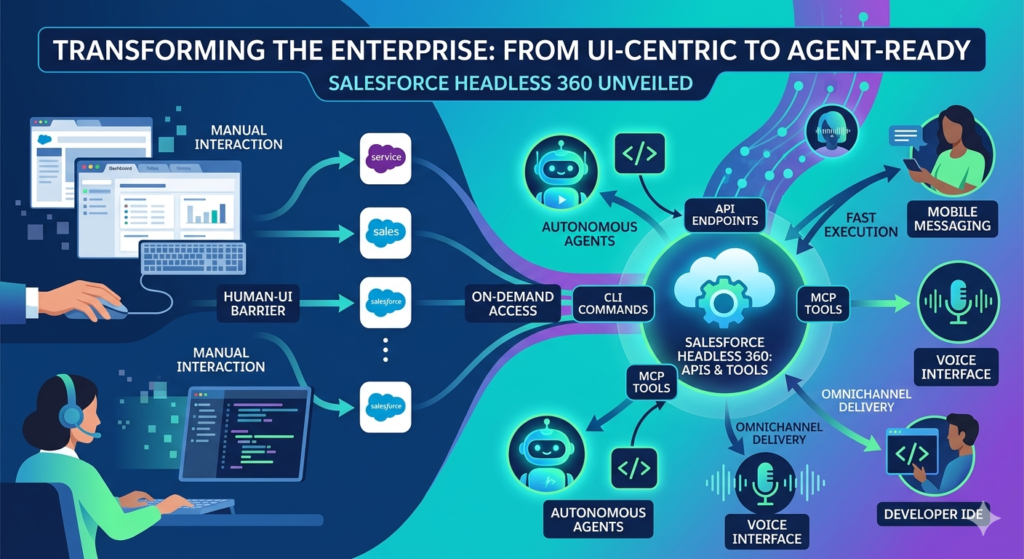
For a quarter-century, using Salesforce meant being inside Salesforce. A service representative would launch a console, navigate through tabs, locate a customer case, and manually update its status. A sales executive would click through opportunity stages, refresh dashboards, and copy data between screens. Every action required a human being, sitting at a computer, navigating a graphical interface designed for eyes and fingers.
But the enterprise is evolving. In the Agentic Enterprise, humans aren’t the only actors performing work. Autonomous agents are too—and they don’t open browsers, they don’t click buttons, and they certainly don’t struggle with cluttered UIs designed for human perception. They interact through APIs. They invoke MCP tools. They execute CLI commands with precision and speed no human could match.
So two and a half years ago, we made a foundational decision: Rebuild Salesforce from the ground up for this new reality. Instead of hiding capabilities behind layers of user interface chrome, expose everything. Make the entire platform programmable, accessible, and agent-ready from anywhere, on any surface, through any interface.
If your enterprise platform still requires humans to manually click through user interfaces or write custom integration code just to accomplish basic tasks, you’re not ready for what’s coming. You’re building for yesterday’s paradigms.
The result of this complete reimagining, which we’re unveiling today, is Salesforce Headless 360: a comprehensive transformation that makes every capability your agents and developers need accessible as an API, MCP tool, or CLI command. Now humans and agents alike can build, act, and deliver experiences on any surface imaginable—from coding environments to messaging platforms to voice interfaces.
This isn’t a narrow feature release. This extends across the full breadth of everything Salesforce has constructed over 25 years: from the intricate processes that resolve complex customer support escalations to the sophisticated workflows that help sales organizations close multi-million-dollar deals.
Three Foundational Innovations
Salesforce Headless 360 delivers three transformative capabilities that redefine what’s possible:
1. Complete Platform Access for Coding Agents
New MCP tools and preconfigured coding skills give your development agents comprehensive, live access to your entire Salesforce platform—every data model, every workflow, every piece of business logic.
2. Universal Experience Layer
A revolutionary new rendering system that delivers rich, native interactions across every surface where work happens—from Slack conversations to voice assistants to WhatsApp chats.
3. Production-Grade Agent Governance
Sophisticated new tooling that gives you complete control over how agents behave in production environments, both before launch and continuously after deployment.
Salesforce remains the unified platform that powers how humans and agents collaborate, whether they’re using traditional Customer 360 applications, conversing in Slack, operating through Headless 360 APIs, or working on entirely novel surfaces we haven’t yet imagined.
Agents now orchestrate your applications, execute your workflows, and leverage your business logic—and they inherit all of this institutional knowledge without requiring you to rebuild any of it from scratch. Both humans and agents fundamentally need the same things: accurate data, proven workflows, and robust trust mechanisms. The surface through which they access these capabilities changes. The underlying platform doesn’t.
“With Agentforce, we’ve been able to deploy sophisticated, production-ready AI agents in just 12 days, driving millions in savings while significantly increasing our technical velocity. This unified platform proves that we can scale our most complex service needs without adding operational complexity.”
— Elia Wallen, CEO, Engine
Build Any Way You Want: Developer Freedom Unleashed
For developers, “headless” means something profound: You can build on Salesforce however you want, using whatever tools you prefer.
MCP Tools and Coding Skills: Your Platform, Your Coding Agent
More than 60 newly released MCP (Model Context Protocol) tools and over 30 preconfigured coding skills give your preferred coding agent complete, real-time access to your entire Salesforce platform. This includes all of your data models, all of your workflows, all of your custom business logic, and all of your metadata—accessible directly within the coding agents you already use daily.
Whether you’re working in Claude Code, Cursor, Codex, Windsurf, or any other modern development environment, your coding agent now has the same comprehensive platform access that previously required deep Salesforce expertise and extensive custom integration work.
Imagine describing a business requirement in natural language—”Create a new flow that automatically escalates high-value opportunities when they haven’t been touched in 48 hours”—and watching your coding agent immediately understand your org structure, identify the relevant objects and fields, construct the appropriate flow logic, and deploy it with proper testing and documentation. That’s not a future vision. That’s available today.
Agentforce Vibes 2.0: Native Platform Intelligence
Agentforce Vibes 2.0 brings that same transformative power natively inside Salesforce itself, with several critical enhancements:
- Full org awareness from the start: Your coding agent understands your specific org structure, customizations, and business logic before it writes a single line of code
- Multi-model support: Seamlessly work with Claude Sonnet, GPT-5, and other leading models based on your specific task requirements
- Business-context coding: An AI development partner that understands not just syntax and patterns, but your actual business processes and requirements
This isn’t a general-purpose coding assistant that happens to know some Salesforce syntax. This is an intelligent development partner that deeply understands your organization’s unique implementation and can reason about solutions in business context, not just technical terms.
DevOps Center MCP: Natural Language CI/CD
The DevOps Center MCP brings that same programmatic, agent-accessible power into your continuous integration and deployment pipelines. This enables what we call Natural Language DevOps—you describe what you want to deploy, and your agent handles the entire execution.
The build loop that previously required context-switching across four different tools, maintaining mental state across multiple interfaces, and manually coordinating between development, testing, and deployment environments now happens inside one unified, connected experience.
Early adopters report cycle time reductions of up to 40%. More importantly, they report dramatic reductions in deployment errors caused by human context-switching and manual coordination mistakes.
Native React Support: Complete UI Control
For developers who want absolute control over the visual layer and user experience, native React support means you can build completely custom interfaces and experiences while retaining all the platform power underneath.
Any design language. Any interaction model. Any brand expression. Your visual layer, your rules—with full access to Salesforce’s data, workflows, and business logic engines beneath.
“As a dev team lead, I’ve seen firsthand how Agentforce Vibes is supporting our Salesforce development. It’s been especially valuable for speeding up day-to-day tasks like metadata updates and quick tweaks, reducing manual work and boosting efficiency. We primarily use it for repetitive, time-consuming work, from config analysis and metadata adjustments to generating boilerplate code, tests, and handling small refactors or pre-deployment checks. Vibes acts as a strong assistant that streamlines our workflows, and we’re excited to see how it evolves and drives even greater impact over time.”
— Adones Guerra, Tech Lead, Grupo Globo
In the Agentic Enterprise, the Conversation Is the Interface
The fundamental goal is elegantly simple: Work that used to pull people out of conversations now happens inside them.
Not just text exchanges back and forth. We’re talking about approvals, complex decisions, rich data visualizations, complete workflow executions—all surfaced and actionable inside the channels where your people already spend their days.
That’s what it genuinely means for the conversation to become the interface. And increasingly, that conversation lives in Slack.
The Explosive Growth of Conversational AI
The numbers tell a compelling story. Custom AI agents operating on Slack have grown by 300% since January alone. Slackbot has become the primary front door to the Agentic Enterprise for millions of knowledge workers who no longer want to context-switch between a dozen different applications just to complete a single business process.
People want to work where they already are. They want to ask questions in natural language. They want agents to surface the right information, execute the appropriate workflows, and present decisions in context—without forcing them to open another application, navigate through menus, or remember which system contains which piece of information.
The Agentforce Experience Layer: Rich Interactions Everywhere
This is precisely why we built the Agentforce Experience Layer—because some work genuinely needs more than plain text.
A card to approve with a single tap. A workflow to complete with structured inputs. A decision to make with all relevant context immediately visible. A data layout that presents complex information in scannable, actionable formats.
The Experience Layer is a revolutionary new UI service that fundamentally separates what an agent does from how it appears. This architecture enables your agents to deliver rich, interactive components—flight status cards with real-time updates, rebooking workflows with multiple options, decision tiles with supporting data, complex data layouts with contextual actions—that render natively inside Slack.
But here’s the transformative part: these same components also render beautifully across Mobile applications, ChatGPT interfaces, Claude conversations, Gemini chats, Microsoft Teams channels, or any client that supports MCP applications.
Build once, render everywhere your people already work. No more rebuilding the same functionality for six different platforms. No more maintaining separate codebases for web, mobile, and messaging interfaces. One component definition, native rendering across every surface that matters to your business.
Real Work Happening in Real Conversations
Imagine a customer service scenario that previously required opening Salesforce, searching for a customer record, reviewing their case history, checking their entitlements, creating a new case, assigning it to the appropriate queue, and documenting the interaction—all while the customer waited on hold.
Now that same scenario happens in a Slack conversation:
Agent: “Customer John Smith is asking about return policy for an order placed 35 days ago.”
Agentforce: [Displays customer card with order history, entitlements, and policy information]
Agent: “Can we make an exception here? He’s a platinum customer.”
Agentforce: [Displays approval workflow with business context and policy details]
Manager: [Taps ‘Approve with conditions’ directly in Slack]
Agentforce: [Creates return authorization, updates customer record, generates shipping label, sends confirmation email]
Agent: “Done. I’ll let him know to expect the label in the next hour.”
Five minutes, one conversation, zero context switches. That’s the promise of conversational interfaces powered by intelligent agents with complete platform access.
“At Indeed, our mission is to help people get jobs, and the faster we can innovate, the faster we can connect job seekers to the right opportunities and employers to the right talent. By building on Agentforce, we’re able to give coding agents live access to our entire platform, directly within the tools we already use, so we can move from idea to implementation quickly. This paired with proper gating and human-in-the-loop best practices, the results are faster delivery, more consistent execution, and a much clearer path from experimentation to production impact.”
— Oliver Bodden, Senior Product Manager, Indeed
Build Agents You Can Trust at Scale
Here’s the uncomfortable truth that every enterprise deploying AI agents eventually confronts: Shipping an agent is the easy part.
Knowing that agent will behave the way you designed it—reliably, consistently, appropriately—across every edge case, under every scenario, weeks and months after launch, is where most organizations struggle. Many fail entirely.
Why Traditional Software Practices Don’t Apply
This challenge exists because agents are fundamentally different from traditional software. They are probabilistic, not deterministic. They don’t behave exactly the same way every single time they encounter the same inputs. They encounter unanticipated scenarios and reason their way to unexpected outcomes based on patterns they’ve learned, not just rules they’ve been programmed to follow.
When a traditional application fails, there’s a bug to identify and fix. When an agent behaves unexpectedly, there often isn’t a “bug” in the conventional sense—there’s behavior to observe, evaluate, understand, and tune.
This requires an entirely different approach to quality assurance, testing, deployment, and monitoring. It requires new tools, new processes, and new ways of thinking about what “correct” even means in a probabilistic system.
We built a comprehensive set of tools to give you that control across every stage of the agent lifecycle.
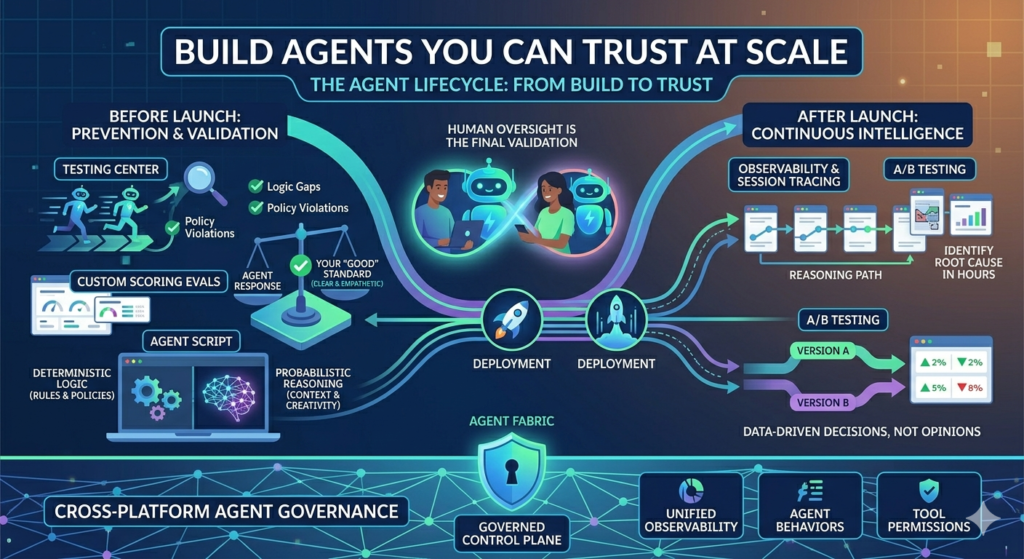
Before Launch: Prevention and Validation
Testing Center represents a fundamental shift in how we validate agent behavior before deployment. Instead of just checking whether code runs without errors, Testing Center surfaces logic gaps, policy violations, and inconsistent outputs before they ever reach actual users.
But we go significantly further with Custom Scoring Evals. Traditional testing tells you whether something executed. Scoring evaluations tell you whether it made the right decision.
You define what “good” looks like for your specific use case. For example, a customer service agent that declines an out-of-policy refund request should do so clearly and empathetically while explaining alternatives and offering other forms of assistance. Every agent response is evaluated against that standard—not just whether it technically executed, but whether it delivered the outcome you defined as correct.
Agent Script gives you fine-grained control over the agent itself before it ever sees a test case. Define exactly which parts of its behavior must follow explicit, deterministic business logic (like compliance requirements and legal policies) and which parts can reason freely based on context and patterns (like tone, explanation style, and creative problem-solving approaches).
This hybrid approach—deterministic where precision matters, probabilistic where judgment adds value—represents the optimal balance between control and capability.
After Launch: Continuous Intelligence
Observability and Session Tracing show not just what happened during an agent interaction, but why it happened. When an agent’s behavior drifts from expectations—and drift is inevitable in probabilistic systems operating in dynamic environments—you can identify the root cause in hours instead of weeks or months.
You can trace the exact reasoning path the agent followed, examine the data it considered, review the tools it chose to invoke, and understand the logic that led to its ultimate decision. This level of transparency is essential for maintaining trust in production agent systems.
A/B Testing for agents brings the rigor of modern software development to AI deployments. Run multiple agent versions against real production traffic simultaneously, with statistically rigorous data collection and analysis informing decisions about what to promote to full production.
Which prompt engineering approach performs better? Which reasoning strategy handles edge cases more gracefully? Which personality and tone resonates most effectively with your specific customer base? Answer these questions with data, not opinions.
Cross-Platform Agent Governance
For enterprises running agents across multiple platforms, models, and vendors—and most sophisticated organizations are—the new Agent Fabric brings everything under one governed control plane.
Centralized management of agent behaviors, tool permissions, and LLM governance across your entire AI landscape. Deterministic orchestration that ensures agents from different sources work together predictably. Unified observability that shows how agents are actually being used across your organization.
In the agentic enterprise, launching an agent used to be the finish line. Now it’s the starting line. The real work of ensuring reliable, trustworthy, valuable agent behavior happens continuously, over time, with sophisticated tooling supporting human oversight.
Why the Platform Still Matters: Context, Workflows, Trust, and Engagement
If agents can call any API, and if foundation models are already extraordinarily powerful, a reasonable question emerges: Why does the underlying platform matter?
The answer is fundamental: Because intelligence alone is just inference.
Raw inference needs context, proven workflows, robust trust mechanisms, and the right engagement layer to actually do anything valuable in a production enterprise environment.
The Context Layer: What Intelligence Needs to Be Useful
The best coding agents and large language models available today are genuinely extraordinary at reasoning, pattern recognition, and generating coherent responses. But a powerful coding agent connected to a raw database doesn’t automatically know that:
- A particular customer has an open escalation that’s been running for three weeks
- That same customer has a renewal coming due in 30 days representing $2M in annual contract value
- Their support SLA was breached twice in the past quarter
- The relationship owner has a personal connection to their CFO from a previous company
- They’re currently evaluating three competitive alternatives
- Two stakeholders are champions while one is actively blocking
That context took years to accumulate across dozens of touchpoints, hundreds of interactions, and thousands of data points. It lives in Salesforce, encoded in data models, activity histories, relationship maps, and business processes that capture institutional knowledge.
And now, Data 360 exposes all of that accumulated context as an API, an MCP tool, a CLI command—so your coding agent can reach it from anywhere, without touching a UI, without requiring specialized Salesforce knowledge, without manual integration work.
That’s what separates a coding agent that writes syntactically correct code from one that genuinely understands your business, your customers, and your specific context.
The Workflow Layer: Inherited Intelligence
Context alone isn’t sufficient. Agents also need proven workflows—the approval chains, the business rules, the exception handling logic, the edge-case procedures that someone built years ago and that your legal, finance, and compliance teams still depend on today.
When an agent operates inside Salesforce, it inherits all of that accumulated process intelligence. It doesn’t have to rediscover established procedures through trial and error. It doesn’t have to approximate complex approval logic with general-purpose reasoning. It works within proven, tested, audited workflows that already reflect years of organizational learning.
This is institutional knowledge at scale, instantly accessible to every agent you deploy.
The Trust Layer: Security That Scales
Then there’s the trust dimension: the permissions, sharing rules, field-level security, and compliance controls that your IT and security teams have already reviewed, approved, and certified.
In most platforms, you rebuild this entire trust layer from scratch every single time you deploy something new. Every new integration requires new security reviews. Every new capability requires new permission frameworks. Every new data access pattern requires new compliance validation.
In Salesforce, that trust infrastructure already exists. The guardrails your organization relies on to protect customer data, ensure regulatory compliance, and maintain proper access controls are the same guardrails your agents automatically operate within.
Agents inherit the same permission model as humans. If a user doesn’t have access to sensitive fields, neither does an agent acting on their behalf. If certain operations require approval workflows, agents must follow those same workflows. If data must remain within certain geographic boundaries, agents respect those same data residency requirements.
Security and compliance at scale, by default, without rebuilding foundational controls for every new AI capability.
The Engagement Layer: Where Work Actually Happens
Finally, there’s the engagement layer—the surfaces where humans and agents actually interact to accomplish work. For millions of knowledge workers, that surface is increasingly Slack.
Slack integration isn’t just another channel. It’s where conversations happen, decisions get made, teams coordinate, and work gets done. An agent that can surface information, execute workflows, and facilitate decisions directly in Slack eliminates the constant context-switching that destroys productivity.
The Unique Salesforce Advantage
Most vendors can give you one of these layers. Some can give you two. A few might claim three.
Only Salesforce gives you all four—already integrated, already running inside your enterprise, already trusted by your teams.
| Layer | Product | What It Provides |
|---|---|---|
| System of Context | Data 360 | All your trusted business data, unified, real-time, and ready for agents to access and act upon |
| System of Work | Customer 360 | Decades of accumulated business logic and proven workflows across sales, service, marketing, and every other function—now orchestrated by agents |
| System of Agency | Agentforce | Build, deploy, manage, and govern agents at scale across every channel and surface |
| System of Engagement | Slack | Where humans and agents come together in conversation to collaborate and get work done |
Developers aren’t starting from a blank slate, reinventing basic infrastructure, or integrating disparate systems. They’re building on top of sophisticated infrastructure that’s already running inside their enterprise, with the data models, the workflows, the permission frameworks, and the engagement channels already in place.
That’s the advantage nobody else can legitimately offer.
AgentExchange: One Marketplace, Every Tool Your Agents Need
The power of a platform isn’t just what you build directly—it’s also the ecosystem that builds on top of it.
AgentExchange brings together an unprecedented collection of capabilities:
- 10,000+ Salesforce apps with established enterprise adoption
- 2,600+ Slack apps spanning every business function
- 1,000+ Agentforce agents, tools, and MCP servers from partners including Google, Docusign, Notion, and hundreds of others
All discoverable through AI-guided search that understands what you’re trying to accomplish, not just keyword matching. All activatable in one click, with automatic permission inheritance and governance.
Real Impact, Real Velocity
The results speak for themselves. After listing on AgentExchange, Notion cut its average sales cycle from four months to three weeks—an 81% reduction. Docusign processed over 200 private offers in Q4 2025 alone, with 60% faster time to signature. MeshMesh closed its first Fortune 500 customer just six weeks after listing.
This isn’t incremental improvement. This is order-of-magnitude acceleration in how quickly valuable capabilities can be discovered, evaluated, and deployed.
The $50M Builders Fund: Investing in the Future
We’re backing this ecosystem expansion with a $50 million Builders Fund providing:
- Direct investment capital for high-potential builders
- Engineering support and technical resources
- Go-to-market pathways and distribution channels
- Co-innovation opportunities with Salesforce product teams
If you’re an Agentblazer ready to scale your innovation, ready to reach enterprise customers, ready to build the tools that will define the agentic enterprise, we’re ready to invest in your success.
The Complete Toolkit: 100+ New Capabilities Available Today
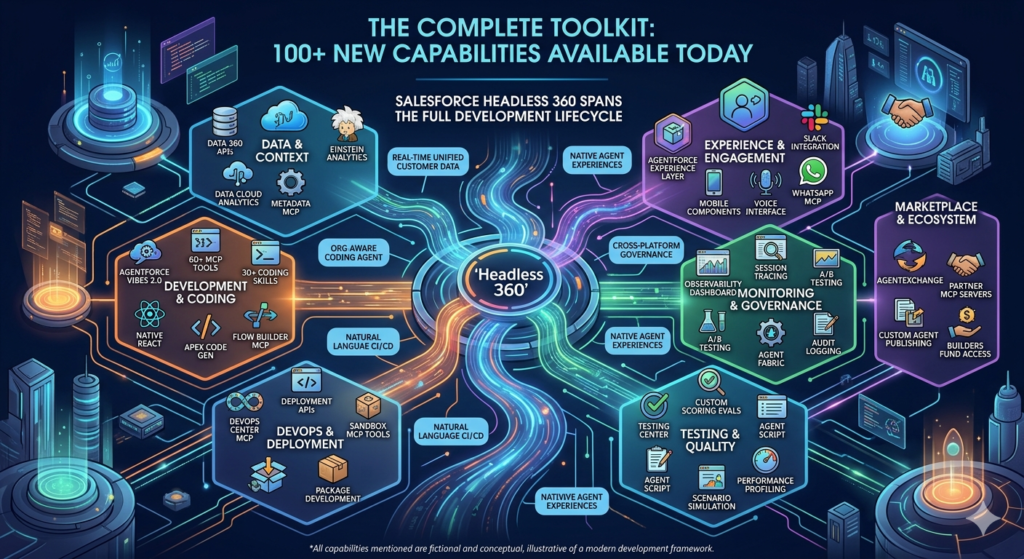
Salesforce Headless 360 spans the full development lifecycle with purpose-built capabilities at every stage:
Data & Context
- Data 360 APIs: Real-time access to unified customer data across every touchpoint
- Data Cloud MCP: Stream processing and real-time data activation for agents
- Einstein Analytics APIs: Predictive insights and data science capabilities
- Metadata MCP Tools: Programmatic access to org structure and customizations
Development & Coding
- Agentforce Vibes 2.0: Org-aware coding agent with multi-model support
- 60+ MCP Tools: Complete platform access for external coding agents
- 30+ Coding Skills: Pre-configured capabilities for common development patterns
- Native React Support: Custom UI development with full platform integration
- Apex Code Generation: AI-assisted business logic development
- Flow Builder MCP: Declarative automation accessible to agents
DevOps & Deployment
- DevOps Center MCP: Natural language CI/CD pipelines
- Deployment APIs: Programmatic change management
- Sandbox MCP Tools: Automated environment management
- Package Development: Modular, versioned solution distribution
Testing & Quality
- Testing Center: Comprehensive agent behavior validation
- Custom Scoring Evals: Business-outcome focused quality metrics
- Agent Script: Hybrid deterministic/probabilistic control
- Scenario Simulation: Edge case and stress testing
- Performance Profiling: Response time and resource optimization
Monitoring & Governance
- Observability Dashboard: Real-time agent behavior monitoring
- Session Tracing: Detailed reasoning path inspection
- A/B Testing Framework: Data-driven optimization
- Agent Fabric: Cross-platform governance and orchestration
- Audit Logging: Comprehensive compliance and security tracking
Experience & Engagement
- Agentforce Experience Layer: Rich UI components across any surface
- Slack Integration: Native agent experiences in conversation
- Mobile Components: First-class mobile agent interactions
- Voice Interface APIs: Conversational agent access
- WhatsApp MCP: Messaging platform integration
- Multi-Channel Rendering: Build once, deploy everywhere
Marketplace & Ecosystem
- AgentExchange: Unified discovery for 13,000+ apps, agents, and tools
- Partner MCP Servers: Google, Docusign, Notion, and hundreds more
- Custom Agent Publishing: Share your innovations with the ecosystem
- Builders Fund Access: Investment and support for high-potential builders
Getting Started: Your Path to Headless 360
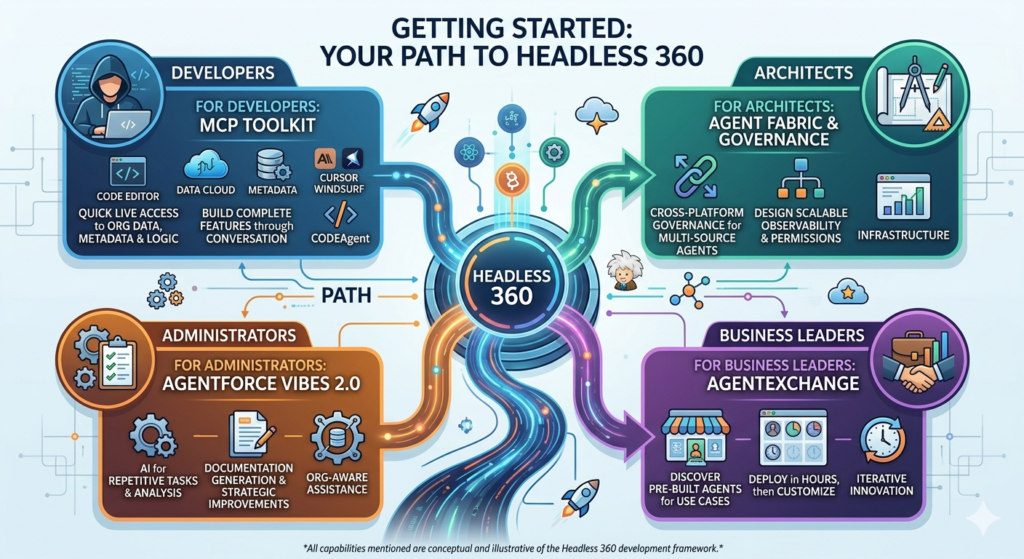
Whether you’re a developer looking to supercharge your coding environment, a business leader exploring agent deployment, or an architect designing next-generation customer experiences, Salesforce Headless 360 provides the foundation you need.
For Developers
Start with the MCP Toolkit for your preferred coding environment. In minutes, you’ll have live access to your org’s data, metadata, and business logic directly in Claude Code, Cursor, or Windsurf. Begin with simple queries, progress to metadata modifications, and soon you’ll be building complete features through conversation with your coding agent.
For Administrators
Explore Agentforce Vibes 2.0 for org-aware assistance with daily admin tasks. Let AI handle repetitive metadata updates, configuration analysis, and documentation generation while you focus on strategic improvements and user support.
For Architects
Review the Agent Fabric capabilities for cross-platform governance. Design how agents from different sources will work together, establish permission frameworks, and create the observability infrastructure you’ll need as agent deployment scales.
For Business Leaders
Start with AgentExchange to discover pre-built agents and tools that address your specific use cases. Deploy proven capabilities in hours instead of months, then iterate and customize based on real-world usage and feedback.
The Agentic Enterprise Starts Today
For 25 years, Salesforce has evolved alongside the changing needs of enterprise customers—from on-premise software to cloud platforms, from desktop interfaces to mobile experiences, from manual processes to automated workflows.
Salesforce Headless 360 represents the next fundamental evolution: from human-operated systems to human-agent collaboration, from UI-bound capabilities to universally accessible tools, from platform-specific experiences to work that happens wherever your people already are.
The question Parker Harris asked wasn’t rhetorical: “Why should you ever log into Salesforce again?”
The answer is becoming clear: You shouldn’t have to. Your agents shouldn’t have to. Your work should happen where you are, in the tools you prefer, through the interfaces that make sense for each specific task.
Build any way you want. Deploy anywhere your users are. Trust that it will work reliably, securely, and at scale.
Welcome to Salesforce Headless 360.
Welcome to the Agentic Enterprise.
About RizeX Labs
At RizeX Labs, we specialize in delivering next-generation Salesforce solutions, including Headless Architecture and composable digital experiences powered by Salesforce Headless 360.
Our expertise combines deep technical knowledge, modern API-first strategies, and real-world implementation experience to help businesses build scalable, flexible, and future-ready digital ecosystems.
We empower organizations to move beyond rigid, monolithic systems—enabling them to adopt a headless approach that delivers seamless customer experiences across multiple channels while improving agility, performance, and innovation.
Internal Links:
- Salesforce Admin course page
- Salesforce Flows vs Apex: When Should You Use Code vs No-Code Automation?
- Salesforce Data Cloud Explained — What It Is and Why It Matters
- AI Tools for Salesforce Development in 2026 — Cursor AI, Copilot and More
- Why Your Company Should Invest in Salesforce Developer Training in 2026
- Salesforce Named Credentials: What They Are and How to Use Them Safely
- Prompt Engineering for Salesforce Agentforce — Beginner’s Guide
External Links:
McKinsey Sales Growth Reports
