
Introduction: Why Most Beginners Feel Overwhelmed (And How to Fix That)
You’ve decided to pursue the Salesforce Marketing Cloud certification in 2026 — great decision. But here’s the reality most study guides won’t tell you: the majority of candidates who fail their first attempt don’t fail because the exam is impossible. They fail because they studied the wrong things, in the wrong order, without ever touching the actual platform.
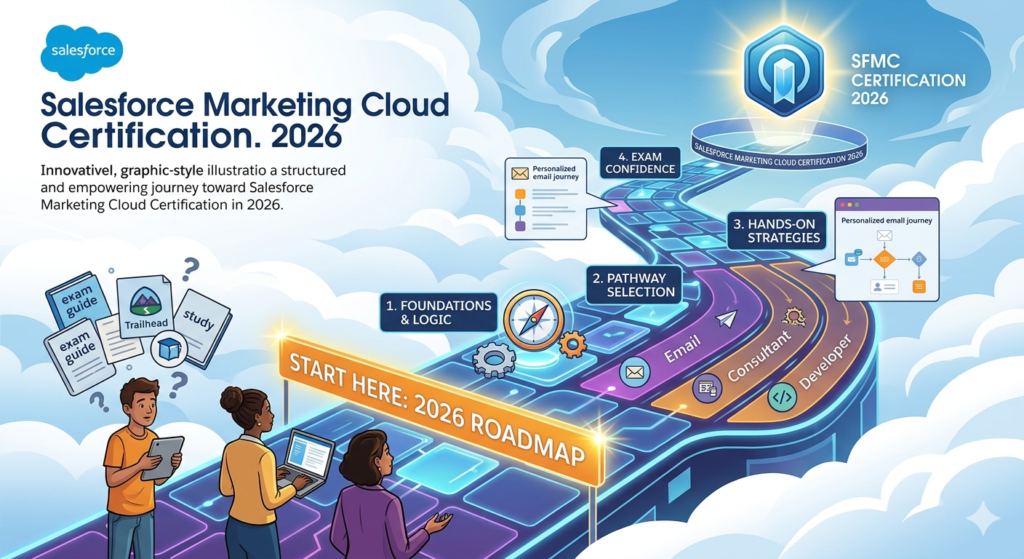
If you’ve been staring at Trailhead modules, YouTube videos, and PDF dumps all at once, wondering where to actually begin — you’re not alone. The SFMC ecosystem is massive. Between Journey Builder, Email Studio, Automation Studio, Data Extensions, AMPscript, and a dozen other tools, it can feel like you’re trying to drink from a fire hose.
This guide is different. It’s built specifically for the salesforce marketing cloud certification 2026 landscape, meaning it accounts for recent exam updates, the skills employers are actually hiring for, and the study strategies that consistently work for real candidates.
Whether you’re a marketing professional transitioning into a technical role, a Salesforce Admin expanding your credentials, or a developer looking to validate your SFMC expertise, this complete SFMC certification guide will give you a structured, realistic path from zero to certified.
Let’s cut through the noise and get to work.
What Is Salesforce Marketing Cloud Certification?
Salesforce Marketing Cloud (SFMC) is widely recognized as one of the most powerful and comprehensive digital marketing platforms used by businesses across the globe. It enables organizations to manage and optimize multiple aspects of their marketing strategy within a single, unified ecosystem. With SFMC, companies can handle email campaigns, design personalized customer journeys, manage social media interactions, execute mobile messaging strategies, run digital advertising campaigns, and analyze customer data — all in one place. This level of integration helps businesses create more targeted, data-driven, and effective marketing experiences.
A Salesforce Marketing Cloud certification is a professional credential that validates your expertise in using this platform. It demonstrates that you possess both the technical understanding and practical skills required to work efficiently within SFMC. Whether it involves building automated journeys, managing subscriber data, creating high-performing email campaigns, or leveraging analytics tools, certification proves that you can handle real-world marketing challenges using Salesforce technology.
This certification is globally recognized and highly valued by employers, especially in enterprise-level organizations that rely heavily on cloud-based marketing solutions. It serves as a benchmark of your capability and credibility in the competitive job market. Companies prefer certified professionals because they reduce training time, improve campaign performance, and bring a structured approach to marketing operations.
Beyond recognition, SFMC certification can have a strong impact on your earning potential. According to recent Salesforce ecosystem salary surveys, professionals with SFMC certifications typically earn between $85,000 and $140,000+ annually, depending on their role, experience, and level of expertise. Roles such as Email Specialist, Marketing Cloud Consultant, and Marketing Automation Manager often command higher salaries due to their strategic importance in driving business growth.
The demand for certified Salesforce Marketing Cloud professionals continues to grow rapidly. As more companies shift towards digital transformation and adopt cloud-based platforms, the need for skilled marketers who can effectively use SFMC is increasing. This makes certification not just a qualification, but a strategic investment in your long-term career growth, helping you stay relevant and competitive in the evolving marketing industry.
Salesforce Marketing Cloud Certification Types Explained
Before you open a single study resource, you need to know which certification is right for you. Picking the wrong path is one of the most common mistakes beginners make.
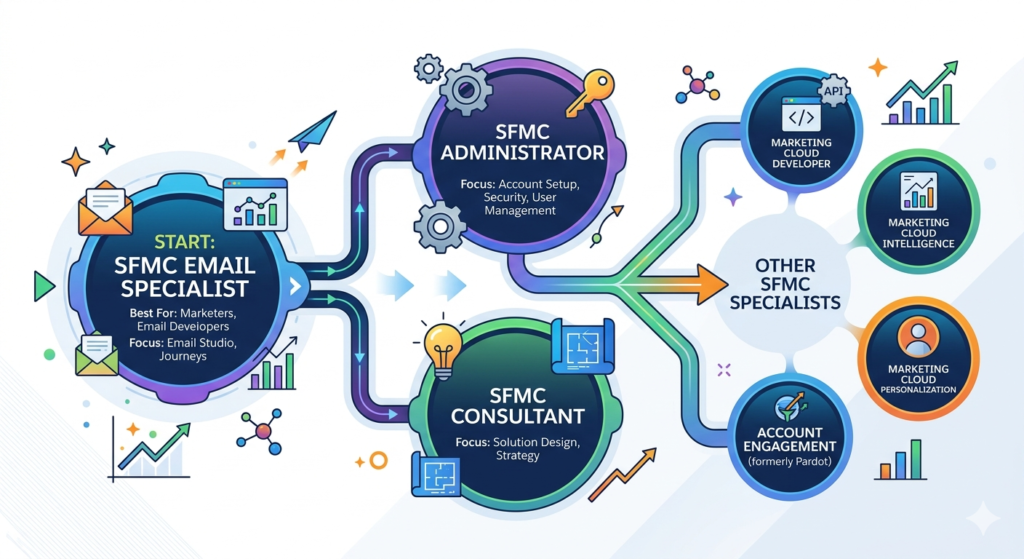
H3: 1. Salesforce Marketing Cloud Email Specialist
Best for: Marketers, campaign managers, and email developers
Focus areas: Email Studio, Content Builder, Journey Builder, subscriber management, deliverability, analytics
The SFMC Email Specialist exam is the most popular entry-level certification in the Marketing Cloud track. It proves you can build, send, and analyze email campaigns using the platform’s core tools.
Exam details:
- 60 multiple-choice questions
- 105-minute time limit
- Passing score: 65%
- Registration fee: $200 (retake: $100)
Core topic weightings:
- Email Marketing Best Practices: 10%
- Email Marketing Strategy: 10%
- Subscriber and List Management: 12%
- Data Management: 12%
- Inbox Delivery: 12%
- Content Creation and Delivery: 24%
- Tracking and Reporting: 20%
This is typically the first certification most people pursue, and it’s the focus of the majority of this guide.
H3: 2. Salesforce Marketing Cloud Administrator
Best for: System admins, marketing ops professionals, IT-adjacent roles
Focus areas: Account setup, user management, data configuration, security, integration
The Admin certification validates your ability to configure and maintain an SFMC instance at an organizational level. You’ll be tested on business units, role permissions, data extensions, subscriber management at scale, and platform maintenance.
Who should pursue this: If you’re responsible for the backend health of an SFMC environment — managing users, setting up data structures, or handling integrations — this is your cert.
H3: 3. Salesforce Marketing Cloud Consultant
Best for: Solution architects, consultants, senior marketing ops professionals
Focus areas: Discovery, solution design, implementation strategy, data architecture, cross-channel marketing
This is an advanced certification that requires significant hands-on experience. It tests your ability to translate business requirements into scalable SFMC solutions. Most candidates have 2+ years of real-world SFMC experience before attempting this exam.
Important note: There is no strict prerequisite listed by Salesforce for any of these certifications, but in practice, the Email Specialist is considered the natural starting point before advancing to Admin or Consultant.
H3: 4. Other SFMC Specialist Certifications
Salesforce also offers additional credentials in the Marketing Cloud track:
- Marketing Cloud Developer — for developers working with AMPscript, SSJS, APIs
- Marketing Cloud Intelligence (formerly Datorama) — for data analysts and reporting specialists
- Marketing Cloud Personalization (formerly Interaction Studio) — for personalization strategists
- Marketing Cloud Account Engagement Specialist (formerly Pardot) — technically a separate product but often grouped with SFMC learning paths
For 2026, the Email Specialist and Administrator certifications continue to be the most in-demand starting points, so this guide will concentrate primarily on those paths.
Understanding the 2026 Exam Landscape
Salesforce updates its certification exams regularly — typically twice per year — to reflect platform changes. Here’s what’s new and relevant for the salesforce marketing cloud certification 2026 candidates:
- Einstein AI features are increasingly appearing in exam questions. Salesforce’s AI integrations across email optimization, send-time optimization, and engagement scoring are now testable topics.
- Data Cloud integration with Marketing Cloud is a growing area. You don’t need deep expertise, but awareness of how Data Cloud connects to SFMC is now valuable.
- Content Builder updates and enhanced personalization features have replaced older email tools. Classic content and legacy list-based architecture questions have decreased.
- Journey Builder complexity questions have increased, including multi-step, multi-channel journey design scenarios.
Always check the official exam guide on Salesforce’s Trailhead website before you begin studying. The exam outline PDFs are free, publicly available, and tell you exactly what topics are weighted and how.
Realistic Study Roadmap: 8-Week Plan to SFMC Certification
This is not a “study hard and you’ll pass” generic plan. This is a week-by-week structure built for working professionals who have limited time and need maximum efficiency.
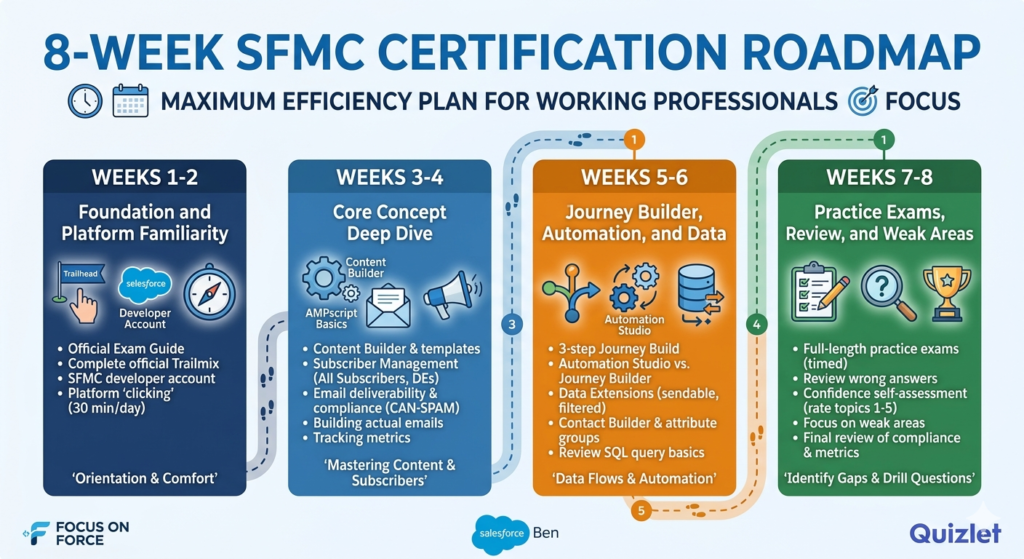
Assumption: 1–2 hours of study per day on weekdays, 3–4 hours on weekends.
H3: Weeks 1–2: Foundation and Platform Familiarity
Goal: Understand what SFMC does, how the interface works, and what the exam actually covers.
Actions:
- Download the official Email Specialist Exam Guide from Trailhead
- Complete the “Marketing Cloud Email Specialist” Trailmix on Trailhead (this is the official Salesforce-curated path)
- Sign up for a Salesforce Marketing Cloud developer account (free trial available)
- Spend 30 minutes per day just clicking through the platform — explore Email Studio, Content Builder, Contact Builder, and Automation Studio without any agenda
Key mindset: Don’t try to memorize anything yet. This phase is about orientation. You want to feel comfortable in the platform before you start studying concepts.
H3: Weeks 3–4: Core Concept Deep Dive
Goal: Master the high-weighted topic areas — Content Creation, Tracking, and Subscriber Management.
Actions:
- Study Content Builder in depth: email templates, content blocks, dynamic content, AMPscript basics
- Learn Subscriber and List Management: All Subscribers list, publication lists, suppression lists, data extensions vs. lists
- Understand Email deliverability: sender authentication (SPF, DKIM, DMARC), IP warming, bounce categories, compliance (CAN-SPAM, GDPR)
- Practice building actual emails in Content Builder using dynamic content rules
- Study tracking metrics: unique opens, unique clicks, bounce rates, unsubscribe rates, and what each tells you about campaign health
Tools to use:
- Trailhead modules on Email Studio and Content Builder
- Salesforce’s official documentation (Salesforce Help)
- YouTube channel: “Salesforce Hulk” (detailed SFMC walkthroughs)
H3: Weeks 5–6: Journey Builder, Automation, and Data
Goal: Understand how data flows through SFMC and how automation drives campaigns.
Actions:
- Build a 3-step Journey in Journey Builder using a data extension entry source — include a wait activity, a decision split, and an email send
- Learn Automation Studio vs. Journey Builder: understand when to use each, what activities are available, and how they connect
- Study Data Extensions: standard vs. sendable vs. filtered, field types, primary keys, relationships
- Understand Contact Builder: how attribute groups, population, and data relationships work
- Review SQL query basics — you don’t need to be a SQL expert, but you should be able to read and understand basic SELECT statements used in Automation Studio
Practical project idea: Build a welcome email series for a fictional e-commerce brand. Create the data extension, import test subscribers, design the emails in Content Builder, and activate a Journey. This single project covers 40%+ of exam topics in a practical context.
H3: Weeks 7–8: Practice Exams, Review, and Weak Areas
Goal: Identify gaps, drill practice questions, and build exam-day confidence.
Actions:
- Take your first full-length practice exam (aim for 60 questions, timed)
- Review every wrong answer — don’t just note the correct answer, understand why it’s correct
- Return to the official exam guide and rate your confidence on each topic area (1–5 scale)
- Focus your final week’s study time exclusively on your lowest-confidence areas
- Take 2–3 additional practice exams in the final week
- Complete a final review of email compliance rules, deliverability concepts, and tracking metrics (these are highly testable)
Best practice exam resources:
- Focus on Force (paid, but worth it — $39 for full practice bank)
- Salesforce Ben’s free practice questions
- Quizlet decks for SFMC terminology (search “SFMC Email Specialist 2025” for most current decks)
Practical Preparation Strategies That Actually Work
H3: 1. Get Hands-On Time with a Real SFMC Environment
Reading about Journey Builder is not the same as using it. If your employer uses SFMC, ask for sandbox access. If not, Salesforce occasionally offers free developer orgs or trial accounts. There are also partner programs where consulting firms provide access to demo environments.
Alternatively, some training platforms like CloudAnalysts or SFMC-specific bootcamps provide temporary environment access as part of their courses.
H3: 2. Use Trailhead Strategically — Not Exhaustively
Trailhead is excellent, but trying to complete every SFMC module will take months and result in information overload. Instead, use the official Trailmix for your target certification and supplement with specific modules only when you need to go deeper on a weak area.
H3: 3. Join the SFMC Community
- Salesforce Trailblazer Community — active forums with real exam discussions
- SFMC Slack communities — search for “Marketing Cloud Slack group” to find active communities
- LinkedIn groups — “Salesforce Marketing Cloud Professionals” has thousands of active members
- Reddit r/salesforce — practical advice from certified professionals
H3: 4. Teach What You’re Learning
After each study session, write a short explanation of what you learned as if you’re explaining it to someone with no SFMC background. This technique (called the Feynman Method) forces you to identify gaps in your understanding that passive reading won’t reveal.
H3: 5. Build a Personal Reference Document
Create a Google Doc or Notion page where you document every SFMC concept in your own words. Include screenshots, flowcharts, and examples. By the time you’re done, you’ll have a personalized study guide that’s infinitely more useful than any third-party material.
Common Mistakes SFMC Certification Candidates Make
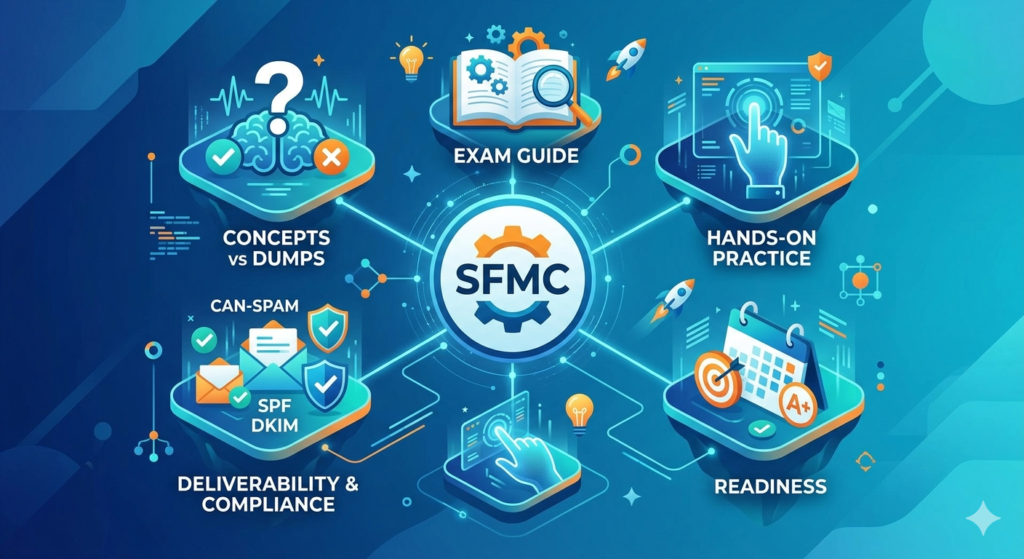
H3: Mistake 1: Studying Dumps Instead of Concepts
Brain dumps (leaked exam answers) are tempting, but they’re unreliable, unethical, and increasingly ineffective as Salesforce refreshes its question bank. Candidates who rely on dumps can pass the exam but have no real-world skill — which defeats the entire purpose of the credential.
Fix: Study concepts, not answers. If you understand why a data extension is better than a list for a specific use case, you’ll answer related questions correctly regardless of how they’re phrased.
H3: Mistake 2: Skipping the Official Exam Guide
The exam guide is your syllabus. Ignoring it is like studying for a final exam without knowing which chapters will be covered.
Fix: Download the official exam guide on day one. Build your study plan around the weighted topic areas.
H3: Mistake 3: Not Practicing in the Platform
Many candidates read and watch videos but never actually use SFMC. The exam includes scenario-based questions that require you to understand how the platform actually works in context.
Fix: Set a rule: for every hour of reading, spend 30 minutes doing something in the platform.
H3: Mistake 4: Underestimating Deliverability and Compliance
Many candidates focus heavily on technical tools and underestimate the email deliverability and compliance section. Questions about SPF, DKIM, DMARC, bounce types, and CAN-SPAM regulations appear consistently on the SFMC Email Specialist exam.
Fix: Dedicate a full study session (3–4 hours) exclusively to deliverability concepts and email compliance rules.
H3: Mistake 5: Taking the Exam Before They’re Ready
The $200 exam fee and eagerness to get certified push some candidates to book the exam before they’ve genuinely prepared. This leads to failed attempts, additional costs, and demoralization.
Fix: Don’t book your exam until you’re consistently scoring 75%+ on practice exams across multiple attempts. That 10% buffer above the passing score gives you comfort for exam-day nerves.
How to Register for the SFMC Certification Exam in 2026
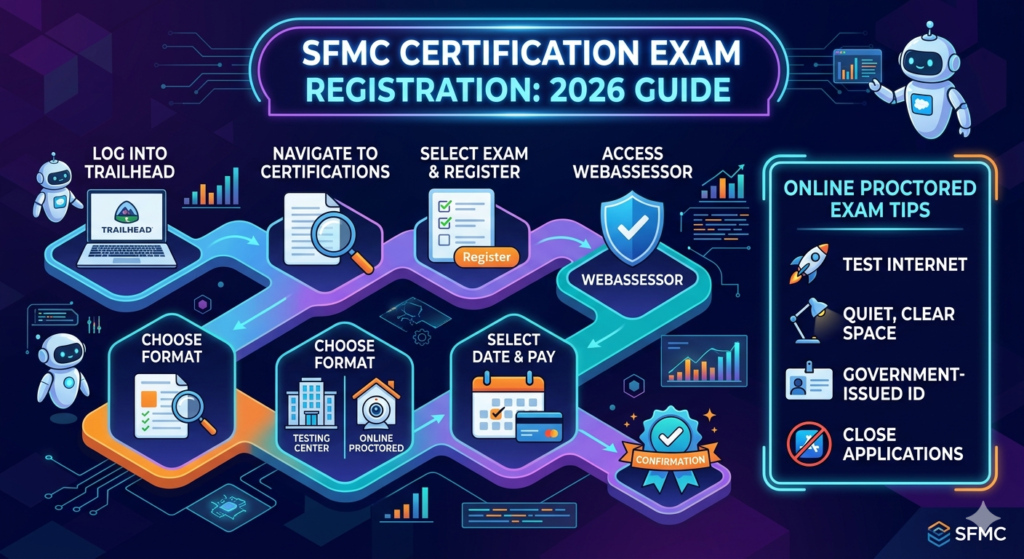
- Go to Trailhead.salesforce.com and log into your account
- Navigate to Credentials > Certifications
- Search for your target certification and click “Register”
- You’ll be directed to Webassessor (the exam platform) — create an account if you don’t have one
- Choose your exam format: online proctored (take from home) or in-person at a testing center
- Select your date, pay the fee ($200), and receive your confirmation
Online proctored exam tips:
- Test your internet connection the day before
- Ensure your room is quiet and your desk is clear
- Have your government-issued ID ready
- Close all background applications on your computer
After Certification: What’s Next?
Passing your first SFMC certification is a milestone, not a destination. Here’s how to build momentum:
- Update your LinkedIn headline and resume immediately — add the digital badge Salesforce sends you
- Start applying skills at work or in freelance projects — certification without experience limits your career growth
- Begin studying for your next credential — most Email Specialists move to the Admin or Consultant certification within 12 months
- Maintain your certification — Salesforce requires annual Superbadge or maintenance module completions to keep credentials active. These are free on Trailhead
Conclusion
The Salesforce Marketing Cloud certification in 2026 remains one of the most valuable credentials in the digital marketing and marketing technology space. Whether you’re targeting the SFMC Email Specialist exam as your entry point or building toward the Consultant certification, success comes down to three things: studying the right content in the right order, getting genuine hands-on time with the platform, and consistently testing your knowledge through practice exams before you sit the real thing. Use the 8-week roadmap in this SFMC certification guide, avoid the common mistakes that derail most candidates, and engage with the Salesforce community throughout your journey — because learning from people who’ve already passed the exam is as valuable as any study material you’ll find.
About RizeX Labs
At RizeX Labs, we specialize in delivering cutting-edge Salesforce solutions, including Marketing Cloud implementations and certification training. Our expertise combines deep technical knowledge, industry best practices, and real-world experience to help individuals and businesses master Salesforce Marketing Cloud.
We empower learners and professionals to transform their marketing automation skills—from basic concepts to advanced strategies—through structured learning paths, hands-on practice, and certification-focused guidance.
Internal Links:
- Salesforce Admin course page
- Salesforce Marketing Cloud vs Pardot: Which Is Right for You in 2026
- Salesforce Data Import Wizard vs Data Loader: Full Comparison (2024 Guide)
- SFMC Data Extensions vs Lists: What Every Marketer Should Know
- SFMC Email Content Builder: Best Practices & Templates 2026
- SFMC Query Activity SQL: The Complete Guide to Marketing Cloud SQL for Data-Driven Marketers
- SFMC Einstein Send Time Optimization: How It Works
External Links:
McKinsey Sales Growth Reports
