
Introduction: Why the AI Conversation Inside Salesforce Just Got More Interesting
Artificial intelligence has gone from being a “nice-to-have” to an absolute business priority—and Salesforce is right at the center of that transformation. Over the past couple of years, Salesforce has rolled out a series of AI-powered tools designed to help organizations work smarter, respond faster, and automate more intelligently than ever before.
Two of the most talked-about AI innovations in the Salesforce ecosystem right now are Einstein Copilot and Agentforce. And if you’ve been trying to figure out which one deserves your attention—or your budget—you’re definitely not alone.
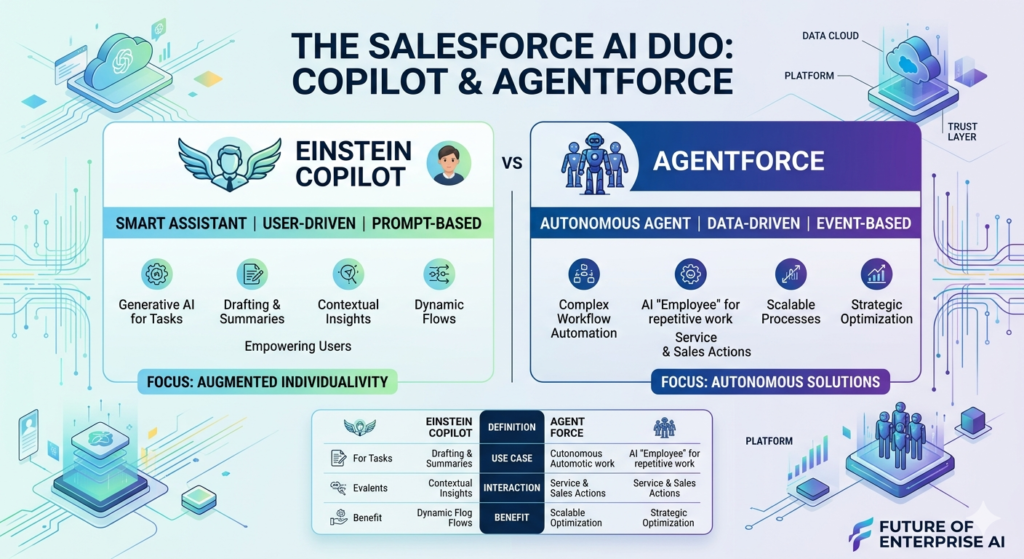
Business leaders, Salesforce admins, developers, and consultants are actively searching for clarity around Salesforce Einstein Copilot vs Agentforce, wanting to understand how these two tools differ, where they overlap, and which one is the right fit for their specific goals.
Are they competitors? Are they complementary? Is one replacing the other? The short answer is: they serve different purposes, but together they represent Salesforce’s bold vision for the future of enterprise AI.
This guide breaks it all down for you—from definitions and use cases to a detailed comparison table, real-world examples, and strategic recommendations. Whether you’re a beginner just learning about Salesforce AI or a seasoned architect evaluating your organization’s roadmap, this article has something for you.
Let’s dive in.
Section 1: What Is Salesforce Einstein Copilot?
Definition and Overview
Salesforce Einstein Copilot is an AI-powered conversational assistant embedded directly within the Salesforce platform. Think of it as your intelligent digital teammate that sits inside Salesforce and helps users get things done faster through natural language conversations.
Launched as part of Salesforce’s broader Einstein AI strategy, Einstein Copilot allows users to ask questions, generate content, summarize records, and trigger CRM actions—all without leaving the Salesforce interface. It’s built on large language models (LLMs) and is grounded in your organization’s CRM data, which means its responses are contextual, relevant, and business-specific.
How Einstein Copilot Works
Einstein Copilot operates as a conversational AI assistant integrated into Salesforce apps like Sales Cloud, Service Cloud, Marketing Cloud, and more. Users interact with it through a chat-style interface where they can type requests in plain English (or other supported languages), and Copilot responds with intelligent answers, content drafts, or automated actions.
Here’s what makes it powerful:
- It understands the context of your Salesforce data
- It can take in-app actions like updating records or creating tasks
- It leverages Salesforce Flows and Apex under the hood
- It respects role-based security and permissions
- It uses Einstein Trust Layer to ensure data privacy and security
Key Capabilities of Einstein Copilot
1. Record Summarization
A sales rep can ask, “Summarize the last three interactions with Acme Corp,” and Copilot instantly pulls relevant activity history, emails, and notes to deliver a concise summary.
2. Email and Content Generation
Marketing and sales teams can use Copilot to draft personalized emails: “Write a follow-up email to John based on our last call notes.” The result is a contextual draft ready for review and sending.
3. CRM Record Updates
Admins or reps can say, “Update the opportunity stage to Proposal Sent and add a follow-up task for Friday.” Copilot executes the action directly in Salesforce.
4. Data Q&A
Business users can ask questions like, “How many open cases do we have in the West region this week?” and receive instant, data-driven answers without running a report manually.
5. Guided Workflows
For admins and developers, Copilot can help build flows, suggest automation improvements, or explain how a particular process works.
Use Cases by Role
| Role | How They Use Einstein Copilot |
|---|---|
| Sales Reps | Summarize accounts, generate outreach emails, update opportunities |
| Service Agents | Draft case responses, retrieve knowledge articles, close cases faster |
| Marketing Teams | Generate campaign content, analyze engagement data |
| Admins | Troubleshoot flows, generate reports, explain metadata |
| Business Leaders | Ask strategic data questions, get pipeline summaries |
Benefits of Einstein Copilot
- Accelerates daily tasks for CRM users
- Reduces manual data entry through natural language commands
- Improves response quality with AI-generated content
- Easy to adopt with minimal learning curve
- Secure and governed via Einstein Trust Layer
Limitations to Know
- Einstein Copilot is primarily user-triggered, meaning it waits for a human to ask it something
- It is best suited for in-session assistance, not background automation
- Complex multi-step workflows may require Agentforce instead
- Effectiveness depends heavily on data quality in your Salesforce org
Section 2: What Is Agentforce?
Definition and Overview
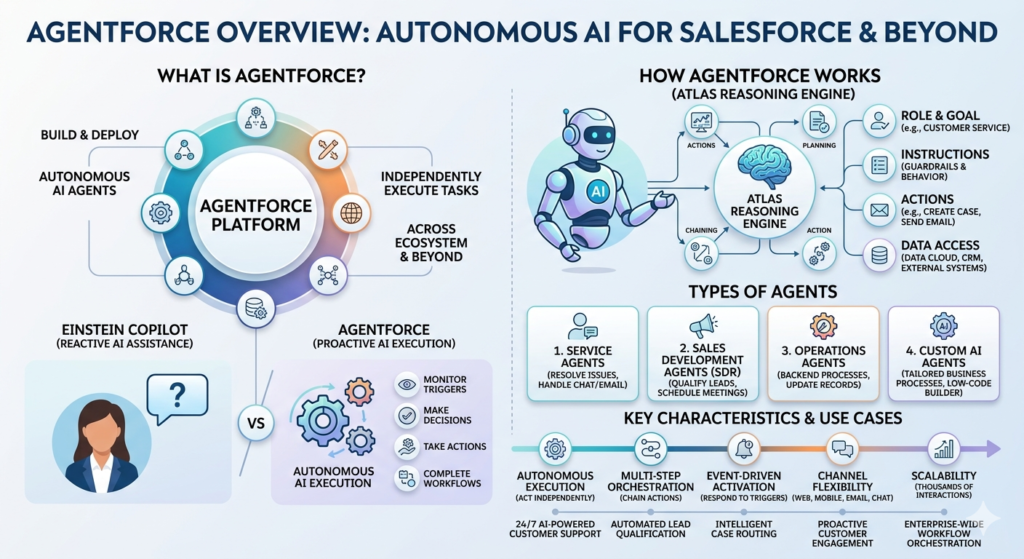
Agentforce is Salesforce’s platform for building and deploying autonomous AI agents that can independently execute complex, multi-step tasks across the Salesforce ecosystem—and beyond. Announced as a major leap forward in Salesforce’s AI strategy, Agentforce represents a shift from reactive AI assistance to proactive, autonomous AI execution.
While Einstein Copilot answers questions and helps users when they ask, Agentforce agents can work independently, monitor triggers, make decisions, take actions, and complete entire workflows—all without constant human supervision.
How Agentforce Works
Agentforce is built on the concept of AI agents: intelligent software entities that can perceive their environment, reason about what needs to be done, and execute actions autonomously. These agents are configured with:
- A role and goal (e.g., handle customer service inquiries)
- Instructions (guardrails that define how the agent should behave)
- Actions (what the agent is allowed to do, like create a case, send an email, or escalate a ticket)
- Data access (connected to Salesforce Data Cloud, CRM records, and external systems)
Agentforce agents use Salesforce’s Atlas Reasoning Engine, which enables them to plan, chain actions, and adapt to real-world scenarios with remarkable sophistication.
Types of Agents in Agentforce
1. Service Agents
These agents handle customer support inquiries across channels like chat, email, and messaging apps. They can resolve issues, look up order history, process refunds, and escalate to human agents when necessary—autonomously.
2. Sales Development Agents (SDR Agents)
These agents qualify inbound leads, respond to prospect inquiries, schedule meetings, and move leads through the funnel without waiting for a human rep to intervene.
3. Operations Agents
These handle backend processes like updating records based on events, generating reports at scheduled intervals, and triggering workflows based on business conditions.
4. Custom AI Agents
Organizations can build their own agents tailored to specific business processes using Agentforce’s low-code/no-code builder.
Agentforce Comparison: Key Characteristics
When doing any agentforce comparison with other AI tools, the standout traits are:
- Autonomous execution: Agents act independently without needing user prompts
- Multi-step orchestration: Agents can chain multiple actions together logically
- Event-driven activation: Agents respond to triggers, not just human queries
- Channel flexibility: Agents can work across web, mobile, chat, email, and third-party platforms
- Scalability: One agent can handle thousands of interactions simultaneously
Use Cases for Agentforce
- 24/7 AI-powered customer support without increasing headcount
- Automated lead qualification and outreach at scale
- Intelligent case routing and resolution
- Proactive customer engagement based on behavior triggers
- Enterprise-wide workflow orchestration
Section 3: Salesforce Einstein Copilot vs Agentforce — Detailed Comparison Table
When evaluating copilot vs agent Salesforce capabilities, the differences become clear across multiple dimensions. Here’s a comprehensive side-by-side comparison:
| Feature | Einstein Copilot | Agentforce |
|---|---|---|
| Primary Purpose | AI assistant for users | Autonomous AI agent platform |
| AI Type | Conversational / Generative AI | Agentic AI with reasoning engine |
| User Interaction | Human-initiated, chat-based | Autonomous, trigger-based |
| Automation Level | Assisted (human in the loop) | Highly autonomous (minimal human input) |
| CRM Integration | Deep Salesforce CRM integration | Deep Salesforce + external system integration |
| Workflow Execution | Executes actions when asked | Independently executes multi-step workflows |
| Best For | Daily productivity and guidance | Process automation and scalable operations |
| Customization | Copilot actions, custom prompts | Custom agents, custom actions, instructions |
| Learning Curve | Low — conversational interface | Medium — requires agent design and configuration |
| Ideal Users | Sales reps, service agents, admins | Architects, developers, enterprise teams |
| Activation Trigger | Human prompt | Event, schedule, or data condition |
| Scalability | Per user session | Enterprise-wide, thousands of simultaneous sessions |
| Decision-Making | Guided by human | Independent reasoning with guardrails |
Section 4: Key Differences Explained in Detail
Understanding the salesforce einstein copilot vs agentforce distinction goes deeper than a table. Let’s unpack the most important differences:
1. Conversational AI vs. Autonomous AI
Einstein Copilot is fundamentally a conversational AI tool. It responds to what you tell it. You initiate the conversation, you guide the direction, and you approve or execute the result. This makes it intuitive and accessible for everyday Salesforce users.
Agentforce operates on an entirely different paradigm. It’s built around autonomous AI agents that have goals, reasoning capabilities, and execution authority. Once deployed, an Agentforce agent doesn’t wait to be asked—it monitors for triggers and acts accordingly.
Example: A service rep using Einstein Copilot might ask, “Draft a response to this customer complaint.” An Agentforce service agent, on the other hand, would automatically detect a new complaint, analyze sentiment, look up the customer’s history, draft a response, and send it—all without human involvement.
2. Human-Assisted Actions vs. Independent Execution
Copilot keeps humans firmly in the loop. It suggests, drafts, and helps—but the user makes the final call. This is ideal in high-stakes scenarios where human judgment is essential.
Agentforce is designed to execute independently within defined guardrails. Organizations set the rules and boundaries; the agent handles the execution. This is perfect for high-volume, repetitive processes where human oversight at every step isn’t practical.
3. Productivity Enhancement vs. Process Automation
Think of Einstein Copilot as a force multiplier for individual users—it helps each person do their job better and faster. Think of Agentforce as a force multiplier for entire business processes—it allows organizations to scale operations without proportionally scaling headcount.
4. User-Triggered Tasks vs. Event-Driven Agents
Copilot is reactive. Agentforce is proactive.
Copilot waits for the user to ask: “What are my top accounts?” Agentforce agents can be configured to proactively reach out to accounts showing churn signals, send renewal reminders before contracts expire, or escalate service cases that haven’t been resolved within SLA windows.
5. Real-Time Guidance vs. Proactive Workflows
Einstein Copilot is about in-the-moment guidance: helping a sales rep prepare for a call, helping a service agent resolve a ticket, or helping an admin understand a Salesforce configuration.
Agentforce is about ongoing operational intelligence: continuously working in the background to ensure business processes run smoothly without human intervention.
Section 5: When Should You Use Einstein Copilot?
Einstein Copilot is the right choice when your primary goal is to improve individual user productivity and reduce the friction in daily Salesforce tasks.
Ideal Scenarios for Einstein Copilot
Sales Productivity
A sales rep with a full pipeline benefits enormously from Copilot. Before a customer call, they can ask for a full account summary in seconds. After the call, they can log notes and update the opportunity stage using natural language.
CRM Assistance for Non-Technical Users
Business users who struggle with Salesforce reports or complex record navigation can use Copilot to ask data questions in plain language and get immediate, accurate answers.
Faster Case Handling
Service agents can use Copilot to instantly retrieve relevant knowledge base articles, draft empathetic responses, and suggest next-best actions for complex cases—dramatically reducing handle time.
Admin Productivity
Salesforce admins can ask Copilot to explain what a flow does, suggest optimizations, generate SOQL queries, or help troubleshoot errors—saving hours of manual investigation.
AI-Generated Summaries and Recommendations
Leaders can use Copilot to get instant pipeline summaries, identify at-risk deals, or review weekly performance metrics without waiting for a BI team to build a report.
Real-World Example
A mid-sized financial services firm deployed Einstein Copilot for their sales team. Within the first month, average time spent on CRM data entry dropped by 40%, and email response rates improved by 22% thanks to AI-generated, personalized outreach messages.
Section 6: When Should You Use Agentforce?
Agentforce shines when your goal is to automate entire processes, scale operations, and deploy AI that can work independently around the clock.
Ideal Scenarios for Agentforce
AI-Powered Customer Support at Scale
An enterprise with thousands of daily support inquiries can deploy Agentforce service agents to handle Tier 1 issues autonomously—resolving password resets, order status checks, FAQs, and routine complaints without human intervention.
Autonomous Service Operations
Agentforce can monitor SLA timelines and automatically escalate cases, notify managers, and send customer updates when resolution timelines are at risk—all without a human needing to check.
Complex Workflow Automation
Multi-step processes like employee onboarding, contract renewals, or partner certification workflows can be orchestrated by Agentforce agents that move each task forward based on data conditions and approvals.
Scalable Lead Qualification
An SDR agent can engage inbound leads through conversational AI, qualify them against ideal customer profile criteria, schedule demos with the right sales reps, and update CRM records—handling hundreds of leads simultaneously.
Enterprise AI Transformation
Organizations looking to fundamentally transform how they operate can use Agentforce as the backbone of their AI strategy, deploying multiple specialized agents across departments.
Real-World Example
A global e-commerce company deployed Agentforce service agents to handle post-purchase customer inquiries. The result was a 65% reduction in tickets routed to human agents, a 30% improvement in customer satisfaction scores, and the ability to provide true 24/7 support across multiple time zones without adding staff.
Section 7: Can Einstein Copilot and Agentforce Work Together?
Absolutely—and this is where Salesforce’s AI vision becomes truly powerful.
A Complementary AI Strategy
Rather than choosing one over the other, forward-thinking organizations are deploying both Einstein Copilot and Agentforce as complementary layers of their AI strategy.
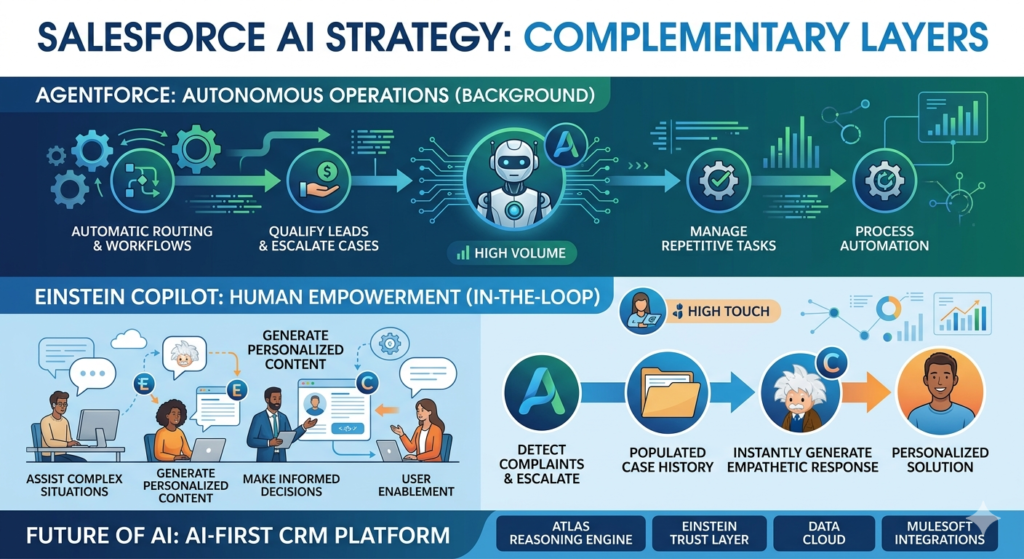
Here’s how they work together:
- Agentforce handles the autonomous, background operations: routing cases, qualifying leads, triggering workflows, and managing high-volume repetitive tasks
- Einstein Copilot empowers the humans in the loop: helping sales reps, service agents, and admins navigate complex situations, generate content, and make informed decisions
Think of it like a well-run hospital: robots and automated systems handle logistics, medication dispensing, and routine monitoring, while doctors and nurses use intelligent tools to provide the nuanced, human-centered care that matters most. Both are necessary. Neither replaces the other.
Combining Conversational AI with Autonomous Agents
A concrete example: An Agentforce agent detects that a high-value customer has submitted their third complaint in 30 days. It automatically escalates the case to a senior service rep and populates the case with relevant history. The service rep then uses Einstein Copilot to instantly generate a personalized, empathetic response that acknowledges the customer’s frustration and proposes a solution.
The agent did the background work. The human, assisted by Copilot, delivered the high-touch interaction.
The Future of AI Inside Salesforce
Salesforce has made it clear that its vision is an AI-first CRM platform where agents and assistants work together seamlessly. With continued investments in the Atlas Reasoning Engine, Einstein Trust Layer, Data Cloud, and MuleSoft integrations, the Salesforce AI ecosystem is becoming one of the most sophisticated enterprise AI platforms available.
Organizations that start building their AI strategy now—deploying Copilot for user enablement and Agentforce for process automation—will be best positioned to lead in their industries.
Section 8: Benefits of AI Agents in Salesforce
Whether you’re evaluating Einstein Copilot, Agentforce, or both, the broader benefits of deploying AI agents in Salesforce are significant:
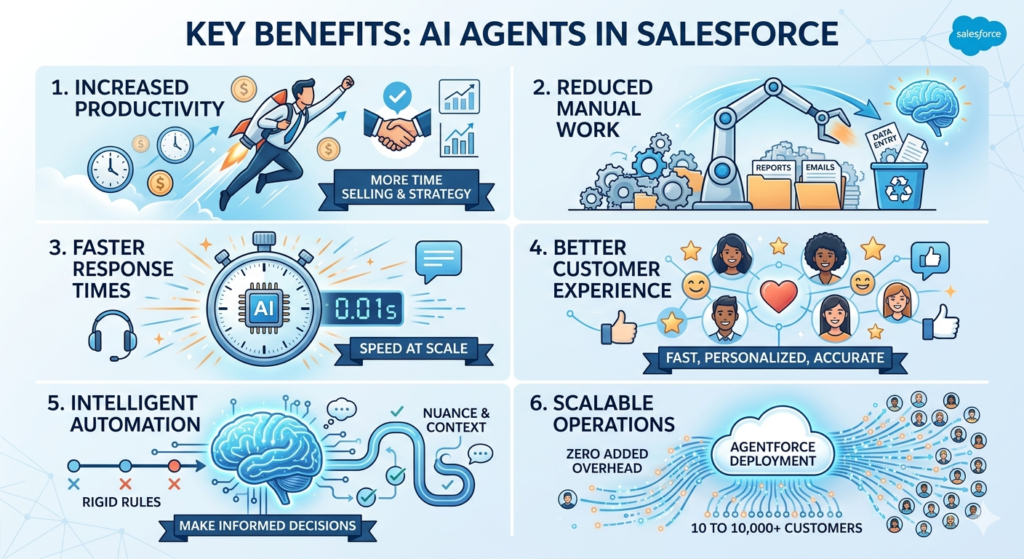
1. Increased Productivity
AI tools dramatically reduce the time spent on repetitive, low-value tasks. Sales reps spend more time selling. Service agents handle more cases. Admins focus on strategic initiatives rather than data maintenance.
2. Reduced Manual Work
Data entry, record updates, report generation, and email drafting can all be partially or fully automated, freeing up human capacity for creative and strategic work.
3. Faster Response Times
AI agents and assistants respond in seconds. Whether it’s a customer waiting for a support reply or a sales rep needing account context before a call, AI delivers speed that humans simply can’t match at scale.
4. Better Customer Experience
Customers receive faster, more accurate, and more personalized interactions—whether they’re engaging with an AI agent directly or with a human rep who’s been empowered by Copilot.
5. Intelligent Automation
Unlike traditional rule-based automation, AI-powered agents can handle nuance, ambiguity, and variation—making decisions based on context rather than rigid if/then logic.
6. Scalable Operations
AI agents scale horizontally with zero additional overhead. One Agentforce deployment can handle ten customers or ten thousand simultaneously—without adding headcount or infrastructure.
Section 9: Challenges and Considerations
Before deploying Einstein Copilot or Agentforce, it’s important to understand the challenges and governance considerations involved.
1. AI Governance and Trust
Autonomous AI agents must be carefully governed. Organizations need clear policies around what agents can and cannot do, how decisions are logged, and how errors are handled. Salesforce’s Einstein Trust Layer provides a strong foundation, but internal governance frameworks are equally important.
2. Data Quality
Both tools are only as good as the data they’re built on. Poor data quality—duplicate records, incomplete information, inconsistent formatting—will undermine AI performance. Invest in data hygiene before deploying AI at scale.
3. User Adoption
Employees may be skeptical or even resistant to AI tools, especially if they fear job replacement. A strong change management strategy, clear communication about AI’s role as an assistant rather than a replacement, and robust training programs are essential.
4. Licensing and Costs
Both Einstein Copilot and Agentforce come with licensing implications. Agentforce, in particular, operates on a consumption-based pricing model (per conversation). Organizations should model expected usage carefully to avoid cost surprises.
5. Customization Complexity
While both tools offer no-code/low-code configuration options, advanced customization—especially for Agentforce—requires a solid understanding of Salesforce architecture, data models, and AI design principles. Plan for the right skill sets on your team.
6. Ethical AI Considerations
As AI agents make more autonomous decisions, questions around bias, fairness, and transparency become increasingly important. Organizations should regularly audit AI outputs and ensure diverse datasets are used in training.
Conclusion: Which One Is Right for You?
Here’s the bottom line on Salesforce Einstein Copilot vs Agentforce:
Einstein Copilot is your go-to solution when you want to enhance individual user productivity, make Salesforce easier to use, and empower your teams with an intelligent conversational assistant that helps them work smarter every day.
Agentforce is the right choice when you need to automate entire business processes, scale operations without adding headcount, and deploy autonomous AI that can handle complex, multi-step workflows independently.
The real magic? You don’t have to choose just one. The most successful Salesforce organizations of the next decade will be those that deploy both—using Agentforce for autonomous operational excellence and Einstein Copilot for empowering the humans who manage, oversee, and handle the complex interactions that still require a personal touch.
The age of AI-first Salesforce is here. Whether you’re just starting your AI journey or ready to go all-in, there’s never been a better time to explore what Salesforce’s AI ecosystem can do for your business.
Ready to transform your Salesforce org with AI? Connect with a certified Salesforce AI consultant today and start building your intelligent enterprise strategy—one that combines the best of Einstein Copilot and Agentforce for maximum impact.
About RizeX Labs
At RizeX Labs, we specialize in delivering cutting-edge Salesforce solutions, including AI-powered automation and intelligent CRM experiences across the Salesforce ecosystem. Our expertise combines deep technical knowledge, industry best practices, and real-world implementation experience to help businesses streamline workflows, improve productivity, and accelerate digital transformation.
We empower organizations to leverage next-generation Salesforce AI tools such as Einstein Copilot and Agentforce to automate business operations, enhance customer engagement, and build scalable AI-driven experiences.
Internal Linking Opportunities:
External Linking Opportunities:
- Salesforce Official Website
- Salesforce Einstein AI
- Salesforce Agentforce
- Salesforce Help Documentation
- Salesforce Trailhead AI Modules
- Salesforce Developers
- Gartner AI Research
Quick Summary
Salesforce AI is evolving rapidly, and businesses are increasingly comparing Einstein Copilot and Agentforce to determine which solution best fits their automation and productivity goals. While both tools are built within the Salesforce ecosystem and powered by AI, they serve different purposes.
Einstein Copilot primarily acts as a conversational AI assistant that helps users interact with CRM data, generate summaries, automate repetitive tasks, and improve daily productivity. Agentforce, on the other hand, focuses on autonomous AI agents capable of independently executing workflows, managing multi-step processes, and driving intelligent automation across enterprise operations.
Understanding the difference between these two Salesforce AI solutions is essential for organizations planning their AI strategy, improving customer experiences, and scaling automation initiatives effectively.
