
Introduction: Why Understanding Agentforce Pricing Licensing Matters More Than Ever
Salesforce’s Agentforce has rapidly evolved from an ambitious AI initiative into the backbone of intelligent enterprise automation. Organizations across industries are deploying autonomous AI agents to handle customer service inquiries, qualify sales leads, streamline operations, and execute complex multi-step workflows — all without human intervention.
But with transformative capability comes a critical question that every Salesforce admin, developer, and C-suite decision-maker must answer: What does Agentforce actually cost, and what exactly do you get for that investment?
The landscape of agentforce pricing licensing is nuanced. Unlike traditional Salesforce products with straightforward per-user-per-month models, Agentforce introduces consumption-based pricing, tiered capability bundles, and enterprise-grade add-ons that can make budgeting feel opaque. Misunderstanding the licensing structure doesn’t just lead to overspending — it can bottleneck your AI adoption strategy entirely.
At RizeX Labs, we’ve guided dozens of organizations through Agentforce implementation, and we’ve seen firsthand how the difference between a well-planned licensing strategy and a reactive one can amount to hundreds of thousands of dollars annually. This guide is designed to give you complete clarity.
Whether you’re evaluating Agentforce for the first time, preparing a business case for leadership, or optimizing an existing deployment, this blog will walk you through everything you need to know about agentforce pricing licensing — from the foundational models and license types to hidden costs, scalability planning, and ROI frameworks.
Let’s dive in.
What Is Agentforce? A Quick Refresher
Before dissecting the pricing, it’s worth grounding ourselves in what Agentforce actually is and why it represents a fundamentally different Salesforce product category.
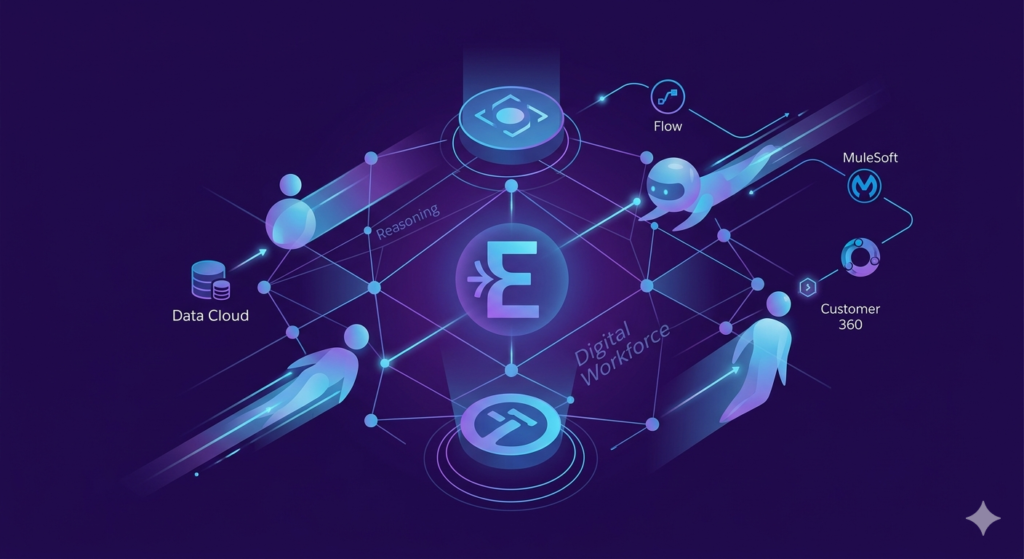
Agentforce is Salesforce’s autonomous AI agent platform, built on the Einstein AI layer and deeply integrated with the Salesforce Data Cloud, Flow, MuleSoft, and the broader Customer 360 ecosystem. Unlike traditional automation (which follows rigid, predefined rules) or basic AI assistants (which offer suggestions for humans to act on), Agentforce agents can:
- Reason over structured and unstructured data
- Plan multi-step actions to achieve a defined goal
- Execute those actions across Salesforce and connected systems
- Learn from outcomes to improve future performance
- Escalate to human agents when confidence thresholds aren’t met
Think of Agentforce agents as digital employees — not chatbots, not workflow automations, but genuinely autonomous workers that operate within the guardrails you define.
This paradigm shift is precisely why agentforce pricing licensing works differently from anything Salesforce has offered before. You’re not licensing a tool; you’re licensing a workforce.
Agentforce Licensing Models: The Foundation
Salesforce has structured Agentforce licensing around a hybrid model that combines platform access fees with consumption-based pricing. Understanding this dual structure is essential to forecasting your Salesforce Agentforce cost accurately.
1. Platform Access (Edition-Based Licensing)
At the base level, Agentforce capabilities are tied to your Salesforce edition and specific Agentforce SKUs. Not all Salesforce editions include Agentforce access, and the depth of functionality varies significantly based on which Agentforce package you subscribe to.
2. Consumption-Based Pricing (Conversations)
On top of the platform license, Agentforce charges based on conversations — defined as discrete interactions between an AI agent and a user (customer, employee, or system). Each conversation represents a complete interaction cycle, from initiation to resolution or escalation.
This consumption model is where the real cost variability lives. An organization deploying Agentforce for low-volume internal IT support will have a radically different cost profile than one using it for high-volume e-commerce customer service.
3. Add-On Capabilities
Certain advanced features — such as custom agent development, extended Data Cloud integration, premium guardrails, and multi-agent orchestration — require additional licensing beyond the base package.
Agentforce License Types: A Detailed Comparison
Understanding the distinct agentforce license types available is crucial for making the right investment decision. Salesforce has organized Agentforce into several tiers, each designed for different organizational needs and maturity levels.
Agentforce Standard
Who it’s for: Organizations beginning their AI agent journey, typically running Service Cloud or Sales Cloud.
What’s included:
- Pre-built agent templates (Service Agent, Sales Coach, etc.)
- Standard conversation allocation (typically 1,000 conversations per month included)
- Basic topic and action configuration
- Einstein Trust Layer with standard guardrails
- Native integration with Salesforce Knowledge, Cases, and Leads
- Standard analytics and conversation logging
Best suited for: Small to mid-sized deployments where out-of-the-box agents can handle common use cases without extensive customization.
Agentforce Enterprise
Who it’s for: Mid-market and enterprise organizations that need custom agents, higher volumes, and deeper integrations.
What’s included:
- Everything in Standard
- Custom agent builder with advanced topic/action configuration
- Higher conversation allocation (typically 5,000–25,000 conversations per month, depending on contract)
- Advanced Data Cloud integration for unified customer profiles
- Multi-channel deployment (web, mobile, Slack, WhatsApp, SMS)
- MuleSoft connector access for external system actions
- Enhanced analytics with conversation intelligence dashboards
- Priority support and dedicated CSM
Best suited for: Organizations deploying Agentforce across multiple departments or channels, with custom workflows and integration requirements.
Agentforce Unlimited
Who it’s for: Large enterprises with complex, high-volume AI agent deployments.
What’s included:
- Everything in Enterprise
- Unlimited or negotiated high-volume conversation tiers
- Multi-agent orchestration (agents collaborating to solve complex tasks)
- Custom LLM grounding and Bring Your Own Model (BYOM) capabilities
- Advanced Einstein Trust Layer controls (custom toxicity filters, PII masking rules, audit trails)
- Sandbox environments for agent testing
- Premier+ support
- Dedicated technical account management
Best suited for: Fortune 500 organizations, regulated industries, and companies running Agentforce as a core part of their customer experience or operational infrastructure.
Agentforce License Types: Comparison Table
| Feature | Standard | Enterprise | Unlimited |
|---|---|---|---|
| Pre-built agent templates | ✅ | ✅ | ✅ |
| Custom agent builder | ❌ | ✅ | ✅ |
| Monthly conversations (included) | ~1,000 | ~5,000–25,000 | Negotiated / Unlimited |
| Overage cost per conversation | $2–$3 | $1.50–$2.50 | Negotiated |
| Data Cloud integration | Basic | Advanced | Full |
| Multi-channel deployment | Web only | Web, Mobile, Slack, WhatsApp, SMS | All channels + custom |
| MuleSoft connector access | ❌ | ✅ | ✅ |
| Multi-agent orchestration | ❌ | ❌ | ✅ |
| BYOM / Custom LLM grounding | ❌ | ❌ | ✅ |
| Einstein Trust Layer | Standard | Enhanced | Advanced + Custom |
| Sandbox testing environments | ❌ | Limited | Full |
| Support tier | Standard | Priority | Premier+ |
| Estimated starting price (annual) | $50K–$80K | $120K–$300K | $300K+ (custom) |
Note: Pricing is approximate and varies based on contract terms, existing Salesforce agreements, region, and negotiation. Contact RizeX Labs for tailored estimates.
Factors That Affect Salesforce Agentforce Cost
The sticker price on an Agentforce license is only part of the equation. Several variables can significantly influence your total Salesforce Agentforce cost, and understanding them upfront can prevent budget surprises down the line.
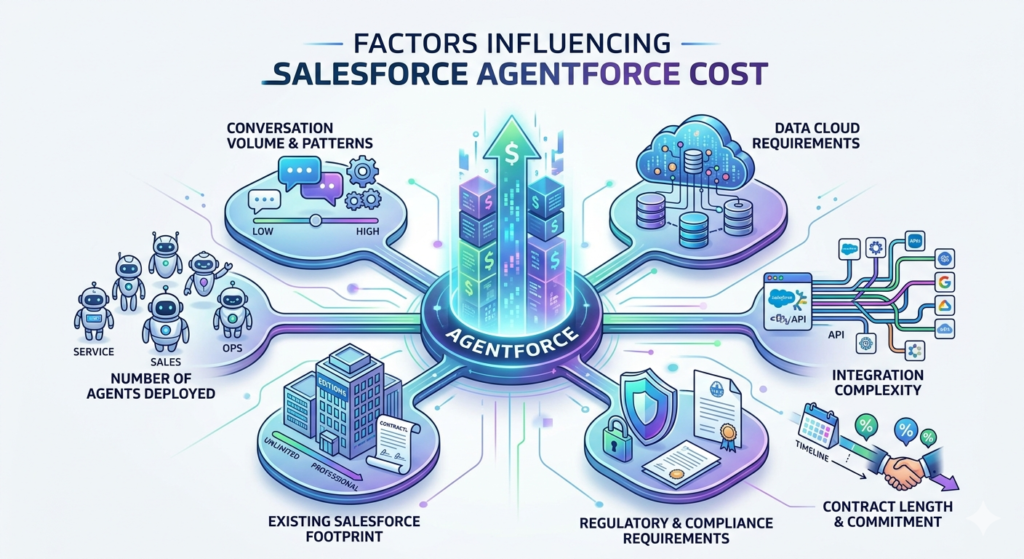
1. Conversation Volume and Patterns
Since Agentforce uses consumption-based pricing, your conversation volume is the single largest variable cost driver. But volume alone doesn’t tell the full story — conversation complexity matters too.
- Simple conversations (e.g., order status lookups, password resets) consume minimal compute and resolve quickly.
- Complex conversations (e.g., multi-step troubleshooting, personalized product recommendations with cross-selling) require more reasoning steps, more data retrieval, and more actions — all of which affect cost.
Salesforce has indicated that future pricing may incorporate complexity weighting, so organizations should monitor their conversation profiles closely.
2. Number of Agents Deployed
Each distinct AI agent you configure and deploy can affect licensing, particularly in the Enterprise and Unlimited tiers. Deploying a single Service Agent is very different from deploying a Service Agent, Sales Development Agent, Operations Agent, and IT Support Agent simultaneously.
3. Data Cloud Requirements
Agentforce agents are most effective when grounded in rich, unified customer data — which means Data Cloud. However, Data Cloud has its own licensing structure (credits, data services, identity resolution), and the depth of integration you require will add to your overall cost.
4. Integration Complexity
Agents that need to execute actions in external systems (ERP, legacy databases, third-party APIs) via MuleSoft or custom Apex connectors add implementation cost and may require higher-tier licenses.
5. Existing Salesforce Footprint
Your current Salesforce edition and contract terms significantly influence Agentforce pricing. Organizations on Unlimited Edition with existing Einstein and Data Cloud entitlements may negotiate substantially lower Agentforce add-on pricing compared to those on Professional or Enterprise Edition starting from scratch.
6. Regulatory and Compliance Requirements
Industries like financial services, healthcare, and government often require enhanced audit trails, data residency controls, custom PII handling, and explainability features — capabilities typically available only in higher-tier licenses or as premium add-ons.
7. Contract Length and Commitment
Like most Salesforce products, multi-year commitments unlock better per-conversation rates and platform pricing. Organizations willing to commit to 3-year agreements with minimum volume guarantees can often negotiate 20–40% reductions in effective cost.
Hidden Costs of Agentforce: What the Price Sheet Doesn’t Tell You
Every experienced Salesforce professional knows that the license fee is never the whole story. Here are the hidden costs that organizations frequently underestimate when budgeting for Agentforce:
Implementation and Configuration
Building effective AI agents requires thoughtful design — defining topics, mapping actions, creating guardrails, configuring escalation paths, integrating data sources, and testing extensively. This isn’t a weekend project. Plan for 8–20 weeks of implementation depending on complexity, either with internal resources or an implementation partner like RizeX Labs.
Estimated cost: $30,000–$200,000+ depending on scope
Data Preparation and Quality
Agentforce agents are only as good as the data they can access. If your Salesforce org has inconsistent records, duplicate contacts, fragmented knowledge bases, or poorly structured case histories, your agents will underperform — and you’ll pay for wasted conversations.
Estimated cost: $15,000–$75,000 for data cleanup and knowledge base development
Change Management and Training
Deploying AI agents changes how your team works. Service reps need to understand when and how agents escalate. Sales teams need to trust AI-qualified leads. Admins need to monitor agent performance and refine configurations. Without proper change management, adoption stalls and ROI evaporates.
Estimated cost: $10,000–$50,000 for training programs and change management
Ongoing Optimization
Agents aren’t set-and-forget. They require continuous monitoring, prompt refinement, action updates, guardrail adjustments, and performance analysis. Organizations that treat Agentforce as a “launch and leave” product consistently see degrading performance within 3–6 months.
Estimated cost: 0.5–1 FTE equivalent for ongoing management, or a managed services retainer
Overage Charges
If your actual conversation volume exceeds your licensed allocation, overage charges apply — and they’re typically priced at a premium over your contracted per-conversation rate. Without proactive monitoring, these charges can add 15–30% to your expected annual cost.
Enterprise Considerations for Agentforce Licensing
Large organizations face unique considerations when planning their agentforce pricing licensing strategy. Here’s what enterprise buyers should keep in mind:
Multi-Org Deployments
Companies running multiple Salesforce orgs (e.g., different business units, regions, or acquired companies) need to understand how Agentforce licenses apply across orgs. In most cases, each org requires its own Agentforce entitlement, though enterprise agreements may allow for pooled conversation credits across orgs.
Global Data Residency
For multinational enterprises, understanding where Agentforce processes data is critical. The Einstein Trust Layer provides data residency controls, but configuring them for compliance with GDPR, CCPA, LGPD, and other regulations may require Unlimited tier licensing and additional professional services.
Security and Governance
Enterprise deployments typically require:
- Custom permission sets controlling who can create and modify agents
- Detailed audit logs of all agent actions
- Automated compliance reporting
- Integration with enterprise security tools (SIEM, SOAR)
- Approval workflows for agent configuration changes
These capabilities are generally available in higher-tier licenses and may require custom development.
Procurement and Contract Strategy
Enterprise Salesforce contracts are complex, and adding Agentforce to an existing enterprise agreement requires careful negotiation. Key strategies include:
- Bundling Agentforce with Data Cloud and Einstein renewals for volume discounts
- Piloting with a limited license before committing to enterprise-wide deployment
- Negotiating overage caps to limit exposure to unexpected conversation spikes
- Including conversation rollover provisions so unused monthly conversations carry forward
Working with an experienced Salesforce partner like RizeX Labs during the negotiation process can save significant budget.
Scalability Options: Growing with Agentforce
One of Agentforce’s strongest value propositions is scalability. Unlike human workforces, AI agents can scale almost infinitely — but your licensing needs to scale with them.
Scaling Conversation Volume
Most Agentforce contracts allow you to purchase additional conversation packs as your usage grows. The key is negotiating favorable expansion pricing upfront rather than paying ad-hoc overage rates.
Scaling Agent Types
As your organization matures with Agentforce, you’ll likely want to deploy new agent types — moving from a single Service Agent to a full ecosystem including Sales, Marketing, Operations, Commerce, and custom agents. Enterprise and Unlimited licenses provide the flexibility for this expansion.
Scaling Across Channels
Starting with web-based agents and expanding to mobile, Slack, WhatsApp, voice, and custom channels is a common growth pattern. Ensure your license tier supports your channel roadmap so you’re not forced into a mid-contract upgrade.
Scaling with Data Cloud
As your agents handle more conversations, the volume of data flowing through Data Cloud increases. Monitor your Data Cloud credit consumption alongside Agentforce conversation volumes to avoid unexpected Data Cloud overage costs.
Evaluating ROI: Is Agentforce Worth the Investment?
Understanding agentforce pricing licensing is only valuable if you can connect it to business outcomes. Here’s a framework for evaluating Agentforce ROI:
Direct Cost Savings
- Case deflection: Each case handled by an AI agent instead of a human agent saves $5–$15 per interaction (industry average).
- Reduced handle time: Even when agents escalate to humans, they often pre-gather information, reducing average handle time by 20–40%.
- 24/7 availability: AI agents provide round-the-clock coverage without overtime costs.
Example: An organization handling 50,000 service cases per month that deflects 35% through Agentforce saves approximately $2.6M–$3.1M annually in direct labor costs.
Revenue Impact
- Faster lead qualification: Sales agents can qualify leads in real-time, reducing response times from hours to seconds.
- Increased conversion rates: Personalized, instant engagement typically improves conversion rates by 15–30%.
- Upsell and cross-sell: Agents grounded in customer data can identify and execute revenue opportunities during service interactions.
Operational Efficiency
- Reduced training costs: AI agents don’t require onboarding or ongoing training programs.
- Consistent quality: Every interaction follows your defined standards without variance.
- Scalability without hiring: Handle seasonal spikes without temporary staffing.
ROI Calculation Framework
| Metric | Calculation |
|---|---|
| Total Annual Agentforce Cost | License + Conversations + Implementation (amortized) + Ongoing Optimization |
| Annual Savings from Case Deflection | (Deflected Cases × Cost per Human Case) |
| Annual Revenue Impact | (AI-Influenced Deals × Average Deal Value × Conversion Lift) |
| Net ROI | (Total Savings + Revenue Impact – Total Cost) / Total Cost × 100 |
Most organizations we work with at RizeX Labs see positive ROI within 6–9 months of deployment, with mature implementations delivering 300–500% ROI annually.
Best Practices to Optimize Your Agentforce Licensing Expenses
Based on our experience at RizeX Labs, here are the top strategies for getting maximum value from your agentforce pricing licensing investment:
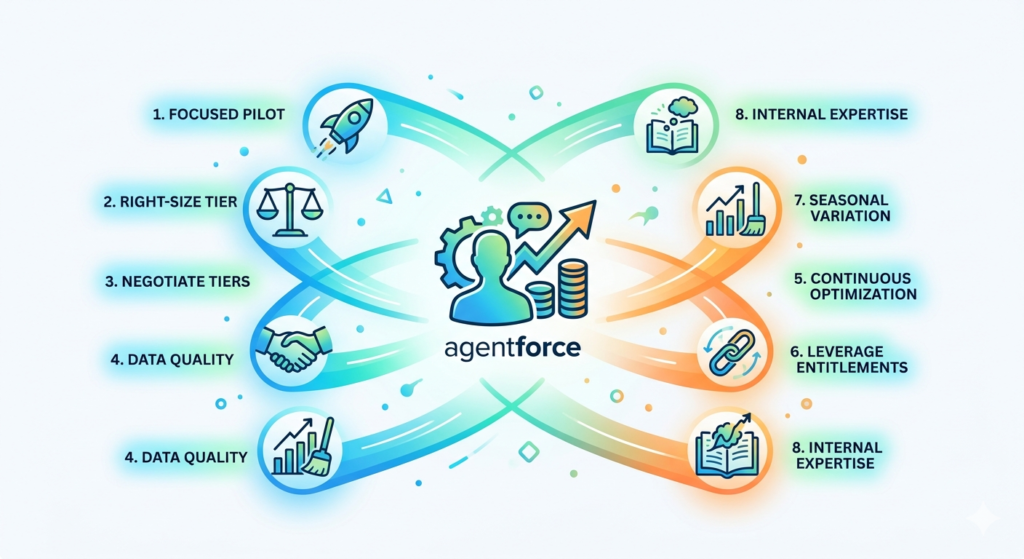
1. Start with a Focused Pilot
Don’t license for enterprise-wide deployment on day one. Begin with a single use case — typically service case deflection — prove the value, then expand. This limits initial investment and builds internal confidence.
2. Right-Size Your License Tier
Many organizations over-buy, purchasing Enterprise or Unlimited licenses when Standard would serve their needs for the first 12 months. Conversely, some under-buy and end up paying premium upgrade and migration costs mid-contract. Work with a partner who can objectively assess your needs.
3. Negotiate Consumption Tiers Proactively
Don’t accept default per-conversation pricing. Negotiate volume tiers, overage caps, and rollover provisions. The difference between a well-negotiated and poorly negotiated contract can be 30–50% of annual cost.
4. Invest in Data Quality Before Launch
Every dollar spent on data quality before deploying Agentforce pays for itself multiple times over. Clean data means higher first-contact resolution rates, fewer wasted conversations, and better customer experiences.
5. Monitor and Optimize Continuously
Implement dashboards that track:
- Conversation volumes and trends
- Resolution rates and escalation rates
- Cost per conversation
- Customer satisfaction scores for AI-handled interactions
- Conversation complexity profiles
Use this data to refine agent configurations, adjust guardrails, and forecast future licensing needs.
6. Leverage Existing Salesforce Entitlements
Many organizations already have Einstein, Data Cloud, or Flow entitlements that can reduce their incremental Agentforce cost. Audit your current contract before purchasing new licenses.
7. Plan for Seasonal Variation
If your business has predictable demand spikes (holiday seasons, fiscal year-end, product launches), negotiate flexible conversation allocations rather than paying overage rates during peaks and wasting allocation during troughs.
8. Build Internal Expertise
While implementation partners are valuable for initial deployment, building internal Agentforce expertise reduces your ongoing optimization costs and accelerates your ability to deploy new agents and use cases.
Conclusion: Making Agentforce Pricing Licensing Work for Your Organization
Agentforce pricing licensing represents a new paradigm in Salesforce investment — one where you’re not just buying software seats but licensing an autonomous digital workforce. The hybrid model of platform fees plus consumption-based conversation pricing offers flexibility but also demands careful planning.
The organizations that get the most value from their Salesforce Agentforce cost are those that:
- Understand the different agentforce license types and choose the right tier for their current needs and growth trajectory
- Account for the full cost of ownership — including implementation, data preparation, change management, and ongoing optimization
- Negotiate proactively on conversation volumes, overage protections, and multi-year terms
- Monitor and optimize continuously, treating Agentforce as a living system rather than a one-time deployment
- Partner with experienced advisors who can bridge the gap between licensing complexity and business outcomes
The potential ROI is substantial. Organizations are deflecting millions of cases, accelerating revenue cycles, and delivering 24/7 personalized experiences at a fraction of the cost of traditional approaches. But realizing that ROI requires getting the licensing foundation right.
If you’re evaluating agentforce pricing licensing for your organization — or if you’re already deployed and suspect you’re overpaying — RizeX Labs is here to help. We’ll give you an honest, data-driven assessment of your licensing strategy and a clear roadmap to maximize your return on every dollar spent.
About RizeX Labs
At RizeX Labs, we help businesses unlock the full power of Salesforce AI solutions, including Agentforce and advanced automation capabilities. Our team combines real-world Salesforce expertise, AI implementation knowledge, and strategic consulting to help organizations improve productivity, customer engagement, and operational efficiency.
We specialize in helping companies understand Agentforce licensing, pricing structures, and deployment strategies so they can choose the right AI solution without overspending or creating unnecessary complexity.
From AI-powered customer support to intelligent workflow automation, we help businesses maximize ROI while scaling Salesforce efficiently.
Internal Links:
- Salesforce Admin course page
- Salesforce Einstein Analytics for Beginners: Getting Started in 2026
- Agentforce vs ChatGPT for Enterprise: A Salesforce Developer’s Perspective
- How to Deploy Agentforce in a Sandbox: Step-by-Step Guide for Salesforce Teams
- Einstein for SFMC: Predictive Emails and Recommended Content — The Future of AI-Driven Marketing
- SFMC Einstein Send Time Optimization: How It Works
External Links:
McKinsey Sales Growth Reports
