
Introduction: Why Salesforce Adoption Is More Than Just Buying a License
Salesforce is one of the most powerful CRM platforms in the world. Companies invest thousands — sometimes millions — of dollars implementing it, customizing it, and integrating it with their existing tech stack. And yet, a surprisingly large number of businesses never fully realize its potential.
Why? Because the technology itself is only half the battle.
The other half is people.
According to industry research, CRM adoption rates across organizations hover around 26%, meaning nearly three out of four companies struggle to get their teams to fully embrace the tools they pay for. Salesforce team adoption failure is not just a technology problem — it’s a people, process, and strategy problem.
Whether you’re a sales manager frustrated that your reps aren’t logging calls, a customer support leader watching your team bypass Salesforce Cases entirely, or an operations director who can’t get clean data for reporting — this blog is for you.
At RizeX Labs, we’ve worked with businesses across industries to diagnose and fix exactly these kinds of adoption challenges. In this guide, we’ll walk you through the 7 most common reasons Salesforce adoption fails and, more importantly, how to fix each one with practical, proven strategies.
Let’s dig in.
Understanding the Salesforce Adoption Challenge
Before we jump into specific reasons, it’s worth understanding what “Salesforce adoption” actually means in practice.
Adoption isn’t just about whether your team has a Salesforce login. True adoption means your team is:
- Consistently entering and updating data
- Using Salesforce workflows instead of spreadsheets or personal notebooks
- Trusting the system as the single source of truth
- Gaining measurable productivity or insight from the platform
When adoption fails, the consequences ripple across the entire business. Sales forecasts become unreliable. Customer support teams duplicate effort. Operations leaders can’t make data-driven decisions. Marketing campaigns target the wrong people. The CRM becomes an expensive liability instead of a strategic asset.
Understanding the root causes of salesforce team adoption failure is the critical first step to building a real solution.
7 Major Reasons Salesforce Adoption Fails (And How to Fix Each One)

Reason #1: Poor or Insufficient Training at Rollout
The Problem:
One of the most common reasons Salesforce adoption fails is that teams receive inadequate training — or worse, no structured training at all. A typical scenario plays out like this: IT or a consultant sets up Salesforce, an admin sends out login credentials, and a brief 45-minute “overview” session is scheduled. Teams are then expected to figure out the rest on their own.
This is a recipe for frustration and abandonment.
Salesforce is feature-rich and highly customizable, which also makes it complex. A sales rep who doesn’t understand how to log activities, create opportunities, or navigate dashboards will simply revert to what they know — spreadsheets, sticky notes, or personal email folders.
The same challenge applies to support teams. If a customer service agent doesn’t know how to properly create or escalate a Case in Salesforce Service Cloud, they’ll find a workaround that bypasses the system entirely.
The Fix:
Training needs to be role-specific, ongoing, and practical — not generic and one-time.
Here’s what works:
- Role-based training programs: Train your sales reps on opportunity management and pipeline tracking. Train your support team on Case management and knowledge articles. Train operations on reports and dashboards. Don’t give everyone the same generic walkthrough.
- Hands-on learning: Use sandbox environments so teams can practice without fear of breaking real data.
- Micro-training modules: Short, focused sessions (10–15 minutes) covering one feature at a time are far more effective than marathon training days.
- Regular refreshers: Salesforce releases updates three times a year. Training should evolve with the platform.
How RizeX Labs Helps:
At RizeX Labs, we design tailored Salesforce training programs for each department. We don’t just teach the platform — we teach your team how Salesforce solves their specific daily challenges. Our training is interactive, scenario-based, and built around how your team actually works.
Reason #2: The System Doesn’t Match How the Team Actually Works
The Problem:
Many Salesforce implementations are set up out of the box with minimal customization. The result? A system that doesn’t reflect your actual sales process, support workflows, or operational needs.
Imagine a B2B sales team with a complex, multi-stage deal cycle being asked to work within Salesforce’s default opportunity stages. Or a support team that handles product-specific tickets being forced to use a generic Case layout that doesn’t capture the information they need.
When the system feels foreign to how your team already thinks and works, resistance is natural. People don’t adopt tools that create friction — they avoid them.
The Fix:
Invest in meaningful customization that aligns Salesforce with your actual business processes:
- Custom fields and page layouts: Show only the information each role needs to see and capture.
- Custom objects: Build structures that reflect your unique business model.
- Workflow automation: Automate repetitive tasks like follow-up reminders, status updates, or lead assignments so the system feels helpful, not burdensome.
- Tailored dashboards: Give each team a homepage that shows their KPIs, not generic metrics.
The goal is to make Salesforce feel like it was built for your team — because it should be.
How RizeX Labs Helps:
RizeX Labs specializes in Salesforce customization and implementation. We work closely with department heads and end-users to map out real workflows, then configure Salesforce to mirror and enhance those processes. The result is a system your team actually wants to use.
Reason #3: Lack of Leadership Buy-In and Accountability
The Problem:
If leadership doesn’t use Salesforce — or doesn’t enforce its use — the team won’t either.
This is one of the most underestimated drivers of salesforce team adoption failure. When a sales manager asks for a pipeline update in a team meeting and accepts a verbal answer instead of saying “pull it up in Salesforce,” they’re unintentionally signaling that the CRM isn’t really necessary.
Teams follow their leaders’ behavior. If the VP of Sales doesn’t check their Salesforce reports, uses email to track deals, or tolerates incomplete CRM data, adoption will stagnate no matter how good the training is.
The Fix:
Leadership must champion Salesforce visibly and consistently:
- Use Salesforce in meetings: Run pipeline reviews directly from Salesforce dashboards. Make it visible.
- Set clear expectations: Define what data must be in Salesforce and by when. Make it a team standard, not a suggestion.
- Hold teams accountable through data: Use Salesforce reports to identify who is and isn’t using the system, then address gaps directly in 1-on-1s.
- Recognize adoption wins: When a rep closes a deal that was properly managed in Salesforce, call it out. Positive reinforcement matters.
Leadership buy-in isn’t just helpful — it’s essential. Without it, even the best salesforce adoption strategy will fall apart.
Reason #4: Data Quality Issues That Erode Trust in the System
The Problem:
Bad data is the silent killer of Salesforce adoption. When your team opens Salesforce and finds:
- Duplicate contacts and accounts
- Missing or outdated information
- Inconsistent data entry from different team members
- Reports that don’t make sense
…they stop trusting the system. And once trust is lost, people stop entering data, which makes the data quality even worse. It becomes a self-reinforcing cycle that’s very hard to break.
For example, if a sales rep pulls up an account and finds three duplicate records with different phone numbers, they’ll just call the client directly and never update the CRM. If a support agent sees that case history is incomplete, they’ll call the customer to ask questions they should already have the answers to.
The Fix:
Invest in data governance and quality control:
- Data audit: Start with a thorough audit of your existing Salesforce data. Identify and merge duplicates, fill in critical missing fields, and archive outdated records.
- Validation rules: Set up Salesforce validation rules to enforce data standards at the point of entry (e.g., phone numbers must follow a specific format, opportunity close dates can’t be in the past).
- Duplicate management tools: Use Salesforce’s built-in duplicate rules or a third-party tool like Dedupely to prevent duplicates from being created.
- Assign data stewards: Designate team members responsible for data quality in their department.
Clean, trustworthy data is the foundation of Salesforce adoption. When your team can rely on what’s in the system, they’ll use it more.
Reason #5: Salesforce Feels Like Extra Work, Not a Helpful Tool
The Problem:
If using Salesforce adds time and effort to someone’s day without a clear benefit to them, they’ll resist it. This is especially common with sales reps who see CRM entry as administrative overhead that takes them away from selling.
Think about it from their perspective: They have calls to make, emails to send, and deals to close. If entering data into Salesforce feels like busywork that benefits management reporting but not their own performance, motivation will be low.
The same applies to operations teams running manual reports or support teams copying and pasting information between systems.
The Fix:
Reframe Salesforce as a personal productivity tool, not just a reporting requirement:
- Show the “what’s in it for me”: Help each team member understand how Salesforce directly benefits their work. A rep who tracks their pipeline properly can see where deals are stalling and act faster. A support agent with full case history can resolve issues faster and impress customers.
- Reduce manual entry with automation: Use email integration (Einstein Activity Capture or Outlook/Gmail connectors) to automatically log emails. Use mobile apps so reps can update records on the go. Use voice-to-text tools for call logging.
- Streamline the interface: Remove unnecessary fields and clutter. The fewer clicks it takes to do something, the more likely people are to do it.
When Salesforce helps your team do their job better — not just helps management see what they’re doing — adoption follows naturally.
Reason #6: No Clear Success Metrics or Adoption KPIs
The Problem:
What gets measured gets managed. If you’re not tracking Salesforce adoption itself as a metric, you won’t know where the gaps are — and you can’t fix what you can’t see.
Many organizations implement Salesforce and then simply hope it sticks. There’s no baseline, no targets, and no reporting on usage. Months later, leadership realizes the system isn’t being used properly, but by then, bad habits are deeply ingrained.
Without clear metrics, it’s also impossible to show teams that their Salesforce usage is actually impacting results — which makes it harder to build momentum.
The Fix:
Define and track Salesforce adoption KPIs from day one:
- Login frequency: How often are users logging in?
- Record completeness: What percentage of leads, contacts, and opportunities have required fields filled in?
- Activity logging: How many calls, emails, and meetings are being logged per rep per week?
- Pipeline accuracy: How closely do actual close dates and deal values match what’s recorded?
- Feature utilization: Are teams using specific features like dashboards, reports, or task management?
Set a baseline, set targets, and review these metrics regularly. Use Salesforce’s built-in adoption dashboards or create custom reports to make this data visible.
When teams see adoption being measured, they take it more seriously. And when you can show correlations between high Salesforce usage and better sales performance or faster case resolution, you build a compelling case for continued engagement.
Reason #7: Resistance to Change and Cultural Barriers
The Problem:
Sometimes the biggest obstacle to increase Salesforce usage isn’t technical — it’s human. Change is hard. People are comfortable with their existing processes, even when those processes are inefficient.
Sales reps who’ve managed their pipeline in Excel for years. Support agents who use a shared email inbox instead of Cases. Operations teams who build reports manually in Google Sheets. These aren’t just habits — they’re part of how people define their competence and comfort at work.
Introducing Salesforce means asking people to change not just their tools but their daily routines, their sense of expertise, and sometimes their sense of control. Resistance is natural and should be expected — not dismissed.
The Fix:
Address resistance with empathy, communication, and inclusion:
- Communicate the “why” clearly: Before rollout, explain why the company is moving to Salesforce and what outcomes it’s expected to deliver for the business and for each team.
- Involve end-users early: Include team representatives in the configuration process. When people feel ownership over the system, they’re more likely to champion it.
- Identify internal champions: Find the naturally tech-savvy or enthusiastic people in each department and give them extra training. Empower them to support their peers and celebrate adoption wins.
- Be patient and supportive: Expect a learning curve and create a safe environment for questions and mistakes. Avoid punitive approaches to low adoption in the early stages.
Cultural change takes time. But with consistent leadership, clear communication, and visible wins, resistance gives way to routine.
Real-World Scenarios: How These Problems Play Out Across Teams
Sales Teams:
A regional sales team of 15 reps was missing quota consistently. Management assumed it was a performance issue — but the real problem was that pipeline data in Salesforce was incomplete and inaccurate. Reps weren’t logging activities, so forecasts were unreliable, coaching was ineffective, and deals were falling through the cracks. After targeted training, process alignment, and pipeline review meetings held directly in Salesforce, the team’s close rate improved by 22% in one quarter.
Customer Support Teams:
A SaaS company’s support team was receiving repeat calls from customers because agents didn’t have access to complete case history. Cases were being created sporadically, and many issues were handled via email threads outside Salesforce. After implementing proper Case management workflows, knowledge articles, and auto-escalation rules, average handle time dropped by 30% and customer satisfaction scores improved significantly.
Operations Teams:
An operations manager was spending 10+ hours a week manually compiling reports from different spreadsheets. Once Salesforce was properly configured with automated reports and dashboards, that time dropped to under 2 hours — and the data was more accurate and timely than ever before.
The Real Benefits of Improving Salesforce Adoption
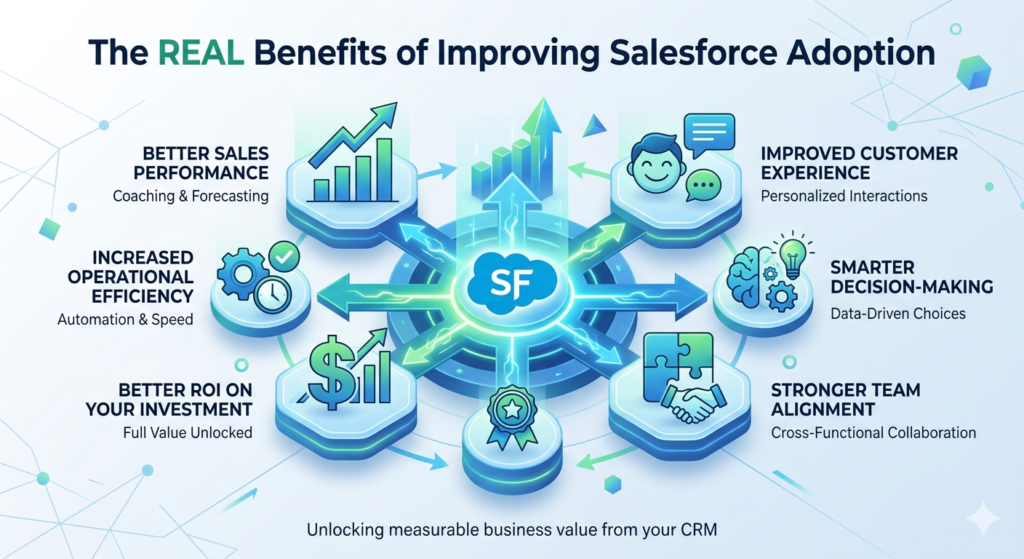
Getting Salesforce adoption right isn’t just about avoiding failure — it’s about unlocking real, measurable business value. Here’s what businesses consistently experience when they successfully implement a salesforce adoption strategy:
1. Better Sales Performance
When reps consistently track activities and opportunities, managers can coach more effectively, forecast more accurately, and identify deals at risk before they’re lost.
2. Improved Customer Experience
Support teams with complete customer history can resolve issues faster, personalize interactions, and reduce repeat contacts — all of which drive satisfaction and loyalty.
3. Smarter Decision-Making
Clean, reliable Salesforce data means leadership can make strategic decisions with confidence instead of relying on gut feeling or outdated spreadsheets.
4. Increased Operational Efficiency
Automation of routine tasks frees up time for higher-value work. Teams spend less time on admin and more time on what actually moves the needle.
5. Better ROI on Your Salesforce Investment
Every unused license and overlooked feature represents wasted investment. Full adoption means you’re actually getting the return you paid for.
6. Stronger Team Alignment
When all teams — sales, support, marketing, operations — work from the same CRM data, cross-functional collaboration improves dramatically.
Best Practices for Long-Term Salesforce Adoption Success
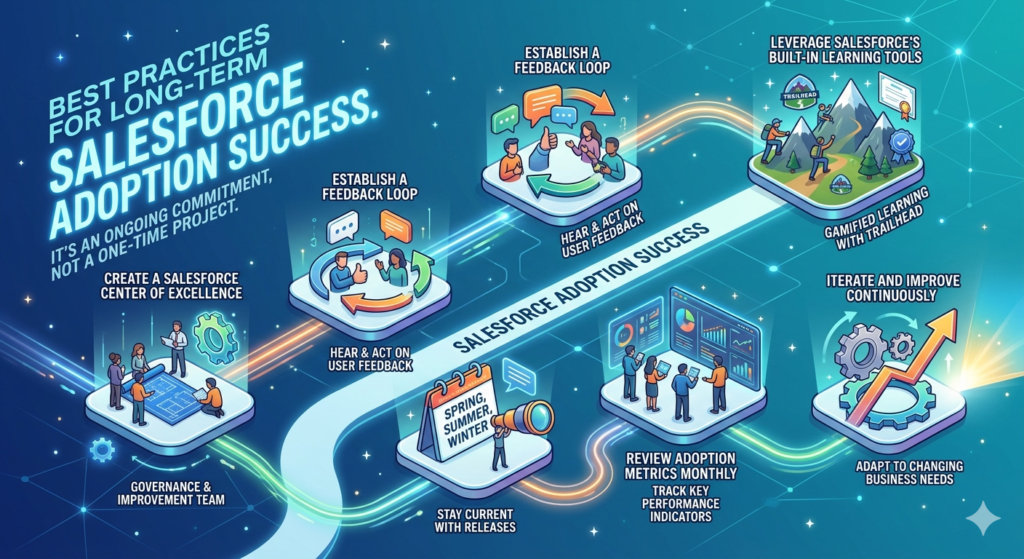
Fixing adoption is not a one-time project. It’s an ongoing commitment. Here are the best practices that separate companies with thriving Salesforce environments from those that perpetually struggle:
Create a Salesforce Center of Excellence
Designate a small internal team (even one or two people) responsible for Salesforce governance, training, and continuous improvement. This doesn’t have to be full-time, but someone needs to own it.
Establish a Feedback Loop
Regularly ask users what’s working, what’s frustrating, and what they wish Salesforce could do. Act on that feedback. When people see their input reflected in improvements, they feel valued and stay engaged.
Leverage Salesforce’s Built-In Learning Tools
Trailhead, Salesforce’s free online learning platform, offers role-specific training paths. Encourage your team to earn badges and complete relevant trails. It’s gamified, bite-sized, and surprisingly effective.
Keep Up With Salesforce Updates
Salesforce releases three major updates per year (Spring, Summer, and Winter releases). Assign someone to review release notes, test new features in a sandbox, and communicate relevant changes to the team.
Review Adoption Metrics Monthly
Don’t wait for a crisis to check adoption data. Build a monthly adoption review into your operations rhythm. Celebrate improvements and address declines quickly.
Iterate and Improve Continuously
Your business changes. Your Salesforce should too. Schedule quarterly configuration reviews to ensure the system still reflects current processes, team structures, and business priorities.
How RizeX Labs Helps Businesses Overcome Salesforce Adoption Challenges
At RizeX Labs, we understand that Salesforce team adoption failure is one of the most costly and frustrating challenges businesses face — and one of the most solvable.
Our approach is built on three pillars:
1. Customization That Fits Your Business
We don’t believe in out-of-the-box implementations. We work with your teams to understand your actual workflows, pain points, and goals — then customize Salesforce to be the perfect fit. From custom objects and page layouts to automation and integrations, we build a system your team will actually want to use.
2. Training That Sticks
Our training programs are role-specific, practical, and designed for real-world use. We don’t just explain features — we show your team how Salesforce solves their everyday challenges. We offer live training, recorded sessions, and ongoing support to ensure knowledge doesn’t fade after day one.
3. Implementation and Ongoing Support
We don’t disappear after go-live. RizeX Labs provides continuous implementation support, adoption monitoring, and regular check-ins to help your team grow with the platform. Whether you need help improving data quality, building dashboards, or training new hires, we’re with you for the long term.
If your business is struggling with Salesforce adoption — or if you’re planning a new implementation and want to do it right from the start — RizeX Labs is ready to help.
Conclusion: Adoption Is the True Measure of Salesforce Success
Implementing Salesforce is a significant investment. But the real measure of success isn’t whether you launched — it’s whether your team is actually using it, relying on it, and benefiting from it every single day.
Salesforce team adoption failure is common, but it’s not inevitable. With the right training, meaningful customization, strong leadership, clean data, and a culture that embraces the tool, Salesforce can transform how your business operates.
The seven reasons we’ve explored — poor training, misaligned configuration, lack of leadership buy-in, bad data, poor user experience, missing metrics, and cultural resistance — are all solvable. Each one has a clear, practical path forward.
The businesses that win with Salesforce aren’t the ones with the biggest budgets or the most complex implementations. They’re the ones that invest in their salesforce adoption strategy with the same seriousness they invest in the technology itself.
If you’re ready to finally get the most out of your Salesforce investment, RizeX Labs is here to make it happen.
Internal Links:
- Salesforce Admin course page
- Salesforce Einstein Case Classification: Reduce Manual Triage and Supercharge Your Support Operations
- Agentforce vs ChatGPT for Enterprise: A Salesforce Developer’s Perspective
- How to Deploy Agentforce in a Sandbox: Step-by-Step Guide for Salesforce Teams
- Agentforce Licensing: What It Costs and What You Get
- How RizeX Labs Delivers Corporate Salesforce Training: Our Approach
External Links:
McKinsey Sales Growth Reports
