
Introduction: The Salesforce Skills Gap Is Real — And Closing It Starts With You
Salesforce is no longer just a CRM. It is a full-scale enterprise platform powering sales, service, marketing, commerce, analytics, and AI-driven automation across thousands of organizations worldwide. According to IDC, the Salesforce ecosystem is expected to create 9.3 million new jobs and $1.6 trillion in new business revenues by 2026. Yet one of the most persistent challenges facing organizations today is not whether to adopt Salesforce — it is how to build the internal expertise to run it effectively.
Many companies fall into the same expensive pattern: they implement Salesforce with the help of an external consulting partner, go live, and then continue paying premium rates for routine customizations, minor enhancements, and basic administration tasks that a well-trained internal team could handle in a fraction of the time and cost. The result is a growing dependency on third-party vendors, slower delivery timelines, and a widening gap between business needs and technical execution.
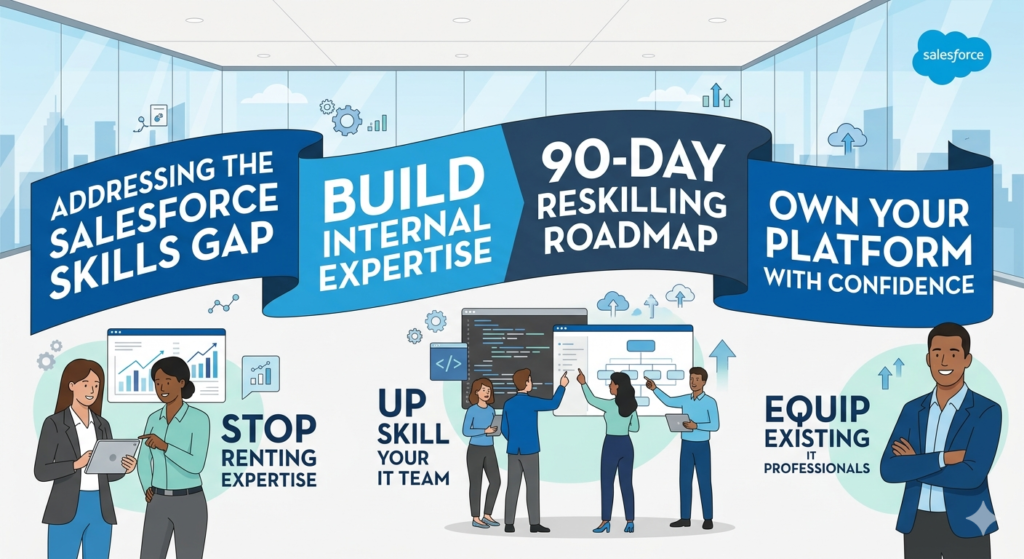
The solution is deliberate, structured upskilling IT teams on Salesforce capability from within.
This blog post is designed specifically for IT managers, Salesforce practice leads, CTOs, and digital transformation leaders who want to stop renting expertise and start building it. What follows is a practical, role-based, 90-day Salesforce reskilling roadmap that takes your existing IT team — whether they come from a .NET background, Java development, traditional IT administration, or business analysis — and equips them to own your Salesforce platform with confidence.
This is not a theoretical framework. It is a manager’s execution guide.
Why Upskilling IT Teams on Salesforce Is a Strategic Business Decision
Before diving into the roadmap, it is important to understand why this investment matters beyond the obvious cost-saving narrative. Salesforce reskilling is not just about reducing your consulting bill — though it absolutely will do that. It is about organizational resilience, faster innovation, and competitive advantage.
1. Reduces Dependency on External Implementation Partners
Implementation partners serve a critical role during initial deployment and complex integrations. But when your team cannot independently write a Flow, create a permission set, or build a basic Lightning Web Component, you are permanently anchored to expensive external resources for work that should be routine. Building internal Salesforce expertise gives your organization the ability to respond to business requirements without scheduling and billing cycles.
2. Accelerates Project Delivery
Internal teams understand your business processes, your data, your users, and your organizational politics. A reskilled internal developer does not need onboarding time, business context briefings, or extended discovery phases. They move faster because they already know the domain. Organizations with strong internal Salesforce capabilities consistently report shorter development cycles and faster time-to-value on platform enhancements.
3. Improves Internal Ownership and Quality
There is a fundamental difference in accountability between an external consultant and an internal team member. Your internal Salesforce developers and admins own the outcome long after the implementation partner has moved to their next engagement. That ownership drives higher quality decisions, better documentation practices, and more thoughtful architecture choices.
4. Builds Long-Term Competitive Advantage
Organizations that develop strong internal Salesforce Centers of Excellence can move from reactive maintenance mode to proactive innovation. They build reusable components, establish governance frameworks, and continuously improve the platform in alignment with business strategy. That is a capability your competitors cannot easily replicate.
5. Significant ROI on Training Investment
The average Salesforce consulting rate ranges from $150 to $300 per hour. The cost of a Salesforce Trailhead Plus subscription or a structured internal training program is a fraction of that. When you calculate the number of consulting hours your internal team can absorb after proper upskilling, the return on investment becomes immediately clear.
Step One: Assess Your Current Team’s Salesforce Readiness
Effective IT team Salesforce training does not start with Trailhead. It starts with an honest assessment of where your team currently stands. Every team member brings transferable skills, and identifying those accelerates the learning curve significantly.
Key Dimensions to Evaluate
When assessing your team, look at the following areas:
- CRM experience: Has the team worked with any CRM platform before? Familiarity with objects, records, relationships, and workflows translates directly.
- Apex and Java development background: Apex is heavily influenced by Java. Developers with strong Java foundations typically reach Apex proficiency significantly faster than those without.
- Integration knowledge: Experience with REST/SOAP APIs, middleware tools like MuleSoft or Dell Boomi, and ETL processes maps cleanly to Salesforce integration patterns.
- Business analysis skills: Team members who can gather requirements, write user stories, and map processes are natural fits for Salesforce Business Analyst and functional configuration roles.
- Database and data modeling knowledge: Understanding relational data models, SQL querying, and data normalization directly supports Salesforce object design and SOQL development.
Skills Matrix: Mapping Your Team to Salesforce Roles
Use the following matrix as a starting point during your assessment conversations. Rate each team member on a scale of 1 (none) to 5 (strong) for each competency area:
| Competency Area | Salesforce Admin | Salesforce Developer | Business Analyst | Salesforce Architect | QA Engineer |
|---|---|---|---|---|---|
| CRM Platform Experience | High | Medium | High | High | Medium |
| Declarative Configuration (Flows, Process Builder) | Critical | Helpful | Helpful | Critical | Helpful |
| Apex / Object-Oriented Programming | Low | Critical | Low | Critical | Low |
| Lightning Web Components / JavaScript | Low | Critical | Low | High | Low |
| REST/SOAP API Integration | Low | High | Low | Critical | Medium |
| Business Process Mapping | High | Medium | Critical | High | Medium |
| Data Modeling and SOQL | Medium | High | Medium | Critical | Medium |
| Security Model (Profiles, Permission Sets, Sharing) | Critical | Medium | Medium | Critical | Medium |
| Test Automation (Selenium, Provar, Copado) | Low | Medium | Low | Low | Critical |
| Reporting and Analytics | High | Low | High | Medium | Low |
Once you have completed this assessment for each team member, you can assign primary learning paths and structure cohorts for the 90-day program. Do not try to turn every team member into an architect on day one. The goal is targeted role-based development that produces measurable results within the 90-day window.
The 90-Day Salesforce Training Roadmap: Phase by Phase
This plan assumes a working team that is balancing learning alongside existing responsibilities. Each phase builds on the previous one, moving from platform literacy to role-specific depth to practical application and certification readiness.
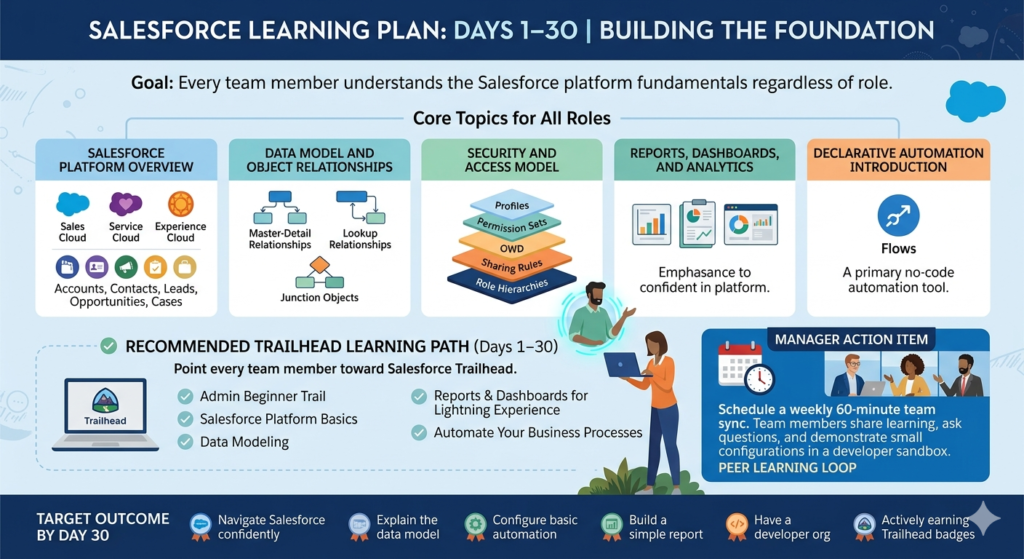
Days 1–30: Building the Foundation
Goal: Every team member understands the Salesforce platform fundamentals regardless of role.
The first 30 days are about creating a shared language and baseline platform literacy across the entire team. Before developers write Apex and admins configure Flows, everyone needs to understand what Salesforce is, how it is structured, and how data moves through the system.
Core Topics for All Roles
Salesforce Platform Overview
Begin with the Salesforce ecosystem: clouds (Sales Cloud, Service Cloud, Experience Cloud), core objects (Accounts, Contacts, Leads, Opportunities, Cases), and the relationship between standard and custom objects. Understanding where the platform begins and ends is foundational to every subsequent decision.
Data Model and Object Relationships
Introduce master-detail relationships, lookup relationships, junction objects, and how schema design impacts security, reporting, and application logic. This is often where developers from relational database backgrounds immediately feel at home.
Security and Access Model
Profiles, Permission Sets, Permission Set Groups, OWD (Organization-Wide Defaults), Sharing Rules, and Role Hierarchies form the backbone of Salesforce governance. This topic is non-negotiable for every role on the team.
Reports, Dashboards, and Analytics
Every team member should understand how to build a basic report and dashboard in Salesforce. This builds confidence in the platform and is directly useful for user acceptance testing, stakeholder communication, and business validation.
Declarative Automation Introduction
Introduce Flows as the primary no-code automation tool on the platform. Even developers benefit from understanding what Flow can accomplish without code, since building declaratively first is both a best practice and a platform philosophy.
Recommended Trailhead Learning Path (Days 1–30)
Point every team member toward Salesforce Trailhead, Salesforce’s free, gamified learning platform. Assign the following Trailmixes and modules:
- Admin Beginner Trail — Platform basics, data model, security fundamentals
- Salesforce Platform Basics — Superbadge prerequisite knowledge
- Data Modeling — Objects, fields, and relationships
- Reports & Dashboards for Lightning Experience — Analytics fundamentals
- Automate Your Business Processes — Introduction to Flow Builder
Manager Action Item: Schedule a weekly 60-minute team sync during this phase where team members share what they learned, ask questions, and demonstrate small configurations in a developer sandbox. This peer learning loop dramatically accelerates retention.
Target outcome by Day 30: Every team member can navigate Salesforce confidently, explain the data model, configure basic automation, and build a simple report. They have a developer org and are actively earning Trailhead badges.
Days 31–60: Role-Based Depth Learning
Goal: Team members develop functional expertise in their designated Salesforce role.
Once the foundation is established, the program branches into role-specific learning paths. This is where the real transformation happens. Each cohort — admins, developers, analysts, QA — follows a targeted curriculum aligned with their professional background and organizational responsibilities.
Salesforce Admin Track (Days 31–60)
Admins are the operational backbone of every Salesforce org. They need to move from basic configuration to sophisticated automation, data management, and security governance.
Key Learning Areas:
- Flow Builder (Advanced): Record-triggered flows, screen flows, scheduled flows, subflows, error handling, and flow best practices. Admins should be building flows that handle complex multi-step automation without code.
- Approval Processes: Designing multi-step approval workflows for business processes like discount approvals, contract reviews, and expense authorizations.
- Advanced Security: Deep dive into Permission Sets, Permission Set Groups, field-level security, record-level access, and Salesforce Shield basics.
- Data Management: Data Import Wizard, Data Loader, duplicate management, validation rules, and data quality governance.
- Change Management and Sandbox Strategy: Understanding sandbox environments, change sets, and basic deployment practices.
Recommended Trailhead for Admins:
- Admin Intermediate Trail
- Flow Builder: Quick Look
- Prepare Your Salesforce Org for Users
- Admin Superbadge (target completion by Day 60)
Salesforce Developer Track (Days 31–60)
For Java, .NET, or Python developers, this phase is where technical skills begin to map directly onto the Salesforce platform. The learning curve here is real but manageable with the right foundation.
Key Learning Areas:
- Apex Programming Language: Apex syntax, data types, collections, SOQL (Salesforce Object Query Language), DML (Data Manipulation Language), and governor limits. Java developers pick this up quickly — the parallels are significant.
- Apex Triggers: Before and after triggers, trigger frameworks (trigger handler pattern), bulkification, and avoiding recursive triggers.
- Lightning Web Components (LWC): HTML, JavaScript, and CSS for Salesforce UI components. LWC is modern JavaScript-based and developers with front-end experience adapt quickly.
- REST API Integration: Calling external REST APIs from Apex, building Salesforce REST endpoints, authentication (OAuth), and handling callouts.
- Testing in Apex: Writing test classes, achieving 75%+ code coverage, using Test.startTest() and Test.stopTest(), and mocking external callouts.
Recommended Trailhead for Developers:
- Apex Basics & Database
- Apex Triggers
- Lightning Web Components Basics
- Apex Integration Services
- Platform Developer I Certification Preparation
Manager Action Item: Set up a shared GitHub repository for the developer cohort during this phase. All Apex and LWC code should be version-controlled from day one. Establish a basic code review process between developers to accelerate peer learning.
Business Analyst Track (Days 31–60)
Salesforce Business Analysts translate business requirements into platform solutions. Their value lies in bridging the gap between what stakeholders want and what the technical team builds.
Key Learning Areas:
- Requirements Gathering for Salesforce: User stories, acceptance criteria, process mapping using tools like Lucidchart or Miro, and stakeholder interviews.
- Salesforce Process Mapping: Mapping current-state and future-state business processes using Salesforce capabilities, identifying gaps, and proposing configuration-first solutions.
- Data Analysis and Reporting: Advanced report types, cross-object reports, joined reports, and dashboard design for business stakeholders.
- User Acceptance Testing (UAT) Coordination: Designing test scripts, coordinating UAT sessions, documenting defects, and managing sign-off processes.
- Change Management Communication: Writing release notes, training documentation, and user communication templates.
Recommended Trailhead for Analysts:
- Business Analysis for Salesforce Projects
- User Story Writing
- Salesforce Business Analyst Certification Preparation
- Reports and Dashboards Superbadge
QA Engineer Track (Days 31–60)
Quality assurance on Salesforce requires both manual testing expertise and familiarity with automation tools built for the platform.
Key Learning Areas:
- Salesforce Testing Strategy: Understanding what to test (configuration, Apex, integrations, UI), test environment management, and regression testing approaches.
- Manual Testing on Salesforce: Testing Flows, validation rules, security configurations, and integrations in sandbox environments.
- Test Automation Fundamentals: Introduction to tools like Provar (purpose-built for Salesforce), Copado Robotic Testing, or Selenium with Salesforce-specific patterns.
- Apex Test Class Review: QA engineers should understand Apex test classes well enough to review them for coverage and quality, even if they are not writing them from scratch.
- CI/CD Concepts: Understanding how testing fits into deployment pipelines using tools like Copado, Gearset, or SFDX-based CI/CD.
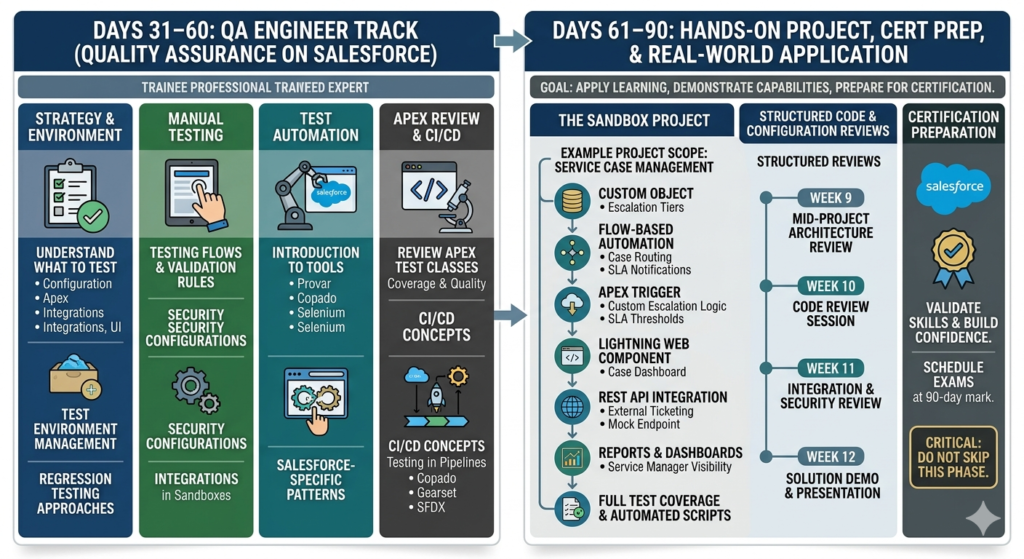
Days 61–90: Hands-On Project, Certification Prep, and Real-World Application
Goal: Team members apply their learning to a structured sandbox project, demonstrate their capabilities, and prepare for certification.
This is where classroom knowledge becomes operational expertise. The hands-on project phase is the most critical and often the most neglected part of enterprise training programs. Do not skip it.
The Sandbox Project
Assign a realistic, scoped project that your team builds collaboratively in a full sandbox environment. The project should mirror actual business requirements and require contributions from all roles.
Example Project Scope:
Build a Service Case Management process in Salesforce that includes:
- Custom object for tracking escalation tiers
- Flow-based automation for case routing and SLA notifications
- An Apex trigger for custom escalation logic when SLA thresholds are breached
- A Lightning Web Component for a case dashboard visible to service agents
- REST API integration with an external ticketing system (mock endpoint acceptable)
- Reports and dashboards for service manager visibility
- Full test class coverage for all Apex code
- Automated test scripts for critical user flows
This type of project is realistic, cross-functional, and produces demonstrable output that managers can evaluate.
Structured Code and Configuration Reviews
During this phase, establish formal review checkpoints:
- Week 9: Mid-project architecture review — does the design follow Salesforce best practices? Is the data model clean? Are declarative-first principles being applied?
- Week 10: Code review session — Apex quality, test coverage, bulkification, governor limit awareness, and LWC component structure.
- Week 11: Integration and security review — is the integration authenticated properly? Are permission sets scoped correctly?
- Week 12: Solution demo and stakeholder presentation — each team member or cohort presents their component to a simulated stakeholder audience.
Certification Preparation
Certifications validate skills, build team confidence, and signal organizational capability to internal stakeholders and external partners. Schedule certification exams to coincide with the end of the 90-day window.
Recommended Target Certifications by Role:
| Role | Target Certification |
|---|---|
| Salesforce Admin | Salesforce Certified Administrator |
| Junior Developer | Salesforce Platform App Builder |
| Experienced Developer | Salesforce Platform Developer I |
| Business Analyst | Salesforce Business Analyst |
| Senior Developer / Architect | Salesforce Platform Developer I (with App Builder) |
Use the Salesforce Certification Guide on Trailhead to access official exam guides, practice questions, and recommended study trails for each credential. Supplement with platforms like Focus on Force, Salesforce Ben’s exam prep resources, and the Salesforce Developer Documentation for reference-level technical depth.
Manager Action Item: Pre-register your team for certification exams before Day 60. Having a scheduled exam date creates accountability and urgency that dramatically increases pass rates.
Role-Based Salesforce Certification Path: A Quick Reference
| Experience Level | Recommended Certification Sequence |
|---|---|
| Admin (Beginner) | Salesforce Certified Administrator → Advanced Administrator |
| Admin (Experienced) | Salesforce Certified Administrator → Platform App Builder |
| Developer (Beginner) | Platform App Builder → Platform Developer I |
| Developer (Experienced) | Platform Developer I → Platform Developer II |
| Business Analyst | Salesforce Business Analyst → Administrator |
| Architect (Path) | Admin + Dev I → App Builder → Data Architect → System Architect |
Best Learning Resources for IT Team Salesforce Training
Equip your team with the right tools from day one. Here are the most effective resources for structured IT team Salesforce training:
Salesforce Trailhead
Trailhead is the free, official Salesforce learning platform. It offers trails, modules, projects, superbadges, and hands-on challenges in live Trailhead Playground environments. It is the single most important resource for any Salesforce upskilling program. Trailhead Plus (available through some Salesforce agreements) adds live learning content and mentored programs.
Salesforce Developer Documentation
The official developer documentation at developer.salesforce.com is comprehensive, current, and essential for developers working with Apex, LWC, APIs, and SFDX. Train your developers to treat this as their primary technical reference.
Salesforce Certification Guide
Available through Trailhead, the certification guide for each exam includes an exam outline, topic weightings, recommended trails, and sample questions. This should be the starting point for all certification preparation.
Supplementary Platforms
- Focus on Force — High-quality practice exams and study guides for Salesforce certifications
- Salesforce Ben — Blog, certification preparation resources, and admin-focused tutorials
- Salesforce YouTube Channel — Official tutorials, release highlights, and developer-focused video content
- Salesforce Stack Exchange — Community Q&A for technical problem solving
- GitHub (Salesforce Repos) — Official sample code repositories for LWC, Apex patterns, and integration examples
Building a Salesforce Center of Excellence (CoE)
As your team develops Salesforce expertise, the natural next step is formalizing that capability into a Salesforce Center of Excellence. A CoE transforms individual skill into organizational infrastructure.
What a Salesforce CoE Includes
Governance Framework
Define who has authority to approve new customizations, manage production deployments, grant permissions, and make architectural decisions. Without governance, orgs quickly become cluttered, insecure, and unmaintainable.
Coding Standards and Best Practices
Document your team’s Apex coding standards, trigger framework patterns, LWC component structure guidelines, naming conventions, and security review requirements. Make these accessible in your internal knowledge base and enforce them through code reviews.
Reusable Component Library
As your team builds LWC components, Flow templates, Apex utility classes, and integration patterns, catalog them in a shared repository. Reuse reduces development time, improves consistency, and accelerates onboarding for new team members.
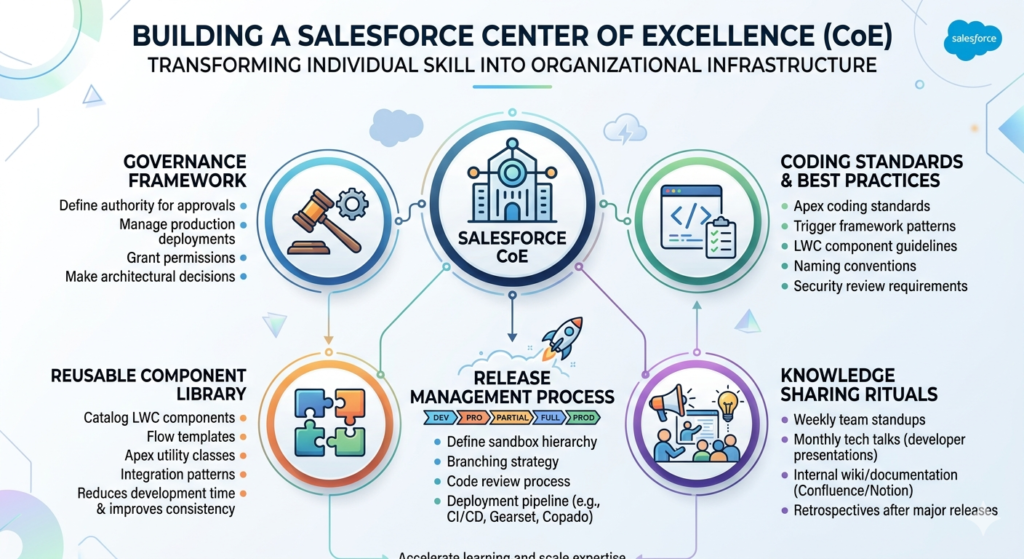
Release Management Process
Define your sandbox hierarchy (Developer → Developer Pro → Partial Copy → Full Copy), branching strategy, code review process, and deployment pipeline. Tools like Gearset, Copado, or SFDX-based CI/CD pipelines with GitHub Actions support this at scale.
Knowledge Sharing Rituals
Establish regular internal knowledge sharing: weekly team standups, monthly tech talks where developers present solutions, an internal Confluence or Notion wiki for Salesforce documentation, and retrospectives after major releases. Communities of practice within your organization amplify learning beyond the initial 90-day window.
KPIs to Measure the Success of Your Salesforce Upskilling Program
Investing in Salesforce reskilling without measuring outcomes is a missed opportunity. Here are the metrics that matter most and how to track them:
Certifications Earned
The most immediate and tangible measure of progress. Track certifications earned per team member, total credentials across the team, and the timeline from training start to first certification. A team that earns five Salesforce certifications in 90 days has a quantifiable credentialing outcome.
Sandbox Project Completion Rate
Did the team successfully deliver the hands-on project within scope and timeline? Rate the quality of the output against the defined rubric. This measures practical application of skills, not just theoretical knowledge.
Reduction in External Consulting Spend
Compare your Salesforce consulting costs in the quarter before the training program versus the quarter after. Many organizations see a 30–50% reduction in consulting hours within six months of completing a structured reskilling program.
Faster Release Cycles
Measure the average time from business requirement to production deployment before and after the program. Internal teams with strong Salesforce expertise consistently ship faster than teams dependent on external resources.
Internal Ticket Resolution Rate
Track what percentage of Salesforce support tickets and enhancement requests are resolved internally versus escalated to consultants or Salesforce support. An improving internal resolution rate signals growing team capability.
User Satisfaction Scores
Survey end users on their Salesforce experience before and after the upskilling investment. Internal teams who understand the business often deliver better user experience improvements than external consultants working from a requirements document.
Trailhead Engagement Metrics
Track badges earned, trails completed, and superbadge completions per team member. Salesforce Trailhead provides learner dashboards that make this easy to monitor at a team level.
Common Challenges in Salesforce Reskilling (And How to Solve Them)
No 90-day transformation program is without friction. Here are the most common obstacles managers face during Salesforce upskilling initiatives and practical strategies to address them:
Challenge 1: Limited Time for Training Alongside Existing Responsibilities
This is the most universal challenge. Your team has a day job, and carving out learning time competes with sprint commitments, support tickets, and business demands.
Solution: Protect dedicated learning time formally. Block two to four hours per week per team member for Salesforce training as a recurring calendar commitment. Treat it as unmovable as a critical meeting. Communicate to stakeholders that this investment will reduce future dependency costs. Use Friday afternoons or Monday mornings consistently so the cadence becomes a habit.
Challenge 2: Varying Skill Levels Within the Team
A team with five developers does not mean five people at the same starting point. Some may have Salesforce experience, others may be new to cloud platforms entirely.
Solution: Use your skills matrix assessment to create differentiated learning paths from Day 1. Do not force your most experienced developer to sit through admin fundamentals when they need to be in Apex triggers. Cohort-based learning with role-specific tracks solves this. Pair stronger learners with weaker ones as learning buddies — teaching is one of the most effective learning accelerators.
Challenge 3: Certification Anxiety
Salesforce certifications are respected credentials, but they are also genuinely challenging exams. Team members without a history of professional certifications may feel significant anxiety.
Solution: Normalize failure as part of the process. Salesforce certifications can be retaken. Create a psychologically safe environment where exam results are not punitive. Run internal mock exam sessions, group study sessions, and celebrate every attempt, not just passes. Pre-paying for exams also removes a financial barrier that can cause team members to delay scheduling.
Challenge 4: Lack of Practical Experience Beyond Trailhead
Trailhead is excellent for foundational learning, but it does not replicate the complexity and messiness of a real Salesforce org. Teams who only learn through structured modules often struggle when they encounter real-world scenarios.
Solution: The sandbox project in Days 61–90 directly addresses this. Additionally, identify low-risk internal enhancement requests that newly trained team members can tackle under the mentorship of a more experienced Salesforce professional. Real-world application, even on small tasks, is exponentially more valuable than additional passive learning modules.
Challenge 5: No Internal Mentor or Expert to Guide the Team
If your organization is starting from zero Salesforce expertise internally, the team has no internal benchmark for quality.
Solution: Engage an experienced Salesforce consultant specifically in a coaching and mentoring capacity rather than a delivery capacity. This is a fundamentally different engagement model — the consultant’s role is to review your team’s work, answer architectural questions, and guide decisions, while your internal team does the building. This accelerates learning dramatically while keeping costs far below a full implementation engagement.
Real-World Example: From Java Developers to Salesforce Specialists in 90 Days
Consider the experience of a mid-sized financial services firm that was spending approximately $800,000 annually on Salesforce implementation partner fees for what amounted to ongoing enhancement work, rather than transformational projects.
The IT manager assembled a team of four senior Java developers, two business analysts, and one experienced system administrator — none of whom had prior Salesforce experience. The team was placed on a structured 90-day reskilling program modeled closely on the plan outlined in this post.
The approach:
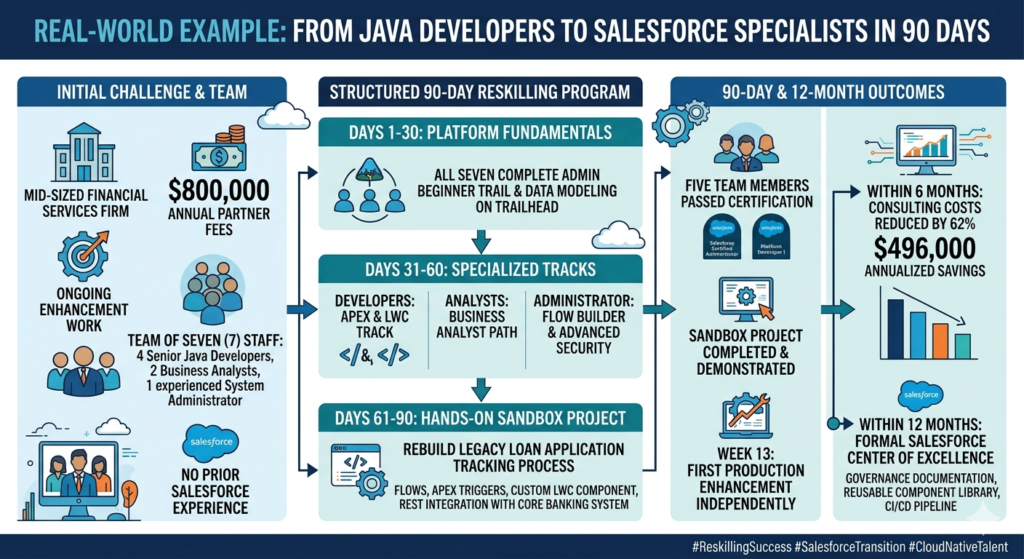
- Days 1–30 focused on Salesforce platform fundamentals, with all seven team members completing the Admin Beginner Trail and core data modeling modules on Trailhead.
- Days 31–60 split the developers onto the Apex and LWC track while analysts pursued the Business Analyst path and the administrator dove deep into Flow Builder and advanced security.
- Days 61–90 culminated in a hands-on sandbox project: rebuilding a legacy loan application tracking process in Salesforce using Flows, Apex triggers, a custom LWC component, and a REST integration with their core banking system.
The outcomes at 90 days:
- Five team members passed Salesforce certification exams (three Salesforce Certified Administrator credentials and two Platform Developer I credentials).
- The sandbox project was completed on schedule and demonstrated to internal stakeholders.
- The team took on their first production enhancement independently in Week 13.
- Within six months, consulting costs had been reduced by 62%, representing savings of approximately $496,000 on an annualized basis.
- Within 12 months, the firm had established a formal Salesforce Center of Excellence with governance documentation, a reusable component library, and a CI/CD pipeline.
The Java-to-Salesforce transition worked because the foundational programming skills transferred directly. SOQL felt familiar to developers who understood SQL. Apex felt like a constrained version of Java with a learning curve that experienced developers cleared within three to four weeks. The real challenge was not technical — it was unlearning certain architectural assumptions that do not apply to a cloud-native, governor-limit-aware platform. That is exactly the kind of nuanced guidance that a mentoring engagement model provides.
Conclusion: Building Internal Salesforce Expertise Is a Strategic Imperative
The organizations that will extract the most value from Salesforce in the next five years will not be those with the largest consulting budgets. They will be the ones that invested deliberately in upskilling IT team Salesforce capabilities and built durable internal expertise that compounds over time.
A structured 90-day Salesforce reskilling program is not a small undertaking. It requires protected time, managerial commitment, the right resources, and a willingness to invest in people before you see the return. But the return is real, measurable, and significant — in reduced consulting spend, faster delivery cycles, improved solution quality, and an empowered team that owns the platform rather than renting expertise from outside.
The roadmap outlined in this post gives you a concrete starting point:
- Assess your team’s current skills and map them to Salesforce roles.
- Build the foundation with shared platform literacy in the first 30 days.
- Develop role-specific depth in the second 30 days through targeted learning paths.
- Apply the learning through a hands-on sandbox project, code reviews, and certification preparation in the final 30 days.
- Measure outcomes through certifications, project delivery, and consulting cost reduction.
- Formalize the capability through a Salesforce Center of Excellence that scales beyond the initial cohort.
This is how you stop paying for expertise you should own and start building the internal Salesforce capability your organization needs to scale.
About RizeX Labs
At RizeX Labs, we specialize in delivering cutting-edge Salesforce solutions, consulting, and corporate training programs that help organizations build in-house expertise across the Salesforce ecosystem.
Our team combines deep technical knowledge, real-world implementation experience, and structured learning methodologies to help businesses accelerate Salesforce adoption and reduce dependency on external consultants.
We empower organizations to transform their IT teams into Salesforce-ready professionals through practical, role-based enablement programs that drive productivity, innovation, and long-term success.
Internal Linking Opportunities:
External Linking Opportunities:
- Salesforce
- Trailhead by Salesforce
- Salesforce Credentials
- Salesforce Developer Docs
- Salesforce Architects
- Salesforce Training
- McKinsey & Company and Gartner
Quick Summary
Upskilling IT teams on Salesforce is one of the most effective strategies for organizations looking to accelerate CRM transformation, reduce consulting costs, and build internal technical capabilities. Through a structured 90-day approach, managers can guide their teams from foundational platform knowledge to hands-on project delivery and certification readiness.
By investing in targeted upskilling IT team Salesforce initiatives, businesses can support successful salesforce reskilling efforts and create scalable IT team Salesforce training programs. This approach enables IT professionals to confidently manage administration, development, automation, and integration tasks while driving long-term Salesforce success.
