
Introduction: The Salesforce Opportunity in India Is Real — But Only With the Right Training
India has rapidly emerged as one of the world’s most active hubs for Salesforce talent. From Bengaluru and Hyderabad to Pune, Chennai, and Mumbai, thousands of IT professionals, fresh graduates, and career changers are pursuing Salesforce skills every year — and for good reason. The global Salesforce ecosystem is projected to generate millions of new jobs over the next several years, and Indian professionals are increasingly positioned to capture a significant share of that opportunity through both domestic placements and global remote roles.
But here is the challenge that most aspiring Salesforce professionals do not fully appreciate until they are already in the middle of it: the quality of Salesforce training available in India varies enormously. The difference between a well-structured, mentor-led program with real project experience and a poorly designed course that teaches outdated content through recorded videos can mean the difference between landing your first Salesforce role in four months and spending twelve months studying without a clear path to employment.
Choosing the right Salesforce training partner India is not a minor administrative decision. It is one of the most important investments you will make in your professional future — and it deserves the same level of research and critical evaluation that you would apply to any significant career decision.
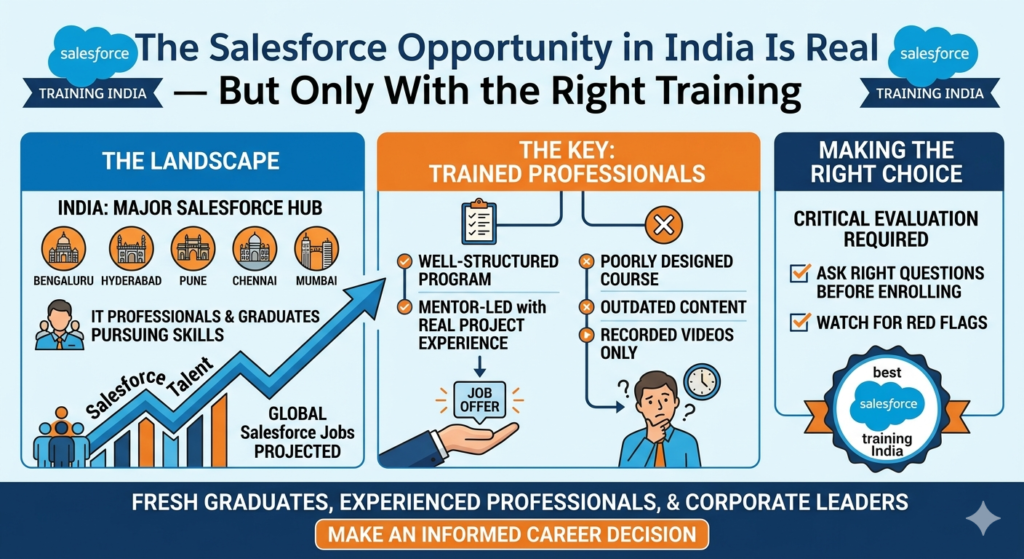
This guide is designed to help you make that decision with clarity and confidence. We will walk through what separates a genuinely excellent Salesforce training institute from one that looks impressive on a website but fails to deliver real outcomes, the specific questions you should ask before enrolling anywhere, the red flags that signal a program is not worth your time or money, and the qualities that define the best Salesforce training India has to offer.
Whether you are a fresh graduate exploring your first technology career, an experienced IT professional planning a platform transition, or a corporate leader evaluating team training options, this guide will equip you to make the right choice.
Why Salesforce Training Matters More Than You Think
Before evaluating training providers, it is worth grounding the conversation in why quality Salesforce training matters so significantly in the first place.
Salesforce Is the World’s Leading CRM Platform
Salesforce holds over 23% of the global CRM market share — more than its next four competitors combined. It is deployed by companies ranging from small startups to Fortune 500 enterprises across virtually every industry: technology, banking, insurance, healthcare, retail, manufacturing, nonprofit, and government. In India specifically, the adoption of Salesforce has accelerated dramatically as multinational corporations expand their Indian operations and domestic enterprises invest in digital transformation. This market dominance translates directly into sustained, growing demand for certified Salesforce professionals.
Certifications Improve Employability and Salary Potential
Salesforce certifications are not decorative credentials — they are actively used by employers as hiring filters and compensation benchmarks. According to industry surveys, certified Salesforce professionals consistently earn higher salaries than their non-certified peers, and many enterprise employers and Salesforce implementation partners explicitly require certifications as a minimum qualification for hiring. In India, a certified Salesforce Administrator with six months of practical experience commands significantly better opportunities than an uncertified candidate who has studied the platform independently without structured guidance.
Hands-On Training Accelerates Job Readiness
The gap between theoretical Salesforce knowledge and practical job readiness is substantial. Professionals who have only studied Salesforce concepts without building real solutions in sandbox environments, working through realistic business scenarios, or receiving feedback on their configuration and development decisions consistently struggle in technical interviews and early job performance. Quality training that emphasizes hands-on practice from day one — not as an afterthought at the end of a course — dramatically compresses the time between starting training and being genuinely capable of delivering value in a professional Salesforce role.
What Is a Salesforce Training Partner?
The term “Salesforce training partner” is used broadly in the market, and it is important to understand what it should mean versus what it sometimes actually means.
A genuine Salesforce training partner is an organization that provides structured, outcomes-oriented Salesforce education designed to take learners from their current skill level to certified, job-ready proficiency. The key word is outcomes — a training partner’s measure of success should be your success, not simply your course completion.
The defining characteristics of a legitimate Salesforce training partner include:
Structured Courses With Clear Learning Objectives: Every module, every week, and every assignment should serve a specific learning purpose that builds toward a defined outcome — certification readiness, role-specific competency, or project delivery capability.
Real-World Project Experience: Hands-on work in Salesforce sandbox environments on realistic business scenarios, not just textbook exercises or Trailhead module repetition.
Certification Preparation Support: Structured exam preparation including mock tests, exam strategy guidance, topic weightings, and study plans aligned with official Salesforce certification exam outlines.
Mentor Support and Instructor Accessibility: Access to experienced Salesforce professionals who can answer questions, review your work, provide feedback, and guide your learning beyond the scheduled class hours.
Placement Assistance: Resume preparation, interview coaching, job referral networks, and ongoing support in connecting learners with employment opportunities after course completion.
The distinction between a genuine training partner and a course provider that simply delivers recorded video content is significant. The best training relationships are active, responsive, and outcome-focused — not transactional.
Key Factors to Consider When Choosing a Salesforce Training Partner in India
Evaluating a Salesforce training partner India requires looking beyond the marketing materials and asking hard, specific questions about what the program actually delivers. Here are the most important factors to assess:
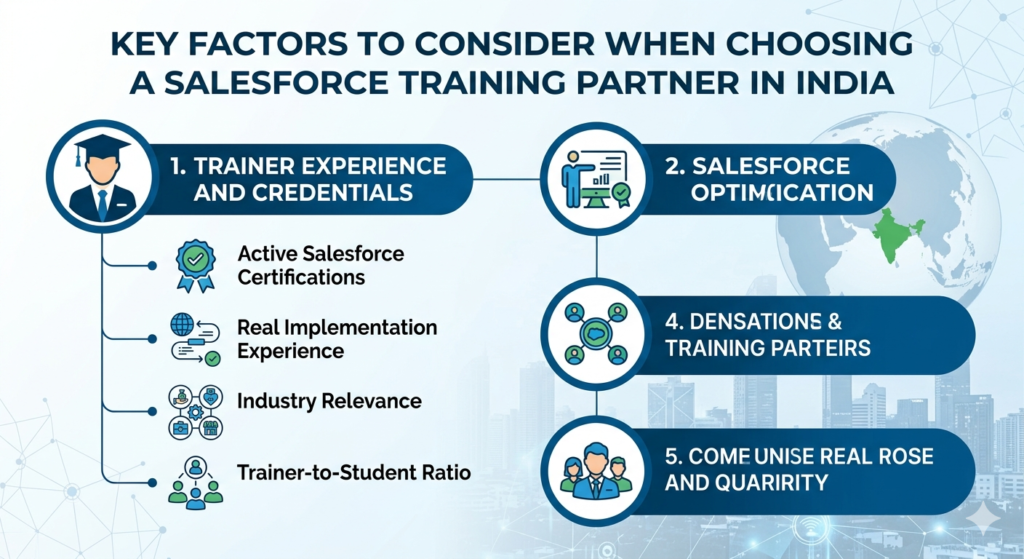
1. Trainer Experience and Credentials
The quality of your Salesforce training is almost entirely determined by the quality of the people delivering it. A trainer who has Salesforce certifications but has never implemented the platform in a real enterprise environment will teach you how to pass exams. A trainer who has deployed Salesforce for actual clients across multiple industries will teach you how to think like a Salesforce professional — which is an entirely different and far more valuable outcome.
What to look for:
- Active Salesforce Certifications: Trainers should hold current, relevant Salesforce certifications — not certifications they earned five years ago and have not renewed. Salesforce releases three major updates per year, and certifications require maintenance to remain active. An instructor whose credentials have lapsed is teaching you a version of Salesforce that no longer exists.
- Real Implementation Experience: Ask specifically how many Salesforce implementation projects the trainer has worked on, in what industries, and in what roles. A trainer who has managed five enterprise Salesforce implementations brings a depth of real-world judgment that cannot be replicated through study alone.
- Industry Relevance: Ideally, trainers should have experience across multiple industry verticals — financial services, healthcare, retail, manufacturing — because this breadth helps them contextualize platform features in the kinds of business scenarios you will actually encounter in your career.
- Trainer-to-Student Ratio: In live training programs, the ratio of trainers to students significantly impacts learning quality. Programs that run batches of fifty or more students with a single trainer cannot provide meaningful individual attention. Look for programs that maintain manageable batch sizes where instructors can genuinely engage with each learner.
Questions to ask:
- What Salesforce certifications does the trainer hold, and when were they last renewed?
- How many live Salesforce implementation projects has the trainer worked on in the last three years?
- Will I be learning from the same trainer throughout the program, or will instruction rotate across multiple instructors?
2. Curriculum Quality and Relevance
Salesforce releases three major platform updates every year — Spring, Summer, and Winter releases — and each release introduces new features, deprecates old ones, and changes best practices. A curriculum that was excellent eighteen months ago may be teaching approaches that Salesforce itself has moved away from.
What a strong curriculum looks like:
- Current Content: The curriculum should explicitly reference the current Salesforce release and include recent features like enhanced Flow Builder capabilities, updated LWC patterns, new Einstein AI features, and current security model updates.
- Comprehensive Topic Coverage for Admin Tracks: Data model, object relationships, security and access model, Flow Builder automation, approval processes, reports and dashboards, data management, change management, and deployment basics.
- Comprehensive Topic Coverage for Developer Tracks: Apex programming with governor limits, SOQL and DML, trigger frameworks, Lightning Web Components, REST and SOAP API integration, Apex test classes, SFDX and CI/CD basics.
- Role-Based Learning Paths: The curriculum should be structured around specific professional roles — Admin, Developer, Business Analyst, QA — rather than a single undifferentiated course that tries to cover everything superficially.
- Integration and Advanced Topics: For developer tracks specifically, the curriculum should cover integration patterns, authentication (OAuth), platform events, and external service connections — not just basic Apex syntax.
What weak curriculum looks like:
- Modules that reference legacy features like Workflow Rules and Process Builder as primary automation tools without emphasizing Flow Builder as the current platform direction.
- Developer content that focuses exclusively on Apex without addressing LWC, which is the current standard for Salesforce UI development.
- No coverage of Salesforce DX, version control, or deployment practices — skills that are standard requirements in professional Salesforce development environments.
Questions to ask:
- When was the curriculum last updated, and how frequently is it reviewed?
- Does the developer track cover Lightning Web Components and SFDX?
- How is the content structured for different roles?
3. Practical Learning and Hands-On Experience
This is where the most significant quality gaps between Salesforce training providers emerge. Any provider can create slides about Salesforce features. Far fewer can deliver the kind of structured, realistic, feedback-rich hands-on experience that produces genuinely capable professionals.
What genuine practical learning includes:
- Dedicated Sandbox Access: Every learner should have their own Salesforce sandbox or Developer Org available from the first week of training. Hands-on work should begin immediately — not after completing several weeks of theory.
- Realistic Project Scenarios: Assignments and projects should be based on actual business scenarios that mirror what you will encounter in professional Salesforce work. A project requirement like “build a lead management process for a financial services company including automated scoring, routing, and conversion tracking” is realistic. “Complete the module exercises” is not.
- Capstone or Mini Projects: The program should culminate in a complete, multi-feature Salesforce project that demonstrates end-to-end capability — from requirements analysis through configuration or development to testing and documentation. This project becomes the portfolio evidence that employers evaluate during hiring.
- Code Reviews and Configuration Reviews: For developer tracks, experienced instructors should review learners’ Apex code and LWC components with specific, actionable feedback. Learning to write good Salesforce code requires guided iteration, not just initial instruction followed by independent practice.
- Live Problem Solving: Training sessions should include live troubleshooting exercises where learners encounter realistic errors — governor limit exceptions, SOQL errors, Flow debug issues — and learn to diagnose and resolve them systematically.
Questions to ask:
- From which week does hands-on project work begin?
- Will I have my own sandbox environment throughout the program?
- Are there capstone projects that I can add to my professional portfolio?
- How is feedback provided on assignments and projects?
4. Certification Preparation and Support
Earning a Salesforce certification is a significant milestone that requires structured preparation beyond general platform knowledge. The best Salesforce certification training providers treat exam preparation as a dedicated component of the program, not an afterthought.
What strong certification support looks like:
- Exam-Aligned Content: The curriculum should explicitly map to the official Salesforce certification exam outline, with proportional coverage of each topic based on its weighting in the actual exam.
- Mock Examinations: Full-length practice exams that simulate the actual testing experience — timed, question format-matched, and covering the full topic range of the target certification. Learners should complete multiple mock exams before their actual certification attempt.
- Exam Strategy Guidance: Experienced instructors who have taken and passed Salesforce certifications can share specific strategies — how to approach scenario-based questions, how to eliminate wrong answers, how to manage time during the exam — that meaningfully improve pass rates.
- Study Plans: A structured week-by-week study plan aligned with the exam date helps learners allocate preparation time appropriately across topic areas rather than studying randomly and hoping for complete coverage.
- Post-Failure Support: Salesforce certifications can be retaken, and a quality training provider should support learners through a failed first attempt rather than considering their obligation complete once the course ends. Understanding what topics to focus on for a retake is valuable guidance that experienced training partners can provide.
Questions to ask:
- How many mock certification exams are included in the program?
- Is post-exam support available if I need to retake?
- Does the curriculum align with the current Salesforce certification exam outline?
5. Placement Assistance and Career Support
For individual learners — freshers and career changers especially — Salesforce course with placement support is often a critical factor in the training investment decision. But placement assistance varies enormously in quality, and it is important to understand specifically what a provider offers rather than accepting vague assurances.
What genuine placement assistance includes:
- Resume Preparation: Specific, expert guidance on presenting your Salesforce skills, certifications, and project experience on a resume in a way that resonates with Salesforce employers. Generic resume templates are not placement assistance — personalized, role-specific resume coaching is.
- LinkedIn Profile Optimization: Your LinkedIn profile is your primary professional presence in the Salesforce job market. Strong training providers help you build a compelling Salesforce-focused LinkedIn profile that attracts recruiter attention and showcases your Trailhead credentials and certifications.
- Interview Preparation: Structured mock interviews covering both technical Salesforce questions and behavioral interview scenarios, with specific feedback on your responses. Knowing the platform is not enough — being able to articulate your knowledge clearly and confidently under interview conditions requires practice.
- Job Referral Networks: Training providers with active relationships with Salesforce implementation partners, product companies, and enterprise employers can facilitate introductions that open doors faster than cold job applications. Ask specifically which employers the training provider has placed graduates with and how recently.
- Ongoing Support: Career support should not end the day you finish your course. Look for providers that maintain ongoing relationships with alumni — providing job lead referrals, networking opportunities, and support through the job search process.
Questions to ask:
- Can you share specific examples of recent graduate placements — company names, roles, and timeframes?
- What does your interview preparation program include?
- How long does placement support continue after course completion?
6. Delivery Format and Schedule Flexibility
The best Salesforce training in India is not one-size-fits-all in terms of delivery format. Working professionals have different scheduling constraints than full-time students, and corporate training programs have different structural requirements than individual learner programs.
Delivery formats to look for:
- Live Online Classes: Real-time instructor-led sessions delivered via video conferencing that maintain the interactive, question-answering benefits of classroom training with the flexibility of remote access. Live online classes are the most effective format for most learners because they combine structure with accessibility.
- Weekend Batches: For working professionals who cannot dedicate weekday hours to training, weekend batch options allow structured learning without requiring career interruption. Saturday and Sunday sessions of three to four hours each provide sufficient weekly learning volume without overwhelming a professional’s workweek.
- Self-Paced Components: While live instruction is irreplaceable for conceptual clarity and question resolution, well-designed self-paced supplementary content — recorded session replays, supplementary reading, practice assignments — allows learners to revisit complex topics at their own pace between live sessions.
- Flexible Rescheduling: Life happens during a multi-month training program. Training providers that offer session recordings and make-up options for missed classes demonstrate a practical commitment to learner success over administrative convenience.
- Corporate Training Programs: For IT managers and business leaders seeking team training, look for providers that offer customized corporate programs with flexible scheduling, company-specific project scenarios, and group progress tracking capabilities.
Questions to ask:
- Are live sessions recorded for later review?
- What happens if I miss a class?
- Do you offer weekend or evening batch options?
- Do you offer customized corporate training programs?
7. Reviews, Testimonials, and Verifiable Outcomes
Marketing claims are easy to make. Verifiable evidence of learner outcomes is much harder to fabricate — and much more meaningful. Before enrolling in any Salesforce training institute, invest time in researching independent evidence of the provider’s track record.
Where to find credible reviews:
- Google Reviews: Look at the overall rating and — more importantly — read the detailed reviews carefully. Pay attention to reviews that mention specific outcomes: certification pass rates, job placement timelines, instructor quality, and post-course support responsiveness.
- LinkedIn Recommendations: Search for the training provider on LinkedIn and look for alumni who have posted recommendations or testimonials. Cross-reference their profiles — are these real professionals with verifiable Salesforce career trajectories that align with their stated training experience?
- Trailblazer Community: The Salesforce Trailblazer Community is a candid space where Salesforce professionals share honest opinions about training providers, learning resources, and career advice. Search for discussions mentioning the training institute you are evaluating.
- Direct Alumni References: Ask the training provider to connect you with recent alumni you can speak with directly. Any provider confident in their outcomes will facilitate these conversations willingly. Reluctance to provide alumni references is itself informative.
- Placement Evidence: Request specific, verifiable placement data — not percentage claims, but actual examples of learners placed in named companies with specified roles and timeframes.
Questions to ask:
- Can you connect me with three recent alumni I can speak with directly?
- What is your certification first-attempt pass rate?
- Can you share specific placement examples from the last six months?
Best Salesforce Training India: Questions to Ask Before Enrolling
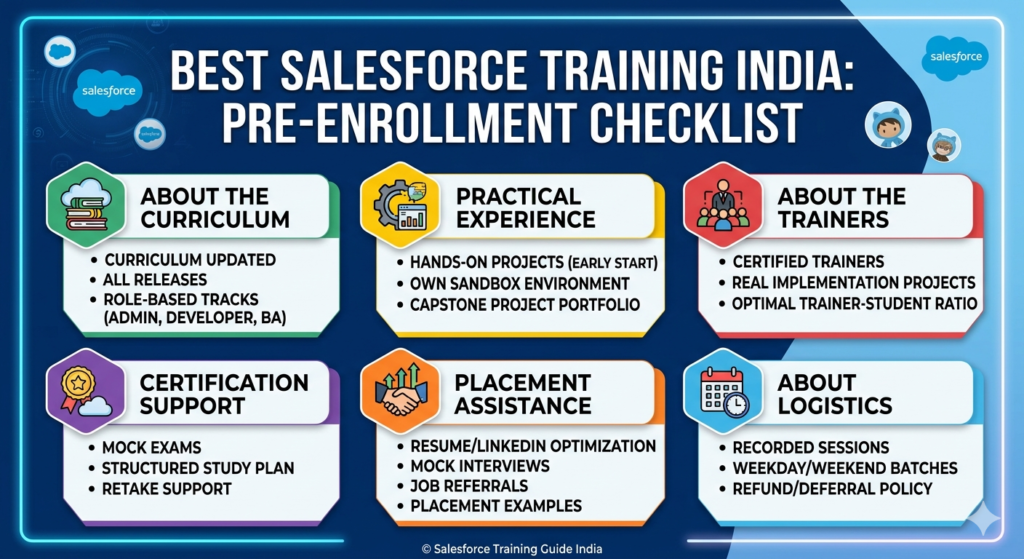
Consolidating the evaluation criteria above into a practical pre-enrollment checklist, here are the most important questions to ask every Salesforce training provider you are seriously considering:
About the Curriculum:
- Is the curriculum updated for the current Salesforce release, and how frequently is it reviewed?
- Does the developer curriculum cover Apex, Lightning Web Components, REST API integration, and SFDX?
- Are there role-based learning tracks for admins, developers, and business analysts?
About Practical Experience:
- From which week does hands-on project work begin in the program?
- Will I have my own sandbox environment throughout the entire course?
- Is there a capstone project I can add to my professional portfolio?
- How is feedback provided on assignments and projects?
About the Trainers:
- What Salesforce certifications do the trainers hold, and when were they last renewed?
- How many real Salesforce implementation projects has the primary trainer worked on?
- What is the trainer-to-student ratio in live sessions?
About Certification Support:
- How many mock certification exams are included?
- Does the program provide a structured study plan aligned with the exam outline?
- Is support available if I need to retake a certification exam?
About Placement Assistance:
- What specific placement support is included — resume prep, LinkedIn optimization, mock interviews, job referrals?
- Can you provide specific recent placement examples with company names and roles?
- How long does placement support continue after course completion?
About Logistics:
- Are live sessions recorded for review?
- What batch scheduling options are available — weekday, weekend, evening?
- What is the refund or deferral policy if my circumstances change?
Why RizeX Labs Is a Trusted Salesforce Training Partner in India
Among the growing number of providers offering Salesforce classes in India, RizeX Labs has established a reputation built on practical outcomes rather than marketing promises. Here is what sets RizeX Labs apart as a Salesforce training institute that genuinely delivers:
Industry-Expert Instructors With Real Implementation Experience
Every RizeX Labs Salesforce instructor is an active Salesforce-certified professional with hands-on enterprise implementation experience. Our trainers bring real-world perspective from actual Salesforce projects across banking, insurance, healthcare, retail, and technology industries — which means learners receive guidance that goes beyond platform mechanics to include the judgment, trade-off thinking, and business context that professional Salesforce work requires.
Hands-On Project-Based Training From Day One
At RizeX Labs, sandbox access is provided from the first week of every program. Our curriculum is built around progressive, realistic project scenarios that reflect actual business requirements — not textbook exercises. Learners complete mini-projects throughout the course and culminate in a comprehensive capstone project that demonstrates end-to-end capability and serves as a tangible portfolio piece for job applications.
Comprehensive Salesforce Certification Training Support
Our Salesforce certification training support includes structured exam preparation aligned with official certification exam outlines, multiple full-length mock examinations, personalized exam strategy coaching, and study plans calibrated to each learner’s target exam date. Our certification pass rates reflect a preparation approach that takes exam readiness seriously as a dedicated program component — not an add-on.
Flexible Schedules for Working Professionals and Students
RizeX Labs offers live online classes in weekday, weekend, and evening batch formats to accommodate the scheduling realities of working professionals, fresh graduates, and career changers alike. All live sessions are recorded and accessible to enrolled learners for review, ensuring that a missed session never means a missed learning opportunity.
Corporate Salesforce Training Programs
For IT managers and business leaders seeking to upskill their teams, RizeX Labs offers customized corporate Salesforce training programs designed around your organization’s specific platform environment, business processes, and capability goals. Corporate programs include progress tracking, management reporting, and the option for team certification support — all delivered with the scheduling flexibility that enterprise training programs require.
Active Placement Assistance and Career Support
RizeX Labs provides structured career support that extends beyond course completion, including personalized resume preparation, LinkedIn profile optimization, technical and behavioral mock interview coaching, and active job referral support through our employer network. Our placement assistance is built around verifiable outcomes — real graduates in real Salesforce roles — not percentage claims.
Red Flags to Watch For When Evaluating Salesforce Training Providers
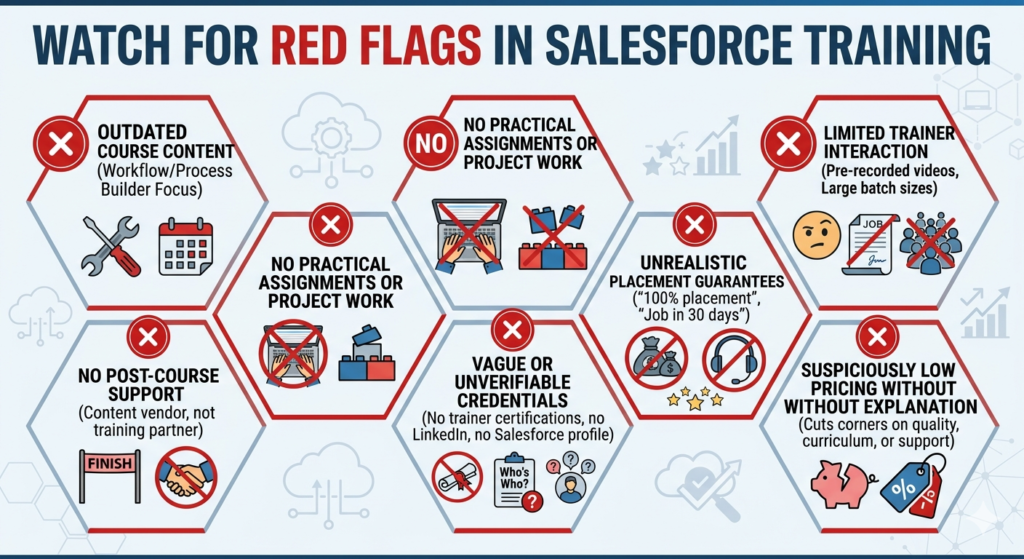
As important as knowing what to look for is knowing what to avoid. Here are the warning signs that a Salesforce training provider is unlikely to deliver on its promises:
Outdated Course Content
If a provider’s curriculum still prominently features Workflow Rules and Process Builder as the primary automation tools — rather than Flow Builder, which is Salesforce’s current and exclusively supported automation platform — the curriculum has not been updated to reflect current platform direction. Training on deprecated features may partially prepare you for certification exams but will not prepare you for professional Salesforce work.
No Practical Assignments or Project Work
A program that consists primarily or entirely of instructor lectures, slide presentations, and recorded videos without structured hands-on assignments is not preparing you for professional practice — it is giving you information that you will struggle to apply without supervised practical experience. If a provider cannot clearly articulate what projects and assignments learners complete, that is a significant red flag.
Unrealistic Placement Guarantees
Phrases like “100% placement guaranteed” or “job in 30 days guaranteed” should trigger immediate skepticism. No ethical training provider can guarantee employment outcomes that depend on factors including the learner’s performance, the job market, and individual circumstances. Providers who make such claims are typically using them as marketing tactics rather than substantive commitments, and the fine print invariably reveals conditions that make the guarantee effectively meaningless.
Limited Trainer Interaction
Programs where learners cannot ask questions of the trainer in real time — whether because classes are entirely pre-recorded, batch sizes are excessively large, or instructor availability outside class hours is nonexistent — cannot provide the personalized guidance that effective Salesforce learning requires. If you cannot get a specific question answered by a qualified trainer within a reasonable timeframe, the learning experience is fundamentally compromised.
No Post-Course Support
A training program that considers its responsibility complete the moment you receive your course completion certificate is not a training partner — it is a content vendor. Genuine training partners maintain ongoing relationships with their learners through the certification process and the job search, providing support that extends to where it matters most: actual career outcomes.
Vague or Unverifiable Credentials
If a training provider cannot provide specific information about their trainers’ certifications, implementation experience, and professional backgrounds — or if the credentials they claim cannot be independently verified on LinkedIn or the Salesforce credential verification site — treat that lack of transparency as a serious concern.
Suspiciously Low Pricing Without Clear Explanation
Quality Salesforce training delivered by genuinely experienced instructors with proper sandbox infrastructure, certification support, and placement services has real costs. Programs priced dramatically below the market norm are almost certainly cutting corners somewhere — on trainer quality, curriculum currency, practical infrastructure, or support services. Price alone should never be the primary decision criterion for a training investment with significant career implications.
Conclusion: The Right Salesforce Training Partner India Changes Everything
The Salesforce opportunity in India is genuine, growing, and accessible to professionals across a wide range of backgrounds and experience levels. But the path from aspiration to employment is not navigated by platform access and self-study alone — it is navigated by the quality of the guidance, structure, and support you receive along the way.
Choosing the right Salesforce training partner India is the decision that determines whether your Salesforce investment produces the career outcomes you are working toward or becomes an expensive lesson in what to look for next time. The evaluation framework in this guide — assessing trainer experience, curriculum currency, practical learning depth, certification support, placement assistance, delivery flexibility, and independent reviews — gives you the tools to make that decision with confidence rather than guesswork.
The best Salesforce training India is not necessarily the most expensive, the most advertised, or the one that appears first in a search result. It is the program delivered by practitioners with real implementation experience, built around hands-on learning from day one, supported by structured certification preparation, and backed by genuine placement assistance with verifiable outcomes.
Take the time to ask the hard questions before you enroll. Request alumni references. Review the curriculum in detail. Understand exactly what placement support means in specific, concrete terms. The training provider that welcomes these questions and answers them with transparency and specificity is the one most likely to deliver on its promises.
Your Salesforce career starts with the right foundation — and the right training partner is that foundation.
About RizeX Labs
At RizeX Labs, we specialize in delivering expert-led Salesforce training programs for students, professionals, and corporate teams across India. Our courses are designed by industry practitioners and combine practical assignments, real-world use cases, and certification-focused guidance.
With extensive implementation and consulting experience, our trainers help learners build both technical and functional Salesforce skills that align with current market demand.
We empower individuals and organizations to accelerate career growth and digital transformation through structured, hands-on Salesforce training that delivers measurable results.
Internal Linking Opportunities:
External Linking Opportunities:
- Salesforce official website: Salesforce
- Salesforce learning platform: Trailhead by Salesforce
- Salesforce certifications overview: Salesforce Credentials
- Salesforce developer documentation: Salesforce Developer Documentation
- Salesforce architect resources: Salesforce Architects
- Industry reviews and ratings: Google Reviews, LinkedIn
- Career and salary insights: Glassdoor
Quick Summary
Choosing the right Salesforce training partner in India can significantly impact your learning experience, certification success, and career opportunities. The best training providers offer experienced instructors, up-to-date curriculum, hands-on projects, certification preparation, and placement assistance to help learners become job-ready.
When evaluating a salesforce training partner india, focus on practical learning, trainer expertise, and learner outcomes rather than price alone. The best salesforce training india programs provide a structured roadmap tailored to your goals, while a trusted salesforce training institute equips you with the skills and confidence needed to succeed in the Salesforce ecosystem.
