
Introduction: Why Salesforce Is Transforming Healthcare — and Why Training Makes the Difference
The healthcare industry is in the middle of one of the most significant digital transformations in its history. Patient expectations are evolving rapidly, regulatory requirements are growing more complex, and care delivery models are shifting from episodic treatment to continuous, connected patient journeys. In this environment, Salesforce Health Cloud has emerged as a leading platform for healthcare organizations that want to unify patient data, streamline care coordination, power personalized patient engagement, and maintain rigorous compliance standards across every touchpoint.
Hospitals, health systems, specialty clinics, health insurance companies, and life sciences organizations are investing heavily in Salesforce as their enterprise CRM and patient relationship management platform. But here is the reality that many organizations discover only after go-live: investing in Salesforce Health Cloud is not the same as successfully deploying it.
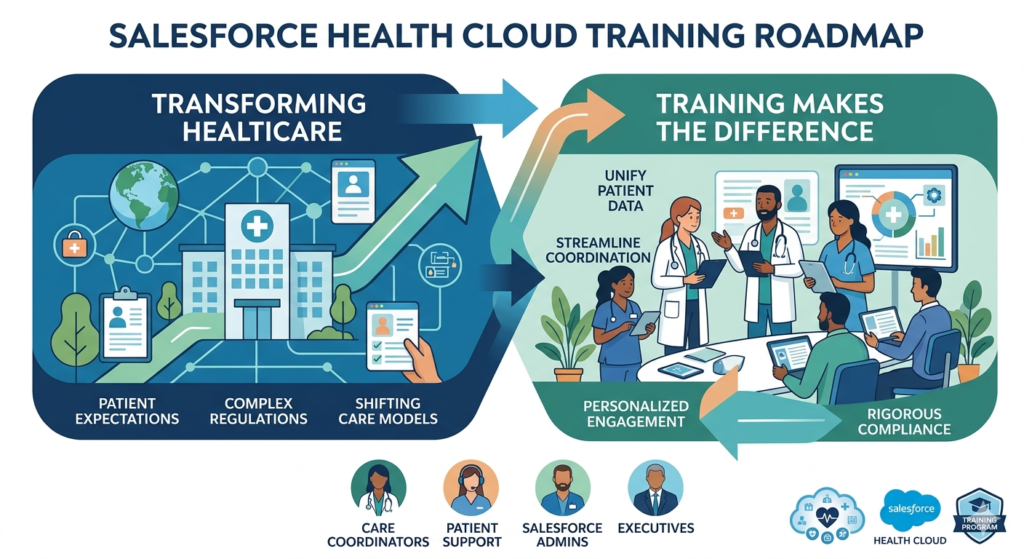
The most advanced technology in the world delivers limited value if the clinical teams, administrative staff, care coordinators, and IT professionals using it every day are not properly trained. And critically, generic Salesforce training — the kind designed for sales teams in retail or financial services — is simply not adequate for the regulated, patient-centered, compliance-driven environment of healthcare.
Healthcare professionals need salesforce training for healthcare programs that reflect their actual workflows, speak their clinical and operational language, respect the sensitivity of protected health information (PHI), and address the specific features, configurations, and automation capabilities of Salesforce Health Cloud. They need training that prepares them not just to use a software platform, but to transform how they deliver care and engage patients through that platform.
This blog post provides a detailed roadmap for building or selecting a health cloud training program that equips every member of your healthcare organization — from care coordinators and patient support specialists to Salesforce admins, developers, and executives — with the role-specific skills and knowledge they need to maximize the value of Salesforce Health Cloud. Let us explore what that training looks like, module by module.
Why Healthcare Organizations Need Specialized Salesforce Training
Before examining the specific modules of a healthcare Salesforce training curriculum, it is worth understanding why the stakes are so high and why specialized training is not optional — it is essential.
Improving Patient Engagement and Communication
Salesforce Health Cloud gives healthcare organizations powerful tools for personalized, omnichannel patient outreach — appointment reminders, care follow-ups, health education campaigns, and chronic disease management communications. But these capabilities only improve patient engagement when staff members know how to configure, manage, and optimize them. Poorly trained staff may underuse these features, use them incorrectly, or create communications that feel impersonal or poorly timed. Targeted healthcare CRM training ensures your teams can leverage every patient engagement capability that Health Cloud offers.
Streamlining Care Coordination
Care coordination is one of the most complex and high-stakes workflows in healthcare. It involves multiple clinicians, care team members, external providers, and administrative staff working together across organizational boundaries to manage a patient’s care journey. Salesforce Health Cloud’s care plan, case management, and referral management features are specifically designed to support this complexity — but only trained teams can use them effectively. Without proper training, care coordinators default to familiar but inefficient tools like phone calls, spreadsheets, and email chains, defeating the purpose of implementing a sophisticated Health Cloud environment.
Maintaining Data Security and HIPAA Compliance
In healthcare, inadequate Salesforce training is not just an operational risk — it is a regulatory and legal risk. The Health Insurance Portability and Accountability Act (HIPAA) requires that organizations maintain strict controls over how protected health information is accessed, shared, stored, and audited. Salesforce provides powerful compliance tools including role-based access controls, field-level security, consent management frameworks, and comprehensive audit trails. But these tools only protect patient data if the staff using them understand how they work and why they matter. HIPAA-compliant Salesforce training is therefore not a nice-to-have addition to your curriculum — it is a foundational requirement.
Increasing Staff Productivity
Healthcare organizations operate under constant pressure to do more with less. Administrative burdens, manual data entry, and inefficient workflows consume time that clinical staff would rather spend on patient care. Salesforce Health Cloud’s automation capabilities — built on Salesforce Flow — can eliminate enormous amounts of repetitive manual work. But automation only happens when trained administrators and developers know how to build it, and when end users know how to trigger and interact with automated workflows correctly.
Maximizing Health Cloud Return on Investment
Enterprise software investments of the scale typically associated with Salesforce Health Cloud implementation represent significant financial commitments. Licensing costs, implementation fees, integration investments, and ongoing administration expenses add up quickly. The return on that investment depends almost entirely on whether your teams adopt the platform effectively and use it to its full capability. A robust health cloud training program is the most direct lever an organization has to maximize that return.
What Is Included in a Health Cloud Training Program? An Overview
A well-designed healthcare Salesforce training program is not a single course or a one-day workshop. It is a structured curriculum of interconnected learning modules, delivered across multiple formats — live instructor-led sessions, self-paced digital learning, sandbox practice environments, and scenario-based simulation — that together build comprehensive platform competency across every role in the organization.
Here is a detailed look at the eight core modules that should form the foundation of every healthcare Salesforce training program:
Module 1: Salesforce Health Cloud Fundamentals
Who it is for: All staff who will use Salesforce Health Cloud in any capacity — clinical, administrative, and technical.
Why it matters: Before any healthcare professional can use Salesforce Health Cloud effectively, they need a solid understanding of how the platform is structured and what makes it different from standard Salesforce or any other CRM they may have used before. This foundational module sets the stage for everything that follows.
Core Topics Covered:
The Health Cloud Data Model
Salesforce Health Cloud is built on a specialized data model that extends the standard Salesforce object structure to support healthcare-specific concepts. Training must cover how standard objects like Accounts, Contacts, and Cases are extended and related to Health Cloud-specific objects including Patient, Member, Care Plan, Care Team, Medical Record, and Episode of Care. Understanding this data model is essential for everyone from care coordinators creating patient records to administrators building reports and developers writing automation logic.
Patient and Member Profiles
Health Cloud’s unified patient profile brings together clinical data, contact information, communication history, care team assignments, and social determinants of health into a single, comprehensive view. Training in this area covers how to create, update, and navigate patient profiles, how to manage household and relationship networks, and how to use the person account model effectively for different patient population types.
Timeline Views
One of Health Cloud’s most clinically valuable features is the patient timeline — a chronological view of all interactions, clinical events, care activities, and communications associated with a patient. Training covers how to configure and read timeline views, how to filter timeline events by type or date range, and how to use timeline data to inform care decisions and patient conversations.
Clinical and Non-Clinical Data Management
Healthcare organizations work with a combination of clinical data (diagnoses, medications, allergies, lab results, care gaps) and non-clinical data (contact information, insurance details, appointment history, communication preferences). Module 1 training covers how both data types are represented in Health Cloud and how to maintain data quality and completeness across both domains.
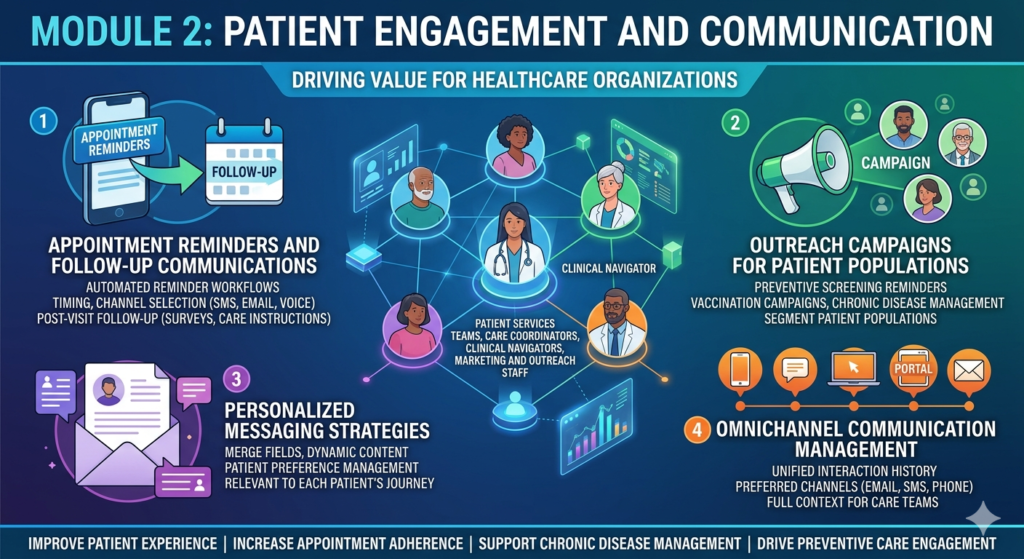
Module 2: Patient Engagement and Communication
Who it is for: Patient services teams, care coordinators, marketing and outreach staff, and clinical navigators.
Why it matters: Effective patient engagement is one of the primary value drivers of Salesforce Health Cloud for healthcare organizations. This module trains teams to leverage Health Cloud’s communication and outreach capabilities to improve patient experience, increase appointment adherence, support chronic disease management, and drive preventive care engagement.
Core Topics Covered:
Appointment Reminders and Follow-Up Communications
Training covers how to configure and manage automated appointment reminder workflows in Health Cloud, including the timing, channel selection (SMS, email, voice), and personalization logic that drives high reminder response rates. Post-visit follow-up communication workflows — including satisfaction surveys, care instruction delivery, and follow-up appointment scheduling prompts — are also covered in detail.
Outreach Campaigns for Patient Populations
Health Cloud integrates with Salesforce’s marketing automation capabilities to enable population health outreach campaigns — preventive screening reminders, vaccination campaigns, chronic disease management check-ins, and wellness program enrollment. Training covers how to build and execute these campaigns, how to segment patient populations based on clinical and demographic criteria, and how to measure campaign performance.
Personalized Messaging Strategies
Generic, impersonal patient communications drive low engagement. Training covers how to use Health Cloud’s personalization features — including merge fields, dynamic content, and patient preference management — to create communications that feel relevant and respectful of each patient’s individual health journey and communication preferences.
Omnichannel Communication Management
Modern patients expect to communicate with their healthcare providers through their preferred channels — whether that is email, SMS text, phone, patient portal, or even social messaging. Training covers how Health Cloud’s omnichannel capabilities bring all communication channels into a unified interaction history, ensuring that care teams always have full context when engaging with patients regardless of which channel the conversation started on.
Module 3: Care Coordination and Case Management
Who it is for: Care coordinators, case managers, social workers, clinical navigators, and care team managers.
Why it matters: Care coordination is arguably the most complex and consequential workflow that Salesforce Health Cloud is designed to support. This module is the most critical for clinical and care management staff, covering the tools and processes that directly impact patient outcomes and care team efficiency.
Core Topics Covered:
Care Plans
Salesforce Health Cloud’s care plan functionality allows care teams to create structured, goal-oriented plans for individual patients that include health goals, interventions, tasks, and progress tracking. Training covers how to create and customize care plan templates for different patient populations and conditions, how to assign tasks to care team members, how to document progress toward health goals, and how to use care plan data to inform clinical conversations and care transitions.
Task Management and Prioritization
Care coordinators typically manage large patient caseloads, making effective task management essential for ensuring no patient falls through the cracks. Training covers Health Cloud’s task management features including task creation, assignment, prioritization, due date management, and completion tracking. Best practices for managing high-volume task queues and identifying at-risk patients who require urgent attention are also covered.
Care Team Collaboration
Effective care coordination requires seamless collaboration among multidisciplinary care teams that may include physicians, nurses, social workers, pharmacists, community health workers, and administrative staff — often across different facilities or organizations. Training covers how to configure and manage care team assignments in Health Cloud, how to use Salesforce Chatter for secure internal communication within care teams, and how to maintain clear accountability for each care team role.
Referral Workflows
Managing patient referrals — from primary care to specialists, from hospital to post-acute care, or from clinical care to community services — is one of the most common and error-prone processes in healthcare. Training covers how to manage the full referral lifecycle in Health Cloud, including referral creation, status tracking, provider communication, referral completion documentation, and outcome measurement. Care coordination workflows for referral management represent one of the highest-impact areas where Health Cloud training can reduce care gaps and improve patient outcomes.
Module 4: HIPAA, Security, and Compliance
Who it is for: All staff who access patient data in Salesforce, with advanced content for Salesforce administrators and developers.
Why it matters: This module is non-negotiable for every healthcare organization using Salesforce. HIPAA violations can result in fines ranging from $100 to $50,000 per violation, with annual maximum penalties of $1.9 million per violation category — not to mention the reputational damage and patient trust erosion that follows a data breach. HIPAA-compliant Salesforce training is a foundational requirement, not an optional addition.
Core Topics Covered:
Role-Based Access Controls
Salesforce provides a multi-layered security model that includes profiles, permission sets, sharing rules, and field-level security — all of which must be configured to ensure that each user can access only the patient data their role requires. Training covers how the Salesforce security model works, how to audit current access configurations, and how to design and implement a least-privilege access model that meets HIPAA’s minimum necessary standard.
Consent Management
Healthcare organizations must manage patient consent for treatment, communication, and data sharing in accordance with HIPAA and state privacy laws. Salesforce Health Cloud includes consent management features that track the status, scope, and expiration of patient consents. Training covers how to configure consent management workflows, how to associate consent records with patient profiles, and how to enforce consent restrictions in automated communications and data sharing processes.
Audit Trails and Compliance Monitoring
HIPAA requires that healthcare organizations maintain audit logs of who accessed or modified patient records and when. Salesforce’s field history tracking and Setup Audit Trail features provide this capability. Training covers how to configure field history tracking for PHI-containing objects, how to run and interpret audit trail reports, and how to respond to potential security incidents or compliance investigations using Salesforce audit data.
Data Sharing Controls and PHI Protection
Training covers Salesforce’s data sharing architecture including organization-wide defaults, sharing rules, manual sharing, and territory management — and how these settings must be configured to protect PHI in compliance with HIPAA’s access control requirements. Practical exercises include reviewing and auditing existing sharing configurations and identifying potential PHI exposure risks.
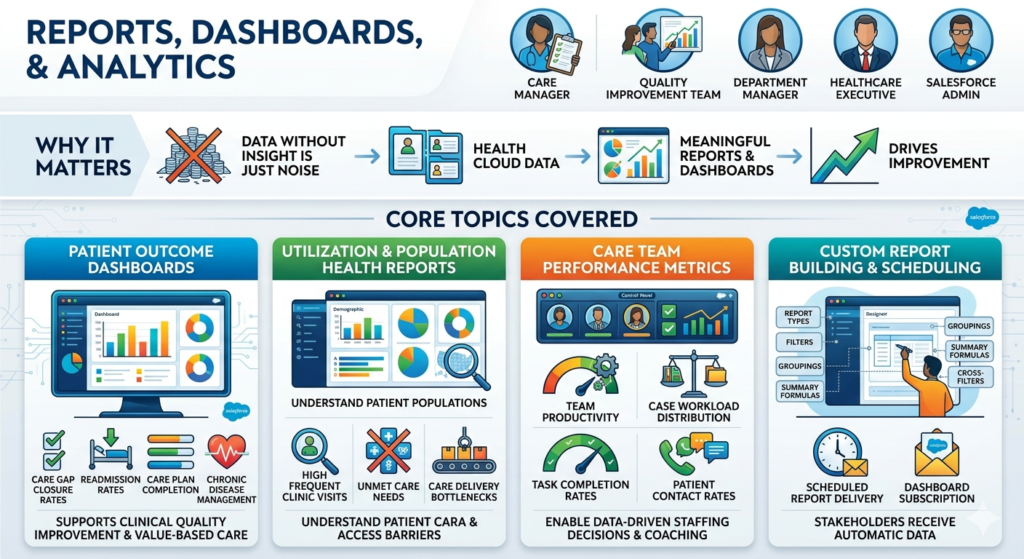
Module 5: Reports, Dashboards, and Analytics
Who it is for: Care managers, quality improvement teams, department managers, healthcare executives, and Salesforce admins.
Why it matters: Data without insight is just noise. Salesforce Health Cloud generates enormous volumes of patient, care, and operational data — but this data only drives improvement when it is organized into meaningful reports and dashboards that support clinical and operational decision-making. This module trains healthcare professionals to transform raw Salesforce data into actionable intelligence.
Core Topics Covered:
Patient Outcome Dashboards
Training covers how to build and interpret patient outcome dashboards that track key metrics such as care gap closure rates, readmission rates, care plan completion rates, chronic disease management metrics, and patient risk stratification. These dashboards support clinical quality improvement initiatives and value-based care performance management.
Utilization and Population Health Reports
Healthcare administrators and quality teams need to understand how their patient populations are using services — which patients are high utilizers, which populations have unmet care needs, and where care delivery bottlenecks are creating access barriers. Training covers how to build utilization reports segmented by population, condition, geography, insurance status, and care team.
Care Team Performance Metrics
Managers overseeing care coordination teams need visibility into team productivity, case workload distribution, task completion rates, and patient contact rates. Training covers how to build care team performance dashboards that enable data-driven staffing decisions, individual coaching conversations, and workload balancing.
Custom Report Building and Scheduling
Training covers the fundamentals of Salesforce report building — including report types, filters, groupings, summary formulas, and cross-filters — specifically applied to Health Cloud data objects. Scheduled report delivery and dashboard subscription features are also covered so that relevant stakeholders receive the data they need automatically.
Module 6: Automation with Salesforce Flow
Who it is for: Salesforce administrators, developers, and advanced power users; conceptual awareness training for care coordinators and managers who work with automated workflows.
Why it matters: Automation is where Salesforce Health Cloud’s efficiency promise becomes operational reality. Patient engagement automation and clinical workflow automation built on Salesforce Flow can eliminate hours of manual work per care team member per week, reduce human error in critical patient communication processes, and ensure that no patient follow-up or care intervention falls through the cracks. This module is one of the highest-ROI components of any health cloud training program.
Core Topics Covered:
Patient Intake Automation
Training covers how to build intake automation flows that trigger when new patient records are created in Health Cloud — automatically assigning care team members, creating initial care plan tasks, scheduling welcome communications, and populating risk assessment flags based on incoming patient data. Properly designed intake automation dramatically reduces the administrative burden on care coordinators during the critical initial patient engagement phase.
Automated Follow-Up Workflows
Follow-up communications are one of the most impactful and most commonly neglected aspects of patient engagement. Training covers how to build time-based automation flows that trigger follow-up tasks and communications at clinically appropriate intervals — post-discharge follow-ups, chronic disease management check-ins, care plan milestone notifications, and overdue appointment reminders.
Escalation Processes
Not all patients respond to standard outreach, and some develop urgent health needs that require rapid care team intervention. Training covers how to build escalation automation that identifies patients who have not responded to outreach, whose risk scores have increased, or who have triggered clinical alert criteria — and automatically escalates these cases to senior care team members or creates urgent task records for immediate action.
Flow Builder Fundamentals for Healthcare
For Salesforce admins, training covers the core capabilities of Salesforce Flow Builder — including screen flows, auto-launched flows, scheduled flows, and record-triggered flows — specifically in the context of Healthcare Cloud use cases. Participants build and test multiple healthcare-specific flows in a sandbox environment, developing the practical skills needed to design and maintain automation independently after training.
Module 7: Integration Training
Who it is for: Salesforce administrators, developers, health IT leaders, and integration specialists.
Why it matters: Salesforce Health Cloud rarely operates in isolation. Most healthcare organizations integrate it with electronic health records (EHR) systems, patient portals, scheduling systems, billing platforms, population health management tools, and payer data sources. Integration training ensures that the technical teams responsible for building and maintaining these connections understand both the Salesforce side of the architecture and the healthcare data standards that govern health information exchange.
Core Topics Covered:
EHR Integration Concepts and Patterns
Training covers the common architectural patterns used to integrate Salesforce Health Cloud with EHR systems such as Epic, Cerner, Meditech, and Athenahealth — including real-time API integration, batch data synchronization, event-driven triggers, and middleware-based integration using platforms like MuleSoft. Participants learn how to evaluate integration architecture options against performance, reliability, and compliance requirements.
HL7 and FHIR Standards Fundamentals
HL7 (Health Level Seven) and FHIR (Fast Healthcare Interoperability Resources) are the dominant standards for health information exchange. Training covers the fundamentals of both standards — including FHIR resource types, RESTful API concepts, HL7 v2 message structures, and how Salesforce Health Cloud’s native FHIR support enables standards-based data exchange with EHR and payer systems. While deep technical proficiency in HL7/FHIR requires specialized expertise, all health IT professionals working with Health Cloud integrations benefit from foundational literacy in these standards.
Third-Party Connector Configuration
Healthcare organizations use a wide ecosystem of third-party applications that must be connected to Salesforce Health Cloud — including telehealth platforms, remote patient monitoring tools, scheduling applications, and patient satisfaction survey systems. Training covers how to evaluate and configure third-party connectors from the Salesforce AppExchange, including authentication setup, field mapping, error handling, and ongoing monitoring.
Module 8: Role-Based Learning Paths
Who it is for: All healthcare staff — differentiated by role and function.
Why it matters: A single, one-size-fits-all Salesforce training program does not work for a healthcare organization whose Salesforce users include everyone from bedside clinical navigators to database administrators to C-suite executives. Effective healthcare staff enablement requires role-based learning paths that give each group the specific skills and knowledge they need for their particular use of Health Cloud — without burdening them with irrelevant content that reduces engagement and increases training time.
Role-Based Learning Path Recommendations:
Care Coordinators
Core modules: Health Cloud Fundamentals, Care Coordination and Case Management, Patient Engagement and Communication, Reports and Dashboards (basic), HIPAA Compliance fundamentals. Focus: Day-to-day care plan management, patient outreach, task management, and referral processing.
Patient Support and Service Teams
Core modules: Health Cloud Fundamentals, Patient Engagement and Communication, HIPAA Compliance fundamentals, Reports and Dashboards (basic). Focus: Inbound patient communication management, appointment coordination, issue resolution, and omnichannel interaction history.
Salesforce Administrators
Core modules: All eight modules with advanced depth in Security and Compliance, Automation with Flow, Integration Training, and Reports and Dashboards. Focus: Platform configuration, security administration, automation design, report building, and user support.
Developers
Core modules: Health Cloud Fundamentals (data model deep dive), Integration Training, Automation with Flow (advanced), Security and Compliance (API and data layer). Focus: Custom development, API integration, advanced automation, and Health Cloud extension development.
Healthcare Executives and Department Leaders
Core modules: Health Cloud Fundamentals (strategic overview), Reports and Dashboards (executive focus), HIPAA Compliance (governance responsibilities). Focus: Strategic platform value, executive dashboard literacy, compliance governance, and ROI measurement.
Key Salesforce Training KPIs for Healthcare Organizations
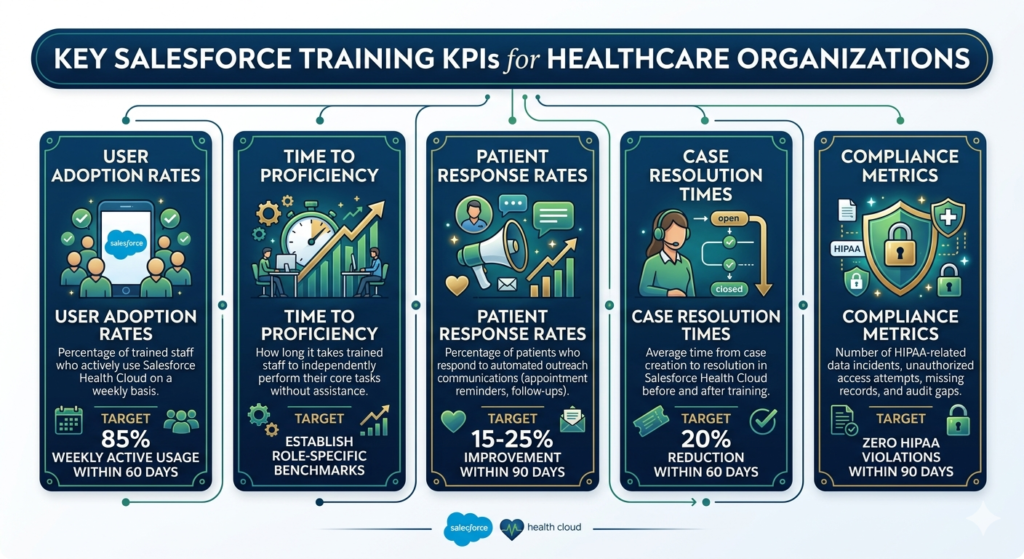
Measuring the effectiveness of your healthcare Salesforce training is as important as the training itself. Here are the most critical Salesforce training KPIs for healthcare organizations:
User Adoption Rates
Track the percentage of trained staff who actively use Salesforce Health Cloud on a weekly basis following training completion. Segment adoption by role, department, and facility to identify pockets of low adoption that require additional support or reinforcement training.
Target: 85% weekly active usage among trained users within 60 days of training completion.
Time to Proficiency
Measure how long it takes trained care coordinators, patient support staff, and administrators to independently perform their core Health Cloud tasks without supervisory assistance following training completion.
Target: Establish role-specific proficiency benchmarks and track improvement in ramp-up time across successive training cohorts.
Patient Response Rates
Track the percentage of patients who respond to automated outreach communications — appointment reminders, care follow-ups, and health education campaigns — before and after training. Improvements in patient response rates indicate that training has enabled staff to configure and deploy more effective patient engagement automation.
Target: Measure pre- and post-training patient response rates for key communication types and target a 15-25% improvement in response rates within 90 days.
Case Resolution Times
For care coordination and patient services teams, track the average time from case creation to case resolution in Salesforce Health Cloud before and after training. Faster resolution times indicate improved platform proficiency and workflow efficiency.
Target: Target a 20% or greater reduction in average case resolution time within 60 days of care coordination training completion.
Compliance Metrics
Track the number of HIPAA-related data access incidents, unauthorized PHI access attempts, missing consent records, and audit trail gaps before and after HIPAA compliance training. The goal is not just to reduce incidents — it is to build a culture of compliance that makes data protection second nature for every Health Cloud user.
Target: Zero HIPAA violations attributable to inadequate training or user error within 90 days of comprehensive compliance training completion.
Best Practices for Healthcare Salesforce Training
A technically complete training curriculum is necessary but not sufficient for training success. Here are the best practices that separate excellent healthcare Salesforce training programs from average ones:
Use Healthcare-Specific Scenarios and Workflows
Nothing undermines healthcare training engagement faster than examples that feel irrelevant. Effective training uses realistic, role-appropriate healthcare scenarios — a care coordinator managing a post-discharge patient follow-up, an admin configuring consent management for a new patient population, a developer building an EHR integration for lab results. When learners recognize their actual workflows in training scenarios, knowledge transfer to the real work environment is dramatically faster and more durable.
Include Compliance-Focused Exercises Throughout
Rather than isolating HIPAA compliance content in a single module, weave compliance considerations throughout every module of the training curriculum. Every exercise involving patient data should reinforce proper access controls, appropriate data handling, and documentation requirements. This integration approach builds compliance awareness as a natural part of how staff think about Health Cloud usage — not as a separate compliance checkbox.
Provide Sandbox Practice Environments
There is no substitute for hands-on practice in a safe environment. Healthcare organizations should provision dedicated Health Cloud sandbox environments — populated with realistic but completely de-identified patient data — that allow training participants to practice every skill they learn without any risk to real patient data or production system stability. Sandbox practice time should represent at least 40-50% of total training time for technical and administrative roles.
Measure Post-Training Adoption and Performance
As covered in the KPIs section above, measurement is not optional. Build a measurement plan — including baselines, KPI selection, and review intervals — into every training program before it launches. Schedule 30-day and 60-day post-training adoption reviews and share results with department managers and L&D leaders to drive accountability.
Offer Ongoing Support and Reinforcement
Training is not a one-time event — it is the beginning of a continuous learning journey. Effective healthcare Salesforce training programs include post-training support mechanisms such as office hours with Salesforce administrators, a searchable knowledge base of healthcare Health Cloud how-to guides, peer learning communities, and refresher training sessions for new features or workflow updates. Ongoing support is especially important for healthcare organizations where staff turnover creates continuous waves of new platform users who need onboarding.
Common Challenges in Healthcare Salesforce Training and How to Overcome Them
Challenge 1: Resistance to Change Among Clinical Staff
Clinical professionals — particularly those with long-established workflows — may resist adopting new technology platforms, especially if they perceive Salesforce Health Cloud as an administrative burden rather than a clinical productivity tool. Solution: Engage clinical champions early in the training design process to shape content around real clinical pain points. Frame every training module around the question “How does this make your job easier or your patients better cared for?” Involve respected clinical leaders as internal advocates and role models for platform adoption.
Challenge 2: Complex Integrations Create Training Uncertainty
When Health Cloud integrations with EHR systems are incomplete or unstable at the time of training, end users often encounter data discrepancies or workflow gaps that undermine their confidence in the platform. Solution: Sequence training to begin after core integrations have been tested and stabilized. For organizations that must train before integrations are complete, clearly communicate what data will and will not be available in Health Cloud at launch, and plan refresher training once integrations are live.
Challenge 3: Security Concerns About PHI in Training Environments
Healthcare organizations are understandably cautious about using real patient data in any training context — even internal training. Solution: Invest in a properly configured sandbox environment with fully synthetic or de-identified patient data that mirrors the complexity and variety of your actual patient population. Work with your compliance and legal teams to establish clear policies for sandbox data governance before training launches.
Challenge 4: Serving a Diverse Learner Population
Healthcare organizations include some of the most role-diverse workforces of any industry — from highly technical IT professionals to clinical staff with limited technology experience to administrative staff with varying digital literacy levels. A single training approach cannot serve all these learners effectively. Solution: Implement a role-based learning path structure as described in Module 8, differentiating content depth, technical complexity, and delivery format by role. Offer additional foundational digital skills support for less technology-confident clinical staff before introducing Health Cloud-specific training.
Why Partner with RizeX Labs for Healthcare Salesforce Training
Building a comprehensive, clinically relevant, HIPAA-compliant, and role-differentiated Salesforce Health Cloud training program from scratch is a significant undertaking that requires deep expertise in both Salesforce technology and healthcare operations. That is exactly where RizeX Labs makes the difference.
RizeX Labs is a specialized Salesforce training and enablement partner with deep experience designing and delivering customized healthcare Salesforce training programs for hospitals, health systems, specialty practices, and health plans. Our team combines Salesforce Health Cloud expertise with healthcare industry knowledge to build training curricula that reflect how your organization actually delivers care — not generic CRM training adapted from other industries.
What Makes RizeX Labs Different:
Healthcare-First Training Design: Every module, scenario, exercise, and assessment is designed specifically for healthcare workflows, compliance requirements, and patient engagement goals. Our trainers understand care coordination, HIPAA, EHR integration, and clinical operations — not just Salesforce platform mechanics.
Customized Role-Based Learning Paths: We work with your L&D team, department managers, and clinical leaders to design role-specific learning paths that give each staff group exactly what they need — and nothing that wastes their time.
Sandbox-Enabled Hands-On Practice: RizeX Labs configures dedicated Health Cloud sandbox environments populated with realistic, fully de-identified patient data so your teams can build genuine skills through practice — safely and confidently.
Compliance-Integrated Curriculum: HIPAA compliance is not an afterthought in our training programs — it is woven throughout every module, every exercise, and every assessment so that data protection becomes second nature for every Health Cloud user.
Ongoing Support and Measurement: Our engagement does not end when training is delivered. RizeX Labs provides post-training adoption monitoring, KPI dashboards, reinforcement training sessions, and continuous improvement consulting to ensure your Salesforce Health Cloud investment delivers lasting results.
Whether you are preparing for a Health Cloud go-live, expanding to new departments, rolling out new Health Cloud features, or addressing adoption gaps in an existing deployment, RizeX Labs has the healthcare Salesforce training expertise to meet you where you are and take your teams where they need to go.
Conclusion: Building a Healthier Future Through Better Salesforce Training
Salesforce Health Cloud represents a transformational opportunity for healthcare organizations to improve patient experiences, streamline care coordination, and operate with greater efficiency and compliance confidence. But technology alone does not transform healthcare — people do. And people can only leverage powerful technology when they are properly trained to use it.
A structured, healthcare-specific, role-based health cloud training program is the bridge between your Salesforce investment and its full potential value. By covering the eight core modules outlined in this guide — from Health Cloud fundamentals and patient engagement automation through HIPAA compliance, analytics, Flow automation, and EHR integration — your organization can equip every team member with the skills, knowledge, and confidence they need to deliver better care through Salesforce.
The organizations that will lead the future of patient-centered healthcare are those that invest not only in the right technology, but in the right training to make that technology work. Start building that training foundation today.
About RizeX Labs
At RizeX Labs, we specialize in delivering industry-focused Salesforce training programs that help healthcare organizations build the skills needed to maximize their investment in Salesforce Health Cloud and related technologies. Our training combines deep Salesforce expertise, healthcare domain knowledge, and hands-on learning tailored to real-world clinical and operational workflows.
We empower hospitals, clinics, payers, and healthcare service providers to improve patient engagement, streamline care coordination, and maintain compliance through structured salesforce training healthcare programs.
Our customized healthcare salesforce training approach ensures every learner gains practical experience with the most important modules included in a comprehensive health cloud training program.
Internal Linking Opportunities:
External Linking Opportunities:
- Salesforce official website: Salesforce
- Salesforce Health Cloud overview: Salesforce Health Cloud
- Trailhead Health Cloud modules: Trailhead by Salesforce
- HIPAA overview: U.S. Department of Health & Human Services HIPAA Guidance
- HL7 standards: HL7 International
- FHIR standard: FHIR Specification
Quick Summary
Healthcare organizations need specialized Salesforce training to effectively use Health Cloud for patient engagement, care coordination, and regulatory compliance. A structured salesforce training healthcare program typically includes key modules such as Health Cloud fundamentals, patient data management, care plans, automation, reporting, security, and integration concepts.
By investing in targeted healthcare salesforce training, hospitals and healthcare providers can equip teams with the skills needed to streamline workflows, improve patient experiences, and ensure secure data handling. A well-designed health cloud training program enables organizations to accelerate adoption and realize faster returns from their Salesforce investment.
