
Introduction: The Readiness Gap That Determines Enterprise AI Success
Salesforce Agentforce represents one of the most significant shifts in enterprise technology in the past decade. For the first time, organizations can deploy autonomous AI agents directly within their Salesforce environment—agents capable of handling customer service inquiries, qualifying sales leads, resolving IT support tickets, and driving internal productivity without constant human intervention. The promise is extraordinary, and the early results from organizations that have deployed Agentforce correctly are genuinely compelling.
But here is the uncomfortable truth that every CIO, Salesforce architect, and enterprise transformation leader needs to hear: the technology alone will not deliver results. Across enterprises that have rushed AI adoption without adequate preparation, the story is frustratingly consistent. Agents return inaccurate responses. Business users distrust the outputs. Compliance teams raise red flags weeks into deployment. Adoption stalls. The ROI that looked so clear in the proof-of-concept phase evaporates in production.
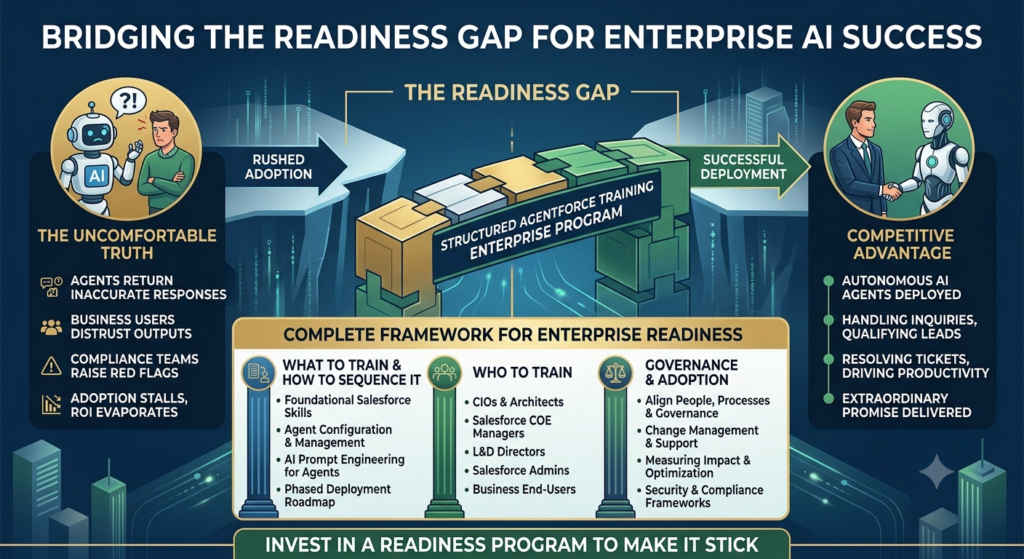
The difference between enterprises that succeed with Agentforce and those that struggle is not budget, headcount, or even the sophistication of their use cases. It is whether they invested in a structured agentforce training enterprise program that aligned people, processes, and governance before the first agent went live.
This guide is designed for the leaders and practitioners making that investment decision right now. Whether you are a CIO mapping an enterprise AI roadmap, a Salesforce Center of Excellence manager building internal capability, an L&D director designing corporate training curriculum, or a Salesforce Admin who will be configuring agents in the trenches, you will find here a complete framework for enterprise Agentforce readiness—covering what to train, who to train, how to sequence it, and how to choose the right training partner to make it stick.
What Is Agentforce and Why Enterprise Teams Need Training
Before exploring training strategy, it is worth establishing a precise understanding of what Agentforce actually is—because many enterprise teams are working from incomplete or outdated mental models of Salesforce AI, and that misunderstanding is itself a readiness risk.
Agentforce Capabilities at a Glance
Autonomous AI Agents
Agentforce enables organizations to build and deploy AI agents that can reason across multi-step tasks, make decisions based on business rules and data context, and take actions within Salesforce workflows—all with minimal or no human intervention for routine interactions. These are not chatbots following decision trees. They are reasoning systems capable of understanding intent, retrieving relevant information, and executing appropriate actions.
Integration with Salesforce Data Cloud
Agentforce draws on Salesforce Data Cloud to ground agent responses in unified, real-time customer and business data. This means agents can access a 360-degree customer profile, recent interaction history, product ownership data, and behavioral signals when formulating responses or triggering actions. Without properly governed and structured data in Data Cloud, agent performance degrades significantly—which is why data readiness is a central component of enterprise training programs.
Prompt and Action Orchestration
Agentforce agents operate through prompt templates that guide reasoning, and action frameworks that determine what the agent can do—such as updating a Salesforce record, sending an email, escalating a case, or triggering a Flow. Building effective prompts and well-structured action libraries requires a combination of technical skill, business domain knowledge, and understanding of AI behavior that most enterprise teams do not have on day one.
Einstein Trust Layer and Security Controls
One of Agentforce’s most important enterprise features is the Einstein Trust Layer, which provides data masking, toxicity filtering, audit logging, and zero-data-retention guarantees for LLM interactions. This is the infrastructure that makes Agentforce viable for regulated industries. But leveraging it effectively requires that security, compliance, and architecture teams understand how it works—and that requires training.
Why Corporate Agentforce Training Is Non-Negotiable at Enterprise Scale
The capabilities described above are powerful. They are also complex. Enterprise environments add additional layers of complexity: multiple Salesforce clouds, large volumes of legacy data, sophisticated permission structures, regulatory obligations, cross-functional stakeholder groups, and organizational change dynamics that no technology vendor can fully anticipate.
Corporate Agentforce training bridges the gap between what the platform can do and what your specific organization needs it to do. It ensures that the people designing agents understand AI behavior. It ensures that the people governing agents understand the risks. It ensures that the business users interacting with agents trust them enough to actually use them. And it ensures that the metrics and monitoring frameworks are in place to continuously improve agent performance after go-live.
Without that foundation, even the most technically sophisticated Agentforce implementation will underperform.
Why Enterprise AI Projects Fail Without Training
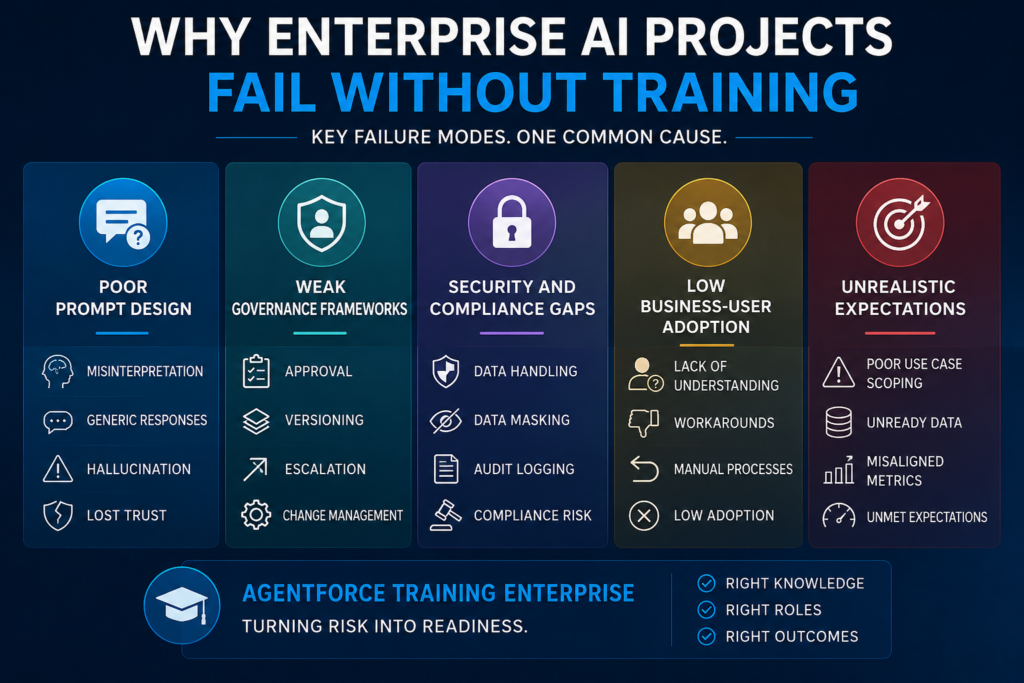
Understanding the failure modes of enterprise AI projects is not pessimism—it is strategic risk management. These patterns appear consistently across industries, and they are almost always traceable to insufficient preparation rather than technology limitations.
Poor Prompt Design
Prompt engineering is a genuine discipline. In an enterprise context, poorly designed prompts produce agents that misinterpret customer intent, return generic responses that fail to address specific business scenarios, or hallucinate information that undermines user trust. Teams that go into Agentforce deployment without structured prompt training tend to discover these problems in production, where the cost of remediation is high and the reputational damage is already done.
Weak Governance Frameworks
Enterprise AI requires clear governance: who approves agent behaviors, how are prompt templates versioned and reviewed, what is the escalation path when an agent response is flagged as inappropriate, and how are changes to agent configuration managed across development, staging, and production environments? Without training that explicitly addresses governance design, these questions get answered inconsistently—or not at all—and the result is operational risk that grows with every new agent deployed.
Security and Compliance Gaps
Regulated industries—financial services, healthcare, public sector, manufacturing—have specific requirements around data handling, auditability, and explainability that must be reflected in Agentforce configuration. Teams that have not been trained on the Einstein Trust Layer, data masking capabilities, and audit logging often configure agents in ways that create compliance exposure without realizing it. This is not a hypothetical risk; it is a pattern that has triggered costly remediation projects at multiple large enterprises.
Low Business-User Adoption
Technology adoption is a human challenge as much as a technical one. Business users who do not understand what Agentforce agents are doing, why they can be trusted, and how to interact with them effectively will find workarounds, revert to manual processes, or simply ignore the investment. End-user training—focused not on technical configuration but on effective interaction, feedback mechanisms, and understanding agent limitations—is consistently the most underfunded component of enterprise AI programs, and its absence is a primary driver of poor adoption metrics.
Unrealistic Expectations
Without training that grounds leadership teams in realistic AI capabilities and limitations, Agentforce projects often launch with expectations that the technology cannot meet—not because the technology is poor, but because the use cases were not properly scoped, the data was not ready, or the success metrics were not aligned with what AI can actually deliver. Structured AI training Salesforce teams ensures that expectation alignment happens before deployment, not after.
A focused agentforce training enterprise program directly addresses each of these failure modes—not by eliminating risk, but by ensuring that every role involved in Agentforce deployment has the knowledge to manage that risk intelligently.
Enterprise Agentforce Readiness Checklist
Before a single training session begins, enterprise teams benefit from an honest readiness assessment. The following checklist covers the dimensions that determine whether an organization is positioned to benefit from corporate Agentforce training and execute a successful deployment.
✅ Salesforce Platform Maturity
- Salesforce org is on a supported release with Agentforce features enabled
- Core Salesforce objects (Account, Contact, Case, Opportunity) are properly configured and maintained
- Flows, Apex classes, and automation are documented and understood by the admin team
- Einstein features (if previously enabled) have been reviewed for compatibility
- Sandbox environments are available and properly configured for agent testing
✅ Data Quality and Access Controls
- Customer and business data in Salesforce is current, complete, and deduplicated
- Salesforce Data Cloud is implemented or planned as part of the Agentforce architecture
- Data access permissions are granular and role-appropriate
- Sensitive data fields are identified and appropriate masking/restriction policies are in place
- Data lineage documentation exists for key objects used by planned agents
✅ Defined Business Use Cases
- Two to three priority use cases for Agentforce have been identified and scoped
- Success metrics for each use case are defined and measurable
- Business process owners have been identified for each use case
- Expected interaction volume and complexity have been estimated
- Escalation and fallback scenarios have been mapped for each use case
✅ Security and Compliance Requirements
- Regulatory obligations relevant to AI systems have been documented (GDPR, HIPAA, SOX, etc.)
- Einstein Trust Layer capabilities have been reviewed against compliance requirements
- Security review process for AI agent configuration has been defined
- Audit logging requirements have been specified
- Data residency requirements have been confirmed with Salesforce account team
✅ Cross-Functional Ownership
- Executive sponsor for Agentforce program has been identified
- Salesforce Center of Excellence (or equivalent) is engaged and informed
- Business stakeholders are actively participating in use case definition
- Legal and compliance teams have been briefed on Agentforce capabilities and risks
- IT security team is involved in architecture review
✅ Change Management Planning
- Communication plan for Agentforce rollout exists
- Training program has been designed with role-based tracks
- Feedback mechanisms for end users and business teams are planned
- KPIs for adoption and performance have been defined
- Post-go-live support and iteration process has been established
Organizations that complete this checklist and identify gaps are in a much stronger position to structure their corporate Agentforce training program around the specific readiness challenges they face.
Role-Based Agentforce Training Path
One of the most common mistakes in enterprise AI training programs is treating all participants as a uniform audience. The roles involved in Agentforce deployment have fundamentally different responsibilities, different technical backgrounds, and different learning objectives. Effective agentforce training enterprise programs are segmented by role—ensuring that each participant receives the depth and context appropriate to their function.
🔧 Salesforce Admins
Learning Focus: Configuration, prompt template management, agent testing, monitoring, and iteration.
Admins are typically the hands-on builders and maintainers of Agentforce agents. Their training should cover:
- Agentforce setup and configuration within Salesforce org
- Prompt template creation and optimization
- Action library configuration and testing
- Agent behavior monitoring and performance dashboards
- Integration with Flows, Apex, and external systems
- Troubleshooting common agent errors
Recommended Depth: Intermediate to advanced. Admins need working proficiency, not just conceptual awareness.
💻 Developers
Learning Focus: Custom action development, API integrations, Apex extensions, and performance optimization.
Developers extend Agentforce capabilities beyond out-of-the-box functionality. Their training should cover:
- Agentforce architecture and component model
- Building custom Apex actions for agents
- API integrations with external systems
- Performance testing and optimization techniques
- Version control and deployment practices for agent configuration
- Security implementation at the code level
Recommended Depth: Advanced. Developers need technical depth across both Salesforce development and AI system behavior.
🏗️ Architects
Learning Focus: Enterprise architecture patterns, Data Cloud integration, trust and security framework, and scalability planning.
Architects make the foundational design decisions that determine whether Agentforce will scale effectively across the enterprise. Their training should cover:
- Agentforce architecture patterns for enterprise environments
- Data Cloud integration design and data model considerations
- Einstein Trust Layer architecture and configuration
- Multi-cloud Agentforce deployment patterns
- Governance framework design
- Performance and scalability planning
Recommended Depth: Advanced with enterprise architecture emphasis. Architects need a complete systems-level understanding.
📊 Business Analysts and Product Owners
Learning Focus: Use case design, requirements documentation, success metrics definition, and user story development for AI agents.
BAs and Product Owners translate business needs into agent requirements. Their training should cover:
- Agentforce capabilities and realistic limitations
- Use case assessment framework and prioritization
- Writing effective requirements for AI agent behavior
- Defining and measuring agent success metrics
- User acceptance testing for AI systems
- Stakeholder communication about AI capabilities
Recommended Depth: Intermediate. BAs need enough technical understanding to write accurate requirements without needing implementation skills.
🔒 Compliance and Security Teams
Learning Focus: Einstein Trust Layer, data privacy controls, audit capabilities, regulatory alignment, and risk assessment.
Compliance and security professionals are gatekeepers for responsible AI deployment. Their training should cover:
- Einstein Trust Layer capabilities and configuration
- Data masking, encryption, and access control for AI agents
- Audit log review and compliance reporting
- AI risk assessment frameworks
- Regulatory mapping for AI systems (GDPR, CCPA, industry-specific)
- Incident response procedures for AI-related issues
Recommended Depth: Targeted and compliance-specific. These teams need deep knowledge of governance mechanisms, not builder skills.
👥 End Users
Learning Focus: Effective interaction with AI agents, understanding agent capabilities and limitations, feedback submission, and escalation recognition.
End users—customer service representatives, sales teams, operations staff—are the humans working alongside Agentforce agents every day. Their training should cover:
- What Agentforce agents can and cannot do in their specific context
- How to review and act on agent outputs
- When and how to escalate from agent to human handling
- How to submit feedback on agent performance
- Data privacy considerations in AI-assisted workflows
- Building appropriate trust in AI-assisted decisions
Recommended Depth: Accessible and scenario-based. End users need practical confidence, not technical depth.
This role-based approach to agentforce training enterprise programs ensures that training resources are used efficiently and that each participant emerges with the specific competencies their role requires.
Core Topics Covered in Corporate Agentforce Training
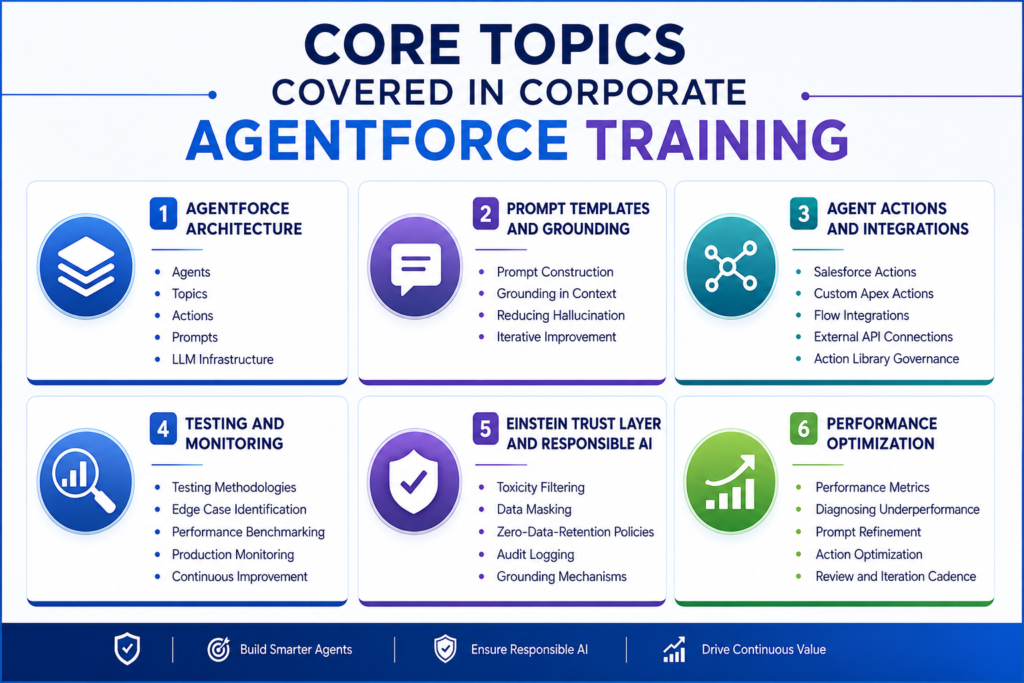
Regardless of role, enterprise Agentforce training programs share a set of foundational topic areas that every participant engages with at an appropriate level of depth. Here is what comprehensive corporate Agentforce training covers:
Agentforce Architecture
A thorough understanding of how Agentforce is structured—the relationship between agents, topics, actions, prompts, and the underlying LLM infrastructure—is foundational to every subsequent training topic. Teams that skip architecture fundamentals consistently struggle with troubleshooting, governance, and optimization.
Prompt Templates and Grounding
Prompt design is one of the highest-leverage skills in Agentforce implementation. Training covers the principles of effective prompt construction, techniques for grounding prompts in business-specific context, methods for reducing hallucination, and strategies for iterative prompt improvement based on performance data.
Agent Actions and Integrations
Actions define what an agent can actually do—the operations it can perform within Salesforce and in connected systems. Training covers standard Salesforce actions, custom Apex actions, Flow integrations, external API connections, and the governance framework for managing and approving action libraries.
Testing and Monitoring
Responsible AI deployment requires rigorous testing before go-live and continuous monitoring in production. Training covers agent testing methodologies, edge case identification, performance benchmarking, production monitoring dashboards, and the feedback loops that drive continuous improvement.
Einstein Trust Layer and Responsible AI
The Einstein Trust Layer is Salesforce’s answer to the question: “How do we ensure AI behaves appropriately and safely at enterprise scale?” Training covers every component of the Trust Layer—toxicity filtering, data masking, zero-data-retention policies, audit logging, and the grounding mechanisms that keep agent responses factually anchored.
Performance Optimization
Once agents are deployed, the work of improvement begins. Training covers the metrics that matter for agent performance, techniques for diagnosing underperformance, prompt refinement strategies, action optimization approaches, and the cadence of review and iteration that keeps agents delivering value as business conditions evolve.
Sample 4-Week Enterprise Agentforce Training Plan
For organizations implementing corporate Agentforce training as a structured program, the following four-week plan provides a proven sequencing framework. This plan assumes a blended learning approach combining instructor-led sessions, hands-on labs, self-paced modules, and collaborative working sessions.
Week 1: Agentforce Fundamentals and AI Concepts
Objective: Build a shared foundation of Agentforce knowledge and AI literacy across all participating roles.
Sessions:
- Day 1–2: Introduction to AI agents and Agentforce in enterprise context
- What are autonomous AI agents?
- Agentforce architecture overview (all roles, appropriate depth)
- Agentforce positioning within Salesforce AI ecosystem
- Einstein Trust Layer introduction
- Realistic expectations: what Agentforce can and cannot do
- Day 3–4: Use case foundations and readiness assessment
- Identifying and prioritizing enterprise use cases
- Data readiness for Agentforce
- Data Cloud integration fundamentals
- Governance and compliance overview
- Day 5: Role-specific breakouts begin
- Technical roles: Salesforce platform prerequisites review
- Business roles: Use case documentation workshop
- Compliance/Security roles: Trust Layer deep dive begins
Lab Activity: Participants explore a pre-configured Agentforce demo environment and document observations about agent behavior, limitations, and potential use cases relevant to their business.
Week 2: Build and Configure Agents
Objective: Develop hands-on proficiency in Agentforce configuration, prompt design, and action creation.
Sessions:
- Day 1–2: Prompt engineering fundamentals
- Prompt template structure and syntax
- Grounding techniques and context injection
- Common prompt errors and remediation
- Prompt testing methodology
- Day 3–4: Agent configuration and action development
- Building an agent from scratch in a sandbox environment
- Configuring standard and custom actions
- Integrating Flows and Apex with agent actions
- Managing topics and agent decision routing
- Day 5: Integration patterns and API connectivity
- External system integrations
- Data Cloud data activation for agents
- Permission and security configuration for actions
Lab Activity: Technical participants build a functional agent for a defined use case in a sandbox org. Business participants review and validate agent behavior against documented requirements. A structured feedback session captures gaps for Week 3 refinement.
Week 3: Governance, Security, and Testing
Objective: Ensure that agents being built meet enterprise security, compliance, and quality standards.
Sessions:
- Day 1–2: Security and compliance deep dive
- Einstein Trust Layer configuration for enterprise requirements
- Data masking and access control implementation
- Audit logging setup and review
- Regulatory mapping workshop (GDPR, HIPAA, SOX as applicable)
- Day 3: Governance framework design
- Agent lifecycle management
- Change control processes for agent configuration
- Prompt template versioning and approval workflows
- Cross-functional ownership model
- Day 4–5: Testing and quality assurance
- Agent testing methodology and test case design
- Edge case identification and handling
- User acceptance testing framework
- Performance benchmarking and baseline setting
Lab Activity: Participants conduct a structured security review of the agents built in Week 2, identify and remediate compliance gaps, and complete a full test cycle against defined acceptance criteria.
Week 4: Pilot Use Case Deployment and Review
Objective: Move from training environment to real-world deployment in a controlled pilot, with structured review and iteration.
Sessions:
- Day 1–2: Pilot deployment preparation
- Production readiness checklist review
- Deployment procedures and rollback planning
- End-user communication and training delivery
- Monitoring dashboard configuration
- Day 3: Pilot go-live (controlled environment with defined user group)
- Agent deployed to pilot user population
- Real-time monitoring active
- Support team on standby for escalations
- Day 4: Performance review and iteration
- Pilot data analysis: response quality, escalation rates, user satisfaction
- Prompt refinement based on production performance
- Action adjustments based on observed patterns
- Governance gap identification and remediation
- Day 5: Program review and roadmap planning
- Lessons learned documentation
- Expanded rollout planning
- Ongoing training and capability-building roadmap
- ROI measurement framework activation
Lab Activity: Each participating team presents their pilot results, documents what worked and what requires adjustment, and proposes a prioritized list of next-phase improvements.
This four-week structure delivers the depth and hands-on experience required for enterprise Agentforce readiness without requiring months of runway before value begins to materialize.
Benefits of Agentforce Training for Enterprise Teams
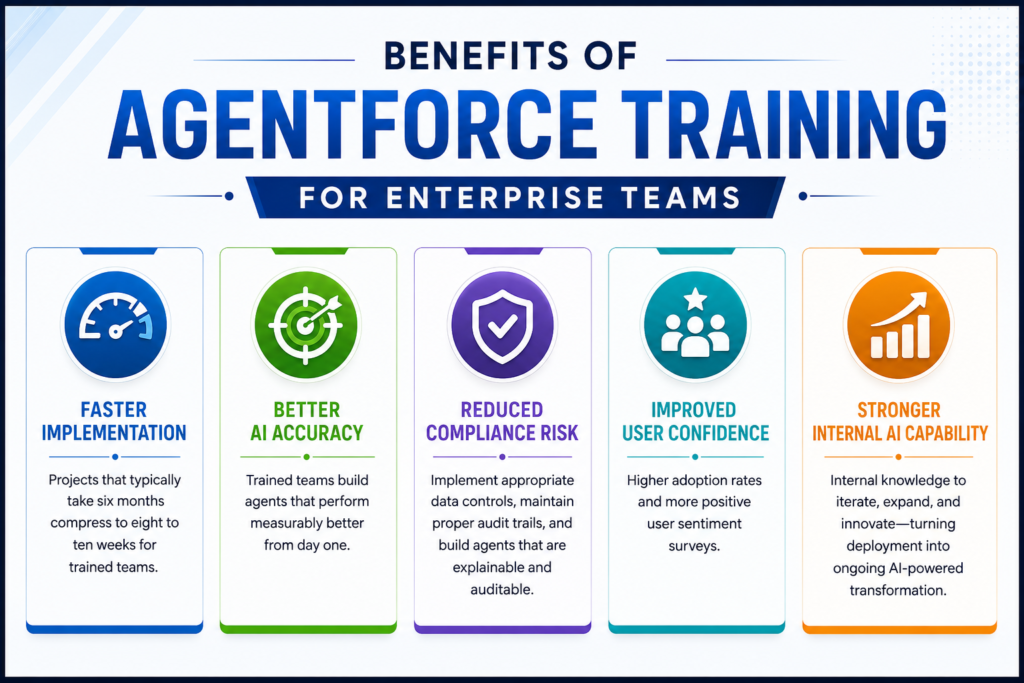
The case for investing in structured corporate Agentforce training goes well beyond risk avoidance. The organizations that train well do not just avoid failure—they create compounding advantages that amplify the ROI of their Agentforce investment over time.
Faster Implementation
Teams that enter Agentforce implementation with strong foundational training move significantly faster through design, build, and testing phases. They spend less time on trial-and-error prompt engineering, encounter fewer unexpected security issues, and require fewer cycles of stakeholder review because requirements were captured correctly from the beginning. Projects that typically take six months compress to eight to ten weeks for trained teams.
Better AI Accuracy
Agent accuracy is not just a function of model quality—it is a function of prompt quality, data quality, and action design. Trained teams build agents that perform measurably better from day one, because they understand the levers that drive accuracy and have the skills to pull them deliberately rather than hoping for good results.
Reduced Compliance Risk
For organizations in regulated industries, the cost of a compliance failure related to AI can dwarf the cost of the entire Agentforce implementation. Trained teams configure the Einstein Trust Layer correctly, implement appropriate data controls, maintain proper audit trails, and build agents that are explainable and auditable. The compliance risk reduction alone can justify the entire training investment for a single large deployment.
Improved User Confidence
AI adoption is ultimately a confidence game. Business users who have been trained on what agents can and cannot do, who have participated in pilot testing, and who have a clear feedback mechanism for reporting issues are dramatically more likely to trust and use AI-assisted workflows. Trained organizations consistently report higher adoption rates and more positive user sentiment surveys than those that deploy without adequate change management and user education.
Stronger Internal AI Capability
Perhaps the most lasting benefit of structured agentforce training enterprise programs is the internal capability that remains after training ends. Organizations that build deep Agentforce competency across their teams are not dependent on external consultants for every configuration change or optimization cycle. They have the internal knowledge to iterate, expand, and innovate—turning the initial Agentforce deployment into a platform for ongoing AI-powered transformation.
How to Choose the Right Corporate Agentforce Training Partner
Not all training providers are equal, and the stakes for enterprise AI training are high enough that partner selection deserves serious evaluation. Here is what to look for when assessing a corporate Agentforce training partner:
Salesforce AI Expertise
Your training partner should have deep, current expertise in Salesforce AI—not just general AI knowledge translated to Salesforce terminology. Look for evidence of Agentforce-specific implementation experience, Salesforce certification depth across the team, and ongoing engagement with Salesforce product roadmap developments.
Enterprise Delivery Experience
Corporate Agentforce training for a 10,000-person enterprise is a fundamentally different challenge than training a small team. Look for partners with documented experience delivering training programs at enterprise scale—managing large cohorts, coordinating across multiple time zones, adapting to complex organizational structures, and navigating enterprise procurement and compliance requirements.
Role-Based Curriculum
Generic AI training that does not account for the distinct needs of Admins, Developers, Architects, Business Analysts, and end users will not produce the role-specific competencies that enterprise deployment requires. Evaluate whether the training provider has genuinely differentiated learning tracks or is delivering one-size-fits-all content.
Hands-On Workshops
Conceptual understanding is necessary but insufficient for enterprise Agentforce readiness. The best corporate Agentforce training programs are built around hands-on labs in sandbox environments, structured working sessions where participants build real agents for realistic use cases, and guided practice with expert facilitators available to address questions in real time.
Post-Training Support
The four weeks of structured training are the beginning of the journey, not the end. Look for training partners who offer post-training support—office hours, technical Q&A channels, implementation review sessions, and access to expertise as teams move from training environments to production deployments.
The right corporate Agentforce training partner does not just deliver content—they invest in your organization’s long-term AI success.
Why Choose Tectonic Technologies for Enterprise Agentforce Training
At Tectonic Technologies, we have built our enterprise Agentforce training practice around one conviction: your teams deserve to be genuinely ready, not just technically briefed.
Our corporate Agentforce training programs are designed specifically for enterprise environments, with the complexity, scale, and regulatory considerations that enterprise organizations face built into every module. Here is what distinguishes our approach:
Deep Salesforce AI Implementation Expertise
Our trainers are not instructional designers who have read the Agentforce documentation. They are Salesforce architects, developers, and AI practitioners who have implemented Agentforce in production environments across financial services, healthcare, manufacturing, retail, and the public sector. The gap between documentation and reality is where our expertise lives.
Customized, Role-Based Curriculum
We do not deliver generic training. Every corporate Agentforce training engagement begins with a discovery process that maps your specific use cases, your organizational structure, your regulatory environment, and your existing Salesforce maturity to a curriculum that addresses your actual needs. Your Admins learn what your Admins need. Your Compliance team learns what your Compliance team needs.
Hands-On Labs with Real-World Scenarios
Every training track we deliver includes structured hands-on labs using sandbox environments configured to reflect your specific Salesforce architecture. Participants build agents, test them, break them, fix them, and deploy them—in a safe environment with expert guidance—before any of that activity happens in a production setting.
Enterprise Governance Guidance
Tectonic Technologies brings governance frameworks, compliance mapping tools, and change management resources that go beyond technical training. We help your organization answer the hard questions: who owns AI governance, how do you manage agent lifecycles, and how do you build the internal processes that keep Agentforce deployment responsible and effective as it scales.
Post-Training Implementation Support
Our engagement does not end when training sessions conclude. Tectonic Technologies offers post-training support packages that give your teams access to expert guidance as they move through pilot deployment, production go-live, and first-wave expansion. We are invested in your outcomes, not just your training completion rates.
When you partner with Tectonic Technologies for AI training Salesforce teams, you are investing in a relationship with a team that has navigated enterprise Agentforce deployment challenges across industries and brings that hard-won knowledge directly into your training program.
Conclusion: Structured Training Is the Foundation of Enterprise AI Success
Salesforce Agentforce is a genuinely transformative technology. Its ability to put autonomous, intelligent agents to work across service, sales, HR, and operations represents a step-change in what enterprise teams can accomplish. But transformative technology demands transformative preparation—and that preparation begins and ends with your people.
The organizations that will win with Agentforce over the next three to five years are not necessarily those with the biggest budgets or the most sophisticated initial use cases. They are the organizations that invested early in structured agentforce training enterprise programs that gave every role the specific knowledge, hands-on experience, and governance framework needed to deploy AI responsibly and effectively.
The readiness checklist, the role-based learning paths, the four-week training plan, and the partner selection guidance in this guide are designed to help you build exactly that foundation. The technology is ready. The business case is clear. The only question is whether your teams are ready to meet the moment.
About RizeX Labs
At RizeX Labs, we specialize in delivering cutting-edge Salesforce AI and enterprise training solutions, including comprehensive Agentforce training for enterprise teams. Our expertise combines deep Salesforce knowledge, practical implementation experience, and proven corporate learning methodologies to help organizations adopt AI with confidence.
We empower enterprises to transform their teams into AI-ready Salesforce professionals—from foundational Agentforce concepts to advanced agent design, governance, and deployment strategies that accelerate innovation and business productivity.
Internal Linking Opportunities:
External Linking Opportunities:
- Salesforce official website
- Salesforce Agentforce overview
- Salesforce Trailhead
- Salesforce AI and Einstein
- Salesforce Trust Layer
- Salesforce Help Documentation
- Gartner AI adoption insights
Quick Summary
Agentforce is Salesforce’s AI platform for building autonomous agents that can support sales, service, and business operations. However, successful implementation requires more than enabling the technology—it requires structured agentforce training enterprise programs that prepare teams with the right skills, governance practices, and operational readiness.
With well-designed corporate Agentforce training, organizations can equip Salesforce admins, developers, architects, and business stakeholders to design, deploy, and manage AI agents responsibly. This readiness guide outlines how AI training Salesforce teams can reduce risk, accelerate adoption, and maximize ROI from Salesforce AI initiatives.
