
Introduction
Here’s a truth that keeps CRM managers and enterprise IT leaders up at night: your organization is probably using less than 40% of Salesforce’s actual capabilities. According to Salesforce’s own research, the average enterprise leverages only a fraction of the platform’s features, leaving enormous value — and competitive advantage — sitting untouched on the table.
Now, here’s the paradox. Companies invest millions of dollars in Salesforce licenses, customizations, integrations, and consulting. They roll out training modules, send employees to Dreamforce, and hire certified admins and architects. And yet, adoption stalls. Innovation flatlines. Teams default to spreadsheets, manual workarounds, and the same tired workflows they’ve been running for years.
The problem isn’t the platform. Salesforce is arguably the most powerful and extensible CRM ecosystem on the planet. The problem is how organizations engage their people with the platform.
Enter the Salesforce internal hackathon — a structured, time-boxed innovation event that empowers your internal teams to explore, build, experiment, and solve real business problems using the Salesforce platform. It’s not just a fun team-building exercise (although it’s absolutely that, too). It’s a strategic initiative that accelerates platform adoption, surfaces hidden talent, fosters cross-functional collaboration, and generates production-ready solutions that can deliver measurable ROI.
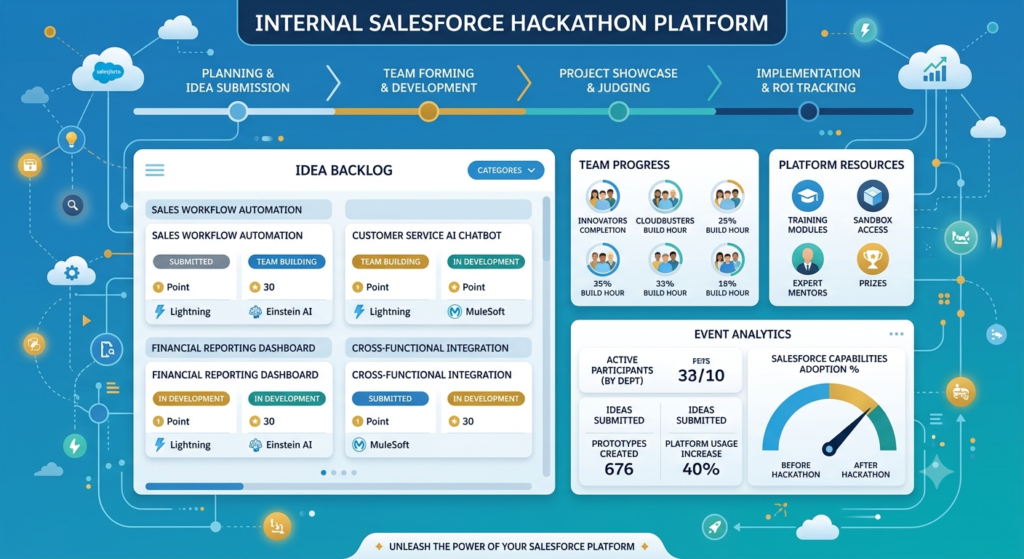
At RizeX Labs, we’ve helped enterprises across industries design and execute Salesforce innovation events that transform how teams interact with their CRM ecosystem. We’ve seen firsthand how a well-run internal Salesforce competition can shift an organization’s culture from passive platform consumption to active, enthusiastic innovation.
In this comprehensive guide, we’ll walk you through everything you need to know — from understanding why traditional adoption strategies fall short, to a detailed step-by-step framework for planning and executing a successful Salesforce hackathon, to measuring outcomes and avoiding common pitfalls. Whether you’re a Salesforce admin looking to energize your team, an architect exploring new ways to drive technical excellence, or an IT leader seeking a fresh approach to digital transformation, this guide is for you.
Let’s build something extraordinary.
Why Companies Struggle with Salesforce Adoption and Innovation
Before we dive into the mechanics of running a hackathon, it’s essential to understand the problem we’re solving. Salesforce adoption and innovation challenges aren’t unique to any one industry or company size — they’re systemic, and they stem from a handful of recurring patterns.
The Training-to-Action Gap
Most organizations approach Salesforce enablement through traditional training: classroom sessions, Trailhead modules, webinars, and documentation. These are valuable — Trailhead, in particular, is an exceptional resource. But there’s a well-documented gap between learning a concept in a training environment and applying it to solve a real business problem under real constraints.
Research from the Association for Talent Development suggests that only 12% of employees apply the skills learned in training to their actual jobs. The rest of that knowledge evaporates within weeks. It’s not a failure of the training itself — it’s a failure of context. People learn best when they’re solving problems they care about, under conditions that feel real and consequential.
Siloed Teams, Siloed Knowledge
In most enterprises, Salesforce knowledge is concentrated in a small group of admins and developers. Sales teams know their piece of the platform. Service teams know theirs. Marketing has their own corner. But rarely do these groups collaborate on cross-functional solutions. The result is a fragmented platform experience, redundant customizations, and missed opportunities for end-to-end process optimization.
Fear of Experimentation
Enterprise environments are inherently risk-averse. Production orgs are sacred. Change management processes are rigorous (and rightfully so). But this culture of caution can inadvertently stifle experimentation. When every change requires a business case, a requirements document, a sprint cycle, and a CAB review, the barrier to trying new ideas becomes prohibitively high. Employees stop suggesting improvements. Innovation slows to a crawl.
The “It’s Not My Job” Syndrome
Many business users view Salesforce as a tool imposed upon them by IT — something they’re required to use, not something they’re empowered to shape. This passive relationship with the platform is one of the biggest obstacles to adoption. When people feel ownership over a system, they engage with it differently. They optimize it. They advocate for it. They innovate within it.
Where Hackathons Come In
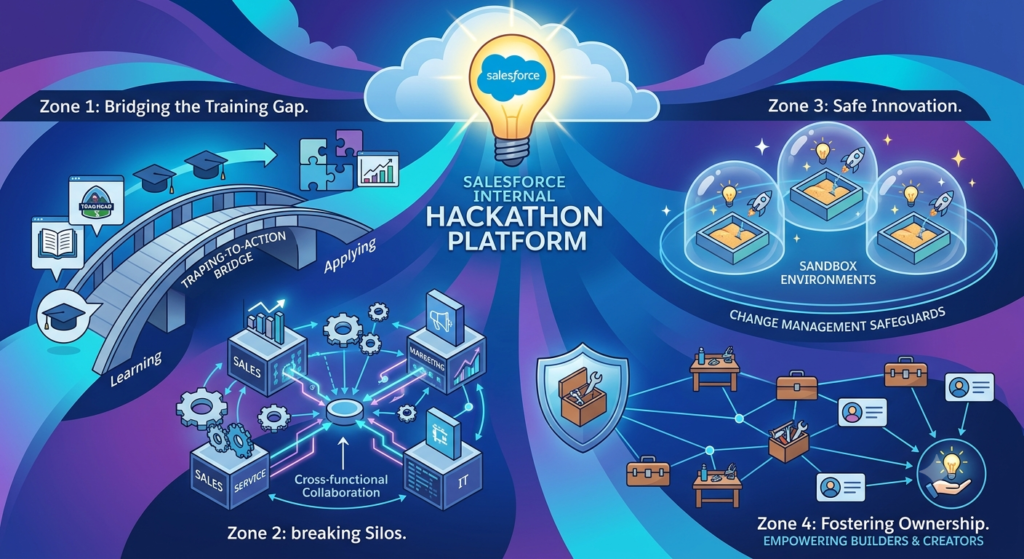
A Salesforce internal hackathon directly addresses every one of these challenges. It bridges the training-to-action gap by giving people real problems to solve. It breaks down silos by forming cross-functional teams. It creates a safe space for experimentation through sandbox environments. And it shifts the organizational mindset from passive consumption to active creation.
In short, it transforms Salesforce from a tool your team has to use into a platform your team wants to build with.
What Is a Salesforce Internal Hackathon?
Definition
A Salesforce internal hackathon is a time-boxed innovation event — typically lasting between one and five days — where employees form teams and work collaboratively to design, prototype, and present solutions built on the Salesforce platform. These solutions address real business challenges, process inefficiencies, or strategic opportunities identified by the organization.
Unlike external hackathons (where participants compete for prizes or job offers), an internal Salesforce hackathon is focused on organizational impact. The goal isn’t just to build something clever — it’s to build something that can be implemented, that solves a genuine problem, and that advances the company’s digital transformation agenda.
Goals of a Salesforce Internal Hackathon
The specific goals will vary by organization, but most successful Salesforce innovation events target a combination of the following:
- Accelerate platform adoption by giving teams hands-on experience with features and capabilities they haven’t explored
- Drive cross-functional collaboration by bringing together people from sales, service, marketing, operations, IT, and other departments
- Surface innovative solutions to real business problems that might never emerge through traditional project intake processes
- Upskill employees in Salesforce development, administration, and architecture through experiential learning
- Build a Salesforce learning culture that values experimentation, continuous improvement, and technical curiosity
- Identify hidden talent — the business analyst who’s secretly a Flow genius, the sales rep who has brilliant ideas about pipeline automation, the service agent who understands customer journeys better than anyone
- Boost employee engagement by creating an energizing, creative, and collaborative experience
How It Differs from Traditional Hackathons
Traditional hackathons — the kind you see at tech conferences and startup incubators — tend to be open-ended. Participants can build anything, using any technology, for any audience. That creative freedom is exhilarating but can produce solutions that are technically impressive yet practically useless.
A Salesforce-focused innovation event is fundamentally different in several important ways:
| Dimension | Traditional Hackathon | Salesforce Internal Hackathon |
|---|---|---|
| Platform | Any technology | Salesforce ecosystem (Sales Cloud, Service Cloud, Experience Cloud, Flow, Apex, LWC, Agentforce, etc.) |
| Participants | External developers, students, freelancers | Internal employees across departments |
| Problems | Open-ended or sponsor-defined | Real business challenges facing the organization |
| Outcome | Prototype or demo | Potentially production-ready solution |
| Impact | Portfolio piece or prize | Measurable business value and process improvement |
| Follow-up | Usually none | Implementation roadmap and executive sponsorship |
This focus is what makes internal Salesforce hackathons so powerful. They’re not theoretical exercises. They produce real solutions to real problems, built by the people who understand those problems best.
Benefits of Running a Salesforce Innovation Event
The returns from a well-executed Salesforce innovation workshop extend far beyond the solutions produced during the event itself. Here’s a detailed look at the benefits:
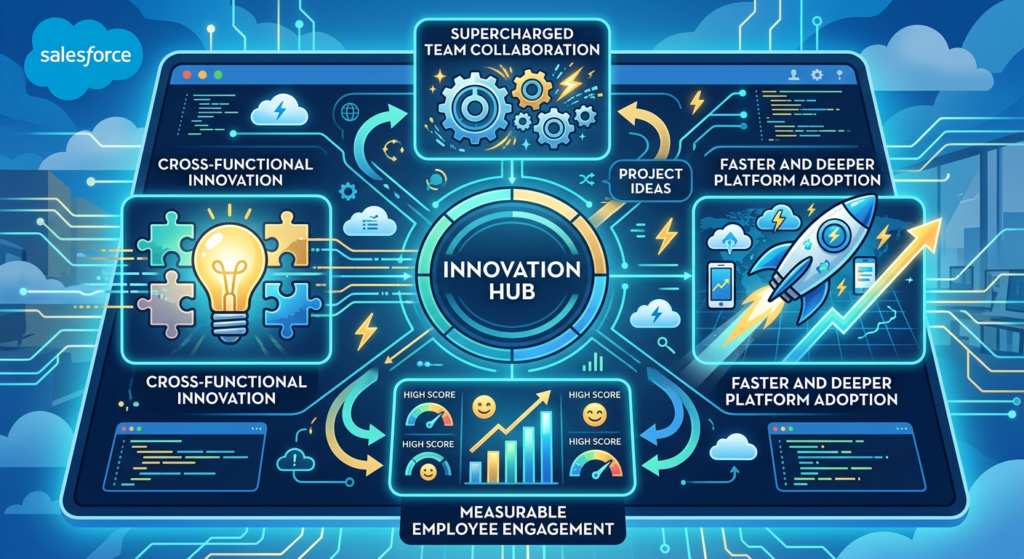
1. Supercharged Team Collaboration
Hackathons force people to work together who might never interact in their daily roles. A sales operations analyst teams up with a service desk agent, a marketing coordinator, and a Salesforce developer. They have to communicate, negotiate, divide labor, and integrate their different perspectives into a cohesive solution.
This kind of enterprise Salesforce collaboration builds relationships and shared understanding that persist long after the hackathon ends. Teams that have hacked together develop a shorthand. They’re more likely to reach across departmental boundaries to solve problems in the future.
2. Faster and Deeper Platform Adoption
Nothing accelerates learning like building something real under a deadline. During a hackathon, participants explore Salesforce features they might never encounter in their regular work — Flow orchestration, dynamic forms, custom Lightning Web Components, Einstein AI capabilities, Slack integrations, Agentforce configurations.
This experiential learning is dramatically more effective than passive training. According to research from the National Training Laboratories, learning-by-doing has a retention rate of approximately 75%, compared to just 5% for lecture-based training and 10% for reading.
A Salesforce internal hackathon is, in effect, the most engaging and effective Salesforce training idea you can implement.
3. Measurable Employee Engagement
Gallup’s research consistently shows that only about 33% of U.S. employees are engaged at work. Disengagement costs organizations an estimated $8.8 trillion globally in lost productivity.
Hackathons are engagement accelerators. They give people autonomy (choose your problem), mastery (build your skills), and purpose (solve something that matters) — the three pillars of intrinsic motivation identified by Daniel Pink. The energy, excitement, and camaraderie of a hackathon create positive associations with the platform, the team, and the organization.
Salesforce employee engagement isn’t just about making people feel good — it’s about creating the conditions where people voluntarily invest discretionary effort into making the platform work better for everyone.
4. Cross-Functional Innovation
Some of the best Salesforce solutions we’ve seen at RizeX Labs have come from unexpected combinations of people and perspectives. A finance team member notices that the quote-to-cash process has a bottleneck that nobody in sales ops has identified. A customer success manager realizes that a simple Flow could automate 80% of their onboarding tasks. A field service technician suggests a mobile-first approach to work order management that the development team hadn’t considered.
Hackathons create the conditions for these breakthroughs by intentionally mixing functional expertise, technical skill, and business context.
5. Upskilling Admins and Developers
For Salesforce admins and developers, hackathons are an opportunity to stretch beyond their comfort zones. An admin who primarily works with reports and dashboards might experiment with Flow orchestration or Experience Cloud. A developer who focuses on Apex triggers might build their first Lightning Web Component or explore Salesforce Functions.
This kind of Salesforce team building training accelerates professional development while simultaneously producing organizational value.
6. Creating a Pipeline of Innovation
One of the most underappreciated benefits of recurring hackathons is the innovation pipeline they create. Each event generates a portfolio of prototyped solutions, many of which can be refined and deployed in subsequent sprints. Over time, the organization builds a rich backlog of validated ideas — solutions that have already been user-tested, technically prototyped, and vetted by cross-functional teams.
This pipeline becomes a strategic asset, feeding the product roadmap and accelerating the organization’s Salesforce adoption strategy.
Step-by-Step Guide to Running a Successful Salesforce Hackathon
Now let’s get into the tactical details. Here’s a comprehensive, actionable framework for planning and executing a Salesforce internal hackathon that delivers real results.
Step 1: Define Clear Goals and Success Metrics
Before anything else, answer these questions:
- Why are we doing this? (Adoption? Innovation? Engagement? Upskilling? All of the above?)
- What does success look like? (Number of solutions prototyped? Adoption metrics post-event? Employee satisfaction scores? Solutions deployed to production?)
- Who is our executive sponsor? (More on this below — it’s critical.)
Be specific. “Drive innovation” is not a goal. “Generate at least 5 prototyped solutions addressing our top 10 CRM pain points, with at least 2 selected for production deployment within 90 days” — that’s a goal.
Pro tip: Align hackathon goals with existing strategic priorities. If your organization is focused on customer retention, theme the hackathon around service excellence. If you’re launching a new product line, focus on sales enablement. This alignment makes it easier to secure executive sponsorship and post-event implementation resources.
Step 2: Choose Compelling Themes and Challenge Statements
The best hackathons don’t give participants a blank canvas. They provide structured freedom — clear problem domains within which teams can explore creatively.
Consider organizing your hackathon around 3–5 themed tracks, such as:
- Customer Experience: How might we use Salesforce to reduce customer onboarding time by 50%?
- Sales Productivity: How might we leverage AI and automation to help reps spend more time selling and less time on data entry?
- Service Excellence: How might we use Service Cloud and Agentforce to resolve Tier 1 cases without human intervention?
- Data Intelligence: How might we build dashboards and analytics that surface actionable insights for leadership?
- Internal Operations: How might we automate internal processes (approvals, onboarding, compliance) using the Salesforce platform?
Each theme should include a “How Might We…” challenge statement that’s broad enough to allow creative exploration but specific enough to produce actionable solutions.
Step 3: Build Diverse, Cross-Functional Teams
Team composition is one of the most important factors in hackathon success. Aim for teams of 3–6 people, and ensure each team includes a mix of:
- Technical talent: Salesforce admins, developers, architects
- Business expertise: Sales reps, service agents, marketing coordinators, operations staff
- Design thinking: UX designers, business analysts, product managers (if available)
You can allow self-selection, assign teams randomly, or use a hybrid approach (let people choose their theme, then balance teams within each track). At RizeX Labs, we’ve found that hybrid approaches tend to produce the best results — they give people agency while ensuring diversity of perspective.
Important: Don’t exclude non-technical participants. Some of the most valuable contributions come from people who understand business processes deeply but have never built a Flow. Pair them with technical teammates, and magic happens.
Step 4: Set Realistic Timelines
Hackathon duration depends on your organizational context, but here are the most common formats:
- 1-Day Sprint (6–8 hours): Best for awareness and engagement. Teams can prototype basic solutions using clicks-not-code tools like Flow, reports, dashboards, and app builder. Good for first-time hackathons.
- 2-Day Intensive (16 hours across two days): The sweet spot for most organizations. Enough time to build something meaningful without requiring a significant time commitment. Day 1 for ideation and building, Day 2 for refinement and demos.
- 5-Day Innovation Week: Best for organizations with mature Salesforce practices and strong executive sponsorship. Teams can build sophisticated solutions, conduct user testing, and prepare polished presentations. This format produces the most production-ready outcomes.
Whichever format you choose, build in buffer time. Things always take longer than expected — environment setup, API limits, unexpected bugs, scope creep. A timeline that feels slightly generous is better than one that feels crushingly tight.
Sample 2-Day Hackathon Timeline
Day 1:
- 9:00 AM — Kickoff and welcome (executive sponsor remarks, rules, theme reveal)
- 9:30 AM — Team formation and ideation workshop
- 10:30 AM — Hacking begins
- 12:30 PM — Lunch and informal check-ins
- 1:30 PM — Hacking continues
- 3:00 PM — Mid-day mentor check-ins
- 5:00 PM — Day 1 wrap-up and progress share
Day 2:
- 9:00 AM — Day 2 kickoff and final push
- 12:00 PM — Hacking stops — presentation prep begins
- 1:00 PM — Lunch
- 2:00 PM — Demo Day presentations (5–7 minutes per team)
- 4:00 PM — Judging deliberation
- 4:30 PM — Awards ceremony and closing remarks
- 5:00 PM — Celebration
Step 5: Provide Sandbox Environments and Technical Resources
This is a non-negotiable. Participants need safe, pre-configured environments where they can build, break, and experiment without any risk to production systems.
Environment options include:
- Salesforce Developer Orgs: Free, easy to provision, and perfect for greenfield prototyping. Available at developer.salesforce.com.
- Salesforce Sandboxes: Best when teams need to work with realistic data structures, existing customizations, or installed packages. Use Full or Partial Copy sandboxes for data realism, or Developer sandboxes for lightweight prototyping.
- Scratch Orgs: Ideal for teams working with Salesforce DX and source-driven development. Offers maximum configurability and reproducibility.
Pre-event technical preparation should include:
- Provisioning environments at least one week before the event
- Pre-loading sample data (use Salesforce’s Data Loader, Snowfakery, or custom scripts)
- Ensuring necessary licenses and permissions are in place (Einstein AI, Experience Cloud, etc.)
- Providing API access and connected app configurations if teams need to integrate with external systems
- Creating a shared repository (GitHub, GitLab, or Bitbucket) for code collaboration
- Documenting environment access credentials and distributing them to team leads
Don’t underestimate this step. Nothing kills hackathon momentum faster than spending the first three hours troubleshooting login issues, permission sets, and sandbox refresh failures. Get this right, and you set your teams up for success from minute one.
Step 6: Establish a Mentorship Structure
Even the most experienced Salesforce professionals benefit from guidance during a hackathon. Recruit a team of mentors — senior admins, architects, developers, and business leaders — who can circulate among teams, offer technical advice, challenge assumptions, and help teams stay focused.
Mentor responsibilities include:
- Helping teams scope their ideas realistically (the most common hackathon pitfall is overscoping)
- Providing technical guidance on platform capabilities and best practices
- Encouraging teams that are struggling and keeping energy high
- Offering feedback on presentation structure and demo strategy
At RizeX Labs, we typically recommend a mentor-to-team ratio of 1:2 — one dedicated mentor for every two teams, with additional floating mentors available for specialized topics (AI, integrations, UX design).
Step 7: Define Judging Criteria
Transparent, well-communicated judging criteria ensure fairness and help teams prioritize their efforts. We recommend a balanced scorecard approach:
| Criterion | Weight | Description |
|---|---|---|
| Business Impact | 30% | Does the solution address a real and significant business problem? What’s the potential ROI? |
| Innovation | 25% | Is the approach creative? Does it leverage platform capabilities in novel ways? |
| Technical Execution | 20% | Is the solution well-built? Does it follow Salesforce best practices? Is it scalable? |
| User Experience | 15% | Is the solution intuitive and user-friendly? Would end users actually adopt it? |
| Presentation Quality | 10% | Is the demo compelling? Does the team communicate their vision effectively? |
Assemble a judging panel that includes a mix of technical leaders (Salesforce architect, senior developer), business leaders (VP of Sales, Head of Customer Success), and executive sponsors. This diversity ensures solutions are evaluated from multiple perspectives.
Step 8: Execute Demo Day with Energy and Recognition
Demo Day is the culmination of the hackathon — the moment where teams showcase their work, receive feedback, and compete for recognition. It should feel like an event, not a meeting.
Best practices for Demo Day:
- Give each team a fixed time slot (5–7 minutes for demo, 2–3 minutes for Q&A)
- Enforce time limits strictly — it keeps the energy high and forces teams to be concise
- Livestream the demos for remote participants and stakeholders who can’t attend in person
- Record everything — these recordings become powerful assets for internal communications, future hackathon recruitment, and executive reporting
- Create a buzz — use music, emcee energy, real-time audience voting (Slido or Mentimeter work great), and branded swag
- Recognize every team, not just the winners — highlight unique contributions, creative approaches, and team spirit
Award categories might include:
- 🏆 Grand Prize: Best overall solution
- 💡 Most Innovative: Most creative use of platform capabilities
- 📈 Highest Business Impact: Solution with the greatest potential ROI
- 🎨 Best User Experience: Most intuitive and user-friendly design
- 🤝 Best Team Collaboration: Team that demonstrated the strongest cross-functional teamwork
- 🌟 People’s Choice: Audience-voted favorite
Best Salesforce Hackathon Ideas
Need inspiration for challenge statements and project ideas? Here are some of the most compelling themes we’ve seen generate exceptional results at Salesforce innovation events:
1. AI-Powered Salesforce Workflows
Build intelligent automation using Einstein AI, Einstein GPT, or Prompt Builder. Examples: AI-generated email responses for sales reps, predictive lead scoring refinement, intelligent case routing based on sentiment analysis.
2. Agentforce Innovation
Design and deploy autonomous AI agents using Salesforce’s Agentforce platform. Create agents that handle customer inquiries, qualify leads, schedule appointments, or provide real-time coaching to sales reps during calls.
3. Service Cloud Automation
Automate Tier 1 support case resolution, build self-service portals on Experience Cloud, create knowledge article recommendation engines, or design escalation workflows that reduce average handle time.
4. Sales Dashboard Revolution
Build executive dashboards in Tableau CRM (formerly Einstein Analytics) or native Salesforce reports that surface actionable insights — pipeline risk indicators, forecasting accuracy trends, rep activity benchmarks, and win/loss pattern analysis.
5. Slack + Salesforce Integration
Create Slack workflows that surface Salesforce data in context — deal alerts in sales channels, case update notifications for service teams, approval workflows triggered from Slack, or daily digest bots that summarize pipeline changes.
6. Customer Onboarding Automation
Design end-to-end customer onboarding flows that automate welcome communications, task assignments, milestone tracking, and health score initialization. This is particularly valuable for organizations with complex, multi-step onboarding processes.
7. Internal Productivity Apps
Build apps on the Salesforce platform that solve internal operational challenges — employee onboarding trackers, IT asset management, conference room booking, PTO request automation, or compliance checklist tools.
8. Data Quality and Governance
Create solutions that identify and remediate data quality issues — duplicate detection and merge workflows, field completeness scorecards, data validation rules, and automated data enrichment using third-party APIs.
9. Mobile-First Field Solutions
Design mobile-optimized solutions for field teams using Salesforce Mobile or custom Lightning Web Components — mobile work order management, offline-capable data capture, GPS-enabled check-in/check-out, and photo documentation workflows.
10. Cross-Cloud Integration
Build solutions that span multiple Salesforce clouds — a lead-to-cash flow connecting Sales Cloud and Revenue Cloud, a customer 360 view integrating Sales, Service, and Marketing Cloud data, or a partner portal on Experience Cloud fed by Sales Cloud opportunities.
Tools and Resources Needed
Equipping your teams with the right tools is essential. Here’s a comprehensive checklist:
Core Salesforce Environments
- Salesforce Developer Orgs (free, unlimited, perfect for prototyping)
- Salesforce Sandboxes (Developer, Developer Pro, Partial Copy, or Full Copy)
- Scratch Orgs (for Salesforce DX-based development)
Development and Administration Tools
- Salesforce CLI (for metadata deployment and scratch org management)
- VS Code with Salesforce Extensions (primary IDE for Apex, LWC, and metadata)
- Salesforce Inspector (Chrome extension for quick data exploration and queries)
- Workbench (for SOQL queries, REST API testing, and metadata exploration)
- Data Loader (for bulk data import/export)
Collaboration and Communication
- Slack (team communication, channel per team, mentor channels)
- Miro or FigJam (virtual whiteboarding for ideation and architecture diagrams)
- Google Docs or Confluence (documentation and presentation prep)
- GitHub or GitLab (source control and code collaboration)
Project Management
- Jira or Trello (lightweight task tracking during the hackathon)
- Notion (alternative for flexible project tracking and documentation)
Analytics and Presentation
- Tableau (for advanced data visualization)
- Salesforce Reports & Dashboards (for native analytics)
- Google Slides or PowerPoint (for Demo Day presentations)
- Loom (for recording demo videos as backup)
AI and Innovation Tools
- Einstein AI (predictive analytics, AI-powered automation)
- Salesforce Prompt Builder (custom AI prompts)
- Agentforce (autonomous AI agent development)
- ChatGPT or Claude (for brainstorming, code assistance, and documentation — with appropriate usage guidelines)
Common Mistakes to Avoid
We’ve seen dozens of internal Salesforce hackathons — the spectacular successes and the painful failures. Here are the most common mistakes that derail otherwise promising events:
1. Poor Planning and Rushed Preparation
The mistake: Deciding to run a hackathon three weeks from now and scrambling to pull it together.
The fix: Start planning at least 6–8 weeks in advance. Environment provisioning, team formation, theme development, mentor recruitment, and logistics all take time. Rushing leads to technical failures, confused participants, and underwhelming results.
2. No Executive Sponsorship
The mistake: Running the hackathon as a grassroots, admin-led initiative without visible executive support.
The fix: Secure an executive sponsor — ideally a VP or C-suite leader — who will kick off the event, attend Demo Day, and champion winning solutions through to implementation. Executive sponsorship signals organizational commitment, elevates the event’s prestige, and dramatically increases the likelihood that hackathon solutions will actually be deployed.
3. Unrealistic Scope and Timelines
The mistake: Expecting teams to build production-ready, fully tested, enterprise-grade solutions in 8 hours.
The fix: Set clear expectations that the goal is a working prototype — a proof of concept that demonstrates the idea’s viability and business value. The path from prototype to production is a separate, post-hackathon workstream.
4. Lack of Meaningful Rewards and Recognition
The mistake: Offering a $25 gift card as the grand prize and wondering why participation is tepid.
The fix: Rewards don’t have to be expensive, but they should be meaningful. The most motivating rewards we’ve seen include:
- Dedicated sprint time to develop the winning solution into a production feature
- Presentation opportunity to the executive leadership team
- Conference attendance (Dreamforce, TrailblazerDX)
- Certification exam vouchers
- Team dinner with the CTO/CIO
- Featured story in the company newsletter or intranet
- Trophy or plaque for the winning team (people love physical recognition)
5. Ignoring Post-Event Implementation
The mistake: Running an amazing hackathon, generating brilliant solutions, and then… nothing. The prototypes collect dust. The excitement fades. Next year, nobody wants to participate because “nothing ever happens with our ideas.”
The fix: Before the hackathon even begins, establish a clear post-event pathway. Define how winning solutions will be evaluated for production deployment, who owns the decision, and what the timeline looks like. At minimum, the top 2–3 solutions should enter the product backlog with a defined owner and target delivery date.
6. Making It Too Technical or Too Exclusive
The mistake: Positioning the hackathon as a “developer event” that excludes business users, admins, and non-technical staff.
The fix: Explicitly invite and welcome participants of all skill levels. Create roles beyond coding — business analysis, user research, project coordination, presentation design, data preparation. The best solutions emerge from diverse teams, and excluding non-technical talent means excluding the people who understand business problems most deeply.
7. Neglecting the Fun Factor
The mistake: Running the hackathon like a grim, high-pressure work assignment.
The fix: Hackathons should be energizing and enjoyable. Invest in the experience — quality food and snacks, comfortable spaces, good music, team swag, informal socializing opportunities. The social and emotional dimension of the hackathon is just as important as the technical output.
How to Measure Success
A hackathon that feels great but can’t demonstrate measurable impact will struggle to secure support for future iterations. Here’s a comprehensive measurement framework:
Participation and Engagement Metrics
- Total number of participants (aim for 10–15% of your Salesforce user base as a starting point)
- Cross-functional representation (number of departments represented)
- Participant satisfaction scores (post-event survey, targeting 4.5+/5.0)
- Net Promoter Score (“How likely are you to recommend this event to a colleague?”)
- Repeat participation rate (for recurring hackathons)
Innovation Output Metrics
- Number of solutions prototyped
- Number of solutions selected for production development
- Number of solutions deployed to production within 90 days
- Number of new Salesforce features or capabilities explored by teams
- Number of patent-eligible or IP-worthy ideas generated (for larger enterprises)
Adoption and Skill Development Metrics
- Post-event increase in Salesforce login frequency among participants
- Post-event increase in feature utilization (Flow usage, report creation, dashboard views)
- Number of Trailhead badges or certifications earned in the 60 days following the hackathon
- Self-reported confidence scores (“How confident are you in building solutions on Salesforce?” — pre vs. post event)
Business Impact Metrics
- Estimated time savings from deployed solutions (hours per week/month)
- Process efficiency improvements (reduction in manual steps, faster cycle times)
- Customer experience improvements (NPS changes, case resolution time, onboarding speed)
- Revenue impact (pipeline acceleration, conversion rate improvements, upsell opportunities)
- Cost avoidance (solutions built internally vs. estimated vendor/consulting cost)
Mini Case Study: Measuring Real Impact
One mid-market financial services company we worked with at RizeX Labs ran a 2-day Salesforce hackathon focused on service automation. Eight teams participated, producing 8 prototyped solutions. Three were selected for production development. Within 90 days:
- An automated case routing solution reduced average case assignment time from 4 hours to 12 minutes
- A customer self-service portal deflected 23% of Tier 1 cases
- A compliance checklist automation eliminated 6 hours per week of manual data entry per agent
The estimated annual value of these three solutions exceeded $340,000 — from a hackathon that cost less than $15,000 to produce (including catering, prizes, and temporary sandbox provisioning).
More importantly, post-event surveys showed a 40% increase in participants’ self-reported Salesforce proficiency and a 67% increase in willingness to propose platform improvements through formal channels.
Mini Case Study: Building a Culture of Innovation
A healthcare technology company partnered with RizeX Labs to establish a quarterly Salesforce hackathon program. The first event had 24 participants and produced 6 prototypes. By the fourth quarterly event, participation had grown to 87 employees — including the CEO, who joined a team and built her first Flow.
Over the course of a year, the hackathon program generated 22 prototyped solutions, 9 of which were deployed to production. The company’s Salesforce adoption score (measured by login frequency, feature utilization, and data quality) increased by 34%. Internal Salesforce support tickets decreased by 28% as users became more self-sufficient.
The program also created an unexpected benefit: a cohort of 15 “Salesforce Champions” — non-technical business users who became proficient platform builders and now serve as embedded resources within their departments, reducing dependency on the central admin team.
Why Companies Partner with RizeX Labs
Running a successful Salesforce internal hackathon requires more than enthusiasm — it demands deep platform expertise, proven facilitation methodologies, and the operational know-how to turn innovation events into lasting organizational impact.
That’s where RizeX Labs comes in.
Deep Salesforce Expertise
Our team includes certified Salesforce architects, developers, consultants, and strategists who collectively hold dozens of certifications across the Salesforce ecosystem. We don’t just know the platform — we know how to help organizations maximize its value through strategic enablement and innovation.
Innovation Consulting That Delivers
We’ve designed and facilitated Salesforce innovation events for enterprises across industries — financial services, healthcare, manufacturing, technology, retail, and more. Our methodology is battle-tested and continuously refined based on real-world outcomes.
Enterprise Enablement Programs
Hackathons are powerful, but they’re most effective as part of a broader Salesforce adoption strategy. RizeX Labs offers comprehensive enablement programs that include:
- Innovation workshop design and facilitation
- Salesforce team building training programs tailored to your organization’s maturity level
- CRM innovation challenges that run quarterly or semi-annually
- Center of Excellence (CoE) development to sustain innovation beyond individual events
- Custom Trailhead-style learning paths aligned to your organization’s platform configuration
- Post-hackathon implementation support to ensure winning solutions reach production
End-to-End Support
From initial strategy and theme development through environment provisioning, mentor training, event facilitation, judging, and post-event implementation planning — RizeX Labs provides end-to-end support that lets your team focus on building, not logistics.
Training and Implementation Support
Beyond hackathons, we offer:
- Salesforce implementation and optimization consulting
- Custom development (Apex, LWC, integrations)
- Data migration and quality initiatives
- AI and Agentforce strategy and implementation
- Ongoing managed services for Salesforce administration and development
We don’t just help you run a hackathon. We help you build a Salesforce learning culture that continuously drives innovation, adoption, and business value.
Conclusion: Build a Culture of Salesforce Innovation
The organizations that get the most value from Salesforce aren’t the ones with the biggest budgets or the most complex configurations. They’re the ones that have created a culture of innovation around the platform — a culture where every employee feels empowered to identify problems, propose solutions, and build improvements.
A Salesforce internal hackathon is one of the most powerful catalysts for creating that culture. It breaks down silos. It accelerates learning. It surfaces brilliant ideas from unexpected places. It builds team cohesion and platform enthusiasm. And it produces tangible, measurable business outcomes that justify ongoing investment in innovation.
But here’s the key insight: the first hackathon is just the beginning. The real transformation happens when hackathons become a recurring rhythm — a quarterly or semi-annual event that the entire organization anticipates, prepares for, and builds upon. Over time, the cumulative impact is transformative: deeper platform adoption, stronger cross-functional relationships, a growing pipeline of innovative solutions, and a workforce that views Salesforce not as a system they’re forced to use, but as a platform they’re inspired to build with.
Whether you’re a Salesforce admin looking to energize your user community, a CRM manager seeking to boost adoption metrics, an IT leader driving digital transformation, or an enterprise architect exploring new ways to maximize platform ROI — a well-executed Salesforce hackathon can be a turning point.
The question isn’t whether your organization can afford to run a Salesforce hackathon. The question is whether you can afford not to.
About RizeX Labs
We’re Pune’s leading IT training institute specializing in emerging technologies like Salesforce and data analytics. At RizeX Labs, we help professionals and enterprise teams master the ecosystem through hands-on training, real-world projects, and expert mentorship. Whether you are aiming to upskill your workforce for an upcoming internal innovation event or trying to turn team members into certified platform experts, our programs are designed to transform learners into job-ready Salesforce professionals with strong development, automation, and reporting skills.
Internal Links:
- Salesforce Admin & Development Training
- Salesforce Apex Triggers: Beginner’s Guide with Real-Time Examples
- Salesforce Lightning Web Components (LWC) vs Aura: Which Should You Learn First
