
Introduction: The Enterprise Marketing Automation Gap
SFMC corporate training marketing teams is no longer optional in today’s data-driven enterprise landscape. Modern enterprise marketing runs on data, automation, and personalization. Yet a startling reality persists across industries: companies invest hundreds of thousands of dollars in sophisticated marketing technology platforms, only to use a fraction of their capabilities. Salesforce Marketing Cloud (SFMC) is perhaps the most striking example of this phenomenon.
According to a Salesforce report, high-performing marketing teams are 3.2 times more likely to use marketing automation than underperforming teams. Yet even among companies that have adopted SFMC, many operate with less than 40% platform utilization. The tools are there. The data pipelines are connected. But the marketing teams haven’t been equipped to use them effectively.
This is precisely where structured SFMC corporate training becomes not just valuable, but mission-critical for every enterprise marketing organization.
For enterprise marketing leaders, CRM heads, and digital transformation officers, the question is no longer whether to invest in Salesforce Marketing Cloud. That decision has often already been made. The more pressing question is: How do you ensure your entire marketing team actually knows how to use it — consistently, strategically, and at scale?
Structured SFMC corporate training for marketing teams is the answer. When marketing teams receive role-appropriate, hands-on, enterprise-focused SFMC training, campaign execution improves, ROI from your Salesforce investment increases, and the entire organization gains confidence in its marketing automation capabilities.
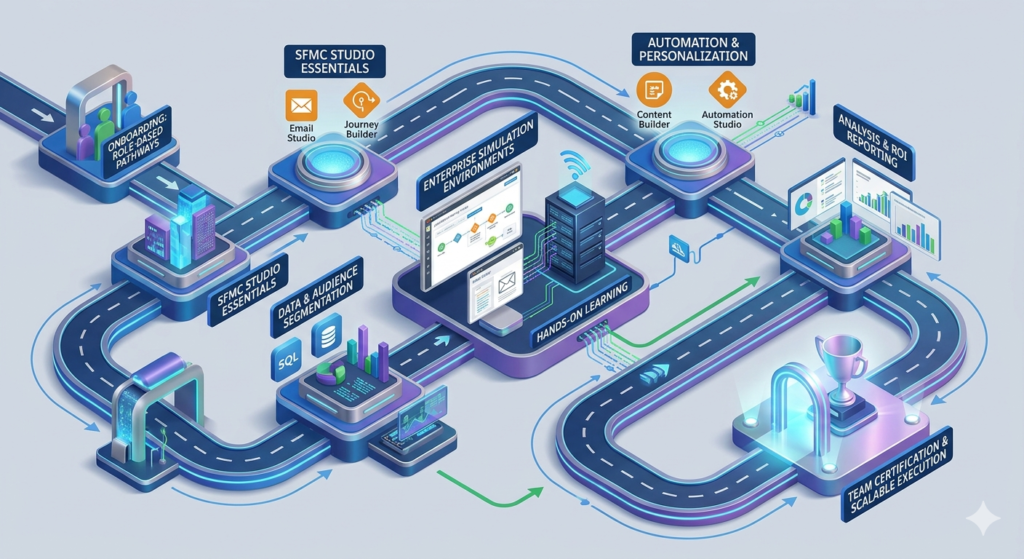
In this article, RizeX Labs — a specialized enterprise technology training partner — breaks down everything enterprise marketing teams need to learn, why team-based training matters more than individual certification, and how to build a culture of continuous SFMC proficiency across your organization. — a specialized enterprise technology training partner — breaks down everything enterprise marketing teams need to learn, why team-based training matters more than individual certification, and how to build a culture of continuous SFMC proficiency across your organization.
What Is Salesforce Marketing Cloud and Why Does It Matter for Enterprises?
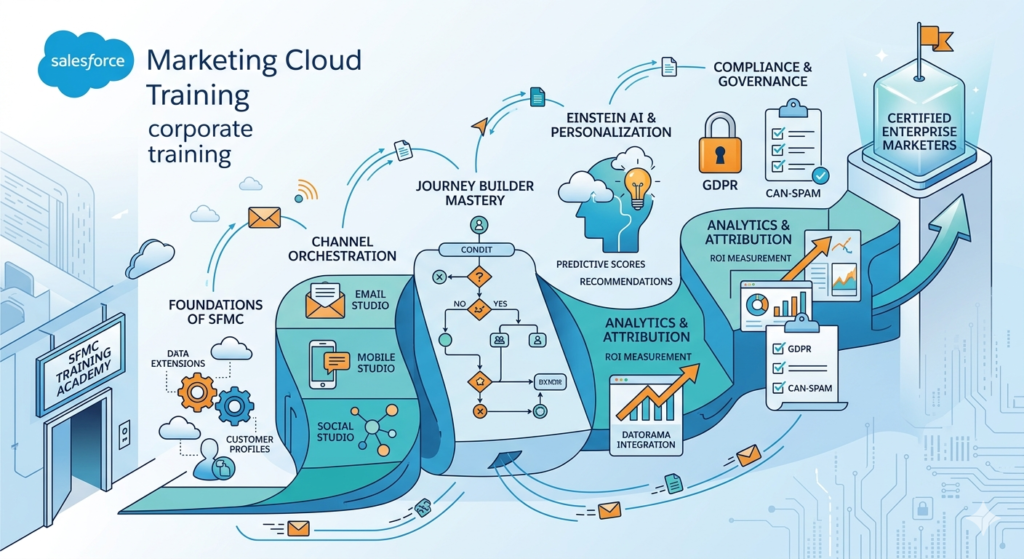
Salesforce Marketing Cloud is the world’s leading enterprise digital marketing platform, used by thousands of organizations to manage email marketing, mobile messaging, social media, customer journeys, advertising, and data analytics from a unified hub. It’s not a single tool — it’s an ecosystem of interconnected studios and builders designed to support complex, multi-channel marketing operations.
For enterprise marketing teams, SFMC offers:
- Multi-channel campaign orchestration across email, SMS, push notifications, social media, and web
- Customer journey automation that responds dynamically to real-time behavior
- Advanced data segmentation powered by first-party and CRM data from Salesforce CRM
- AI-driven personalization through Einstein AI tools
- Enterprise-grade compliance features for GDPR, CAN-SPAM, and data governance
- Deep analytics and attribution modeling to measure what’s working
The platform’s depth is both its greatest strength and its most common stumbling block. Marketing teams that don’t receive proper training often find themselves overwhelmed by the interface, unsure of best practices, and defaulting to basic email blasts when the platform is capable of so much more.
Why Teams Struggle Without Proper SFMC Training
Before diving into what teams should learn, it’s important to understand why training gaps exist and what they cost organizations.
The Complexity Factor
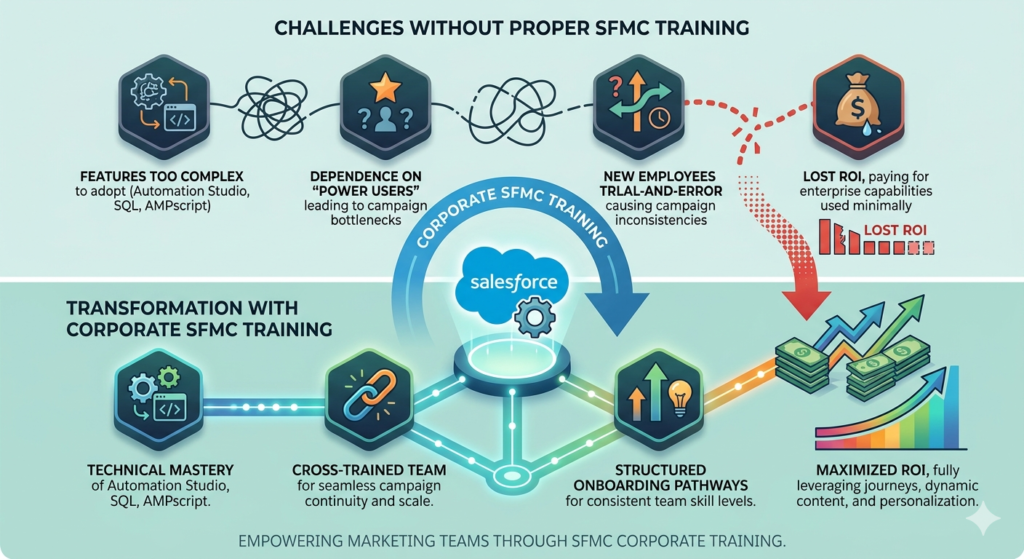
SFMC is not an intuitive out-of-the-box tool for non-technical marketers. It has a steep learning curve, particularly for capabilities like Automation Studio, Contact Builder, SQL query writing for segmentation, and AMPscript for dynamic personalization. Without formal SFMC team training, many marketers simply avoid these features — not because they don’t need them, but because they were never properly introduced to them.
The Siloed Learning Problem
In many enterprises, one or two power users become the de facto SFMC experts through self-directed learning or individual Trailhead completions. This creates dangerous dependency: when those employees leave or are unavailable, entire campaigns stall. The rest of the team lacks the knowledge to step in.
The Onboarding Gap
When new team members join, there’s rarely a structured onboarding pathway for SFMC skills. New employees are often left to figure things out through trial and error, which leads to inconsistent campaign execution, avoidable mistakes, and significant ramp-up time.
The ROI Problem
Every month that passes with an undertrained marketing team is a month of ROI lost on your Salesforce investment. SFMC licenses are expensive. If teams aren’t running dynamic journeys, using suppression logic, personalizing content with AMPscript, or analyzing performance with sophisticated dashboards, you’re paying enterprise prices for a basic email tool.
Structured enterprise marketing automation training directly addresses each of these challenges.
What Is SFMC Corporate Training?
SFMC corporate training — also referred to as SFMC team training or enterprise SFMC training — is a structured, organization-wide learning program designed to build Salesforce Marketing Cloud proficiency across an entire marketing team, department, or enterprise.
Unlike individual Trailhead courses or scattered online tutorials, corporate SFMC training is:
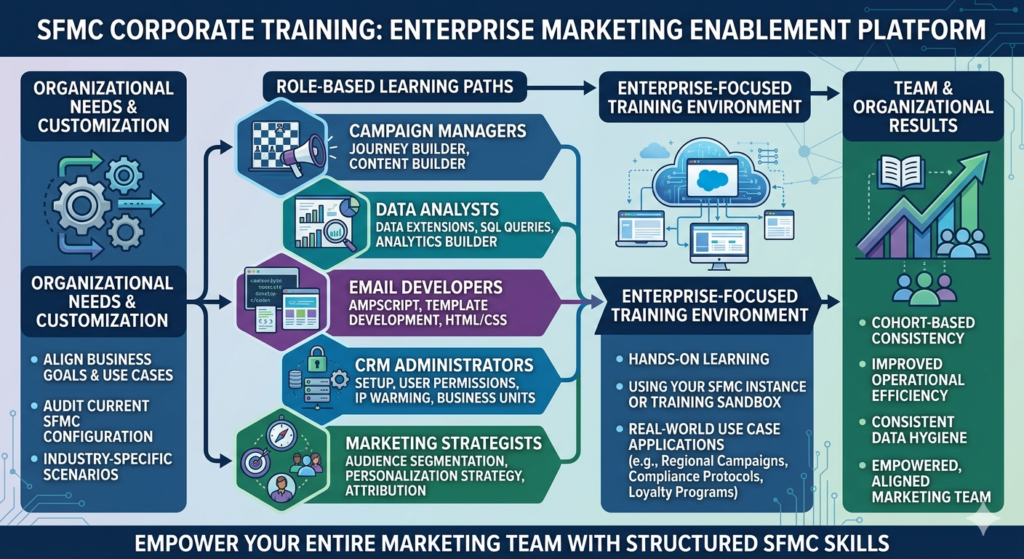
- Customized to your organization’s specific SFMC configuration, use cases, and business goals
- Role-based, providing different learning paths for campaign managers, data analysts, email developers, CRM administrators, and marketing strategists
- Hands-on, conducted within your actual SFMC instance or a dedicated training environment
- Enterprise-focused, using real-world scenarios relevant to your industry and customer segments
- Cohort-based, so teams learn together, share knowledge, and develop consistent operational practices
The difference between sending one marketer to a Salesforce training event and investing in proper SFMC corporate training is the difference between one informed individual and an empowered team.
Enterprise Use Cases for SFMC Team Training
- A global consumer brand needs all regional marketing teams to execute campaigns with consistent data hygiene and customer journey logic
- A financial services firm needs marketers to understand compliance protocols within SFMC before any campaign goes live
- A retail enterprise is launching a new loyalty program and needs the full marketing team capable of building and managing trigger-based journeys
- A healthcare provider needs its marketing coordinators to understand audience segmentation, exclusion lists, and communication preference management
In each scenario, piecemeal learning is insufficient. What’s needed is comprehensive, coordinated marketing cloud team training aligned with business outcomes.
Why Marketing Teams — Not Just Individuals — Need SFMC Training
Cross-Functional Collaboration Requires Shared Knowledge
Modern SFMC campaigns involve multiple stakeholders: content creators building emails in Email Studio, data analysts managing audiences in Contact Builder, campaign managers orchestrating journeys in Journey Builder, and operations teams handling automation in Automation Studio. When any one of these groups lacks SFMC knowledge, the entire campaign pipeline suffers.
Shared training creates a common language. When everyone understands how data feeds into journeys, how segments are built, and how automation rules function, cross-functional collaboration becomes smoother and campaigns move faster.
Consistency at Scale
For enterprises managing multiple brands, regions, or product lines within a single SFMC instance, consistency is everything. Without standardized training, different teams develop different practices — some following naming conventions, others not; some using suppression lists correctly, others creating data risks. Corporate training establishes shared standards that ensure campaign quality is consistent across the organization.
Faster Onboarding for New Employees
A well-designed marketing cloud onboarding program integrated into your corporate training framework means new hires can become productive contributors within weeks rather than months. This reduces the operational burden on experienced team members and accelerates marketing throughput.
Reduced Dependency on External Consultants
One of the most significant financial benefits of investing in SFMC team training is reducing reliance on expensive external consultants for routine platform tasks. When your internal team is proficient, consultants can be reserved for strategic initiatives rather than day-to-day execution support.
Key Skills Marketing Teams Should Learn in SFMC Corporate Training
A comprehensive Salesforce Marketing Cloud training program for enterprise teams should cover the following critical skill areas:
1. Email Studio: The Foundation of Marketing Cloud
Email Studio is typically the entry point for most SFMC users, but its full capabilities go far beyond sending newsletters.
What teams should learn:
- Building and managing email templates with Responsive Design principles
- Using Content Blocks and dynamic content rules to personalize at scale
- Setting up Send Classifications and Sender Profiles for compliance
- Managing subscriber lists, publication lists, and suppression lists correctly
- Understanding Deliverability best practices — authentication protocols (SPF, DKIM, DMARC), IP warming, and bounce management
- A/B testing frameworks within Email Studio
- Triggered sends and transactional email configuration
Why it matters: Poor email setup leads to deliverability issues, unsubscribe rate spikes, and compliance violations — all of which damage your brand reputation and reduce campaign effectiveness.
2. Journey Builder: The Heart of Customer Experience
Journey Builder is arguably SFMC’s most powerful tool for creating personalized, automated customer experiences. It’s also one of the most complex.
What teams should learn:
- Designing multi-step, multi-channel customer journeys from a strategic and technical perspective
- Configuring Entry Sources — including Data Extensions, Salesforce Data, and API Events
- Using Decision Splits, Engagement Splits, and Random Splits intelligently
- Setting wait times, date-based splits, and goal configurations
- Building re-engagement journeys, onboarding flows, and post-purchase sequences
- Testing and validating journeys before activation
- Monitoring journey performance and iterating based on analytics
Why it matters: A poorly configured Journey Builder flow can send customers the wrong messages at the wrong times, damage customer relationships, and create compliance risks. Proper customer journey training in SFMC is non-negotiable for enterprise marketers.
3. Automation Studio: Powering Operational Efficiency
Automation Studio handles the behind-the-scenes operations that make large-scale marketing possible — data imports, segment refreshes, triggered processes, and system integrations.
What teams should learn:
- Building scheduled and triggered automation workflows
- Configuring File Transfer activities for FTP-based data imports/exports
- Using SQL Query activities for advanced data segmentation
- Automating data extension refreshes and audience builds
- Setting up filter-based automations for dynamic list management
- Error handling and monitoring automation performance
- Integrating Automation Studio processes with Journey Builder
Why it matters: Without proper enterprise marketing automation training in Automation Studio, teams rely on manual processes, create data inconsistencies, and miss the operational efficiency that justifies the SFMC investment.
4. Contact Builder and Data Architecture
Understanding how data flows through SFMC is foundational to everything else. Contact Builder is where that data architecture lives.
What teams should learn:
- Understanding the SFMC data model — Data Extensions, Sendable vs. Non-Sendable Data Extensions
- Building and managing the Contact Data Model
- Creating relationships between Data Extensions using Attribute Groups
- Understanding Contact Key and Contact ID implications
- Data retention policies and contact count management
- Connecting Salesforce CRM data through Marketing Cloud Connect
- Importing and managing data hygienically
Why it matters: Data architecture errors in SFMC are among the most expensive and difficult problems to fix. They affect everything from deliverability to journey logic to compliance. Enterprise teams need a solid foundation in data management to prevent these issues.
5. Audience Segmentation and Personalization Strategies
Segmentation and personalization are what separate enterprise marketing from mass communication.
What teams should learn:
- Building dynamic audience segments using SQL queries and filter activities
- Using AMPscript for in-email personalization — pulling first-party data, conditional content blocks, dynamic product recommendations
- Leveraging Einstein AI tools — Einstein Send Time Optimization, Einstein Engagement Scoring
- Creating content variations for different audience personas
- Managing preference centers for communication preference-based segmentation
- Using Predictive Intelligence and Web Personalization (Interaction Studio/Marketing Cloud Personalization)
Why it matters: Personalization at scale is the primary reason enterprises invest in SFMC over simpler email tools. If teams don’t know how to use AMPscript, dynamic content, or Einstein features, they’re leaving the most valuable capabilities on the table.
6. Analytics, Reporting, and Campaign Intelligence
Marketing teams need to move beyond vanity metrics and build a data-informed optimization practice.
What teams should learn:
- Navigating and customizing Marketing Cloud Intelligence (formerly Datorama) dashboards
- Using Email Studio’s built-in analytics — open rates, click rates, bounce classifications, unsubscribe tracking
- Journey Analytics — understanding flow performance, drop-off points, and conversion attribution
- Building custom reports using SQL queries on Tracking Data Extensions
- Setting up Google Analytics integration for web journey tracking
- Defining and tracking marketing KPIs aligned with business objectives
- Presenting campaign performance to executive stakeholders
Why it matters: Teams that can’t analyze performance can’t improve. A strong analytics curriculum in SFMC corporate training ensures that data drives decisions rather than intuition.
7. Compliance, Data Governance, and Security
For enterprises — especially in regulated industries — compliance is not optional.
What teams should learn:
- CAN-SPAM, GDPR, CASL, and other regional compliance requirements within SFMC workflows
- Configuring and managing preference centers and unsubscribe mechanisms
- Understanding Consent Management in SFMC
- Data Retention settings and contact suppression best practices
- Role-based access control and user permission management
- Security best practices for API integrations and data connections
Why it matters: A single compliance failure can result in significant financial penalties and brand damage. SFMC for enterprise marketers includes a responsibility to ensure every team member understands the governance framework within which they operate.
Best Practices for Successful SFMC Corporate Training Programs
Investing in training is only the first step. Here are the best practices that separate effective enterprise SFMC training programs from ineffective ones:
1. Implement Role-Based Learning Paths
Not everyone on the marketing team needs to know AMPscript coding or SQL queries. Design training paths for distinct roles:
- Campaign Managers — Journey Builder, Email Studio, Segmentation
- Email Developers — AMPscript, dynamic content, HTML/CSS in Email Studio
- Data Analysts — SQL queries, Automation Studio, Contact Builder, Analytics
- CRM Administrators — Marketing Cloud Connect, data architecture, access management
- Marketing Strategists — Journey design principles, Einstein AI, reporting
2. Use Hands-On Projects, Not Passive Learning
Knowledge retention research consistently shows that learners retain far more from doing than from watching. Structure training around building actual campaigns, journeys, and automation workflows that participants can use as reference models after training concludes.
3. Build a Continuous Learning Culture
SFMC training is not a one-time event. Build a culture where:
- New platform features are regularly reviewed and adopted
- Team members share learnings and best practices
- Quarterly refresher sessions update the team on Salesforce releases
- Internal documentation is maintained and updated
4. Pursue SFMC Certification as a Team Goal
When SFMC certification for teams becomes a shared organizational goal rather than a personal achievement, teams develop together. Consider making certification preparation part of your professional development framework, with organizational support including study time and exam cost coverage.
5. Track Training Performance and Business Impact
Measure the effectiveness of SFMC training by tracking:
- Pre/post assessment scores for participants
- Campaign performance metrics before and after training (open rates, conversion rates, automation efficiency)
- Feature utilization rates across the platform
- Reduction in support tickets and consultant dependencies
- Time-to-productivity for new SFMC users after onboarding
(→ Internal Link Opportunity 3: Link to RizeX Labs’ Enterprise Marketing Technology Training Overview page)
What Is Salesforce Marketing Cloud and Why Does It Matter for Enterprises?
Salesforce Marketing Cloud is the world’s leading enterprise digital marketing platform, used by thousands of organizations to manage email marketing, mobile messaging, social media, customer journeys, advertising, and data analytics from a unified hub. It’s not a single tool — it’s an ecosystem of interconnected studios and builders designed to support complex, multi-channel marketing operations.
For enterprise marketing teams, SFMC offers:
- Multi-channel campaign orchestration across email, SMS, push notifications, social media, and web
- Customer journey automation that responds dynamically to real-time behavior
- Advanced data segmentation powered by first-party and CRM data from Salesforce CRM
- AI-driven personalization through Einstein AI tools
- Enterprise-grade compliance features for GDPR, CAN-SPAM, and data governance
- Deep analytics and attribution modeling to measure what’s working
The platform’s depth is both its greatest strength and its most common stumbling block. Marketing teams that don’t receive proper training often find themselves overwhelmed by the interface, unsure of best practices, and defaulting to basic email blasts when the platform is capable of so much more.
Why Teams Struggle Without Proper SFMC Training
Before diving into what teams should learn, it’s important to understand why training gaps exist and what they cost organizations.
The Complexity Factor
SFMC is not an intuitive out-of-the-box tool for non-technical marketers. It has a steep learning curve, particularly for capabilities like Automation Studio, Contact Builder, SQL query writing for segmentation, and AMPscript for dynamic personalization. Without formal SFMC team training, many marketers simply avoid these features — not because they don’t need them, but because they were never properly introduced to them.
The Siloed Learning Problem
In many enterprises, one or two power users become the de facto SFMC experts through self-directed learning or individual Trailhead completions. This creates dangerous dependency: when those employees leave or are unavailable, entire campaigns stall. The rest of the team lacks the knowledge to step in.
The Onboarding Gap
When new team members join, there’s rarely a structured onboarding pathway for SFMC skills. New employees are often left to figure things out through trial and error, which leads to inconsistent campaign execution, avoidable mistakes, and significant ramp-up time.
The ROI Problem
Every month that passes with an undertrained marketing team is a month of ROI lost on your Salesforce investment. SFMC licenses are expensive. If teams aren’t running dynamic journeys, using suppression logic, personalizing content with AMPscript, or analyzing performance with sophisticated dashboards, you’re paying enterprise prices for a basic email tool.
Structured enterprise marketing automation training directly addresses each of these challenges.
What Is SFMC Corporate Training?
SFMC corporate training — also referred to as SFMC team training or enterprise SFMC training — is a structured, organization-wide learning program designed to build Salesforce Marketing Cloud proficiency across an entire marketing team, department, or enterprise.
Unlike individual Trailhead courses or scattered online tutorials, corporate SFMC training is:
- Customized to your organization’s specific SFMC configuration, use cases, and business goals
- Role-based, providing different learning paths for campaign managers, data analysts, email developers, CRM administrators, and marketing strategists
- Hands-on, conducted within your actual SFMC instance or a dedicated training environment
- Enterprise-focused, using real-world scenarios relevant to your industry and customer segments
- Cohort-based, so teams learn together, share knowledge, and develop consistent operational practices
The difference between sending one marketer to a Salesforce training event and investing in proper SFMC corporate training is the difference between one informed individual and an empowered team.
Enterprise Use Cases for SFMC Team Training
- A global consumer brand needs all regional marketing teams to execute campaigns with consistent data hygiene and customer journey logic
- A financial services firm needs marketers to understand compliance protocols within SFMC before any campaign goes live
- A retail enterprise is launching a new loyalty program and needs the full marketing team capable of building and managing trigger-based journeys
- A healthcare provider needs its marketing coordinators to understand audience segmentation, exclusion lists, and communication preference management
In each scenario, piecemeal learning is insufficient. What’s needed is comprehensive, coordinated marketing cloud team training aligned with business outcomes.
Why Marketing Teams — Not Just Individuals — Need SFMC Training
Cross-Functional Collaboration Requires Shared Knowledge
Modern SFMC campaigns involve multiple stakeholders: content creators building emails in Email Studio, data analysts managing audiences in Contact Builder, campaign managers orchestrating journeys in Journey Builder, and operations teams handling automation in Automation Studio. When any one of these groups lacks SFMC knowledge, the entire campaign pipeline suffers.
Shared training creates a common language. When everyone understands how data feeds into journeys, how segments are built, and how automation rules function, cross-functional collaboration becomes smoother and campaigns move faster.
Consistency at Scale
For enterprises managing multiple brands, regions, or product lines within a single SFMC instance, consistency is everything. Without standardized training, different teams develop different practices — some following naming conventions, others not; some using suppression lists correctly, others creating data risks. Corporate training establishes shared standards that ensure campaign quality is consistent across the organization.
Faster Onboarding for New Employees
A well-designed marketing cloud onboarding program integrated into your corporate training framework means new hires can become productive contributors within weeks rather than months. This reduces the operational burden on experienced team members and accelerates marketing throughput.
Reduced Dependency on External Consultants
One of the most significant financial benefits of investing in SFMC team training is reducing reliance on expensive external consultants for routine platform tasks. When your internal team is proficient, consultants can be reserved for strategic initiatives rather than day-to-day execution support.
Key Skills Marketing Teams Should Learn in SFMC Corporate Training
A comprehensive Salesforce Marketing Cloud training program for enterprise teams should cover the following critical skill areas:
1. Email Studio: The Foundation of Marketing Cloud
Email Studio is typically the entry point for most SFMC users, but its full capabilities go far beyond sending newsletters.
What teams should learn:
- Building and managing email templates with Responsive Design principles
- Using Content Blocks and dynamic content rules to personalize at scale
- Setting up Send Classifications and Sender Profiles for compliance
- Managing subscriber lists, publication lists, and suppression lists correctly
- Understanding Deliverability best practices — authentication protocols (SPF, DKIM, DMARC), IP warming, and bounce management
- A/B testing frameworks within Email Studio
- Triggered sends and transactional email configuration
Why it matters: Poor email setup leads to deliverability issues, unsubscribe rate spikes, and compliance violations — all of which damage your brand reputation and reduce campaign effectiveness.
2. Journey Builder: The Heart of Customer Experience
Journey Builder is arguably SFMC’s most powerful tool for creating personalized, automated customer experiences. It’s also one of the most complex.
What teams should learn:
- Designing multi-step, multi-channel customer journeys from a strategic and technical perspective
- Configuring Entry Sources — including Data Extensions, Salesforce Data, and API Events
- Using Decision Splits, Engagement Splits, and Random Splits intelligently
- Setting wait times, date-based splits, and goal configurations
- Building re-engagement journeys, onboarding flows, and post-purchase sequences
- Testing and validating journeys before activation
- Monitoring journey performance and iterating based on analytics
Why it matters: A poorly configured Journey Builder flow can send customers the wrong messages at the wrong times, damage customer relationships, and create compliance risks. Proper customer journey training in SFMC is non-negotiable for enterprise marketers.
3. Automation Studio: Powering Operational Efficiency
Automation Studio handles the behind-the-scenes operations that make large-scale marketing possible — data imports, segment refreshes, triggered processes, and system integrations.
What teams should learn:
- Building scheduled and triggered automation workflows
- Configuring File Transfer activities for FTP-based data imports/exports
- Using SQL Query activities for advanced data segmentation
- Automating data extension refreshes and audience builds
- Setting up filter-based automations for dynamic list management
- Error handling and monitoring automation performance
- Integrating Automation Studio processes with Journey Builder
Why it matters: Without proper enterprise marketing automation training in Automation Studio, teams rely on manual processes, create data inconsistencies, and miss the operational efficiency that justifies the SFMC investment.
4. Contact Builder and Data Architecture
Understanding how data flows through SFMC is foundational to everything else. Contact Builder is where that data architecture lives.
What teams should learn:
- Understanding the SFMC data model — Data Extensions, Sendable vs. Non-Sendable Data Extensions
- Building and managing the Contact Data Model
- Creating relationships between Data Extensions using Attribute Groups
- Understanding Contact Key and Contact ID implications
- Data retention policies and contact count management
- Connecting Salesforce CRM data through Marketing Cloud Connect
- Importing and managing data hygienically
Why it matters: Data architecture errors in SFMC are among the most expensive and difficult problems to fix. They affect everything from deliverability to journey logic to compliance. Enterprise teams need a solid foundation in data management to prevent these issues.
5. Audience Segmentation and Personalization Strategies
Segmentation and personalization are what separate enterprise marketing from mass communication.
What teams should learn:
- Building dynamic audience segments using SQL queries and filter activities
- Using AMPscript for in-email personalization — pulling first-party data, conditional content blocks, dynamic product recommendations
- Leveraging Einstein AI tools — Einstein Send Time Optimization, Einstein Engagement Scoring
- Creating content variations for different audience personas
- Managing preference centers for communication preference-based segmentation
- Using Predictive Intelligence and Web Personalization (Interaction Studio/Marketing Cloud Personalization)
Why it matters: Personalization at scale is the primary reason enterprises invest in SFMC over simpler email tools. If teams don’t know how to use AMPscript, dynamic content, or Einstein features, they’re leaving the most valuable capabilities on the table.
6. Analytics, Reporting, and Campaign Intelligence
Marketing teams need to move beyond vanity metrics and build a data-informed optimization practice.
What teams should learn:
- Navigating and customizing Marketing Cloud Intelligence (formerly Datorama) dashboards
- Using Email Studio’s built-in analytics — open rates, click rates, bounce classifications, unsubscribe tracking
- Journey Analytics — understanding flow performance, drop-off points, and conversion attribution
- Building custom reports using SQL queries on Tracking Data Extensions
- Setting up Google Analytics integration for web journey tracking
- Defining and tracking marketing KPIs aligned with business objectives
- Presenting campaign performance to executive stakeholders
Why it matters: Teams that can’t analyze performance can’t improve. A strong analytics curriculum in SFMC corporate training ensures that data drives decisions rather than intuition.
7. Compliance, Data Governance, and Security
For enterprises — especially in regulated industries — compliance is not optional.
What teams should learn:
- CAN-SPAM, GDPR, CASL, and other regional compliance requirements within SFMC workflows
- Configuring and managing preference centers and unsubscribe mechanisms
- Understanding Consent Management in SFMC
- Data Retention settings and contact suppression best practices
- Role-based access control and user permission management
- Security best practices for API integrations and data connections
Why it matters: A single compliance failure can result in significant financial penalties and brand damage. SFMC for enterprise marketers includes a responsibility to ensure every team member understands the governance framework within which they operate.
Benefits of Enterprise Marketing Cloud Training
Investing in structured marketing cloud training for enterprise teams delivers measurable business outcomes:
Improved Campaign Performance
Teams that understand the full capabilities of SFMC execute more sophisticated campaigns — better segmented, more personalized, properly timed — resulting in higher open rates, better conversion rates, and stronger customer engagement.
Greater Marketing Automation Efficiency
With Automation Studio proficiency, teams eliminate manual processes, reduce human error, and scale campaign operations without proportionally scaling headcount.
Reduced Operational Errors
Understanding proper data management, send classification, suppression logic, and journey testing means fewer mistakes, fewer accidental sends, and fewer compliance incidents.
Faster SFMC Adoption Across the Organization
Structured training shortens the time-to-productivity for new users and accelerates full platform adoption across the enterprise.
Stronger ROI from Your Salesforce Investment
Perhaps most importantly, enterprises that train their teams effectively see a dramatically higher return on their SFMC licensing investment. When the platform is fully utilized, the cost-per-result drops significantly.
Common Challenges Without Proper SFMC Team Training
Organizations that skip structured team training commonly experience these costly challenges:
Severe Feature Underutilization
Most SFMC customers use less than half of the features included in their license. Journey Builder, Einstein AI, AMPscript personalization, and Automation Studio remain underused while teams default to manual, one-size-fits-all campaigns.
Data Silos and Data Quality Issues
Without training in Contact Builder and data architecture, teams create inconsistent data models, duplicate contacts, and orphaned data extensions — leading to inflated contact counts, billing issues, and inaccurate reporting.
Poor Automation Workflows
Untrained teams build automation workflows with logical gaps — incorrect entry rules, missing error handling, poorly configured data refreshes — that cause campaigns to fail silently or deliver incorrect experiences.
Inconsistent Customer Journeys
When different team members or regional teams build journeys without shared training, customers receive inconsistent experiences. One region’s journey may follow best practices; another’s may violate compliance rules.
Dependency on External Consultants for Routine Tasks
Without internal SFMC proficiency, organizations pay consultants to perform tasks that trained internal teams could handle themselves, inflating operational costs significantly over time.
How RizeX Labs Helps Enterprises with SFMC Corporate Training
At RizeX Labs, we specialize in delivering enterprise-grade Salesforce Marketing Cloud training that’s built for the way real marketing teams work. We understand that B2B decision-makers need more than a theoretical walkthrough of platform features — they need practical, measurable, business-aligned training that creates lasting organizational capability.
Here’s how we do it:
Customized Corporate Training Workshops
Every SFMC implementation is different. We begin every enterprise engagement with a discovery phase, understanding your specific SFMC configuration, your team’s current capability levels, your industry’s compliance requirements, and your marketing objectives. Training is then designed specifically for your context — not a generic curriculum.
Hands-On Practical Sessions
Our training programs are built around doing, not just watching. Participants work in actual SFMC environments, building real campaign components, configuring real journeys, and solving real data challenges. This hands-on approach ensures knowledge translates to on-the-job performance.
Real-World Enterprise Use Cases
We incorporate case studies and exercises drawn from enterprise marketing contexts relevant to your industry — whether retail, financial services, healthcare, technology, or consumer goods. Participants immediately see how training concepts apply to their own marketing challenges.
SFMC Certification Guidance
For team members seeking formal recognition of their SFMC expertise, RizeX Labs provides structured preparation for Salesforce Marketing Cloud certifications, including the Marketing Cloud Email Specialist, Marketing Cloud Consultant, and Marketing Cloud Developer credentials. Certified team members demonstrate organizational SFMC maturity and command greater credibility internally.
(→ Internal Link Opportunity 1: Link to RizeX Labs‘ SFMC Certification Preparation Programs page)
Ongoing Support and Consultation
SFMC evolves constantly — Salesforce releases three major platform updates every year. Our enterprise training partnerships include ongoing support through documentation updates, monthly knowledge refreshers, and access to our team of SFMC-certified consultants for questions that arise post-training.
(→ Internal Link Opportunity 2: Link to RizeX Labs‘ SFMC Consulting and Support Services page)
Best Practices for Successful SFMC Corporate Training Programs
Investing in training is only the first step. Here are the best practices that separate effective enterprise SFMC training programs from ineffective ones:
1. Implement Role-Based Learning Paths
Not everyone on the marketing team needs to know AMPscript coding or SQL queries. Design training paths for distinct roles:
- Campaign Managers — Journey Builder, Email Studio, Segmentation
- Email Developers — AMPscript, dynamic content, HTML/CSS in Email Studio
- Data Analysts — SQL queries, Automation Studio, Contact Builder, Analytics
- CRM Administrators — Marketing Cloud Connect, data architecture, access management
- Marketing Strategists — Journey design principles, Einstein AI, reporting
2. Use Hands-On Projects, Not Passive Learning
Knowledge retention research consistently shows that learners retain far more from doing than from watching. Structure training around building actual campaigns, journeys, and automation workflows that participants can use as reference models after training concludes.
3. Build a Continuous Learning Culture
SFMC training is not a one-time event. Build a culture where:
- New platform features are regularly reviewed and adopted
- Team members share learnings and best practices
- Quarterly refresher sessions update the team on Salesforce releases
- Internal documentation is maintained and updated
4. Pursue SFMC Certification as a Team Goal
When SFMC certification for teams becomes a shared organizational goal rather than a personal achievement, teams develop together. Consider making certification preparation part of your professional development framework, with organizational support including study time and exam cost coverage.
5. Track Training Performance and Business Impact
Measure the effectiveness of SFMC training by tracking:
- Pre/post assessment scores for participants
- Campaign performance metrics before and after training (open rates, conversion rates, automation efficiency)
- Feature utilization rates across the platform
- Reduction in support tickets and consultant dependencies
- Time-to-productivity for new SFMC users after onboarding
(→ Internal Link Opportunity 3: Link to RizeX Labs‘ Enterprise Marketing Technology Training Overview page)
Conclusion: SFMC Team Training Is a Strategic Business Investment
Salesforce Marketing Cloud is among the most powerful enterprise marketing platforms available today. But platform capability is only as valuable as your team’s ability to use it.
The organizations that extract the highest ROI from their SFMC investment share a common characteristic: they’ve invested in structured, comprehensive, role-based SFMC corporate training for their marketing teams. They’ve moved beyond hoping that individuals figure it out on their own and instead built organizational SFMC capability that scales, adapts, and drives consistent business results.
For enterprise marketing leaders reading this, the message is clear: if your team is not fully trained on Salesforce Marketing Cloud, you are leaving money, performance, and competitive advantage on the table every single day.
RizeX Labs is your specialized partner for enterprise SFMC team training. With customized corporate training programs, hands-on practical sessions, real-world use cases, and ongoing support, we help marketing organizations transform from SFMC users into SFMC experts.
Ready to build a marketing team that truly masters Salesforce Marketing Cloud? Contact RizeX Labs today to discuss your enterprise SFMC training needs and take the first step toward a fully empowered marketing organization.Introduction: The Enterprise Marketing Automation Gap
Modern enterprise marketing runs on data, automation, and personalization. Yet a startling reality persists across industries: companies invest hundreds of thousands of dollars in sophisticated marketing technology platforms, only to use a fraction of their capabilities. Salesforce Marketing Cloud (SFMC) is perhaps the most striking example of this phenomenon.
According to a Salesforce report, high-performing marketing teams are 3.2 times more likely to use marketing automation than underperforming teams. Yet even among companies that have adopted SFMC, many operate with less than 40% platform utilization. The tools are there. The data pipelines are connected. But the marketing teams haven’t been equipped to use them effectively.
This is precisely where SFMC corporate training for marketing teams becomes not just valuable, but mission-critical.
For enterprise marketing leaders, CRM heads, and digital transformation officers, the question is no longer whether to invest in Salesforce Marketing Cloud. That decision has often already been made. The more pressing question is: How do you ensure your entire marketing organization actually knows how to use it — consistently, strategically, and at scale?
Structured marketing cloud training for enterprises is the answer. When marketing teams receive role-appropriate, hands-on, enterprise-focused SFMC training, campaign execution improves, ROI from your Salesforce investment increases, and the entire organization gains confidence in its marketing automation capabilities.
In this article, RizeX Labs — a specialized enterprise technology training partner — breaks down everything enterprise marketing teams need to learn, why team-based training matters more than individual certification, and how to build a culture of continuous SFMC proficiency across your organization.
About RizeX Labs
We’re Pune’s leading IT training institute specializing in emerging technologies like Salesforce and data analytics. At RizeX Labs, we help marketing organizations master enterprise tools like Salesforce Marketing Cloud (SFMC) through hands-on training, real-world campaign projects, and expert mentorship. Our programs are designed to transform marketing teams into platform experts with strong automation, segmentation, and multi-channel orchestration skills.
Internal Links:
- Salesforce Admin & Development Training
- Salesforce Apex Triggers: Beginner’s Guide with Real-Time Examples
- Salesforce Lightning Web Components (LWC) vs Aura: Which Should You Learn First
