
Introduction: The Hidden Crisis Behind Your Salesforce Investment
Retain Salesforce trained employees — this is the challenge keeping HR leaders, Salesforce consulting firms, and enterprise decision-makers awake at night. You’ve done everything right. You identified high-potential employees, invested in comprehensive Salesforce training programmes, covered certification fees, and sent your team through rigorous upskilling journeys. Your people are now Salesforce Certified Administrators, Developers, or Consultants. The organisation is ready to scale.
Then, six months later, they leave.
This scenario is playing out across organisations worldwide — from mid-sized enterprises to global Salesforce consulting firms. And it represents one of the most painful, expensive, and preventable talent challenges in today’s technology landscape.
The demand for Salesforce-trained employees has never been higher. According to IDC research commissioned by Salesforce, the Salesforce ecosystem is projected to create 9.3 million new jobs and $1.6 trillion in new business revenues by 2026. With that level of market demand, certified Salesforce professionals are not sitting still. They are being aggressively recruited, headhunted on LinkedIn daily, and offered salary packages that many organisations simply cannot match reactively.
Yet the problem isn’t entirely about money. Companies that successfully retain Salesforce trained employees understand something critical: training is not the finish line — it’s the starting gun. The real work of retention begins the moment certification is achieved.
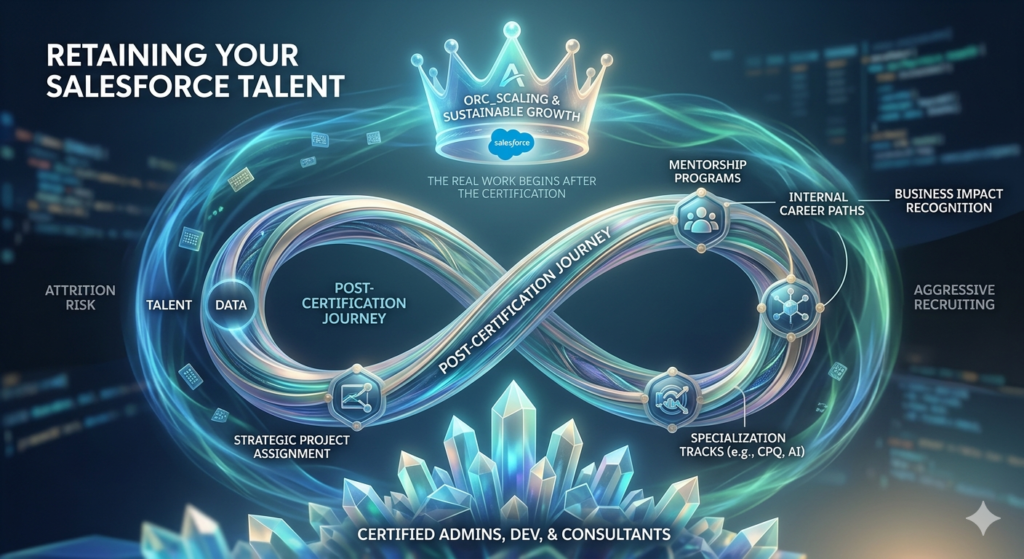
This article explores why organisations struggle to retain Salesforce-trained employees, what it truly costs when they leave, and — most importantly — what practical, proven strategies you can implement to build a loyal, high-performing Salesforce workforce that stays, grows, and drives lasting business value.
Why Salesforce-Trained Employees Leave: Understanding the Root Causes
Before you can fix a retention problem, you need to understand it deeply. Most organisations default to assuming salary is the primary driver of attrition. While compensation matters, the reality is far more nuanced — especially within the Salesforce ecosystem.
1. The Competitive Job Market Is Relentless
The moment an employee earns a Salesforce certification, their market value increases dramatically. A freshly certified Salesforce Administrator can command a 20–40% salary premium over their pre-certification earnings. A Salesforce Developer or Architect sits at an even steeper premium.
Competitors, rival consulting firms, and Salesforce ISV partners are watching certification announcements on LinkedIn with strategic intent. Recruiters target newly certified professionals within weeks — sometimes days — of their credentials going live. If your organisation isn’t actively engaging these employees at the point of certification, someone else already is.
2. Lack of Clear Career Progression
One of the most consistent themes in exit interviews with Salesforce professionals is the absence of a visible career path. Employees who have invested time and energy into mastering a complex ecosystem want to know: Where does this lead within this organisation?
If your answer is vague — or worse, non-existent — talented employees will find organisations that have a clear answer. Salesforce professionals are ambitious by nature. They understand the ecosystem deeply enough to know there are multiple career trajectories: from administration to architecture, from development to product management, from consulting to technical leadership. If your organisation doesn’t map those paths internally, they will find them externally.
3. Burnout from Overutilisation
This is particularly acute in Salesforce consulting firms and lean IT teams. Once an employee becomes Salesforce-certified, they often become the go-to resource for everything Salesforce-related — implementation support, user training, bug fixes, customisation requests, and stakeholder management — sometimes all simultaneously.
The result is burnout. Skilled employees who came in excited about solving complex business problems find themselves firefighting day-to-day support tickets instead. According to Gallup’s State of the Global Workplace report, 76% of employees experience burnout on the job at least sometimes, and for high-demand tech professionals carrying disproportionate workloads, that number skews even higher.
4. Poor Workplace Culture and Limited Psychological Safety
Salesforce professionals — particularly those with developer or architect-level skills — are typically analytical, problem-solving, and innovation-oriented individuals. They thrive in environments where ideas are welcomed, where failure is treated as learning, and where their expertise is respected.
When they land in cultures defined by bureaucracy, micromanagement, or where their technical recommendations are overridden without discussion, disengagement sets in quickly. A toxic or stagnant workplace culture is a silent killer of Salesforce talent retention.
5. Limited Innovation Opportunities
The Salesforce platform evolves rapidly — three major releases per year, continuous feature launches, and an expanding ecosystem of tools including Agentforce, Data Cloud, Tableau, MuleSoft, and Slack. Salesforce-trained employees want to work on the bleeding edge of this ecosystem.
Organisations that use Salesforce narrowly, or that don’t evolve their usage of the platform, inadvertently stifle the professional energy of their certified team members. When an employee’s skills outpace the organisation’s ambition, departure becomes inevitable.
6. Insufficient Recognition and Reward
High-performing Salesforce professionals often contribute disproportionately to organisational outcomes — successful CRM implementations, improved customer data quality, accelerated sales cycles, enhanced service delivery. When these contributions are not meaningfully recognised — whether through financial reward, public acknowledgement, or career advancement — resentment builds quietly.
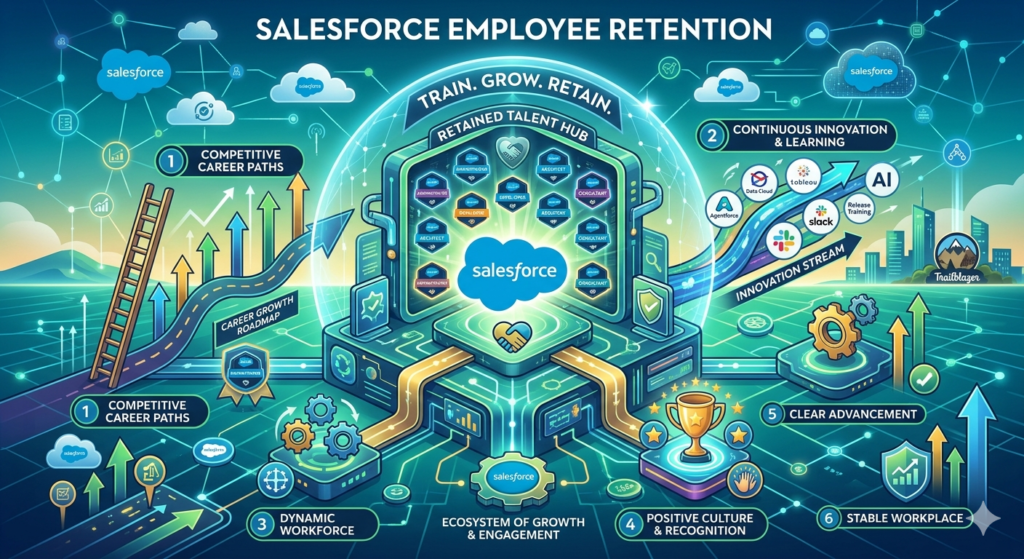
As leadership consultant Liz Wiseman puts it: “People don’t leave jobs; they leave environments where they feel invisible.” Recognition isn’t a ‘nice to have’ — it’s a retention strategy.
The Real Cost of Losing Salesforce Talent: A Number You Can’t Ignore
Many organisations treat employee turnover as an operational inconvenience. In the Salesforce ecosystem, it is a significant financial and strategic risk. Understanding the true cost of losing a Salesforce-trained employee is essential to justifying and prioritising retention investment.
Direct Recruitment Costs
Replacing a Salesforce professional is expensive. When you factor in:
- Agency fees (typically 15–25% of annual salary)
- Job board and LinkedIn Recruiter costs
- Interview and assessment process time
- Offer negotiation cycles
- Onboarding and orientation expenses
…you are looking at a direct cost ranging from £8,000 to £25,000+ per hire, depending on the seniority and specialisation of the role. For senior Salesforce Architects or Technical Leads, this figure can climb significantly higher.
Productivity Loss and the Ramp-Up Gap
Even after a replacement is hired, productivity loss continues. Research from the Society for Human Resource Management (SHRM) estimates that it takes six to nine months for a new employee to reach the productivity level of the person they replaced. In the Salesforce ecosystem, this ramp-up period is often longer, given the complexity of bespoke configurations, custom development, and the organisational knowledge embedded in existing implementations.
During this gap period, remaining team members absorb additional workload — accelerating their own burnout risk and potentially triggering secondary attrition.
Project Delays and Client Relationship Damage
For Salesforce consulting firms specifically, losing a key project resource mid-engagement can be catastrophic. Clients have contractual expectations, project timelines, and business-critical deliverables tied to specific milestones. When the consultant who understood their business requirements, system architecture, and stakeholder relationships walks out the door, you are not just facing a resourcing problem — you are facing a potential client relationship crisis.
In competitive consulting markets, client trust is your most valuable currency. Talent attrition that disrupts delivery quality is one of the fastest ways to erode it.
Knowledge Drain: The Invisible Loss
Perhaps the most underestimated cost of Salesforce talent attrition is the loss of institutional knowledge. Salesforce implementations are deeply contextual — they reflect years of business process decisions, data model choices, integration logic, and customisation rationale that exists primarily in the minds of the people who built and maintained them.
When those people leave, that knowledge walks out with them. Documentation rarely captures the full story. New team members inherit complexity without context — leading to longer resolution times, higher error rates, and a perpetual cycle of technical debt.
Training Investment Write-Off
The financial irony of poor retention is stark: the organisation absorbs the full cost of training and certification, and then a competitor benefits from it. Salesforce certification paths are not cheap. Depending on the certification track, preparation courses, exam fees, and paid study time, a single certification journey can cost £1,500 to £5,000 per employee. A multi-certification pathway for a Salesforce Architect can exceed £15,000 when all direct and indirect costs are calculated.
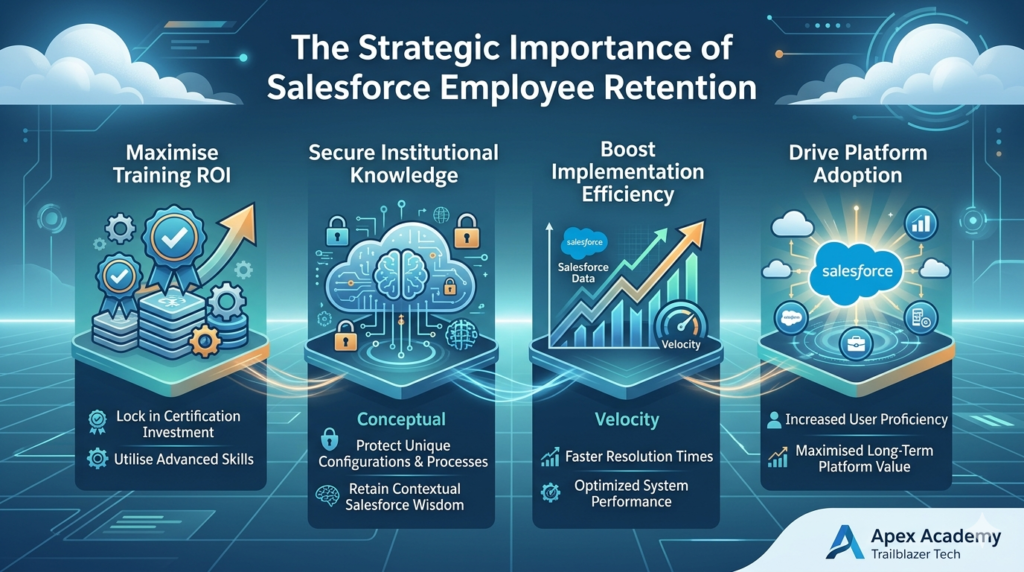
Multiply this across even a small team, and the stakes of poor retention become impossible to ignore.
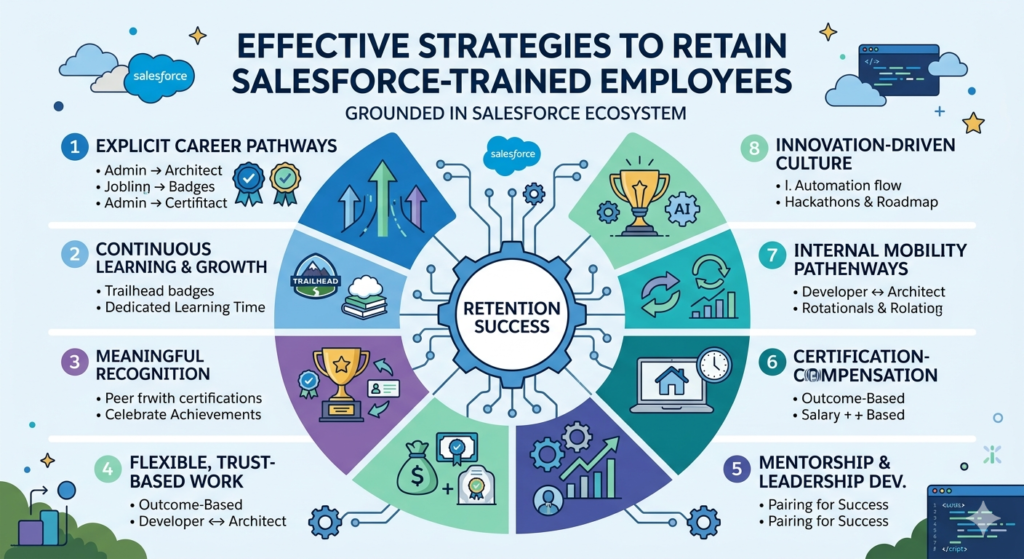
Effective Strategies to Retain Salesforce-Trained Employees
Now for the part that matters most — what you can actually do about it. The following strategies are grounded in the specific dynamics of the Salesforce ecosystem and the particular motivations of Salesforce-trained professionals. This is not generic HR advice. These are targeted, actionable approaches that organisations can implement to meaningfully improve Salesforce talent retention.
1. Create Explicit, Personalised Career Pathways
Generic career ladders don’t work for Salesforce professionals. What does work is a Salesforce-specific career architecture that maps clearly from entry-level certifications to senior technical and leadership roles.
What this looks like in practice:
- Define role tiers aligned with the Salesforce certification ecosystem (e.g., Admin → Senior Admin → Platform App Builder → Solution Architect)
- Map each tier to compensation bands, responsibilities, and growth expectations
- Conduct individual Career Path Conversations with each Salesforce-trained employee — not annual reviews, but dedicated discussions focused entirely on their professional trajectory
- Co-create a 12–24 month development plan that combines technical certification goals with business impact milestones
When employees can see a credible, personalised future within your organisation, the pull of external opportunities diminishes significantly.
2. Invest in Continuous Learning Beyond the Initial Certification
The organisations that retain Salesforce talent most effectively treat training as an ongoing commitment, not a one-time event. Given that Salesforce releases three major updates per year, continuous learning isn’t optional — it’s operationally necessary.
Actionable steps:
- Allocate dedicated Trailhead learning time within weekly schedules (even 2–3 hours per week makes a measurable difference)
- Fund progression along certification tracks — after Admin, support the journey toward Platform App Builder, Sales Cloud Consultant, or Service Cloud Consultant
- Create internal Salesforce Learning Communities — regular knowledge-sharing sessions, release review meetings, and cross-functional demos
- Encourage and fund attendance at Salesforce World Tour, Dreamforce, and regional user groups
- Support employees pursuing Salesforce MVP status — the recognition it brings benefits both the individual and your organisation’s market credibility
The message this sends is powerful: “We are committed to your growth, not just your current output.”
3. Build a Culture of Meaningful Recognition
Recognition in the context of Salesforce talent retention needs to be specific, timely, and tied to the actual contribution — not generic praise delivered quarterly.
Build a recognition framework that includes:
- Technical Achievement Awards — publicly recognise when team members pass certifications, complete complex implementations, or solve challenging technical problems
- Client Impact Highlights — share stories internally and externally (with client permission) about how your Salesforce team drove measurable business outcomes
- Peer Recognition Platforms — tools like Bonusly, Kudos, or even structured Slack channels dedicated to shoutouts create a culture where recognition flows in all directions
- Leadership Visibility — senior leaders acknowledging technical contributors by name in company-wide communications carries disproportionate weight
Recognition isn’t about empty gestures — it’s about making skilled people feel seen, valued, and connected to business outcomes they helped create.
4. Offer Flexible, Trust-Based Work Environments
The post-pandemic workforce has fundamentally recalibrated expectations around work flexibility. Salesforce professionals — who can perform the vast majority of their work remotely — are particularly attuned to this. Organisations that enforce rigid, unnecessary in-office mandates without compelling rationale are actively disadvantaging themselves in talent retention.
What flexibility looks like for Salesforce teams:
- Remote-first or hybrid-first policies with clear guidelines rather than arbitrary office attendance requirements
- Outcome-based performance management — measuring contribution by impact delivered, not hours logged
- Flexible scheduling for professionals balancing Trailhead study, certification preparation, and project delivery
- Asynchronous collaboration norms that respect deep work and reduce meeting fatigue
Trust is the currency of flexible work. When employees feel trusted, they reciprocate with loyalty.
5. Implement Mentorship and Leadership Development Programmes
One of the most powerful retention tools — and one of the most underutilised — is mentorship. Pairing junior Salesforce professionals with experienced internal mentors creates multiple retention benefits simultaneously.
For the mentee:
- Accelerated technical development
- Clearer career guidance
- Stronger organisational connection
- Reduced isolation during complex projects
For the mentor:
- Leadership experience that enhances their own career progression
- A sense of legacy and organisational contribution
- Stronger team relationships
Building an effective Salesforce mentorship programme:
- Formally match mentors and mentees based on career goals and technical interests, not just seniority
- Provide mentors with structured conversation frameworks — not just an open-ended “catch-up”
- Run quarterly Salesforce internal conferences where mentees present project learnings to leadership
- Identify high-potential Salesforce professionals early and fast-track them into a Future Leaders in Salesforce programme with dedicated coaching, elevated project exposure, and executive visibility
6. Redesign Compensation with Certification-Linked Incentives
Salary competitiveness is table stakes. What differentiates retention-focused organisations is how they structurally link compensation to Salesforce capability milestones.
Consider implementing:
- Certification Bonuses — a one-time payment upon achieving each new Salesforce certification (£500–£2,000 depending on the certification level)
- Salary Band Reviews tied to certification progression — an employee who moves from Admin to Architect-track certifications should see a salary review automatically triggered, not dependent on their ability to negotiate
- Profit-sharing or project success bonuses for consulting teams that deliver on-time, on-budget Salesforce implementations
- Long-term incentive plans (LTIPs) for senior Salesforce professionals — a structured financial incentive to remain with the organisation for 3–5 years
The goal is to make the financial case for staying internally more compelling than the financial case for leaving — not permanently, but long enough to build genuine loyalty through experience and culture.
7. Create Internal Mobility Pathways
One of the most underexplored retention strategies is internal mobility. Many organisations lose Salesforce-trained talent not because they want to leave the company, but because they feel stuck in a specific role or team.
Internal mobility for Salesforce professionals can include:
- Rotational programmes — allowing Salesforce Admins to spend time on the development team, or Developers to work in pre-sales or solution architecture
- Cross-functional project opportunities — inviting Salesforce professionals to participate in business transformation initiatives beyond their immediate remit
- Internal transfer pathways — a formal process by which employees can apply for Salesforce roles in other business units without penalty or friction
When employees see the full breadth of opportunity within your organisation, the need to look externally diminishes.
8. Foster an Innovation-Driven Work Culture
Salesforce-trained professionals are naturally curious about what the platform can do. The fastest way to lose them is to constrain them to routine, maintenance-mode work indefinitely.
Create space for innovation:
- Salesforce Hackathons — internal competitions to solve real business problems using Salesforce capabilities, including newer technologies like Agentforce, Data Cloud, or Flow automation
- Innovation Time — some organisations allocate 10–20% of work time for self-directed innovation projects (a principle popularised by Google’s “20% time” and still relevant today)
- Platform Roadmap Involvement — bring Salesforce-trained employees into conversations about the organisation’s future Salesforce strategy, not just its current execution
- External speaking and thought leadership — encourage and fund team members to present at Salesforce user groups, community events, or industry conferences. This raises their profile and your organisation’s
How Employee Upskilling Improves Retention — When Done Right
Upskilling is often discussed as a solution to the talent shortage problem. What is less discussed — but equally important — is how the manner in which you upskill employees directly influences whether they stay or leave.
The Psychological Ownership Effect
When an organisation invests meaningfully in an employee’s development, it triggers a psychological mechanism researchers call the “felt obligation to reciprocate” — a sense of loyalty and commitment that goes beyond transactional employment. Employees who feel genuinely invested in are more likely to demonstrate discretionary effort, advocate for the organisation, and resist external recruitment overtures.
But this effect is conditional. It only operates when employees perceive the investment as genuine — not performative, not tied exclusively to immediate business need, and not withdrawn when business pressures mount.
Training Aligned with Career Aspiration — Not Just Business Need
The most common upskilling mistake organisations make is training people for the company’s immediate need without connecting it to the employee’s personal career aspiration. This creates a transactional relationship: the employee gains the certification, updates their LinkedIn profile, and then leverages it to move to an organisation that does align with their goals.
The fix is elegant but requires intentionality:
- Start the career conversation before the training programme begins — understand where the employee wants to go, and design a training pathway that serves both organisational need and personal ambition
- Frame each certification in the context of the employee’s career story — “This certification gets you closer to your goal of becoming a Salesforce Architect”
- Pair training completion with a concrete career advancement milestone — a new title, expanded responsibilities, a salary review, or a high-profile project assignment
When training is experienced as a personal investment rather than an organisational extraction, loyalty follows naturally.
Building a Learning Culture That Outlasts Any Individual Certification
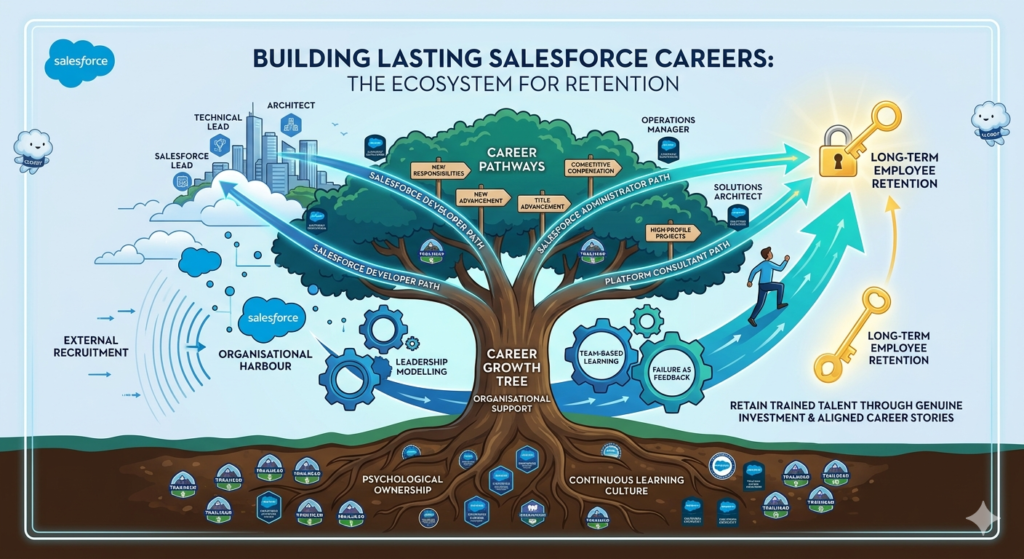
Organisations with the strongest Salesforce retention rates are rarely those that ran one great training programme. They are those that built a culture of continuous learning — where curiosity is rewarded, where Trailhead badges are celebrated on internal Slack channels, where certification announcements are treated as company news worth sharing.
This culture cannot be manufactured overnight, but it can be built deliberately through:
- Leadership modelling — when senior leaders are visibly learning (sharing Trailhead completions, attending Salesforce events, engaging with platform updates), it signals that learning is a shared organisational value
- Learning as a team sport — group certification challenges, study cohorts, and peer accountability partnerships
- Failure as feedback — normalising the experience of failing a Salesforce exam, regrouping, and retrying (which is incredibly common) removes the stigma that prevents some employees from pursuing advanced certifications
Building a Long-Term Salesforce Talent Retention Strategy
Individual tactics matter, but sustainable Salesforce talent retention requires a systematic, organisation-wide strategy that is built into workforce planning, leadership accountability, and cultural DNA.
Start with Workforce Planning — Before the Skills Gap Hits
Most organisations react to Salesforce talent shortages after they occur. The organisations that retain talent most effectively anticipate skills needs 12–24 months ahead and build internal capability proactively.
This means:
- Mapping your Salesforce roadmap to your talent requirements — if you plan to implement Salesforce Data Cloud in 18 months, which team members should begin building that expertise now?
- Conducting annual skills audits to identify capability gaps and retirement risks within your Salesforce team
- Building a talent pipeline through apprenticeships, graduate programmes, or partnerships with Salesforce training providers like RizeX Labs — developing talent internally from an earlier career stage creates deeper loyalty than lateral hires
Track the Right Retention Metrics
What gets measured gets managed. If you are serious about improving Salesforce talent retention, you need a clear set of metrics to track progress and identify problems early.
Key retention metrics for Salesforce teams:
| Metric | What It Tells You |
|---|---|
| Salesforce Team Turnover Rate | Overall attrition within your certified Salesforce workforce |
| Time-to-Resignation Post-Certification | How quickly employees leave after achieving certification — a critical early warning indicator |
| Internal Promotion Rate | Whether Salesforce professionals are advancing internally or leaving for advancement |
| Employee Net Promoter Score (eNPS) | How likely Salesforce team members are to recommend your organisation as a great place to work |
| Training ROI (Skills Retention Rate) | Are trained skills being actively applied and maintained internally? |
| Certification Progression Rate | Are employees continuing to grow their Salesforce expertise post-initial certification? |
Review these metrics quarterly, not annually. Retention problems that are visible in the data in February are solvable. The same problems visible in December — when exit interviews confirm what the data already knew — are expensive.
Create Consistent Employee Feedback Loops
One of the most practical and underutilised retention tools is simply asking your Salesforce team what they need — and then acting on the answers.
This doesn’t require complex HR infrastructure. It requires:
- Monthly one-on-ones between Salesforce professionals and their direct managers — with a specific agenda item focused on career development and satisfaction
- Quarterly pulse surveys with targeted questions about workload, career trajectory, recognition, and learning opportunities
- Stay interviews — structured conversations with high-performing Salesforce professionals designed to understand what keeps them engaged (before they decide to leave, not after)
- Post-certification check-ins — a formal touchpoint within 30, 60, and 90 days of certification to discuss the employee’s evolving career expectations and how the organisation can meet them
The intelligence gathered from these conversations is invaluable — and acting on it visibly is what builds trust.
Leadership Must Own Retention — Not Just HR
A critical mindset shift for organisations serious about Salesforce talent retention: retention is a leadership responsibility, not an HR function.
HR can build the frameworks, track the metrics, and facilitate the programmes. But the daily retention of Salesforce professionals happens in the relationship between those employees and their direct leaders. Managers who are invested in their team’s growth, who advocate for their recognition and promotion, who shield them from unnecessary bureaucracy and burnout — these managers retain talent.
Investing in manager capability is a direct retention strategy. Consider:
- Training technical team leads and Salesforce project managers on career coaching skills
- Including team retention metrics in manager performance evaluations
- Creating a Manager Excellence in Retention award that publicly recognises leaders who build loyal, high-performing Salesforce teams
Culture-Driven Retention: The Ultimate Differentiator
Ultimately, no compensation package, no training budget, and no perks programme can substitute for a workplace culture that Salesforce professionals genuinely want to be part of. Culture is the retention strategy that competitors cannot replicate overnight.
A retention-positive culture for Salesforce teams is characterised by:
- Psychological safety — where technical challenges are raised openly, mistakes are analysed without blame, and dissenting technical opinions are welcomed
- Shared purpose — where Salesforce professionals understand how their work connects to meaningful business outcomes and client impact
- Diverse and inclusive teams — where a wide range of backgrounds and perspectives strengthens both team performance and individual sense of belonging
- Transparent leadership — where business decisions, financial performance, and strategic direction are communicated honestly and regularly
These cultural elements don’t happen by accident. They are built through deliberate leadership behaviour, reinforced through organisational systems, and protected through hiring and promotion decisions that prioritise cultural contribution alongside technical skill.
Conclusion: Retention Is a Business Strategy, Not an HR Checkbox
The challenge of retaining Salesforce-trained talent is one that will only intensify as the Salesforce ecosystem continues to expand and the global demand for certified professionals continues to outpace supply. Organisations that approach this challenge reactively — responding to resignations with counter-offers and scrambling to rehire — will find themselves on an exhausting, expensive, and ultimately losing cycle.
The organisations that win are those that treat retention as a proactive, strategic, and continuous investment — in career development, in culture, in recognition, in flexibility, in leadership, and in the genuine belief that their Salesforce-trained people are among their most valuable long-term assets.
To retain Salesforce-trained employees effectively, you need to start well before the exit interview. You need to start with a clear career architecture, a culture of continuous learning, leadership that champions individual growth, and compensation structures that reward milestone achievement. You need feedback loops that surface problems early, workforce planning that anticipates future needs, and a cultural identity strong enough to make your organisation the obvious choice over any external offer.
At RizeX Labs, we work with organisations at every stage of this journey — from building high-quality Salesforce training programmes designed with retention in mind, to advising on the workforce strategies that transform certified professionals into loyal, long-term contributors.
The Salesforce ecosystem will continue to grow. The talent market will continue to compete fiercely for your best people. The question isn’t whether you can afford to invest in retention — it’s whether you can afford not to.
About RizeX Labs
We’re Pune’s leading IT training institute specializing in emerging technologies like Salesforce and data analytics. At RizeX Labs, we help professionals master tools like Salesforce Tableau CRM through hands-on training, real-world projects, and expert mentorship. Our programs are designed to transform learners into job-ready Salesforce professionals with strong analytical and reporting skills.
Internal Links:
- Salesforce Admin & Development Training
- Salesforce Apex Triggers: Beginner’s Guide with Real-Time Examples
- Salesforce Lightning Web Components (LWC) vs Aura: Which Should You Learn First
