
Introduction: The Big Question Everyone Is Asking Right Now
Salesforce Career in 2026: Is It Still Worth It? Honest Breakdown
Salesforce career 2026 worth it — this is the question almost everyone in the tech industry is asking right now, and honestly, the concern is valid.
Over the past few years, the Salesforce ecosystem has changed dramatically. AI tools are automating repetitive work, tech layoffs have created uncertainty, and the entry-level Salesforce job market has become far more competitive than it was before. At the same time, companies are still investing heavily in Salesforce, automation, AI-powered CRM solutions, and digital transformation.
So what’s the real truth behind the Salesforce job market in 2026?
Is Salesforce still a good career path for beginners, admins, developers, and consultants? Or has the ecosystem become too saturated and AI-driven for new professionals to succeed?
In this honest breakdown, we’ll explore:
- The current Salesforce job market in 2026
- How AI and Agentforce are changing Salesforce careers
- Which Salesforce roles are growing
- Which skills are becoming outdated
- Salary trends and future opportunities
- Whether a Salesforce career is still worth it in 2026
If you’re a student, career switcher, junior Salesforce professional, or experienced IT employee looking for clarity, this guide will help you make a smarter career decision.
Let’s get into it.
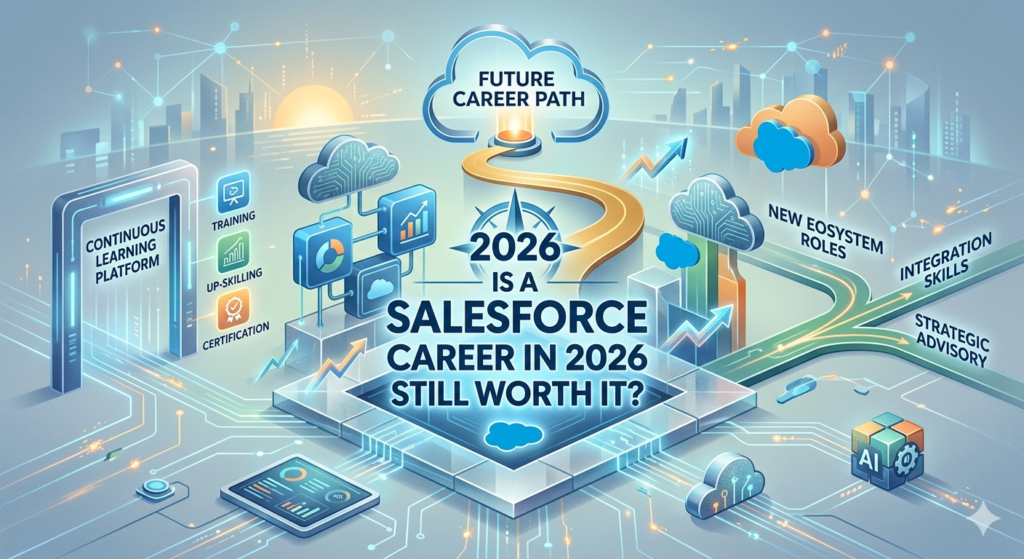
TL;DR — Quick Honest Answer
Yes, a Salesforce career in 2026 is still worth it — but only if you’re willing to adapt.
The days of “get one certification, land a $90K job” are largely over. The ecosystem is maturing, AI is reshaping job expectations, and entry-level saturation is real. But for professionals who specialize, build real skills, embrace AI tools like Agentforce, and solve actual business problems — the Salesforce ecosystem remains one of the most lucrative and stable tech career paths available.
The short version:
- Worth it if you upskill, specialize, and adapt
- Not worth it if you expect an easy ride with minimal effort
- The market is shifting — those who shift with it will thrive
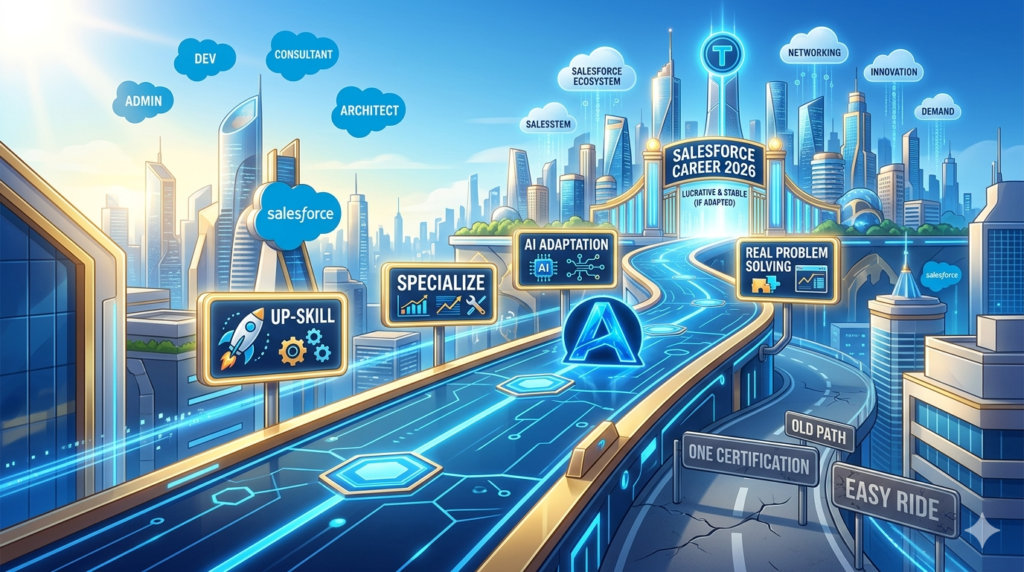
What’s Actually Happening in the Salesforce Job Market in 2026?
Before making any career decision, you need to understand the landscape. Here’s what the Salesforce job market in 2026 looks like from the inside.
AI Is Changing Everything — But Not in the Way You Fear
Artificial intelligence is reshaping the Salesforce ecosystem in profound ways. Salesforce’s own AI platform, Agentforce, launched in late 2024 and has rapidly evolved into one of the most significant changes the platform has seen in years. Agentforce allows businesses to build autonomous AI agents that can handle customer service inquiries, process leads, trigger workflows, and execute multi-step business logic — all without human intervention.
What does this mean for jobs?
It means that repetitive, low-skill Salesforce work is genuinely being automated. Simple case routing, basic lead assignment rules, standard report generation — these tasks are increasingly handled by AI agents rather than human admins configuring them manually.
But here’s the critical nuance most people miss: someone has to build, configure, monitor, and optimize those AI agents. That someone is a Salesforce professional who understands both the platform and the business context.
AI isn’t eliminating Salesforce jobs. It’s redefining what those jobs look like.
Entry-Level Market Saturation Is Real
This is the uncomfortable truth that a lot of training companies won’t tell you.
Between 2020 and 2023, the Salesforce ecosystem experienced explosive growth. Companies scrambled for talent, salaries skyrocketed, and the promise of “learn Salesforce Admin in 3 months and land a $70K job” became widespread.
That created a wave of new Salesforce professionals entering the market simultaneously. In 2025 and 2026, companies have more certified candidates than they have entry-level positions. The competition at the junior level is significantly higher than it was three years ago.
According to data from job platforms like LinkedIn and Indeed, the ratio of applicants to entry-level Salesforce Admin positions has increased substantially in many markets. What used to attract 20-30 applicants per role now attracts 200+.
This doesn’t mean entry-level is impossible. It means you need more than a certification to stand out.
Experienced Professionals Are Still in High Demand
Here’s the flip side: senior and specialized Salesforce professionals are harder to find than ever.
Companies are actively struggling to fill roles that require:
- Deep Salesforce architecture experience
- AI and Agentforce implementation expertise
- Data Cloud and CDP knowledge
- Complex integration experience
- DevOps and CI/CD capabilities
The market isn’t dying. It’s bifurcating — brutal at the entry level, excellent at the experienced and specialized level.
Agentforce Is Creating an Entirely New Career Category
Salesforce’s Agentforce isn’t just a feature update. It represents a fundamental platform shift. Businesses are moving from workflow automation to agentic AI — systems that don’t just follow rules, but reason, decide, and act autonomously within defined boundaries.
This is creating demand for professionals who understand:
- How to design AI agent architectures
- Prompt engineering within the Salesforce context
- AI safety, governance, and oversight
- Integration of Agentforce with external data sources
Agentforce careers are genuinely emerging as one of the hottest new categories in the Salesforce ecosystem, and the professionals who get ahead of this curve now will have a significant advantage.
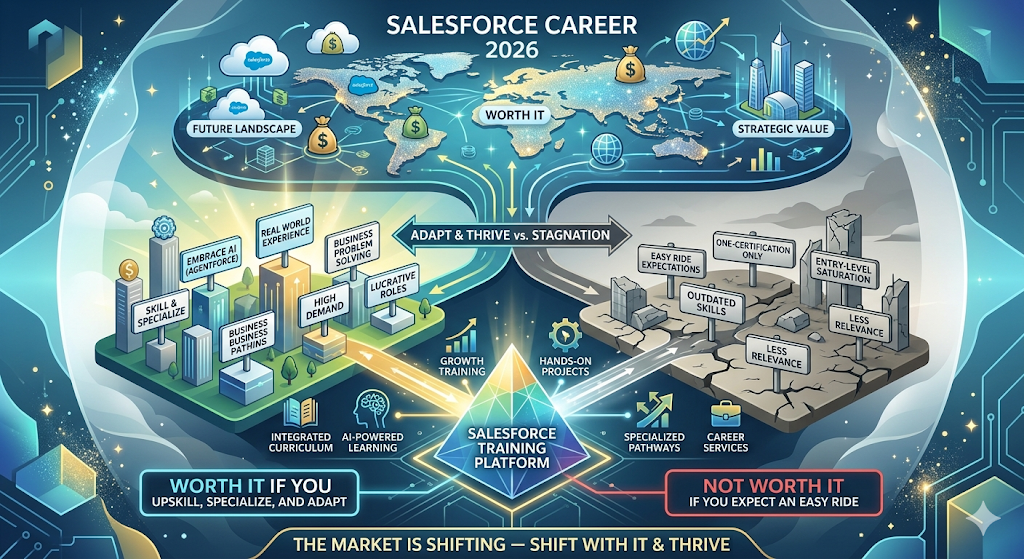
Is a Salesforce Career Still Good in 2026? Honest Pros & Cons
The Pros
1. The Salesforce Ecosystem Is Enormous
Salesforce remains the world’s #1 CRM platform with over 150,000 customers globally, including the majority of Fortune 500 companies. The ecosystem of AppExchange partners, consulting firms, and ISVs creates a massive demand layer beyond Salesforce itself.
2. Remote Work Opportunities Are Abundant
Salesforce careers are exceptionally well-suited to remote and hybrid work. Configuration, development, consulting, and architecture work can all be done remotely. This opens global opportunities for professionals who know their craft.
3. Salary Ceiling Is High — Very High
While entry-level salaries have faced some compression, senior and specialized roles command impressive compensation:
- Salesforce Solution Architects: $150,000–$220,000+ in the US
- Agentforce/AI Specialists: Emerging as premium-paid roles
- Data Cloud Consultants: Strong compensation with high demand
- Senior Developers: $120,000–$180,000 in most major markets
4. The Ecosystem Rewards Continuous Learners
Salesforce releases three major updates per year (Spring, Summer, Winter). Professionals who stay current consistently hold an advantage. If you enjoy learning, this ecosystem rewards you for it.
5. Multiple Career Paths Within One Ecosystem
Unlike some tech niches, the Salesforce ecosystem offers genuine diversity: technical development, business analysis, architecture, consulting, AI specialization, industry clouds, data management, DevOps, and more. You can pivot and evolve your career without leaving the ecosystem.
6. Global Demand Remains Consistent
While the US market has seen some adjustment, global demand for Salesforce professionals — particularly in the UK, Europe, Australia, the Middle East, and Southeast Asia — remains strong and in many cases is growing.
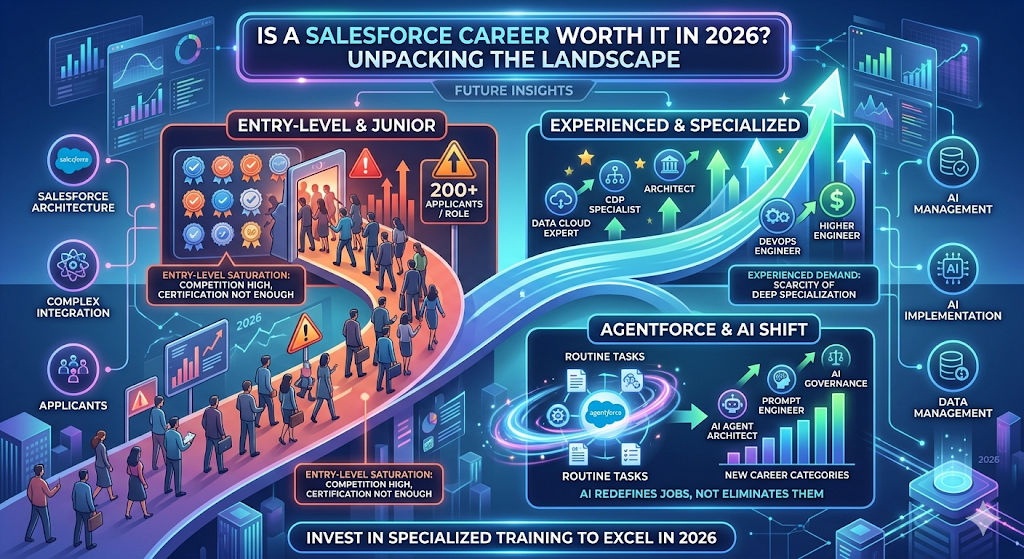
The Cons
1. Entry-Level Is Genuinely Competitive
As discussed, the admin-level market is crowded. If you’re starting fresh, expect it to take longer to land your first role than it would have in 2021-2022. Preparation, project experience, and differentiation are non-negotiable.
2. Certifications Alone Won’t Get You Hired Anymore
The market is saturated with certified professionals who lack practical experience. Recruiters and hiring managers are increasingly prioritizing demonstrated project work, hands-on capability, and problem-solving ability over certification count.
3. AI Is Raising the Baseline Expectations
Employers increasingly expect Salesforce professionals to understand AI tools, automation capabilities, and platform intelligence features. The baseline of what constitutes a “qualified” professional is rising.
4. The Learning Curve Is Steeper Than Marketed
Many training programs market Salesforce as easy to learn and quick to monetize. The reality is that becoming genuinely proficient — the kind of proficient that commands strong salaries — requires consistent effort over 12-24 months minimum.
5. Platform Costs Are Pushing Some Businesses Away
Salesforce licensing is expensive. Some small and mid-market businesses are evaluating alternatives. While this hasn’t dramatically impacted enterprise demand, it does affect the types of companies hiring Salesforce professionals.
The Reality Check
The Salesforce career path in 2026 is like any mature professional field: it rewards genuine expertise and punishes mediocrity. The days of coasting on a single admin certification are over, but the opportunity for skilled professionals has never been more interesting — especially at the intersection of CRM and AI.
Which Salesforce Roles Are Growing in 2026?
If you want to understand the future of Salesforce jobs, pay attention to where the demand is actually moving.
Salesforce Developer
Apex, LWC, integration development — skilled developers continue to be in consistent demand. As platform complexity grows and AI needs to be integrated with custom code, development skills remain highly valuable.
Solution Architect / Technical Architect
The highest-paid and arguably most respected role in the ecosystem. Architects design end-to-end solutions, govern implementation quality, and translate complex business requirements into scalable Salesforce architecture. Demand is high; supply is low.
AI + Agentforce Specialist
This is the fastest-emerging new role category. Companies adopting Agentforce need professionals who understand how to design, build, and govern AI agents within the platform. Early specialization here carries significant career advantage.Data Cloud Consultant
Salesforce Data Cloud (formerly Customer Data Platform) is a major strategic priority for Salesforce. Helping businesses unify customer data across sources and activate it within Salesforce is a complex, high-value skill set with growing demand.
Integration Specialist / MuleSoft Consultant
As businesses run increasingly complex tech stacks, integration expertise — particularly with MuleSoft and REST/SOAP API work — remains consistently valuable. Integration is where many Salesforce implementations succeed or fail.
RevOps Consultant
Revenue Operations is a growing business function that sits at the intersection of Sales, Marketing, and Customer Success. Salesforce professionals who understand RevOps strategy — not just platform configuration — are becoming increasingly sought after.
Salesforce DevOps Engineer
CI/CD pipelines, version control, deployment automation, tools like Gearset, Copado, and AutoRABIT — DevOps capabilities for Salesforce are increasingly expected at senior levels and represent a growing specialization niche.
Which Salesforce Roles Are Becoming Risky?
Let’s be honest about where the Salesforce admin future faces pressure.
Basic Admin-Only Roles
If your primary skill set is creating users, managing profiles, building simple reports, and handling routine configuration — that work is increasingly being automated or consolidated. Basic admin roles are not disappearing entirely, but they are facing compression and often require admins to demonstrate broader skills to remain competitive.
Repetitive Configuration Work
Point-and-click configuration without strategic context, business analysis skills, or deeper platform knowledge is exactly the type of work that AI-assisted tools and automation are reducing in scope.
Manual Reporting and Dashboard Jobs
Basic report building is increasingly handled by AI-assisted analytics tools. Professionals whose primary value is creating standard Salesforce reports without analytical interpretation or business insight are in the most vulnerable position.
The common thread: The riskiest position in 2026 is being a Salesforce professional who only does one thing and that thing is repetitive, low-complexity, and easily automated. Breadth + depth + AI fluency is the protection.
Skills That Will Matter Most in 2026
If you want to future-proof your Salesforce career, here’s where to invest your learning time.
AI & Agentforce
Understanding how to build, configure, and manage AI agents within Salesforce. This includes Agentforce configuration, prompt templates, agent actions, and governance. Non-negotiable as a forward-looking skill.
Flow Automation (Advanced)
Flow Builder is the dominant automation tool in Salesforce. Advanced Flow skills — subflows, complex logic, orchestration, triggered automation — are essential for any serious Salesforce professional in 2026.
Data Cloud
Salesforce Data Cloud is becoming central to enterprise implementations. Understanding data unification, identity resolution, calculated insights, and data activations will make you significantly more valuable.
Integrations & APIs
REST APIs, MuleSoft, external data connectors, and platform integration patterns are critical skills for developers and consultants working on complex implementations.
DevOps & CI/CD
Version control, deployment pipelines, sandox strategy, and tools like Gearset and Copado are increasingly expected, especially in development and senior technical roles.
Business Analysis Skills
The ability to translate business requirements into Salesforce solutions is what separates great consultants from mediocre ones. Understanding processes, asking the right questions, and thinking in solutions — not just features — is invaluable.
Communication & Stakeholder Management
Technical skills without the ability to communicate clearly with business stakeholders will limit your career ceiling. Professionals who can bridge business and technology are consistently in demand.
Industry Clouds
Salesforce has industry-specific clouds for Financial Services, Healthcare & Life Sciences, Manufacturing, Retail, and more. Industry specialization — combining Salesforce expertise with domain knowledge — creates rare and highly compensated professionals.
Certifications in 2026: Are They Still Worth It?
Short answer: Yes, but not in isolation.
Certifications still serve important functions:
- They validate foundational knowledge
- They signal commitment to the ecosystem
- Many employers use them as screening criteria
- They provide structured learning pathways
But the certification landscape has changed fundamentally. When hundreds of thousands of people hold Salesforce Administrator or Platform Developer I certifications, a certification alone doesn’t differentiate you.
What Actually Matters Now
Certifications + Real Project Experience + Portfolio Work = Market Readiness
Employers increasingly want to see:
- Projects you’ve actually worked on (even if volunteer, nonprofit, or personal sandbox work)
- Your ability to solve a business problem during an interview
- Evidence that you understand why things are done, not just how
- Demonstrated learning of current tools (AI, Data Cloud, Agentforce)
Which Certifications Are Most Valuable in 2026?
- Salesforce Certified Administrator — Still the entry point, but not enough alone
- Platform Developer I & II — Strong foundational value for technical roles
- Data Cloud Consultant — High demand, limited supply
- Agentforce Specialist — Newly emerging, strong early-mover advantage
- Application Architect / System Architect / CTA — Premium credentials with significant career impact
- MuleSoft Certifications — Consistently valued for integration roles
Advice: Don’t collect certifications to feel accomplished. Get certified in areas where you’re building real skills and can demonstrate practical application.
Salesforce Salary Trends in 2026
Here’s an honest look at Salesforce salary trends in 2026.
Entry Level (0-2 Years Experience)
- US: $55,000–$80,000
- UK: £35,000–£50,000
- India: ₹6–12 LPA
- Australia: AUD $65,000–$90,000
Salary pressure at this level is real. Expect lower starting salaries in many markets compared to 2021-2022 peaks.
Mid-Level (3-5 Years Experience)
- US: $85,000–$130,000
- UK: £55,000–£80,000
- India: ₹15–28 LPA
- Australia: AUD $100,000–$140,000
Senior/Specialized (5+ Years, AI/Architect Roles)
- US: $140,000–$220,000+
- UK: £80,000–£130,000+
- India: ₹30–60+ LPA (especially for specialized skills)
- Australia: AUD $150,000–$200,000+
Key Salary Insights
AI and Agentforce specialists are currently commanding premium compensation as the skill is rare and demand is spiking.
Freelance and consulting rates remain strong — experienced independent Salesforce consultants in the US and UK regularly earn $100–$200+ per hour.
Remote work has democratized access to higher-paying markets, allowing professionals in lower cost-of-living regions to earn global market rates.
The gap between junior and senior compensation is widening — another strong incentive to invest in upskilling rather than staying at the entry level.
Honest Advice for People Starting Their Salesforce Journey
If you’re new to Salesforce and reading this in 2026, here’s what I’d genuinely tell you as someone who’s seen the ecosystem evolve.
1. Don’t Enter Salesforce Just for “Easy Money”
The narrative of “learn Salesforce in 90 days, make six figures” was always an oversimplification. It’s even less accurate now. Enter the ecosystem because you’re genuinely interested in business technology, problem-solving, and continuous learning. The money follows genuine competence — not the other way around.
2. Build Real Projects Before Applying for Jobs
Use a free Salesforce Developer org. Build something. Volunteer to help a nonprofit with their Salesforce setup. Document your work. Create a portfolio you can actually show to employers. This alone will put you ahead of most other candidates who only have certifications.
3. Learn AI Tools Alongside Core Platform Skills
Don’t treat Agentforce and Salesforce Einstein as optional add-ons. They are the future of how the platform works. Get comfortable with them early, and you’ll have a significant edge.
4. Focus on Solving Business Problems
The best Salesforce professionals don’t just know the platform — they understand why a business needs what it needs. Learn basic business analysis. Understand sales processes, service operations, and marketing workflows. The ability to translate business needs into Salesforce solutions is what actually gets you promoted and paid.
5. Don’t Collect Certifications Blindly
Getting five certifications without meaningful project experience doesn’t make you more employable. It makes you more confused and no more hireable. Be strategic — get certified in areas where you can demonstrate real skills.
6. Build a Professional Presence
Engage with the Trailblazer Community. Write about what you’re learning. Share project insights on LinkedIn. Network genuinely with Salesforce professionals. The ecosystem has a strong community, and being part of it opens doors.
7. Be Patient With the Timeline
Expect 6-18 months from serious start to first job, depending on your background, effort level, and local market. Be realistic about this timeline and plan accordingly.
For Experienced Salesforce Professionals: How to Stay Relevant
If you already have a few years in the ecosystem, your biggest risk is complacency.
What to prioritize:
- Get hands-on with Agentforce. Don’t just read about it — build with it.
- Develop Data Cloud skills if you haven’t started already.
- Move toward architectural thinking even if you’re not an architect yet.
- Add AI governance and responsible AI understanding to your knowledge base.
- Sharpen your business communication and consulting skills.
The professionals who thrive in the next 3-5 years will be those who combine deep Salesforce expertise with AI fluency and business acumen. That’s a combination the market desperately needs and increasingly well rewards.
Final Verdict: Is a Salesforce Career Worth It in 2026?
After looking at all of this honestly, here’s the bottom line.
Yes — for the right person, with the right approach.
If you’re adaptable, genuinely curious, willing to invest in real skills (not just certifications), and excited about working at the intersection of AI and business technology, the Salesforce ecosystem in 2026 offers genuine opportunity. Strong salaries for specialists. Remote work flexibility. A massive, global ecosystem with multiple career paths. And an AI evolution that’s creating entirely new categories of high-value work.
No — if you’re looking for an easy shortcut.
If you’re entering Salesforce expecting to do the minimum, grab a couple of certs, and coast into a comfortable six-figure job — that ship has sailed. The market has matured. Competition is real. Expectations are rising. Half-hearted effort produces disappointing results.
The honest summary:
| Factor | 2021-2022 | 2026 |
|---|---|---|
| Entry-level competition | Low-Medium | High |
| Senior role demand | High | Very High |
| AI knowledge expectation | Optional | Essential |
| Certification value alone | High | Medium |
| Remote opportunities | Good | Excellent |
| Salary for specialists | High | Very High |
| Career longevity | Strong | Strong (with adaptation) |
The Salesforce career path in 2026 isn’t easier than it was. But for those who take it seriously, it’s arguably more interesting and more rewarding than ever before — because the problems being solved are more complex, the technology is more sophisticated, and the professionals who can navigate that complexity are genuinely rare and genuinely valued.
The ecosystem isn’t dying. It’s evolving. The question is whether you’ll evolve with it.
About RizeX Labs
We’re Pune’s leading IT training institute specializing in emerging technologies like Salesforce and data analytics. At RizeX Labs, we help professionals master critical tools like Salesforce CRM Analytics through hands-on training, real-world projects, and expert mentorship. Our programs are designed to transform learners into job-ready Salesforce professionals with strong analytical, automation, and reporting skills tailored for the modern market.
Internal Links:
- Salesforce Admin & Development Training
- Salesforce Apex Triggers: Beginner’s Guide with Real-Time Examples
- Salesforce Lightning Web Components (LWC) vs Aura: Which Should You Learn First
