
Introduction
Let’s be real—2026 feels like a confusing time to plan a tech career.
Every other week, there’s news about layoffs at major tech companies. AI tools are automating tasks that used to require entire teams. New frameworks, new platforms, and new buzzwords pop up constantly. And if you’re a student, a fresher, or someone thinking about switching careers, you’re probably asking one very reasonable question:
“Is investing time and money into Salesforce still worth it in 2026?”
It’s a fair question. The tech world has changed dramatically in just the last two years. What worked in 2022 or 2023 doesn’t necessarily work today. Certifications that once guaranteed interviews now compete with hundreds of similarly certified candidates.
So, is a Salesforce career in 2026 worth it? Is the demand real, or is the market oversaturated? And more importantly, is Salesforce career good for someone just starting out—or for someone looking to pivot from a different field?
In this post, I’m going to give you an honest, no-fluff breakdown. No hype. No fake promises. Just a realistic look at where Salesforce stands in 2026, who it’s best suited for, what challenges you’ll face, and how to build a career that actually lasts.
Let’s dive in.
Section 1: Understanding the Salesforce Ecosystem in 2026
Before we talk about careers, let’s make sure we’re on the same page about what Salesforce actually is in 2026—because it’s not the same platform it was five years ago.
At its core, Salesforce is the world’s leading Customer Relationship Management (CRM) platform. Businesses use it to manage sales, customer service, marketing, analytics, and more. But Salesforce has evolved far beyond a simple CRM.
Here’s what the Salesforce ecosystem looks like in 2026:
- Sales Cloud – Still the bread and butter. Sales teams worldwide depend on it.
- Service Cloud – Powering customer support at scale.
- Marketing Cloud & Account Engagement – Driving personalized marketing campaigns.
- Data Cloud – Salesforce’s answer to unified data management and real-time customer insights.
- Agentforce – The newest addition, enabling businesses to build and deploy autonomous AI agents.
- Einstein AI – Embedded AI across the platform for predictions, recommendations, and automation.
- MuleSoft – Integration across enterprise systems.
- Tableau – Data visualization and analytics.
- Slack – Workplace collaboration, now deeply integrated into Salesforce workflows.
The Salesforce job market 2026 isn’t just about admins and developers anymore. It now spans AI specialists, data architects, integration consultants, and Agentforce builders.
And here’s a number that matters: Salesforce’s ecosystem is projected to generate over $2 trillion in business revenue and create millions of jobs globally between now and 2028, according to IDC research. Companies aren’t just using Salesforce—they’re building their entire digital strategy around it.
That kind of investment doesn’t disappear overnight.
Section 2: Current Salesforce Job Market in 2026
Let’s talk about what the actual hiring landscape looks like.
Roles in demand:
- Salesforce Administrators – Still the most accessible entry point. Every company using Salesforce needs at least one.
- Salesforce Developers – Apex, LWC (Lightning Web Components), and integration development remain highly sought after.
- Consultants (Functional & Technical) – Companies pay a premium for professionals who can translate business needs into Salesforce solutions.
- Architects (Solution & Technical) – Senior roles with high salaries. Demand is growing as implementations become more complex.
- AI + Agentforce Specialists – This is the fastest-growing niche in the Salesforce ecosystem. Professionals who understand how to configure and deploy Einstein AI features and Agentforce agents are in high demand.
- Freelancers & Independent Consultants – The gig economy for Salesforce professionals is thriving, especially on platforms like Upwork, Toptal, and through Salesforce partner firms.
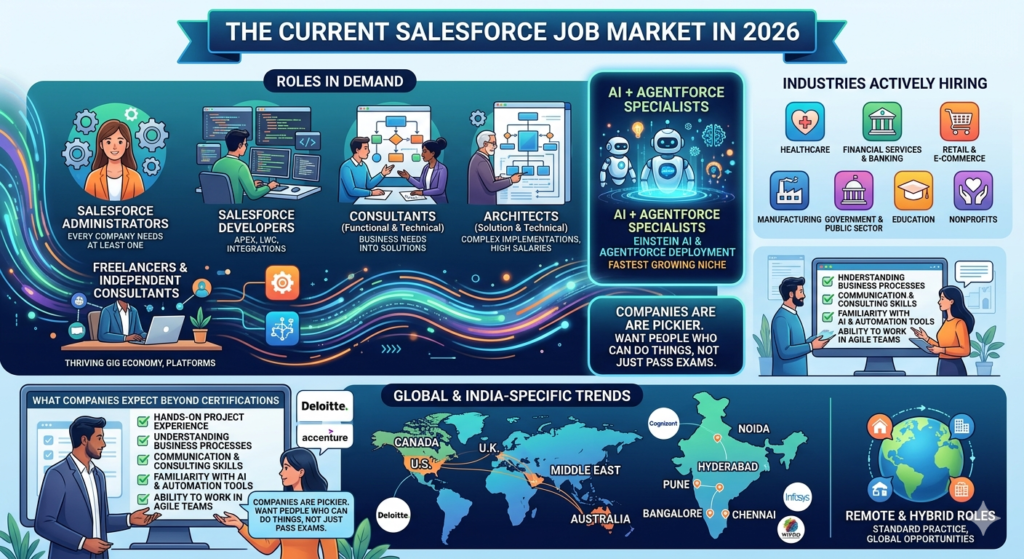
Industries actively hiring:
- Healthcare
- Financial services & banking
- Retail & e-commerce
- Manufacturing
- Government & public sector
- Education
- Nonprofits
What companies expect beyond certifications:
- Hands-on project experience
- Understanding of business processes
- Communication and consulting skills
- Familiarity with AI and automation tools
- Ability to work in agile teams
The Salesforce job market 2026 is competitive, yes—but it’s also expanding. The key difference from a few years ago? Companies are pickier. They want people who can do things, not just people who passed a multiple-choice exam.
Global and India-specific trends:
Globally, the U.S., U.K., Canada, Australia, and the Middle East continue to be strong markets. In India, cities like Hyderabad, Bangalore, Pune, Chennai, and Noida have a high concentration of Salesforce roles—both in product companies and IT consulting firms like Deloitte, Accenture, Cognizant, Infosys, and Wipro.
Remote and hybrid roles are now standard for many Salesforce positions, which opens up opportunities regardless of location.
Section 3: Is Salesforce Career Good for Freshers?
This is probably the most common question I get, so let me be direct.
Yes, a Salesforce career is good for freshers—but it’s not easy.
Here’s the honest reality:
- Entry barriers are higher than before. Five years ago, one certification could land you an interview. In 2026, you need certifications plus demonstrable skills.
- Hands-on projects matter more than anything. Employers want to see what you’ve built, not just what you’ve studied.
- Trailhead is still a goldmine. Salesforce’s free learning platform gives you access to real labs, projects, and certifications. Use it aggressively.
- Building a portfolio is non-negotiable. Create sample projects on your Salesforce Developer Org. Document them. Share them on LinkedIn and GitHub.
- Internship opportunities exist, especially at Salesforce partner companies and consulting firms.
How long does it take to get your first Salesforce job?
Honestly? For most freshers, it takes 3 to 8 months of focused effort—learning, getting certified, building projects, networking, and applying consistently. Some get lucky faster. Some take a year. The key is persistence and continuous improvement.
Is Salesforce career good if you’re not from a computer science background? Absolutely. Many successful Salesforce professionals come from non-tech backgrounds—business, finance, marketing, even healthcare. The platform values problem-solving and business understanding as much as coding.
Section 4: Salary Expectations in 2026
Let’s talk money. Here are realistic salary ranges based on current market data:
India (Annual, in INR):
| Role | Experience | Salary Range |
|---|---|---|
| Salesforce Admin | 0–2 years | ₹3.5L – ₹7L |
| Salesforce Developer | 1–3 years | ₹5L – ₹12L |
| Salesforce Consultant | 2–5 years | ₹8L – ₹18L |
| Salesforce Architect | 5–10 years | ₹18L – ₹40L+ |
| AI/Agentforce Specialist | 2–5 years | ₹10L – ₹25L |
U.S. (Annual, in USD):
| Role | Salary Range |
|---|---|
| Salesforce Admin | $65K – $95K |
| Salesforce Developer | $90K – $140K |
| Salesforce Consultant | $100K – $160K |
| Salesforce Architect | $150K – $220K+ |
| AI/Agentforce Specialist | $110K – $180K |
Factors that affect salary:
- Experience – Obviously, more experience = more pay.
- Certifications – They validate your skills. Stacking multiple relevant certifications helps.
- Communication skills – Especially critical for consultant and client-facing roles.
- Domain expertise – Knowing healthcare, finance, or retail processes alongside Salesforce gives you an edge.
- Location – U.S., U.K., and Australia pay significantly more than most Asian markets, though remote work is narrowing the gap.
Section 5: How AI Is Changing Salesforce Careers
This is the elephant in the room. Let’s address it head-on.
Will AI replace Salesforce professionals?
Short answer: No. But it will change what they do.
Salesforce has embedded AI deeply into its platform:
- Einstein AI provides predictive analytics, lead scoring, email insights, and automated recommendations.
- Agentforce allows businesses to create autonomous AI agents that handle customer interactions, resolve cases, and take actions—without human intervention.
- Einstein Copilot assists users with natural language prompts, generating reports, writing code, and automating workflows.
Here’s what this means for your career:
Roles that involve repetitive, manual configuration tasks (basic report building, simple data entry automation, routine admin work) will shrink over time. AI can handle much of this now.
Roles that involve strategic thinking, complex problem-solving, customization, and client consulting will grow. AI creates new complexity—someone has to configure it, train it, integrate it, and make strategic decisions about it.
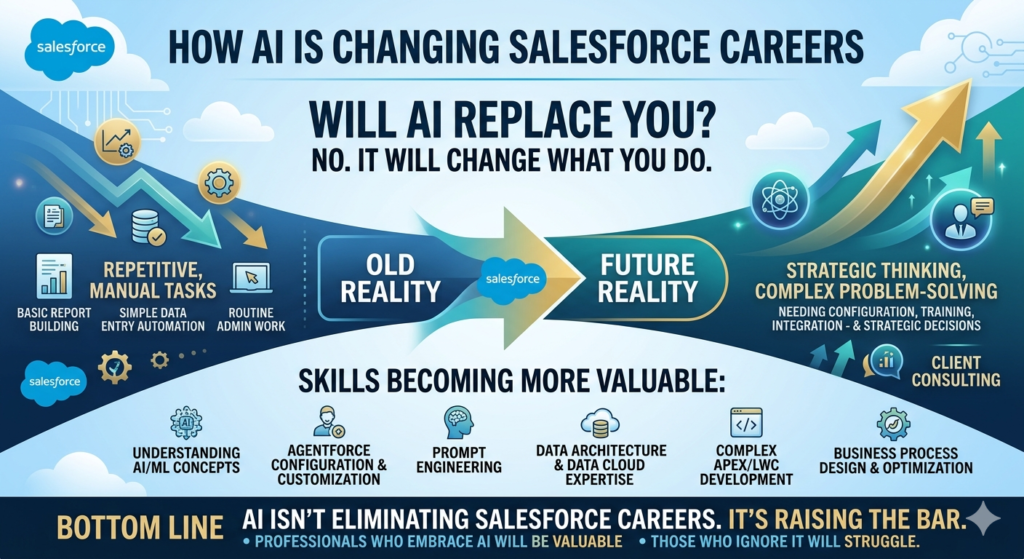
Skills becoming more valuable:
- Understanding AI/ML concepts at a practical level
- Configuring and customizing Agentforce agents
- Prompt engineering within Salesforce
- Data architecture and Data Cloud expertise
- Complex Apex/LWC development that goes beyond what AI can auto-generate
- Business process design and optimization
The bottom line: AI is not eliminating Salesforce careers. It’s raising the bar. Professionals who embrace AI and learn to work with it will be more valuable than ever. Those who ignore it will struggle.
Section 6: Biggest Challenges in Building a Salesforce Career
I’d be doing you a disservice if I only talked about the good stuff. Here are real challenges you should be prepared for:
- Increasing competition – More people are entering the Salesforce ecosystem every year. Standing out requires more than a certification badge.
- Fake training promises – Beware of coaching institutes that promise “100% placement” or “₹10L+ salary guaranteed.” Most of these are scams or exaggerations.
- Certification-only candidates struggle – Employers report that many candidates have certifications but can’t solve basic real-world problems in interviews.
- Lack of practical exposure – If you’ve never worked on a real Salesforce org or built a project, you’ll find interviews very difficult.
- Constant learning is required – Salesforce releases updates three times a year. New features, new products, new best practices. You can never stop learning.
- Initial salary can be modest – Especially in India, entry-level Salesforce salaries can be underwhelming. The growth comes with experience and expertise.
My honest advice? Don’t let these challenges scare you off—but don’t ignore them either. Go in with realistic expectations and a solid plan.
Section 7: Salesforce vs Other Tech Careers in 2026
How does Salesforce stack up against other popular tech career paths?
| Factor | Salesforce | Full-Stack Dev | Data Analytics | Cybersecurity | Cloud Computing | AI Engineering |
|---|---|---|---|---|---|---|
| Learning Curve | Moderate | Steep | Moderate | Steep | Steep | Very Steep |
| Entry Barrier | Low–Medium | Medium | Low–Medium | Medium–High | Medium–High | High |
| Salary Growth | Strong | Strong | Moderate | Very Strong | Strong | Very Strong |
| Job Stability | High | Moderate | Moderate | High | High | High |
| Work-Life Balance | Generally Good | Variable | Good | Variable | Variable | Variable |
| Job Availability | High | High | High | Growing | Growing | Growing but niche |
| Non-Tech Friendly | Yes | Less so | Somewhat | Less so | Less so | No |
Key takeaway:
Salesforce is one of the most accessible tech careers, especially for people without a traditional CS background. It offers strong stability, good salaries (especially at mid-senior levels), and a clear growth path. It may not have the “flashiness” of AI engineering, but it offers something many other paths don’t: a massive, established ecosystem with consistent enterprise demand.
If you’re analytical, enjoy solving business problems, and prefer a structured career path over the wild west of startup culture, Salesforce is genuinely hard to beat.
Section 8: Who Should Choose Salesforce in 2026?
Salesforce is a great fit if you are:
- A business-oriented professional who understands workflows, processes, and customer management
- A CRM enthusiast interested in how businesses manage relationships
- A good communicator who enjoys talking to clients and stakeholders
- A problem solver who likes configuring systems to meet specific needs
- Someone looking for a stable enterprise career with a clear growth trajectory
- A career switcher from non-tech fields like banking, healthcare, HR, or sales
- A fresher willing to invest 6–12 months in serious learning before expecting results
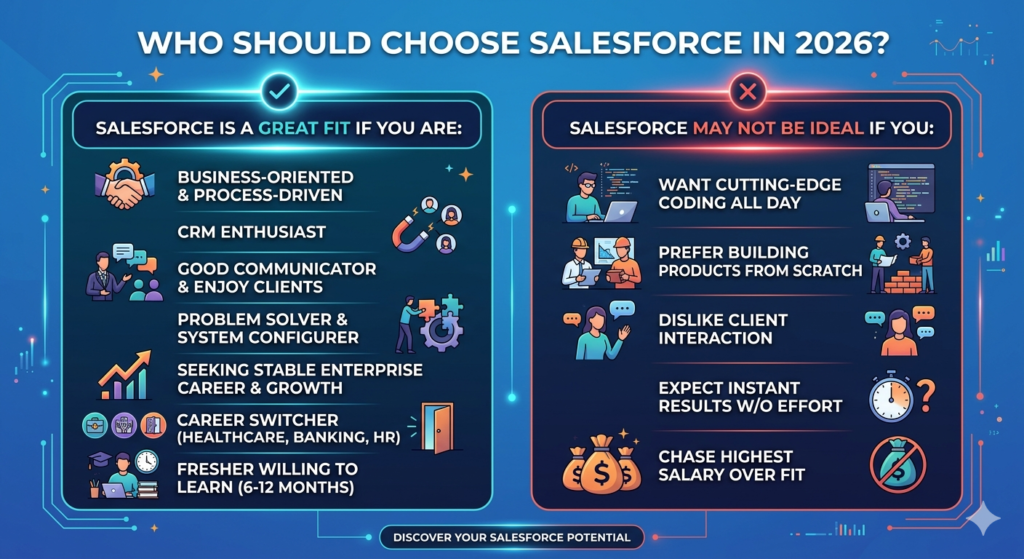
Salesforce may not be ideal if you:
- Want to work primarily on cutting-edge algorithms or pure coding all day
- Prefer building products from scratch rather than configuring existing platforms
- Dislike client interaction and consulting-style work
- Expect instant results without putting in the learning effort
- Are only chasing the highest possible salary without considering fit
Section 9: Roadmap to Start a Salesforce Career in 2026
If you’ve read this far and you’re thinking, “Okay, I want to give this a shot”—here’s a step-by-step roadmap.
Step 1: Learn Salesforce Basics
Start with understanding what Salesforce is, how CRM works, and the core concepts (objects, fields, records, relationships, automation).
Step 2: Complete Trailhead Modules
Salesforce Trailhead (trailhead.salesforce.com) is free and incredibly well-structured. Start with the Admin Beginner trail and work your way up.
Step 3: Practice on a Developer Org
Sign up for a free Salesforce Developer Edition org. This is your playground. Build, break, and rebuild.
Step 4: Build Mini Projects
Create real-world scenarios:
- A recruitment tracking app
- A student management system
- A small business CRM with automation and dashboards
Document these projects and publish them on your portfolio.
Step 5: Earn Certifications Strategically
Start with Salesforce Administrator. Then consider:
- Platform App Builder
- Salesforce AI Associate
- Platform Developer I (if you’re inclined toward coding)
Don’t collect certifications randomly—align them with your career goals.
Step 6: Create a LinkedIn Presence
Share your learning journey. Post about projects. Engage with the Salesforce community. Many hiring managers actively scout LinkedIn for Salesforce talent.
Step 7: Apply for Internships and Jobs
Target Salesforce consulting partners, IT services companies, and startups. Don’t wait until you feel “100% ready”—you’ll learn the most on the job.
Step 8: Learn AI + Agentforce Concepts
This is the differentiator in 2026. Even basic knowledge of Einstein AI, Agentforce, prompt templates, and Data Cloud will set you apart from the majority of candidates.
Step 9: Never Stop Learning
Join the Trailblazer Community. Attend Salesforce events (Dreamforce, TrailblazerDX, local user groups). Read release notes. The platform evolves constantly, and so should you.
Conclusion
So, is a Salesforce career 2026 worth it?
Here’s my honest verdict:
Yes—but with caveats.
Salesforce remains one of the most reliable, accessible, and well-compensated career paths in enterprise technology. The ecosystem is growing, not shrinking. AI is creating new opportunities within Salesforce, not eliminating them. And the demand for skilled professionals—people who can actually solve problems, not just pass exams—is strong and increasing.
But the days of “get one certification and land a job” are behind us. In 2026, the market rewards real skills, practical experience, business understanding, and continuous learning.
Is Salesforce career good for you specifically? That depends on your interests, your willingness to put in the work, and whether you enjoy the kind of problem-solving that Salesforce involves. If you’re someone who likes building solutions at the intersection of technology and business, Salesforce is genuinely one of the best places to build a long, rewarding career.
The market is competitive. The learning never stops. But for those who commit to it properly, the opportunities in 2026—and beyond—are very, very real.
About RizeX Labs
At RizeX Labs, we help professionals and organizations build future-ready Salesforce skills through practical training, real-world implementation knowledge, and industry-focused learning programs.
With the rapid evolution of AI, automation, and cloud technologies, Salesforce continues to remain one of the most in-demand enterprise platforms globally. Our mission is to help learners understand the real Salesforce ecosystem, build job-ready skills, and create sustainable career growth opportunities in the modern CRM industry.
We guide students, freshers, developers, admins, and career switchers with hands-on Salesforce learning paths designed for long-term success in the changing tech landscape.
Internal Linking Opportunities:
External Linking Opportunities:
- Salesforce Official Website
- Salesforce Careers
- Salesforce Trailhead
- Salesforce Administrator Career Path
- Salesforce Developer Career Path
- Salesforce Agentforce Overview
- Salesforce Ecosystem Resources
Quick Summary
A Salesforce career in 2026 continues to be a strong option for professionals looking for stability, growth, and opportunities in cloud technology and enterprise solutions. As businesses increasingly adopt CRM platforms, AI-powered automation, and customer experience technologies, the demand for skilled Salesforce professionals remains significant across industries.
The Salesforce ecosystem now extends beyond traditional admin and development roles into AI, automation, consulting, Data Cloud, Agentforce, analytics, and customer success operations. Professionals with practical experience, communication skills, and hands-on project exposure are likely to remain highly valuable in the evolving tech market.
While competition in the Salesforce job market 2026 is higher than before, companies are actively seeking candidates who can solve real business problems instead of relying only on certifications. For learners willing to continuously upskill and adapt to new technologies, Salesforce remains a promising long-term career path with strong salary potential and global demand.
