
Introduction
The cloud technology job market in 2026 is nothing short of explosive. Enterprises across every sector — banking, healthcare, retail, manufacturing, and government — are aggressively shifting to cloud-based platforms. And right at the centre of this transformation sit two titans: Salesforce and ServiceNow.
If you have spent even a few hours researching tech careers recently, you have probably come across both names. And if you are anything like most professionals in India right now, you are probably asking yourself the same question that thousands of others are asking every single day:
Should I learn Salesforce or ServiceNow?
It is a genuinely difficult question — not because one platform is clearly better than the other, but because they are fundamentally different tools built for different business goals. Choosing the wrong one for your background, interests, and career aspirations could mean months of wasted effort. Choosing the right one could fast-track your career into one of the most in-demand, well-paying tech niches in the world.
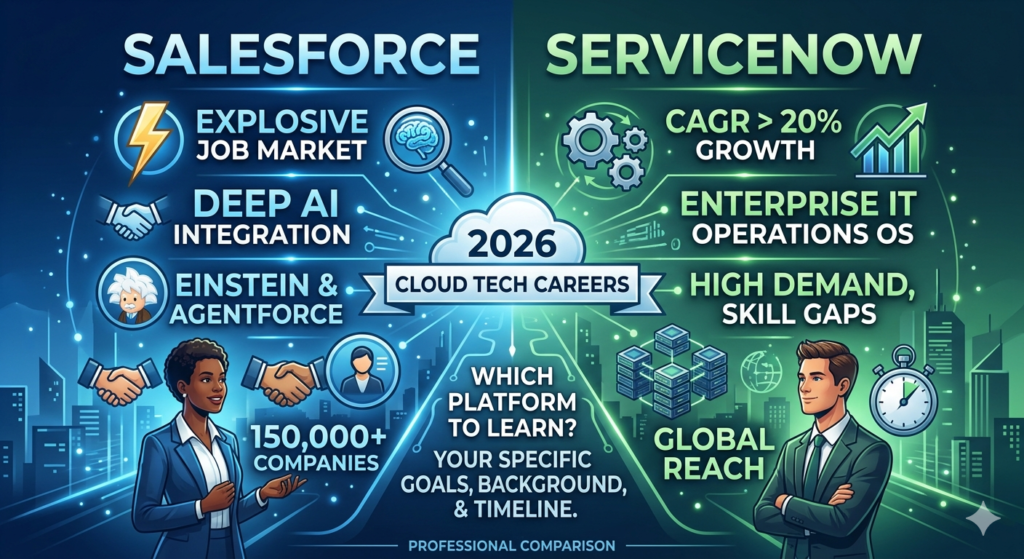
Here is what makes this comparison particularly interesting in 2026:
- Salesforce now powers over 150,000 companies globally and has integrated deep AI capabilities through its Einstein and Agentforce platforms
- ServiceNow is growing at a compound annual growth rate (CAGR) of over 20% and is becoming the operating system of choice for enterprise IT operations
- Both platforms offer certified professionals salaries significantly above the Indian IT average
- Both have massive skill gaps — meaning demand consistently outpaces supply
This article gives you a deeply researched, honest, and practical comparison of the Salesforce vs ServiceNow best career in 2026 landscape. By the time you finish reading, you will know exactly which platform to learn based on your specific background, goals, and timeline.
Let us dive in.
What Is Salesforce?
Salesforce is the world’s number one Customer Relationship Management (CRM) platform. Founded in 1999 by Marc Benioff, it was one of the first enterprise applications delivered entirely via the cloud — a revolutionary concept at the time. Today, it is a multi-cloud ecosystem used by businesses of every size, from early-stage startups to Fortune 500 corporations.
At its core, Salesforce helps businesses manage their relationships with customers — tracking leads, automating sales processes, delivering better customer service, running personalised marketing campaigns, and building custom business applications.
Core Salesforce Products in 2026
| Product | What It Does |
|---|---|
| Sales Cloud | Manages leads, opportunities, accounts, and sales pipelines |
| Service Cloud | Powers customer support, case management, and contact centres |
| Marketing Cloud | Enables email, social, and digital marketing automation |
| Commerce Cloud | Manages e-commerce storefronts and order management |
| Experience Cloud | Builds portals and communities for customers and partners |
| Einstein AI / Agentforce | Delivers AI-powered predictions, automation, and intelligent agents |
| MuleSoft | Integration platform connecting Salesforce with other enterprise systems |
| Tableau | Business intelligence and data visualisation |
| Slack | Collaboration platform integrated within the Salesforce ecosystem |
Industries That Use Salesforce
Salesforce is genuinely industry-agnostic. You will find it deployed across:
- Financial services (HDFC, Bajaj Finserv, insurance companies)
- Healthcare and life sciences (hospitals, pharma companies)
- Retail and e-commerce (brands managing customer loyalty and sales)
- Technology companies (SaaS businesses managing subscriptions and support)
- Manufacturing (managing distributor and dealer networks)
- Education (student relationship management)
- Non-profits (donor management and grant tracking)
Types of Salesforce Career Roles
The Salesforce ecosystem offers a wide variety of career paths:
1. Salesforce Administrator
The entry point for most professionals, especially non-IT backgrounds. Admins configure the platform, manage users, create reports and dashboards, and automate workflows using clicks — not code.
2. Salesforce Developer
Developers write code using Apex (Salesforce’s proprietary Java-like language) and Lightning Web Components (JavaScript-based) to build custom functionality beyond what out-of-the-box configuration allows.
3. Salesforce Consultant
Consultants work with clients to understand their business requirements, design solutions, and implement Salesforce. This role is highly client-facing and demands both technical and communication skills.
4. Salesforce Architect
Senior-level professionals who design the overall Salesforce solution architecture. Architects make critical decisions about data modelling, integration patterns, security models, and multi-cloud strategies.
5. Salesforce Business Analyst
BAs bridge the gap between business stakeholders and technical teams. They gather requirements, write user stories, create process maps, and ensure that the implemented solution actually solves the business problem.
6. Salesforce AI Specialist (New in 2026)
With the rapid rise of Einstein AI and Agentforce, a new career category has emerged — professionals who design, implement, and manage AI agents and predictive models within the Salesforce platform.
Why Salesforce Remains Popular in 2026
Salesforce has maintained its dominance for a simple reason: businesses always need customers, and managing those customer relationships requires powerful tools. Despite the entry of competitors like Microsoft Dynamics 365, Salesforce continues to hold over 23% of the global CRM market — more than its next four competitors combined.
The 2026 landscape also shows Salesforce doubling down on AI-first features. Agentforce — Salesforce’s autonomous AI agent platform — is being adopted rapidly by enterprises looking to automate customer interactions, sales follow-ups, and support resolution. This means the demand for Salesforce professionals who understand both CRM fundamentals and AI capabilities is skyrocketing.
What Is ServiceNow?
ServiceNow is an enterprise cloud platform that helps organisations manage, automate, and optimise workflows across IT, HR, security, customer service, and operations. Founded in 2004 by Fred Luddy, ServiceNow started as an ITSM (IT Service Management) tool and has since expanded into a comprehensive digital transformation platform.
If Salesforce is about managing customer relationships, ServiceNow is about managing how work gets done inside an organisation — across departments, systems, and teams.
Core ServiceNow Modules in 2026
| Module | What It Covers |
|---|---|
| ITSM (IT Service Management) | Incident, problem, change, and request management |
| ITOM (IT Operations Management) | Infrastructure visibility, event management, and discovery |
| HRSD (HR Service Delivery) | Employee onboarding, HR case management, lifecycle events |
| CSM (Customer Service Management) | Customer-facing service workflows connected to internal teams |
| SecOps (Security Operations) | Vulnerability response and security incident management |
| GRC (Governance, Risk, Compliance) | Risk management and regulatory compliance workflows |
| SPM (Strategic Portfolio Management) | Project and portfolio management aligned to business strategy |
| Now Assist (AI) | Generative AI capabilities embedded across the platform |
Industries That Use ServiceNow
ServiceNow is predominantly used by large enterprises and mid-sized organisations across:
- IT and technology companies (managing internal IT operations at scale)
- Banking and financial services (compliance workflows, IT risk management)
- Healthcare (clinical operations management, HR workflows)
- Government and public sector (digital service delivery)
- Telecom (network operations management)
- Manufacturing (plant maintenance, safety, and operations workflows)
- Retail (supply chain and operations management)
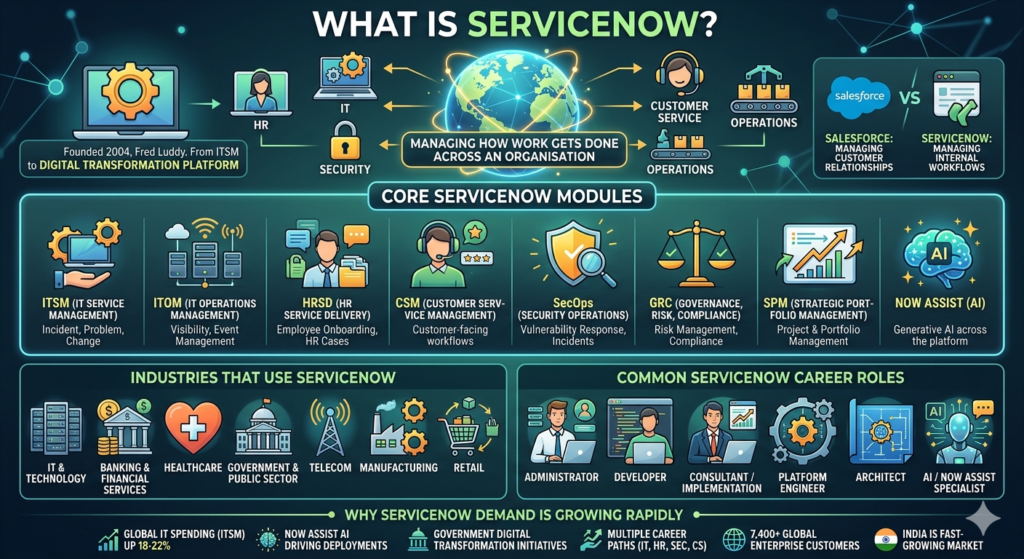
Common ServiceNow Career Roles
1. ServiceNow Administrator
Administers the ServiceNow platform — managing users, groups, roles, and basic configuration. The entry-level role that most professionals start with.
2. ServiceNow Developer
Builds custom applications, workflows, and integrations on the ServiceNow platform using JavaScript, Glide APIs, Flow Designer, and REST APIs.
3. ServiceNow Consultant / Implementation Specialist
Implements ServiceNow for clients, configures modules based on business requirements, and delivers solutions within project timelines.
4. ServiceNow Platform Engineer
A more technically advanced role focused on maintaining the health, performance, and upgrades of the ServiceNow instance. Often sits within an organisation’s internal IT team.
5. ServiceNow Architect
Designs the end-to-end ServiceNow platform strategy, integration architecture, and multi-instance governance frameworks for large enterprises.
6. ServiceNow AI/Now Assist Specialist (Emerging in 2026)
Professionals who implement and configure Now Assist features — the generative AI layer built into ServiceNow — for use cases like AI-powered ticketing, knowledge article generation, and agent assistance.
Why ServiceNow Demand Is Growing Rapidly
ServiceNow’s growth story in 2026 is compelling. With enterprises under increasing pressure to reduce IT costs, improve employee experience, and digitise operations, ServiceNow has become the go-to platform for enterprise digital transformation.
Key growth drivers include:
- Global IT spending on ITSM tools continues to grow at 18-22% annually
- ServiceNow’s Now Assist AI features are driving new deployment waves among existing customers
- Government digital transformation projects in India and globally are creating massive new demand
- The platform’s expansion beyond ITSM into HR, security, and customer service means one platform, multiple career paths
- ServiceNow reports that it currently has 7,400+ enterprise customers globally, with India being one of its fastest-growing markets
Salesforce vs ServiceNow Career 2026 – Core Differences
When evaluating the Salesforce vs ServiceNow career 2026 landscape, it helps to look at the core differences side by side. Here is a comprehensive comparison table:
| Parameter | Salesforce | ServiceNow |
|---|---|---|
| Primary Purpose | CRM — managing customer relationships, sales, and marketing | ITSM and enterprise workflow automation |
| Target Users | Sales, marketing, customer service, and business teams | IT, HR, operations, and enterprise service teams |
| Learning Curve | Moderate — admin track is beginner-friendly; developer track is steeper | Moderate — admin track accessible; developer track requires JavaScript |
| Coding Requirement | Optional for admin; Apex + LWC needed for developers | Optional for admin; JavaScript + Glide API for developers |
| Primary Languages | Apex (Java-like), Lightning Web Components (JavaScript) | JavaScript, Glide API, Angular (legacy), REST APIs |
| Certifications | 40+ certifications across roles and clouds | 15+ certifications across modules |
| Entry-level Job Availability | High — many admin and junior consultant roles available | Moderate — fewer pure entry-level roles; support background helps |
| Average Fresher Salary (India) | ₹4–7 LPA | ₹4–6 LPA |
| Average Mid-level Salary (India) | ₹10–18 LPA | ₹10–16 LPA |
| Average Senior Salary (India) | ₹20–40 LPA | ₹18–35 LPA |
| Global Demand | Very high — dominant in US, UK, Australia, Canada | High and growing — strong in US, Europe, Middle East |
| Remote Work Opportunities | Excellent — many remote consulting and admin roles | Good — growing but fewer fully remote roles than Salesforce |
| Ecosystem Size | Very large — 9 million+ Trailblazers community | Growing — 1 million+ community members |
| Community Support | Exceptional — Trailhead, community groups, events | Good — Now Community, TechNow events |
| Startup Adoption | High — many SMBs use Salesforce | Low to moderate — primarily enterprise-focused |
| Enterprise Adoption | Very high | Very high |
| Freelancing Potential | High — strong market for Salesforce consultants | Moderate — primarily B2B consulting |
| AI Integration (2026) | Deep — Agentforce, Einstein AI, Predictive Analytics | Strong — Now Assist, generative AI workflows |
| Future Job Security | Very strong | Very strong |
The key insight from this table: both platforms offer excellent careers in 2026, but they cater to different professionals with different backgrounds, interests, and career goals.
Salesforce or ServiceNow – Which Has Better Career Opportunities?
This is the question that really matters. Let us look at this from multiple angles.
Market Demand in India
India is one of the fastest-growing markets for both platforms. Here is what the job market looks like right now:
Salesforce in India:
- As of 2026, there are approximately 50,000–70,000 active Salesforce job listings in India at any given time (across LinkedIn, Naukri, and other platforms)
- Salesforce has invested significantly in India through its operations in Hyderabad, Bangalore, Mumbai, and Pune
- India-based Salesforce consulting partners (Accenture, Wipro, Infosys, Capgemini) are aggressively hiring
- The Salesforce ecosystem in India is expected to create 1.1 million new jobs by 2028 according to IDC research
ServiceNow in India:
- ServiceNow job listings in India hover around 20,000–35,000 at any given time
- ServiceNow has established its India Development Center in Hyderabad
- ITSM transformation projects across BFSI, telecom, and IT companies are driving hiring
- Many large Indian IT services companies (TCS, HCL, Cognizant, Tech Mahindra) have dedicated ServiceNow practices
Verdict on Market Demand: Salesforce has a larger raw volume of job postings in India right now. However, ServiceNow demand is growing at a faster rate, which could narrow the gap significantly by 2027-28.
Hiring Trends Across Indian Cities
| City | Salesforce Jobs | ServiceNow Jobs |
|---|---|---|
| Bangalore | Very High | High |
| Hyderabad | High (Salesforce India HQ) | Very High (ServiceNow Dev Centre) |
| Pune | High | Moderate-High |
| Mumbai | Moderate-High | Moderate |
| Chennai | Moderate | Moderate |
| Delhi NCR | Moderate-High | Moderate |
Opportunities for Freshers
Salesforce is generally more accessible for freshers because:
- The Admin role does not require coding knowledge
- Many companies hire freshers directly as junior admins or trainee consultants
- Internship opportunities are more plentiful
- The Trailhead learning platform makes self-learning extremely accessible
ServiceNow typically prefers candidates with at least 1-2 years of IT support, ITSM, or systems administration experience. However:
- Freshers from IT backgrounds (B.Tech, BCA, MCA) can still break in through structured training programs
- Companies like TCS, Wipro, and HCL run internal ServiceNow training programs for freshers
Opportunities for Experienced Professionals
Both platforms reward experienced professionals handsomely. However:
- Salesforce has more lateral entry opportunities — a marketing professional, HR manager, or business analyst can relatively easily pivot into a Salesforce career
- ServiceNow is more natural for IT professionals, especially those with ITSM, helpdesk, or IT operations experience
Startup vs Enterprise Demand
- Salesforce serves both startups and enterprises. Many growing SMBs adopt Salesforce for their sales and customer service operations. This creates consulting and admin opportunities with diverse, dynamic companies
- ServiceNow is predominantly an enterprise product. Its pricing and complexity make it less suitable for small businesses. This means ServiceNow careers are largely within large organisations or enterprise-focused consulting firms
Freelancing and Consulting Potential
Salesforce wins here quite significantly:
- A large number of SMBs need Salesforce expertise but cannot afford full-time employees
- Freelance Salesforce consultants and admins charge anywhere from ₹2,000–₹8,000 per hour for project work
- Platforms like Upwork, Toptal, and Salesforce AppExchange partner networks offer substantial freelance opportunities
ServiceNow freelancing exists but is more limited:
- Most ServiceNow implementations are enterprise-scale projects managed by large consulting firms
- Independent ServiceNow consultants do exist, but they typically work as sub-contractors for larger firms rather than directly with end clients
Salary Comparison in 2026
Money matters. Here is a realistic salary breakdown for both platforms in India in 2026:
Salesforce Salary Ranges in India
| Experience Level | Role | Salary Range (Annual) |
|---|---|---|
| Fresher (0–1 year) | Junior Admin / Trainee Consultant | ₹4,00,000 – ₹7,00,000 |
| Entry-level (1–2 years) | Salesforce Admin / Junior Developer | ₹6,00,000 – ₹10,00,000 |
| Mid-level (3–5 years) | Senior Admin / Developer / Consultant | ₹10,00,000 – ₹18,00,000 |
| Experienced (5–8 years) | Lead Consultant / Senior Developer / Solution Architect | ₹18,00,000 – ₹30,00,000 |
| Senior (8+ years) | Technical Architect / CRM Director / Practice Head | ₹30,00,000 – ₹50,00,000+ |
ServiceNow Salary Ranges in India
| Experience Level | Role | Salary Range (Annual) |
|---|---|---|
| Fresher (0–1 year) | Junior Admin / Trainee Developer | ₹3,50,000 – ₹6,00,000 |
| Entry-level (1–2 years) | ServiceNow Admin / Associate Developer | ₹5,50,000 – ₹9,00,000 |
| Mid-level (3–5 years) | Senior Developer / ITSM Consultant | ₹10,00,000 – ₹16,00,000 |
| Experienced (5–8 years) | Lead Developer / Solution Consultant | ₹16,00,000 – ₹28,00,000 |
| Senior (8+ years) | Platform Architect / ServiceNow Practice Lead | ₹28,00,000 – ₹45,00,000+ |
Global Salary Comparison (For Professionals Working Abroad or Remotely)
| Role | Salesforce (USD/Year) | ServiceNow (USD/Year) |
|---|---|---|
| Admin / Junior Role | $65,000 – $85,000 | $60,000 – $80,000 |
| Mid-level Consultant | $90,000 – $130,000 | $85,000 – $125,000 |
| Senior Architect | $150,000 – $220,000+ | $140,000 – $200,000+ |
Factors That Affect Your Salary
Regardless of which platform you choose, these factors significantly impact your earning potential:
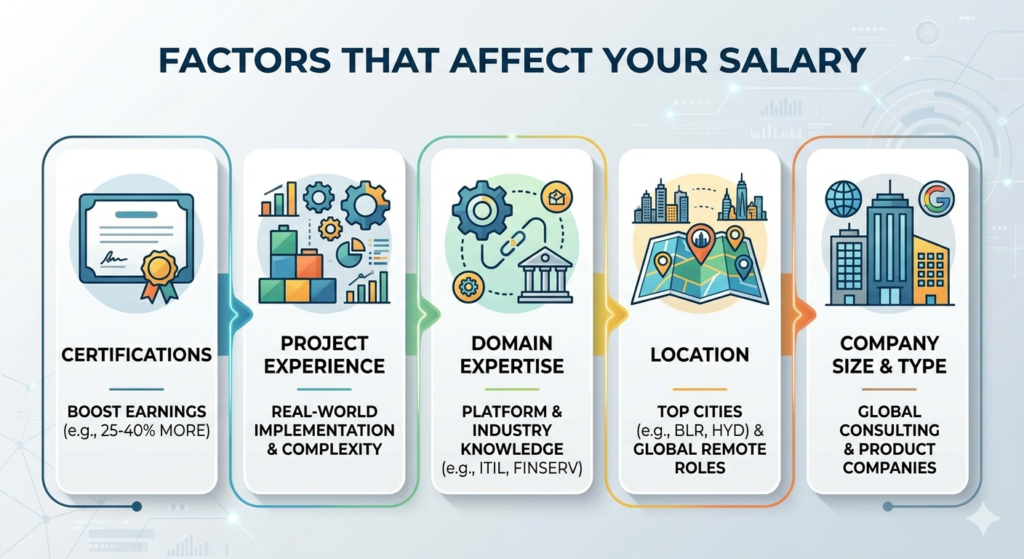
1. Certifications
Certified professionals consistently earn 25-40% more than non-certified peers. Multiple certifications can push salaries even higher.
2. Project Experience
Real-world implementation experience — especially on complex, multi-cloud or multi-module projects — is the biggest salary differentiator.
3. Domain Expertise
Professionals who combine platform knowledge with domain expertise (for example, a Salesforce consultant who also understands financial services, or a ServiceNow developer who deeply understands ITIL processes) command premium salaries.
4. Location
Bangalore and Hyderabad typically pay 10-20% more than other Indian cities for the same roles. Remote roles for US or European companies pay significantly more.
5. Company Size and Type
Global consulting firms (Accenture, Deloitte, PwC) and product companies often pay more than small domestic IT firms, even for equivalent roles.
Which Platform Is Easier to Learn?
When professionals ask which platform to learn, ease of learning is often the deciding factor — especially for beginners. Here is an honest assessment:
Beginner Friendliness
Salesforce wins for non-technical beginners.
The primary reason is Trailhead — Salesforce’s free, gamified learning platform. Trailhead offers hundreds of structured modules, projects, and learning paths designed specifically for beginners. You can earn badges, superbadges, and certifications without ever touching a textbook.
The Salesforce Admin track requires zero coding knowledge. You configure the platform through point-and-click tools: drag-and-drop page layouts, formula fields, validation rules, workflow automations, and reporting dashboards. A complete beginner can become a functional Salesforce Admin in 3–6 months of dedicated learning.
ServiceNow is also learnable for beginners, but the path is slightly less intuitive. The ServiceNow Developer portal and Now Learning platform offer free training, but the interface and underlying concepts (ITSM processes, CMDB, service catalogues) can feel abstract if you have never worked in IT operations before.
Technical Complexity
| Aspect | Salesforce | ServiceNow |
|---|---|---|
| No-code / Low-code tools | Excellent — Flow Builder, Lightning App Builder | Good — Flow Designer, App Engine Studio |
| When coding is needed | Admin roles rarely need code; developer roles need Apex + LWC | Admin roles rarely need code; developer roles need JavaScript |
| Language difficulty | Apex is Java-like (familiar to Java developers); LWC uses modern JavaScript | Glide API uses JavaScript; easier for web developers |
| ITSM process knowledge | Not required | Helpful — ITIL v4 knowledge is a plus |
| CRM business knowledge | Helpful but not required | Not applicable |
Coding Requirements Breakdown
For non-technical professionals:
- Both platforms have admin roles that require no coding
- Salesforce Admin is slightly more accessible due to better beginner resources
- ServiceNow Admin is accessible but assumes some familiarity with IT environments
For developers:
- Java or .NET developers will find Salesforce Apex familiar and relatively easy to pick up
- Web developers (especially those with JavaScript experience) will find ServiceNow’s Glide API more natural
- Both require learning platform-specific patterns and APIs
Training Availability in India
| Resource | Salesforce | ServiceNow |
|---|---|---|
| Free official learning | Trailhead (excellent) | Now Learning (good) |
| Paid training institutes | Very widely available in all major cities | Growing, but fewer options than Salesforce |
| YouTube tutorials | Abundant | Good, growing |
| Bootcamps | Many available | Fewer, mostly enterprise-focused |
| University programs | Limited formal programs | Limited formal programs |
Who Should Learn Which Platform?
Non-IT professionals (HR, sales, marketing, finance):
→ Salesforce is significantly more accessible. The admin track aligns directly with business workflows you already understand.
IT support engineers and helpdesk professionals:
→ ServiceNow is a natural progression. Your ITSM experience translates directly into ServiceNow knowledge.
Java / .NET developers:
→ Salesforce development will feel more familiar due to Apex’s similarity to Java.
JavaScript / web developers:
→ ServiceNow development may feel more comfortable given its JavaScript-heavy approach. Salesforce LWC is also JavaScript-based, so both are viable.
Business analysts:
→ Both are excellent, but Salesforce has more BA-specific career paths and certifications. ServiceNow BA roles exist primarily within large enterprise consulting projects.
Fresh graduates (B.Tech, BCA, MCA):
→ Salesforce offers more entry-level opportunities. However, if your interest lies in IT operations, ServiceNow is equally worth considering.
Best Certifications for Salesforce and ServiceNow in 2026
Certifications are not just pieces of paper in the Salesforce and ServiceNow world — they are direct career accelerators that signal validated expertise to employers and clients. Here is a detailed breakdown:
Salesforce Certifications
Entry Level:
1. Salesforce Certified Administrator (ADM 201)
- The most popular starting point for Salesforce careers
- Tests: CRM configuration, data management, security, automation, reports
- Exam cost: $200 USD (approximately ₹16,500)
- Difficulty: Moderate — requires 2–3 months of focused preparation
- Career impact: Opens doors to admin, junior consultant, and business analyst roles
2. Salesforce Certified AI Associate
- New certification introduced in response to AI integration across the platform
- Tests: AI fundamentals, ethical AI, Einstein AI concepts
- Exam cost: $75 USD (approximately ₹6,200)
- Difficulty: Beginner-friendly
- Career impact: Strong signal for AI-focused Salesforce roles in 2026
Mid-Level:
3. Salesforce Platform Developer I (PD1)
- The primary developer certification
- Tests: Apex programming, SOQL, Lightning Web Components, data modelling
- Exam cost: $200 USD
- Difficulty: High — requires real coding experience
- Career impact: Required for most Salesforce developer roles
4. Salesforce Certified Business Analyst
- Tests: Requirements gathering, user story writing, process mapping, solution design
- Exam cost: $200 USD
- Difficulty: Moderate
- Career impact: Excellent for professionals bridging business and technology
5. Salesforce Sales Cloud Consultant / Service Cloud Consultant
- Product-specific certifications for consultants
- Exam cost: $200 USD each
- Difficulty: Moderate to high
- Career impact: Significant salary boost, required for consulting roles
Advanced:
6. Salesforce Platform Developer II (PD2)
- Advanced developer certification testing complex Apex patterns and integration
- Exam cost: $200 USD
- Difficulty: Very high — includes a programming assignment
7. Salesforce Technical Architect (CTA)
- The most prestigious Salesforce certification
- Involves a live board exam with a panel of judges
- Very few professionals globally hold this certification — creates enormous demand and salary premiums
ServiceNow Certifications
Entry Level:
1. Certified System Administrator (CSA)
- The foundational ServiceNow certification — equivalent to Salesforce Admin
- Tests: Platform navigation, user management, tables and forms, workflows, reporting
- Exam cost: $150 USD (approximately ₹12,400)
- Difficulty: Moderate — 3–4 months of preparation for beginners
- Career impact: Required for most ServiceNow roles; a must-have first certification
2. Certified Application Developer (CAD)
- The developer-track certification
- Tests: Scripting, application development, UI policies, client scripts, REST integrations
- Exam cost: $150 USD
- Difficulty: High — requires solid JavaScript and platform knowledge
- Career impact: Significant — most developer roles require or prefer CAD
Specialist / Advanced:
3. Certified Implementation Specialist (CIS) Series
- Module-specific certifications: CIS-ITSM, CIS-HRSD, CIS-CSM, CIS-SecOps, and others
- Exam cost: $150 USD each
- Difficulty: Moderate to high
- Career impact: Specialisation certifications that dramatically increase your value for specific projects
4. Certified Now Assist Specialist (AI Certification — New in 2026)
- Covers Now Assist generative AI capabilities, prompt engineering, and AI workflow implementation
- Growing in demand as enterprises implement AI features
- Career impact: Early adopters of this certification are commanding significant premium salaries
Which Certifications Give the Best Return on Investment?
For Salesforce: Start with Salesforce Administrator → then AI Associate → then Platform Developer I (if technical) or Sales/Service Cloud Consultant (if consulting-focused)
For ServiceNow: Start with CSA → then CAD (if technical) or CIS-ITSM (if ITSM-focused) → then additional CIS certifications aligned to your project experience
Future Scope – Which Platform Has Better Long-Term Growth?
Looking beyond 2026 and thinking about career sustainability through 2030 requires understanding how both platforms are evolving.
AI Integration Is Changing Both Ecosystems
Salesforce AI (Agentforce and Einstein):
Salesforce made a landmark move in 2024-25 by launching Agentforce — a platform for building autonomous AI agents that can perform complex tasks like qualifying leads, resolving customer cases, processing returns, and onboarding customers without human intervention.
This does not mean Salesforce jobs are disappearing. Quite the opposite:
- Someone needs to design, build, configure, and manage these AI agents
- AI is creating entirely new Salesforce roles: AI Specialist, Prompt Engineer, Agentforce Architect
- Companies are investing more in Salesforce precisely because AI makes the ROI even higher
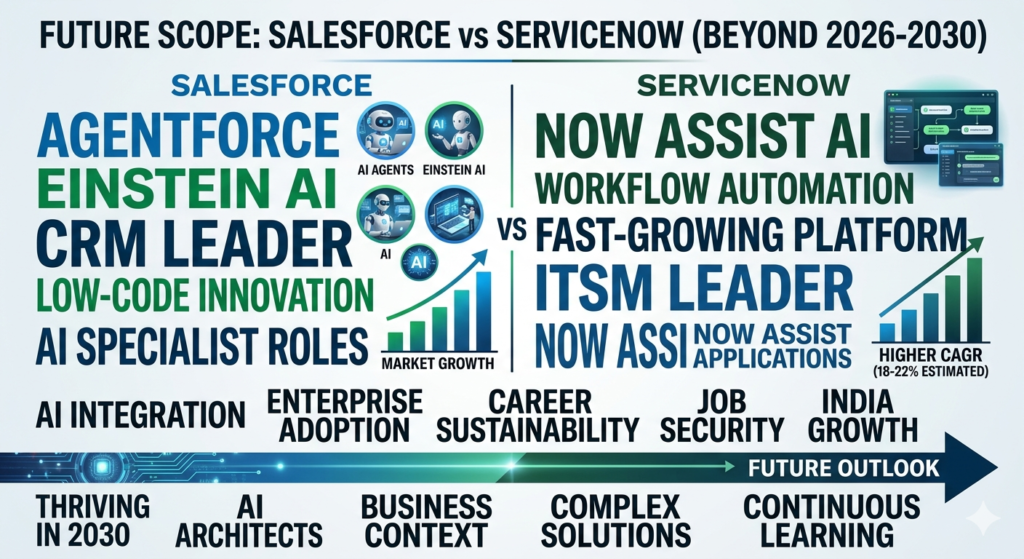
ServiceNow AI (Now Assist):
ServiceNow embedded generative AI across its platform through Now Assist — helping IT agents summarise tickets, auto-generate knowledge articles, suggest solutions, and handle routine requests through AI-powered conversational interfaces.
Similar dynamic: AI is not replacing ServiceNow professionals — it is making the platform more powerful and driving greater adoption, which creates more implementation and management work.
Automation Trends
Both platforms are deeply invested in low-code/no-code automation — making it easier for business users to build workflows without developers. This is a double-edged sword:
- It could reduce demand for basic admin work in the long run
- It simultaneously drives wider adoption, which creates more complex, high-skilled work
The professionals most at risk are those doing only basic, repetitive configuration work. The professionals who will thrive are those who understand the business context, can architect complex solutions, and can work with AI-augmented tools.
Enterprise Adoption Trends
| Trend | Impact on Salesforce | Impact on ServiceNow |
|---|---|---|
| Digital transformation spending | Very positive | Very positive |
| AI/ML enterprise adoption | Very positive (Agentforce) | Very positive (Now Assist) |
| Cloud-first mandates | Very positive | Very positive |
| IT consolidation trends | Neutral (competitors exist) | Positive (platform consolidation) |
| ESG and compliance needs | Positive | Very positive (GRC module) |
| Remote workforce management | Positive | Positive (HRSD) |
Job Security Assessment
Both platforms score extremely high on job security for these reasons:
- Switching costs are enormous — once an enterprise deploys Salesforce or ServiceNow at scale, replacing it is a multi-year, multi-million-dollar project. These platforms become deeply embedded.
- Skilled professionals are scarce — the supply of certified, experienced professionals is significantly below market demand in both ecosystems
- Both companies are growing their India presence — creating both direct employment and partner ecosystem opportunities
Growth Outlook Until 2030
| Metric | Salesforce | ServiceNow |
|---|---|---|
| Global market size (2026) | ~$50B CRM market | ~$15B ITSM/workflow market |
| CAGR (2026-2030) | ~12-15% | ~18-22% |
| India job growth | Very high | High, accelerating |
| AI-driven new roles | Significant | Significant |
| Platform risk | Low — entrenched market leader | Low — rapidly expanding |
Interesting insight: ServiceNow’s faster growth rate means that while Salesforce has more absolute opportunities today, ServiceNow may close the gap significantly by 2028-30. Getting certified in ServiceNow now could put you ahead of the curve.
Salesforce or ServiceNow – Which One Should YOU Choose?
Here is where the answer gets personal. The right choice depends entirely on who you are, what you have done, and where you want to go. Let us break it down by profile:
For Freshers (0–1 Year Experience)
Choose Salesforce if:
- You want to enter the job market faster with an admin role
- You come from a business, commerce, or non-technical background
- You prefer a larger, more established community for learning and job hunting
- You want more entry-level job options to choose from
Choose ServiceNow if:
- You have some IT background (networking, support, systems administration)
- You understand ITIL processes or have worked in a helpdesk environment
- You are interested in IT operations rather than customer-facing business processes
Recommendation: Freshers from non-IT backgrounds → Salesforce. Freshers from IT backgrounds → ServiceNow (or Salesforce — both viable)
For Non-IT Professionals (HR, Sales, Marketing, Finance, Operations)
Choose Salesforce — strongly.
The Salesforce Admin and Consultant tracks were practically designed for professionals like you. Your understanding of business processes, customer management, and sales operations is a genuine competitive advantage that purely technical professionals do not have.
A sales professional who learns Salesforce becomes extraordinarily valuable because they understand both the business problem and the platform that solves it.
For Java / .NET Developers
Choose Salesforce development.
Apex, Salesforce’s primary programming language, is syntactically similar to Java. If you have Java experience, you will pick up Apex in weeks, not months. Combined with Lightning Web Components (JavaScript), you can become a full-stack Salesforce developer relatively quickly.
That said, ServiceNow development (pure JavaScript) is also a viable path for Java developers willing to transition to a JavaScript-first environment.
For IT Support Engineers and Helpdesk Professionals
Choose ServiceNow — it is your natural home.
If you have been working with ITSM tools, managing incident queues, or handling IT service requests, you already understand the core concepts that ServiceNow is built around. Your practical experience is the foundation — all you need to add is the platform-specific knowledge.
The jump from IT support engineer to ServiceNow Administrator to ServiceNow Developer is one of the most well-documented career progression paths in the Indian IT industry.
For Business Analysts
Both are excellent, but Salesforce is broader.
Salesforce BA roles exist at virtually every company that uses Salesforce — which includes SMBs, mid-market companies, and enterprises. The Salesforce Certified Business Analyst certification creates a clear, recognised career path.
ServiceNow BA roles are more enterprise-focused and often combined with consultant or product owner responsibilities. If you want a pure BA path with more job options, Salesforce has the edge.
For Managers and Team Leads Looking to Upskill
Consider ServiceNow if you manage IT or operations teams. ServiceNow’s platform and ITSM concepts align directly with operational leadership experience.
Consider Salesforce if you lead sales, customer service, or business development teams. Salesforce expertise will make you a far more effective leader and decision-maker for CRM strategy.
For Freelancers
Choose Salesforce.
The freelance market for Salesforce consultants, admins, and developers is substantial and global. SMBs cannot always afford full-time Salesforce professionals, creating a consistent demand for freelance expertise. Platforms like Upwork, Toptal, PeoplePerHour, and the Salesforce AppExchange partner network all have active freelance opportunities.
Decision-Making Scenarios
| Your Situation | Best Choice |
|---|---|
| “I am from sales and want a tech career” | Salesforce |
| “I work in IT helpdesk, want to grow” | ServiceNow |
| “I am a Java developer wanting to upskill” | Salesforce |
| “I am a JavaScript developer” | ServiceNow (or Salesforce LWC) |
| “I want to freelance as a consultant” | Salesforce |
| “I want to work in large enterprise IT” | ServiceNow |
| “I am an HR professional wanting a tech career” | Salesforce (or ServiceNow HRSD) |
| “I am a project manager in IT” | ServiceNow SPM |
| “I want the fastest entry into tech” | Salesforce Admin |
| “I want to specialise in ITSM/ITIL” | ServiceNow |
Final Verdict
After this deep dive, here is the honest conclusion:
There is no universally “better” platform. Both Salesforce and ServiceNow offer outstanding careers in 2026 — high salaries, strong job security, growing demand in India and globally, and exciting AI-powered futures. The question was never which platform is better in absolute terms. The question has always been: which platform is better for you?
Here is the summary:
Salesforce may be your ideal choice if:
- You come from or want to work in customer-facing business environments (sales, marketing, service)
- You are a beginner looking for the fastest, most accessible entry point into a tech career
- You want more entry-level jobs, a larger community, and stronger freelancing opportunities
- You are excited about AI-powered CRM and the Agentforce revolution
ServiceNow may be your ideal choice if:
- You come from or want to work in IT operations, service management, or enterprise workflow
- You have an IT background and want to leverage your existing technical experience
- You prefer working on large enterprise projects with complex, end-to-end implementations
- You are interested in the fast-growing ITSM, HRSD, and SecOps domains
Here is what to do next, regardless of which platform you choose:
- Start with free learning — Trailhead for Salesforce, Now Learning for ServiceNow
- Spend 30 days exploring the platform before committing to certification preparation
- Build at least one hands-on project in a free developer/personal instance
- Earn your first certification — Admin for Salesforce, CSA for ServiceNow
- Join the community — Trailblazer Community for Salesforce, Now Community for ServiceNow
- Network actively — attend local user groups, online events, and connect with professionals in your target roles
- Apply for internships or junior roles — even 6 months of real project experience is worth more than any number of certifications alone
- Never stop learning — both platforms evolve rapidly, and continuous upskilling is non-negotiable
The Salesforce vs ServiceNow career 2026 debate will not resolve itself. But you now have everything you need to resolve it for yourself.
Choose the platform that aligns with your background. Build your skills consistently. Earn your certifications. And step into one of the most in-demand, well-paying career ecosystems in the technology world today.
Your cloud career starts now.
About RizeX Labs
At RizeX Labs, we specialize in delivering industry-focused Salesforce training, career guidance, and enterprise cloud solutions that help professionals and organizations stay ahead in the evolving tech landscape.
Our expertise spans Salesforce CRM, AI-powered automation, Service Cloud, DevOps, and emerging enterprise platforms like ServiceNow. We combine real-world implementation experience, hands-on learning strategies, and career-focused mentorship to help learners build job-ready skills for the future.
We empower students, freshers, working professionals, and enterprises to make smarter technology career decisions by providing practical insights, structured learning paths, and up-to-date industry knowledge aligned with 2026 hiring trends.
Internal Linking Opportunities:
External Linking Opportunities:
- Salesforce Official Website
- ServiceNow Official Website
- Salesforce Trailhead
- ServiceNow Developer Program
- Salesforce Certification Portal
- ServiceNow Certifications
- Gartner Research
Quick Summary
Choosing between Salesforce and ServiceNow has become one of the biggest career decisions for IT professionals in 2026. Both platforms offer strong global demand, excellent salary packages, remote work opportunities, and long-term career growth. However, they serve different business functions and require different skill sets.
Salesforce is primarily focused on customer relationship management (CRM), sales automation, marketing, and customer experience solutions. It is ideal for professionals interested in business processes, customer engagement, consulting, and cloud application development.
ServiceNow, on the other hand, specializes in IT Service Management (ITSM), workflow automation, enterprise operations, and internal business process management. It is often preferred by professionals coming from IT support, infrastructure, operations, and enterprise workflow backgrounds.
When evaluating salesforce vs servicenow career 2026, the right choice depends on your technical background, career goals, learning preferences, and the type of projects you want to work on in the future. Both ecosystems continue to grow rapidly due to AI adoption, automation, and digital transformation initiatives across industries.
If you are wondering salesforce or servicenow and trying to decide which platform to learn, the best approach is to compare career opportunities, certifications, salaries, learning curve, and long-term industry demand before making your decision.
