
Introduction
Landing a ServiceNow ITSM role can be your gateway to a thriving IT career. Whether you’re a fresher stepping into IT Service Management or a seasoned professional aiming for advancement, interviews can feel overwhelming. That’s where preparation makes all the difference.
This comprehensive guide features 70 carefully curated ServiceNow ITSM interview questions drawn from real-world hiring scenarios. Each answer is crisp, meaningful, and designed to stick in your memory without overwhelming you.
Ready to ace that interview? Let’s dive in!

What is ServiceNow ITSM and Why Does It Matter?
ITSM (IT Service Management) is the framework that enables organizations to design, deliver, manage, and improve IT services. ServiceNow ITSM is the leading cloud-based platform that streamlines these processes, automating workflows and enhancing user experience.
Why ServiceNow ITSM Skills Are In-Demand
- Market Leader: ServiceNow dominates the ITSM space with 30%+ market share
- High Salaries: ITSM professionals earn 20-40% above average IT roles
- Career Growth: Opens doors to admin, developer, and architect positions
- Industry Agnostic: Used across healthcare, finance, retail, and government sectors
Basic ServiceNow ITSM Interview Questions (1-20)
1. What is ServiceNow ITSM?
Answer: ServiceNow ITSM is a cloud-based platform that helps organizations manage IT services efficiently. It automates incident management, problem management, change management, and other ITIL-aligned processes to improve service delivery.
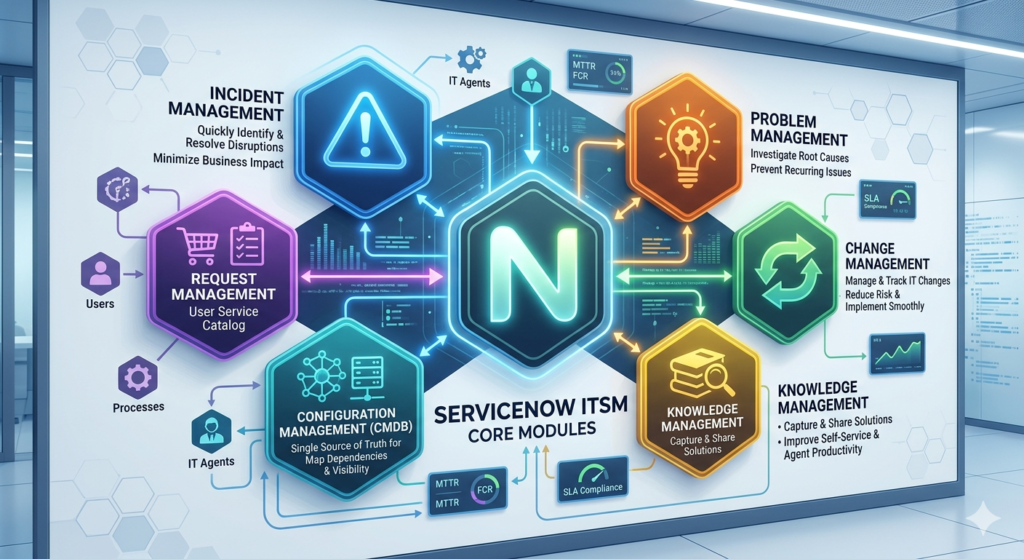
2. What are the core modules in ServiceNow ITSM?
Answer:
- Incident Management
- Problem Management
- Change Management
- Knowledge Management
- Service Catalog
- Asset Management
- Configuration Management Database (CMDB)
3. What is an Incident in ServiceNow?
Answer: An incident is an unplanned interruption or reduction in quality of an IT service. Example: email server down, application crash, or login issues.
4. Difference between Incident and Problem?
Answer:
- Incident: Addresses immediate service disruption (symptoms)
- Problem: Identifies root cause of recurring incidents (disease)
5. What is a Change Request?
Answer: A Change Request is a formal proposal to modify IT infrastructure, applications, or services. It goes through approval workflows to minimize risk.
6. What are Change types in ServiceNow?
Answer:
- Standard: Pre-approved, low-risk (password reset)
- Normal: Requires CAB approval
- Emergency: Urgent changes to restore service
7. What is CMDB?
Answer: Configuration Management Database stores information about IT assets (Configuration Items) and their relationships, providing a complete infrastructure view.
8. What is a CI (Configuration Item)?
Answer: Any IT component that needs to be managed to deliver services—servers, applications, network devices, or even documentation.
9. What is the Service Catalog?
Answer: A self-service portal where users can request IT services like software access, hardware, or password resets without contacting the help desk.
10. What is SLA in ServiceNow?
Answer: Service Level Agreement defines expected service response and resolution times. Example: P1 incidents resolved within 4 hours.
11. Difference between SLA, OLA, and UC?
Answer:
- SLA: Agreement with external customers
- OLA: Operational Level Agreement between internal teams
- UC: Underpinning Contract with third-party vendors
12. What is ITIL?
Answer: IT Infrastructure Library—a framework of best practices for IT Service Management that ServiceNow ITSM modules follow.
13. What are Workflow Activities in ServiceNow?
Answer: Automated actions within workflows like approvals, notifications, script execution, or timer delays that orchestrate business processes.
14. What is Assignment Group?
Answer: A team of users assigned to work on specific tasks or tickets based on their expertise (e.g., Network Team, Database Team).
15. What is Knowledge Base?
Answer: A repository of articles containing solutions, how-to guides, and documentation that helps users and agents resolve issues faster.
16. What is Major Incident Management?
Answer: A process to handle high-impact incidents affecting multiple users or critical services, requiring immediate attention and dedicated resources.
17. What are Notifications in ServiceNow?
Answer: Automated emails or system alerts triggered by specific events like ticket assignment, SLA breaches, or approval requests.
18. What is Business Rule?
Answer: Server-side scripts that run automatically when records are inserted, updated, or deleted to enforce business logic.
19. What is Client Script?
Answer: JavaScript code that runs on the client browser to validate data, manipulate forms, or provide user prompts in real-time.
20. What is UI Policy?
Answer: Controls field visibility, mandatory status, or read-only behavior on forms based on specific conditions without coding.
Intermediate ServiceNow ITSM Questions (21-45)
21. Explain the Incident Management workflow.
Answer: User reports issue → Incident created → Categorized & prioritized → Assigned to appropriate group → Investigation & diagnosis → Resolution → Closure → User confirmation.
22. What is Priority and how is it calculated?
Answer: Priority = Impact × Urgency. It determines the order in which incidents are handled.
23. What are Inbound Email Actions?
Answer: Automated processes that convert incoming emails into ServiceNow records like incidents or requests based on defined criteria.
24. What is a Catalog Item vs Record Producer?
Answer:
- Catalog Item: Creates specific task types (e.g., HR case)
- Record Producer: Creates any record type with custom forms
25. What is the CAB (Change Advisory Board)?
Answer: A group of stakeholders who assess, prioritize, and approve change requests to minimize business risk.
26. Explain Problem Management workflow.
Answer: Identify problem → Investigate root cause → Document workaround → Implement permanent fix → Close problem → Create knowledge article.
27. What is a Known Error?
Answer: A problem with a documented root cause and workaround, stored in the Known Error Database for quick reference.
28. What are Service Level Requirements?
Answer: Measurable targets within SLAs like response time (30 minutes) or resolution time (4 hours) for different priority levels.
29. What is Orchestration in ServiceNow?
Answer: Automation that integrates ServiceNow with external systems and tools to execute complex multi-step workflows across platforms.
30. What is a Workflow vs Flow Designer?
Answer:
- Workflow: Legacy automation tool
- Flow Designer: Modern, user-friendly automation with better integration capabilities
31. What are Update Sets?
Answer: Containers that capture configuration changes made in a development instance for migration to testing/production environments.
32. What is ACL (Access Control List)?
Answer: Security rules that control which users can view, create, update, or delete specific records and fields.
33. What is a Reference Field?
Answer: A field that links to records in another table, creating relationships (e.g., Caller field references User table).
34. What is Dictionary Override?
Answer: Customizing inherited field properties from parent tables without affecting the parent table definition.
35. What are Business Rules execution order?
Answer: Before rules (display) → Before rules (database) → After rules → Async rules.
36. What is a GlideRecord?
Answer: A server-side API for database operations—querying, inserting, updating, or deleting records programmatically.
37. Difference between GlideRecord and GlideAggregate?
Answer:
- GlideRecord: Fetches individual records
- GlideAggregate: Performs aggregate queries (COUNT, SUM, AVG)
38. What is Role-based Access Control?
Answer: Security model where permissions are assigned to roles, and users inherit permissions through their assigned roles.
39. What is a ServiceNow Application?
Answer: A collection of related modules, tables, and configurations packaged together to deliver specific functionality.
40. What is the Difference Table?
Answer: Tables inherit from parent tables (e.g., Incident extends Task table), inheriting all parent fields and adding custom fields.
41. What are Script Includes?
Answer: Reusable server-side JavaScript code libraries that can be called from multiple scripts to promote code reusability.
42. What is onBefore vs onAfter in Business Rules?
Answer:
- onBefore: Runs before database operation (validation)
- onAfter: Runs after database commit (notifications)
43. What is Approval Engine?
Answer: Framework that manages approval workflows with automatic routing based on criteria, escalations, and delegation capabilities.
44. What is Performance Analytics?
Answer: ServiceNow’s reporting solution providing real-time dashboards, KPIs, and trending analysis for data-driven decisions.
45. What is Virtual Agent?
Answer: AI-powered chatbot that handles common user requests through conversational interfaces, reducing help desk workload.
Advanced ServiceNow ITSM Questions (46-70)
46. Explain Event Management in ITSM.
Answer: Monitors IT infrastructure events from monitoring tools, filters noise, correlates related events, and creates incidents automatically for actionable issues.
47. What is Service Mapping?
Answer: Automatically discovers and maps business services and their dependencies across infrastructure to understand service relationships.
48. What is Predictive Intelligence?
Answer: Machine learning capabilities that auto-categorize tickets, suggest solutions, predict trends, and identify anomalies based on historical data.
49. What is Universal Request?
Answer: A unified interface consolidating all request types (IT, HR, Facilities) into a single user experience for simplified service access.
50. How does Auto-Assignment work?
Answer: Assignment Rules automatically route tickets to appropriate groups/individuals based on criteria like category, location, or skillset.
51. What are Domain Separations?
Answer: Capability to partition data within a single instance so different organizations or departments have isolated, secure data views.
52. What is Multi-Row Variable Set (MRVS)?
Answer: Catalog item feature allowing users to add multiple rows of information in a single request (e.g., ordering multiple laptops).
53. Explain Transform Maps.
Answer: Configuration that maps imported data from external sources to ServiceNow table fields, with transformation scripts for data manipulation.
54. What is Contextual Search?
Answer: Enhanced search that understands user intent, provides relevant results from knowledge, catalog, and records based on context.
55. What are Scheduled Jobs?
Answer: Automated tasks that run on defined schedules to perform maintenance, data imports, cleanup, or report generation.
56. What is CI Relationship?
Answer: Connections between Configuration Items showing dependencies (e.g., application runs on server, server uses network).
57. What is Continual Improvement Management?
Answer: ITIL process for identifying and implementing incremental service improvements through structured assessment and implementation.
58. What are Import Sets?
Answer: Staging tables where external data lands before being transformed and loaded into production tables through transform maps.
59. What is Workbench?
Answer: Configuration workspace providing centralized management for workflows, fields, forms, and business rules within a single interface.
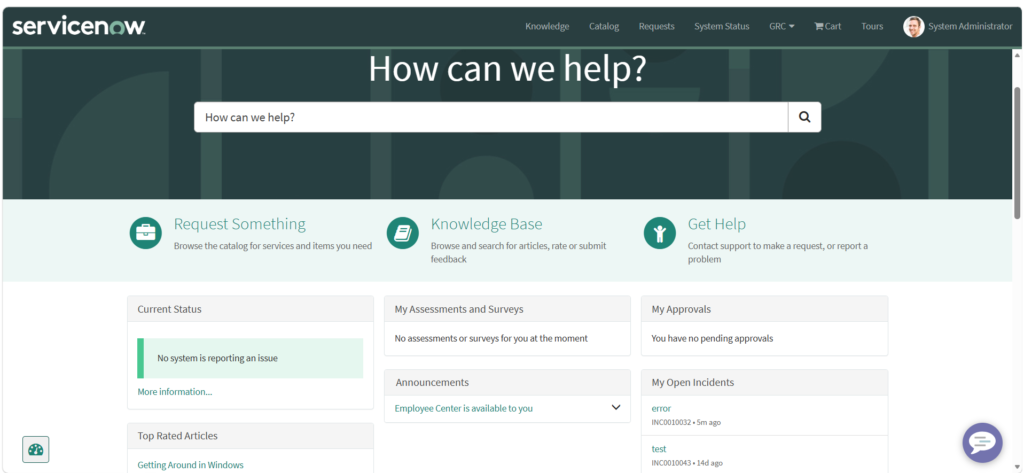
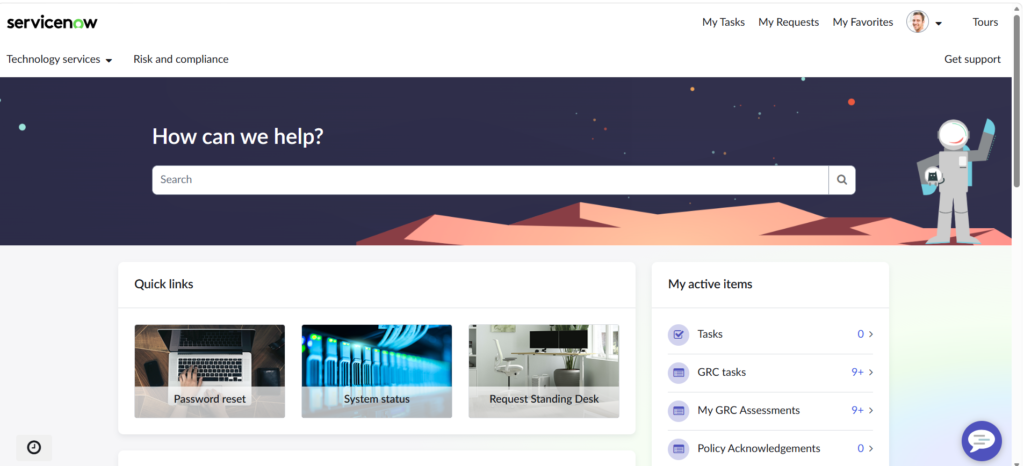
60. Explain Service Portal vs Employee Service Center.
Answer:
- Service Portal: Customizable portal framework
- Employee Service Center: Pre-built modern portal with AI, mobile-optimized for end users
61. What is Guided Setup?
Answer: Step-by-step wizard helping administrators configure ITSM modules through best-practice workflows without deep technical knowledge.
62. What are ATF (Automated Test Framework)?
Answer: Built-in testing tool to create and execute automated tests validating functionality after changes or upgrades.
63. What is Application Portfolio Management?
Answer: Module managing application lifecycle from planning through retirement, tracking costs, risks, and business value.
64. What are Dashboard vs Reports?
Answer:
- Reports: Data queries presented as lists, charts, or graphs
- Dashboards: Visual containers displaying multiple reports in single view
65. What is Field Level Encryption?
Answer: Security feature encrypting sensitive field data at rest (passwords, credit cards) with key management for compliance.
66. What is Agent Workspace?
Answer: Unified, intelligent interface for service agents consolidating multiple applications and tools into single productivity environment.
67. What are Macros?
Answer: Pre-recorded sequences of actions (field updates, comments) that agents can apply with one click for repetitive tasks.
68. What is HR Service Delivery?
Answer: ITSM extension applying service management principles to HR processes like onboarding, benefits, and employee lifecycle management.
69. What is Workspace?
Answer: Modern, configurable UI framework replacing classic interfaces with context-aware layouts, embedded analytics, and enhanced productivity tools.
70. What is Governance, Risk, and Compliance (GRC)?
Answer: Integrated framework managing organizational governance, identifying/mitigating risks, and ensuring compliance with regulations and policies.
Your Next Steps to Interview Success
Preparation doesn’t stop here! Here’s your action plan:
- Create a Personal Developer Instance – Get free hands-on practice at developer.servicenow.com
- Practice Daily – Spend 30 minutes exploring each ITSM module
- Take Mock Interviews – Rehearse answers until they feel natural
- Earn Your CSA Certification – Validate your knowledge officially
- Join ServiceNow Community – Network with professionals and stay updated
Ready for More Expert Guidance?
Explore RizeX Labs’ ServiceNow Training Programs – We offer comprehensive courses, hands-on labs, and personalized mentoring to accelerate your ServiceNow career.
Share this guide with colleagues preparing for interviews, and drop a comment below with your toughest interview question—we’ll help you craft the perfect answer!
External Links
FAQs About ServiceNow ITSM Interviews
Q1: What is the average salary for ServiceNow ITSM professionals?
Entry-level positions start around $70,000-$85,000, while experienced professionals earn $100,000-$150,000+ depending on location and expertise.
Q2: Do I need ServiceNow certification for interviews?
While not always mandatory, certifications like CSA (Certified System Administrator) significantly boost your chances and demonstrate commitment.
Q3: How long should I prepare for a ServiceNow ITSM interview?
Beginners should dedicate 3-4 weeks, while experienced professionals may need 1-2 weeks for refreshing concepts and practicing questions.
Q4: What are the most common technical questions?
Business Rules, Client Scripts, CMDB relationships, SLA configurations, and workflow automation dominate technical interviews.
Q5: Should I mention specific projects in interviews?
Absolutely! Discussing real implementations with measurable outcomes (reduced resolution time, increased automation) makes you memorable.
