In today’s fast-paced business environment, managing revenue has become increasingly complex. Organizations juggle multiple pricing models, subscription services, usage-based billing, and ever-changing compliance requirements. Finance teams struggle with manual processes that span disconnected systems, leading to revenue leakage, compliance risks, and delayed cash flow. The challenge? Traditional tools simply weren’t designed to handle the intricate, end-to-end journey that modern revenue requires.
Enter Revenue Lifecycle Management (RLM)—a comprehensive approach that transforms how businesses manage their entire revenue process, from the initial quote to final cash collection. When powered by Salesforce Revenue Cloud, RLM becomes more than just a concept; it becomes a competitive advantage.
In this post, we’ll explore what Revenue Lifecycle Management truly means and how Salesforce Revenue Cloud empowers organizations to optimize every stage of their revenue journey.
What is Revenue Lifecycle Management?
Revenue Lifecycle Management refers to the systematic orchestration of all processes involved in generating, recognizing, and reporting revenue. It’s not just about closing deals—it’s about managing the complete journey that revenue takes through your organization.
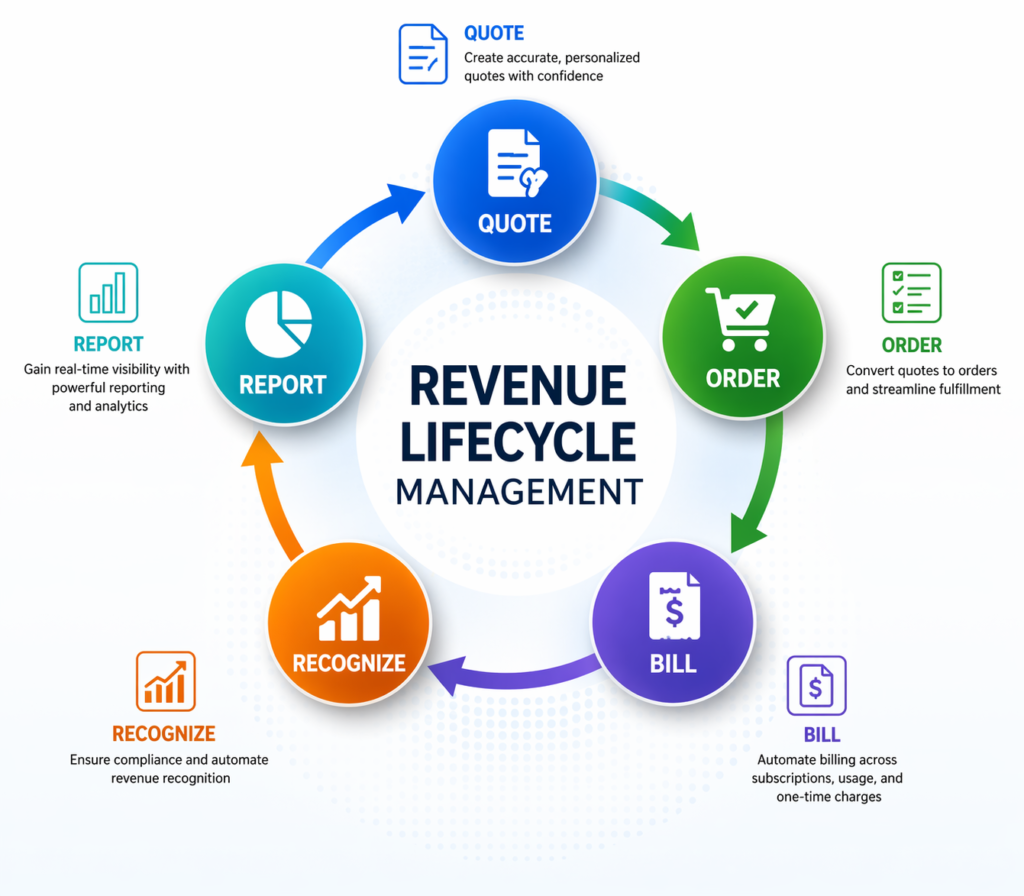
The revenue lifecycle typically encompasses five critical stages:
- Quoting – Creating accurate, competitive proposals for customers
- Ordering – Converting quotes into confirmed orders
- Billing – Generating and delivering invoices based on agreed terms
- Revenue Recognition – Recording revenue in compliance with accounting standards
- Reporting & Analytics – Gaining insights into revenue performance and forecasting
The ultimate goal of RLM is to create a seamless, automated flow across these stages—eliminating silos, reducing errors, ensuring compliance, and providing real-time visibility into your revenue performance. When executed effectively, RLM transforms revenue operations from a series of disconnected tasks into a strategic asset.
In the modern business landscape, companies need more than just isolated tools for each stage. They require an integrated platform that connects customer data, sales activities, pricing intelligence, billing automation, and financial reporting in a single, unified ecosystem. This integration is precisely what sets Revenue Cloud apart from legacy solutions.
Understanding Salesforce Revenue Cloud
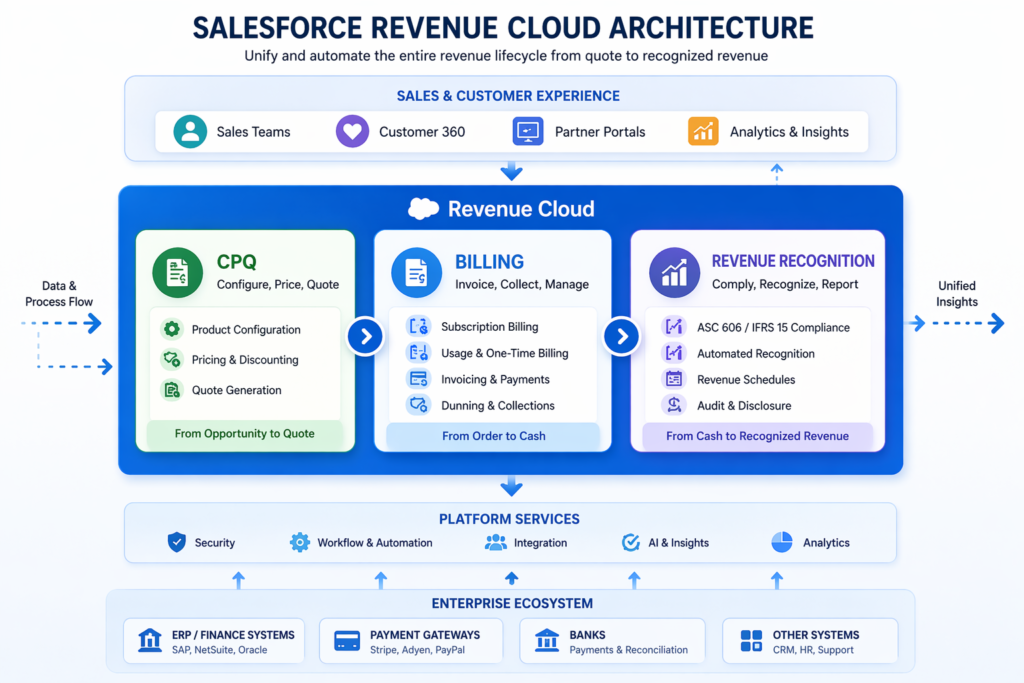
Salesforce Revenue Cloud is a comprehensive platform designed specifically to address the complexities of modern revenue management. It unifies critical revenue processes on a single platform, bringing together Configure, Price, Quote (CPQ), billing, and revenue recognition capabilities.
At its core, Revenue Cloud consists of:
- Salesforce CPQ – Streamlining quote generation with intelligent configuration and pricing
- Salesforce Billing – Automating invoicing and payment collection
- Revenue Recognition – Ensuring compliance with ASC 606 and IFRS 15 accounting standards
By integrating these components, Revenue Cloud creates a unified source of truth for all revenue-related data, enabling businesses to manage their entire revenue lifecycle within the Salesforce ecosystem.
What makes Revenue Cloud truly transformative is its native integration with Salesforce CRM. Unlike standalone billing or ERP systems that require complex integrations and constant data synchronization, Revenue Cloud operates on the same platform where your customer relationships are managed. This means every interaction, from lead capture through revenue recognition, happens in a connected environment where data flows seamlessly between systems.
How Revenue Cloud Powers Each Stage of the Revenue Lifecycle
1. Quoting: Precision and Speed
The quote-to-cash journey begins with an accurate, compelling quote. Revenue Cloud’s CPQ functionality eliminates the guesswork and manual errors that plague traditional quoting processes.
With Revenue Cloud, sales teams can:
- Configure complex products and services with guided selling tools
- Apply sophisticated pricing rules automatically, including discounts, bundling, and tiered pricing
- Generate professional quotes in minutes rather than hours
- Ensure pricing consistency and approval workflows to maintain margins
The CPQ engine handles product dependencies, ensuring incompatible items are never combined and required components are always included. It supports dynamic pricing based on volume, customer segment, contract term, or any custom business logic you define. Sales representatives no longer need to be pricing experts—the system guides them through optimal configurations while protecting profit margins through automated approval processes.
The result? Sales teams close deals faster while finance teams maintain confidence in pricing accuracy and profitability. Quote generation time decreases by up to 75%, and pricing errors that previously led to revenue leakage or margin erosion are virtually eliminated.
2. Ordering: Seamless Conversion
Once a quote is accepted, Revenue Cloud automatically converts it into an order without manual re-entry. This seamless transition eliminates a common source of errors and delays in traditional systems.
Orders carry forward all the configuration, pricing, and terms from the quote, ensuring that what was sold is exactly what gets delivered, billed, and recognized. This continuity is essential for maintaining data integrity throughout the revenue lifecycle.
The order object becomes the authoritative record of what was sold. It captures not just products and pricing, but also contract terms, renewal dates, billing schedules, and revenue recognition rules. This comprehensive record ensures that downstream processes—from fulfillment to finance—all work from the same accurate information.
For subscription businesses, the order management capabilities extend to amendments, upgrades, downgrades, and cancellations. When a customer modifies their subscription mid-term, Revenue Cloud automatically calculates proration, adjusts billing schedules, and updates revenue recognition—all while maintaining a complete audit trail of changes.
3. Billing: Flexibility Meets Automation
Modern businesses require billing flexibility—subscriptions, one-time purchases, usage-based models, and hybrid combinations. Revenue Cloud’s billing capabilities handle this complexity with ease.
Key billing benefits include:
- Support for diverse billing models and schedules (monthly, annual, usage-based, milestone-based)
- Automated invoice generation based on order terms
- Prorated billing for mid-cycle changes
- Amendment and renewal management for subscription businesses
- Integration with payment gateways for streamlined collections
Revenue Cloud’s billing engine supports virtually any billing scenario. You can bill in advance or arrears, on fixed schedules or triggered by events. Usage-based billing can incorporate data from IoT devices, application APIs, or manual entry. Tiered and overage pricing automatically calculate based on actual consumption.
The system generates invoices automatically according to the schedules defined in orders. These invoices can be customized to match your brand and can include detailed line items or summary totals, depending on customer preferences. Invoice delivery is automated through email, customer portals, or integration with accounts payable systems.
For B2B companies, Revenue Cloud supports complex billing relationships including separate bill-to and ship-to addresses, multi-currency transactions, tax calculations based on jurisdiction, and parent-child account hierarchies where invoices roll up to corporate headquarters.
By automating billing, Revenue Cloud reduces the administrative burden on finance teams, accelerates cash collection, and improves the customer experience with accurate, timely invoices. Companies typically see days sales outstanding (DSO) decrease by 20-30% after implementing automated billing.
4. Revenue Recognition: Compliance Without Complexity
For many organizations, revenue recognition represents one of the most challenging aspects of revenue management, particularly with stringent standards like ASC 606 and IFRS 15. Revenue Cloud automates this process, creating compliant recognition schedules based on your revenue arrangements.
Revenue Cloud handles:
- Automatic creation of revenue recognition schedules
- Multi-element arrangement allocation
- Performance obligation tracking
- Waterfall reporting for revenue forecasting
- Audit trails for compliance documentation
The revenue recognition engine analyzes each order to identify distinct performance obligations—the separate goods or services you’ve committed to deliver. It then allocates transaction price to these obligations based on standalone selling prices, creating recognition schedules that match when obligations are satisfied.
For subscription services recognized ratably over time, the system creates monthly or daily recognition entries. For milestone-based recognition, it tracks completion criteria and recognizes revenue when milestones are achieved. For complex arrangements combining multiple products and services, it handles the allocation and tracks each component separately.
This automation not only ensures compliance but also provides finance teams with accurate, real-time insights into recognized versus deferred revenue—critical for financial reporting and forecasting. CFOs can see exactly how much revenue will be recognized in future periods based on current backlog, enabling more accurate guidance and planning.
The system maintains complete audit trails showing the business logic behind every recognition entry, making external audits faster and less painful. When accounting rules change, centralized configuration allows you to update recognition logic globally rather than spreadsheet by spreadsheet.
5. Reporting & Analytics: Visibility That Drives Decisions
Perhaps one of the most powerful aspects of managing your revenue lifecycle in Revenue Cloud is the comprehensive visibility it provides. Because all revenue data lives within the Salesforce platform, you gain end-to-end insights that were previously impossible with disconnected systems.
Leaders can access:
- Real-time revenue dashboards and forecasts
- Quote-to-cash cycle time metrics
- Revenue performance by product, region, or team
- Subscription metrics (MRR, ARR, churn, expansion)
- Compliance and audit reports
The analytics capabilities extend beyond simple reporting to predictive insights. You can identify which products have the longest quote-to-cash cycles, which customer segments have the highest lifetime value, and which pricing strategies generate optimal margins.
Revenue waterfalls show exactly how pipeline converts to bookings, bookings to billing, and billing to recognized revenue. This visibility helps identify bottlenecks and opportunities at each stage. Sales operations can optimize processes based on data rather than intuition.
For subscription businesses, specialized metrics track monthly recurring revenue (MRR), annual recurring revenue (ARR), customer acquisition cost (CAC), churn rate, and net revenue retention. Cohort analysis shows how customer value changes over time, informing retention and expansion strategies.
This visibility empowers data-driven decision-making across sales, finance, and executive leadership. When everyone works from the same revenue data, strategic alignment improves dramatically.
Integrating CRM Objects with Revenue Lifecycle Management
One of Revenue Cloud’s most transformative capabilities is its native integration with Salesforce CRM objects. This seamless connection between customer relationship data and revenue processes creates an unbroken flow from initial prospect engagement through revenue recognition and renewal.
The Foundation: Understanding CRM Objects
Before diving into integration specifics, it’s important to understand the core CRM objects that form the foundation of customer relationships in Salesforce:
Leads represent potential customers who have shown interest but haven’t yet been qualified as active sales opportunities. They contain contact information and preliminary engagement data.
Accounts are the organizations or individuals you do business with. They serve as the central hub for all customer-related information, including contacts, opportunities, orders, and billing details.
Contacts are the individual people at Account organizations with whom you interact. They may be decision-makers, influencers, or users of your products.
Opportunities represent potential deals in your sales pipeline. They track deal value, probability, stage, and timeline—forming the basis of sales forecasting.
When Revenue Cloud is implemented, these familiar CRM objects integrate with new RLM-specific objects including Quotes, Orders, Subscriptions, Invoices, and Revenue Schedules, creating a complete view of the customer lifecycle.
Connecting Leads to Revenue: The Starting Point
The revenue journey often begins long before a quote is generated—it starts with a Lead. Marketing campaigns generate leads through various channels: website forms, trade shows, content downloads, webinars, and advertising. These leads enter Salesforce with rich attribution data showing exactly how they were acquired.
In Revenue Cloud’s integrated ecosystem:
- Marketing teams capture leads with complete campaign attribution and engagement history
- Lead scoring models identify the most promising prospects based on demographic and behavioral data
- Sales development teams qualify leads through structured discovery processes
- When leads meet qualification criteria, they convert to Accounts, Contacts, and Opportunities
This conversion is crucial because it preserves the entire history of how the prospect was acquired and nurtured. When a sales representative creates a quote weeks later, they can see every marketing touchpoint, every content piece downloaded, and every interaction the prospect had with your organization. This context informs pricing strategies, product recommendations, and negotiation approaches.
The lead source information also flows through to revenue reporting, enabling marketing ROI analysis. You can calculate exactly how much revenue each campaign generates, which channels produce the highest lifetime value customers, and where to invest future marketing dollars.
Accounts: The Central Hub for Revenue Relationships
Accounts serve as the foundation for all revenue-related activities in Revenue Cloud. While Opportunities represent individual deals, Accounts represent ongoing customer relationships that may span multiple deals, products, and years.
Revenue Cloud leverages Account data to:
Maintain Customer-Specific Pricing and Terms
Each Account can have negotiated pricing agreements, volume discounts, payment terms, and billing preferences stored directly on the Account record. When a sales rep creates a quote for that Account, these preferences automatically apply—ensuring consistency and honoring negotiated terms without manual lookup.
Track Account Hierarchies
For enterprise customers with multiple divisions, subsidiaries, or locations, Account hierarchies represent the organizational structure. Revenue Cloud respects these hierarchies for consolidated billing, where individual business units receive services but invoices roll up to corporate headquarters. It also enables enterprise-wide reporting and contract management.
Store Billing and Payment Information
Accounts contain billing addresses, shipping addresses, tax exemption certificates, preferred payment methods, and payment gateway tokens for automated collections. This information automatically populates invoices and payment transactions, streamlining the billing process.
Enable Account-Based Revenue Analytics
Because all Orders, Subscriptions, and Invoices link to Accounts, you can analyze total customer lifetime value, wallet share, expansion rate, and health scores. Account-level dashboards show complete revenue history, current subscription status, renewal dates, and growth trends.
Support Multi-Year Relationships
Unlike transactional systems that treat each sale independently, Revenue Cloud maintains the continuous relationship. You can see that an Account started with a basic subscription three years ago, expanded to premium tiers, added users, adopted new products, and is now your second-largest customer by ARR. This historical context informs retention strategies and expansion opportunities.
The Account object becomes the single source of truth for “who is this customer and what is our relationship with them?”—a question that must be answered consistently across sales, service, finance, and executive teams.
Opportunities: The Bridge Between Sales and Revenue Operations
Opportunities represent potential deals in your sales pipeline and serve as the critical bridge between sales forecasting and revenue execution. In traditional CRM implementations, Opportunities are often disconnected from actual order and billing systems, creating forecast unreliability. Revenue Cloud eliminates this disconnect through tight integration.
Quote Creation from Opportunities
Sales representatives create Quotes directly from Opportunity records. The Quote inherits key information from the Opportunity including Account, Contact, close date, and any products already added. The rep then uses CPQ to configure the specific solution, apply pricing, and generate a professional proposal document.
Multiple Quotes can exist for a single Opportunity, representing different configuration options or pricing scenarios. As negotiations progress, the sales rep can create revisions, compare alternatives, and ultimately mark one Quote as Primary.
Bi-Directional Syncing
Here’s where the integration becomes powerful: the Primary Quote can sync critical information back to the Opportunity. When the sales rep finalizes pricing in CPQ, the Opportunity Amount automatically updates to match the Quote total. Product line items from the Quote sync to Opportunity Products. The subscription term influences the close date.
This bi-directional sync ensures your sales forecast reflects actual, configured deals rather than rough estimates. Sales managers can trust that the Opportunity Amount represents real pricing from CPQ, not a hopeful guess entered in a spreadsheet.
Automated Order Creation
When an Opportunity closes as Closed-Won, Revenue Cloud can automatically convert the Primary Quote into an Order. This automation eliminates the handoff delay between sales and operations. The customer signs the proposal, the rep marks the Opportunity as won, and within seconds an Order exists with complete product configuration, pricing, billing schedules, and revenue recognition rules.
This Order immediately triggers downstream processes: provisioning teams receive fulfillment notifications, finance teams see the booking in their pipeline, and billing schedules queue up for future invoice generation. What once required multiple handoffs and days of processing now happens instantly and automatically.
Renewal Opportunity Generation
For subscription businesses, Revenue Cloud creates renewal Opportunities automatically based on subscription expiration dates. Ninety days before a subscription ends, a new Opportunity appears in the sales team’s pipeline with all current products and pricing pre-populated. The account executive can then proactively engage the customer about renewal, negotiate any changes, and ensure continuity of service.
This automation ensures renewals never fall through the cracks—a critical capability when recurring revenue depends on high retention rates.
The Complete Object Flow: Lead to Cash and Beyond
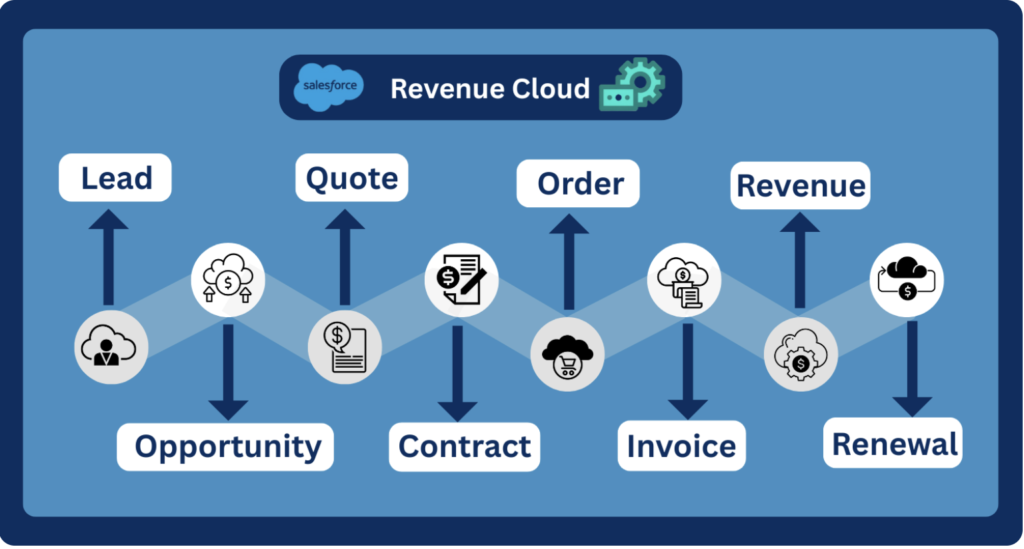
Understanding how objects connect throughout the revenue lifecycle is essential for maximizing Revenue Cloud’s value. Here’s the complete flow:
Stage 1: Acquisition
- Lead → Marketing captures interest through campaigns
- Lead Conversion → Creates Account, Contact, and Opportunity when qualified
- Opportunity → Sales tracks the deal through pipeline stages
Stage 2: Quoting and Closing
- Quote → Created from Opportunity, configured via CPQ
- Quote Line Items → Specific products, pricing, and terms
- Quote Sync → Updates Opportunity with final pricing
- Opportunity Closure → Marks deal as won
Stage 3: Order and Fulfillment
- Order → Automatically generated from accepted Quote
- Order Products → Individual line items with billing and recognition rules
- Subscriptions → Created for recurring revenue products
- Assets → Track delivered products and services
Stage 4: Billing
- Invoice → Generated according to billing schedule
- Invoice Lines → Detail what’s being billed
- Payments → Record cash collection
- Credit Memos → Handle returns and adjustments
Stage 5: Revenue Recognition
- Revenue Schedules → Define when revenue is recognized
- Revenue Recognition Entries → Journal entries for accounting
- Deferred Revenue → Track liabilities for unearned revenue
Stage 6: Renewal and Expansion
- Renewal Opportunity → Auto-created before subscription expires
- Amendment Orders → Handle mid-term changes
- Expansion Revenue → Track upsells and cross-sells
Every object in this flow maintains relationships to the others, creating a complete audit trail from marketing source through revenue recognition. You can start with a single revenue recognition entry and trace backward through Invoice, Order, Quote, Opportunity, and Lead to see the entire customer journey.
Cross-Object Reporting: Unlocking Strategic Insights
Because all these objects exist in a unified platform, Revenue Cloud enables powerful cross-functional analytics that would be impossible in disconnected systems:
Pipeline to Revenue Conversion
Track how Opportunities in your sales pipeline convert to Orders, how Orders convert to Invoices, and how Invoices convert to recognized revenue. Identify conversion rate bottlenecks and optimize accordingly.
Lead Source ROI
Calculate the complete return on investment for each marketing campaign by connecting Lead Source through to total revenue generated and recognized. Determine which marketing channels produce the highest quality customers with the best lifetime value.
Account Expansion Analysis
Identify patterns in how customers expand over time. Which products lead to the largest expansion? How long after initial purchase do customers typically expand? What triggers indicate expansion readiness? These insights inform expansion playbooks and identify at-risk accounts that should be expanding but aren’t.
Sales Velocity Metrics
Measure the complete time from Lead creation to cash collection, breaking down cycle time by stage. How long does lead qualification take? Quote generation? Contract negotiation? Order processing? Payment collection? Optimizing each stage compounds into dramatically faster revenue realization.
Product Performance Across Segments
Analyze which products perform best in which customer segments, regions, or industries. Identify cross-sell patterns (customers who buy Product A typically add Product B within six months). Use these insights to inform product development and go-to-market strategies.
Forecast Accuracy
Compare Opportunity forecasts to actual bookings, billing, and recognized revenue. Identify systematic biases (sales always overestimates close dates by 30 days) and correct them. Build confidence in revenue projections by showing historical accuracy.
Customer Health and Churn Prediction
Combine CRM engagement data (support cases, login frequency, feature adoption) with revenue data (payment history, expansion rate, discount levels) to build predictive models for churn risk. Identify at-risk customers early enough to intervene successfully.
These insights transform revenue operations from reactive to predictive, from siloed to strategic.
Automation and Workflow Integration Across Objects
Revenue Cloud’s integration with CRM objects enables sophisticated automation that reduces manual work and ensures consistency:
Automated Approvals
Configure approval workflows that consider both CRM and revenue data. For example: “Quotes over $100K or with discounts exceeding 20% require VP approval, but only if the Account is less than one year old or has a payment history with more than two late payments.” This nuanced logic protects margins while avoiding bureaucracy for low-risk deals.
Renewal Automation
Automatically create renewal Opportunities 90 days before subscription expiration, assign them to the appropriate account executive based on territory rules, and send automated reminders at 60, 30, and 15 days. For customers with strong health scores, enable auto-renewal with notification rather than active negotiation.
Upsell Triggers
Monitor usage patterns and trigger alerts when customers approach subscription limits. If a customer on a 100-user license has 95 active users, automatically create an expansion Opportunity and notify the account team to proactively offer an upgrade before they hit the limit and experience service degradation.
Payment Follow-Up
When an Invoice becomes overdue, automatically create a Task for the account executive to follow up, send escalating email reminders to the customer, and eventually suspend service or block new orders if payment isn’t received. These workflows maintain cash flow while preserving customer relationships through appropriate escalation paths.
Contract Lifecycle Management
Track contract effective dates and expiration dates on the Account. Send alerts to legal and finance teams 180 days before major contracts expire, initiating renewal negotiations well before deadline pressure creates unfavorable terms.
Customer Onboarding
When an Order is activated, automatically create an onboarding Case, assign it to the implementation team, and trigger welcome email sequences. This ensures every new customer receives consistent, timely onboarding regardless of which sales rep closed the deal.
These automations eliminate manual handoffs where deals often stall, ensuring seamless execution across the revenue lifecycle.
The Business Benefits: Why RLM with Revenue Cloud Matters
Implementing Revenue Lifecycle Management through Revenue Cloud delivers measurable business value across multiple dimensions:
Increased Accuracy
Automation eliminates manual data entry and calculation errors, ensuring revenue data integrity from quote through recognition. Companies typically see quote errors decrease by 90% and revenue recognition compliance improve to near 100%. The single source of truth eliminates reconciliation discrepancies between sales, billing, and finance.
Accelerated Cash Flow
Streamlined processes reduce quote-to-cash cycle times, getting invoices out faster and cash in sooner. Organizations report 30-50% reductions in average days sales outstanding (DSO). Automated billing means invoices go out on schedule rather than when someone gets around to it, and automated payment processing eliminates collection delays.
Regulatory Compliance
Built-in revenue recognition capabilities ensure adherence to accounting standards like ASC 606 and IFRS 15, reducing audit risk and penalties. Audit trails are automatic and complete, showing exactly how every recognition entry was calculated. When standards change, centralized configuration allows rapid adaptation.
Enhanced Visibility
Real-time dashboards and reporting provide the insights needed for accurate forecasting and strategic planning. Finance teams can produce management reports in hours rather than weeks. Sales leadership trusts pipeline numbers because they’re based on actual CPQ configurations rather than estimates. The executive team can make strategic decisions based on current data, not last month’s financials.
Improved Customer Experience
Faster quotes, accurate billing, and seamless order management create a smoother customer journey. Customers receive professional proposals quickly, invoices arrive on schedule with clear detail, and subscriptions renew automatically without service interruption. Self-service portals allow customers to view invoices, make payments, and manage subscriptions without contacting support.
Scalability
As your business grows and revenue models evolve, Revenue Cloud scales with you, supporting new products, markets, and complexity without requiring system overhauls. The platform handles 10 orders per month or 10,000 with the same underlying architecture. You can add new billing models, currencies, or tax jurisdictions through configuration rather than custom development.
Unified Data Model
The integration of CRM and RLM objects creates a single source of truth, eliminating data silos and reconciliation headaches. Sales, finance, operations, and executives all work from the same data, ending the endless debates about “whose numbers are right.” This alignment accelerates decision-making and builds organizational confidence.
Reduced Revenue Leakage
Automated processes ensure nothing falls through the cracks. Renewals don’t get forgotten. Price increases trigger automatically per contract terms. Usage overages are billed accurately. Companies typically recover 2-5% of revenue that was previously lost to manual process gaps.
Faster Close
Finance teams can close books faster when revenue data flows automatically from source systems. No more waiting for billing systems to reconcile with sales data. Recognition schedules update in real-time as orders change. What once took two weeks can happen in two days.
Transform Your Revenue Operations with RizeX Labs
Revenue Lifecycle Management isn’t just a finance initiative—it’s a strategic imperative that touches every revenue-generating function in your organization. By implementing RLM through Salesforce Revenue Cloud, businesses can transform fragmented, error-prone revenue processes into a streamlined, automated system that drives growth, ensures compliance, and delivers the visibility needed to make confident decisions.
The power of Revenue Cloud lies not just in its individual capabilities for CPQ, billing, or revenue recognition, but in how seamlessly it connects your entire revenue ecosystem—from the moment a lead enters your system to the final recognition of revenue in your financial statements and beyond to renewal and expansion.
The integration of CRM objects (Leads, Accounts, Contacts, Opportunities) with RLM objects (Quotes, Orders, Subscriptions, Invoices, Revenue Schedules) creates an unprecedented level of visibility and control. This unified platform eliminates the disconnects that plague traditional revenue operations, where sales uses one system, billing uses another, and finance maintains spreadsheets trying to reconcile the two.
At RizeX Labs, we specialize in helping organizations unlock the full potential of Salesforce Revenue Cloud. Whether you’re implementing Revenue Cloud for the first time or optimizing your existing deployment, our team brings the expertise and experience to ensure your revenue lifecycle runs smoothly from quote to cash.
We understand that successful Revenue Cloud implementations require more than technical expertise—they require deep understanding of your business processes, revenue models, and strategic objectives. Our implementation methodology focuses on:
- Discovery and Process Design: Understanding your current revenue operations and designing optimized future-state processes
- Object Model Architecture: Properly configuring the integration between CRM and RLM objects for your specific business needs
- CPQ Configuration: Building product catalogs, pricing rules, and approval workflows that match your go-to-market strategy
- Billing Automation: Implementing billing schedules, invoice templates, and payment processing for your revenue models
- Revenue Recognition: Configuring recognition rules that ensure compliance while providing financial visibility
- Reporting and Analytics: Creating dashboards and reports that deliver actionable insights to each stakeholder
- Change Management: Training your teams and managing the organizational transformation that comes with new systems
Our certified Revenue Cloud experts have implemented solutions across industries including SaaS, manufacturing, telecommunications, media, and professional services. We’ve helped companies with simple subscription models and complex enterprise arrangements involving multi-year contracts, usage-based pricing, milestone billing, and intricate revenue recognition requirements.
Ready to transform your revenue operations? Contact RizeX Labs today to learn how we can help you master Revenue Lifecycle Management with Salesforce Revenue Cloud. Let’s build a revenue engine that drives predictable growth, ensures compliance, and delivers the visibility your business needs to thrive in an increasingly complex market.Contact RizeX Labs today to learn how we can help you master Revenue Lifecycle Management with Salesforce Revenue Cloud.
About RizeX Labs
RizeX Labs is a leading Salesforce consulting and training company specializing in Revenue Cloud, CPQ, Billing, and end-to-end revenue transformation. Our programs combine deep domain expertise, hands-on implementation experience, and real-world use cases to help businesses streamline their quote-to-cash processes and unlock scalable growth.
Internal Linking Opportunities:
- Link to your Salesforce course page: https://rizexlabs.com/salesforce-admin-and-development-training
External Linking Opportunities:
- Salesforce official website: https://www.salesforce.com/
- Salesforce Revenue Cloud overview: https://www.salesforce.com/products/revenue-cloud/overview/
- Salesforce CPQ documentation: https://help.salesforce.com/
- Revenue recognition standards (ASC 606 / IFRS 15 overview): https://www.ifrs.org/
Conclusion
Revenue Lifecycle Management isn’t just about technology—it’s about transforming how your entire organization manages revenue from quote to cash. Salesforce Revenue Cloud delivers this transformation by unifying CPQ, billing, and revenue recognition on a single platform, seamlessly integrated with your CRM data.
The results speak for themselves: faster quote-to-cash cycles, improved accuracy, enhanced compliance, and the real-time visibility needed to drive strategic decisions. By connecting Leads, Accounts, Opportunities, and revenue objects in one ecosystem, Revenue Cloud eliminates silos and creates a single source of truth for your entire revenue operation.
Whether you’re struggling with manual processes, revenue leakage, compliance challenges, or simply lack visibility into your revenue performance, Revenue Lifecycle Management with Revenue Cloud offers a proven path forward.
Quick Summary
Revenue Lifecycle Management (RLM) is essential for modern businesses managing complex pricing models, subscriptions, and compliance requirements. By leveraging Salesforce Revenue Cloud, organizations can unify quoting, ordering, billing, and revenue recognition into a single streamlined process. This not only reduces errors and accelerates cash flow but also provides real-time visibility into revenue performance—making RLM a critical driver of scalable and predictable growth.