
Introduction: The AI Revolution in IT Service Management
IT Service Management has always been about efficiency, user satisfaction, and continuous improvement. But for years, ITSM tools were glorified ticketing systems—reactive, manual, and frustrating for both agents and end-users. Enter generative AI in ITSM, a paradigm shift that's fundamentally changing how IT teams operate.
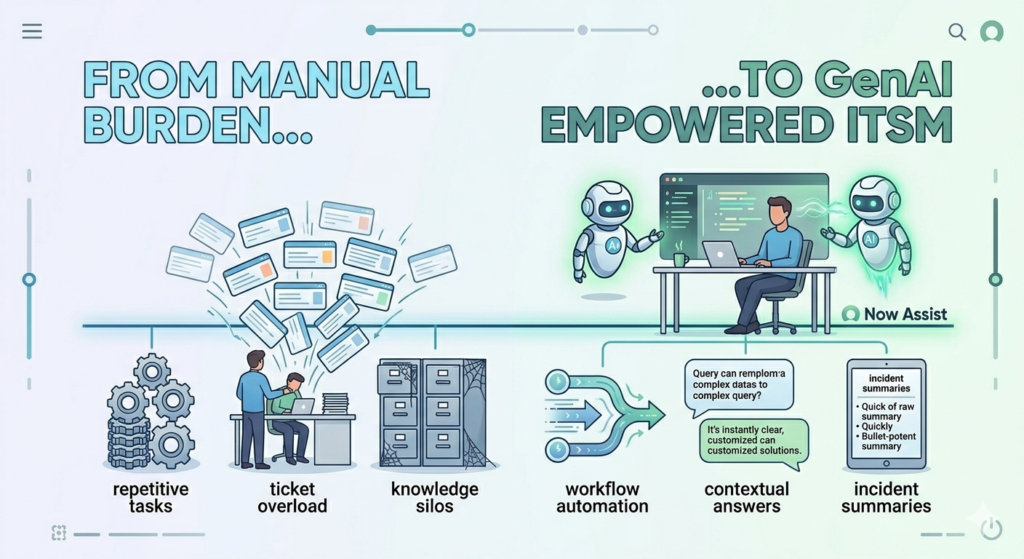
ServiceNow, the dominant player in the ITSM space, has gone all-in on artificial intelligence with its Now Assist suite and broader AI capabilities. Unlike the wave of vague "AI-powered" marketing we've seen across tech, ServiceNow's implementation targets specific pain points: ticket resolution speed, knowledge management gaps, automation of repetitive tasks, and predictive incident management.
This isn't about replacing IT professionals—it's about augmenting their capabilities. For IT professionals exploring these tools and beginners in ServiceNow looking to understand where the platform is heading, this guide breaks down exactly how generative AI is transforming ITSM, what ServiceNow is doing right (and where challenges remain), and what this means for the future of IT operations.
Understanding Generative AI in ITSM: Beyond the Buzzwords
What Is Generative AI in the ITSM Context?
Generative AI refers to machine learning models that can create new content—text, code, images, or structured data—based on patterns learned from training data. In ITSM, this translates to:
- Generating ticket summaries from lengthy user descriptions
- Creating knowledge base articles automatically from resolved incidents
- Drafting response emails based on ticket context
- Suggesting resolution steps by analyzing similar past incidents
- Writing scripts or code snippets for common automation tasks
Unlike traditional AI in ITSM (which focused on classification, routing, and basic chatbots), generative AI can produce original, contextually relevant outputs that feel human-written.
Why ITSM Needs Generative AI Now
The modern IT environment is increasingly complex:
- Volume overload: IT teams handle thousands of tickets monthly, with repetitive issues consuming 40-60% of agent time
- Knowledge fragmentation: Critical information sits scattered across documentation, chat logs, and tribal knowledge
- Skills gap: Organizations struggle to find and retain skilled IT staff
- User expectations: Employees expect consumer-grade, instant support experiences
Generative AI addresses these pressures by automating knowledge work—not just routine tasks, but the cognitive labor of understanding context, finding solutions, and communicating effectively.
ServiceNow's Generative AI Strategy: Now Assist and Beyond
ServiceNow has positioned itself as the enterprise AI leader in ITSM, integrating generative AI deeply into its platform rather than bolting it on as an afterthought.
The Now Assist Family: ServiceNow's AI Flagship
Now Assist is ServiceNow's branded generative AI capability, built on large language models (LLMs) and integrated across multiple ServiceNow products. It's not a single feature but a family of AI-powered capabilities designed for different personas and use cases.
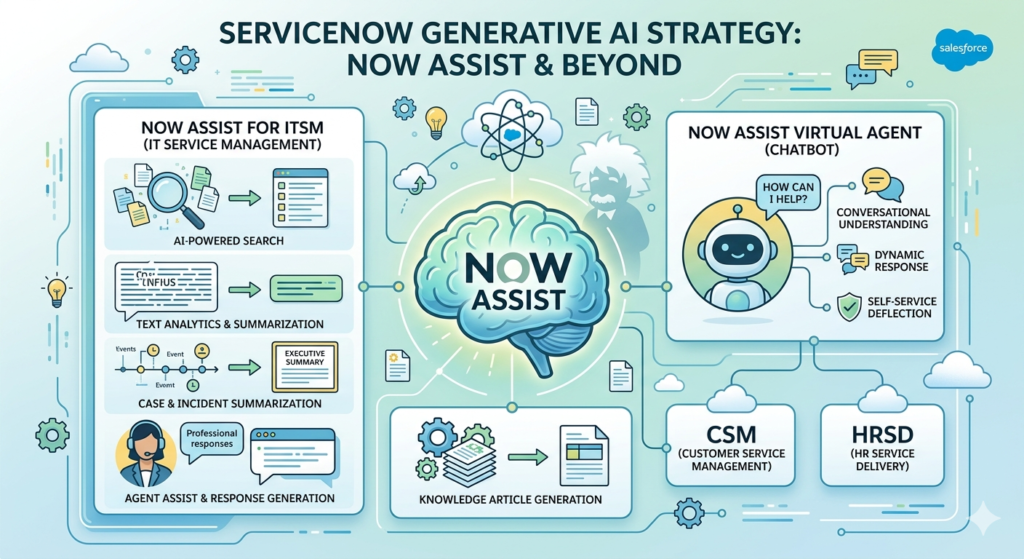
Now Assist for IT Service Management
This is the core ITSM-focused offering, with capabilities including:
1. AI-Powered Search
Traditional ServiceNow search has been notoriously frustrating. Now Assist transforms this with conversational search that understands natural language queries. Instead of searching for "VPN config," agents can ask "How do I reset a user's VPN access?" and get relevant knowledge articles, past tickets, and suggested actions.
2. Text Analytics and Summarization
When agents open a ticket with a wall of text from a frustrated user, Now Assist can:
- Summarize the core issue in 2-3 sentences
- Extract key entities (affected systems, error codes, usernames)
- Identify sentiment and urgency
- Suggest appropriate categorization
This saves agents 3-5 minutes per ticket—which compounds dramatically across thousands of tickets.
3. Case and Incident Summarization
For major incidents involving dozens of updates and multiple resolver groups, Now Assist generates executive summaries automatically. This is invaluable for post-incident reviews and status communications to stakeholders.
4. Agent Assist and Response Generation
The AI analyzes the ticket context and suggests:
- Response templates tailored to the specific issue
- Resolution steps based on similar past incidents
- Follow-up questions to gather necessary information
- Tone adjustments (formal vs. casual) based on the requester
Critically, agents can edit these suggestions before sending—keeping humans in the loop while dramatically speeding up response time.
5. Knowledge Article Generation
Perhaps the most powerful feature: after resolving a ticket, Now Assist can draft a knowledge base article capturing:
- Problem description
- Resolution steps
- Related system configurations
- Troubleshooting tips
Knowledge management has always been ITSM's Achilles heel—teams know they should document solutions, but it's tedious and rarely prioritized. Automating the first draft changes this equation entirely.
Now Assist for Virtual Agent (Chatbot)
ServiceNow's Virtual Agent gets a significant upgrade with generative AI:
Conversational Understanding
Earlier chatbot versions relied on rigid intent matching. Now Assist enables truly conversational interactions where users can ask follow-up questions, provide context in different ways, and receive coherent, helpful responses.
Dynamic Response Generation
Instead of pulling pre-scripted responses, the AI generates answers by synthesizing information from:
- The knowledge base
- CMDB (Configuration Management Database) data
- Past ticket resolutions
- Official documentation
Self-Service Deflection
The goal is resolving issues without creating tickets. Generative AI dramatically improves this by providing contextual, multi-step guidance rather than just linking to knowledge articles.
Now Assist for CSM (Customer Service Management) and HRSD
While our focus is ITSM, it's worth noting ServiceNow extends these capabilities to customer service and HR service delivery, demonstrating the platform's broader AI strategy.
ServiceNow's AI Architecture: How It Actually Works
ServiceNow doesn't exclusively use proprietary models. Their approach is pragmatic:
- Foundation models: Partnership with leading LLM providers (including integration with Azure OpenAI Service, Google's models, and others)
- Domain-specific training: Models fine-tuned on ITSM-specific language and workflows
- Enterprise safeguards: Data protection, compliance controls, and governance features
- Hybrid approach: Generative AI works alongside traditional machine learning for classification, prediction, and anomaly detection
This matters because it means ServiceNow can leverage rapid improvements in foundation models while maintaining enterprise-grade security and compliance.
Real-World Use Cases: Generative AI in ITSM Action
Let's move beyond features to practical applications that IT teams are implementing today.
Use Case 1: Tier 1 Ticket Resolution Acceleration
The Challenge: A financial services company's IT team handled 8,000+ tickets monthly, with 60% being password resets, access requests, and basic troubleshooting—all consuming Tier 1 agent time.
The Solution:
- Deployed Now Assist for Virtual Agent with generative AI responses
- Implemented AI-powered search to help agents find solutions faster
- Used automated ticket summarization to speed up triage
Results:
- 35% reduction in Tier 1 ticket volume (deflected to self-service)
- 40% faster average handling time for remaining tickets
- 22% improvement in first-call resolution
- Agents could focus on complex, high-value work
Use Case 2: Knowledge Base Transformation
The Challenge: A healthcare organization had accumulated 15 years of tribal knowledge with a severely outdated knowledge base. Only 12% of tickets were resolved using KB articles.
The Solution:
- Enabled Now Assist knowledge article generation for all resolved tickets
- Implemented AI-powered content suggestions to update existing articles
- Used generative AI to identify gaps in documentation
Results:
- Created 400+ new knowledge articles in 6 months (vs. 23 the previous year)
- KB article usage increased to 41% of ticket resolutions
- Reduced new employee onboarding time by 30% (better documentation)
- Improved incident resolution consistency
Use Case 3: Major Incident Management
The Challenge: During major incidents, a global retailer struggled with communication—too many updates, too much noise, executives wanting summaries, and post-incident reviews taking weeks to compile.
The Solution:
- Applied Now Assist to automatically generate stakeholder updates during incidents
- Used AI summarization for post-incident review documentation
- Implemented predictive capabilities to identify incidents before they became critical
Results:
- Reduced time to create stakeholder communications by 70%
- Completed post-incident reviews in 2 days instead of 2-3 weeks
- Improved proactive incident detection by 28%
Use Case 4: Multi-Language Global Support
The Challenge: A manufacturing company with operations in 23 countries struggled to provide consistent ITSM support across languages. Knowledge articles existed primarily in English, creating delays for non-English speakers.
The Solution:
- Leveraged Now Assist's multi-language capabilities for real-time translation
- Used generative AI to create localized knowledge content
- Deployed Virtual Agent with language detection and response generation
Results:
- Expanded knowledge base coverage to 7 languages without hiring translators
- Improved user satisfaction scores in APAC and Latin American regions by 34%
- Reduced language-related ticket escalations by 52%
Now Assist Capabilities: A Deep Dive for Practitioners
For IT professionals evaluating or implementing these tools, here's a more technical breakdown of Now Assist capabilities:
Natural Language Processing and Understanding
Semantic Search
- Understands intent beyond keyword matching
- Recognizes synonyms, abbreviations, and domain-specific terminology
- Provides ranked results based on relevance and context
Entity Recognition
- Automatically identifies CIs (Configuration Items), users, locations, and systems
- Links extracted entities to CMDB records
- Enables more accurate routing and categorization
Sentiment Analysis
- Detects frustration, urgency, or satisfaction in user communications
- Adjusts prioritization based on sentiment signals
- Helps identify VIP users or potential escalations
Content Generation Features
Contextual Response Templates
- Analyzes ticket content, user history, and CMDB context
- Generates personalized responses maintaining brand voice
- Includes relevant links, attachments, and next steps
Documentation Automation
- Creates first-draft KB articles from ticket resolutions
- Generates runbooks for common procedures
- Produces change documentation templates
Code and Script Generation
- Creates basic scripts for workflow automation
- Generates catalog item forms and configurations
- Suggests integration code snippets (with appropriate safeguards)
Predictive and Proactive Capabilities
While focused on generative AI, ServiceNow combines this with predictive analytics:
Incident Prediction
- Identifies patterns suggesting potential incidents before they occur
- Recommends preventive actions
- Prioritizes proactive maintenance
Resolution Recommendation
- Suggests likely solutions based on similar historical tickets
- Ranks recommendations by confidence score
- Learns from feedback to improve over time
Integration and Extensibility
Platform Integration
- Works natively with ServiceNow workflows, forms, and data structures
- Integrates with CMDB for context-aware responses
- Connects to ITOM (IT Operations Management) for operational insights
Third-Party Connectivity
- APIs for extending AI capabilities to custom applications
- Integration with collaboration tools (Slack, Teams) for contextual support
- Connects to monitoring tools for enriched incident context
Governance and Control Features
Human-in-the-Loop Design
- AI suggestions are reviewable before implementation
- Agents can provide feedback to improve model accuracy
- Override capabilities for edge cases
Compliance and Privacy
- Data residency controls for regulated industries
- PII (Personally Identifiable Information) detection and masking
- Audit trails for AI-generated content
Transparency
- Confidence scores for AI suggestions
- Explanations for recommendations (where possible)
- Clear indicators when users are interacting with AI vs. humans
Benefits of Generative AI in ITSM: The Realistic Picture
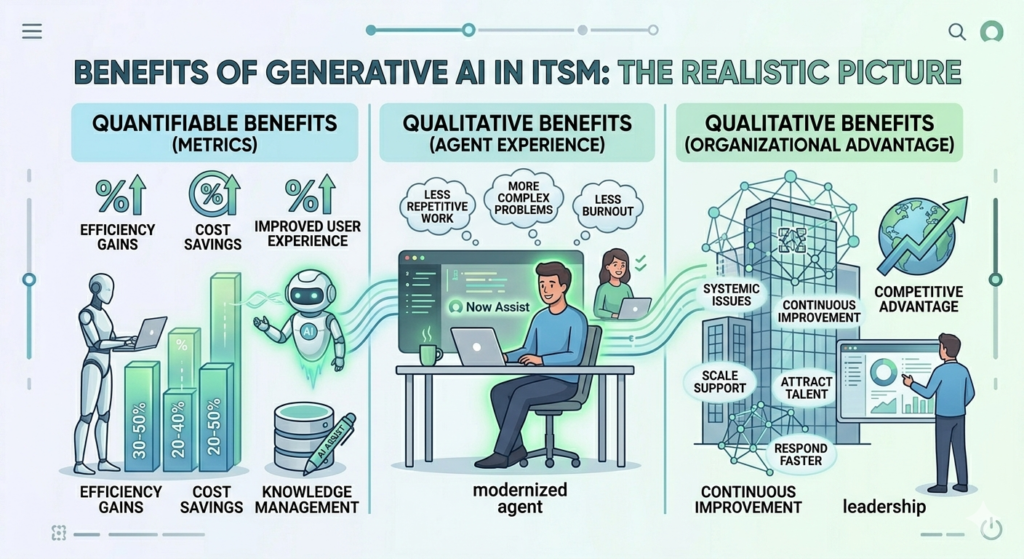
Quantifiable Benefits
Efficiency Gains
- 30-50% reduction in average handling time for common tickets
- 20-40% increase in first-contact resolution rates
- 40-60% reduction in time spent searching for information
Cost Savings
- Reduced need for overtime during peak periods
- Lower cost per ticket through automation
- Decreased reliance on expensive escalations
Improved User Experience
- Faster response times (especially with AI-powered Virtual Agent)
- 24/7 availability for self-service support
- More consistent, higher-quality responses
Knowledge Management
- Dramatically increased knowledge article creation rates
- Better knowledge quality through AI-assisted writing
- Reduced knowledge rot (outdated articles identified automatically)
Qualitative Benefits
Agent Satisfaction
IT professionals generally report improved job satisfaction because:
- Less time on tedious, repetitive work
- More capacity for interesting, complex problem-solving
- Reduced burnout from ticket overload
Organizational Learning
- Pattern recognition across tickets identifies systemic issues
- Better data for continuous improvement initiatives
- Enhanced ability to identify training needs
Competitive Advantage
Organizations implementing generative AI in ITSM effectively can:
- Scale support without proportionally scaling headcount
- Attract talent by offering modern, AI-augmented work environments
- Respond faster to business changes and incidents
Challenges and Limitations: What ServiceNow Won't Tell You
Let's be candid about the difficulties and limitations you'll encounter.
Implementation Challenges
Data Quality Requirements
Generative AI is only as good as the data it's trained on. Organizations with:
- Poorly documented historical tickets
- Inconsistent categorization
- Incomplete CMDB data
...will see limited benefits until they clean up their data. This is unglamorous work but essential.
Change Management Complexity
Introducing AI into ITSM workflows requires:
- Agent training and buy-in (resistance is common)
- Process redesign to leverage AI capabilities
- Shift in team culture from "doing everything manually" to "augmented by AI"
Many implementations fail not due to technology but due to insufficient change management.
Cost and Licensing
Now Assist capabilities require additional licensing beyond core ServiceNow subscriptions. For smaller organizations or those with tight budgets, ROI calculations need to be realistic—benefits may take 12-18 months to fully materialize.
Technical Limitations
Hallucination Risk
Generative AI models can produce confident-sounding but incorrect information. In ITSM, this could mean:
- Incorrect resolution steps that waste time or cause damage
- Fabricated knowledge article references
- Misidentified root causes
ServiceNow has built safeguards (confidence scoring, human review), but the risk isn't zero. Critical decisions still need human validation.
Context Window Constraints
While improving, LLMs have limits on how much information they can process at once. For tickets with extensive histories or major incidents with hundreds of updates, context can be lost or oversimplified.
Customization Complexity
Organizations with heavily customized ServiceNow instances may find:
- AI features require configuration to work with custom workflows
- Integration with custom applications needs development effort
- Some AI capabilities may not support certain customizations
Organizational and Ethical Concerns
Job Displacement Anxiety
Even if the reality is "augmentation not replacement," IT staff may fear for their jobs. This requires transparent communication about how AI will change (not eliminate) roles.
Over-Reliance on AI
There's a risk that agents start blindly trusting AI suggestions without critical thinking, especially for newer team members who lack experience to identify incorrect recommendations.
Bias and Fairness
AI models can perpetuate biases present in training data. In ITSM, this might manifest as:
- Certain user groups receiving lower-quality responses
- Systematic mis-categorization of specific ticket types
- Unequal service levels based on language or location
Ongoing monitoring and bias testing are necessary.
Privacy and Data Security
Sending ticket data (which may contain sensitive information) to AI models raises questions:
- Where is data processed?
- Is data used to train models?
- How is PII protected?
ServiceNow addresses these concerns with enterprise controls, but organizations must verify configurations meet their compliance requirements.
Comparison with Other AI ITSM Tools (2026 Landscape)
ServiceNow isn't the only player implementing generative AI in ITSM. How does it stack up?
ServiceNow vs. BMC Helix
BMC Helix has integrated AI capabilities through its Helix ITSM platform, including:
- AI-powered virtual agents
- Predictive incident management
- Automated ticket classification and routing
Comparison:
- ServiceNow has a more comprehensive generative AI offering with Now Assist
- BMC focuses heavily on AIOps integration (correlating operational data with service management)
- ServiceNow generally leads in user experience and interface design
- BMC can be more cost-effective for certain enterprise deployments
Verdict: ServiceNow edges ahead in generative AI capabilities, but BMC is competitive for organizations prioritizing AIOps integration.
ServiceNow vs. Atlassian (Jira Service Management)
Atlassian has introduced Atlassian Intelligence across its product suite, including Jira Service Management, with features like:
- AI-generated summaries
- Automated responses
- Knowledge base search improvements
Comparison:
- ServiceNow is more enterprise-focused with deeper ITSM process integration
- Atlassian's AI is newer and less mature in ITSM context
- Atlassian offers better value for smaller organizations or teams already in the Atlassian ecosystem
- ServiceNow provides more sophisticated workflow automation and CMDB integration
Verdict: For full-scale enterprise ITSM with advanced AI, ServiceNow wins. For smaller teams or dev-centric organizations, Atlassian is compelling.
ServiceNow vs. Freshservice
Freshservice (Freshworks' ITSM solution) has implemented Freddy AI with capabilities including:
- Ticket categorization and routing
- Chatbot interactions
- Agent assist features
Comparison:
- Freshservice is significantly more affordable
- ServiceNow offers more sophisticated, enterprise-grade AI capabilities
- Freshservice is easier to implement and manage for smaller IT teams
- ServiceNow provides better integration with complex IT ecosystems
Verdict: Freshservice is excellent for SMBs and mid-market; ServiceNow is the choice for complex enterprise environments.
AI ITSM Tools 2026: The Competitive Landscape
As of 2026, the market has evolved:
Emerging Patterns:
- Most major ITSM vendors now offer some generative AI capabilities
- Differentiation is shifting from "having AI" to implementation quality and domain specialization
- Open-source AI alternatives are appearing but lack enterprise support
- Integration between ITSM AI and broader workplace AI (Microsoft Copilot, Google Workspace AI) is increasing
ServiceNow's Position:
ServiceNow remains the market leader in AI-powered enterprise ITSM due to:
- Heavy R&D investment in AI capabilities
- Strong partner ecosystem (Microsoft, Google, AWS)
- Deep platform integration rather than bolt-on features
- Enterprise-grade security and compliance
However, the gap is narrowing as competitors improve their offerings.
Future Trends: Where Generative AI in ITSM Is Heading
Autonomous IT Operations
The next evolution moves beyond assistance to autonomy:
- Self-healing systems: AI doesn't just suggest fixes—it implements them (with appropriate safeguards)
- Proactive service delivery: AI predicts and prevents issues before users notice
- Autonomous change management: Routine changes deployed without human intervention
ServiceNow is investing heavily in this direction, though full autonomy is still 3-5 years away for most organizations.
Hyper-Personalization
Future AI in ITSM will deliver experiences tailored to individual users:
- Personalized interfaces: Virtual agents that adapt tone, complexity, and communication style to each user
- Predictive user needs: AI anticipates what a user might need based on role, behavior patterns, and context
- Customized learning: Knowledge delivery adapted to user's expertise level
Integration with Business Process AI
ITSM AI won't operate in isolation:
- Cross-domain insights: ITSM AI shares context with HR, finance, and customer service AI
- Business impact analysis: AI automatically assesses how IT issues affect business outcomes
- Unified employee experience: Seamless support across all workplace needs, not just IT
ServiceNow's focus on a unified platform positions it well for this trend.
Improved Explainability and Transparency
As AI makes more decisions, understanding "why" becomes critical:
- Explainable AI: Models that can articulate their reasoning in human terms
- Audit capabilities: Complete transparency into AI decision-making for compliance
- Bias detection: Built-in monitoring for fairness and equitable treatment
Multimodal AI in ITSM
Future capabilities will extend beyond text:
- Visual problem diagnosis: Users submit screenshots or photos; AI identifies issues
- Voice-based support: Conversational AI via phone or smart speakers
- Video analysis: AI watches screen recordings to understand user problems
ServiceNow has demonstrated some of these capabilities in labs; full production deployment is coming.
Getting Started: Practical Advice for IT Teams
If you're considering implementing generative AI in ITSM with ServiceNow, here's actionable guidance:
Assessment Phase
1. Evaluate Your Foundation
Before implementing AI:
- Assess data quality in your ServiceNow instance
- Review your CMDB completeness and accuracy
- Evaluate knowledge base current state
- Identify high-volume, repetitive ticket categories
2. Define Success Metrics
Establish baseline measurements:
- Average handling time
- First-contact resolution rate
- Knowledge article usage
- User satisfaction scores
- Agent satisfaction and productivity
3. Start with Specific Use Cases
Don't try to implement everything at once. Prioritize:
- High-volume, low-complexity ticket types
- Knowledge base generation for teams that currently document poorly
- Virtual agent for common self-service requests
Implementation Phase
4. Pilot Before Full Deployment
Run controlled pilots:
- Select one service desk team or one ticket category
- Implement AI capabilities with opt-in for agents
- Gather feedback and refine before broader rollout
5. Invest in Change Management
- Communicate transparently about AI's role (augmentation, not replacement)
- Provide hands-on training for agents
- Create feedback loops so agents can improve AI performance
- Celebrate wins and share success stories
6. Configure Thoughtfully
- Customize AI responses to match your organization's tone and policies
- Set appropriate confidence thresholds for automation
- Implement review processes for AI-generated content
- Establish governance for AI usage
Optimization Phase
7. Monitor and Refine
Continuously track:
- AI suggestion acceptance rates
- Accuracy of AI-generated content
- User and agent feedback
- ROI against initial projections
8. Expand Gradually
Once initial use cases prove successful:
- Extend to additional ticket categories
- Implement more advanced features (predictive capabilities, proactive support)
- Integrate with additional ServiceNow modules
9. Build Internal Expertise
- Develop in-house AI champions who understand capabilities and limitations
- Create documentation for your specific AI configurations
- Establish best practices for AI-augmented ITSM in your context
Conclusion: The Pragmatic Path Forward
Generative AI in ITSM represents a genuine transformation, not just incremental improvement. ServiceNow's approach with Now Assist and broader AI capabilities demonstrates how enterprise software can meaningfully leverage AI to solve real problems—faster ticket resolution, better knowledge management, improved user experience, and more strategic use of IT talent.
But this isn't magic. Success requires:
- Clean data and solid ITSM fundamentals—AI amplifies what you have; garbage in, garbage out
- Realistic expectations—AI augments human capabilities; it doesn't replace critical thinking
- Thoughtful implementation—technology alone won't drive change; process redesign and change management are essential
- Ongoing refinement—AI capabilities improve with feedback and iteration
For IT professionals and organizations beginning this journey, the opportunity is significant. Early adopters who implement generative AI thoughtfully are seeing measurable improvements in efficiency, user satisfaction, and team morale. As the technology matures and becomes more accessible, laggards will find themselves at a competitive disadvantage.
ServiceNow, while not the only player in AI ITSM tools 2026, has established itself as the leader through comprehensive capabilities, enterprise-grade implementation, and continuous innovation. For organizations already invested in the ServiceNow ecosystem, Now Assist capabilities represent a natural evolution worth serious consideration.
The question isn't whether generative AI will transform ITSM—it already is. The question is whether your organization will lead or follow in this transformation.
Start small, learn quickly, and scale what works. That's the pragmatic path to leveraging generative AI in ITSM effectively.
About RizeX Labs
At RizeX Labs, we specialize in delivering next-generation IT service solutions powered by Generative AI in ITSM, with a strong focus on platforms like ServiceNow.
Our expertise combines real-world implementation experience, deep technical knowledge, and modern AI capabilities to help organizations automate IT operations, reduce manual effort, and improve service delivery efficiency.
We help businesses shift from traditional IT service management to AI-driven intelligent workflows—enabling faster incident resolution, predictive support, and smarter decision-making.
Internal Links:
- Link to your ServiceNow / Salesforce training page:
ServiceNow CAD Certification Guide 2026 – Everything You Need to Pass - ServiceNow Salary in Pune for Freshers: 7 Best Insights (2026 Guide)
- ServiceNow Scripting Basics: Ultimate Guide to Client Scripts vs Business Rules vs Script Include
- ServiceNow Customer Acceptance Document: What it is and Why it Matters for Admins:https
- ServiceNow CIS: Ultimate Guide to Choose the Right Track for Success in 2026
External Links:
- ServiceNow official website: https://www.servicenow.com/
- ServiceNow AI / Now Assist overview: https://www.servicenow.com/products/now-assist.html
- ServiceNow Documentation: https://docs.servicenow.com/
- ServiceNow Developer Portal: https://developer.servicenow.com/