
Introduction: Choosing Your ITSM Career Path in a Transforming Digital Landscape
The technology landscape is experiencing seismic shifts, and nowhere is this more evident than in the world of IT Service Management (ITSM). As organizations worldwide accelerate their digital transformation initiatives, two platforms have emerged as dominant forces: ServiceNow and JIRA. For IT professionals navigating their career trajectories in 2026, understanding the nuances between these platforms isn’t just academic—it’s potentially worth tens of thousands of dollars in salary differences and decades of career trajectory.
According to recent industry surveys, demand for ITSM professionals has surged by 47% since 2023, with companies desperately seeking talent who can streamline operations, improve service delivery, and create seamless digital experiences. But here’s the million-dollar question: which platform should you invest your time mastering?
This comprehensive analysis examines ServiceNow vs JIRA through the lens of career growth potential, market demand, salary benchmarks, learning curves, and future-proofing your professional skill set. Whether you’re a recent graduate mapping out your first career move, a mid-level IT professional considering upskilling, or a seasoned expert evaluating your next specialization, this guide provides the data-driven insights you need to make an informed decision.
Let’s begin by understanding what each platform brings to the table.
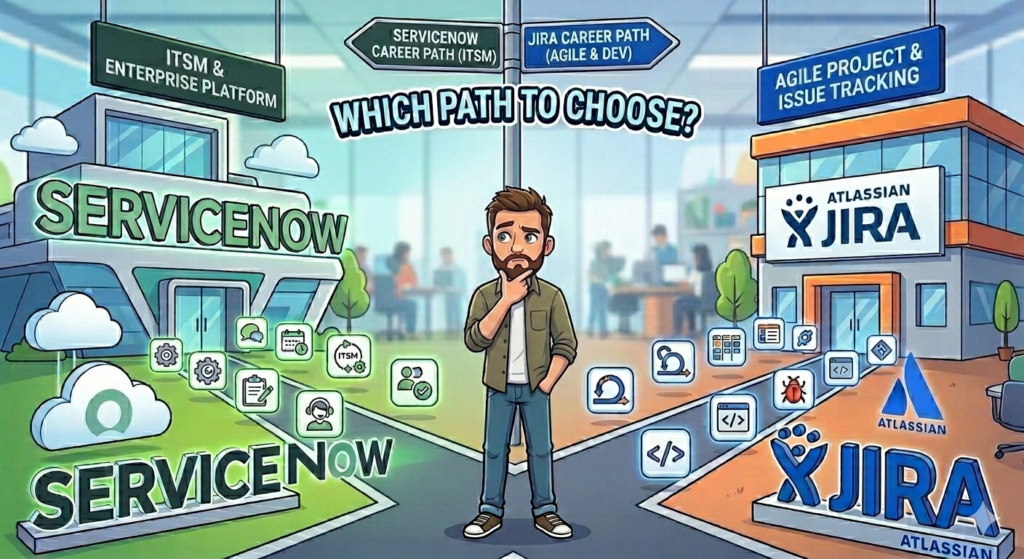
Understanding the Contenders: ServiceNow and JIRA Defined
What is ServiceNow?
ServiceNow is an enterprise-grade cloud computing platform designed to help organizations manage digital workflows for enterprise operations. Founded in 2004, ServiceNow has evolved from a pure-play ITSM solution into a comprehensive platform that orchestrates work across IT, Customer Service, HR, Security Operations, and beyond.
The platform operates on a single cloud-based architecture that provides:
- IT Service Management (ITSM) capabilities including incident, problem, and change management
- IT Operations Management (ITOM) for infrastructure monitoring
- IT Business Management (ITBM) for project portfolio management
- Customer Service Management (CSM) solutions
- HR Service Delivery (HRSD) platforms
- Security Operations through integrated SOC capabilities
ServiceNow’s strength lies in its enterprise-scale capabilities, handling complex workflows across multiple departments while maintaining data integrity and providing comprehensive analytics. The platform uses a proprietary scripting language and development framework, creating a specialized skill set among its practitioners.
What is JIRA?
JIRA, created by Atlassian in 2002, began as an issue-tracking tool for software development teams and has since expanded into a versatile project management and ITSM platform. JIRA’s ecosystem includes several specialized products:
- JIRA Software: Designed for agile software development teams
- JIRA Service Management (formerly JIRA Service Desk): The ITSM-focused offering
- JIRA Work Management: For business teams managing general projects
- JIRA Align: Enterprise-level agile planning
JIRA Service Management specifically competes in the ITSM space, offering incident management, change management, asset management, and self-service capabilities. Unlike ServiceNow’s all-in-one approach, JIRA thrives on integration with other Atlassian products (Confluence, Bitbucket, Trello) and third-party tools, creating a flexible ecosystem.
The platform is particularly popular among small to mid-sized organizations and development teams due to its accessibility, customization options, and developer-friendly interface.
Market Position and Adoption Trends in 2026
ServiceNow’s Enterprise Dominance
ServiceNow has cemented its position as the enterprise ITSM platform of choice. As of 2026, the company serves over 8,100 enterprise customers, including 85% of Fortune 500 companies. This market penetration isn’t accidental—ServiceNow’s capabilities align perfectly with large organizations requiring:
- Cross-departmental workflow automation
- Compliance and governance frameworks
- Scalability to support hundreds of thousands of users
- Advanced AI and machine learning capabilities through Now Assist
- Comprehensive security protocols meeting enterprise requirements
The platform’s revenue growth trajectory remains impressive, with ServiceNow reporting $10.2 billion in subscription revenues in fiscal 2025, representing 23% year-over-year growth. This financial strength translates directly into R&D investments that keep the platform competitive and create ongoing demand for skilled professionals.
Industry analysts project ServiceNow will continue expanding beyond traditional ITSM into hyperautomation, process mining, and AI-driven decision support, broadening the career opportunities available to specialists.
JIRA’s Agile Development Stronghold
JIRA occupies a different but equally valuable market position. Atlassian reports over 250,000 customers globally, with JIRA being the most widely adopted tool among development teams practicing agile methodologies. The platform’s market strength comes from:
- Deep penetration in software development organizations
- Strong presence in startups and scale-ups
- Cost-effectiveness for small to mid-sized businesses
- Seamless integration with DevOps toolchains
- Lower barrier to entry for implementation
JIRA Service Management has been gaining ITSM market share, particularly among organizations that started with JIRA Software and expanded into service management capabilities. The 2026 market shows JIRA positioned as the challenger to ServiceNow’s enterprise dominance, winning customers through flexibility, pricing advantages, and its developer-centric approach.
Atlassian’s strategic acquisitions and continued product integration create an expanding ecosystem that requires professionals who understand not just JIRA in isolation, but the entire Atlassian suite.
ServiceNow vs JIRA Career: Demand Analysis for 2026
Job Market Landscape
The conversation around ServiceNow vs JIRA career opportunities reveals distinct patterns:
ServiceNow Opportunities:
- LinkedIn job postings for ServiceNow specialists increased 52% between 2024-2026
- Enterprise organizations posting 78% of ServiceNow positions
- Common titles: ServiceNow Developer, ServiceNow Administrator, ServiceNow Architect, ServiceNow Business Analyst
- Global job distribution: Strong in North America (45%), Europe (32%), Asia-Pacific (18%)
- Approximately 87,000 active ServiceNow positions globally as of Q1 2026
JIRA Opportunities:
- JIRA-related job postings show 38% growth in the same period
- More distributed across company sizes, with 54% from mid-sized organizations
- Common titles: Agile Project Manager, JIRA Administrator, Atlassian Consultant, DevOps Engineer (JIRA integration)
- Similar geographic distribution with slightly higher concentration in tech hubs
- Approximately 142,000 positions mentioning JIRA skills (though not always primary focus)
The numbers tell an interesting story. While JIRA appears in more job postings overall, these positions often list JIRA as one skill among many. ServiceNow positions, conversely, typically require it as the primary expertise, suggesting more specialized, focused career paths.
Career Progression Paths
ServiceNow Career Trajectory:
The ServiceNow career path tends to follow a well-defined progression:
- Entry Level (0-2 years): ServiceNow Administrator or Junior Developer ($65,000-$85,000)
- Mid Level (2-5 years): ServiceNow Developer or Implementation Consultant ($95,000-$130,000)
- Senior Level (5-8 years): Senior Developer, Solution Architect ($130,000-$175,000)
- Expert Level (8+ years): Technical Architect, Principal Consultant ($175,000-$250,000+)
The platform’s complexity and enterprise focus create clear specialization opportunities in specific modules (ITSM, ITOM, CSM, SecOps), allowing professionals to become subject matter experts commanding premium compensation.
JIRA Career Trajectory:
JIRA careers often integrate with broader roles:
- Entry Level (0-2 years): JIRA Administrator, Junior Project Coordinator ($55,000-$75,000)
- Mid Level (2-5 years): Agile Project Manager, Atlassian Administrator ($80,000-$110,000)
- Senior Level (5-8 years): Senior Agile Coach, Atlassian Solution Consultant ($110,000-$150,000)
- Expert Level (8+ years): Enterprise Agile Architect, Atlassian Practice Lead ($150,000-$200,000)
JIRA expertise often pairs with complementary skills (Scrum Master certification, DevOps knowledge, broader Atlassian ecosystem understanding), creating T-shaped professionals rather than pure specialists.
Salary Comparison: Following the Money
When evaluating ServiceNow vs JIRA from a compensation perspective, data from multiple sources (Glassdoor, Indeed, LinkedIn Salary Insights, and specialized IT salary surveys) provides clear trends:
ServiceNow Compensation Benchmarks (2026 US Market)
- ServiceNow Administrator: $68,000-$92,000 (median: $78,500)
- ServiceNow Developer: $95,000-$135,000 (median: $112,000)
- ServiceNow Consultant: $105,000-$145,000 (median: $122,000)
- ServiceNow Architect: $140,000-$190,000 (median: $162,000)
- ServiceNow Technical Lead: $155,000-$220,000 (median: $183,000)
Compensation varies significantly by geography, with San Francisco, New York, and Boston markets showing 15-25% premiums over national averages. Contractors and consultants often command $100-$200 per hour depending on specialization and experience.
JIRA Compensation Benchmarks (2026 US Market)
- JIRA Administrator: $58,000-$82,000 (median: $68,500)
- Agile PM (JIRA focus): $85,000-$115,000 (median: $97,000)
- Atlassian Consultant: $95,000-$135,000 (median: $112,000)
- Atlassian Solution Architect: $125,000-$170,000 (median: $143,000)
- Enterprise Agile Coach: $130,000-$185,000 (median: $153,000)
JIRA compensation shows less variance across geographies, reflecting its more distributed adoption pattern.
The Compensation Verdict
Across comparable experience levels, ServiceNow specialists typically earn 10-20% more than JIRA-focused professionals. This premium reflects several factors:
- Higher complexity and steeper learning curve
- Enterprise-scale implementations with larger budgets
- Specialized skill set with fewer practitioners
- Direct revenue impact in enterprise environments
- Certification requirements and ongoing training investments
However, JIRA professionals often enjoy greater job availability and geographic flexibility, potentially offsetting pure salary differences with better work-life balance and remote work opportunities.
Learning Curve and Skill Development
ServiceNow: The Deep Dive
ServiceNow’s learning curve is legitimately steep. Becoming proficient requires mastering:
Technical Foundation:
- JavaScript (and specifically ServiceNow’s Glide framework)
- ServiceNow platform architecture and data model
- Workflow design and automation
- Integration patterns and REST/SOAP APIs
- Update sets and version control
- Performance optimization and best practices
Business Knowledge:
- ITIL framework understanding
- Industry-specific processes (especially for specialized modules)
- Change management principles
- Service catalog design
- SLA and OLA management
Platform-Specific Skills:
- ServiceNow Studio and development environment
- Service Portal customization
- Flow Designer and IntegrationHub
- Performance Analytics and reporting
- Mobile application development
- Security and access control implementation
The official ServiceNow learning path includes multiple certifications:
- Certified System Administrator (CSA) – Foundation
- Certified Application Developer (CAD) – Development
- Certified Implementation Specialist (CIS) – Specialized modules
- Certified Technical Architect (CTA) – Expert level
Realistically, reaching intermediate proficiency takes 6-12 months of dedicated study and hands-on practice. Achieving mastery often requires 2-3 years of consistent work on diverse implementations.
JIRA: The Accessible Entry Point
JIRA presents a gentler learning curve, particularly for those with project management or development backgrounds:
Technical Foundation:
- Basic understanding of agile methodologies
- JIRA query language (JQL)
- Workflow configuration
- Custom field creation
- Integration setup (primarily UI-based)
- Automation rules and triggers
Business Knowledge:
- Scrum, Kanban, and hybrid frameworks
- Software development lifecycle
- Service management principles (for JIRA Service Management)
- Project governance and reporting
Platform Skills:
- JIRA administration console
- Confluence integration for documentation
- Marketplace app evaluation and integration
- Dashboard and filter creation
- Permission schemes and security levels
- Migration and data management
JIRA certifications include:
- Atlassian Certified Associate
- Atlassian Certified Professional (JIRA Administrator, Project Administrator)
- Atlassian Certified Expert
Most professionals reach working proficiency with JIRA in 2-4 months, with administrative mastery achievable in 6-12 months. The lower technical barriers make JIRA more accessible for career changers and those without development backgrounds.
Best ITSM Tool 2026: Future-Proofing Your Career
Technology Trends Shaping ITSM Careers
The best ITSM tool 2026 discussion extends beyond current capabilities to future trajectories:
AI and Automation:
Both platforms are heavily investing in AI capabilities, but with different approaches:
- ServiceNow has integrated AI throughout its platform via Now Assist, offering predictive intelligence for incident management, automated task routing, and natural language interfaces. The platform’s AI roadmap focuses on proactive service delivery and autonomous resolution of common issues. For professionals, this means opportunities in AI workflow design, machine learning model training, and intelligent automation architecture.
- JIRA leverages Atlassian Intelligence to provide smart suggestions, automated field population, and predictive issue assignment. The focus remains on enhancing team productivity rather than autonomous operations. Career opportunities center on optimizing AI-assisted collaboration and intelligent project orchestration.
Integration and Ecosystem:
- ServiceNow continues building an integrated platform approach, reducing external integrations through native capabilities. This creates specialization opportunities within the ServiceNow ecosystem but potentially limits cross-platform skills.
- JIRA thrives on its integration ecosystem, with 4,000+ marketplace apps and deep connections to development toolchains. This approach favors professionals with broad integration skills and understanding of complementary technologies.
Industry-Specific Solutions:
- ServiceNow is expanding vertical-specific capabilities in healthcare, financial services, telecommunications, and government sectors. These specialized implementations require domain expertise alongside platform knowledge, creating lucrative niche specializations.
- JIRA maintains its horizontal approach, adaptable across industries but without deep vertical customization. This versatility suits professionals preferring to work across diverse sectors.
Remote Work and Geographic Considerations
The post-pandemic work landscape significantly impacts ServiceNow vs JIRA career decisions:
ServiceNow Remote Opportunities:
Large enterprise implementations often require some on-site presence, particularly during discovery and deployment phases. However, 68% of ServiceNow positions now offer hybrid or fully remote options, up from 34% in 2022. The specialized nature of the work supports remote arrangements once relationships are established.
JIRA Remote Opportunities:
Approximately 78% of JIRA-focused positions offer remote work options, reflecting the platform’s distributed usage and lower need for hands-on enterprise engagement. The developer-friendly nature aligns well with remote work cultures.
Geographic arbitrage—living in lower-cost areas while working for high-paying metropolitan companies—is more feasible for JIRA professionals, though ServiceNow’s specialized skills often command premium compensation even remotely.
Industry Preferences and Organizational Context
Where ServiceNow Thrives
ServiceNow dominates in:
Industries:
- Financial services and banking (regulatory compliance, complex processes)
- Healthcare and life sciences (HIPAA compliance, integrated workflows)
- Government and public sector (security, audit trails)
- Large manufacturing (asset management, supply chain integration)
- Telecommunications (customer service management, complex operations)
Organizational Characteristics:
- 1,000+ employees
- Multiple departments requiring service management
- Mature ITSM practices
- Regulatory compliance requirements
- Budget for comprehensive platform investment
If your career interests align with enterprise environments, complex organizational challenges, and working with Fortune 500 companies, ServiceNow offers the clearer path.
Where JIRA Excels
JIRA dominates in:
Industries:
- Software development and technology companies
- Digital agencies and creative services
- Startups and scale-ups
- E-commerce and digital retail
- Professional services firms
Organizational Characteristics:
- Agile development practices
- 50-5,000 employees
- Developer-centric cultures
- Rapid iteration and change
- Cost-conscious technology investments
If you’re drawn to agile environments, software development cultures, and organizational flexibility, JIRA provides better alignment.
Certification Paths and Professional Development
ServiceNow Certification Strategy
ServiceNow offers a structured certification path that significantly impacts career progression:
Entry-Level Certification:
- CSA (Certified System Administrator): The foundation for all ServiceNow careers, covering platform basics, UI configuration, and fundamental workflows. Preparation time: 40-80 hours. Cost: $300. Pass rate: approximately 65%.
Intermediate Certifications:
- CAD (Certified Application Developer): For development-focused careers, covering scripting, APIs, and custom applications. Preparation time: 80-120 hours. Cost: $300.
- CIS (Certified Implementation Specialist): Module-specific certifications (ITSM, ITOM, CSM, HRSD, etc.) demonstrating specialized expertise. Preparation time: 60-100 hours per module. Cost: $300 each.
Advanced Certifications:
- CTA (Certified Technical Architect): The pinnacle ServiceNow certification, requiring extensive experience and demonstrating platform mastery. Highly exclusive (fewer than 1,000 globally). Preparation time: 200+ hours after years of experience.
Certification ROI: ServiceNow certifications correlate with 15-25% salary premiums at each level, making them high-value investments.
JIRA/Atlassian Certification Strategy
Atlassian’s certification program is less extensive but growing:
Available Certifications:
- ACP-100 (JIRA Administrator): Covers administration, configuration, and troubleshooting. Preparation time: 30-50 hours. Cost: $150.
- ACP-300 (JIRA Project Administrator): Focuses on project setup and management. Preparation time: 25-40 hours. Cost: $150.
- Atlassian Certified Expert: Advanced certification for consultants and specialists. Preparation time: 60-80 hours. Cost: $300.
Certification ROI: JIRA certifications show more modest 8-12% salary correlation, as practical experience often weighs more heavily than formal credentials in Atlassian ecosystems.
Consulting vs In-House Career Paths
ServiceNow Consulting Opportunities
The ServiceNow consulting market is robust, with major players including:
- Accenture, Deloitte, KPMG (Big 4 consulting)
- DXC Technology, Cognizant (IT services firms)
- Specialized ServiceNow partners (Thirdera, Cprime, Crossfuze)
- Boutique consultancies focusing exclusively on ServiceNow
Consulting Advantages:
- Exposure to diverse implementations and industries
- Accelerated learning through varied projects
- Higher earning potential ($120-$250/hour for experienced consultants)
- Travel opportunities (though reduced post-pandemic)
- Clear progression to partnership/leadership
Consulting Challenges:
- Frequent travel (when required)
- Project-to-project instability
- High-pressure deliverables and timelines
- Work-life balance concerns during implementations
JIRA In-House Opportunities
JIRA careers often flourish in internal product or technology roles:
In-House Advantages:
- Deep organizational knowledge enabling meaningful impact
- Better work-life balance
- Stable, predictable environments
- Opportunity to build long-term solutions
- Strong remote work options
In-House Challenges:
- Potentially slower career progression
- Limited exposure to diverse implementations
- Salary ceilings below consulting rates
- Risk of skills becoming organizationally specific
The choice between consulting and in-house significantly impacts your career experience regardless of platform choice, though ServiceNow’s enterprise focus makes consulting more prevalent.
Making Your Decision: Key Considerations
Choose ServiceNow If You:
- Seek maximum earning potential: The salary premium and specialization opportunities favor ServiceNow
- Prefer deep specialization: Becoming an expert in specific ServiceNow modules creates valuable niche expertise
- Want enterprise exposure: Working with Fortune 500 companies and complex organizations
- Enjoy technical complexity: The platform’s depth suits those who like intricate technical challenges
- Have time for substantial upskilling: The learning investment is significant but pays dividends
- Target consulting careers: The robust ServiceNow consulting market offers diverse opportunities
- Value structured career paths: Clear certification and progression frameworks
Choose JIRA If You:
- Prefer faster entry: Lower barriers to proficiency enable quicker career starts
- Want broader flexibility: Skills applicable across more organizations and contexts
- Value work-life balance: Generally less demanding implementations and better remote options
- Enjoy agile environments: Natural fit with software development cultures
- Prefer collaborative tools: Focus on team productivity rather than enterprise automation
- Target diverse industries: Applicable across virtually any sector
- Like integration ecosystems: Working with diverse toolchains and technologies
The Hybrid Approach
Increasingly, professionals are finding value in understanding both platforms:
- ServiceNow specialists learning JIRA gain agile methodology insights and development team collaboration skills
- JIRA experts adding ServiceNow knowledge can command premium consulting rates and address enterprise clients
- Organizations using both platforms (common in large enterprises with development teams) prize professionals bridging both worlds
This T-shaped expertise—deep in one platform while competent in the other—may represent the optimal 2026 career strategy.
Practical Steps to Launch Your Chosen Career Path
For ServiceNow Aspirants:
Month 1-2: Foundation Building
- Enroll in ServiceNow Fundamentals (free on Now Learning platform)
- Request a Personal Developer Instance (PDI) for hands-on practice
- Join ServiceNow Community forums and local user groups
- Begin CSA certification preparation using official training materials
Month 3-4: Certification and Projects
- Schedule and pass CSA exam
- Build 2-3 demonstration projects in your PDI showcasing different capabilities
- Contribute to ServiceNow Community discussions
- Attend ServiceNow Knowledge conference (virtual or in-person)
Month 5-6: Job Market Entry
- Apply for junior ServiceNow Administrator or Associate Developer positions
- Consider contract/temporary roles for initial experience
- Connect with ServiceNow recruiters on LinkedIn
- Join ServiceNow partner programs if pursuing consulting
Year 2+: Specialization
- Pursue CAD or CIS certifications aligned with your interests
- Develop expertise in specific modules or industries
- Build professional network through user groups and conferences
- Consider lateral moves to expand module experience
For JIRA Aspirants:
Month 1-2: Foundation Building
- Complete Atlassian University free courses (JIRA Fundamentals, Agile Fundamentals)
- Set up a free JIRA Cloud site for experimentation
- Obtain Scrum Master or Product Owner certification (complementary credential)
- Explore the Atlassian Community and Marketplace
Month 3-4: Skill Development
- Learn JQL and advanced filtering
- Build custom workflows for different use cases
- Experiment with marketplace apps and integrations
- Consider ACP-100 certification preparation
Month 5-6: Job Market Entry
- Apply for JIRA Administrator, Agile Project Coordinator, or DevOps positions
- Highlight project management or development experience
- Demonstrate JIRA expertise through portfolio projects
- Network within agile and development communities
Year 2+: Expansion
- Master broader Atlassian ecosystem (Confluence, Bitbucket)
- Develop automation and integration skills
- Consider Atlassian Certified Expert certification
- Explore consulting or product management paths
Real-World Success Stories
ServiceNow Career Journey: From Administrator to Architect
Sarah M., ServiceNow Technical Architect, Financial Services
“I started as a ServiceNow Administrator at a mid-sized insurance company in 2021 with zero platform experience but a background in IT support. The learning curve was brutal—I spent 3-4 hours after work daily for the first six months just understanding the platform architecture.
After earning my CSA, I moved into a developer role at a ServiceNow partner, which accelerated my growth exponentially. Working on 8-10 implementations annually exposed me to scenarios I’d never encounter in-house. I specialized in Financial Services ITSM, earning my CIS-ITSM certification.
By 2024, I was leading implementation projects. In early 2026, I achieved CTA certification—among fewer than 50 women globally holding this credential. My salary progression: $72K (Administrator, 2021) → $108K (Developer, 2022) → $145K (Senior Developer, 2024) → $195K (Technical Architect, 2026).
ServiceNow changed my life, but it required genuine dedication. This isn’t a platform you casually learn.”
JIRA Career Journey: From Coordinator to Agile Coach
Marcus T., Enterprise Agile Coach, Technology Sector
“I discovered JIRA as a Project Coordinator at a startup in 2020. Unlike formal ITSM tools, JIRA felt intuitive—I was productive within weeks. I earned my CSM certification alongside learning JIRA, which proved a powerful combination.
As our company scaled from 50 to 500 employees, I grew with it, eventually managing JIRA for 30+ projects and 200+ users. I became the go-to person for workflow optimization, custom automation, and integrating our development toolchain.
In 2024, I joined a consultancy as an Atlassian Consultant, working with clients across industries. The diversity was energizing—healthcare one month, e-commerce the next. I recently transitioned to Enterprise Agile Coach, where JIRA expertise combines with organizational change management.
My salary progression: $58K (Coordinator, 2020) → $78K (JIRA Admin, 2022) → $105K (Atlassian Consultant, 2024) → $142K (Agile Coach, 2026).
JIRA gave me flexibility to explore different aspects of agile transformation while maintaining technical credibility.”
Industry Expert Perspectives
We consulted several ITSM industry leaders for their perspectives on the ServiceNow vs JIRA career question:
From a Major Enterprise CIO:
“We use both platforms—ServiceNow for enterprise-wide ITSM and JIRA for our development teams. Professionals who understand the distinctions and can bridge both worlds are invaluable. If you’re starting out, I’d recommend mastering one deeply before exploring the other. ServiceNow specialists are harder to find and command premiums, but JIRA skills are more universally applicable.”
From a ServiceNow Implementation Partner Principal:
“The ServiceNow market is nowhere near saturation. Every new customer creates demand for 5-20 specialists across different competencies. We’re constantly hiring and struggling to find qualified talent, especially with CIS-level certifications. For driven individuals willing to invest in continuous learning, ServiceNow offers exceptional career stability and growth.”
From an Atlassian Solutions Partner Director:
“JIRA’s strength is its approachability and flexibility. We see career paths branching in multiple directions—some become deep JIRA/Atlassian experts, others use it as a foundation for DevOps or agile coaching careers. The platform doesn’t lock you into a single career trajectory the way more specialized tools might.”
The Verdict: Which Platform Offers Better Career Growth in 2026?
After examining market demand, compensation, learning curves, future trends, and real-world experiences, here’s the nuanced conclusion:
ServiceNow offers superior career growth for those willing to make the investment. The numbers support this: higher salaries across all experience levels, stronger demand in enterprise markets, clearer specialization paths, and robust long-term growth projections. The platform’s expanding scope into AI, automation, and industry-specific solutions creates continuously emerging opportunities.
However, this comes with significant caveats:
- Steeper learning curve requiring substantial upfront investment
- More demanding work environments, especially in consulting
- Greater specialization that may limit flexibility
- Higher barriers to entry for career changers
JIRA offers better accessibility and versatility. The platform provides:
- Faster path to productivity and employment
- Broader applicability across organization sizes and industries
- Better work-life balance in typical roles
- Lower risk entry point for testing ITSM careers
- Strong foundation for diverse career pivots
The optimal choice depends entirely on your personal circumstances:
- Recent graduates with technical aptitude: ServiceNow’s investment yields better long-term returns
- Career changers seeking quick entry: JIRA provides faster results with lower risk
- Mid-career professionals in agile organizations: JIRA leverages existing knowledge
- Consultants targeting enterprise clients: ServiceNow specialization commands premium rates
- Professionals valuing work-life balance: JIRA roles typically offer better boundaries
- Those seeking maximum earning potential: ServiceNow edges ahead significantly
Conclusion: Making Your Strategic Career Investment
The ServiceNow vs JIRA decision ultimately represents different career philosophies rather than simply choosing between tools. ServiceNow embodies specialization, deep expertise, enterprise complexity, and premium compensation. JIRA represents versatility, accessibility, collaborative tooling, and flexibility.
Neither choice is wrong. The ITSM market continues expanding rapidly, creating opportunities in both ecosystems. The best ITSM tool 2026 from a career perspective is the one that aligns with your learning style, work preferences, career timeline, and professional goals.
What matters most is committed action. The worst career decision is analysis paralysis—endlessly comparing options without developing expertise in either. Choose the platform that resonates with your circumstances, invest genuinely in mastering it, and remain open to evolving your skills as the market shifts.
The digital transformation wave continues building momentum. Organizations desperately need skilled ITSM professionals who can translate business needs into efficient, automated workflows. Whether you choose ServiceNow’s specialized enterprise path or JIRA’s versatile agile approach, the career opportunities in 2026 and beyond remain exceptional.

About RizeX Labs
RizeX Labs empowers technology professionals to make informed career decisions through data-driven insights, comprehensive training resources, and expert guidance. Our mission is accelerating your career growth through strategic skill development aligned with market realities.
Explore our related resources:
Ready to launch your ITSM career? Schedule a free career consultation with our ITSM career specialists to develop your personalized roadmap.
External Resources:
Have questions about ServiceNow vs JIRA career paths? Drop them in the comments below, and our ITSM experts will provide personalized guidance.
Quick Summary
ServiceNow vs JIRA: Career Growth Analysis 2026 - Executive Summary This comprehensive analysis examines two leading ITSM platforms—ServiceNow and JIRA—from a career growth perspective, providing data-driven insights for IT professionals planning their 2026 career trajectory. Key Findings: ServiceNow emerges as the higher-earning career path, with professionals commanding 10-20% salary premiums across all experience levels (median salaries ranging from $78,500 for Administrators to $183,000 for Technical Leads). The platform dominates enterprise markets, serving 85% of Fortune 500 companies, and offers clear specialization paths through a structured certification framework. However, this comes with a steep 6-12 month learning curve requiring mastery of JavaScript, platform architecture, and ITIL frameworks. JIRA provides faster market entry (2-4 months to proficiency), broader applicability across organization sizes, and superior work-life balance with 78% of positions offering remote options. Salaries range from $68,500 (Administrators) to $153,000 (Enterprise Agile Coaches), lower than ServiceNow but with approximately 142,000 global job postings showing wider availability. Market Trends: ServiceNow shows 52% job posting growth (2024-2026) versus JIRA's 38%, though JIRA appears in more diverse roles. Both platforms are heavily investing in AI capabilities—ServiceNow through integrated enterprise automation, JIRA via collaborative intelligence features. Verdict: ServiceNow offers superior career growth potential for those willing to make substantial learning investments and target enterprise consulting or specialized roles. JIRA provides better accessibility, versatility, and work-life balance, making it ideal for career changers, agile environments, or professionals valuing flexibility over maximum earning potential. Recommendation: Choose based on personal circumstances—ServiceNow for technical professionals seeking specialization and premium compensation; JIRA for faster entry, broader applicability, and balanced lifestyle. Both platforms offer excellent 2026 opportunities in the expanding ITSM market projected to grow 47% since 2023. The analysis includes real-world salary benchmarks, certification roadmaps, practical career launch steps, and success stories, providing immediately actionable guidance for IT professionals at any career stage.