
In the modern digital economy, the gap between “closing a deal” and “delivering a service” is where most companies win or lose their reputation. As businesses transition from one-time sales to recurring revenue models, the complexity of managing orders has skyrocketed.
At RizeX Labs, we consistently see organizations struggling with fragmented systems where Salesforce CPQ handles the quote, but the actual fulfillment is a “black box” of manual emails, spreadsheets, and disconnected ERP tasks.
This is where Advanced Order Management (AOM) in Salesforce Revenue Cloud steps in. It is the connective tissue that transforms a signed contract into a perfectly executed delivery. In this comprehensive guide, we will explore the intricacies of order orchestration and fulfillment, and how they drive operational excellence.
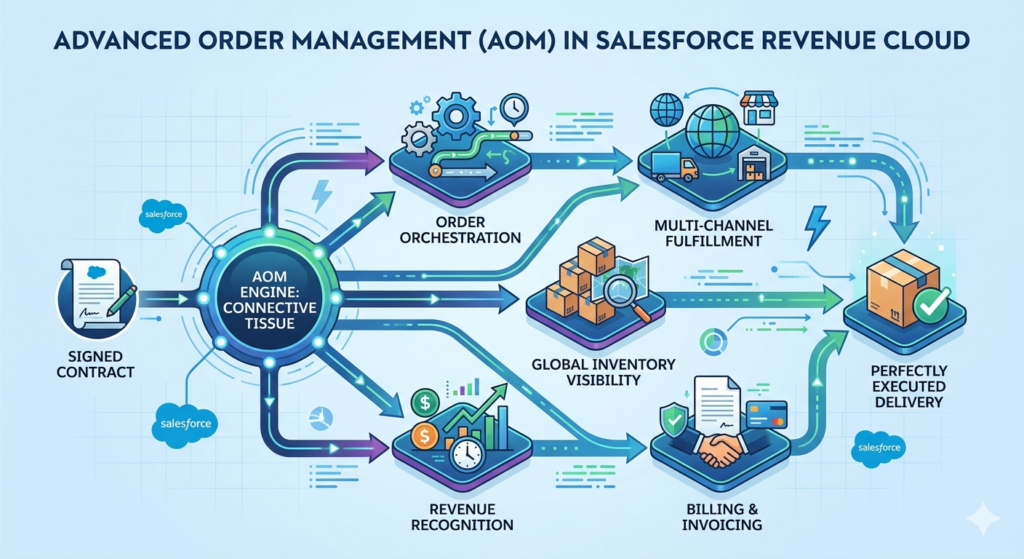
1. What is Advanced Order Management?
Traditional order management was linear: a customer buys a widget, the warehouse ships the widget, and an invoice is sent. However, in the era of Revenue Cloud, products are rarely that simple. A single order might include a physical device, a monthly software subscription, a professional services installation, and a consumption-based cloud storage plan.
Defining the Concept
Advanced Order Management is a strategic layer within Salesforce Revenue Cloud that automates the complex lifecycle of an order after the “Closed-Won” stage. It encompasses the decomposition of orders, the sequencing of delivery tasks, and the real-time synchronization with external downstream systems.
The Evolution from Basic Processing
Basic order processing captures data; Advanced Order Management governs it.
- Basic: Creates a static record of what was bought.
- Advanced: Understands that the software cannot be activated until the hardware is delivered, and the billing shouldn’t start until the customer logs in for the first time.
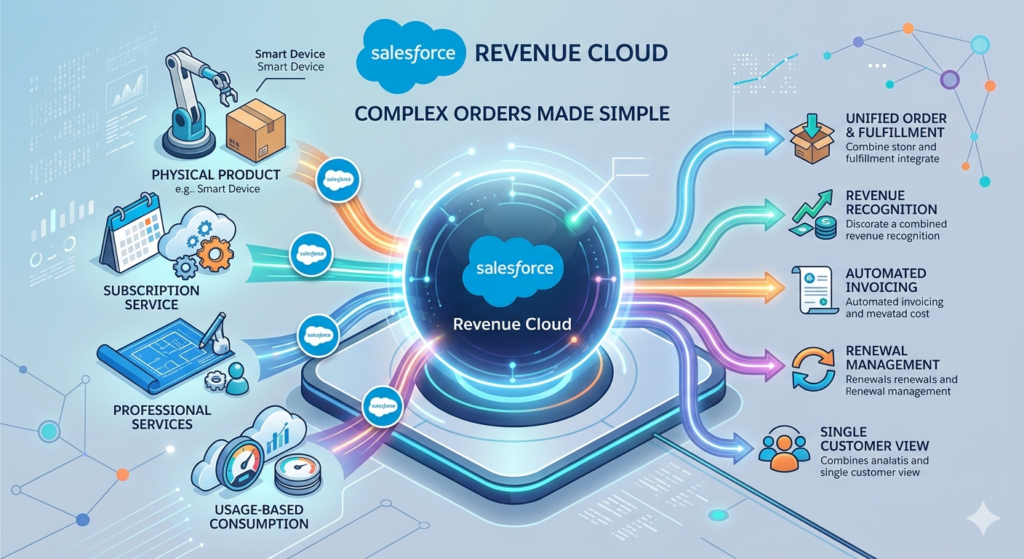
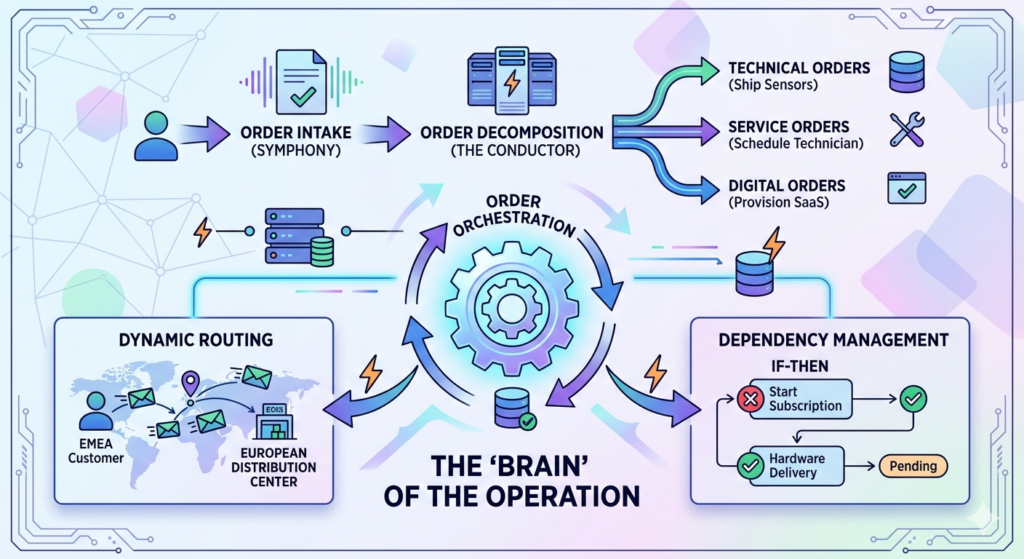
2. Understanding Order Orchestration: The “Brain” of the Operation
If an order is a symphony, orchestration is the conductor. Order Orchestration is the automated coordination of multiple tasks, departments, and systems required to fulfill a complex order.
Why Orchestration Matters
Without orchestration, departments operate in silos. Finance might bill for a service that Engineering hasn’t provisioned yet, leading to customer frustration and potential churn. Orchestration ensures that every step happens in the correct order, at the correct time.
Key Capabilities of Orchestration
A. Order Decomposition
An order for a “Connected Manufacturing Suite” might contain five different line items. Order decomposition breaks these down into:
- Technical Orders: Signals to the warehouse to ship sensors.
- Service Orders: Scheduling a technician for on-site calibration.
- Digital Orders: Provisioning the SaaS dashboard access.
B. Dynamic Routing
Advanced OM uses logic to route tasks. If a customer is in EMEA, the orchestration engine routes the fulfillment task to the European distribution center rather than the US headquarters.
C. Dependency Management
This is the “If-Then” logic of fulfillment. You cannot “Start Subscription” if “Hardware Delivery” is still in “Pending” status. Orchestration manages these dependencies automatically, pausing and resuming workflows without human intervention.
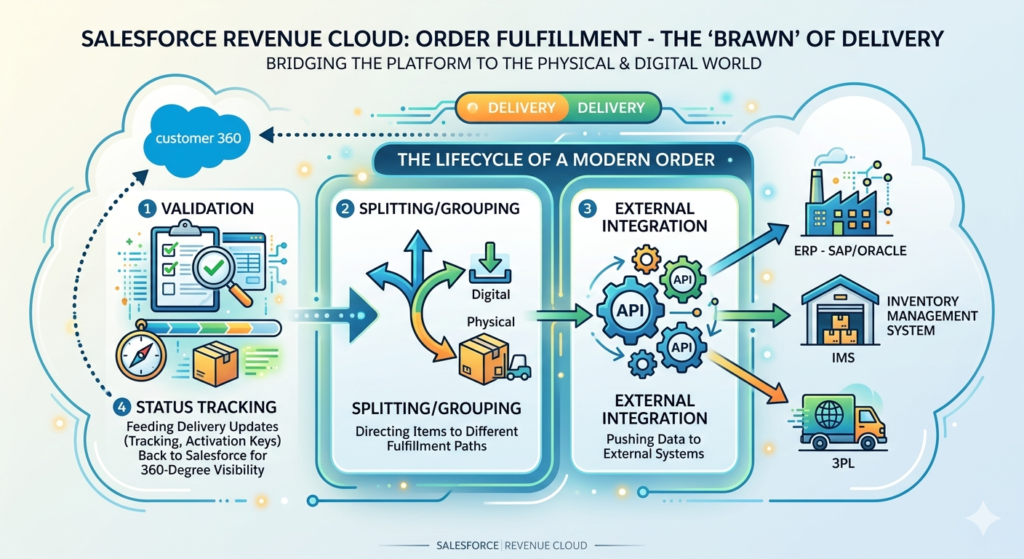
3. Order Fulfillment: The “Brawn” of Delivery
While orchestration plans the work, Order Fulfillment is the execution of those plans. In Revenue Cloud, fulfillment is the bridge between the Salesforce platform and the physical or digital world.
The Lifecycle of a Modern Order
- Validation: Ensuring the order data is clean and compliant.
- Splitting/Grouping: Directing items to different fulfillment paths (e.g., Digital vs. Physical).
- External Integration: Pushing data to an ERP (like SAP or Oracle), an Inventory Management System (IMS), or a 3PL (Third-Party Logistics) provider.
- Status Tracking: Feeding delivery updates (Tracking numbers, Activation keys) back into Salesforce so Sales and Support have 360-degree visibility.
Integration with External Systems
Fulfillment rarely happens entirely inside Salesforce. RizeX Labs specializes in building the “integration tissue” between Revenue Cloud and:
- ERP Systems: For financial sub-ledger entries and inventory reconciliation.
- Provisioning Engines: For SaaS companies to automate the creation of user tenants.
- Logistics Providers: For real-time shipping updates and “Proof of Delivery” documentation.
4. The Technical Architecture: Under the Hood of Revenue Cloud OM
For the solution architects in your audience, understanding the data model is crucial. Revenue Cloud doesn’t just use a single “Order” object; it utilizes a sophisticated hierarchy to ensure data integrity.
- Order Action & Order Product: Explain how Revenue Cloud tracks changes over time. Unlike standard orders, Revenue Cloud uses “Order Actions” to represent whether a line item is a new sale, an amendment, a renewal, or a cancellation.
- The Fulfillment Workbench: Discuss the UI where operations teams can see pending tasks. Mention how Salesforce uses Flow Builder as the primary engine for custom orchestration logic, allowing for low-code but high-power automation.
- Asynchronous Processing: Explain why AOM uses asynchronous jobs. When dealing with thousands of line items, the system processes them in the background to avoid “Apex CPU limit” errors, ensuring the platform remains stable.
5. Bridging the Gap: Order Management and Revenue Recognition (ASC 606)
One of the most significant advantages of using Revenue Cloud for order orchestration is the seamless handoff to Salesforce Billing.
- Triggering Finance: An orchestrated order isn’t just about delivery; it’s about the “Billing Trigger.” Advanced OM ensures that the
Invoice Start Dateis dynamically set based on theFulfillment Date. - Compliance with ASC 606: For SaaS and manufacturing, revenue cannot be recognized until the “performance obligation” is met. Orchestration provides the timestamped proof of delivery needed for auditors to verify that revenue was earned according to global accounting standards.
- Reducing Revenue Leakage: By automating the link between a shipped item and an active billing schedule, companies eliminate the “forgotten invoice” syndrome, where services are delivered but never billed.
6. Key Features of Revenue Cloud Order Management
To support global enterprises, Salesforce Revenue Cloud offers a suite of tools designed to handle high-volume, high-complexity scenarios.
1. Automation & Workflow Rules
AOM eliminates manual data entry. Once a quote is converted to an order, the system can automatically trigger contract creation, asset generation, and fulfillment requests based on pre-defined business rules.
2. Real-Time Visibility
One of the greatest pain points for Sales Reps is the “Where is my order?” question. Advanced OM provides a real-time “Order Timeline” view, allowing anyone in the organization to see exactly where an order sits in the fulfillment pipeline.
3. Scalability
Whether you are processing 100 orders a month or 100,000, the orchestration engine is designed to handle “burstiness”—such as end-of-quarter spikes—without degrading performance.
4. Error Handling (The “Order Fallout” Management)
In the real world, things go wrong. An item is out of stock; an email address for a SaaS admin is misspelled. AOM provides Fallout Management, which flags errors, notifies the relevant stakeholder, and allows for manual intervention to get the order back on track.
7. Managing Lifecycle Complexity: Amendments and Renewals
Order management is rarely a one-time event. The real complexity lies in Day 2 Operations.
- The Mid-Term Amendment: What happens when a customer adds 50 more seats to a SaaS subscription mid-month? Advanced OM orchestrates the “Delta” order—ensuring only the new seats are provisioned without disrupting the existing service.
- Automated Renewals: Instead of Sales Reps manually creating renewal quotes, the orchestration engine can “look ahead.” It can trigger a renewal order 90 days out, check if the customer’s credit is still good, and send an automated notification for signature.
- Cancellations and “De-provisioning”: This is often the most manual process in most companies. AOM can automate the “Kill Signal” to external systems, ensuring that when a contract ends, the customer’s access is revoked and billing stops instantly.
8. The Role of AI: Einstein for Order Management
How does Artificial Intelligence fit into orchestration? RizeX Labs leverages Salesforce Einstein to move from reactive to proactive management.
- Predictive Lead Times: Einstein can analyze historical fulfillment data to predict that a specific hardware component is likely to be delayed due to supply chain trends.
- Automated Risk Flagging: AI can identify “At-Risk” orders that have been sitting in a “Pending” status for longer than the average duration, alerting a manager before the customer even notices the delay.
- Intelligent Inventory Allocation: If stock is low, AI can help orchestrate which orders should be fulfilled first based on customer lifetime value (CLV) or contract urgency.
9. Business Benefits: Why Invest in Advanced OM?
At RizeX Labs, we measure the success of an implementation by the tangible value it brings to the C-suite and the end-user.
- Accelerated Time-to-Revenue: By automating the handoff between Sales and Fulfillment, you can recognize revenue faster. If you reduce your fulfillment cycle from 10 days to 2 days, you gain over a week of billable time per customer.
- Improved Customer Experience: Customers today expect transparency. Providing automated updates and faster delivery builds trust and reduces the burden on your customer support team.
- Reduced Operational Costs: Manual order management is expensive and prone to error. Automation allows your team to manage higher volumes of business without increasing headcount.
- Better Compliance and Tracking: Every step of the orchestration process is logged. This creates an immutable audit trail that is invaluable for regulatory compliance and internal process improvement.
10. Real-World Use Cases
Telecom: Complex Service Provisioning
A national telecom provider sells a “Business Fiber Bundle.” This includes hardware (router), a service (fiber installation), and a recurring subscription (internet plan).
- The Orchestration: The system triggers the router shipment, waits for the “Delivered” status from the carrier, then automatically schedules a field technician. Once the technician marks the install as complete, the billing system is triggered to start the monthly subscription charge.
SaaS: Instant Subscription Fulfillment
A global SaaS company sells enterprise licenses with tiered add-ons.
- The Orchestration: Upon contract signature, the OM engine calls an API to provision the customer’s cloud environment, assigns the correct number of seats, and emails the “Welcome Kit” to the admin—all in under 60 seconds.
Manufacturing: Multi-Step Delivery
A manufacturer of industrial medical equipment sells high-value machines that require custom configuration.
- The Orchestration: The order is decomposed into “Core Components” (sent to the factory) and “Installation Services” (sent to the local regional office). The system ensures that the installer is not dispatched until the heavy equipment has cleared customs.
11. Measuring Success: Key Performance Indicators (KPIs)
To prove the ROI of a RizeX Labs implementation, businesses should track these four metrics:
- Order Cycle Time (OCT): The total time from “Closed-Won” to “Service Active.”
- Order Accuracy Rate: The percentage of orders fulfilled without requiring a manual correction or a return (RMA).
- Fallout Rate: The percentage of orders that fail the orchestration process due to errors. A healthy system should aim for a fallout rate of less than 2%.
- Touchless Order Ratio: The percentage of orders that move from quote to fulfillment with zero human intervention.
12. Challenges & Best Practices
Implementing Advanced Order Management is a journey. Here are the common pitfalls we see at RizeX Labs and how to avoid them.
Common Pitfalls
- Over-Engineering: Trying to automate every 1% edge case can make the system too rigid.
- Data Silos: If your ERP and Salesforce data don’t speak the same language (e.g., different SKU formats), orchestration will fail.
- Ignoring Change Management: Moving from manual to automated processes requires training and a shift in mindset for the operations team.
Best Practices for Implementation
- Map Your Process First: Before touching a line of code, document your “Happy Path” and your “Fallout Paths” on a whiteboard.
- Start with “Minimum Viable Orchestration”: Automate the most common 80% of orders first, then iterate.
- Focus on Data Cleanliness: Ensure your Product Catalog is standardized across CPQ and your fulfillment systems.
- Involve Cross-Functional Teams: Order management touches Sales, Ops, Finance, and IT. Everyone needs a seat at the table.
13. Advanced Security & Compliance in Fulfillment
For industries like Telecom and Finance, order data is sensitive.
- Field Level Security (FLS): Ensuring that only the logistics team sees shipping addresses, while only the finance team sees the payment terms.
- Audit Trails: Every change in the order lifecycle—who approved it, when it was sent to the ERP, and when the API call returned—is logged for SOC2 and GDPR compliance.
14. The “Single Source of Truth” Debate: Revenue Cloud vs. ERP
One of the most common questions RizeX Labs receives is: “Should orchestration happen in Salesforce or in our ERP (like SAP, Oracle, or NetSuite)?”
For a modern, agile business, the answer is increasingly Salesforce Revenue Cloud. Here’s why:
- Front-Office Alignment: Sales reps need to see fulfillment status to manage renewals. If the data is locked in the ERP, the front office is flying blind.
- Change Agility: Updating a workflow in Salesforce is often faster and less costly than a code-heavy change in a legacy ERP.
- Customer-Centricity: By keeping the orchestration “brain” in Salesforce, you can easily expose order status to customers via Experience Cloud, providing a seamless self-service portal experience.
15. Global Orchestration: Navigating Multi-Tax and Multi-Currency
For global enterprises, order management isn’t just about delivery; it’s about compliance across borders.
- Tax Engine Integration: Advanced OM must talk to engines like Avalara or Vertex in real-time. During orchestration, the system verifies the tax jurisdiction of the shipping destination versus the billing address.
- Multi-Entity Routing: If a company has subsidiaries in the UK, US, and Singapore, the orchestration engine must decide which legal entity “owns” the order based on stock availability and tax optimization.
- Localization of Fulfillment: Orchestration handles the translation of “Internal SKUs” to “Customer-Facing Descriptions” in the local language, ensuring that packing slips and activation emails are localized.
16. The “Human-in-the-Loop”: Task Management within Orchestration
While the goal is “Touchless Fulfillment,” some steps require human expertise. AOM manages these via Orchestration Tasks.
- Credit Checks: If an order exceeds a certain dollar amount, the orchestration flow pauses and creates a task for the Finance Team to approve credit terms.
- Technical Scoping: For complex manufacturing, an engineer might need to review the “Build of Materials” (BOM) before the order is sent to the factory floor.
- Provisioning Approval: In high-security SaaS environments, a security officer may need to manually authorize a new tenant creation.
- RizeX Labs Tip: We recommend using Salesforce Notifications and Slack Integration to alert these “Human-in-the-Loop” actors instantly, preventing bottlenecks.
17. Inventory Strategy: MTO vs. MTS in Revenue Cloud
How you orchestrate depends on your inventory model.
- Make-to-Order (MTO): The orchestration triggers a production order. The “Fulfillment” step is the completion of the manufacturing process.
- Make-to-Stock (MTS): The orchestration engine performs a “Soft Allocation” of existing inventory. If the item is out of stock, the engine must decide whether to backorder the item or split the shipment.
- Drop-Ship Orchestration: If a product is fulfilled by a third-party partner, the orchestration engine automatically generates a Purchase Order (PO) to the vendor and tracks the vendor’s fulfillment status.
18. Detailed “Order Fallout” Workflow (Step-by-Step)
What happens when a “Technical Order” fails? A robust AOM strategy includes a Fallout Management Framework:
- Detection: The system receives an “Error” response from an external API (e.g., a provisioning server is down).
- Classification: Is it a Retriable Error (Network timeout) or a Fatal Error (Invalid data)?
- Automatic Retry: For retriable errors, the engine attempts to resend the data three times over 24 hours.
- Escalation: If retries fail, a “Fallout Case” is automatically created and assigned to the Order Operations Queue.
- Resolution & Resume: Once a human fixes the data, they click “Resume,” and the orchestration picks up exactly where it left off.
19. Sustainability: “Green” Order Management
Modern business leaders are focused on ESG (Environmental, Social, and Governance) goals. Advanced Order Management can contribute to sustainability:
- Consolidated Shipments: Instead of shipping three items from three different warehouses, the orchestration engine can wait and consolidate them into a single box to reduce carbon footprint.
- Digital-First Fulfillment: Orchestrating the delivery of digital manuals and software keys instead of physical CDs or printed documentation.
- Optimized Routing: Choosing the fulfillment center closest to the customer to minimize “shipping miles.”
20. The Future: Headless Order Management and APIs
The future of Revenue Cloud is “Headless.” This means the orchestration engine is so robust that it can receive orders from any “Head”—a mobile app, a partner portal, a web shop, or even an IoT device.
- API-First Architecture: By using the Salesforce Omnichannel Inventory and Order Management APIs, RizeX Labs helps companies build custom front-end experiences while using Revenue Cloud as the powerful “Back-End” engine that manages the heavy lifting of fulfillment.
Conclusion: Orchestrating the Future of Revenue
The “Revenue” in Revenue Cloud isn’t just about the price on the quote; it’s about the successful delivery of value to your customer. By mastering Advanced Order Management, businesses can bridge the gap between a promise made by Sales and a promise kept by Operations.
Whether you are dealing with complex telecom provisioning, rapid-fire SaaS activations, or intricate manufacturing logistics, orchestration and fulfillment are the keys to unlocking scalable growth.
About RizeX Labs
We’re Pune’s leading IT training institute specializing in high-demand Salesforce domains like Revenue Cloud and Advanced Order Management. At RizeX Labs, we empower professionals to master complex fulfillment architectures through hands-on, real-world scenarios. Our programs are designed to transform learners into strategic Salesforce architects capable of bridging the gap between a “Closed-Won” deal and successful revenue realization.
Internal Links:
- Mastering Salesforce Revenue Cloud: A Beginner’s Roadmap
- Understanding CPQ Quote-to-Cash Workflows with Real-Time Examples
- Salesforce Billing vs. ERP Integration: Which Architecture is Best?
