
Introduction: The AI Wave Is Here — And Salesforce Is Riding It
We are living through one of the most significant technological shifts in modern history. Artificial intelligence is no longer a distant concept reserved for science fiction movies or research laboratories. It is actively reshaping how businesses operate, how developers write code, how sales teams close deals, and how customer relationships are managed at scale.
For Salesforce professionals — whether you are a seasoned developer, a certified admin, a fresh graduate eyeing your first tech role, or a consultant building enterprise solutions — this AI revolution raises both exciting possibilities and pressing questions. The most common one we hear today is simple but deeply important: What happens to my Salesforce career as AI takes over more tasks?
The future of Salesforce career AI is not a story of replacement. It is a story of transformation. Just as the internet did not kill traditional businesses but forced them to evolve, AI is not going to eliminate Salesforce careers. It is going to redefine them, elevate them, and create entirely new categories of opportunity that did not exist just a few years ago.
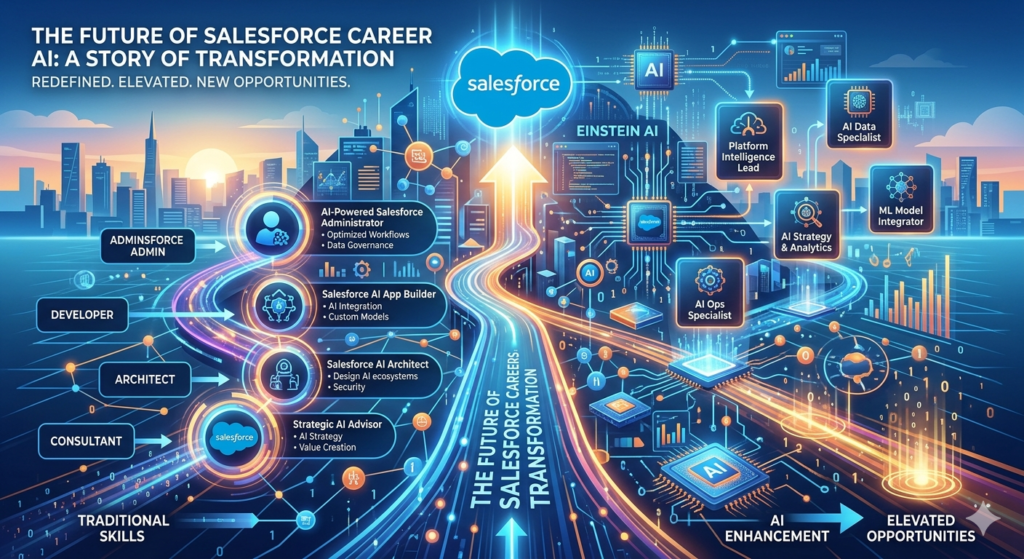
CRM ecosystems — the backbone of modern sales, service, and marketing operations — are evolving faster than ever. Salesforce, as the world’s leading CRM platform with over 150,000 customers globally, is at the very center of this evolution. With the introduction of Agentforce, Einstein AI, and a robust suite of AI-native features, Salesforce is not just adapting to the AI era — it is actively leading it.
In this blog post, we will take a comprehensive, honest, and forward-looking look at what the future holds for Salesforce professionals. Whether you are deciding whether to start your Salesforce journey or figuring out how to stay relevant in a career you have already built, this guide is for you.
Let us dive in.
The Current State of Salesforce Careers in 2026
Before we talk about the future, it helps to understand where we stand right now. As of 2026, the Salesforce ecosystem remains one of the most robust and in-demand career paths in the technology industry.
Demand Is Still Strong — But Changing
According to IDC research, the Salesforce ecosystem is expected to generate approximately $1.6 trillion in new business revenues and create 9.3 million new jobs globally by 2026. While some earlier projections from 2021 were made before the AI surge, the job market data tells a nuanced story: overall demand remains high, but the type of roles being sought is shifting noticeably.
Here is a snapshot of the current Salesforce job landscape in 2026:
- Salesforce Administrators remain in strong demand, especially for mid-sized businesses that are implementing or optimizing Salesforce for the first time
- Salesforce Developers (Apex, LWC) are still needed, but companies increasingly expect them to be comfortable working alongside AI coding tools
- Salesforce Consultants are thriving, particularly those who understand industry-specific use cases and can translate business requirements into smart technical solutions
- Salesforce Architects who can design scalable, AI-integrated systems are commanding premium salaries
- AI and Automation Specialists within the Salesforce ecosystem are emerging as one of the fastest-growing categories
The average Salesforce professional salary continues to be competitive. According to the Mason Frank Salary Survey, experienced Salesforce developers and architects routinely earn between $110,000 and $180,000 per year in the US market, with consultants and solution architects on the higher end of that range.
Einstein AI and the AI-Native Salesforce Platform
One of the biggest shifts in the Salesforce ecosystem over the past two years has been the deep integration of Einstein AI across virtually every Salesforce cloud.
Einstein AI was not new in 2026 — it had been in development since 2016. But what is new is how deeply embedded and capable it has become. Key AI-powered features now include:
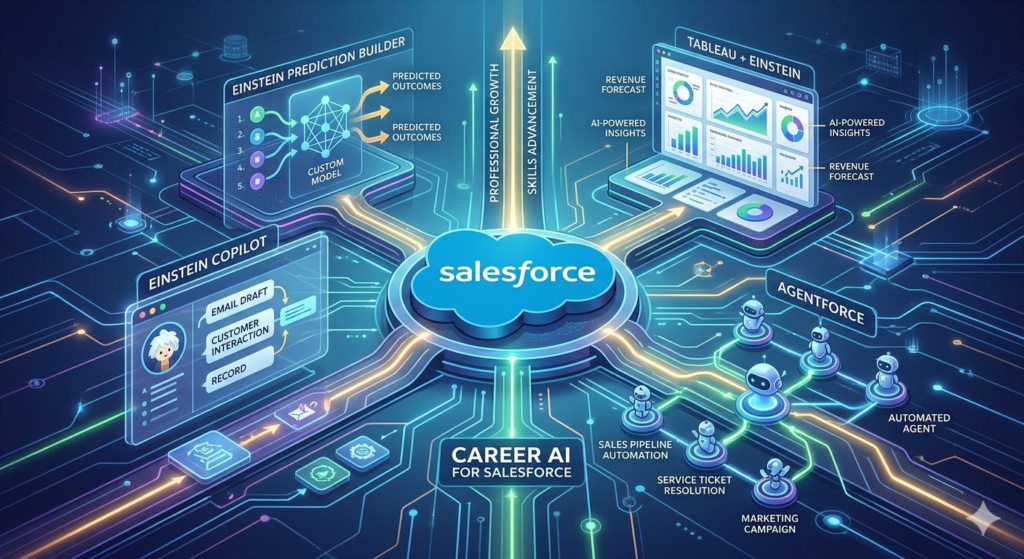
- Einstein Copilot — A conversational AI assistant built directly into the Salesforce platform that helps users generate reports, update records, summarize customer interactions, and draft emails
- Agentforce — Salesforce’s autonomous AI agent platform that can handle end-to-end tasks across sales, service, and marketing with minimal human intervention
- Einstein Prediction Builder — Allows admins and developers to build custom predictive models without writing a single line of machine learning code
- Einstein Analytics (now Tableau + Einstein) — Advanced data storytelling and AI-powered insights built into the CRM layer
These tools are powerful. They are also the reason why the question “will AI replace Salesforce developers?” has become one of the most searched queries among Salesforce community members.
The answer, as we will explore in depth shortly, is more nuanced than a simple yes or no.
How AI Is Transforming Salesforce — From the Ground Up
To understand where Salesforce careers are heading, you first need to understand exactly how AI is changing what the Salesforce platform does and how it does it. This transformation is happening across three major dimensions.
1. Automation in Workflows — The End of Repetitive Work
Salesforce has always had automation tools — Process Builder, Workflow Rules, Flow. But the AI era has taken automation to a completely different level.
Today, tools like Agentforce and Einstein Automate can handle complex, multi-step business processes that previously required custom Apex code or significant manual effort. For example:
- A service case submitted by a customer can now be automatically categorized, assigned to the right team, resolved using an AI agent that searches knowledge articles, and followed up on — all without a human touching it
- Sales reps receive AI-generated next-best-action recommendations based on deal history, customer sentiment, and market data
- Marketing campaigns automatically adjust messaging and timing based on real-time engagement signals
The automation impact on CRM is profound. Tasks that once required a developer to write custom code, a system administrator to configure rules, and a business analyst to design the logic can now be initiated through natural language prompts and executed by AI agents.
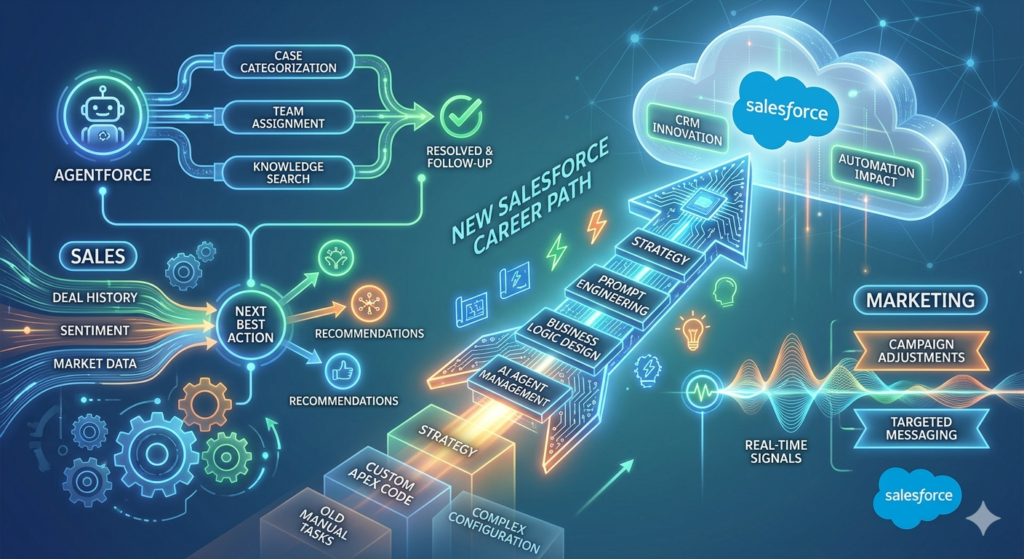
This does not mean those professionals are irrelevant. It means their work moves up the value chain. Instead of spending time on repetitive configuration tasks, they focus on designing smarter systems, thinking about governance, and solving more complex problems.
2. Predictive Analytics in CRM — Smarter Decision Making
Predictive analytics has been a buzzword in CRM for years, but AI has finally delivered on its promise at scale.
Within Salesforce, Einstein AI can now:
- Predict which leads are most likely to convert based on behavioral patterns, historical data, and external signals
- Forecast revenue with a level of accuracy that was simply impossible with traditional analytics
- Identify customers at risk of churning before it happens, allowing proactive retention efforts
- Surface cross-sell and upsell opportunities automatically based on purchase history and customer profile
For businesses, this means their CRM is no longer just a database — it is an intelligent decision-support system. For Salesforce professionals, it means understanding how these predictive models work, how to configure them, and how to help businesses trust and act on AI-generated insights has become a critical skill.
3. AI Copilots and Low-Code / No-Code Tools
Perhaps the most talked-about shift is the rise of low-code and no-code development, supercharged by AI.
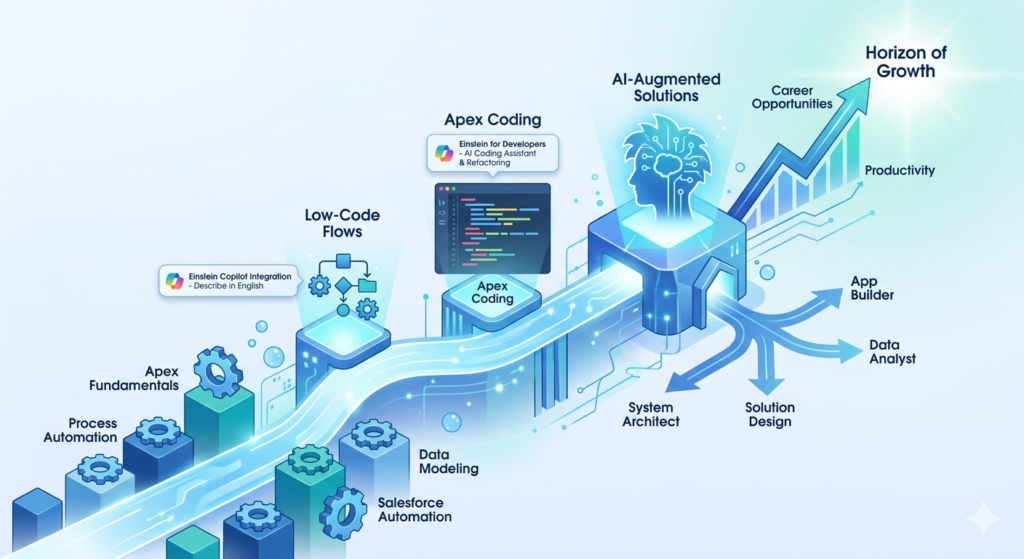
Salesforce’s Flow Builder has long been a low-code tool. But with Einstein Copilot now integrated into the builder, users can describe what they want in plain English and the AI will generate the flow logic. This is genuinely transformative.
Similarly, developers can now use Einstein for Developers — an AI coding assistant built into VS Code for Salesforce — that suggests Apex code, explains errors, writes test classes, and refactors code on demand.
What does this mean in practice?
- Business users can build more automation on their own, reducing dependence on developers for simple tasks
- Developers can work significantly faster, handling more complex work in less time
- The barrier to entry for Salesforce customization has lowered — which means more people can participate in the ecosystem, not fewer
Will AI Replace Salesforce Developers? An Honest Answer
Let us address the most pressing question directly, because it deserves a thoughtful and honest answer.
The short answer: No. But your job will change — and change significantly.
Here is the longer, more useful answer.
What AI Can Automate in Salesforce Development
There is no denying that AI is automating certain categories of developer work. Specifically:
- Boilerplate code generation — Writing repetitive SOQL queries, standard trigger frameworks, and basic LWC components is increasingly handled by AI coding assistants
- Test class generation — One of the most tedious parts of Salesforce development (writing test coverage) is now largely automatable
- Simple flow creation — Flows that handle straightforward if-then logic can be generated through natural language prompts
- Documentation — AI can generate comments, technical specifications, and user guides from existing code
- Bug detection — Static code analysis tools powered by AI can catch errors that humans might miss during reviews
If your role consists primarily of these tasks, you should be paying close attention. Not because you will be replaced, but because the nature of your work is going to change.
What Still Requires Human Expertise
Despite all its capabilities, AI in 2026 has clear limitations. Here is where human Salesforce professionals remain irreplaceable:
- Complex architecture decisions — Designing a scalable Salesforce org that handles millions of records across multiple integrated systems requires judgment, experience, and contextual understanding that AI cannot replicate
- Understanding business requirements — Sitting with a client, listening to their pain points, translating messy human problems into elegant technical solutions — this remains a deeply human skill
- Governance and data integrity — Deciding what should be automated, what risks exist, how to maintain data quality, and how to ensure compliance are all human responsibilities
- Custom integration architecture — Connecting Salesforce with complex third-party systems, designing API strategies, handling authentication, and managing error handling requires deep expertise
- Change management — Getting people to actually use the system correctly is still, and always will be, a human challenge
- Creative problem solving — When a business has a unique problem that no standard tool addresses, humans think creatively in ways AI still cannot match reliably
- Ethical AI oversight — As AI agents make more decisions, someone needs to audit, validate, and be accountable for those decisions
The Evolution Argument
Think about what happened to accountants when spreadsheets were invented. Many predicted that Excel would replace accountants. Instead, it made accountants vastly more productive and shifted their focus from manual calculations to analysis, strategy, and insight. The accountants who adapted thrived. The ones who refused to learn the new tools struggled.
The same principle applies here. Salesforce developers who embrace AI tools will be dramatically more productive. They will take on more complex work. They will become more valuable, not less. The ones who resist will find it increasingly difficult to compete.
AI is not your replacement. It is your leverage.
The Future of Salesforce Career AI — New Roles and Opportunities
If some traditional tasks are being automated, what new opportunities are being created? This is where things get genuinely exciting. The future of Salesforce career AI is generating a wave of new roles that combine technical depth with business acumen and AI fluency.
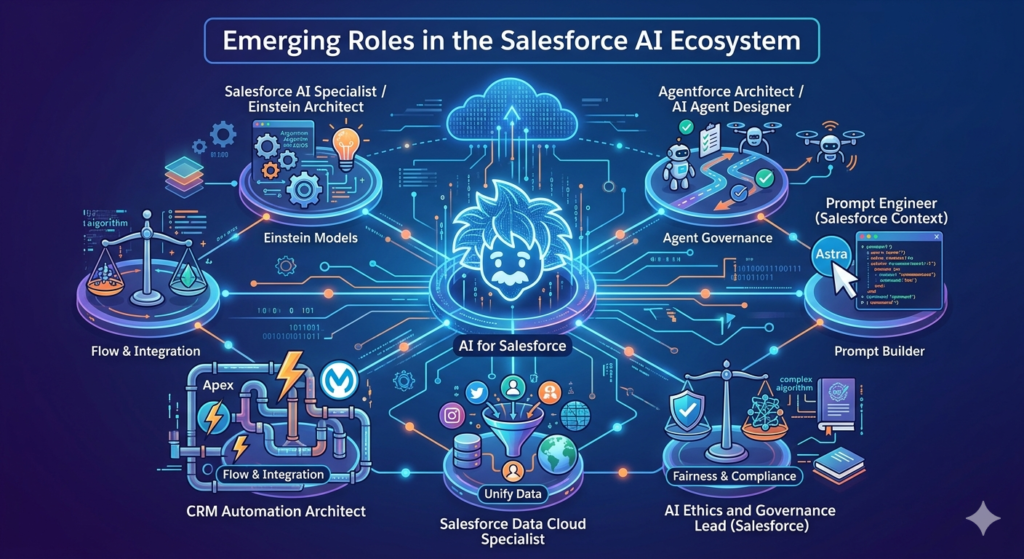
Emerging Roles in the Salesforce AI Ecosystem
1. Salesforce AI Specialist / Einstein Architect
This role focuses specifically on designing, configuring, and optimizing AI-powered features within Salesforce. This professional understands machine learning concepts, knows how to train and fine-tune Einstein models, and can help businesses derive maximum value from their AI investments. Salesforce has even launched a dedicated AI Specialist certification to address this growing need.
2. Agentforce Architect / AI Agent Designer
Agentforce — Salesforce’s autonomous agent platform — requires specialists who understand how to design, deploy, and govern AI agents that operate at scale. This role involves defining agent topics, actions, guardrails, and escalation paths. It is a highly technical role with significant business impact.
3. Prompt Engineer (Salesforce Context)
Prompt engineering — the art and science of designing effective prompts for AI systems — has emerged as a genuine skill set. Within Salesforce, prompt engineers work on creating the instructions that guide Einstein Copilot and Agentforce agents. They use Prompt Builder, one of Salesforce’s newest tools, to craft, test, and optimize prompts that power AI features across the platform.
4. CRM Automation Architect
This role focuses on designing end-to-end automation strategies across Salesforce and connected systems. It requires understanding of Flow, Apex, integration tools like MuleSoft, and increasingly, AI orchestration. The automation impact on CRM is creating demand for professionals who can see the big picture and design automation that actually improves business outcomes — not just automation for its own sake.
5. Salesforce Data Cloud Specialist
Salesforce Data Cloud (formerly Customer Data Platform) is the foundation of AI-powered personalization in Salesforce. Specialists who understand how to unify data from multiple sources, create unified customer profiles, and activate that data across Salesforce clouds are in extraordinary demand.
6. AI Ethics and Governance Lead (Salesforce)
As Salesforce AI makes more consequential decisions — about which customers to prioritize, which cases to escalate, which opportunities to pursue — someone needs to ensure those decisions are fair, compliant, and aligned with company values. This hybrid role combining technical Salesforce knowledge with understanding of AI ethics and regulatory compliance is nascent but growing fast.
Skills Professionals Need to Stay Relevant
Across all these emerging roles, several core competencies keep appearing. If you want to thrive in the Salesforce ecosystem over the next five to ten years, these are the areas to develop:
- AI fluency — Understanding how large language models work, how machine learning models are trained, and how to use AI tools effectively (not just knowing that they exist)
- Salesforce Data Cloud and data architecture — The future of Salesforce is data-first; understanding how data flows, how it is unified, and how it powers AI is critical
- Prompt engineering and AI configuration — Using Prompt Builder, defining agent actions, and designing effective AI interactions
- Business analysis and consultative skills — The more AI handles routine technical work, the more your value comes from understanding business context
- Integration expertise — Systems do not exist in isolation; knowing how to connect Salesforce with other platforms using MuleSoft, APIs, and event-driven architectures is increasingly valuable
- Security and governance — As AI handles more sensitive operations, professionals who understand data security, compliance, and responsible AI deployment are essential
The professionals who will lead the Salesforce ecosystem in 2028 and 2030 will be those who combine business understanding + technical depth + AI literacy. That combination is genuinely rare and genuinely valuable.
Automation Impact on CRM — Transforming Customer Relationships
The automation impact on CRM extends far beyond making developers’ lives easier. It is fundamentally changing how businesses interact with their customers — for better and for worse.
How Automation Is Changing Customer Relationship Management
Traditional CRM was about recording information. You logged a call. You updated an opportunity stage. You noted a customer complaint. The CRM was a sophisticated filing cabinet.
AI-powered CRM is about doing things, not just recording them. Consider these real-world use cases that are now live in Salesforce deployments:
Retail / E-commerce
A clothing retailer uses Einstein AI to automatically identify customers who have not purchased in 60 days and triggers a personalized re-engagement campaign with product recommendations based on browsing history. The entire process — identification, content generation, delivery timing, follow-up — runs autonomously.
Financial Services
A bank uses Agentforce to handle initial mortgage inquiry calls. The AI agent answers questions, collects documents, pre-qualifies applicants, and schedules follow-ups with human advisors — reducing the time from first inquiry to human conversation by 60%.
Healthcare
A healthcare provider uses Salesforce Health Cloud with Einstein AI to flag patients who may be at risk of missing follow-up appointments based on historical patterns and send automated outreach — improving care adherence without adding staff.
Technology / SaaS
A B2B software company uses Einstein Lead Scoring combined with automated nurture sequences to prioritize which leads their human sales team engages with. Sales reps spend 80% of their time on leads statistically most likely to convert, while AI handles initial engagement with the rest.
Benefits for Businesses
The benefits of AI-driven CRM automation are compelling:
- Faster response times — AI can respond to customer inquiries instantly, 24/7, without fatigue
- Personalization at scale — Businesses can deliver personalized experiences to millions of customers simultaneously
- Reduced operational costs — Tasks that required large teams can be handled with smaller, more focused teams
- Better data hygiene — AI can automatically update, enrich, and validate CRM data, reducing the “garbage in, garbage out” problem
- Improved customer satisfaction — Faster resolutions, proactive outreach, and relevant recommendations all contribute to better customer experiences
Challenges and Limitations
It would be misleading to present automation as a perfect solution. There are real challenges:
- Data quality dependency — AI is only as good as the data it is trained on. Poor data quality leads to poor AI decisions, and many Salesforce orgs have years of messy, inconsistent data
- Trust and transparency — Customers and employees alike are sometimes uncomfortable with AI-driven decisions, particularly when those decisions are not explainable
- Over-automation risk — Automating the wrong processes — or automating without proper governance — can create chaos, compliance violations, or poor customer experiences
- The human touch paradox — Research consistently shows that customers, especially in high-stakes situations (complaints, complex purchases, health decisions), still strongly prefer human interaction. Knowing when to escalate from AI to human is a critical design challenge
- Change management — Getting sales teams to trust AI-generated lead scores, or service teams to let AI agents handle cases, requires significant organizational change management effort
These challenges are not reasons to avoid AI-powered CRM. They are reasons why skilled Salesforce professionals who understand both the technology and the business context will remain essential for the foreseeable future.
Skills to Future-Proof Your Salesforce Career
Let us get practical. If you are a Salesforce professional — whether you are just starting out or have years of experience — here is how to position yourself for the AI-powered future.
1. Build AI Literacy — Genuinely, Not Superficially
You do not need to become a machine learning engineer. But you do need to understand:
- How large language models work (at a conceptual level)
- What Einstein AI can and cannot do realistically
- How to use tools like Einstein Copilot, Agentforce, and Einstein for Developers effectively
- How to evaluate AI outputs critically and identify when AI is wrong
Action steps: Complete the Salesforce AI Specialist certification on Trailhead. Take Salesforce’s “AI for Business” and “Generative AI Basics” modules. Experiment with Agentforce in a Salesforce developer org.
2. Master Data Analysis and Data Architecture
AI runs on data. Professionals who understand how to structure, clean, unify, and analyze data will be indispensable. Specifically:
- Learn Salesforce Data Cloud and understand how customer data platforms work
- Develop comfort with Tableau for data visualization and storytelling
- Understand basic statistical concepts — correlation, regression, classification — so you can evaluate predictive models intelligently
- Learn how to design data models that support AI use cases
Action steps: Pursue the Salesforce Data Cloud Consultant certification. Explore basic data analytics courses on platforms like Coursera or DataCamp. Practice building reports and dashboards in Tableau.
3. Develop Prompt Engineering Skills
Prompt engineering is the practice of designing instructions that get the best results from AI systems. Within Salesforce, this means:
- Learning Prompt Builder — Salesforce’s tool for creating and managing AI prompts
- Understanding how to write clear, specific, contextually rich prompts that guide Einstein AI effectively
- Knowing how to test, iterate, and improve prompts based on output quality
- Understanding grounding techniques — how to anchor AI outputs in specific, relevant data from your Salesforce org
This is a genuinely new skill set, and professionals who develop it early will have a significant advantage.
4. Deepen Integration and Architecture Skills
As AI agents operate across multiple systems, the ability to design connected, resilient system architectures becomes more valuable than ever. Key areas include:
- MuleSoft — Salesforce’s integration platform for connecting systems via APIs
- Event-driven architecture — Understanding how Salesforce Platform Events and Change Data Capture work enables more sophisticated automation
- REST API fundamentals — Knowing how to design and consume APIs remains foundational
- Security architecture — Understanding OAuth flows, data encryption, field-level security, and compliance requirements is increasingly critical as AI handles more sensitive operations
5. Strengthen Business Consulting Skills
Here is the counterintuitive truth about the AI era: as technical tasks become more automated, the value of human judgment, communication, and business understanding goes up.
The most sought-after Salesforce professionals in 2026 and beyond will be those who can:
- Lead discovery workshops and ask the right questions
- Translate business requirements into technical solutions
- Communicate complex technical concepts to non-technical stakeholders
- Manage change and drive user adoption
- Think about ROI, business outcomes, and long-term platform health
Action steps: Seek out opportunities to lead client conversations. Practice writing business requirement documents. Develop your storytelling skills with data. Take courses in project management or agile methodologies.
6. Pursue Relevant Certifications Strategically
Salesforce certifications remain highly valued in the job market, but the ones you should prioritize are shifting. As of 2026, the highest-value certifications include:
- Salesforce Certified AI Specialist (newly launched, rapidly growing in demand)
- Salesforce Certified Data Cloud Consultant
- Salesforce Certified Integration Architect
- Salesforce Certified Application Architect / System Architect
- Salesforce Certified Agentforce Specialist (emerging)
Core certifications like Administrator, Platform Developer I, and Sales/Service Cloud Consultant remain solid foundations — particularly for those earlier in their careers.
The Broader Landscape: Salesforce AI Future in Context
It is worth stepping back and looking at the bigger picture of the Salesforce AI future, because context matters.
Salesforce has made enormous bets on AI — not just in product features, but at the organizational and strategic level. The acquisition of Slack (and its AI features), the deep partnership with companies like Anthropic and OpenAI, the development of proprietary foundation models, and the launch of Agentforce all signal that Salesforce is positioning itself as the enterprise AI platform of choice.
This matters for careers for a straightforward reason: the more Salesforce invests in AI, the more Salesforce-skilled professionals are needed to implement, customize, govern, and optimize those AI capabilities.
Consider the scale. There are over 150,000 Salesforce customer organizations globally. Most of them are in various stages of understanding, piloting, or implementing Salesforce’s AI features. Every single one of them needs help — from consultants, architects, developers, admins, and specialists who understand how to make AI work for their specific business context.
The opportunity is enormous. The challenge is that professionals who cling to outdated skills will struggle, while those who continually adapt will find more opportunity than ever.
A Word for Freshers and Career Changers
If you are just starting your Salesforce journey, this is actually an ideal time to enter the ecosystem. Here is why:
- You do not have outdated habits to unlearn
- You can learn AI-native Salesforce from day one
- The demand for Salesforce + AI skills is at a historic high
- Trailhead, Salesforce’s free learning platform, has extensive AI content that did not exist even two years ago
- Entry-level roles in Salesforce administration and junior development remain plentiful, with clear paths to AI-specialized roles
The path into Salesforce has actually gotten clearer, not murkier, in the AI era — provided you learn the right skills from the start.
Conclusion: Your Salesforce Career in the AI Age — Adaptability Is Everything
Let us bring this full circle.
The future of Salesforce career AI is not a threat to be feared. It is a transformation to be embraced — intelligently, proactively, and with a clear strategy.
Will AI replace some tasks that Salesforce professionals currently do? Absolutely yes. Routine code generation, simple flow building, basic report creation, and repetitive data entry are increasingly handled by AI tools. This is not a controversy — it is a reality you should plan around.
Will AI replace Salesforce professionals? No. Not the ones who adapt.
The Salesforce AI future will be defined by professionals who bring something that AI consistently lacks: deep contextual understanding, genuine human connection, creative problem-solving, ethical judgment, and the ability to translate messy business reality into intelligent technical solutions.
The automation impact on CRM is creating a landscape where businesses need more guidance, not less — more architects to design AI systems thoughtfully, more consultants to ensure adoption, more specialists to govern AI agents responsibly, more data experts to ensure the AI actually has good information to work with.
Here at RizeX Labs, we believe the Salesforce professionals of 2026 and beyond will be defined not by how much code they can write, but by how well they understand business problems, how effectively they leverage AI tools, and how adaptively they learn as the platform continues to evolve.
The career path is not narrowing — it is branching. There are more valid, valuable, well-compensated ways to build a Salesforce career today than at any point in the platform’s history. The question is simply whether you are willing to keep learning, keep adapting, and keep pushing your skills forward.
The AI revolution is not the end of the Salesforce career story. It is the beginning of its most exciting chapter yet.
And the best time to position yourself for that chapter is right now.
About RizeX Labs
We’re Pune’s leading IT training institute specializing in high-impact technologies like Salesforce AI, Data Cloud, and advanced analytics. At RizeX Labs, we bridge the gap between legacy CRM skills and the AI-native future through hands-on, project-based learning. Whether you are based in Hinjewadi, Kharadi, or Magarpatta, our expert mentorship is designed to transform developers and admins into AI specialists ready to lead the Salesforce revolution in India and beyond.
Internal Links:
- Salesforce AI & Agentforce Specialist Training
- Data Cloud for Developers: The Foundation of AI
- Advanced Apex: Writing Invocable Actions for Einstein
- Prompt Engineering for Salesforce Professionals
