
Introduction: The Generative AI Revolution Inside Your CRM
Artificial Intelligence has officially moved from the future into the everyday reality of business operations — and nowhere is this more visible than inside Customer Relationship Management platforms.
Salesforce generative AI is reshaping how sales teams write emails, how service agents resolve cases, how marketers build campaigns, and how businesses understand their customers at a deeper level than ever before. In 2026, AI is not a competitive advantage — it is quickly becoming a baseline expectation.
But as generative AI explodes in popularity, a critical question is emerging inside Salesforce organizations worldwide:
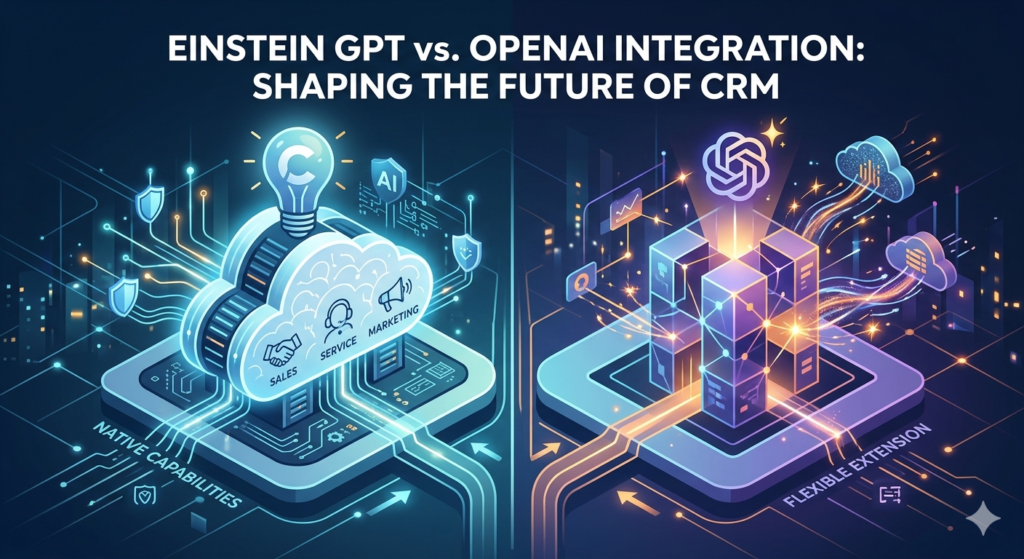
“Should we use Salesforce Einstein GPT, or should we integrate OpenAI directly into our CRM workflows?”
This is not a simple question. Both platforms are powerful. Both leverage large language models. Both can generate content, automate tasks, and enhance productivity. But they are built for fundamentally different purposes, and choosing the wrong one — or not understanding how they relate to each other — can lead to costly mistakes, security vulnerabilities, and missed opportunities.
The salesforce einstein GPT vs openAI conversation is one of the most important strategic discussions happening in enterprise technology right now.
In this blog post, you will learn:
- What Salesforce Einstein GPT is and what makes its features unique inside a CRM
- What OpenAI is and how businesses are using it in a Salesforce context
- A detailed, side-by-side salesforce einstein GPT vs openAI comparison
- How AI in CRM Salesforce actually works across sales, service, and marketing
- Real-world use cases for both platforms
- A practical decision guide to help you choose the right solution
- The future of salesforce generative AI and where this is all heading
Let us start from the beginning.
What is Salesforce Einstein GPT?
Understanding Einstein GPT in Plain English
Salesforce Einstein GPT is Salesforce’s native generative AI layer built directly into the Salesforce platform. Announced at Salesforce’s TrailblazerDX conference and continuously expanded since, Einstein GPT represents Salesforce’s vision for what AI inside a CRM should look like — deeply integrated, data-grounded, secure, and accessible to every user regardless of technical skill level.
In the simplest terms: Einstein GPT brings the power of large language models directly into your Salesforce workflows, without requiring you to leave the platform, manage external APIs, or worry about sending sensitive customer data to third-party systems.
The “GPT” in the name refers to the use of Generative Pre-trained Transformer models — the same foundational technology that powers tools like ChatGPT. However, Einstein GPT is not just a generic AI chatbot dropped into Salesforce. It is a carefully orchestrated system that grounds AI outputs in your actual CRM data, applies enterprise-grade security, and delivers contextual, relevant results tied to specific Salesforce records.
Think of it this way: if ChatGPT is a brilliant generalist who knows a lot about the world, Einstein GPT is a brilliant specialist who knows a lot about your specific customers, deals, cases, and business context.
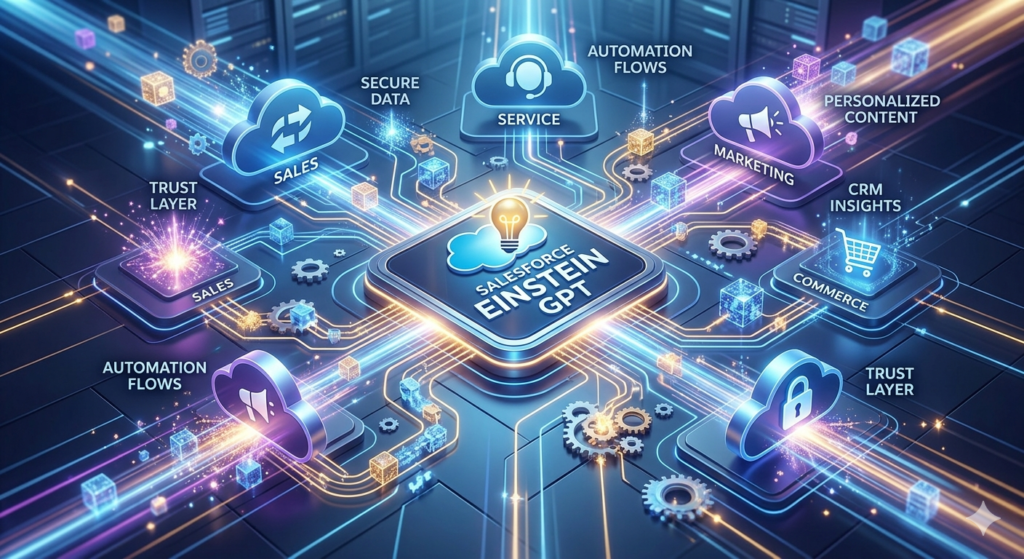
Key Einstein GPT Features You Need to Know
Understanding the full range of einstein gpt features helps paint a clear picture of what this platform can do inside a real CRM environment.
Feature 1: AI-Powered Content Generation
Einstein GPT can generate high-quality, contextually relevant content directly within Salesforce records. This is not generic content — it is personalized based on the actual data in your CRM.
Examples of content generation:
- Sales emails: A sales rep opens an Opportunity record and clicks “Generate Email.” Einstein GPT reads the opportunity details, the contact’s history, recent interactions, and any notes, then generates a personalized follow-up email tailored to that specific prospect
- Service responses: A service agent working a Case clicks “Generate Response.” Einstein GPT reads the case description, the customer’s history, and relevant knowledge articles to draft a precise, empathetic response
- Marketing copy: A marketer building an email campaign uses Einstein GPT to generate personalized email variations for different customer segments, each reflecting the segment’s specific interests and behaviors
Feature 2: Deep CRM Data Integration
This is perhaps the most important einstein gpt feature that distinguishes it from standalone AI tools. Einstein GPT is natively connected to your Salesforce data.
When Einstein GPT generates any output, it can draw on:
- Contact and Account records
- Opportunity history and stage
- Case details and conversation history
- Activity logs (emails, calls, meetings)
- Knowledge articles
- Salesforce Data Cloud profiles (unified customer data from across your enterprise)
- Custom objects and fields specific to your org
This means every AI output is grounded in real, current, business-specific data — not generic AI guessing.
Feature 3: Automation Capabilities
Einstein GPT does not just generate content — it can trigger and enhance automation throughout the Salesforce platform.
- Auto-summarization: Automatically generates summaries of long case histories, sales call recordings, or email threads
- Next Best Action suggestions: Uses AI to recommend the optimal next step in a sales or service interaction
- Automated data enrichment: Suggests updates to CRM records based on email content and interaction history
- Flow integration: Einstein GPT outputs can trigger Salesforce Flows, creating seamless connections between AI-generated insights and automated business processes
Feature 4: Deep Personalization at Scale
Salesforce generative AI through Einstein GPT enables hyper-personalization that would be impossible for humans to achieve manually at scale.
- Marketing teams can generate thousands of personalized email variations, each tailored to individual customer behavior, purchase history, and engagement patterns
- Sales reps receive personalized account briefings before each customer call
- Service agents get customer-specific response suggestions that account for the customer’s tier, history, and current emotional state
Feature 5: Einstein Trust Layer (Security and Privacy)
One of the most critical einstein gpt features — especially for enterprise organizations — is the Einstein Trust Layer.
This is Salesforce’s proprietary security architecture that ensures:
- Data masking: Sensitive PII (Personally Identifiable Information) is automatically masked before any data is sent to an LLM (Large Language Model)
- Zero data retention: Customer data sent to LLMs for processing is never stored or used to train the underlying AI models
- Audit logging: Every AI interaction is logged for compliance and auditing purposes
- Toxicity detection: Outputs are filtered for inappropriate or harmful content before being shown to users
- Grounding: All AI outputs are tied to your specific Salesforce data, reducing hallucinations
Feature 6: Multi-Cloud Integration
Einstein GPT is not limited to one Salesforce cloud. It integrates across the entire Salesforce ecosystem:
- Sales Cloud Einstein — AI for sales reps and managers
- Service Cloud Einstein — AI for support agents and service operations
- Marketing Cloud Einstein — AI for marketers and campaign managers
- Commerce Cloud Einstein — AI for e-commerce personalization
- Slack Einstein — AI assistance within Slack conversations
How Einstein GPT Fits Into AI in CRM Salesforce
AI in CRM Salesforce through Einstein GPT works by embedding generative AI capabilities at every touchpoint in the customer lifecycle — from the first marketing impression to post-sale support. Users do not need to switch to an external tool or learn a new platform. The AI is right there inside the Salesforce interface they already use every day.
This native integration is the foundation of what makes Einstein GPT uniquely powerful in a CRM context.
What is OpenAI?
Understanding OpenAI in a Business Context
OpenAI is the artificial intelligence research and deployment company behind some of the world’s most powerful and widely recognized AI models, including GPT-4, GPT-4o, and the ChatGPT consumer and enterprise products. Founded in 2015 and headquartered in San Francisco, OpenAI’s mission is to build and deploy safe, beneficial artificial general intelligence.
In a business technology context, OpenAI is primarily accessed through:
- ChatGPT Enterprise — A secure, enterprise-grade version of the ChatGPT interface for business users
- OpenAI API — A programmatic interface that allows developers to integrate OpenAI’s models (GPT-4o, GPT-4 Turbo, etc.) directly into their own applications and workflows
- Custom GPTs — Purpose-built AI assistants trained on specific company knowledge bases
OpenAI’s models are incredibly capable general-purpose AI engines. They excel at understanding and generating natural language, writing code, analyzing documents, answering complex questions, and completing creative tasks — across virtually any domain.
OpenAI in a CRM Context
OpenAI by itself is not a CRM tool. It has no native understanding of your Salesforce records, no built-in connection to your customer data, and no knowledge of your specific business processes.
However, many organizations are integrating OpenAI’s capabilities with Salesforce in several ways:
Method 1: Direct API Integration
Developers build custom integrations that call the OpenAI API from within Salesforce (using Apex callouts, MuleSoft, or external services). The integration retrieves relevant Salesforce data, sends it to OpenAI for processing, and returns the AI-generated output back into Salesforce.
Method 2: OpenAI as the LLM Behind Einstein GPT
Here is a nuance that surprises many people: Salesforce’s Einstein Trust Layer can connect to OpenAI models as the underlying LLM. This means in some configurations, Einstein GPT is actually using OpenAI’s GPT models as its reasoning engine — but with Salesforce’s security, grounding, and data integration layer on top.
Method 3: ChatGPT Enterprise for Business Users
Some organizations use ChatGPT Enterprise as a standalone productivity tool for their teams. Sales reps, marketers, and service agents use ChatGPT separately from Salesforce to draft content, analyze information, or generate ideas — then manually transfer that output into Salesforce.
Method 4: Custom GPT Plugins and Connectors
Developers build custom GPT actions or plugins that can read from and write to Salesforce via API, creating AI assistants that have limited access to Salesforce data.
OpenAI’s General Capabilities
- State-of-the-art natural language understanding and generation
- Code generation and debugging (GitHub Copilot integration, custom tools)
- Document analysis and summarization
- Multi-modal capabilities (text, images, voice) with GPT-4o
- Function calling for structured data extraction
- Fine-tuning capabilities for domain-specific customization
- Large context windows for processing lengthy documents
Salesforce Einstein GPT vs OpenAI — The Core Comparison
Now for the section many readers came here for — the detailed salesforce einstein GPT vs openAI breakdown.
Comprehensive Comparison Table
| Comparison Criteria | Salesforce Einstein GPT | OpenAI (Direct/API) |
|---|---|---|
| Primary Purpose | Native AI layer for Salesforce CRM users | General-purpose AI platform accessible via API or ChatGPT |
| CRM Integration | Native — deeply embedded in Salesforce UI and data | External — requires custom development to integrate with Salesforce |
| Data Access | Direct access to Salesforce CRM records, Data Cloud, and custom objects | No native CRM data access — data must be explicitly passed via API calls |
| Setup Complexity | Low — enabled through Salesforce Setup with minimal configuration | High — requires developer resources for Salesforce integration |
| Target User | Salesforce users (sales reps, service agents, marketers, admins) | Developers, data scientists, and technical teams |
| Security Model | Einstein Trust Layer (data masking, zero retention, audit logs, built-in) | OpenAI enterprise security (strong but requires careful implementation to protect CRM data) |
| Data Privacy | PII masking and zero data retention enforced automatically | Requires careful implementation to prevent sending sensitive data to OpenAI |
| Customization | Configurable through Copilot Studio, prompt templates, and custom actions | Highly customizable — fine-tuning, custom system prompts, function calling |
| Model Flexibility | Works with multiple LLMs (OpenAI, Anthropic, others via Trust Layer) | Exclusively OpenAI models |
| Cost Structure | Bundled with Salesforce Einstein licensing; some consumption-based | Pay-per-token (API) or per-seat (ChatGPT Enterprise) |
| Output Grounding | Grounded in real Salesforce CRM data — high contextual relevance | Outputs based on training data + any context provided — risk of hallucination without proper grounding |
| Ease of Use | No-code / low-code for standard users | Requires technical expertise for Salesforce integration |
| Compliance | Built-in GDPR, HIPAA, and enterprise compliance features | Requires additional implementation work for compliance in regulated industries |
| Real-Time Data | Yes — accesses live Salesforce records in real-time | Depends on implementation — requires real-time data pipeline setup |
| Hallucination Risk | Lower — outputs are grounded in actual CRM data | Higher if not properly grounded with accurate, current data |
| Multi-Cloud Support | Yes — Sales Cloud, Service Cloud, Marketing Cloud, Commerce Cloud | Cloud-agnostic — works with any platform through API |
| Vendor Lock-in | High — deeply tied to Salesforce ecosystem | Low — portable across platforms and systems |
Key Differences Explained in Plain English
Integration: Native vs. Custom-Built
The single biggest difference between salesforce einstein GPT vs openAI in a CRM context is integration depth.
Einstein GPT is like having AI built into the steering wheel of your car — it is always there, always contextually aware, and ready to help without any setup.
OpenAI is like having the world’s most powerful engine sitting in your garage — extraordinary potential, but you need a skilled mechanic (developer) to install it properly before you can use it.
For Salesforce organizations that want AI capabilities deployed quickly and accessibly across their entire user base, Einstein GPT wins on integration hands-down.
Data Handling: Grounded vs. Generalized
Einstein GPT generates outputs based on your actual Salesforce records. When a sales rep asks it to “write a follow-up email for this opportunity,” it reads the specific deal, the contact’s history, and recent activity to write something genuinely relevant.
OpenAI without proper integration has no idea what is in your CRM. It can write a great generic follow-up email — but it will not know that your prospect mentioned they are evaluating three vendors, that their contract renewal is in 60 days, and that their last interaction was a frustrated call about implementation delays.
Security and Compliance: Built-In vs. Build-It-Yourself
For enterprise organizations in regulated industries — financial services, healthcare, government — this is often the deciding factor.
Einstein GPT’s Trust Layer provides automatic PII masking, zero data retention, and comprehensive audit logging. These protections are enforced by default — you do not have to build them.
OpenAI has strong security practices (especially ChatGPT Enterprise), but implementing those protections in a Salesforce integration requires deliberate, careful development. Organizations that rush this step risk sending sensitive customer data to external systems without adequate protection.
Customization: Configured vs. Coded
Einstein GPT is configured — admins and developers use Copilot Studio, prompt templates, and Agent Builder to customize AI behavior without extensive coding.
OpenAI is coded — maximizing its capabilities in a Salesforce context requires Apex development, API management, data pipeline design, and ongoing maintenance.
How AI Works in CRM Salesforce
Understanding AI in CRM Salesforce — The Big Picture
AI in CRM Salesforce is not a single feature or button — it is a fundamental reimagining of how CRM systems function. Instead of being a passive database where humans record what happened, Salesforce with generative AI becomes an active intelligence layer that helps users understand what is happening, predict what will happen next, and take the most effective action.
Here is how salesforce generative AI enhances the three core areas of CRM:
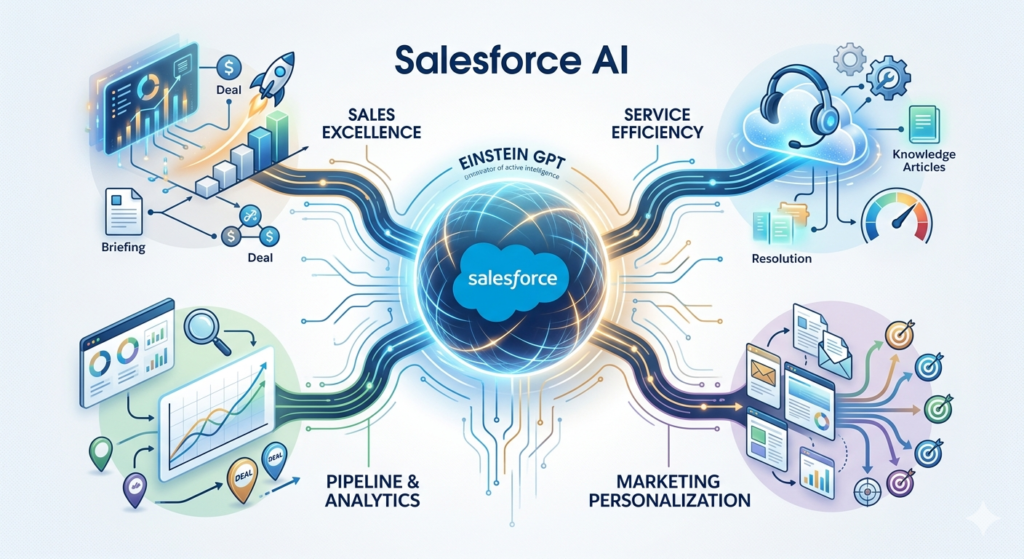
1. AI in Sales Processes
The problem without AI: Sales reps spend only about 28% of their time actually selling. The rest goes to data entry, email writing, research, and administrative tasks.
How AI in CRM Salesforce changes this:
- Pre-meeting preparation: Before a customer call, the AI automatically generates an account briefing — summarizing recent interactions, open opportunities, support history, and relevant news about the account
- Real-time assistance: During a call logged in Salesforce, AI surfaces relevant information and suggested talking points based on the conversation topic
- Post-call automation: After a meeting, AI generates call summaries, suggested next steps, and draft follow-up emails automatically
- Pipeline intelligence: AI analyzes deal patterns and flags at-risk opportunities before they are lost, giving managers and reps time to intervene
Real-World Example: A sales rep at a enterprise software company has 8 customer calls scheduled for the day. Instead of spending 30 minutes per call preparing manually, she uses Einstein GPT to generate AI briefings for each account in seconds. She walks into every call more prepared than she ever was before — and her close rate improves by 23% in the first quarter of using AI.
2. AI in Customer Support
The problem without AI: Service agents spend enormous time reading long case histories, searching knowledge bases, and writing responses — all before they can actually help the customer.
How AI in CRM Salesforce changes this:
- Instant case summarization: When an agent opens a complex case with 50 previous interactions, AI generates a 3-sentence summary of the situation and what has been tried so far
- Resolution recommendations: AI searches the knowledge base and recommends the most relevant articles and past resolved cases similar to the current issue
- Response drafting: AI generates a draft response that the agent can review, edit, and send — turning a 10-minute task into a 2-minute one
- Sentiment detection: AI flags emotionally charged conversations for priority attention and suggests empathetic, de-escalating language
Real-World Example: A telecommunications company’s service center handles 3,000 cases per day. After implementing AI in CRM Salesforce, agents’ average handle time drops from 8 minutes to 5 minutes per case — a 37% improvement — without any reduction in quality scores. The capacity freed up allows the same team to handle 60% more volume without additional hiring.
3. AI in Marketing Automation
The problem without AI: Marketing teams struggle to personalize at scale. Writing individual email variations for each customer segment is impractical — so most marketing ends up being generic, resulting in low engagement.
How salesforce generative AI changes this:
- Content personalization at scale: AI generates hundreds of email and landing page variations, each tailored to specific customer segments, behaviors, and preferences stored in Salesforce Data Cloud
- Campaign brief generation: Marketers describe a campaign goal in natural language, and AI generates a complete campaign brief, messaging framework, and content calendar
- Performance analysis: AI analyzes campaign performance data and provides natural language explanations of what worked, what did not, and what to do differently next time
- Predictive segmentation: AI identifies customer segments likely to respond to specific offers, allowing marketers to target more precisely
Real-World Example: A retail brand with 500,000 customers uses Einstein GPT to generate personalized promotional emails for their summer sale. Instead of sending one generic email to all 500,000 customers, they send 12 AI-generated variations tailored to different purchase history segments. Email open rates improve by 41% and conversion rates improve by 29% compared to their previous generic campaign.
Real-World Use Cases
Einstein GPT Features in Action — Business Scenarios
Use Case 1: Automated Sales Email Sequences
A B2B software company’s sales team uses Einstein GPT to automatically generate personalized email sequences for every new inbound lead. The AI reads the lead’s industry, company size, and the product they expressed interest in, then generates a 3-email nurture sequence tailored to that specific profile. The sales team reviews and approves sequences in minutes rather than writing them from scratch. Response rates increase by 35%.
Use Case 2: Intelligent Case Deflection
A financial services firm deploys Einstein GPT in their Salesforce Experience Cloud customer portal. When customers start typing a support request, Einstein GPT reads their query and proactively surfaces relevant knowledge articles and FAQ content. 40% of customers find their answer without ever submitting a case — dramatically reducing support volume.
Use Case 3: Real-Time Coaching for Service Agents
A healthcare provider uses Einstein GPT to provide real-time coaching to service agents handling sensitive patient inquiries. As the agent types a response, Einstein GPT suggests improvements based on compliance guidelines and empathy best practices. Patient satisfaction scores improve significantly, and compliance violations drop to near zero.
Use Case 4: AI-Generated Account Plans
An enterprise sales team uses Einstein GPT to generate comprehensive account plans for their top 50 strategic accounts. The AI pulls account history, opportunity data, support records, and external news about the company to generate a multi-page strategic account plan. What previously took a full day of research per account now takes 15 minutes.
OpenAI with Salesforce — Business Scenarios
Use Case 1: Custom Document Analysis Pipeline
A legal services firm builds a custom Salesforce integration using the OpenAI API. When a contract document is uploaded to Salesforce, the integration sends it to OpenAI for analysis. GPT-4 extracts key terms, flags non-standard clauses, and summarizes the contract. Results are written back to a custom Salesforce object. This use case goes beyond what Einstein GPT’s standard features offer — requiring the document processing power of OpenAI combined with the CRM structure of Salesforce.
Use Case 2: Advanced Competitive Intelligence
A technology company uses the OpenAI API to build a competitive intelligence assistant that pulls information from web sources, competitor news feeds, and internal Salesforce opportunity data. When a sales rep encounters a specific competitor in a deal, the custom tool (powered by OpenAI) provides a detailed competitive battle card grounded in both current market data and the specific deal context.
Use Case 3: Custom Industry-Specific Language Model
A pharmaceutical company fine-tunes an OpenAI model on their specific medical terminology, product documentation, and regulatory requirements. This fine-tuned model is then integrated with Salesforce Health Cloud via API, giving their sales representatives AI assistance that understands pharmaceutical-specific language and compliance requirements at a much deeper level than a general AI.
When to Choose What — Einstein GPT vs OpenAI Decision Guide
Use this framework to make the right choice for your organization.
Choose Salesforce Einstein GPT If:
Your business profile matches any of these:
- ✅ You are a Salesforce-first organization where most of your business processes live inside Salesforce
- ✅ Your team is primarily non-technical business users who need AI without learning new tools
- ✅ You operate in a regulated industry (healthcare, financial services, government) where data security and compliance are paramount
- ✅ You want quick time-to-value — deploying AI capabilities in weeks, not months
- ✅ You have limited developer resources for building and maintaining custom integrations
- ✅ You want AI that is grounded in your CRM data by default, without complex data pipeline engineering
- ✅ You need AI across multiple Salesforce clouds simultaneously (Sales, Service, Marketing, Commerce)
- ✅ Your primary goal is improving the productivity of existing Salesforce users
Best for: SMB to enterprise Salesforce customers who want AI embedded in their existing workflows without significant technical investment.
Choose OpenAI (Direct Integration) If:
Your business profile matches any of these:
- ✅ You have strong development resources capable of building and maintaining API integrations
- ✅ You need capabilities that go beyond standard CRM AI — advanced document analysis, fine-tuned domain-specific models, or multi-modal AI
- ✅ You are building a custom AI product or tool on top of Salesforce data
- ✅ You need model flexibility and want to use the latest OpenAI models as soon as they are released
- ✅ Your use case requires deep customization that Salesforce’s native AI tools do not support
- ✅ You operate across multiple platforms (not just Salesforce) and need a unified AI layer
- ✅ You are working on a specific high-value use case that justifies the development investment
Best for: Enterprise organizations with dedicated development teams building specialized AI capabilities that extend beyond what native Salesforce AI provides.
The Hybrid Approach (Often the Best Answer)
For many mature Salesforce organizations, the optimal answer to the salesforce einstein GPT vs openAI question is: both, strategically deployed.
- Use Einstein GPT as the default AI layer for all standard Salesforce users — sales reps, service agents, marketers, and admins — because it is secure, grounded, and requires no technical effort from end users
- Use OpenAI API integrations for specific, high-value, specialized use cases that require capabilities beyond what Einstein GPT offers natively — such as complex document analysis, fine-tuned domain models, or multi-system AI workflows
This hybrid strategy gives you the best of both worlds: broad accessibility and security for everyday users, and deep customization and power for specialized workflows.
The Future of Salesforce Generative AI
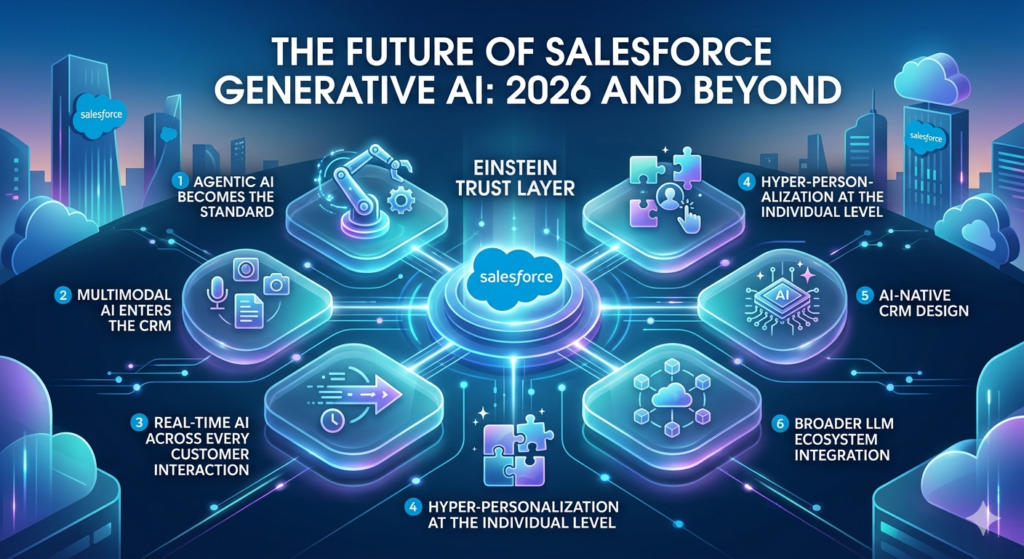
Where Salesforce Generative AI is Heading in 2026 and Beyond
The trajectory of salesforce generative AI is clear — and it is accelerating rapidly. Here are the key trends shaping the next chapter of AI in CRM:
Trend 1: Agentic AI Becomes the Standard
The shift from AI as an assistant to AI as an autonomous agent is already underway with Agentforce. In the coming years, expect this to become the dominant paradigm — AI agents that handle entire customer journeys end-to-end, from first touch to closed deal to ongoing support, with minimal human involvement for routine interactions.
Trend 2: Multimodal AI Enters the CRM
Future versions of einstein gpt features will increasingly incorporate multimodal capabilities — AI that can process and generate not just text, but images, audio, and video. Imagine a service agent showing a customer a product issue on video and AI instantly analyzing the visual content to suggest a solution.
Trend 3: Real-Time AI Across Every Customer Interaction
AI will move from being a tool users invoke to being an always-on intelligence layer that analyzes every customer interaction in real-time — every email, call, chat, and web visit — and continuously updates CRM records, forecasts, and recommendations without any manual prompting.
Trend 4: Hyper-Personalization at the Individual Level
Salesforce generative AI combined with Data Cloud’s unified customer profiles will enable genuine one-to-one personalization at scale — where every customer interaction (marketing, sales, service) is uniquely tailored to that individual’s complete history, preferences, and current context.
Trend 5: AI-Native CRM Design
The next generation of CRM platforms will be designed AI-first from the ground up — not retrofitted with AI features. This means AI will be embedded in every object, every field, every workflow, and every report by default.
Trend 6: Broader LLM Ecosystem Integration
Salesforce will continue to expand the Einstein Trust Layer to support an ever-broader range of LLM providers — giving organizations the ability to choose which AI models power their specific workflows based on cost, capability, and compliance requirements.
Conclusion: Choosing the Right AI for Your CRM in 2026
The salesforce einstein GPT vs openAI debate ultimately comes down to a single fundamental question: What problem are you actually trying to solve, and for whom?
Here is the bottom line from everything we have covered:
Salesforce Einstein GPT is the right choice when your goal is to make AI accessible, secure, and effective for every Salesforce user in your organization — without requiring technical expertise, without risking data security, and without building complex custom integrations. Its einstein gpt features — from contextually grounded content generation to the Einstein Trust Layer — are purpose-built for the CRM environment and deliver immediate value to business users.
OpenAI direct integration is the right choice when you have specialized, complex AI needs that go beyond what native Salesforce AI provides — when you have the development resources to build proper integrations, when you need model-level customization, or when you are building AI capabilities that span multiple platforms beyond Salesforce.
And for many organizations, the smartest strategy is both — using salesforce generative AI through Einstein GPT as the foundation for everyday user productivity, while leveraging OpenAI’s API for specific high-value specialized applications.
What is absolutely clear is this: AI in CRM Salesforce is not optional in 2026. Organizations that embrace generative AI in their CRM workflows are seeing measurable improvements in sales productivity, customer satisfaction, marketing effectiveness, and operational efficiency. Organizations that wait are falling behind.
The technology is here. The use cases are proven. The only question remaining is: which AI strategy will your organization choose?
About RizeX Labs
At RizeX Labs, we specialize in delivering advanced Salesforce AI solutions, helping businesses harness the power of generative AI through tools like Einstein GPT and OpenAI integrations. Our expertise combines deep technical knowledge, industry best practices, and real-world implementation experience to help organizations enhance CRM capabilities and drive smarter customer engagement.
We empower organizations to transform their CRM processes—from manual and reactive systems to intelligent, AI-driven platforms that enable automation, personalization, and data-driven decision-making.
Internal Linking Opportunities:
- Link to your Salesforce AI training page
- How to Build a Salesforce Portfolio That Gets You Hired (With Project Ideas)
- Salesforce Admin vs Developer: Which Career Path is Right for You in 2026?
- Wealth Management App in Financial Services Cloud
- Enroll in Agentforce batch
External Linking Opportunities:
- Salesforce official website
- Salesforce AI overview
- Einstein GPT overview
- OpenAI official website
- Salesforce AppExchange
- Salesforce Help Documentation
Quick Summary
The comparison between Salesforce Einstein GPT and OpenAI highlights how generative AI is transforming CRM systems. Both technologies enable intelligent automation, content generation, and enhanced customer interactions, but they differ in how they integrate and operate within the Salesforce ecosystem.
Einstein GPT is natively built into Salesforce, allowing businesses to leverage CRM data securely for generating personalized emails, summaries, and insights directly within workflows. Its tight integration makes it a powerful solution for enhancing productivity across sales, service, and marketing.
On the other hand, OpenAI provides flexible, API-based generative AI capabilities that can be integrated with Salesforce to build custom AI-powered solutions. It offers broader customization but may require additional setup and development effort.
Understanding how these tools work in CRM helps organizations choose the right approach—whether they prefer the native power of Einstein GPT or the flexibility of OpenAI—to implement scalable and effective AI-driven CRM strategies.
