
Introduction
Salesforce is no longer a single CRM tool sitting quietly in a corner of your tech stack. For most enterprises today, it has evolved into a sprawling ecosystem — spanning Sales Cloud, Service Cloud, Marketing Cloud, Experience Cloud, MuleSoft integrations, Tableau analytics, and an ever-growing constellation of AppExchange packages, custom applications, and automations. With this expansion comes a hard truth: complexity without governance breeds chaos.
If you’re a Salesforce architect or IT leader reading this, you’ve likely felt the pain firsthand. Shadow IT creeping in. Redundant automations colliding with each other. Business units spinning up their own solutions without regard for data architecture. Release management held together by spreadsheets and hope. Technical debt accumulating faster than anyone can pay it down.
This is precisely why a growing number of forward-thinking organizations are investing in building an internal Salesforce Centre of Excellence (CoE) — a centralized function that brings structure, governance, strategic alignment, and operational discipline to the entire Salesforce landscape.
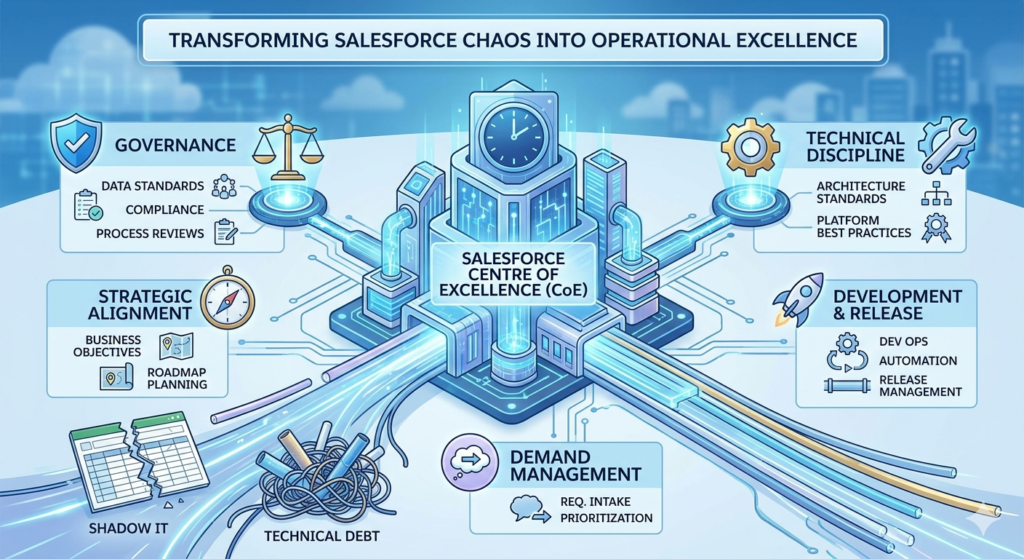
But here’s the challenge: while the concept of a Salesforce CoE setup sounds compelling in theory, actually building one that works — one that delivers measurable business value and earns cross-functional buy-in — is a complex undertaking that requires careful planning, the right talent, robust processes, and sustained executive commitment.
In this comprehensive guide, we’ll walk you through everything you need to know about building an internal SF CoE from the ground up. We’ll cover what it is, why it matters, the critical components you need to get right, a step-by-step implementation roadmap, best practices drawn from real-world engagements, and the common pitfalls that derail even well-intentioned efforts. Whether you’re starting from scratch or formalizing an existing ad hoc structure, this guide is designed to give you an actionable blueprint.
Let’s get started.
What Is a Salesforce Centre of Excellence (CoE)?
Definition and Purpose
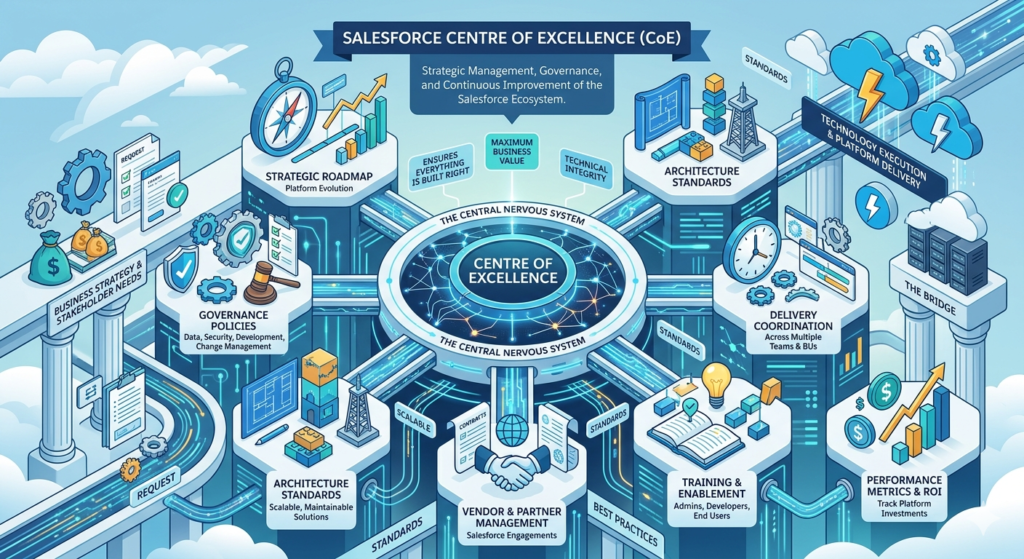
A Salesforce Centre of Excellence is a cross-functional organizational unit — or operating model — dedicated to the strategic management, governance, and continuous improvement of an organization’s entire Salesforce ecosystem. It serves as the central nervous system for all Salesforce-related activities, providing oversight, standards, best practices, and enablement to ensure that the platform delivers maximum business value while maintaining technical integrity.
Think of a CoE not as a team that builds everything, but as a team that ensures everything is built right. It sits at the intersection of business strategy and technology execution, acting as the bridge between what stakeholders need and how the platform delivers it.
A well-functioning Salesforce CoE typically owns or influences the following:
- Strategic roadmap for Salesforce platform evolution
- Governance policies covering data, security, development, and change management
- Architecture standards ensuring scalable, maintainable solutions
- Delivery coordination across multiple business units or project teams
- Vendor and partner management for Salesforce-related engagements
- Training and enablement for admins, developers, and end users
- Performance metrics and ROI tracking for platform investments
Business Value and Outcomes
When implemented effectively, a Salesforce Centre of Excellence delivers tangible, measurable business outcomes:
- Reduced technical debt through enforced coding standards, architecture reviews, and proactive refactoring
- Faster time-to-market by establishing reusable components, standardized processes, and clear approval workflows
- Lower total cost of ownership (TCO) through license optimization, reduced rework, and consolidated vendor management
- Improved user adoption via training programs, change management support, and user-centric design principles
- Better data quality through centralized data governance, validation rules, and integration standards
- Stronger security and compliance posture with consistent access controls, audit trails, and regulatory alignment
- Strategic alignment ensuring that every Salesforce initiative directly supports business objectives rather than becoming a technology project in isolation
In short, a CoE transforms Salesforce from a tool into a strategic asset.
Why Build an Internal SF CoE?
The Benefits: Why It Matters Now More Than Ever
The case for building an internal SF CoE has never been stronger. Here’s why:
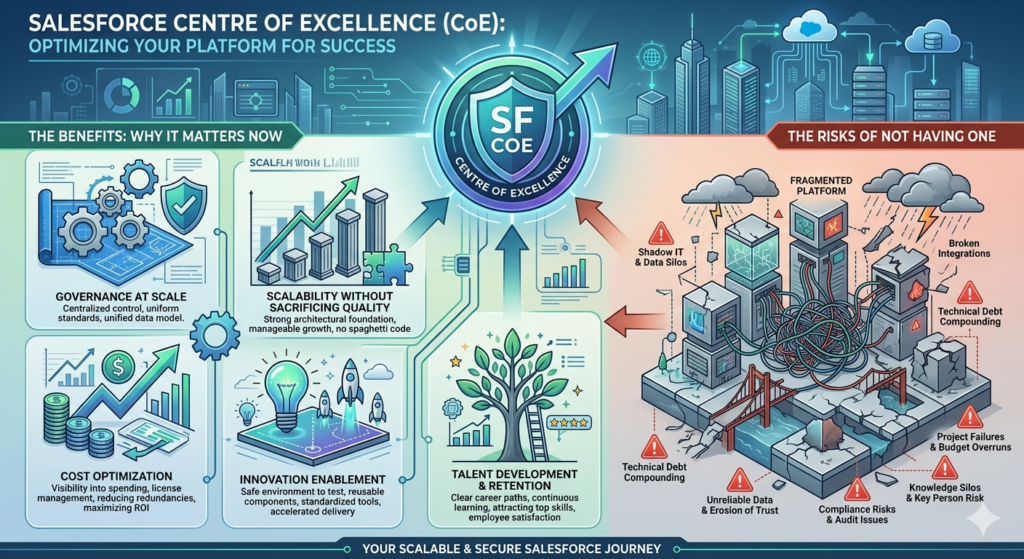
1. Governance at Scale
As organizations grow their Salesforce footprint — adding orgs, clouds, and integrations — the need for a unified Salesforce governance model becomes critical. Without centralized governance, each business unit makes its own decisions about data models, naming conventions, automation frameworks, and security settings. The result is a fragmented platform that becomes increasingly difficult and expensive to maintain.
A CoE establishes the rules of the road. It defines what “good” looks like across the platform and ensures that every team adheres to those standards.
2. Scalability Without Sacrificing Quality
Growth is good, but unmanaged growth is dangerous. A CoE ensures that as your Salesforce ecosystem scales, it does so on a solid architectural foundation. It prevents the “spaghetti architecture” problem where quick fixes and point solutions create a tangled web of dependencies that no one fully understands.
3. Cost Optimization
Salesforce licensing, AppExchange subscriptions, integration middleware, and consulting engagements represent significant investments. A CoE provides visibility into these costs, identifies redundancies, optimizes license allocation, and ensures that every dollar spent on the platform delivers a clear return.
4. Innovation Enablement
Paradoxically, governance enables innovation rather than stifling it. When teams have clear guardrails, standardized tools, and reusable components, they can move faster and experiment more confidently. A CoE creates the safe space for innovation by managing risk.
5. Talent Development and Retention
A CoE creates career paths for Salesforce professionals within your organization. It signals that the company takes the platform seriously, which helps attract and retain top talent — a critical advantage in a competitive Salesforce talent market.
The Risks of Not Having One
Let’s be equally direct about what happens without a CoE:
- Shadow IT proliferates. Business users build flows, install packages, and create custom objects without oversight, creating hidden dependencies and security vulnerabilities.
- Technical debt compounds. Every unreviewed customization, every shortcut taken in the interest of speed, adds to a growing mountain of debt that eventually slows the entire organization.
- Data becomes unreliable. Without centralized data governance, duplicate records, inconsistent field usage, and broken integrations erode trust in the platform.
- Projects fail or underperform. Without architecture reviews and standardized delivery practices, Salesforce projects are more likely to go over budget, miss deadlines, or deliver solutions that don’t meet user needs.
- Compliance risk increases. In regulated industries, ungoverned Salesforce environments create audit nightmares and potential regulatory exposure.
- Knowledge silos form. Critical platform knowledge lives in the heads of a few individuals, creating single points of failure and key-person risk.
If any of these scenarios sound familiar, you’re not alone — and they’re exactly why a Salesforce centre of excellence should be on your strategic agenda.
Key Components of a Salesforce CoE Setup
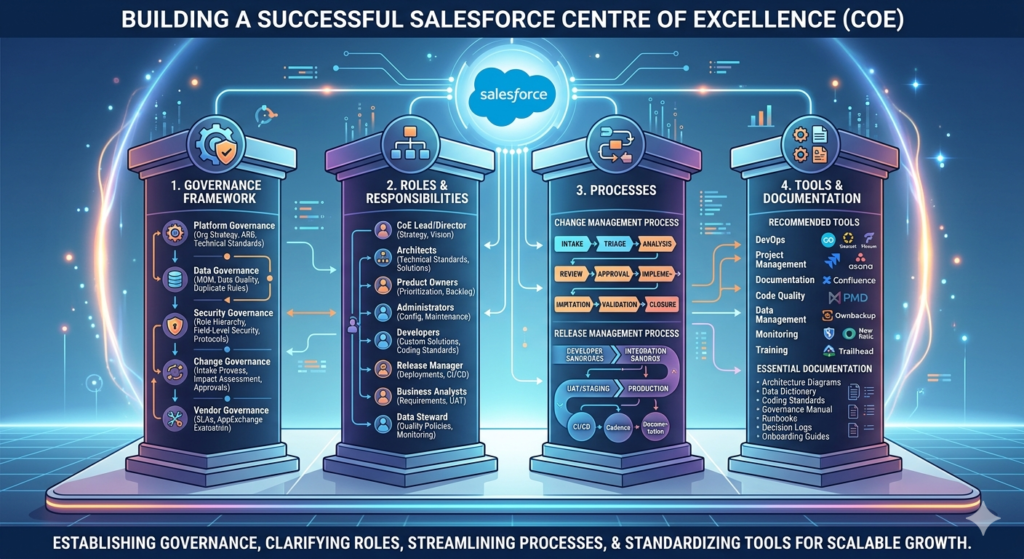
A successful Salesforce CoE setup is built on four foundational pillars: governance, people, processes, and tools. Let’s examine each in detail.
1. Governance Framework: The Salesforce Governance Model
The Salesforce governance model is the backbone of your CoE. It defines the policies, standards, and decision-making structures that guide how the platform is managed and evolved.
A comprehensive governance framework should cover:
Platform Governance
- Org strategy (single-org vs. multi-org decisions)
- Environment management (sandbox strategy, data seeding)
- Release management cadence and policies
- Architecture review board (ARB) processes
- Technical standards (Apex coding standards, LWC best practices, naming conventions)
Data Governance
- Data ownership and stewardship
- Data quality standards and monitoring
- Master data management (MDM) policies
- Duplicate management rules
- Data retention and archiving policies
Security Governance
- Role hierarchy and sharing model design principles
- Permission set and profile management standards
- Field-level security policies
- Integration security protocols (OAuth, named credentials)
- Regular security health check cadence
Change Governance
- Change request intake and prioritization process
- Impact assessment requirements
- Approval workflows for different change types (configuration vs. development)
- Rollback procedures and contingency planning
Vendor and Partner Governance
- Partner engagement models and SLAs
- AppExchange evaluation criteria
- Code review requirements for partner-delivered work
- Intellectual property and documentation standards
The governance model should be documented, accessible, and — critically — enforced. A governance model that exists only on paper provides no value.
2. Roles and Responsibilities
A CoE requires clearly defined roles with explicit ownership. While the exact structure will vary based on organization size and complexity, the following roles are commonly found in mature CoEs:
Salesforce CoE Lead / Director
- Owns the CoE vision, strategy, and roadmap
- Reports to executive sponsor
- Manages cross-functional relationships and stakeholder communications
- Responsible for CoE performance metrics
Salesforce Architect(s)
- Defines and maintains technical architecture standards
- Leads architecture review board
- Provides solution architecture guidance for complex initiatives
- Evaluates new Salesforce features and capabilities for organizational relevance
Salesforce Product Owner(s)
- Manages the platform backlog
- Prioritizes feature requests and enhancements
- Serves as the bridge between business stakeholders and technical teams
- Defines acceptance criteria and validates delivered solutions
Salesforce Administrators
- Handles day-to-day platform configuration and maintenance
- Manages user provisioning and access
- Builds reports, dashboards, and declarative automations
- Provides Tier 1/Tier 2 support for end users
Salesforce Developers
- Builds custom solutions (Apex, LWC, integrations)
- Adheres to coding standards and participates in peer code reviews
- Creates and maintains unit tests
- Contributes to shared code libraries and reusable components
Release Manager
- Coordinates deployment activities across environments
- Manages release calendars and deployment windows
- Ensures change documentation and approval processes are followed
- Oversees CI/CD pipeline configuration and maintenance
Business Analysts
- Gathers and documents business requirements
- Conducts gap analysis between current and desired states
- Facilitates user acceptance testing (UAT)
- Supports change management and end-user training
Data Steward / Data Governance Lead
- Owns data quality policies and monitoring
- Manages data migration and enrichment activities
- Coordinates with integration teams on data flow standards
- Reports on data health metrics
3. Processes: Change Management and Release Management
Processes are the engine that keeps the CoE running. Two processes deserve special attention:
Change Management Process
Every change to the Salesforce platform — from a new validation rule to a major integration — should flow through a defined change management process. This typically includes:
- Intake: Standardized request submission (e.g., via a Salesforce case, Jira ticket, or dedicated intake form)
- Triage: Initial assessment of scope, impact, and priority
- Analysis: Detailed requirements gathering and solution design
- Review: Architecture and/or governance review for changes above a defined threshold
- Approval: Formal sign-off from appropriate stakeholders
- Implementation: Development, testing, and deployment following established standards
- Validation: UAT and post-deployment verification
- Closure: Documentation update and stakeholder notification
Release Management Process
A mature release management process ensures that changes are deployed to production in a controlled, predictable manner. Key elements include:
- Defined release cadence (e.g., bi-weekly sprints with monthly production releases)
- Environment strategy (developer sandboxes → integration sandbox → UAT/staging sandbox → production)
- CI/CD pipeline leveraging tools like Salesforce DevOps Center, Copado, Gearset, or Flosum
- Release notes and communication protocols
- Rollback plans for every deployment
- Post-deployment monitoring and hypercare windows
4. Tools and Documentation
A CoE should establish a standardized toolchain and maintain comprehensive documentation:
Recommended Tool Categories:
- DevOps / CI/CD: Copado, Gearset, Flosum, Salesforce CLI + GitHub/GitLab
- Project Management: Jira, Asana, or Salesforce-native project tracking
- Documentation: Confluence, Notion, or SharePoint for knowledge base
- Code Quality: PMD, Salesforce Code Analyzer, Clayton
- Data Management: Ownbackup, DataLoader, Informatica
- Monitoring: Salesforce Event Monitoring, Shield, New Relic
- Training: Trailhead, custom LMS platforms
Essential Documentation:
- Platform architecture diagrams (org topology, integration landscape, data flow)
- Data dictionary and object model documentation
- Coding standards and development guidelines
- Governance policies and procedures manual
- Runbooks for common operational tasks
- Decision logs for architecture and governance decisions
- Onboarding guides for new team members
Step-by-Step Guide to Building an Internal Salesforce Centre of Excellence
Now let’s move from theory to execution. Here is a practical, phased approach to building your internal SF CoE.
Step 1: Define Vision and Objectives
Every successful CoE starts with a clear articulation of why it exists and what it aims to achieve. This isn’t a generic mission statement — it’s a specific, measurable set of objectives tied to business outcomes.
Actions:
- Conduct a current-state assessment of your Salesforce ecosystem (technical health, organizational maturity, stakeholder satisfaction)
- Identify the top pain points and risks that the CoE will address
- Define 3–5 strategic objectives for the CoE (e.g., “Reduce Salesforce-related production incidents by 50% within 12 months”)
- Establish a target operating model that describes how the CoE will function day-to-day
- Create a CoE charter document that captures vision, scope, objectives, and success criteria
Pro Tip: Involve both business and technology stakeholders in this step. A CoE that is defined purely by IT will struggle to gain business buy-in, and vice versa.
Step 2: Secure Executive Sponsorship
A CoE without executive sponsorship is a committee without authority. You need a senior leader — ideally at the VP or C-level — who will champion the CoE, secure funding, remove organizational obstacles, and hold teams accountable.
Actions:
- Identify the right executive sponsor (typically CTO, CIO, VP of IT, or VP of Business Operations)
- Build a business case that quantifies the cost of the current state (rework hours, failed projects, license waste, compliance risks) and the expected ROI of the CoE
- Present the CoE charter and business case to the executive sponsor for endorsement
- Establish a governance steering committee with cross-functional executive representation
- Agree on reporting cadence and executive communication channels
What the Business Case Should Include:
- Current Salesforce TCO breakdown
- Quantified impact of technical debt (in hours, dollars, or risk scores)
- Projected cost avoidance and efficiency gains from the CoE
- Benchmarks from industry peers or analyst research
- Investment required (headcount, tools, training)
- Timeline to value
Step 3: Design the Governance Model
With vision defined and sponsorship secured, it’s time to design your Salesforce governance model in detail.
Actions:
- Define governance tiers (e.g., strategic governance at the steering committee level, tactical governance at the CoE lead level, operational governance at the team level)
- Document decision rights: who can approve new custom objects? Who authorizes AppExchange installations? Who signs off on architecture decisions?
- Establish an Architecture Review Board (ARB) with clear membership, meeting cadence, and review criteria
- Create governance policies for data, security, development, integrations, and change management
- Design exception handling processes (because rigid governance without flexibility creates bottlenecks)
- Publish governance documentation in an accessible, searchable knowledge base
Governance Tier Model Example:
| Tier | Scope | Forum | Cadence |
|---|---|---|---|
| Strategic | Platform strategy, budget, roadmap | Steering Committee | Quarterly |
| Tactical | Architecture decisions, cross-team coordination, policy changes | CoE Leadership + ARB | Bi-weekly |
| Operational | Day-to-day standards enforcement, change approvals, incident response | CoE Team | Daily/Weekly |
Step 4: Build the Right Team
The CoE is only as strong as the people in it. Building the right team requires a thoughtful approach to hiring, role definition, and organizational placement.
Actions:
- Map the roles outlined earlier to your specific organizational needs and scale
- Conduct a skills gap analysis: what capabilities do you have today, and what do you need?
- Decide on sourcing strategy: full-time employees, contractors, managed services, or a hybrid model
- Define career paths and growth opportunities within the CoE to attract and retain talent
- Establish a CoE onboarding program that ensures every team member understands governance policies, standards, and processes
Team Sizing Guidance:
The right team size depends on the complexity of your Salesforce footprint. As a rough guideline:
- Small (1–2 orgs, < 500 users): 3–5 dedicated CoE members (CoE lead, architect, admin, 1–2 developers)
- Medium (2–5 orgs, 500–5,000 users): 8–15 members with dedicated roles across architecture, administration, development, and product ownership
- Large / Enterprise (5+ orgs, 5,000+ users): 15–30+ members organized into specialized pods (e.g., architecture pod, delivery pod, operations pod, enablement pod)
Important: Not everyone needs to be a full-time CoE member. Consider a “hub and spoke” model where a core CoE team provides standards, governance, and oversight, while embedded resources in business units execute within those guardrails. This model scales more efficiently and fosters business alignment.
Step 5: Establish Processes and Standards
With governance designed and the team in place, it’s time to operationalize through well-defined processes and standards.
Actions:
Development Standards:
- Publish Apex coding standards (naming conventions, separation of concerns, trigger framework, exception handling patterns)
- Define LWC development standards (component structure, CSS conventions, accessibility requirements)
- Establish mandatory code review processes (peer review + architect review for complex changes)
- Set minimum code coverage thresholds (go beyond Salesforce’s 75% minimum — aim for 85%+ with meaningful assertions)
- Standardize use of custom metadata types, custom settings, and platform events
Configuration Standards:
- Define when to use declarative tools (Flow, validation rules) vs. code
- Establish automation framework standards (e.g., one flow per object per process type to avoid conflicts)
- Create naming convention guides for objects, fields, flows, profiles, permission sets, and reports
- Define report and dashboard folder structures
Integration Standards:
- Standardize integration patterns (real-time vs. batch, point-to-point vs. middleware)
- Define API usage guidelines and governor limit management practices
- Establish error handling and retry mechanisms for integrations
- Require integration documentation including data flow diagrams and field mapping specifications
Testing Standards:
- Define testing types required for each change category (unit testing, integration testing, regression testing, UAT, performance testing)
- Establish test data management practices
- Create UAT playbooks and sign-off templates
Step 6: Implement Metrics and KPIs
You can’t improve what you don’t measure. A mature CoE tracks a comprehensive set of metrics that demonstrate value and identify areas for improvement.
Recommended KPI Categories:
Platform Health Metrics:
- Number of production incidents per release
- Mean time to resolution (MTTR) for platform issues
- Salesforce Optimizer score trends
- Technical debt backlog size and burn-down rate
- Governor limit utilization across critical processes
- Code coverage percentage
Delivery Metrics:
- Sprint velocity and predictability
- Cycle time from request to deployment
- Number of deployments per release window
- Deployment success rate (percentage of deployments without rollback)
- Defect escape rate (bugs found in production vs. caught in testing)
Business Value Metrics:
- User adoption rates and login frequency
- User satisfaction scores (via surveys)
- Business process cycle time improvements enabled by Salesforce
- ROI of Salesforce platform investment
- License utilization rate
Governance Metrics:
- Percentage of changes going through the formal change process
- Architecture review board throughput and approval rates
- Governance exception requests and resolutions
- Documentation currency (percentage of documentation up-to-date)
Actions:
- Select 8–12 KPIs that align with your CoE objectives
- Establish baselines before the CoE launches
- Build a CoE dashboard (ideally in Salesforce itself) for real-time visibility
- Report metrics to the steering committee on a quarterly basis
- Use metrics to drive continuous improvement initiatives
Step 7: Continuous Improvement
A CoE is not a “set it and forget it” initiative. It must evolve continuously as the Salesforce platform evolves, as the organization’s needs change, and as the team matures.
Actions:
- Conduct quarterly retrospectives to assess what’s working and what isn’t
- Stay current with Salesforce’s three-times-a-year release cycle and evaluate new features for adoption
- Maintain an active relationship with Salesforce Account Executive and Technical Account Manager
- Participate in Salesforce community events (Dreamforce, TrailblazerDX, local user groups)
- Benchmark your CoE maturity against industry frameworks (e.g., Salesforce’s own Well-Architected framework)
- Regularly refresh governance policies to reflect lessons learned
- Invest in ongoing training and certification for CoE team members
- Solicit feedback from stakeholders and end users on a regular basis
Maturity Model Concept:
Consider defining a CoE maturity model with stages like:
- Ad Hoc: No formal CoE; platform managed reactively by individual contributors
- Foundational: CoE established; basic governance, team, and processes in place
- Standardized: Comprehensive governance model, well-defined processes, consistent standards enforcement
- Optimized: Data-driven decision-making, proactive architecture management, strong business alignment
- Transformational: CoE drives innovation, enables self-service capabilities, contributes to enterprise-wide digital transformation strategy
Use this model to assess your current state, define your target state, and track progress over time.
Best Practices for a Successful Salesforce Centre of Excellence
Drawing from real-world engagements, here are the practices that separate thriving CoEs from those that falter.
Embrace Agile Methodology
A CoE should practice what it preaches. Adopting Agile principles — iterative delivery, regular feedback loops, transparency, and adaptability — makes the CoE itself more responsive and effective.
- Run CoE operations in sprints with defined goals and retrospectives
- Use a prioritized backlog for governance improvements, standard updates, and enablement initiatives
- Avoid the trap of trying to define everything upfront before launching — start with a minimum viable CoE and iterate
- Apply Agile delivery practices to Salesforce projects managed by or through the CoE
Build Strong Communication Channels
The CoE must be visible, accessible, and communicative. Silence breeds suspicion and resistance.
- Establish a dedicated Slack/Teams channel for CoE announcements and questions
- Publish a regular CoE newsletter highlighting wins, upcoming changes, and governance reminders
- Hold monthly “office hours” where anyone in the organization can bring Salesforce questions or ideas
- Create a self-service knowledge base where stakeholders can find standards, templates, and guides without waiting for a CoE member
- Maintain a public CoE roadmap so stakeholders can see what’s coming and provide input
Invest in Training and Enablement
A CoE that hoards knowledge fails. A CoE that distributes knowledge succeeds.
- Develop role-specific training tracks (admin training, developer training, business user training, executive briefings)
- Leverage Trailhead as a foundation but supplement with organization-specific content
- Run quarterly “lunch and learn” sessions on Salesforce topics
- Create a certification support program (study groups, exam vouchers, recognition for certified team members)
- Build a Salesforce champion network — power users in each business unit who serve as local experts and CoE ambassadors
Align Relentlessly with Business Goals
The CoE must demonstrate business value, not just technical excellence. Every governance policy, every standard, and every process should trace back to a business objective.
- Participate in business planning and strategy sessions, not just IT forums
- Frame CoE metrics in business terms (revenue impact, customer satisfaction, operational efficiency) rather than purely technical terms
- Assign product owners who genuinely understand the business domain they serve
- Conduct annual strategic planning sessions where the CoE roadmap is aligned with the broader business strategy
Start Small, Scale Deliberately
One of the most common mistakes is trying to boil the ocean on day one. A CoE that launches with 47 governance policies and a 200-page standards document will overwhelm the organization.
- Start with the most critical pain points (e.g., if production incidents are the biggest problem, focus on release management and code review processes first)
- Prove value quickly with early wins that build credibility and momentum
- Expand scope incrementally as the team matures and stakeholder trust grows
- Celebrate and communicate wins at every stage
Common Challenges and How to Overcome Them
Challenge 1: Resistance to Change
The Problem: Teams accustomed to operating independently may view the CoE as bureaucratic overhead that slows them down.
How to Overcome It:
- Involve resistors early in the CoE design process — give them a voice in shaping governance policies
- Demonstrate value through quick wins that make their lives easier, not harder
- Position the CoE as an enabler, not a gatekeeper — frame governance as “how we help you move faster with confidence” rather than “how we control what you do”
- Use data to show the cost of the current state (failed deployments, rework hours, incident frequency)
- Find influential early adopters who can champion the CoE within their business units
Challenge 2: Lack of Clarity in Ownership
The Problem: Ambiguity about who owns what — especially in organizations with multiple Salesforce orgs or a federated IT model — creates confusion, duplication of effort, and accountability gaps.
How to Overcome It:
- Use a RACI matrix (Responsible, Accountable, Consulted, Informed) for every major CoE process and decision area
- Clearly document and communicate the CoE’s scope — what falls under the CoE’s purview and what doesn’t
- Define the relationship between the CoE and business unit IT teams explicitly (centralized model, federated model, or hybrid)
- Revisit ownership definitions annually or whenever organizational changes occur
Challenge 3: Scaling Issues
The Problem: A CoE model that works for a small Salesforce footprint may not scale as the platform grows. The core team becomes a bottleneck, and quality suffers.
How to Overcome It:
- Adopt the hub-and-spoke model described earlier — a core CoE team with embedded resources in business units
- Invest in automation: CI/CD pipelines, automated code scanning, automated testing, and self-service provisioning reduce manual bottleneck
- Create self-service capabilities: a comprehensive knowledge base, templates, and intake processes that don’t require CoE intervention for simple requests
- Develop internal talent pipelines so that new team members can be onboarded efficiently
- Consider a tiered governance model where low-risk changes follow a lightweight process and only high-risk changes require full CoE review
Challenge 4: Maintaining Momentum After Initial Launch
The Problem: Many CoEs launch with great fanfare but lose steam after the first few months as initial enthusiasm fades and competing priorities emerge.
How to Overcome It:
- Tie CoE performance to executive OKRs so it remains a strategic priority
- Deliver visible value continuously, not just at launch
- Rotate fresh challenges and initiatives through the CoE to keep the work engaging
- Celebrate milestones publicly (e.g., “200 successful deployments with zero rollbacks”)
- Regularly solicit and act on feedback from stakeholders to show responsiveness
Challenge 5: Keeping Up with the Salesforce Platform
The Problem: Salesforce releases hundreds of new features three times a year. Without a deliberate approach, the CoE falls behind on platform capabilities.
How to Overcome It:
- Assign a “release readiness” owner within the CoE who reviews each Salesforce release
- Conduct a release impact assessment for every major Salesforce release (Spring, Summer, Winter)
- Maintain a sandbox specifically for evaluating new features
- Share relevant new features with the broader organization through newsletters or demo sessions
- Update standards and governance documents to reflect new platform capabilities (e.g., when Salesforce introduces new security features, update your security governance accordingly)
How RizeX Labs Can Help
At RizeX Labs, we’ve helped organizations across industries design, launch, and optimize their Salesforce Centre of Excellence. We understand that every organization is different — there’s no one-size-fits-all CoE template. Our approach is tailored to your specific Salesforce footprint, organizational culture, business objectives, and maturity level.
Our CoE Advisory Services Include:
- Current-State Assessment: Deep-dive analysis of your Salesforce ecosystem’s technical health, organizational readiness, and governance gaps
- CoE Strategy and Design: Custom CoE operating model, governance framework, and roadmap development
- Governance Model Development: Comprehensive Salesforce governance model design including policies, standards, and decision frameworks
- Team Building and Enablement: Skills gap analysis, role definition, hiring support, and team training programs
- Process Engineering: Change management, release management, and architecture review process design and implementation
- Ongoing Advisory: Fractional CoE leadership and architecture support to supplement your internal team
Whether you need help building a CoE from scratch or evolving an existing one to the next maturity level, we’re here to partner with you.
Conclusion
The Salesforce platform has become mission-critical for organizations worldwide, but its power comes with proportional complexity. Without intentional governance and strategic management, that complexity becomes a liability rather than an asset — manifesting as technical debt, data quality issues, security risks, failed projects, and frustrated users.
Building an internal Salesforce Centre of Excellence is the single most impactful investment you can make to transform your Salesforce ecosystem from a collection of disconnected projects into a strategic, well-governed platform that drives real business value. A well-structured Salesforce CoE setup provides the governance, talent, processes, and metrics needed to scale with confidence, optimize costs, accelerate innovation, and maintain platform health over the long term.
But success requires more than good intentions. It demands clear vision, executive commitment, a robust Salesforce governance model, the right people in the right roles, disciplined processes, and a relentless focus on continuous improvement. It requires starting with the end in mind but having the pragmatism to begin small, prove value quickly, and scale deliberately.
The organizations that get this right — that invest in building a mature, empowered internal SF CoE — will be the ones that extract the most value from their Salesforce investment, attract the best talent, and position themselves for sustained competitive advantage in an increasingly digital world.
The question isn’t whether you need a Salesforce Centre of Excellence. The question is how quickly you can build one.
About RizeX Labs
We’re Pune’s leading IT training institute specializing in enterprise-grade technologies like Salesforce architecture and DevOps. At RizeX Labs, we help IT leaders and architects master the art of platform governance through hands-on, real-world case studies and expert mentorship. Our programs are designed to transform technical professionals into strategic leaders capable of building and managing high-performing Salesforce Centres of Excellence.
Internal Links:
- Salesforce Admin & Development Training in Pune
- Advanced Salesforce Integration Patterns: A Guide for Architects
- Salesforce DevOps 101: Moving Beyond Change Sets
