
Introduction: Why Salesforce Investments Fail Without Leadership-Backed Training
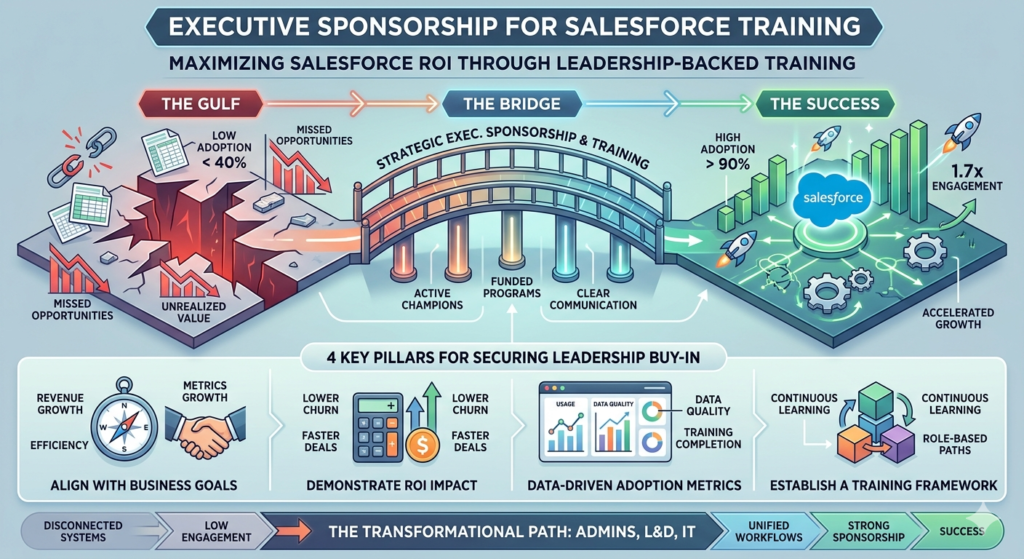
Your organization just invested seven figures in Salesforce. The implementation is complete. The licenses are purchased. The dashboards look promising.
Yet six months later, user adoption hovers below 40%. Sales reps still use spreadsheets. Customer service teams bypass Salesforce workflows. Your COO is questioning the entire investment.
This scenario plays out in enterprises worldwide—not because Salesforce lacks capability, but because organizations treat training as an afterthought rather than a strategic imperative.
The hard truth? Technology alone doesn’t drive transformation. People do.
According to Salesforce’s own research, companies with formal adoption strategies see 1.7x higher user engagement rates. Yet securing leadership buy-in for comprehensive Salesforce training remains one of the biggest challenges facing transformation leaders, L&D heads, and Salesforce administrators.
The disconnect is clear: executives approve substantial technology investments but hesitate when presented with the training budgets necessary to maximize those investments. This resistance creates a dangerous gap between platform potential and actual business outcomes.
This comprehensive guide addresses that gap. Whether you’re a CIO building a business case, an L&D director fighting for budget allocation, or a Salesforce admin trying to improve adoption metrics, you’ll discover proven strategies to secure executive sponsorship for Salesforce training that transforms reluctant leadership into active champions.
Let’s explore why leadership buy-in isn’t just helpful—it’s mission-critical for Salesforce success.
Why Executive Sponsorship Determines Salesforce Training Success
The Leadership Multiplier Effect
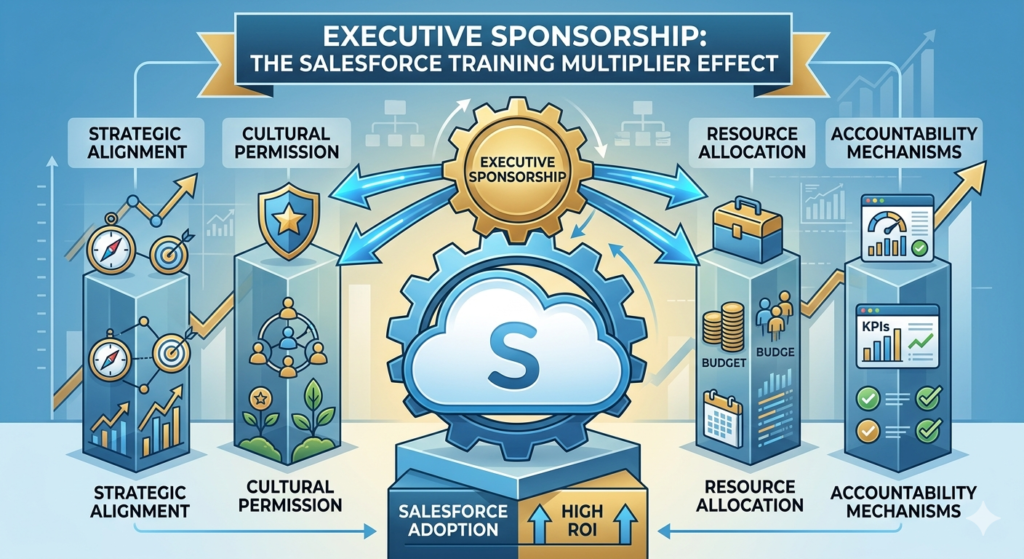
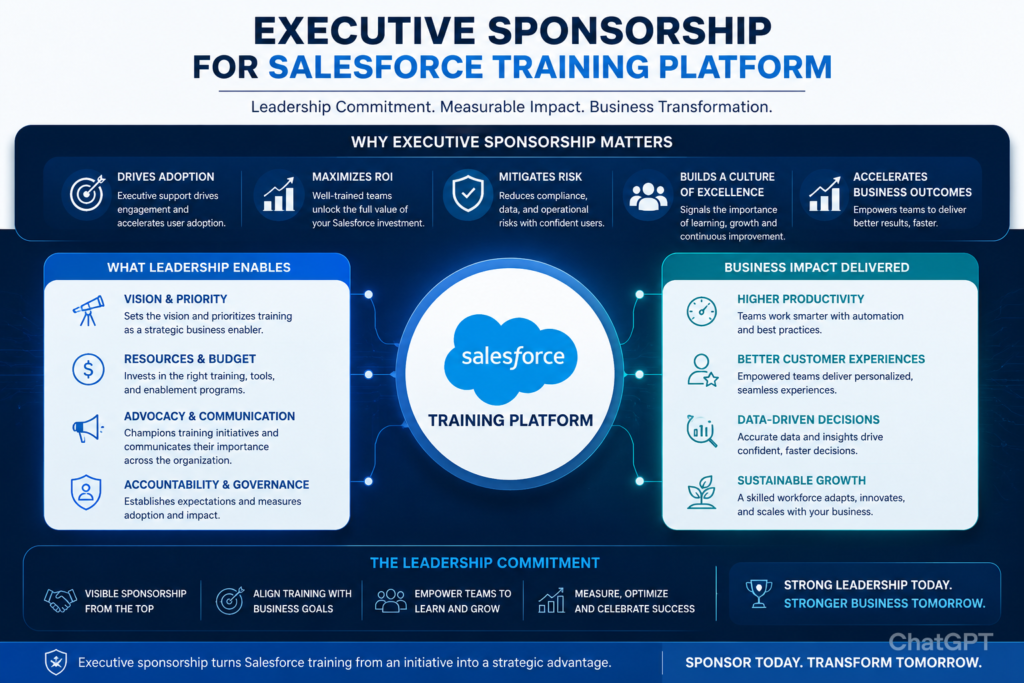
Executive sponsorship for Salesforce training isn’t simply about budget approval. It’s about creating organizational gravity that pulls teams toward adoption rather than resistance.
When leadership actively champions Salesforce training initiatives, several critical things happen:
Cultural Permission: Employees recognize that learning the platform isn’t optional—it’s strategically important. This shifts perception from “another corporate initiative” to “career-critical competency.”
Resource Allocation: Beyond budget, executive backing ensures trainers get access to subject matter experts, dedicated learning time, and integration with performance management systems.
Accountability Mechanisms: Leadership-driven initiatives create measurable KPIs, regular progress reviews, and consequences for non-adoption that middle management alone cannot enforce.
Strategic Alignment: Executive involvement ensures training connects directly to business objectives rather than existing as isolated L&D activity.
The Data Behind Executive Sponsorship
Research consistently demonstrates the impact of leadership alignment on Salesforce initiatives:
- Prosci’s change management research shows projects with active executive sponsorship are 6x more likely to meet objectives
- McKinsey’s transformation studies reveal that 70% of change initiatives fail, with lack of leadership support cited as the primary factor
- Gartner research indicates that organizations with C-level sponsorship achieve 2.5x better ROI on CRM investments
For Salesforce specifically, the correlation is even stronger. A 2023 study by Salesforce’s AppExchange Insight Team found that enterprises with CXO-level training advocacy achieved:
- 34% faster time-to-productivity for new users
- 58% higher feature utilization rates
- 42% greater likelihood of expanding Salesforce across additional departments
These aren’t marginal improvements—they’re transformation multipliers that directly impact your Salesforce ROI training business case.
Beyond Buy-In: Active Championship
True executive sponsorship extends beyond initial approval. It requires visible, ongoing involvement:
- Town halls where leadership explains the “why” behind Salesforce adoption
- Personal participation in kickoff sessions or training modules
- Regular communication reinforcing the connection between Salesforce mastery and business goals
- Recognition systems that celebrate training completion and platform proficiency
This active championship transforms Salesforce workforce enablement from a training department responsibility into an enterprise-wide movement.
Understanding Common Leadership Objections to Salesforce Training
Securing salesforce training leadership buy-in requires anticipating and addressing executive concerns head-on. Let’s examine the five most common objections—and the underlying anxieties driving them.
1. Budget Concerns: “We’ve Already Spent Enough on Salesforce”
The Surface Objection: “We’ve invested millions in Salesforce implementation. Why do we need additional budget for training? Shouldn’t the platform be intuitive?”
The Underlying Concern: CFOs and budget owners see training as operational expense rather than strategic investment. They’re measuring cost without quantifying the opportunity cost of poor adoption.
The Reality Check:
- Salesforce licenses represent recurring costs whether users engage or not
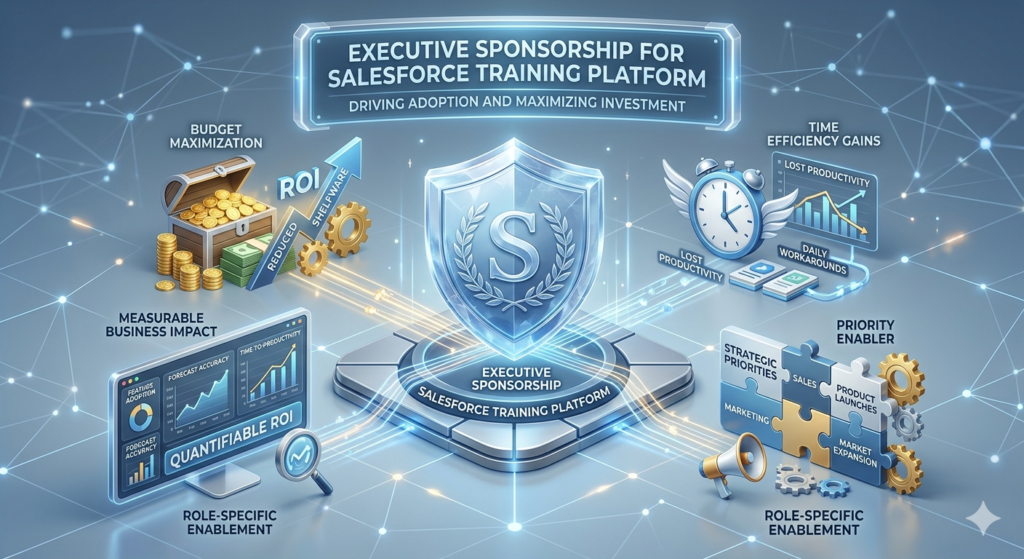
- Low adoption means you’re paying for capability you’re not using—essentially funding shelfware
- The cost of poor training isn’t just wasted licenses; it’s lost productivity, revenue leakage, and competitive disadvantage
Consider this calculation: If 100 sales representatives each lose 30 minutes daily to workarounds because they don’t understand Salesforce automation capabilities, that’s 50 hours of lost productivity per day. At an average fully-loaded cost of $75/hour, that’s $3,750 daily or nearly $1 million annually in wasted capacity.
Quality training that eliminates those workarounds pays for itself in weeks, not years.
2. Time Investment: “Our Teams Don’t Have Time for Training”
The Surface Objection: “Our people are already maxed out. We can’t afford to pull them offline for training sessions.”
The Underlying Concern: Executives fear productivity dips during training periods and question whether learning time will generate sufficient return.
The Reality Check:
Poor Salesforce proficiency creates a permanent productivity tax. Users who stumble through unfamiliar interfaces, manually perform tasks that could be automated, or duplicate work due to process ignorance don’t just lose learning time—they lose productive time every single day.
The time equation reverses:
- 8 hours of comprehensive training that eliminates daily 30-minute inefficiencies breaks even in 16 working days
- After breakeven, it generates permanent productivity gains
- Modern microlearning approaches minimize disruption through 15-minute modules integrated into workflow
Organizations resisting training time investment are choosing perpetual inefficiency over temporary learning curves—a decision that compounds losses over time.
3. Unclear ROI: “How Do We Measure Training Success?”
The Surface Objection: “Training outcomes are soft metrics. We need hard ROI calculations before committing budget.”
The Underlying Concern: Leadership lacks confidence in L&D’s ability to connect training activities to business outcomes. They’ve experienced training initiatives that produced completion certificates but not capability improvements.
The Reality Check:
This objection is entirely legitimate—and entirely addressable. Salesforce ROI training programs should absolutely demonstrate measurable business impact:
Quantifiable Metrics Include:
- User login frequency and session duration
- Feature adoption rates (automation, reporting, collaboration tools)
- Time-to-productivity for new hires
- Data quality improvements (complete records, duplicate reduction)
- Process compliance rates
- Sales cycle length reduction
- Customer service resolution time improvements
- Forecast accuracy enhancement
The Salesforce platform itself provides rich analytics to measure these dimensions. The key is establishing baseline metrics before training, then tracking improvement trajectories afterward.
Furthermore, enterprise Salesforce training programs should include defined success metrics in their charter documents, creating accountability for measurable outcomes rather than activity completion.
4. Employee Resistance: “People Will Resist Another Training Program”
The Surface Objection: “Our teams are suffering from initiative fatigue. Another mandatory training program will create resentment, not engagement.”
The Underlying Concern: Leadership has witnessed previous training mandates create compliance theater—people checking boxes without changing behaviors.
The Reality Check:
Employee resistance to training typically stems from three factors:
- Irrelevance: Training content doesn’t connect to daily work
- Poor Design: Death-by-PowerPoint approaches that don’t respect adult learning principles
- Lack of Context: Participants don’t understand the “why” behind the initiative
These are training design problems, not inherent resistance to learning.
When Salesforce training is:
- Role-specific (sales training differs from service training)
- Scenario-based (real situations they encounter daily)
- Immediately applicable (skills usable tomorrow, not theoretically)
- Leadership-endorsed (connected to strategic priorities)
…engagement improves dramatically.
Additionally, resistance often signals that users are struggling with the current state. Properly positioned, training becomes a relief—finally getting help with the platform they’ve been forced to use without adequate support.
5. Competing Priorities: “We Have More Urgent Initiatives”
The Surface Objection: “Salesforce training is important, but we have product launches, market expansion, and operational challenges that demand immediate attention.”
The Underlying Concern: Leadership operates in perpetual triage mode, addressing squeaky wheels rather than structural capabilities.
The Reality Check:
This objection reveals a critical misunderstanding: Salesforce proficiency isn’t separate from strategic priorities—it’s an enabler of those priorities.
Consider how Salesforce training accelerates common enterprise objectives:
- Market Expansion: Sales teams entering new markets need territory management, multilingual capabilities, and localized process knowledge
- Product Launches: Effective product rollout requires sales enablement content, campaign management, and customer communication—all Salesforce capabilities
- Operational Excellence: Process optimization depends on workflow automation, reporting, and data quality—capabilities requiring training to leverage
- Customer Experience Transformation: Service excellence requires omnichannel case management and knowledge base utilization—advanced Salesforce capabilities
When positioned correctly, Salesforce training isn’t competing with strategic priorities—it’s the infrastructure supporting their success.
Proven Strategies to Secure Leadership Buy-In for Salesforce Training
Now that we’ve dissected common objections, let’s examine actionable strategies that transform skeptical executives into training advocates.
Strategy 1: Align Training Initiatives with Strategic Business KPIs
The Approach:
Don’t present Salesforce training as an L&D initiative. Present it as a strategic enabler of specific business objectives leadership already cares about.
Implementation Framework:
Step 1: Identify Leadership’s Top 3-5 Strategic Priorities
Schedule brief conversations with key executives. Ask: “What are the critical business objectives you’re measured against this year?”
Common responses include:
- Revenue growth targets
- Customer retention improvement
- Operational cost reduction
- Market share expansion
- Digital transformation milestones
Step 2: Map Salesforce Capabilities to Those Priorities
For each strategic priority, identify specific Salesforce capabilities that directly contribute:
| Strategic Priority | Salesforce Capability | Training Requirement |
|---|---|---|
| Increase revenue 20% | Sales automation, opportunity management, forecasting accuracy | Advanced sales cloud training |
| Reduce customer churn 15% | Customer health scoring, proactive service, renewal management | Service cloud + customer success training |
| Improve operational efficiency | Process automation, report building, dashboard creation | Admin training + role-based workflow training |
Step 3: Present Training as the Bridge
Your proposal should explicitly state: “To achieve [Strategic Priority], we need [Salesforce Capability], which requires [Specific Training Investment].”
This reframes training from discretionary expense to necessary infrastructure.
Real-World Example:
A manufacturing company’s CEO prioritized reducing customer acquisition cost (CAC) by 25%. Their L&D director researched how Salesforce could contribute and discovered their sales team wasn’t using:
- Lead scoring (resulting in wasted effort on low-probability prospects)
- Email templates (causing inconsistent, time-consuming manual outreach)
- Opportunity stage automation (creating pipeline visibility gaps)
The proposal: “To reduce CAC 25%, we need to increase sales efficiency. Training our 50-person sales team on Salesforce automation capabilities will reduce time-per-lead by 40%, allowing them to engage 30% more qualified prospects with the same headcount.”
The CEO approved the budget in the same meeting.
Strategy 2: Build Bulletproof ROI Models That Speak Executive Language
The Approach:
Translate training investments into financial terms executives use daily: revenue impact, cost avoidance, productivity gains, and risk mitigation.
ROI Calculation Framework:
Component 1: Direct Productivity Gains
Calculate time saved through improved Salesforce proficiency:
textBaseline: Current average time spent on key processes
Target: Post-training time for same processes
Calculation: (Time Saved per User) × (Number of Users) × (Hourly Cost) × (Work Days per Year)
Example:
- 200 users save 45 minutes daily through automation mastery
- Average fully-loaded cost: $65/hour
- Working days: 240/year
- Annual value: 200 × 0.75 hours × $65 × 240 = $2,340,000
Component 2: Revenue Acceleration
Estimate revenue impact from improved sales effectiveness:
textImproved win rates + Faster sales cycles + Better pipeline visibility = Revenue uplift
Example:
- Training improves win rate from 18% to 22% (4% increase)
- Average deal size: $125,000
- Annual opportunities: 400
- Incremental revenue: 400 × 0.04 × $125,000 = $2,000,000
Component 3: Cost Avoidance
Quantify prevented costs:
- Reduced turnover: Better-trained employees report higher job satisfaction
- Decreased support tickets: Proficient users require less help desk assistance
- Lower error rates: Proper training reduces data quality issues requiring cleanup
Component 4: Risk Mitigation
Calculate potential loss from poor Salesforce utilization:
- Compliance violations from improper data handling
- Revenue recognition errors from forecasting inaccuracies
- Customer churn from poor service experiences
The Complete ROI Presentation:
Present a three-year financial model:
| Year | Training Investment | Productivity Gains | Revenue Impact | Cost Avoidance | Net Benefit | ROI |
|---|---|---|---|---|---|---|
| 1 | $450,000 | $1,200,000 | $800,000 | $250,000 | $1,800,000 | 400% |
| 2 | $180,000 | $2,340,000 | $2,000,000 | $380,000 | $4,540,000 | 2,522% |
| 3 | $180,000 | $2,340,000 | $2,400,000 | $380,000 | $4,940,000 | 2,744% |
Note: Year 1 includes development costs; Years 2-3 reflect maintenance and updates.
Pro Tip: Present conservative estimates. Executives trust models that acknowledge uncertainty. Include sensitivity analysis showing ROI under best-case, expected, and worst-case scenarios.
Strategy 3: Launch Strategic Pilot Programs That Demonstrate Value
The Approach:
When executives resist large-scale commitments, propose limited pilots that prove concept before full deployment.
Pilot Program Design Framework:
Selection Criteria for Pilot Groups:
Choose departments or teams where:
- Leadership is supportive (early adopter executives)
- Success metrics are clearly measurable
- Business impact is visible quickly
- Users are influential within the organization
Pilot Structure:
- Duration: 90-120 days (long enough to show sustained impact, short enough to maintain urgency)
- Size: 20-50 users (large enough for statistical significance, small enough for personalized attention)
- Success Metrics: 3-5 quantifiable KPIs directly tied to business outcomes
- Documentation Protocol: Rigorous before/after measurements, user testimonials, and executive-level summary reports
Real-World Pilot Example:
A financial services company wanted CXO Salesforce training approval for 800 wealth advisors. The COO was skeptical about training ROI.
The compromise: A 90-day pilot with 25 top-performing advisors in a single region.
Pilot Parameters:
- Investment: $35,000 (custom role-based training + ongoing coaching)
- Metrics Tracked: Client outreach efficiency, portfolio review completeness, cross-selling rates
- Governance: Bi-weekly executive briefings with quantified progress
Results After 90 Days:
- Client contact frequency increased 34% (automated reminders and calendar integration)
- Portfolio review completeness improved from 67% to 94% (workflow automation)
- Cross-selling opportunities identified increased 28% (relationship intelligence features)
- Advisor satisfaction scores increased 41% (reduced administrative burden)
The Outcome:
The pilot generated $2.1M in identified revenue opportunities. The COO approved full-scale training for all 800 advisors before the pilot officially concluded.
Pilot Success Factors:
- Executive sponsor visibility: Monthly pilot updates to leadership team
- Rapid iteration: Mid-pilot adjustments based on user feedback
- Success documentation: Video testimonials, data visualizations, financial impact summaries
- Scalability planning: Parallel development of enterprise rollout plan during pilot phase
Strategy 4: Embed Training in a Comprehensive Change Management Framework
The Approach:
Position Salesforce training not as isolated learning events, but as integral components of enterprise Salesforce change management strategy.
Why This Matters to Leadership:
Executives recognize that technology implementations fail due to change management deficiencies, not technical shortcomings. Presenting training within a formal change framework demonstrates strategic sophistication.
Change Management Integration Framework:
Phase 1: Awareness & Desire (Pre-Training)
Objective: Create organizational understanding of why Salesforce transformation matters
Leadership Activities:
- Town halls explaining strategic rationale
- Department-specific messaging about role-based benefits
- Success stories from pilot programs or peer organizations
Training Connection: Pre-learning modules that establish context before skill development
Phase 2: Knowledge & Ability (Training Delivery)
Objective: Build competency through structured learning
Components:
- Role-based curriculum design
- Hands-on practice environments
- Scenario-based learning aligned to actual work
- Performance support resources (job aids, quick references)
Leadership Connection: Executive attendance at kickoff sessions; leadership messaging about training importance
Phase 3: Reinforcement & Integration (Post-Training)
Objective: Ensure skills transfer to daily work and prevent regression
Mechanisms:
- Manager coaching requirements (leaders must support application)
- Performance metrics connected to Salesforce utilization
- Ongoing learning opportunities (advanced modules, office hours)
- Recognition systems celebrating proficiency milestones
Leadership Role: Regular reviews of adoption metrics; addressing barriers to application
The Prosci ADKAR Model Applied to Salesforce Training:
| ADKAR Stage | Salesforce Training Application | Leadership Responsibility |
|---|---|---|
| Awareness | Communicate why Salesforce transformation is necessary | Town halls, strategic messaging |
| Desire | Create personal motivation for Salesforce mastery | Connect proficiency to career development, incentives |
| Knowledge | Deliver role-specific training | Allocate time, budget, resources |
| Ability | Provide practice environments and coaching | Remove barriers to application |
| Reinforcement | Build adoption into performance management | Measure, review, recognize utilization |
Presenting to Leadership:
Your proposal should state: “Our Salesforce training investment is Phase 2 of a four-phase change management strategy designed to achieve [Strategic Objective]. Without formal training, the entire transformation initiative is at risk.”
This reframes training from optional enhancement to critical dependency.
Strategy 5: Quantify Risk Mitigation Benefits
The Approach:
Executives are often more motivated by loss avoidance than gain pursuit. Articulate specific risks that comprehensive training mitigates.
Risk Categories to Address:
1. Technology Investment Waste
The Risk: Paying for Salesforce capabilities that remain unused due to lack of knowledge
Quantification Method:
- Calculate annual Salesforce licensing costs
- Assess current feature utilization rate (Salesforce provides usage analytics)
- Multiply unused capability value by years of continued underutilization
Example Calculation:
- Annual Salesforce investment: $2.4M
- Current utilization: 35% of available features
- Unused capability value: $1.56M annually
- Three-year waste without training: $4.68M
2. Competitive Disadvantage
The Risk: Competitors leveraging Salesforce more effectively gain market advantages
Quantification Method:
- Research competitor Salesforce maturity (often visible through job postings, case studies)
- Identify capability gaps (automation, AI utilization, customer insights)
- Calculate market share vulnerability
Example:
“Our primary competitor recently announced Einstein AI deployment across their sales organization, enabling predictive lead scoring and automated next-best-action recommendations. Without training our teams on comparable Salesforce AI capabilities, we face systematic disadvantage in customer engagement efficiency.”
3. Compliance and Data Governance Risks
The Risk: Untrained users mishandle sensitive data, creating regulatory exposure
Quantification Method:
- Identify applicable regulations (GDPR, CCPA, HIPAA, SOX)
- Calculate potential penalty exposure
- Assess audit findings related to Salesforce usage
Example:
“Recent internal audit identified 47 instances of customer data mishandling in Salesforce, primarily due to users not understanding privacy controls. Under GDPR, potential fines reach €20M or 4% of annual revenue. Comprehensive data governance training mitigates this exposure.”
4. Productivity Opportunity Cost
The Risk: Perpetual inefficiency from manual workarounds compounds over time
We’ve covered this in ROI calculations, but from a risk perspective:
Example:
“Currently, our customer service team manually transfers data between systems because they don’t understand Salesforce integration capabilities. This ‘technical debt’ grows quarterly as data volumes increase. Without training, we’re not just inefficient now—we’re building inefficiency infrastructure that becomes harder to unwind.”
5. Talent Retention Risks
The Risk: Skilled employees leave when frustrated by inadequate tools and training
Quantification Method:
- Calculate turnover cost (typically 1.5-2× annual salary for knowledge workers)
- Survey employee satisfaction regarding tools and training
- Estimate turnover reduction from improved training
Example:
“Exit interviews from our last 12 sales departures cited ‘inadequate tools and training’ as a top-3 factor in 8 cases. Average replacement cost for sales roles: $175K. Training investment that prevents even 3 departures annually pays for itself.”
Risk Mitigation Presentation Framework:
Structure your proposal:
- Current State Risks: Quantified exposures without training intervention
- Mitigation Strategy: How comprehensive training addresses each risk
- Residual Risk: Realistic assessment of remaining exposure post-training
- Risk-Adjusted ROI: Financial model incorporating both opportunity gains and loss prevention
This approach appeals to risk-averse executives who prioritize downside protection.
Strategy 6: Connect Training Directly to Revenue Growth and Productivity
The Approach:
Make explicit connections between Salesforce proficiency and the metrics executives are personally measured against.
Revenue Growth Connection Points:
For Sales Organizations:
Training Impact Areas:
- Pipeline Velocity: Training on opportunity stage automation reduces sales cycle length
- Win Rates: Proper use of competitive intelligence and collaboration features improves close rates
- Deal Size: Training on cross-sell identification and product configuration increases average contract value
- Forecast Accuracy: Proper data hygiene and probability management training improves predictability
Presentation Approach:
“Our CRO is measured on achieving $50M revenue growth this fiscal year. Sales Cloud training that improves our win rate by just 3 percentage points generates $4.2M in additional revenue—8.4% of the annual target from training alone.”
For Service Organizations:
Training Impact Areas:
- Case Resolution Time: Workflow automation and knowledge base utilization reduce handling time
- First-Contact Resolution: Omnichannel training and customer history access improve resolution rates
- Customer Satisfaction: Personalized service enabled by 360-degree customer views increases CSAT scores
- Agent Efficiency: Automation training increases cases handled per agent
Presentation Approach:
“Our COO has committed to 15% efficiency improvement in customer service. Service Cloud training that reduces average handle time by 4 minutes per case saves 8,000 hours annually—equivalent to 4 full-time agents or $380K in capacity creation.”
For Leadership Teams:
Training Impact Areas:
- Decision Quality: Advanced reporting and dashboard training improves data-driven decisions
- Strategic Visibility: Executive-level training on Einstein Analytics enables predictive planning
- Cross-Functional Alignment: Shared platform proficiency reduces departmental silos
- Governance Capability: Admin training ensures platform scales sustainably
Productivity Multiplication Framework:
Help executives understand that Salesforce training creates compound productivity:
Level 1: Individual Efficiency
- Users complete existing tasks faster
- Example: Automated email sequences save 2 hours weekly per sales rep
Level 2: Process Optimization
- Teams redesign workflows using newly-understood capabilities
- Example: Service team implements escalation automation, reducing management intervention 60%
Level 3: Strategic Capability
- Organization pursues opportunities impossible without platform proficiency
- Example: Marketing launches account-based campaigns using Salesforce data they previously couldn’t access
Presentation Structure:
Create a “growth pathway” visual showing:
- Current State: Baseline performance metrics
- Training Intervention: Specific competencies developed
- Improved State: Projected performance improvements
- Strategic Enablement: New capabilities unlocked
- Cumulative Impact: Multi-year compounding effect
This demonstrates that training isn’t a one-time improvement but an investment that generates increasing returns.
What CXOs Care About: Tailoring Your Message to the C-Suite
Securing executive sponsorship Salesforce requires understanding distinct priorities across the C-suite. Here’s how to customize your approach for each executive role.
For the CEO: Strategic Transformation and Competitive Position
Primary Concerns:
- Market leadership and competitive differentiation
- Strategic transformation execution
- Board and investor expectations
- Enterprise-wide alignment
How Salesforce Training Connects:
CEOs care about whether your organization can execute strategy faster and better than competitors. Position training as strategic infrastructure:
Messaging Framework:
“Our Salesforce investment represents a strategic bet on data-driven customer excellence. However, technology alone doesn’t create competitive advantage—organizational capability does. Companies that achieve Salesforce proficiency across their enterprise report 2.4× faster growth than competitors with similar technology but inferior adoption (source: Salesforce State of Sales report).
Our training initiative ensures we don’t just own Salesforce—we master it before competitors do, creating sustainable advantage in customer insight, operational efficiency, and market responsiveness.”
CEO-Specific Metrics:
- Market share trajectory
- Customer lifetime value growth
- Net promoter score improvement
- Strategic initiative success rates
Real-World CEO Perspective:
A Fortune 500 retail CEO approved enterprise-wide Salesforce training after his board questioned why customer satisfaction scores weren’t improving despite significant technology investments.
His realization: “We bought a Formula 1 car but hired drivers who only know how to drive sedans. Training isn’t optional—it’s the difference between justifying this investment to our board or explaining why we wasted it.”
For the CIO/CTO: Technology ROI and Adoption
Primary Concerns:
- Technology investment returns
- Platform adoption and utilization
- Technical debt management
- IT resource optimization
- Digital transformation roadmap execution
How Salesforce Training Connects:
CIOs understand that successful technology deployments require user capability development. They’ve seen expensive systems fail due to adoption challenges.
Messaging Framework:
“Our Salesforce platform represents significant technology investment, but current utilization metrics indicate we’re capturing only 40% of potential value. User proficiency is the primary constraint—not platform capability.
Comprehensive training addresses our adoption challenge systematically, reducing help desk burden on IT (currently 230 Salesforce tickets monthly), improving data quality (reducing downstream integration issues), and enabling advanced capabilities (AI, automation) that currently require manual IT intervention.”
CIO-Specific Metrics:
- Platform utilization rates (active users, feature adoption)
- Help desk ticket reduction
- Data quality improvements
- Time to deploy new capabilities
- Shadow IT reduction (users stop building workarounds outside Salesforce)
Technical Debt Argument:
“Every quarter we delay proper training, our technical debt compounds. Users build manual workarounds, create duplicate data structures, and develop dependencies on unsustainable processes. These accumulate as ‘adoption debt’ that becomes progressively harder to unwind. Training investment now prevents exponentially larger remediation costs later.”
For the CFO: Financial Returns and Cost Management
Primary Concerns:
- Return on investment
- Budget efficiency
- Cost structure optimization
- Financial risk management
- Capital allocation priorities
How Salesforce Training Connects:
CFOs need clear financial justification. They appreciate rigorous ROI models and risk-adjusted projections.
Messaging Framework:
“Our Salesforce licensing represents $3.2M in annual recurring cost—a fixed expense whether users are proficient or not. Current adoption analysis suggests we’re generating approximately $0.35 of value per dollar spent.
Training investment of $580K creates measurable returns through:
- Productivity gains: $2.1M annually (validated through time-motion studies)
- Revenue acceleration: $1.8M (conservative 3% win rate improvement)
- Cost avoidance: $640K (reduced turnover, support costs, rework)
This generates 3-year NPV of $8.4M and IRR of 287%—superior to most capital allocation alternatives available to us.”
CFO-Specific Presentation Elements:
- Detailed financial models with sensitivity analysis
- Payback period calculations (typically 4-8 months for Salesforce training)
- Opportunity cost analysis (cost of not training)
- Budget efficiency metrics (cost per user, cost per competency hour)
- Capital allocation comparison (training ROI vs. alternative investments)
Risk Management Angle:
CFOs appreciate risk mitigation. Emphasize: “Without training, our $3.2M annual Salesforce investment is at risk. Industry data shows platforms with sub-50% adoption rates face 70% probability of abandonment or replacement within 3 years—creating write-off risk and replacement costs potentially exceeding $15M.”
For the CRO/Chief Revenue Officer: Sales Effectiveness and Pipeline Growth
Primary Concerns:
- Revenue target achievement
- Sales productivity and efficiency
- Pipeline quality and velocity
- Forecast accuracy
- Customer acquisition cost
How Salesforce Training Connects:
CROs care intensely about sales team effectiveness. They need confidence that training translates to quota attainment.
Messaging Framework:
“We’re asking our sales organization to deliver 25% revenue growth with only 8% headcount increase. This requires material productivity gains from existing team members.
Sales Cloud training creates direct revenue impact through:
- Pipeline velocity improvement (reducing 87-day sales cycle by 12 days)
- Win rate enhancement (increasing 22% close rate to 26%)
- Opportunity identification (increasing average opportunities per rep from 14 to 19)
- Forecast accuracy (reducing variance from 18% to under 10%)
These improvements compound to $6.2M in incremental revenue—12% of our growth target from training-driven productivity alone.”
CRO-Specific Metrics:
- Revenue per sales rep
- Sales cycle length
- Win/loss ratios
- Pipeline coverage ratios
- Forecast accuracy
- Ramp time for new hires
Competitive Intelligence:
“Our primary competitors have invested heavily in sales enablement and Salesforce proficiency. Their average rep productivity (revenue per seller) exceeds ours by 34%. This gap isn’t talent—it’s capability and tool mastery. Training investment closes this competitive gap.”
For the CHRO/Chief Human Resources Officer: Talent Development and Retention
Primary Concerns:
- Employee engagement and satisfaction
- Talent retention
- Learning and development effectiveness
- Workforce capability building
- Employer brand and recruitment
How Salesforce Training Connects:
CHROs understand that training investments signal organizational commitment to employee development, impacting retention and engagement.
Messaging Framework:
“Exit interview analysis reveals ‘inadequate tools and training’ as a top-3 factor in 42% of regretted departures—particularly among high performers.
Salesforce training addresses this by:
- Demonstrating organizational investment in employee success
- Building marketable skills that enhance career development
- Reducing frustration with inadequate tool knowledge
- Creating clear competency frameworks linked to advancement
Employee Net Promoter Score correlates strongly with training availability. Organizations with comprehensive platform training report 28% higher eNPS and 31% lower regrettable attrition.”
CHRO-Specific Metrics:
- Employee satisfaction scores
- Regrettable turnover reduction
- Training completion and satisfaction rates
- Internal mobility and promotion rates
- Employer brand strength
Talent Attraction Angle:
“Salesforce proficiency is a resume-building skill. Offering comprehensive training enhances our employee value proposition, making us more attractive to top talent and reducing recruitment costs. Competitors advertising ‘Salesforce training and certification opportunities’ in job postings are using our lack of formal training as a recruitment advantage.”
For the COO: Operational Excellence and Process Efficiency
Primary Concerns:
- Operational efficiency
- Process standardization and scalability
- Quality and compliance
- Cross-functional coordination
- Capacity optimization
How Salesforce Training Connects:
COOs focus on operational systems and process excellence. They appreciate training that creates process consistency and reduces operational friction.
Messaging Framework:
“Our operational excellence initiative requires standardized, scalable processes across all customer-facing functions. Salesforce is our process backbone, but inconsistent user proficiency creates process variability.
Training establishes:
- Standardized workflows across departments
- Automated process compliance (reducing manual oversight)
- Cross-functional visibility (reducing coordination costs)
- Scalable operational models (supporting growth without proportional headcount)
Process standardization through training reduces operational cost-to-serve by 18-24% while improving quality metrics.”
COO-Specific Metrics:
- Process cycle times
- Error and rework rates
- Cross-functional handoff efficiency
- Scalability metrics (revenue per employee)
- Compliance rates
Operational Risk:
“Current process inconsistency creates operational fragility. When key employees leave, their Salesforce workarounds and undocumented processes leave with them. Standardized training creates institutional process knowledge, reducing key-person dependencies and operational risk.”
Practical Implementation: Real-World Scenarios
Let’s examine three detailed scenarios showing how organizations successfully secured leadership buy-in for Salesforce training.
Scenario 1: Global Manufacturing Company – The Data Quality Crisis
Company Profile:
- $2.8B revenue manufacturer
- 1,200 Salesforce users across sales, service, and operations
- 5-year Salesforce investment: $18M
The Challenge:
18 months after Salesforce implementation, the CFO questioned continued investment. An audit revealed:
- 34% of customer records contained critical errors
- Sales forecasts varied 40% from actual results
- Customer service couldn’t access accurate order history
- Duplicate accounts proliferated across systems
The root cause: Users didn’t understand data governance, validation rules, or proper record management.
The Resistance:
When the Salesforce Admin proposed comprehensive training:
- CFO: “We’ve spent $18M. Why do we need more budget to make it work?”
- CRO: “My sales team needs to sell, not sit in training sessions.”
- COO: “We’ve done training. People just don’t care about data quality.”
The Strategy:
The IT Director partnered with Finance to build a compelling case:
Step 1: Quantify the Data Quality Cost
They calculated direct costs of poor data quality:
- Lost Revenue: $4.7M in duplicate orders, billing errors, and missed renewals
- Rework Costs: 2,400 hours monthly correcting data issues (12 FTE capacity)
- Customer Impact: 34% of service cases delayed due to inaccurate data
- Decision Quality: Executive dashboards unreliable, forcing manual reporting
Total Annual Impact: $8.2M
Step 2: Present Training as Crisis Response
Rather than positioning training as enhancement, they framed it as crisis mitigation:
“We face a data quality crisis that costs $8.2M annually and threatens forecast credibility with our board. The root cause is user capability, not system design. Training investment of $620K addresses this crisis at a 13:1 return ratio.”
Step 3: Implement Phased Approach with Executive Visibility
- Phase 1 (Month 1-2): Sales leadership training on data governance importance
- Phase 2 (Month 2-4): Role-based training for all users on data quality standards
- Phase 3 (Month 4-6): Advanced training on validation rules, reporting, automation
- Governance: Monthly executive dashboard showing data quality improvements
Step 4: Create Accountability
Data quality metrics became part of departmental scorecards reviewed by executives monthly.
The Outcome:
After 6 months:
- Critical data errors reduced from 34% to 4%
- Forecast accuracy improved from 60% to 91%
- Customer service data-related case delays dropped 78%
- Manual data cleanup time reduced by 1,800 hours monthly
CFO Quote: “This training investment generated higher ROI than our last three capital equipment purchases combined. Why didn’t we do this 18 months ago?”
Key Success Factors:
- Quantified the pain (crisis framing)
- Made executives personally accountable for improvement
- Created visible, frequent progress reporting
- Connected training to specific business crisis
Scenario 2: Healthcare Organization – The Compliance Imperative
Company Profile:
- Regional healthcare network
- 850 Salesforce users in patient services, case management, and administration
- Handling protected health information (PHI) under HIPAA
The Challenge:
An internal audit discovered 73 potential HIPAA violations related to Salesforce usage:
- Improper sharing of patient records
- PHI visible in reports without proper controls
- Unauthorized users accessing sensitive data
- Inadequate audit trail documentation
The Resistance:
When the Compliance Officer proposed mandatory Salesforce security training:
- CEO: “We do annual HIPAA training. Why is Salesforce different?”
- CHRO: “Our clinical staff are overwhelmed. More training will create burnout.”
- CIO: “We have technical controls. This is a policy enforcement issue, not training.”
The Strategy:
The Compliance Officer partnered with Legal to create urgency:
Step 1: Quantify Regulatory Risk
They presented financial exposure:
- HIPAA Penalty Range: $100-$50,000 per violation
- Potential Exposure (73 violations): $7,300 – $3,650,000
- OCR Audit Probability: 12% annually, rising to 45% after self-reported incident
- Reputation Damage: Incalculable but potentially existential
Step 2: Frame Training as Risk Mitigation, Not Burden
Rather than “additional training,” they positioned it as “compliance infrastructure”:
“Our current HIPAA training covers general principles but doesn’t address Salesforce-specific security configurations. Users don’t understand sharing rules, field-level security, or audit trail requirements. This isn’t asking them to learn something new—it’s ensuring they can safely use the tools we’ve already deployed.”
Step 3: Design Role-Specific, Microlearning Approach
To address burnout concerns:
- 15-minute microlearning modules integrated into workflow
- Role-specific content (clinical vs. administrative)
- Scenario-based learning using realistic patient situations
- Monthly 5-minute refreshers rather than annual marathons
Step 4: Make it a Licensure Requirement
The breakthrough: positioning Salesforce security training as a requirement for system access, similar to background checks or credential verification.
The Outcome:
- 98% completion rate within 60 days
- Follow-up audit found zero critical violations
- OCR audit (which did occur 14 months later) resulted in zero findings
- Staff actually appreciated clarity on proper procedures
CEO Quote: “I initially saw this as bureaucratic overhead. But during the OCR audit, the auditor specifically praised our Salesforce security training program as a best practice. That validation alone was worth the investment.”
Key Success Factors:
- Leveraged regulatory risk as motivator
- Designed training that respected user time constraints
- Made training a system access requirement
- Achieved measurable compliance improvement
Scenario 3: Technology Company – The Competitive Urgency Play
Company Profile:
- B2B SaaS company
- $450M revenue, high-growth market
- 320 Salesforce users primarily in sales and customer success
The Challenge:
The CRO noticed disturbing trends:
- Sales cycle lengthening (78 days to 94 days over 18 months)
- Win rates declining (34% to 28%)
- Customer churn increasing (12% to 16% annually)
Competitive intelligence revealed primary competitors had invested heavily in Salesforce Einstein AI, predictive analytics, and advanced automation—capabilities this company’s licenses included but teams didn’t use.
The Resistance:
When the CRO proposed advanced Salesforce training:
- CEO: “Our people are smart. They’ll figure it out.”
- CFO: “We’re not hitting revenue targets. How does training help us close more deals this quarter?”
- Sales VPs: “Training takes them off the phones. We need them selling.”
The Strategy:
The CRO built a competitive urgency narrative:
Step 1: Demonstrate Competitive Disadvantage
He commissioned competitive analysis showing:
- Competitor A: Announced Einstein AI deployment, claiming 30% improvement in lead prioritization
- Competitor B: Case study showing 22% sales cycle reduction through Salesforce automation
- Competitor C: Job postings requiring “advanced Salesforce proficiency” for sales roles
Competitor Capability Map:
| Salesforce Capability | Our Usage | Competitor Avg | Competitive Gap |
|---|---|---|---|
| Einstein Lead Scoring | 0% | 67% | -67% |
| Sales Automation | 23% | 81% | -58% |
| Predictive Analytics | 5% | 72% | -67% |
| Collaborative Selling | 18% | 65% | -47% |
Step 2: Frame Training as Competitive Response
“We’re competing with organizations that are systematically leveraging Salesforce capabilities we’re ignoring. This isn’t a training problem—it’s a competitive positioning problem. Our current approach is equivalent to buying a sports car and only using first gear while competitors run full throttle.”
Step 3: Design “Competitive Bootcamp” Program
To address immediate urgency:
- Accelerated format: 3-week intensive program
- Competitive intelligence integration: Training included how competitors were using these capabilities
- Immediate application: Each session followed by 48-hour “challenge” to apply concepts to real deals
- Performance tracking: Metrics dashboard showing trained vs. untrained rep performance
Step 4: Create Executive Champions
The CRO personally participated in week 1, sending a powerful message about importance.
The Outcome:
Within 90 days of training cohort 1 (80 reps):
- Sales Cycle: Decreased from 94 to 81 days (13-day improvement)
- Win Rate: Increased from 28% to 33% (5-point improvement)
- Pipeline Quality: Predictive lead scoring increased qualified opportunities 41%
- Rep Confidence: Sales team NPS increased 38 points
Revenue Impact: The trained cohort generated $8.4M more in closed revenue than untrained peers over 120 days.
CEO Quote: “I initially thought ‘our people will figure it out.’ But we were essentially asking them to compete in a Formula 1 race without ever teaching them how the car works. This training didn’t just improve performance—it leveled a playing field we didn’t realize was tilted against us.”
The Rollout:
The results were so compelling that the CEO mandated training for all customer-facing roles and personally sponsored expansion to customer success, marketing, and operations.
Key Success Factors:
- Competitive framing created urgency
- Fast, intensive format addressed “time away from selling” objection
- Visible executive participation signaled importance
- Rapid, measurable results built momentum
Building Your Leadership Buy-In Roadmap: A Step-by-Step Implementation Guide
Now let’s translate these strategies into an actionable roadmap you can execute.
Phase 1: Research and Foundation (Weeks 1-3)
Objective: Build the data foundation for your business case
Activities:
1. Conduct Salesforce Utilization Analysis
- Log into Salesforce Setup → Analytics → Adoption Dashboard
- Document: active users, feature adoption rates, login frequency
- Identify: unused features, underutilized capabilities, adoption gaps
- Calculate: % of paid capability actually being used
2. Survey Stakeholders
Create brief (5-7 question) surveys for:
- End Users: What Salesforce tasks take longest? What capabilities would help your role?
- Managers: How does Salesforce proficiency impact team performance?
- Executives: What business outcomes should Salesforce enable?
3. Benchmark Against Industry Standards
Research:
- Industry-specific Salesforce maturity benchmarks (Salesforce releases annual reports)
- Competitor job postings (what Salesforce skills do they require?)
- Analyst reports (Gartner, Forrester on CRM adoption best practices)
4. Quantify Current State Costs
Calculate:
- Time spent on manual workarounds
- Help desk tickets and support costs
- Data quality issues and rework
- Missed opportunities due to poor visibility
Deliverable: Executive Summary document (2-3 pages) titled “Salesforce Current State Assessment: Opportunities and Risks”
Phase 2: Coalition Building (Weeks 3-5)
Objective: Identify and recruit internal champions
Activities:
1. Map Executive Priorities
For each C-suite member:
- Research public commitments (board presentations, all-hands talks)
- Identify personal KPIs and measurement areas
- Document strategic initiatives they’re personally driving
2. Identify Early Adopter Departments
Look for teams/leaders who:
- Already advocate for better Salesforce usage
- Have clear, measurable performance metrics
- Are influential within the organization
- Would benefit visibly from improved proficiency
3. Conduct Informal Discovery Conversations
Schedule 20-minute conversations with potential champions:
- “What are your top 3 priorities this year?”
- “How is Salesforce helping or hindering those priorities?”
- “If you could wave a magic wand and improve one thing about how your team uses Salesforce, what would it be?”
4. Recruit Executive Sponsor
Identify the single most influential executive whose priorities align most closely with training outcomes. Schedule dedicated time to present initial thinking and request sponsorship.
Deliverable: Stakeholder Map showing supporters, resisters, and neutrals with tailored engagement strategies for each
Phase 3: Business Case Development (Weeks 5-8)
Objective: Build bulletproof financial and strategic justification
Activities:
1. Develop ROI Model
Using framework provided earlier:
- Productivity gains calculation
- Revenue impact projection
- Cost avoidance quantification
- Risk mitigation valuation
- Three-year NPV and IRR calculation
2. Create Executive-Specific Value Propositions
Develop one-page summaries for each C-suite role showing how training supports their specific objectives.
3. Design Pilot Program Proposal
If anticipating resistance:
- Select pilot department/team
- Define 90-day success metrics
- Calculate pilot investment
- Outline full-scale rollout plan contingent on pilot success
4. Develop Risk Scenarios
Create “what happens if we don’t invest in training” scenarios:
- Continued low adoption trajectory
- Competitive disadvantage progression
- Potential technology abandonment costs
- Regulatory or compliance exposure
5. Assemble Supporting Evidence
Gather:
- Industry research on training ROI
- Case studies from peer organizations
- Analyst reports on adoption success factors
- Internal data supporting your calculations
Deliverable: Comprehensive Business Case document with executive summary, detailed financial model, and appendices with supporting data
Phase 4: Proposal Presentation (Weeks 8-10)
Objective: Secure decision and budget approval
Activities:
1. Pre-Socialize with Key Stakeholders
Before formal presentation:
- Share draft proposal with executive sponsor for feedback
- Brief each C-suite member individually on relevant sections
- Incorporate feedback and build pre-meeting alignment
2. Develop Executive Presentation
Create concise (12-15 slide) presentation:
- Slide 1: Executive summary (the ask, the return, the timeline)
- Slides 2-3: Current state assessment (the problem)
- Slides 4-6: Business impact and ROI (the opportunity)
- Slides 7-8: Strategic alignment (why now, competitive context)
- Slides 9-11: Implementation approach (how we’ll execute)
- Slide 12: Risk mitigation (what happens if we don’t)
- Slides 13-14: Investment requirement and approval request
- Slide 15: Next steps and decision points
3. Rehearse Thoroughly
- Practice with friendly stakeholders
- Prepare answers to likely objections
- Time your presentation (leave 50% of meeting time for discussion)
- Develop backup slides for detailed questions
4. Conduct Formal Presentation
Best practices:
- Start with the recommendation, not background
- Focus on outcomes, not activities
- Speak to executive priorities, not training methodology
- Present data confidently with sources
- Welcome challenges and questions
- End with clear decision request and next steps
5. Follow-Up
After presentation:
- Send summary email with key points and action items
- Provide any requested additional analysis within 24-48 hours
- Schedule follow-up decision meeting if needed
- Continue one-on-one conversations with undecided stakeholders
Deliverable: Formal approval and budget allocation for Salesforce training program
Phase 5: Program Design (Weeks 10-14)
Objective: Design training program that delivers promised outcomes
Activities:
1. Define Learning Objectives
Based on business case commitments:
- What specific capabilities will participants develop?
- How do these capabilities connect to measured outcomes?
- What proficiency levels are required for different roles?
2. Develop Curriculum Architecture
- Role-based learning paths (sales, service, marketing, admin, executive)
- Competency models (foundational → intermediate → advanced)
- Delivery modalities (instructor-led, self-paced, microlearning, coaching)
- Timeline and sequencing
3. Select Training Delivery Partners
Evaluate options:
- Internal L&D development
- Salesforce official training (Trailhead, instructor-led)
- Specialized Salesforce training partners (like RizeX Labs)
- Hybrid approaches
Criteria:
- Business outcome focus (not just feature training)
- Customization capability (your industry, processes, use cases)
- Measurement and reporting (proving ROI you promised)
- Scalability (can grow with rollout)
4. Design Measurement Framework
Establish baseline metrics and tracking mechanisms:
- Level 1 (Reaction): Participant satisfaction surveys
- Level 2 (Learning): Knowledge assessments, skill demonstrations
- Level 3 (Behavior): Salesforce usage analytics, manager observations
- Level 4 (Results): Business outcome metrics tied to original business case
5. Develop Change Management Plan
Build supporting infrastructure:
- Communication calendar (before, during, after training)
- Manager enablement (preparing leaders to support application)
- Performance support resources (job aids, quick references, office hours)
- Recognition and incentive programs
Deliverable: Detailed Training Program Design document with curriculum, delivery plan, and measurement framework
Phase 6: Pilot Execution (Weeks 14-26, if applicable)
Objective: Prove concept and refine approach before full-scale rollout
Activities:
1. Execute Pilot Program
- Deliver training to selected pilot group
- Maintain rigorous measurement discipline
- Gather continuous feedback
- Make real-time adjustments
2. Document Results
- Compile before/after metrics
- Gather participant testimonials
- Calculate actual ROI
- Identify lessons learned
3. Report to Leadership
- Bi-weekly or monthly executive updates
- Final pilot results presentation
- Recommendations for full-scale rollout
- Request approval for enterprise expansion
Deliverable: Pilot Results Report with data, insights, and rollout recommendations
Phase 7: Enterprise Rollout and Reinforcement (Weeks 26+)
Objective: Scale successful pilot approach across organization
Activities:
1. Phased Rollout Execution
- Deploy training to cohorts by department, region, or role
- Maintain measurement rigor
- Continue executive reporting cadence
2. Build Sustainability Infrastructure
- Ongoing learning opportunities (advanced modules, refreshers)
- Community of practice (user groups, champions network)
- Continuous content updates aligned to Salesforce releases
- Integration with onboarding for new hires
3. Communicate Success
- Share wins broadly (internal newsletters, town halls, recognition events)
- Celebrate milestones (adoption %, certification achievement)
- Reinforce connection to business outcomes
- Maintain executive visibility
4. Iterate and Improve
- Quarterly program reviews
- Curriculum updates based on feedback and results
- Expansion to new capabilities as platform evolves
- Continuous ROI tracking and reporting
Deliverable: Sustained Salesforce training program that becomes part of organizational culture
Overcoming Final Objections: A Quick-Reference Guide
When you’re in the room and face unexpected resistance, use these proven response frameworks:
Objection: “We don’t have budget this year”
Response Framework:
“I understand budget constraints. Let me share three considerations:
First, we’re already spending [$X] annually on Salesforce licenses. Without training, we’re paying for capability we’re not using—essentially pre-committing to waste.
Second, the cost of NOT training compounds quarterly. Our analysis shows poor adoption currently costs [$Y] monthly in productivity loss and missed opportunities. Each quarter we delay training, we forfeit [$3Y] in value.
Third, I’ve designed this proposal with budget flexibility. We could start with a [targeted pilot / single department / phased approach] for [$Z], prove ROI within 90 days, then use demonstrated results to justify expanded funding next quarter.
Which approach would work best given current constraints?”
Key Technique: Acknowledge the constraint, reframe the cost comparison, offer flexible alternatives
Objection: “Our people are too busy”
Response Framework:
“That’s precisely why training is urgent. Our team is busy because they’re working inefficiently.
We’ve calculated that [sales reps / service agents / specific role] currently spend an average of [X minutes/hours] daily on manual tasks that Salesforce could automate. That’s [Y hours] of productive capacity we’re losing weekly.
Training represents a [Z hour] time investment per person. But it eliminates [X minutes] of daily inefficiency permanently. The payback happens in [calculation: Z hours ÷ X minutes daily savings] working days.
We’re not asking people to be busy with training in addition to their work. We’re investing time now to make them less busy permanently. Would you prefer they stay perpetually busy with inefficient processes, or invest brief time learning to work smarter?”
Key Technique: Flip the “too busy” argument—they’re busy because they need training
Objection: “Can’t they just learn from YouTube/Trailhead?”
Response Framework:
“Self-directed learning resources are valuable, and we should definitely leverage them. However, they address only part of our need.
YouTube and Trailhead teach general Salesforce features. What they don’t teach is:
- How to use Salesforce within OUR specific business processes
- OUR data governance standards and compliance requirements
- How to achieve OUR strategic objectives using the platform
- How to integrate with OUR other systems and workflows
Additionally, self-directed learning creates inconsistent proficiency. Everyone learns different things at different levels, creating process fragmentation.
Our approach leverages free resources like Trailhead for foundational knowledge, but adds structured, customized training that ensures consistent proficiency aligned to our business needs. This isn’t either/or—it’s both/and.”
Key Technique: Validate the resource, then explain what it can’t do
Objection: “We tried training before and it didn’t work”
Response Framework:
“That’s valuable context. Help me understand—what didn’t work about the previous training?”
[Listen to response, then address specific concerns. Common themes and responses:]
If previous training was too generic:
“Our approach is fundamentally different. We’re designing role-specific, scenario-based training using your actual business processes and data, not generic feature overviews.”
If previous training wasn’t applied:
“You’ve identified the key issue—training without application doesn’t create change. Our design includes mandatory manager coaching, performance metrics tied to Salesforce usage, and ongoing reinforcement. We’re not just teaching; we’re ensuring application.”
If previous training lacked executive support:
“That’s precisely why executive sponsorship is the first element of this proposal. Without leadership reinforcement, training becomes optional. This initiative includes monthly executive reviews, leadership communication, and accountability mechanisms that create organizational expectation, not just individual opportunity.”
Key Technique: Diagnose why previous training failed, then differentiate your approach
Objection: “Prove this will work for OUR organization”
Response Framework:
“Excellent question. Let me offer three forms of proof:
First, data-driven projection: I’ve built our ROI model using conservative assumptions based on YOUR current Salesforce usage data, YOUR productivity metrics, and YOUR business objectives. [Share 2-3 specific numbers from your analysis].
Second, industry validation: [Share 1-2 relevant case studies or research from similar industries/company sizes].
Third, risk mitigation: I’m proposing we start with a limited pilot—[specific department/team] over [90/120] days with clearly defined success metrics. This lets us prove the approach works in our context before enterprise-scale investment. If the pilot doesn’t deliver measurable results, we don’t proceed with broader rollout.
Which of these proof points would be most valuable to validate further?”
Key Technique: Offer multiple forms of evidence; propose pilot to reduce decision risk
Measuring Success: Proving Training ROI Post-Implementation
Securing approval is only half the battle. Delivering promised results and communicating them effectively ensures sustained support and funding.
Establish Measurement Framework Before Training Begins
Critical Success Factors:
- Baseline Metrics: Document current state before any training occurs
- Clear Attribution: Design measurement to isolate training impact from other variables
- Regular Cadence: Report progress at consistent intervals (monthly executive summaries)
- Multiple Evidence Types: Combine quantitative metrics with qualitative testimonials
Key Performance Indicators by Category
Adoption Metrics:
- Daily/weekly active users (%)
- Average session duration
- Feature utilization rates by role
- Login frequency
- Mobile adoption
Efficiency Metrics:
- Time spent on key processes (before/after)
- Tasks automated vs. manual
- Report generation time
- Data entry speed
- Case resolution time
Quality Metrics:
- Data completeness (%)
- Duplicate records
- Forecast accuracy
- Error rates
- Compliance scores
Business Outcome Metrics:
- Revenue per sales rep
- Sales cycle length
- Win rates
- Customer satisfaction (CSAT/NPS)
- Customer retention
- Pipeline coverage
- Marketing qualified lead conversion
Financial Metrics:
- Cost per transaction
- Support ticket costs
- Training ROI
- License utilization value
Reporting Templates for Executive Audiences
Monthly Executive Dashboard (one-page):
textSALESFORCE TRAINING IMPACT SUMMARY
Month: [Month Year]
Cohorts Trained: [X teams, Y employees]

KEY WINS:
✓ [Specific metric] improved from [baseline] to [current] ([X%] improvement)
✓ [Specific outcome] achieved [Y days/weeks] ahead of target
✓ User satisfaction with Salesforce increased [Z points]

BUSINESS IMPACT:
→ Revenue: $[X] incremental revenue attributed to trained teams
→ Efficiency: [Y] hours reclaimed weekly through automation adoption
→ Quality: [Z%] reduction in data errors

PROGRAM HEALTH:
→ Training Completion: [X%] (target: [Y%])
→ User Satisfaction: [A/B] (target: [C/D])
→ Manager Support: [E%] of managers actively coaching application

ROI TRACKING:
→ Program Investment (YTD): $[X]
→ Measured Value Created (YTD): $[Y]
→ Current ROI: [Z%]

NEXT MONTH PRIORITIES:
→ [Priority 1]
→ [Priority 2]
→ [Priority 3]
Quarterly Business Review Presentation (8-10 slides):
- Executive Summary (wins, challenges, ROI)
- Training Cohort Progress (who’s been trained, what’s next)
- Adoption Metrics Trends (graphs showing improvement trajectories)
- Business Outcome Impact (revenue, efficiency, quality improvements)
- User Voice (testimonial quotes, satisfaction data)
- Manager Feedback (leadership perspective on team changes)
- ROI Analysis (financial model actuals vs. projections)
- Lessons Learned & Adjustments (program improvements based on data)
- Next Quarter Roadmap
- Executive Asks (resources, support needed)
Storytelling Your Success: Making Data Memorable
Numbers matter, but stories create emotional connection and memory.
Effective Success Story Framework:
The Challenge: “[Team/Individual] was struggling with [specific problem] that impacted [business outcome]”
The Intervention: “Through Salesforce training on [specific capability], they learned [skill/process]”
The Transformation: “Within [timeframe], [specific change happened]”
The Impact: “This created [quantified business result] and [qualitative benefit]”
Example:
“Our Austin sales team was spending 8+ hours weekly manually building customer presentations, pulling data from multiple systems. Through our Salesforce training focused on integrated dashboards and automated reporting, they learned to generate customized client views in under 10 minutes.
Regional Manager Sarah Thompson reports her team now spends those reclaimed hours in actual customer conversations. The Austin region closed $2.4M in additional deals last quarter—opportunities that previously wouldn’t have received adequate attention due to time constraints.
The team’s enthusiasm has been contagious. Sales reps from other regions are now asking when training will be available to them.”
Pro Tip: Video testimonials are exponentially more powerful than written quotes. Record 60-90 second user testimonials quarterly.
Conclusion: From Buy-In to Transformation
Securing salesforce training leadership buy-in isn’t a single presentation—it’s a strategic campaign that aligns organizational priorities, demonstrates clear value, mitigates concerns, and builds coalition.
The organizations that achieve CXO Salesforce training sponsorship share common characteristics:
- They connect training to strategic outcomes, not L&D activities
- They quantify financial impact with rigorous ROI models
- They address executive concerns with data and empathy
- They design for quick wins that build momentum and proof
- They measure and communicate relentlessly, creating accountability and celebration
Most importantly, they recognize a fundamental truth: Salesforce training isn’t an expense to minimize—it’s an investment that multiplies the value of every dollar already spent on the platform.
Your organization has already made substantial Salesforce investments. Those investments are appreciating or depreciating assets. Without comprehensive Salesforce workforce enablement, they depreciate—becoming underutilized capabilities that eventually face abandonment or replacement.
With strategic training backed by executive sponsorship, they appreciate—becoming force multipliers that compound returns year after year.
The question isn’t whether you can afford Salesforce training. The question is whether you can afford to continue operating without it.
Your Next Steps
If you’re ready to build your business case for Salesforce training:
- Conduct your baseline assessment using the frameworks in this guide
- Map executive priorities and identify natural champions
- Build your quantified ROI model using your organization’s specific data
- Start coalition-building conversations with key stakeholders
- Develop your executive presentation tailored to C-suite concerns
Need support developing your business case, designing a training program that delivers measurable outcomes, or navigating executive approval processes? [Link to: RizeX Labs Salesforce Training Consulting Services]
Salesforce digital transformation succeeds when technology investments are matched with workforce capability investments. Leadership buy-in transforms that capability development from optional initiative to strategic imperative.
The transformation your organization seeks isn’t found in Salesforce features. It’s unlocked by people who know how to use them.
Make the investment. Secure the sponsorship. Transform your organization.
About RizeX Labs
We’re Pune’s leading IT training institute specializing in emerging technologies like Salesforce and data analytics. At RizeX Labs, we help professionals master tools like Salesforce Tableau CRM through hands-on training, real-world projects, and expert mentorship. Our programs are designed to transform learners into job-ready Salesforce professionals with strong analytical and reporting skills.
Internal Links:
- Salesforce Admin & Development Training
- Salesforce Apex Triggers: Beginner’s Guide with Real-Time Examples
- Salesforce Lightning Web Components (LWC) vs Aura: Which Should You Learn First
