
Introduction: The Growing Demand for Salesforce Skills — and the Training Dilemma No One Talks About
Salesforce training bootcamp vs self paced learning is one of the most debated decisions for companies investing in Salesforce today. Salesforce is no longer just a CRM tool. It has evolved into one of the most powerful business platforms in the world — driving sales automation, customer service, marketing intelligence, and enterprise-wide digital transformation. According to IDC's research commissioned by Salesforce, the Salesforce ecosystem is expected to create 9.3 million new jobs globally and generate $1.6 trillion in new business revenues by 2026. India, in particular, is emerging as one of the fastest-growing Salesforce talent markets in the Asia-Pacific region.
For companies — whether you're a funded startup scaling your operations, an IT services firm onboarding new clients, or an enterprise undergoing digital transformation — Salesforce adoption is no longer optional. It's a competitive necessity.
But here's the challenge that most HR managers, L&D teams, and CTOs quietly wrestle with: How do you actually train your team on Salesforce effectively?
Do you enroll your employees in a self-paced online course and let them learn at their own convenience? Or do you invest in a structured, instructor-led Salesforce training bootcamp that runs on a fixed schedule with mentorship and live projects?
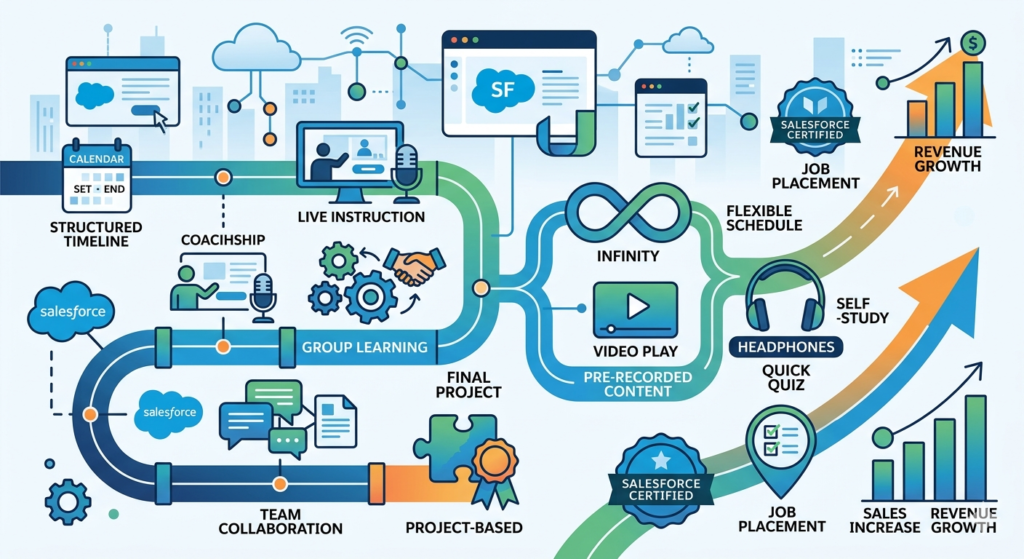
Section 1: What Is a Salesforce Training Bootcamp?
A Salesforce training bootcamp is an intensive, structured, instructor-led learning program designed to equip learners with Salesforce skills in a compressed timeframe — typically ranging from 4 to 12 weeks, depending on the depth of the program.
Unlike casual online courses where learners consume pre-recorded videos at their own pace, a bootcamp follows a defined curriculum, guided by experienced Salesforce professionals who lead live sessions, answer questions in real time, and hold learners accountable for their progress.
What Does a Salesforce Bootcamp Typically Include?
- Live instructor-led sessions conducted over video conferencing or in-person
- Structured curriculum covering core Salesforce modules (Sales Cloud, Service Cloud, Flows, Apex, Lightning, etc.)
- Hands-on projects and real-world use cases to build practical skills
- Mentorship access from certified Salesforce professionals
- Mock exams and certification preparation aligned with Salesforce's official certification tracks
- Team accountability mechanisms — such as cohort-based learning, daily check-ins, and peer collaboration
- Progress tracking through assessments, quizzes, and milestone reviews
Structured Salesforce Training: Why Structure Matters
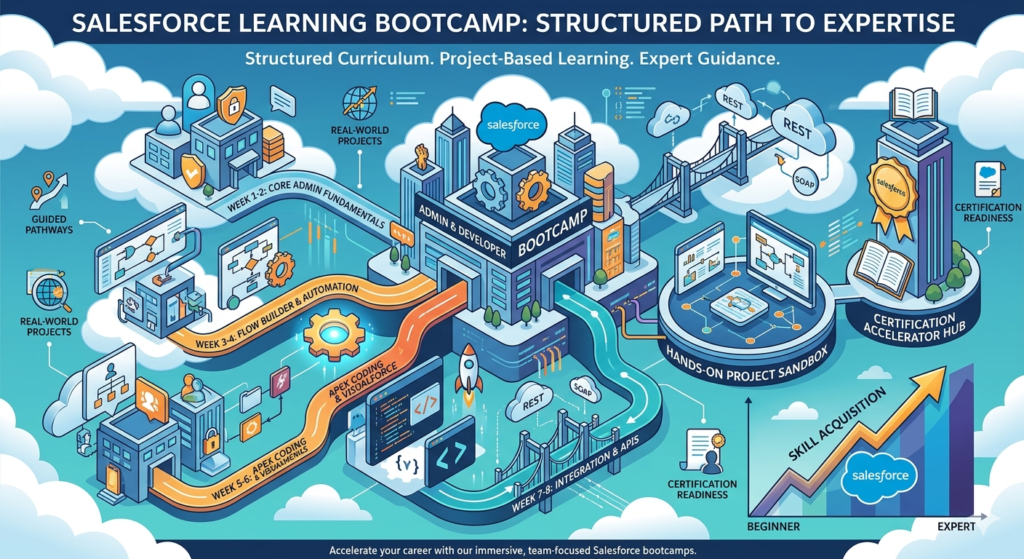
One of the biggest advantages of structured Salesforce training is that it removes the ambiguity from the learning journey. Salesforce is an expansive ecosystem — there are over 40 certifications, multiple clouds, and a constantly evolving platform. Without a structured path, learners often feel overwhelmed and don't know where to start, what to prioritize, or how to connect theoretical knowledge with practical application.
A bootcamp solves this by providing a clear learning roadmap: Week 1 focuses on platform fundamentals, Week 2 dives into CRM data models, Week 3 covers automation tools, and so on. Every session builds on the previous one. There's no scattered learning or half-understood concepts.
The Cohort Advantage
In a bootcamp, your team learns together as a cohort. This is powerful for organizations because:
- Employees develop a shared vocabulary and understanding of Salesforce
- Team members can collaborate on projects and solve problems together
- Peer learning accelerates understanding — when one person grasps a concept, they help others
- The group dynamic creates social accountability, which dramatically increases completion rates
Faster Certification Preparation
Salesforce certifications are industry-recognized markers of competence. Whether your team is aiming for Salesforce Administrator, Platform App Builder, Sales Cloud Consultant, or Salesforce Developer certifications, a bootcamp is specifically designed to prepare learners for these exams systematically.
In India specifically, the rise of the Salesforce bootcamp India market reflects the growing demand for certified Salesforce professionals who can hit the ground running — not learn on the job for six months and still feel lost.
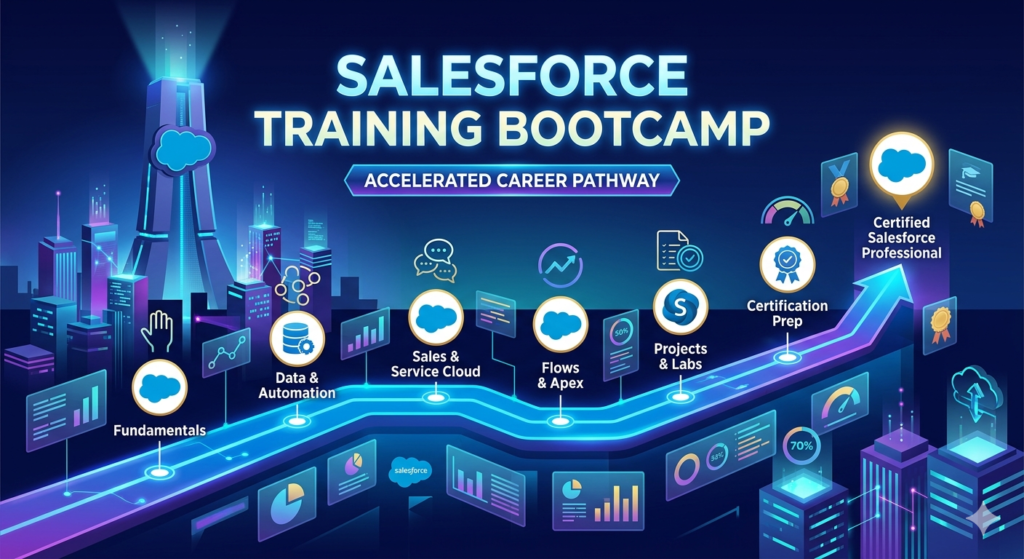
Section 2: What Is Self-Paced Salesforce Learning?
Self-paced Salesforce learning refers to online courses, modules, and resources that learners can access on their own schedule, without fixed class timings or mandatory attendance. Platforms like Salesforce Trailhead (Salesforce's free learning platform), Udemy, Coursera, and LinkedIn Learning offer a wide range of self-paced Salesforce content.
What Self-Paced Learning Offers
- Flexibility: Learners choose when and where they study
- Accessibility: Available 24/7 on any device
- Lower upfront cost: Many resources (especially Trailhead) are free or low-cost
- Self-directed progress: Learners move at their own speed
- Breadth of content: Wide variety of topics, from beginner to advanced
For individual learners — a developer who wants to explore Salesforce APIs on weekends, or a business analyst adding a new skill to their profile — self-paced learning is genuinely excellent. Salesforce Trailhead, in particular, is one of the best free learning platforms in the tech industry.
The Hidden Limitations of Self-Paced Learning for Teams
However, when organizations try to apply a self-paced model to team training, the cracks start to show quickly.
Low Completion Rates
Research from MIT and various learning platforms consistently shows that self-paced online courses have completion rates as low as 5–15%. When employees have the freedom to learn "whenever they want," it often translates to learning "whenever everything else is done" — which rarely happens in a busy work environment.
Lack of Accountability
Without a fixed schedule, deadlines, or an instructor following up, employees tend to deprioritize training when project pressures mount. Within weeks, the course is forgotten.
Inconsistent Skill Levels
Even among employees who do complete self-paced courses, the depth of understanding varies significantly. One team member might breeze through basic modules without truly understanding automation tools, while another might spend too much time on irrelevant advanced topics. The result? Your team has uneven Salesforce knowledge, which creates friction in deployment and collaboration.
No Real-World Application
Most self-paced courses are heavy on theory and light on hands-on practice. Salesforce is a platform you need to do things in, not just read about. Without guided projects, sandbox exercises, and feedback from experienced mentors, learners often struggle to apply what they've learned to real business scenarios.
Poor Preparation for Certification
While self-paced resources can introduce concepts, exam preparation requires a structured approach — understanding the question patterns, practicing scenario-based questions, and getting expert feedback on weak areas. Self-paced learners often feel unprepared walking into a Salesforce certification exam.
Section 3: Salesforce Bootcamp vs Self-Paced — The Detailed Comparison
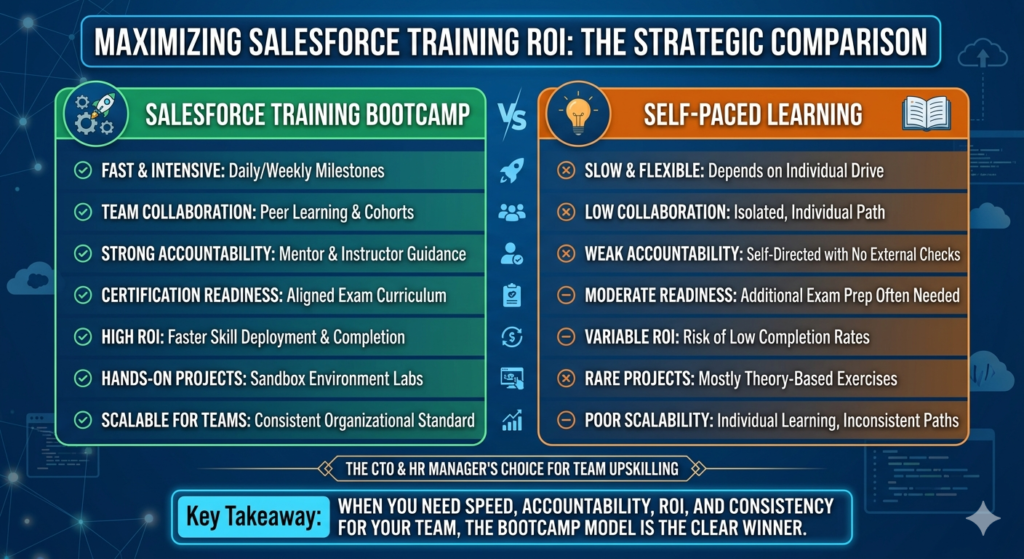
Here's a comprehensive comparison to help you see the differences clearly. This is the breakdown that HR managers, L&D leads, and CTOs need before making a training investment decision.
Comparison Table: Salesforce Training Bootcamp vs Self-Paced
| Criteria | Salesforce Training Bootcamp | Self-Paced Salesforce Learning |
|---|---|---|
| Learning Speed | Fast — compressed timeline with daily/weekly milestones | Slow — depends entirely on individual motivation |
| Team Collaboration | High — cohort-based, peer learning built in | Low — individual experience, no collaboration |
| Accountability | Strong — instructors, mentors, and peers keep learners on track | Weak — self-directed with no external accountability |
| Certification Readiness | High — curriculum aligned to certification exams | Moderate — possible but requires additional exam prep |
| ROI for Companies | High — faster skill deployment, team-wide knowledge | Variable — low completion rates reduce ROI |
| Hands-On Projects | Yes — guided real-world projects in sandbox environments | Rare — mostly theory-based exercises |
| Mentorship Access | Yes — direct access to certified Salesforce mentors | No — learners are on their own |
| Scalability for Teams | Excellent — designed for groups and organizations | Poor — works individually, not as team learning |
| Cost-Effectiveness | Higher upfront, better long-term ROI | Low upfront cost, often poor value due to low completion |
| Knowledge Standardization | High — all team members learn the same curriculum | Low — inconsistent learning paths and depths |
| Flexibility | Lower — fixed schedule required | High — learn anytime, anywhere |
| Best For | Teams, organizations, corporate training | Individual learners, exploratory learning |
Key Takeaway from the Comparison
When you evaluate Salesforce training bootcamp vs self-paced through the lens of organizational needs — speed, accountability, ROI, and team consistency — the bootcamp model wins on nearly every dimension that matters to a business. Self-paced learning remains valuable for individual exploration and ongoing learning, but as a primary training strategy for teams, it frequently underdelivers.
Section 4: Which Training Model Works Better for Teams?
Let's get practical. You have a team of 10, 25, or even 100 employees who need to learn Salesforce. Maybe you're:
- Onboarding a new batch of employees into a Salesforce-based workflow
- Rolling out a Salesforce implementation and need your internal teams to manage it
- Upskilling your sales, service, or IT teams to use a new Salesforce cloud
- Preparing employees for Salesforce certifications to meet client requirements
In every one of these scenarios, a structured bootcamp outperforms self-paced learning. Here's why.
1. Faster Onboarding = Faster Productivity
Time is money. When a company adopts Salesforce, there's a critical window during which employees need to understand the platform well enough to use it effectively. A bootcamp condenses months of learning into weeks, enabling your team to start using Salesforce productively much sooner.
Real-World Example: An IT services company in Pune recently onboarded a new project team for a Salesforce implementation client. Instead of letting employees browse Trailhead on their own, they enrolled the entire team in a 6-week Salesforce Administrator Bootcamp. Within two months of the program ending, 80% of the team had passed their Salesforce Administrator certification. The client noticed faster deployment and fewer errors compared to previous projects.
2. Standardized Knowledge Across the Team
One of the biggest frustrations for CTOs and tech leads is when team members have wildly different levels of Salesforce understanding. One person knows Reports and Dashboards inside out but has never touched Flows. Another has figured out Approval Processes but doesn't understand Data Models. The result is inefficiency, dependency on specific individuals, and a fragile organizational knowledge base.
A bootcamp solves this by taking your entire team through the same structured curriculum, at the same pace, with the same mentor. Everyone emerges with a consistent, baseline understanding of Salesforce. That standardization is invaluable for collaborative work environments.
3. Built-In Accountability Drives Completion
Organizations that have tried to deploy self-paced Salesforce training know this pain: months later, when they check completion dashboards, they find that only 20–30% of employees have finished the course — and many of those didn't truly absorb the material.
In a bootcamp, accountability is built into the structure:
- Attendance is tracked
- Weekly assignments are reviewed by instructors
- Progress is reported to L&D leads or HR managers
- Peer pressure within cohorts encourages consistent participation
This isn't about surveillance — it's about creating the conditions under which learning actually happens.
4. Mentorship Bridges the Gap Between Theory and Practice
Salesforce is intuitive once you understand it, but the learning curve at the beginning can be steep. Self-paced learners often hit roadblocks — a formula field that won't work, a Flow that keeps erroring out, a permission set that isn't behaving as expected — and have no one to turn to for help.
In a bootcamp, there's a mentor or instructor available to answer questions, debug issues in real time, and explain the "why" behind the "what." This dramatically reduces frustration and keeps learners moving forward.
5. Real Projects Build Real Confidence
The best bootcamps don't just teach concepts — they simulate real-world scenarios. Learners work on sandbox projects that mimic actual business use cases: building a lead management system, automating a sales approval process, setting up service case routing, or creating a custom report dashboard. This hands-on experience is what separates learners who can "talk about Salesforce" from professionals who can "work in Salesforce."
Which Teams Benefit Most from Salesforce Bootcamp Training?
- Startups rapidly deploying Salesforce for the first time and needing the whole team aligned quickly
- IT services firms with client-facing Salesforce project teams needing certifications and deployment readiness
- Enterprise digital transformation teams rolling out Salesforce to multiple departments simultaneously
- Sales and service teams transitioning to a new Salesforce Cloud (e.g., moving from a legacy CRM to Sales Cloud or Service Cloud)
- HR and L&D departments managing large-scale Salesforce upskilling programs across business units
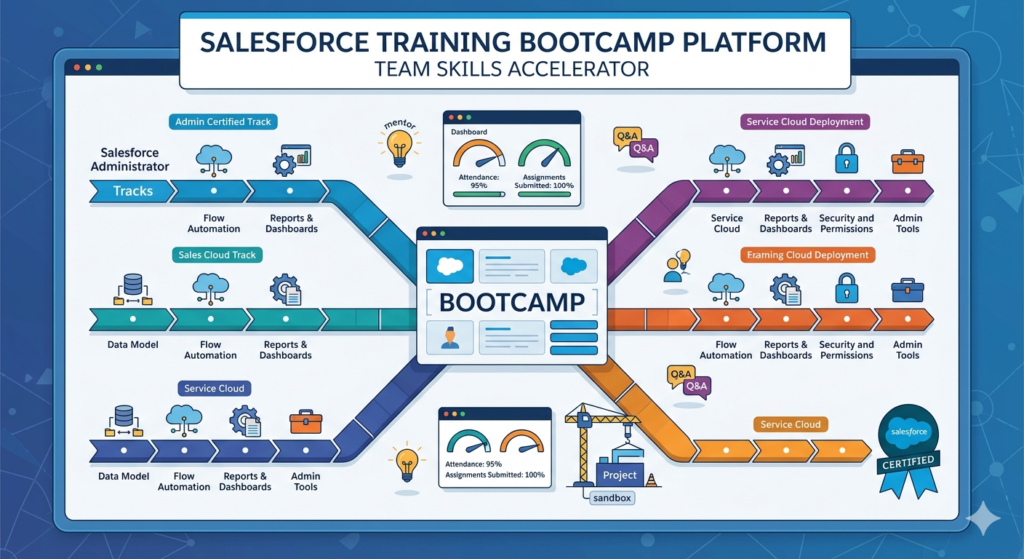
Section 5: Why Companies in India Are Increasingly Choosing Salesforce Bootcamps
The Salesforce bootcamp India market has witnessed significant growth over the past three years, and for good reason. Several converging trends are driving Indian companies and professionals toward intensive, structured Salesforce training programs.
The Salesforce Ecosystem in India Is Exploding
India has become one of Salesforce's most important growth markets. Major Indian IT giants — Infosys, Wipro, TCS, HCL — have built dedicated Salesforce practices. Mid-size IT firms are building entire business verticals around Salesforce implementation and consulting. Startups are adopting Salesforce as their first CRM platform. The demand for Salesforce-certified professionals in India far outpaces the current supply.
According to job market data from platforms like Naukri and LinkedIn India, Salesforce-related job postings in India grew by over 60% between 2021 and 2023, with roles spanning Salesforce Administrators, Developers, Architects, and Consultants. Salaries for Salesforce-certified professionals in India range from ₹6–8 LPA at the entry level to ₹25–50 LPA for experienced architects.
The Skill Gap Challenge
The challenge for Indian organizations isn't awareness of Salesforce — it's the skill gap. Many companies adopt Salesforce but struggle to find trained professionals who can manage, customize, and optimize the platform. The traditional approach of hiring experienced Salesforce professionals from the market is increasingly expensive and competitive.
The smarter solution? Train your existing workforce. Upskill your internal team through a structured bootcamp and create Salesforce champions from within the organization. This approach is cost-effective, builds institutional knowledge, and improves employee retention — because employees who receive high-quality training feel valued.
Faster Deployment Needs
Indian IT services companies operate in a fast-paced, delivery-focused environment. When a client signs a Salesforce implementation contract, the project team needs to be ready almost immediately. Self-paced learning cannot meet this demand. A targeted, intensive Salesforce onboarding bootcamp can prepare a project team in 4–8 weeks, which aligns with real business timelines.
Growing Demand for Certified Salesforce Talent
Many enterprise clients — especially multinational corporations — now require their implementation partners and internal IT teams to have Salesforce-certified professionals managing their instances. This has made Salesforce certification preparation a critical organizational priority, not just a nice-to-have.
Bootcamp programs that include certification-aligned training are naturally better positioned to meet this requirement than open-ended self-paced courses.
The Rise of Corporate Salesforce Training Programs in India
We're seeing a clear trend: forward-thinking companies in India are approaching organizations like RizeX Labs to design and deliver customized Salesforce training programs for their teams. These aren't generic off-the-shelf courses — they're tailored bootcamps built around the company's specific Salesforce implementation, industry context, and certification goals.
This kind of structured Salesforce training is what separates organizations that successfully embed Salesforce into their culture from those that struggle with adoption for years.
Bonus Section: How to Choose the Right Salesforce Training Approach for Your Organization
Before you make a decision, ask these five questions:
1. How quickly do you need results?
If you need your team productive on Salesforce within 2–3 months, a bootcamp is the only realistic option.
2. How many people need to be trained?
For groups of 5 or more, a cohort-based bootcamp provides structure, efficiency, and economies of scale that self-paced simply cannot match.
3. Do you have a certification deadline?
If your team needs to pass Salesforce certifications by a specific date — for a client requirement, internal audit, or business goal — you need the structured preparation that a bootcamp provides.
4. Do you need consistent skills across the team?
If cross-team collaboration, handoffs, and shared platform management are important, standardized training through a bootcamp is essential.
5. What is your long-term Salesforce strategy?
If Salesforce is a strategic, long-term platform investment — not just a tool you're trying out — it deserves a training investment that matches its importance. That means a proper bootcamp, not a "here's your Trailhead login" approach.
When Self-Paced Learning Still Makes Sense
To be fair and balanced: self-paced Salesforce learning is genuinely valuable in specific contexts:
- Continuous learning after a bootcamp — employees use Trailhead to stay updated with new Salesforce releases
- Individual exploratory learning for employees considering a Salesforce career change
- Supplementary study alongside a bootcamp program
- Refresher learning for certified professionals maintaining their credentials
Think of it this way: a bootcamp gets your team to the starting line, and self-paced learning keeps them running.
Conclusion: Salesforce Training Bootcamp vs Self-Paced — Making the Right Call
The debate between Salesforce training bootcamp vs self paced ultimately comes down to a simple question: What does your organization need to achieve, and how quickly do you need to achieve it?
If you're an individual learner with the discipline, time, and motivation to study independently — self-paced learning through platforms like Trailhead is a fantastic, accessible option. There's no question about that.
But if you're an HR manager, L&D leader, CTO, or startup founder trying to train a team on Salesforce, prepare employees for certifications, or roll out a Salesforce implementation across your organization — a structured bootcamp is not just better, it's the smarter business decision.
Here's the summary:
- ✅ Bootcamps deliver faster results through intensive, structured learning
- ✅ Bootcamps create consistent, standardized knowledge across your team
- ✅ Bootcamps provide accountability, mentorship, and real-world projects
- ✅ Bootcamps are specifically designed for certification preparation
- ✅ Bootcamps generate better ROI for organizational training budgets
- ✅ In India specifically, the Salesforce bootcamp India ecosystem is maturing rapidly to meet the growing demand for certified Salesforce professionals
Self-paced learning is a valuable supplement — but it's rarely a complete solution for teams with real organizational goals and real business timelines.
At RizeX Labs, we specialize in structured Salesforce training programs designed specifically for teams, organizations, and enterprises across India and globally. Our bootcamp-style programs are built around your team's specific goals, your Salesforce implementation context, and the certification paths that matter most to your business.
Whether you're a startup deploying Salesforce for the first time, an IT firm building a Salesforce practice, or an enterprise transforming your customer experience — we'll help your team get there faster, smarter, and more confidently.
About RizeX Labs
We’re Pune’s leading IT training institute specializing in emerging technologies like Salesforce and data analytics. At RizeX Labs, we help professionals master tools like Salesforce Tableau CRM through hands-on training, real-world projects, and expert mentorship. Our programs are designed to transform learners into job-ready Salesforce professionals with strong analytical and reporting skills.
Internal Links:
- Salesforce Admin & Development Training
- Salesforce Apex Triggers: Beginner’s Guide with Real-Time Examples
- Salesforce Lightning Web Components (LWC) vs Aura: Which Should You Learn First