
Introduction: Why Structured Salesforce Training Is No Longer Optional
Salesforce has quietly — and then very loudly — become the backbone of how modern businesses manage customer relationships, sales pipelines, service operations, and marketing campaigns. With over 150,000 companies worldwide using Salesforce across industries, it is no longer just a CRM tool. It is a business operating system.
Yet here is the uncomfortable reality that many organizations face: they have invested significantly in Salesforce licenses, implementation, and customization — and their teams are still using it at 40% capacity. Reps are logging calls incorrectly. Managers are pulling inaccurate reports. Service teams are missing SLAs because workflows were never properly configured or understood. The tool is powerful, but the people using it have not been adequately trained to unlock that power.
This gap between platform potential and actual team performance is precisely where corporate Salesforce training steps in.

Whether you are a CTO evaluating your technology stack's ROI, an HR or L&D leader designing upskilling programs, or a business head trying to figure out why Salesforce is not delivering what your implementation partner promised — structured, role-specific, and outcome-oriented training is the answer.
This blog explores everything decision-makers need to know about Salesforce training for companies: what it involves, what ROI to expect, what the scope looks like across different teams, and how to choose the right approach. If you are considering investing in team Salesforce upskilling, this is your complete guide.
What Is Corporate Salesforce Training?
Defining the Concept Beyond "Just a Course"
Corporate Salesforce training is a structured, organizationally-aligned learning initiative designed to equip employees — across various roles and departments — with the skills, knowledge, and practical confidence to use Salesforce effectively in their day-to-day work.
This is fundamentally different from individual learning.
When an individual signs up for a Salesforce certification course on their own, they are learning concepts and best practices in a general context. They are preparing for an exam. When a company invests in corporate SF training, the learning is contextualized to your specific Salesforce configuration, your business processes, your data model, and your team's actual workflows. The training is not generic — it is built around the way your business actually uses the platform.
Think of it this way: a salesperson going through a public Salesforce course will learn what Opportunities are. A salesperson going through a tailored corporate training program will learn how your company's Opportunity stages are configured, what criteria move a deal from Stage 3 to Stage 4, how to log activities correctly, and how to use the forecasting dashboards your sales director checks every Monday morning.
That specificity is what separates corporate training from individual upskilling — and it is what delivers real business impact.
Use Cases: Who Needs Corporate Salesforce Training?
The need for Salesforce training for companies cuts across industries and team functions. Here are common scenarios where organizations recognize the need:

- Post-implementation gaps: A company has just gone live with Salesforce and end-users are confused, resistant, or using it inefficiently despite a brief handover session from the implementation partner.
- Low CRM adoption: Management can see from reports that only a fraction of the team is actively using the system. Data quality is poor. Leadership cannot trust the forecasts.
- Team expansion: A company is scaling its sales or service team and needs new hires to be Salesforce-proficient quickly without burdening existing staff.
- Org re-configuration: A Salesforce environment has been significantly restructured or upgraded, and teams need to be retrained on new processes and features.
- Certification mandates: Companies building internal Salesforce centers of excellence need certified admins and developers on payroll.
- Digital transformation initiatives: Organizations modernizing their operations have decided Salesforce will be central to that transformation and need their workforce prepared.
Across all these situations, a one-size-fits-all training approach does not work. That is why corporate Salesforce training programs worth their investment are modular, role-based, and deeply aligned with business objectives.
Why Companies Invest in Salesforce Training
The decision to invest in Salesforce training for companies is rarely made on sentiment. Business leaders need justification. L&D heads need to show impact. CTOs need to demonstrate that their technology investments are paying off. Here are the core reasons organizations make this investment — and why it consistently proves worthwhile.
1. Productivity Improvement at Scale
Salesforce is packed with features designed to save time: automation rules, email templates, duplicate management, task queues, Lightning app configurations, and much more. But these features only save time if users know they exist and how to use them.
Untrained users often create manual workarounds. They duplicate records. They spend time on data entry tasks that automation was meant to eliminate. They export data to Excel because they do not know how to build reports in Salesforce. Every one of these workarounds costs time — and at scale, those minutes-per-day add up to significant productivity losses across a team of fifty or five hundred people.
Structured training solves this at the source. When employees understand the platform deeply, they work with it instead of around it. Productivity gains are immediate and measurable.
2. Better CRM Adoption and Data Quality
CRM adoption is the metric that haunts most Salesforce implementations. According to various industry studies, CRM failure rates — defined by poor adoption — can be as high as 70%. The primary reason is almost always human: employees do not understand the system, do not see its value to their own role, or were never properly trained on how to use it.
Corporate SF training addresses adoption by making the tool feel intuitive and relevant to each user's role. When a customer service agent understands exactly how to use Case Management, Macros, and Knowledge Articles, they adopt the tool because it makes their job easier. When a sales manager can build meaningful pipeline reports in minutes, they stop asking someone else to do it for them. Adoption rises when competence rises.
Better adoption leads directly to better data quality — and better data is what allows leadership to make sound business decisions.
3. Reduced Errors and Operational Inefficiencies
Misconfigured workflows. Incorrect data entry. Duplicate accounts. Broken validation rules that nobody understands. These are not Salesforce problems — they are training problems. When employees do not understand how the system works, errors multiply.
In regulated industries — financial services, healthcare, insurance, pharmaceutical — data errors in a CRM can have compliance implications beyond simple inefficiency. Proper training creates a team that handles the system responsibly, follows defined processes, and maintains data integrity.
4. Faster Onboarding for New Hires
Without a structured training program, bringing new employees up to speed on Salesforce typically means shadowing a colleague for a few days, reading some documentation nobody has time to maintain, and figuring the rest out by trial and error. This is slow, inconsistent, and expensive.
A corporate training program creates a repeatable, standardized onboarding pathway. New hires become productive faster. The burden on senior team members is reduced. Onboarding quality is consistent regardless of which manager a new hire reports to.

ROI of Corporate Salesforce Training
Return on investment is the question every decision-maker asks — and rightly so. Training budgets are not unlimited, and organizations need to know what they are getting back.
The ROI of corporate Salesforce training operates on two levels: tangible and intangible.
Tangible ROI: Numbers That Move the Business
Time Savings
Let us consider a realistic scenario. A sales team of 30 people spends an average of 45 minutes per day on manual data entry, workarounds, and Salesforce-related confusion — tasks that proper training would eliminate or significantly reduce. That is 22.5 hours per day across the team, or roughly 112 hours per week. If the average loaded cost of a salesperson (salary plus benefits) is ₹600 per hour, that represents over ₹67,000 in wasted labor per week — or more than ₹35 lakh per year — for a single team.
A comprehensive corporate training program costs a fraction of that. Even conservative productivity improvements of 25% on those wasted hours generate positive ROI within the first quarter.
Revenue Impact
Better Salesforce usage translates directly into sales performance. When reps use Opportunity management correctly, follow-up tasks are never missed. When forecasting is accurate, leadership makes better resource allocation decisions. When customer history is properly logged, sales conversations are more informed and conversion rates improve.
Consider a scenario where better pipeline visibility helps a sales team identify and rescue two or three stalled deals per quarter that would otherwise have been lost. If the average deal size is ₹5 lakh, that is ₹10–15 lakh in recovered revenue per quarter — directly attributable to teams using Salesforce more effectively.
Reduced Support Costs
Untrained Salesforce users generate a disproportionate number of internal IT and admin support tickets. Every time someone cannot figure out how to run a report, cannot find a record, or accidentally corrupts a view, someone else's time is consumed. A well-trained team is self-sufficient. Support ticket volume drops. Salesforce admins can spend their time on value-added configuration rather than handholding.
Certification Value and Reduced Hiring Costs
When employees complete certified Salesforce training through programs affiliated with recognized learning paths, the organization builds an internal talent bench. Instead of hiring certified Salesforce professionals at premium market rates, you develop them from within your existing workforce. For companies with significant Salesforce investments, having two or three certified admins in-house eliminates the need for ongoing consultant fees for basic configuration changes.
Intangible ROI: Harder to Measure, Impossible to Ignore
Employee Confidence and Satisfaction
There is a human dimension to this conversation that often gets overlooked in ROI discussions. Employees who are asked to use complex software without adequate training feel frustrated, incompetent, and devalued. They struggle. They make mistakes. They grow resentful of the tool — and sometimes of the organization.
Investing in quality training communicates something important to your team: we care about your success. We are equipping you to do your job well. That signal builds loyalty, improves morale, and contributes to a culture of continuous learning.
Talent Retention
Retention of skilled employees is one of the most significant but least calculated costs in any organization. Replacing a mid-level professional typically costs 50–200% of their annual salary when you factor in recruitment, onboarding, and lost productivity during the transition.
Employees who receive meaningful professional development are significantly less likely to leave. For a company that has invested in team Salesforce upskilling, this training becomes a visible benefit — particularly valuable in competitive hiring markets where Salesforce skills are in high demand.
Organizational Agility
Teams that deeply understand Salesforce can adapt more quickly when the platform is updated, when business processes change, or when new features need to be implemented. Instead of every change requiring external consultants, your internal team has the knowledge to evaluate, implement, and adopt changes efficiently. This organizational agility is difficult to put a number on, but it is one of the most strategic advantages of sustained corporate training investment.
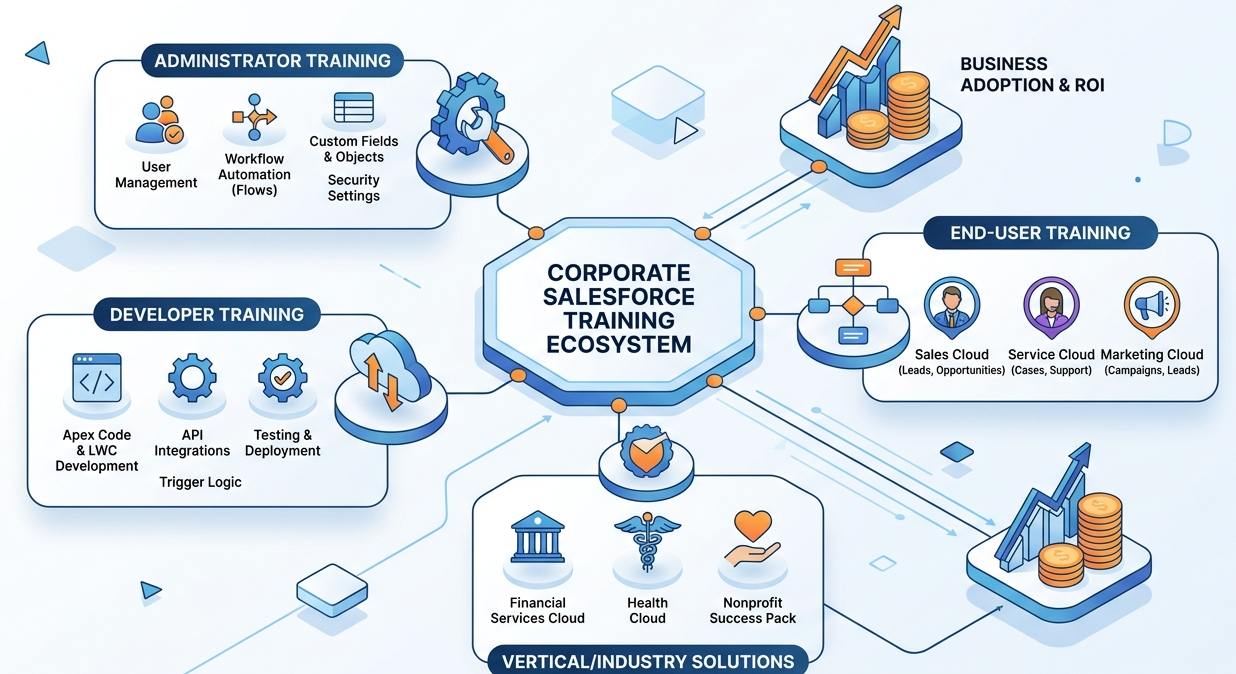
Scope of Salesforce Training for Teams
One of the most important aspects of Salesforce training for companies is understanding that different roles require fundamentally different training. A blanket training program that tries to cover everything for everyone is ineffective by definition. Here is what a well-scoped corporate program should address:
Admin Training
Salesforce Administrators are the heartbeat of any Salesforce org. They maintain data quality, configure workflows and automation, manage user profiles and permissions, create reports and dashboards, and handle day-to-day customization. Poor admin skills mean a Salesforce environment that gradually degrades in quality and utility.
Admin training covers:
- User management, profiles, roles, and permission sets
- Object configuration: custom fields, page layouts, record types
- Automation: Flows, Process Builder, Workflow Rules
- Reports and dashboards
- Data management and data loader
- Security and sharing settings
- Sandbox environments and change management
For companies that rely on Salesforce as their primary business platform, investing in certified admin training is non-negotiable.
Developer Training
For organizations that have customized their Salesforce implementation with custom code — or that need to — developer training is essential. Salesforce developers work with Apex (Salesforce's proprietary programming language), Visualforce, and Lightning Web Components (LWC) to build custom functionality beyond what declarative configuration allows.
Developer training covers:
- Apex programming fundamentals and best practices
- Lightning Web Components development
- REST and SOAP API integrations
- Triggers, batch classes, and asynchronous processing
- Governor limits and performance optimization
- Testing and deployment practices
Many mid-to-large organizations have development needs that are currently being handled by external vendors at high consulting rates. Building internal developer capability through corporate SF training creates significant long-term cost savings.
End-User Training
End-user training is where adoption is won or lost. These are the salespeople, customer service agents, marketing coordinators, and operations staff who use Salesforce every day to do their jobs. They do not need to know how to configure the system — they need to know how to use it effectively in the context of their specific role and your organization's specific processes.
Effective end-user training is:
- Role-specific: Sales end-user training looks entirely different from Service Cloud end-user training
- Scenario-based: Built around real workflows your team follows daily
- Practical: Focused on doing, not just understanding
- Accessible: Delivered in formats that accommodate varying technical comfort levels
Industry-Specific Customization
Salesforce looks different depending on the industry it is deployed in. Financial services organizations use Financial Services Cloud. Healthcare companies may use Health Cloud. Nonprofits often work within the NPSP (Nonprofit Success Pack). Manufacturing and field service organizations use Field Service Lightning.
Quality corporate Salesforce training accounts for these industry-specific configurations. Training for a wealth management firm's relationship managers looks very different from training for a B2B technology company's inside sales team — even if both are using Salesforce Sales Cloud. Industry context matters.
What to Expect from a Corporate Training Program
If you are evaluating corporate training providers, understanding what a well-designed program looks like helps you ask the right questions and set accurate expectations.
Training Formats
The best corporate training programs offer flexibility, recognizing that different organizations have different constraints:
Live Instructor-Led Training (ILT)
Delivered online or in-person by an experienced Salesforce trainer, live ILT allows for real-time questions, discussion, and group exercises. It is particularly effective for complex topics and for teams that benefit from peer learning. For initial onboarding and intensive skill-building, live training typically delivers the fastest results.
Hybrid Training
A blend of live instruction and self-paced learning resources. Participants attend live sessions for core concepts and complex topics, and complete exercises, reading, and assessments on their own schedule. This format balances thoroughness with flexibility — ideal for teams with demanding schedules.
Self-Paced Learning
Pre-recorded video content, interactive exercises, and assessments that learners complete on their own timeline. Best suited for ongoing reinforcement, onboarding new hires into an established program, or geographically dispersed teams in multiple time zones.
Most enterprise training programs use a combination of all three, structured around learning objectives and team preferences.
Duration and Onboarding
Duration varies significantly based on scope, role complexity, and training depth. Here are realistic benchmarks:
- End-user training for a specific role: 8–24 hours of structured learning over 1–3 weeks
- Admin foundation training: 40–80 hours, typically spread over 4–8 weeks
- Developer training: 80–160 hours, often structured as a 6–12 week program
- Comprehensive multi-role enterprise programs: Variable, typically delivered in phases over 2–6 months
A quality training provider begins with a discovery and assessment phase before delivering any training. This onboarding process maps your Salesforce configuration, identifies skill gaps across the team, defines learning objectives aligned with business goals, and creates a training plan. This groundwork is what differentiates corporate training from generic courses — and it is essential for ensuring the training delivers business impact rather than just general knowledge.
Hands-On Projects and Certifications
Theory without application does not stick. The best Salesforce training for companies is built around practical, hands-on exercises using either sandbox environments or configurations that mirror your production org.
Learners should be completing real tasks: building reports, configuring fields, writing automation flows, creating dashboards, handling mock customer scenarios — not just watching demonstrations.
For admin and developer training especially, Salesforce certification preparation should be integrated into the program. Having certified professionals in-house is strategically valuable, and training programs that incorporate certification paths make the most of the learning investment.
Post-Training Support
Learning does not end when the training program does. Employees need time to apply new skills, and questions will inevitably arise. A quality corporate training partner provides post-training support mechanisms, which may include:
- Office hours or follow-up Q&A sessions
- Access to recorded sessions and reference materials
- A period of advisory support for admins implementing new configurations
- Refresher modules for specific topics
- Ongoing access to a learning management system (LMS) with updated content
Post-training support is a key differentiator. It is what separates programs that create lasting capability from those that fade from memory within a month.
Corporate Salesforce Training in India: A Growing and Strategic Market
The Rising Demand for Corporate SF Training India
India's adoption of Salesforce has accelerated dramatically over the past five years. As Indian enterprises — from IT services giants to rapidly scaling startups, from financial institutions to healthcare conglomerates — deepen their Salesforce implementations, the need for structured corporate SF training India has grown in parallel.
Several factors are driving this demand:
Enterprise digital transformation: Large Indian conglomerates and mid-market companies are investing heavily in CRM and cloud-based platforms. Salesforce is frequently at the center of these initiatives.
Global delivery centers: Many multinational companies operate significant Salesforce delivery and support functions in India. These centers require large pools of trained and certified Salesforce talent.
Startup ecosystem growth: India's thriving startup ecosystem increasingly uses Salesforce as a growth infrastructure platform. As these companies scale their sales and service teams, structured training becomes essential.
Talent availability: India produces a significant volume of technically skilled professionals — developers, business analysts, project managers — who are well-suited for Salesforce roles with the right training.

Cost Advantages Without Compromising Quality
One of the most compelling aspects of corporate Salesforce training delivered in India — or delivered by India-based training providers to global teams — is the cost advantage. Training programs of equivalent quality cost significantly less in the Indian market compared to comparable offerings in North America, the UK, or Australia.
This matters for multinationals looking to train large global teams cost-effectively, and it matters for Indian enterprises working within training budget constraints. The emergence of high-quality, internationally aligned corporate SF training India providers means companies no longer need to choose between quality and cost.
RizeX Labs, operating within this ecosystem, brings together experienced Salesforce practitioners, business-contextualized curriculum design, and enterprise-grade delivery standards — providing Indian and global companies access to world-class Salesforce training at competitive investment levels.
The Talent Ecosystem Advantage
India is home to one of the world's largest communities of Salesforce-certified professionals and practitioners. This ecosystem means that training facilitated by India-based providers draws on genuine practitioner experience — trainers who have implemented Salesforce in complex enterprise environments, dealt with real-world integration challenges, and built solutions across diverse industries.
For organizations considering a training partner, this depth of ecosystem experience translates into richer, more practical learning for their teams.
Best Practices for Team Salesforce Upskilling
If you are planning to initiate or expand team Salesforce upskilling in your organization, these best practices will help ensure your program delivers maximum impact.
1. Align Training with Business Goals — Not Just Feature Coverage
The most common mistake companies make when designing Salesforce training is focusing on features rather than outcomes. A training program built around "here is everything Salesforce can do" is far less effective than one built around "here is how your team will use Salesforce to achieve your business objectives."
Before selecting a training provider or designing a program, define your business goals clearly:
- Are you trying to improve pipeline visibility?
- Reduce customer response times?
- Increase data accuracy for leadership reporting?
- Accelerate new hire onboarding?
Once goals are defined, work backwards to identify the specific Salesforce capabilities and behaviors that support those goals. Build your training around those capabilities — not around a feature checklist.
2. Choose Role-Based Learning Paths
A salesperson, a customer service agent, a marketing manager, and a Salesforce administrator all use the platform differently. Training that attempts to cover everything for everyone wastes time and creates confusion.
Map your employee roles to specific Salesforce use cases and build distinct learning paths for each role. Role-based training is faster, more relevant, and more effective. Employees complete training that is directly applicable to their daily responsibilities — which accelerates adoption and retention of learning.
Consider these role categories as a starting framework:
- Sales users (pipeline management, opportunity tracking, contact management, email integration)
- Service users (case management, knowledge base, service console, SLA management)
- Marketing users (campaign management, lead routing, Pardot/Marketing Cloud integration)
- Administrators (configuration, automation, reporting, user management)
- Developers (Apex, LWC, APIs, integrations)
- Managers and leaders (reporting, dashboards, forecasting, analytics)
3. Create a Continuous Learning Culture — Not a One-Time Event
Perhaps the most important best practice of all: treat Salesforce upskilling as an ongoing organizational practice, not a project with a completion date.
Salesforce releases three major updates per year (Spring, Summer, and Winter releases). Each release introduces new features, modifies existing functionality, and occasionally deprecates old approaches. Organizations that do not build continuous learning into their operating model fall behind. Teams that were fully trained two years ago may be working with outdated knowledge.
A continuous learning approach includes:
- Quarterly refresher sessions or release update briefings
- An internal Salesforce learning community or champions program
- Access to an LMS with updated content as the platform evolves
- Regular assessment of skill gaps as business needs change
- A career progression pathway for employees who want to deepen their Salesforce expertise
Organizations that treat team Salesforce upskilling as a continuous investment — rather than a one-time training event — consistently outperform those that do not.
4. Measure Training Effectiveness Rigorously
If you cannot measure it, you cannot improve it — and you cannot justify it. Establish clear metrics before training begins and track them after.
Useful metrics include:
- Salesforce login frequency and active usage rates (pre and post training)
- Data completeness and accuracy scores
- Report and dashboard creation by non-admin users
- Support ticket volume for Salesforce-related issues
- Deal cycle length and conversion rates (for sales teams)
- Customer satisfaction scores (for service teams)
- Certification completion rates
- Employee confidence surveys (self-reported proficiency)
These metrics tell the real story of training ROI — and they give you the data to make informed decisions about where to invest in future learning.
5. Get Leadership Buy-In Before You Begin
Training programs fail when leadership treats them as optional. If managers do not reinforce Salesforce best practices, do not model correct usage themselves, and do not create accountability for applying what employees have learned, the investment is largely wasted.
Before launching a corporate training program, secure visible commitment from senior leaders. Have sales leadership communicate the importance of Salesforce adoption to their teams. Have the CTO or CIO articulate why this investment matters. Include managers in relevant training sessions. Create accountability structures — such as regular pipeline review meetings that require complete Salesforce data — that make applying training skills necessary, not optional.
Conclusion: Making Your Salesforce Investment Work Harder
Every rupee spent on Salesforce licensing, implementation, and customization is underperforming until your teams are genuinely equipped to use the platform at its potential. Corporate Salesforce training is not an add-on expense — it is the investment that activates all your other Salesforce investments.
The return is real: measurable productivity gains, improved CRM adoption, better data quality, stronger revenue performance, faster onboarding, and reduced support costs. Beyond the numbers, the impact on employee confidence, team capability, and organizational agility creates lasting competitive advantage.
Whether you are a mid-market company preparing for your first structured training initiative or a large enterprise looking to standardize and deepen Salesforce capability across multiple teams, the path forward involves the same essential elements: role-based learning paths, business-aligned content, hands-on practical training, and a commitment to continuous upskilling rather than one-time events.
At RizeX Labs, we specialize in helping organizations unlock the full potential of their Salesforce investment through structured, customized, outcomes-driven corporate training. From end-user adoption programs to advanced developer training, from admin certification preparation to enterprise-wide capability-building initiatives, we bring practitioner experience and genuine business context to every program we deliver.
We work with teams across India and globally, bringing the cost advantages and talent depth of the Indian Salesforce ecosystem to every engagement — without compromising on quality, rigor, or business relevance.
If your team is ready to stop working around Salesforce and start working powerfully within it, let us build that capability together.
About RizeX Labs
We’re Pune’s leading IT training institute specializing in empowering enterprises through emerging technologies like Salesforce and cloud-native architecture. At RizeX Labs, we help organizations maximize their CRM investment through tailored corporate training, role-specific upskilling, and outcome-oriented mentorship. Our programs are designed to transform cross-functional teams into high-performing Salesforce experts capable of driving measurable business growth.
Internal Links:
- Salesforce Corporate Training: Customized Upskilling for Teams
- Measuring CRM ROI: A Guide for CTOs and L&D Leaders
- Advanced Salesforce Admin & Developer Training for Enterprises