
Introduction: The Dawn of Autonomous AI in Business
Imagine having a tireless digital employee who never sleeps, never forgets a task, and can handle thousands of customer interactions simultaneously — all while learning and improving with every conversation.

That's not a distant future. That's Salesforce Agentforce, and it's available right now.
We're living through a fundamental shift in how businesses operate. The age of reactive software — where systems only do what humans explicitly tell them to — is giving way to a new era of autonomous AI agents that can reason, plan, and act independently.
Salesforce, the world's leading CRM platform, has positioned itself at the forefront of this revolution with the launch of Agentforce. But for many Salesforce admins, developers, and business leaders, a critical question remains: How does Salesforce Agentforce actually work?
At RizeX Labs, we believe that understanding technology shouldn't require a PhD. That's why we've created this comprehensive, beginner-friendly guide that breaks down Agentforce architecture into simple, digestible concepts — without sacrificing technical accuracy.
Whether you're a seasoned Salesforce developer, a curious business owner, or a complete beginner exploring AI-powered CRM, this blog will give you a clear, complete picture of how this game-changing technology works.
Let's dive in.
What Is Salesforce Agentforce?
A New Kind of AI — Not Just a Chatbot
Before we explore how Salesforce Agentforce works, let's define what it actually is.
Salesforce Agentforce is an AI-powered autonomous agent platform built natively within the Salesforce ecosystem. Unlike traditional chatbots that follow rigid scripts, or simple AI assistants that only respond to questions, Agentforce agents can:
- Understand complex, multi-step instructions
- Reason through problems using large language models (LLMs)
- Take action within business systems autonomously
- Learn and adapt based on data and feedback
- Operate across multiple channels — web, mobile, email, voice, and more
In simpler terms, Agentforce moves beyond "assistant AI" into the territory of agentic AI — AI that acts on your behalf with minimal human intervention.
The Difference Between Agentforce and Einstein AI
Many people confuse Agentforce with Salesforce Einstein, which has been part of the Salesforce platform since 2016. Here's a quick distinction:
| Feature | Einstein AI | Agentforce |
|---|---|---|
| Core Function | Predictions & recommendations | Autonomous task execution |
| Interaction Style | Assists humans | Acts independently |
| Decision Making | Suggests actions | Takes actions |
| Use Case | Insights & scoring | End-to-end task completion |
| Autonomy Level | Low to medium | High |
Einstein AI is the intelligence layer that informs decisions. Agentforce is the action layer that executes them. Together, they form a powerful combination.
Where Does Agentforce Live?
Agentforce is built natively on the Salesforce Platform, which means it integrates seamlessly with:
- Sales Cloud
- Service Cloud
- Marketing Cloud
- Commerce Cloud
- Data Cloud
- MuleSoft
- Slack
This native integration is one of Agentforce's biggest advantages over third-party AI tools that require complex, risky external integrations.
Why Businesses Are Adopting Agentforce
The Business Case Is Compelling
According to Salesforce research, businesses using AI agents report:
- Up to 30% reduction in customer service handle time
- Significant improvements in lead response speed
- Dramatic drops in repetitive task workload for human agents
- Increased customer satisfaction scores across digital channels
But beyond the numbers, the strategic reasons businesses are adopting Agentforce are even more compelling.
Top Reasons Companies Are Making the Move
1. Scalability Without Proportional Hiring
Traditional scaling means hiring more people. With Agentforce, businesses can handle 10x the volume of customer interactions or internal tasks without a 10x increase in headcount.
2. 24/7 Availability
AI agents don't take lunch breaks, go on vacation, or call in sick. They deliver consistent service around the clock.
3. Unified Customer Data
Because Agentforce is deeply integrated with Salesforce Data Cloud, every agent interaction is informed by a 360-degree view of the customer — purchase history, support tickets, preferences, and more.
4. Reduced Human Error
Automated, data-driven actions reduce the risk of manual mistakes in critical processes like order management, case routing, or contract updates.
5. Competitive Advantage
Businesses that adopt intelligent automation early establish a significant lead over competitors still relying on manual, reactive processes.
How Salesforce Agentforce Works: Step-by-Step
Now we arrive at the heart of the matter. Let's walk through how Salesforce Agentforce works in a clear, step-by-step manner.
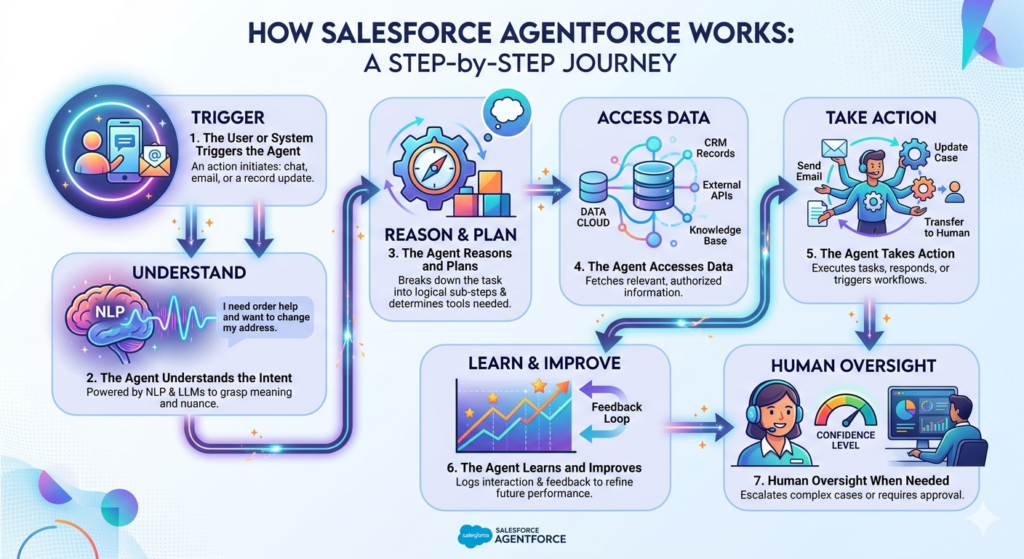
Step 1: The User or System Triggers the Agent
An Agentforce session begins when a trigger event occurs. This could be:
- A customer sending a message on a website chat widget
- An email arriving in a support inbox
- A Salesforce record being created or updated
- A scheduled time trigger (like end-of-month reporting)
- A voice call initiating a conversation
Think of this trigger as the starting gun that wakes the agent up and says, "It's time to work."
Step 2: The Agent Understands the Intent
Once triggered, Agentforce uses Natural Language Processing (NLP) powered by large language models to understand what the user is asking or what the system needs.
This isn't simple keyword matching. The AI can understand:
- Complex, multi-sentence requests
- Ambiguous phrasing and context
- Multiple intentions within a single message
- Sentiment and urgency signals
Example: A customer types: "I placed an order last Tuesday and I still haven't received a shipping update. I need to know where it is and if I can change the delivery address."
Agentforce identifies two distinct intents: check order status AND modify delivery address — and proceeds to handle both.
Step 3: The Agent Reasons and Plans
This is where Agentforce truly differentiates itself. Instead of jumping directly to a response, the agent uses its reasoning engine to:
- Break down the task into logical sub-steps
- Identify what information it needs
- Determine which tools, APIs, or data sources to access
- Plan the sequence of actions
This multi-step reasoning is powered by what Salesforce calls the Agent Reasoning Engine — built on top of enterprise-grade large language models with guardrails customized for business contexts.
Step 4: The Agent Accesses Data
The agent then pulls relevant data from connected sources using Salesforce Data Cloud and integrated systems. This might include:
- CRM records (accounts, contacts, opportunities, cases)
- Order management systems
- ERP databases
- External APIs via MuleSoft connectors
- Knowledge base articles
- Historical interaction data
Crucially, the agent only accesses data that it's authorized to access — governed by Salesforce's enterprise security model.
Step 5: The Agent Takes Action
Armed with a plan and the right data, the agent executes actions. These actions can include:
- Responding to a customer with personalized, accurate information
- Updating a CRM record (changing an address, updating a status)
- Creating a new record (filing a support case, logging a task)
- Triggering a workflow or automation
- Escalating to a human agent when needed
- Sending an email, SMS, or notification
Step 6: The Agent Learns and Improves
After completing a task, Agentforce logs the interaction, outcome, and any feedback signals. This data feeds back into the system, helping to:
- Improve response accuracy over time
- Identify gaps in knowledge base articles
- Refine agent behavior for similar future scenarios
- Provide analytics to human supervisors
Step 7: Human Oversight When Needed
Agentforce operates with a human-in-the-loop design philosophy. When the agent encounters a situation that exceeds its confidence threshold or defined boundaries, it:
- Gracefully escalates to a human agent
- Provides full context of the conversation to the human
- Flags the interaction for review and learning
This ensures accountability and continuous quality improvement.
Simple Explanation of Agentforce Architecture
The Big Picture
Understanding Agentforce architecture doesn't require a computer science degree. Think of it like a well-organized company department:
- The Front Desk (Channels & Interface Layer) — where customers and systems interact
- The Brain (Agent Reasoning Engine) — where thinking and planning happen
- The Library (Data & Knowledge Layer) — where information is stored and retrieved
- The Hands (Action & Integration Layer) — where things actually get done
- The Security Guard (Governance & Trust Layer) — ensuring everything is safe and compliant
These five layers work together seamlessly to deliver intelligent, autonomous action. Let's explore each in more detail.
Components of Agentforce Architecture

1. The Interface and Channel Layer
This is the entry point for Agentforce — the surface where users or systems interact with AI agents.
Supported channels include:
- Messaging platforms: WhatsApp, SMS, Facebook Messenger
- Web chat: Embedded chat widgets on websites
- Email: Automated inbox monitoring and response
- Voice: Phone calls processed via AI voice capabilities
- Salesforce apps: Embedded directly within Sales Cloud, Service Cloud, etc.
- Slack: For internal employee-facing agents
- Custom apps: Via Salesforce APIs
2. The Agent Reasoning Engine
This is the cognitive core of Agentforce — the component that makes agents intelligent rather than just automated.
The Reasoning Engine is built on:
- Large Language Models (LLMs): Enterprise-grade AI models (including partnerships with providers like OpenAI, Anthropic, and Salesforce's own Einstein models)
- Prompt Templates: Pre-built and customizable prompts that guide agent behavior
- Chain-of-Thought Processing: The ability to reason through multiple steps before acting
- Tool Calling: The mechanism by which the agent decides which tools or APIs to invoke
In plain English: This is where the agent "thinks." It reads the situation, considers its options, makes a plan, and decides what to do next.
3. The Data and Knowledge Layer
No AI agent is smarter than its data. Agentforce's data layer consists of:
- Salesforce Data Cloud: A real-time data platform that unifies structured and unstructured data from across the business
- Knowledge Base: Articles, FAQs, product documentation, and policies
- CRM Data: Live customer records, interaction history, and relationship data
- Vector Database: For semantic search — finding information based on meaning, not just keywords
- External Data Sources: Connected via MuleSoft, Salesforce Connect, or custom APIs
4. The Action and Integration Layer
This is where Agentforce's decisions translate into real-world results. The action layer includes:
- Flow Builder Integration: Triggers Salesforce Flows for automated processes
- Apex Actions: Executes custom Salesforce code when needed
- MuleSoft Anypoint: Connects to external systems like SAP, Workday, ServiceNow, etc.
- API Invocations: Calls external REST APIs directly
- Record Operations: Creates, reads, updates, and deletes Salesforce records
- Email & Notification Actions: Sends communications across channels
5. The Governance and Trust Layer
The final — and arguably most important — component of Agentforce architecture is the governance layer. This is what makes Agentforce enterprise-ready.
It includes:
- Einstein Trust Layer: Salesforce's proprietary AI safety framework
- Data Masking: Ensures sensitive data isn't exposed to external LLMs
- Audit Trails: Complete logs of every agent action
- Permission Controls: Granular access control using Salesforce profiles and permission sets
- Rate Limiting: Prevents abuse and manages resource consumption
- Guardrails: Topic restrictions and behavior boundaries for agents
The Role of Data Cloud and Einstein AI
Why Data Cloud Is the Backbone of Agentforce
Salesforce Data Cloud is not just a storage solution — it's the intelligence foundation upon which Agentforce operates.
Here's what Data Cloud brings to the Agentforce equation:
Unified Customer Profiles
Data Cloud harmonizes data from every touchpoint — website visits, purchase history, support tickets, social interactions — into a single, real-time customer profile. When an Agentforce agent needs to personalize a response, it draws from this unified profile.
Real-Time Data Activation
Unlike traditional databases that provide snapshots, Data Cloud provides live, streaming data. This means Agentforce agents are always working with the most current information available.
Semantic Search Capability
Data Cloud supports vector-based search, enabling agents to retrieve knowledge based on meaning and context rather than exact keyword matches. This dramatically improves the quality of agent responses.
How Einstein AI Powers Agentforce
Einstein AI is deeply embedded in the Agentforce experience, serving several critical functions:
- Einstein Copilot: The conversational AI assistant that collaborates with users in Salesforce apps
- Einstein Trust Layer: The safety and privacy framework that governs how AI models interact with enterprise data
- Einstein Models: Pre-trained AI models for specific business use cases (sentiment analysis, lead scoring, next best action)
- Prompt Builder: A low-code tool for creating and managing the instructions that guide agent behavior
Together, Data Cloud and Einstein AI form the intelligent nervous system of Agentforce — ensuring that agents are not just capable but genuinely smart and contextually aware.
Automation and Workflow Integration
Agentforce as an Orchestrator
One of the most powerful aspects of how Salesforce Agentforce works is its ability to orchestrate complex workflows across multiple systems.
Rather than simply responding to a single query, Agentforce can:
- Trigger a multi-step business process
- Coordinate actions across multiple Salesforce clouds
- Integrate external systems through MuleSoft
- Monitor outcomes and adjust in real time
Flow Builder: The Bridge Between AI and Automation
Salesforce Flow Builder is deeply integrated with Agentforce, allowing AI decisions to trigger:
- Record-triggered flows (update an opportunity stage automatically)
- Screen flows (guide users through complex processes)
- Auto-launched flows (background business logic)
- Scheduled flows (time-based automation)
Example in Action:
A customer asks an Agentforce service agent for a refund. The agent:
- Verifies the customer's identity and order history (Data Cloud)
- Confirms the refund policy applies (Knowledge Base)
- Creates a refund case record (Record Operation)
- Triggers a Flow that routes the case to the finance team (Flow Builder)
- Sends a confirmation email to the customer (Email Action)
- Updates the customer's profile with the refund interaction (CRM Update)
All of this happens in seconds, with no human involvement required.
MuleSoft: Breaking Down Data Silos
MuleSoft Anypoint Platform extends Agentforce's reach beyond the Salesforce ecosystem. Through pre-built and custom connectors, agents can interact with:
- ERP systems (SAP, Oracle, Microsoft Dynamics)
- HR platforms (Workday, ADP)
- E-commerce platforms (Shopify, Magento)
- Logistics systems (FedEx, UPS APIs)
- Custom internal databases and applications
This makes Agentforce a true enterprise AI layer, not just a Salesforce-specific tool.
Security and Governance in Agentforce
Enterprise Trust Is Non-Negotiable
As businesses deploy AI agents with increasing autonomy, the question of security and governance becomes paramount. Salesforce has made this a first-class priority with Agentforce.
The Einstein Trust Layer Explained
The Einstein Trust Layer is Salesforce's proprietary security framework specifically designed for enterprise AI. Here's how it protects your business:
Zero Data Retention with External LLMs
When Agentforce sends prompts to external AI models (like those from OpenAI or Anthropic), the Einstein Trust Layer ensures those providers cannot retain or train on your data. Your customer information stays private.
Dynamic Data Masking
Sensitive data (Social Security numbers, credit card details, confidential business information) is automatically masked before it's included in AI prompts.
Toxicity Detection
Built-in filters detect and block harmful, inappropriate, or off-topic content in both inputs and outputs.
Audit Trails and Explainability
Every decision made by an Agentforce agent is logged with full context — what data was accessed, what reasoning was applied, and what actions were taken. This supports compliance, auditing, and continuous improvement.
Role-Based Access and Governance
Agentforce leverages Salesforce's existing security model, including:
- Profiles and Permission Sets: Control what data and actions each agent can access
- Record-Level Security: Ensures agents only see data the interacting user is authorized to view
- Field-Level Security: Prevents agents from exposing sensitive fields
- Org-Wide Defaults: Governs baseline data access across the organization
Agent Guardrails: Keeping AI Behavior in Bounds
Every Agentforce agent is configured with behavioral guardrails that define:
- Topics they can discuss: Prevent agents from going off-script
- Actions they can take: Limit the scope of autonomous actions
- Escalation thresholds: Define when to hand off to humans
- Language and tone guidelines: Ensure brand-consistent communication
Real-World Business Use Cases
How Companies Are Using Agentforce Today
Understanding how Salesforce Agentforce works in theory is valuable, but seeing real-world applications brings it to life.
Use Case 1: Autonomous Customer Service
A retail company deploys an Agentforce service agent to handle tier-1 customer inquiries. The agent:
- Resolves order status queries instantly
- Processes returns and exchanges automatically
- Escalates complex complaints to human agents with full context
- Operates 24/7 across web chat, WhatsApp, and SMS
Result: 40% reduction in average handle time, 35% increase in after-hours resolution rates.
Use Case 2: AI-Powered Sales Development
A B2B software company uses Agentforce to assist its sales team:
- Qualifies inbound leads based on ICP criteria
- Schedules discovery calls automatically
- Drafts personalized outreach emails based on CRM data
- Updates opportunity records after each interaction
Result: Sales reps spend 60% more time on high-value activities instead of administrative tasks.
Use Case 3: HR and Employee Service Agents
A large enterprise deploys an internal Agentforce agent via Slack to handle HR inquiries:
- Answers policy questions using the HR knowledge base
- Helps employees navigate benefits enrollment
- Processes time-off requests and updates relevant records
- Routes complex HR matters to appropriate specialists
Result: HR team capacity freed up for strategic initiatives instead of repetitive inquiries.
Use Case 4: Financial Services Compliance
A financial services firm uses Agentforce for client onboarding:
- Guides clients through KYC (Know Your Customer) documentation requirements
- Validates document completeness before human review
- Sends automated reminders for outstanding items
- Escalates flagged cases to compliance officers
Result: Onboarding time reduced by 50% with improved regulatory compliance.
Benefits and Limitations of Agentforce

Benefits
✅ Native Salesforce Integration
No complex third-party integrations. Agentforce works natively within your existing Salesforce investment.
✅ Low-Code Configuration
Business users and admins can build and deploy agents without deep coding skills, using intuitive tools like Agent Builder, Prompt Builder, and Flow Builder.
✅ Enterprise-Grade Security
The Einstein Trust Layer provides AI safety standards that many standalone AI tools simply cannot match.
✅ Scalability
Handle thousands of simultaneous interactions without additional infrastructure investment.
✅ Continuous Learning
Agents improve over time based on interaction data, feedback signals, and knowledge base updates.
✅ Unified Data Access
Through Data Cloud, agents have access to a comprehensive, real-time view of customers and business data.
Limitations
⚠️ Complexity of Initial Setup
While the low-code tools are powerful, designing truly effective agents requires thoughtful planning, prompt engineering, and process design expertise.
⚠️ Cost Considerations
Agentforce licensing and Data Cloud costs can be significant for smaller organizations. ROI must be carefully evaluated.
⚠️ LLM Hallucination Risk
Like all AI systems based on large language models, Agentforce can occasionally produce inaccurate responses. Guardrails and knowledge base quality are critical mitigations.
⚠️ Change Management
Employees may resist AI automation. Effective change management and training are essential for successful adoption.
⚠️ Data Quality Dependencies
The quality of agent outputs is directly tied to the quality of underlying data. Poor CRM hygiene leads to poor agent performance.
The Future of AI Agents in Salesforce
Where Agentforce Is Headed
The trajectory of Salesforce Agentforce points toward an increasingly autonomous, interconnected, and intelligent future. Here's what's on the horizon:
Multi-Agent Orchestration
Salesforce is actively developing capabilities for multiple specialized agents to work together on complex tasks. Imagine:
- A "Research Agent" gathering market intelligence
- A "Strategy Agent" synthesizing insights into recommendations
- A "Communication Agent" drafting and sending outreach
- An "Analytics Agent" measuring results and reporting back
All coordinating autonomously to execute a complete go-to-market campaign.
Proactive Agents (Event-Driven Autonomy)
Future Agentforce iterations will be more proactively initiative-taking — identifying opportunities and problems before humans notice them, and taking preventive or capitalizing actions automatically.
Deeper Industry-Specific Agents
Salesforce is building vertical AI agents tailored to specific industries like healthcare, financial services, manufacturing, and retail — with pre-built domain knowledge, compliance frameworks, and industry-specific integrations.
Expanded Model Flexibility
The Bring Your Own Model (BYOM) capability allows businesses to plug in their own fine-tuned AI models — a capability that will become increasingly important as organizations develop proprietary AI assets.
Voice and Multimodal Agents
As AI voice technology matures, Agentforce will increasingly handle complex voice interactions — moving beyond simple IVR into genuinely conversational, context-aware phone agents.
How RizeX Labs Can Help You Implement Agentforce
At RizeX Labs, we specialize in helping businesses harness the full power of the Salesforce ecosystem — including cutting-edge solutions like Agentforce.
Our team of certified Salesforce architects, developers, and AI specialists can help you:
- Design your Agentforce strategy aligned with business goals
- Build custom agents tailored to your unique processes
- Integrate Agentforce with your existing tech stack
- Train your team on managing and optimizing AI agents
- Optimize ongoing agent performance through data-driven iteration
Whether you're taking your first steps with AI or looking to expand an existing implementation, RizeX Labs is your trusted Salesforce partner.
Conclusion: The Intelligent Future Is Already Here
Understanding how Salesforce Agentforce works is no longer optional for forward-thinking businesses — it's essential.
From its sophisticated Agentforce architecture with layered components, to the powerful combination of Einstein AI and Data Cloud, to its enterprise-grade security framework, Agentforce represents the most comprehensive, production-ready autonomous AI platform in the CRM world today.
The businesses that invest in understanding and implementing this technology now will have a significant, compounding advantage over those that wait.
The shift from AI that assists to AI that acts is one of the most significant business transformations of our generation. Agentforce isn't just a product update — it's a fundamental reimagining of how businesses can operate, scale, and serve customers.
At RizeX Labs, we're excited to help you navigate this transformation with clarity, confidence, and the technical expertise to get it right.
The intelligent future isn't coming. It's already here.
Ready to explore Agentforce for your business? Contact RizeX Labs today.
About RizeX Labs
At RizeX Labs, we help businesses implement advanced Salesforce solutions powered by AI, automation, and intelligent customer engagement. Our expertise includes Salesforce Agentforce, Salesforce AI technologies, CRM automation, and enterprise workflow optimization.
We combine technical expertise, real-world implementation experience, and business-focused strategies to help organizations automate repetitive tasks, improve customer experiences, and increase operational efficiency using Salesforce’s AI ecosystem.
With Salesforce Agentforce, businesses can build intelligent AI agents that handle customer interactions, automate workflows, assist support teams, and deliver faster, smarter service experiences at scale.
Internal Links:
- Salesforce Admin course page
- Salesforce Marketing Cloud vs Pardot: Which Is Right for You in 2026
- Salesforce Marketing Cloud Certification: Study Guide 2026
- SFMC Data Extensions vs Lists: What Every Marketer Should Know
- SFMC Email Content Builder: Best Practices & Templates 2026
- SFMC Query Activity SQL: The Complete Guide to Marketing Cloud SQL for Data-Driven Marketers
- SFMC Einstein Send Time Optimization: How It Works
External Links:
McKinsey Sales Growth Reports