
Unlocking the Power of AI-Driven Email Timing in Salesforce Marketing Cloud
In the ever-competitive world of digital marketing, timing is everything. You can craft the most compelling subject line, design a breathtaking email template, and segment your audience with surgical precision — but if your message lands in someone's inbox at the wrong moment, all that effort risks being ignored, buried, or worse, marked as spam. This is one of the most persistent pain points for email marketers everywhere, and it's exactly the problem that SFMC Einstein Send Time Optimization was built to solve.

Salesforce Marketing Cloud's Einstein Send Time Optimization (STO) is an artificial intelligence-powered feature that automatically determines the best time to send an email to each individual subscriber, based on their unique engagement history. Rather than sending a campaign blast to your entire list at 10:00 AM on a Tuesday because some best-practice article from 2019 recommended it, Einstein STO analyzes behavioral data at the individual level and delivers your message precisely when each recipient is most likely to open it.
In this comprehensive guide, we'll take a deep dive into how SFMC Einstein Send Time Optimization works under the hood, explore its real-world benefits, walk through practical use cases in Journey Builder and email campaigns, discuss its limitations, compare it against traditional send-time approaches, and leave you with actionable insights you can start using today.
What Is SFMC Einstein Send Time Optimization?
SFMC Einstein Send Time Optimization is part of Salesforce's broader Einstein suite — a collection of AI and machine learning tools embedded directly within the Marketing Cloud platform. Specifically, STO falls under the Einstein Email Optimization umbrella, which includes features like Einstein Subject Line testing, Einstein Copy Insights, and Einstein Engagement Scoring.
At its core, Marketing Cloud STO uses machine learning to analyze each subscriber's historical email engagement data — primarily open rates — and predicts the specific hour during a 24-hour window (or across a 7-day window, depending on configuration) when that individual is most likely to engage with an email. Once this optimal window is calculated, the system schedules message delivery accordingly, without any manual intervention from the marketer.
The concept sounds deceptively simple, but the sophistication behind it is substantial. Instead of applying a one-size-fits-all logic (e.g., "everyone gets the email at 9 AM"), the AI creates what is effectively a personalized delivery schedule for each subscriber in your list. For a list of 500,000 contacts, that means up to 500,000 individual send times — a level of personalization that would be completely impossible to achieve manually.
Why Does Send Time Matter?
Before we dig into the mechanics, let's establish why send time is such a critical variable in email marketing.
Multiple industry studies have consistently shown that email open rates fluctuate significantly based on the time of day and day of the week. According to research from Mailchimp, Campaign Monitor, and HubSpot, emails sent during mid-morning hours on weekdays tend to perform better on average — but "on average" is the problem. These averages flatten out the individual differences that actually drive engagement.
Consider two subscribers:
- Subscriber A is a nurse who works night shifts. She checks her personal email during her lunch break at 2:00 AM or in the early morning when she gets home.
- Subscriber B is a corporate professional who opens emails religiously between 8:00 and 9:00 AM before his first meeting.
Sending the same email to both of them at 10:00 AM Tuesday is suboptimal for Subscriber A and potentially solid for Subscriber B. Einstein STO solves this by treating each subscriber as an individual — not a demographic group.
How SFMC Einstein Send Time Optimization Works: The AI Behind the Curtain
Understanding how the AI model behind Marketing Cloud STO functions is key to using it effectively. The system operates through several interconnected layers: data collection, model training, prediction generation, and delivery execution.
1. Data Collection and Analysis
Einstein STO begins its process by collecting historical engagement data from your Marketing Cloud account. Specifically, it looks at:
- Email open timestamps: When did each subscriber actually open emails in the past?
- Engagement frequency: How often does the subscriber engage with emails overall?
- Day-of-week patterns: Are there specific days when a subscriber is more likely to engage?
- Time-of-day patterns: What hours are most correlated with opens for this individual?
This analysis requires a meaningful volume of historical data to be accurate. Salesforce generally recommends that your subscribers have a minimum of 90 days of engagement history before Einstein STO can make reliable predictions for them. For contacts with insufficient data, the system falls back to either a default send time you specify or uses aggregate modeling from similar behavioral profiles.
Importantly, the model does not just look at raw open counts. It uses timestamped tracking data that tells the algorithm exactly when opens occurred, down to the hour. This temporal granularity is what makes individual-level prediction possible.
2. Machine Learning Model Training
Once the data is collected, Einstein applies machine learning algorithms to identify patterns. The model training phase involves:
- Pattern recognition: The algorithm identifies recurring engagement windows — for example, a subscriber who consistently opens emails between 7:00 PM and 9:00 PM on weekdays.
- Behavioral clustering: Subscribers with similar engagement patterns are grouped to help inform predictions for contacts who have less historical data.
- Recency weighting: More recent behavior is given greater weight than older data, ensuring that the model adapts as subscriber habits evolve over time.
- Cross-brand learning (within limits): The Einstein model benefits from aggregate learning across the Marketing Cloud platform — though always within privacy and data governance boundaries. This means that even newer subscribers can receive reasonable predictions based on behavioral archetypes.
The machine learning model Salesforce uses for Einstein email optimization is a supervised learning model, trained continuously as new engagement data flows in. This means the predictions improve over time as more data becomes available.
3. Predictive Score and Send Window Assignment
Once the model has been trained and individual engagement patterns have been identified, Einstein generates a send time prediction for each subscriber. This prediction is expressed as an optimal time window within a 24-hour or 7-day horizon, depending on how you configure the feature.
Here's how the two modes work:
- 24-Hour Optimization: The system will find the optimal send time within the next 24 hours after you initiate the send. This is useful for time-sensitive (but not urgent) campaigns where you want engagement to happen quickly.
- 7-Day Optimization: The system can delay delivery for up to a week to hit the subscriber's highest-engagement window. This is better suited for evergreen content where the goal is maximum open rate rather than immediate delivery.
Each subscriber receives a score that maps to a specific delivery window. The Marketing Cloud platform then queues up the actual sends across those windows, staggering delivery automatically across hours or days.
4. Delivery Execution
The execution layer works seamlessly within Marketing Cloud's existing infrastructure. When you activate Einstein STO on a campaign or a Journey, the platform essentially holds each message in a delivery queue and releases it according to the optimized schedule. This happens in the background without any additional workflow needed on the marketer's side.
It's worth noting that Einstein STO does not control all aspects of deliverability — factors like sender reputation, inbox placement, and ISP filtering still apply normally. STO specifically addresses the timing dimension of engagement optimization.
Key Benefits of Einstein Send Time Optimization
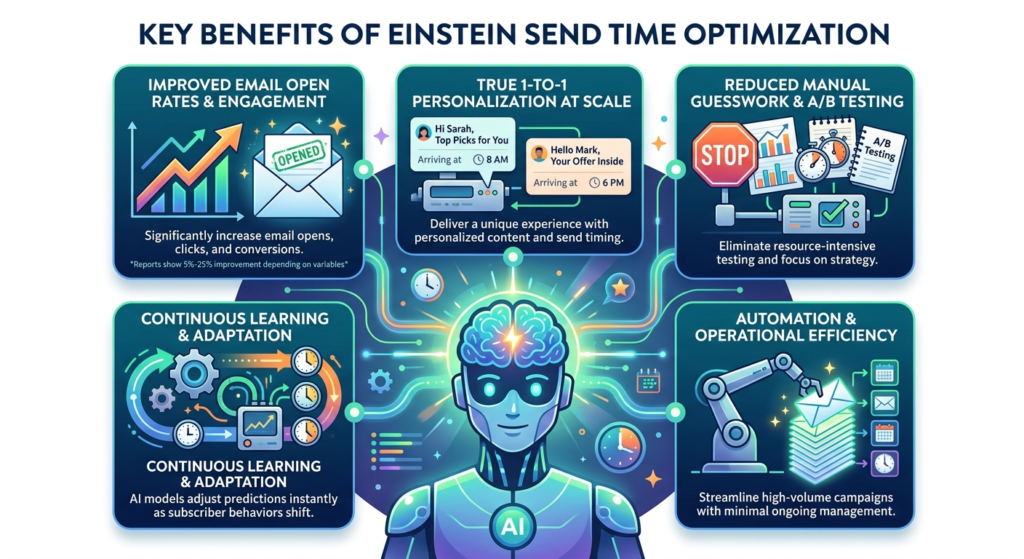
1. Improved Email Open Rates and Engagement
The most direct and measurable benefit of marketing cloud STO is improved email open rates. When subscribers receive emails at the moment they're naturally inclined to check their inbox, open rates improve — often significantly. Salesforce has reported that clients using Einstein STO see open rate improvements ranging from 5% to 25% depending on list quality, industry, and baseline engagement levels.
Higher open rates create a cascading effect: more opens lead to more clicks, more conversions, and better overall campaign ROI. For businesses where email is a primary revenue driver, even a modest improvement in open rates can translate into substantial financial gains.
2. True 1-to-1 Personalization at Scale
Most personalization efforts in email marketing focus on content: using the subscriber's name, referencing past purchases, or recommending relevant products. These are all valuable, but they're largely static — the email arrives at the same time for everyone.
Einstein STO adds a temporal dimension to personalization that complements content personalization beautifully. Combining personalized content with personalized send timing creates a genuinely individualized experience that goes far beyond what most brands currently deliver.
3. Reduced Manual Guesswork and A/B Testing Overhead
Without AI-driven optimization, determining the best send time typically requires ongoing A/B testing — splitting your list, running experiments over weeks or months, and analyzing results. This process is time-consuming, resource-intensive, and still only delivers a single "best time" for the whole group rather than individual-level precision.
Einstein STO eliminates the need for this iterative guesswork by automating the optimization process entirely. Marketers can redirect the time and cognitive bandwidth they'd spend on send-time testing toward higher-value activities like content strategy and audience segmentation.
4. Continuous Learning and Adaptation
Unlike a static best-practice recommendation ("send on Tuesdays at 10 AM"), Einstein STO adapts continuously as subscriber behavior changes. If a contact changes jobs, shifts their daily routine, or simply starts engaging with email at different times, the model picks up on these shifts through new data and adjusts its predictions accordingly.
This makes einstein email optimization inherently future-proof in a way that manual scheduling never can be.
5. Automation and Operational Efficiency
From an operational standpoint, Einstein STO dramatically simplifies the send scheduling process. Once configured, it runs automatically with minimal ongoing management. This is particularly valuable for organizations managing high volumes of email campaigns across multiple business units or geographies.
Practical Use Cases: Journey Builder and Email Campaigns
Use Case 1: Welcome Email Series in Journey Builder
One of the most impactful applications of SFMC Einstein Send Time Optimization is within onboarding or welcome journeys. When a new subscriber joins your list, you typically want to send a series of welcome emails — an initial greeting, a brand story, a product introduction, and perhaps a first-purchase incentive.
Traditionally, these emails are scheduled with fixed time delays (e.g., email 1 immediately, email 2 three days later, email 3 a week after that). With Einstein STO integrated into Journey Builder, each email in the series is delivered to each subscriber not just at the right interval but at the right time of day.
How to configure it:
In Journey Builder, when you add an email activity, you can enable Einstein STO directly within the email activity settings. You select your optimization window (24-hour or 7-day), and the system handles the rest. For new subscribers who lack sufficient engagement history, the system will use a default time you specify or apply aggregate model predictions.
Use Case 2: Promotional Campaign Blasts
For large-scale promotional campaigns — seasonal sales, product launches, limited-time offers — marketers traditionally send to the entire list at once or in batched waves. With Marketing Cloud STO, you can enable optimization even on these mass sends, so that while the campaign goes out on a single day, each subscriber receives it during their personal peak engagement window.
Real-world example: A retail brand running a Black Friday promotion enables Einstein STO with a 24-hour window. Rather than everyone receiving the email at 8 AM, subscribers who are evening email checkers receive it around 6 PM, while early-morning checkers get it at 7 AM. The result is a more evenly distributed wave of opens and website traffic — and a higher aggregate open rate compared to a single blast time.
Use Case 3: Re-Engagement Campaigns
Re-engagement campaigns targeting lapsed subscribers are another excellent use case for Einstein STO. When trying to win back a subscriber who hasn't opened an email in six months, every element of the campaign needs to be optimized — and send time is no exception.
For contacts with historical data, STO can still identify past engagement patterns even if recent activity is low. Hitting a lapsed subscriber at the time they used to be most active can be the difference between re-engagement and a permanent unsubscribe.
Use Case 4: Transactional and Post-Purchase Flows
While transactional emails (order confirmations, shipping notifications) are often time-sensitive and need immediate delivery, post-purchase nurture emails — cross-sell recommendations, review requests, loyalty program invitations — are ideal candidates for Einstein STO. These emails are not urgent, their value doesn't diminish with a few hours' delay, and delivering them at the optimal moment significantly improves engagement.
Use Case 5: Newsletter Campaigns
Regular newsletters, which typically contain evergreen or weekly-digest content, are perfect for the 7-day optimization window. If a subscriber is most likely to engage on Sunday mornings, sending them a Thursday morning newsletter may mean it's buried by the time they open their inbox. With Einstein STO on a 7-day window, that subscriber receives the newsletter Sunday morning, while a Monday morning email-checker gets it Monday.
Limitations of SFMC Einstein Send Time Optimization
As powerful as SFMC Einstein Send Time Optimization is, it's not a silver bullet. Understanding its limitations is essential for using it appropriately.
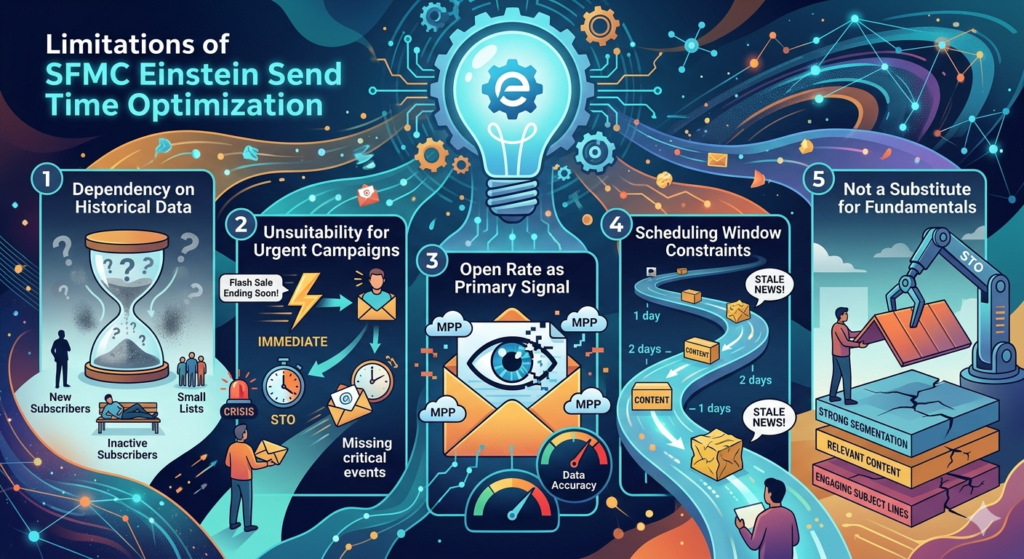
1. Dependency on Historical Data
The most significant limitation of Einstein STO is its dependence on historical engagement data. The AI can only predict future behavior based on past behavior. For:
- New subscribers: Without open history, predictions are based on aggregate patterns or default times, which are less precise.
- Inactive subscribers: If a contact hasn't engaged in a long time, their historical data may no longer reflect their current behavior.
- Small lists: Accounts with very small subscriber bases may not generate enough signal for the model to produce reliable predictions.
Salesforce recommends having at least 90 days of engagement history and a list size of several thousand contacts for optimal STO performance.
2. Unsuitability for Urgent or Time-Critical Campaigns
Einstein STO should not be used for:
- Breaking news or crisis communications: If you need subscribers to receive information immediately (service outages, emergency announcements, time-sensitive compliance notices), STO's delay mechanism could mean some subscribers receive the message hours or days late.
- Flash sales with a tight window: A 4-hour flash sale that starts at noon will not benefit from a 7-day STO window — and even the 24-hour window could be problematic if the optimal send time for some subscribers is after the sale ends.
- Real-time triggered emails where immediacy is essential: Cart abandonment emails, for instance, are most effective when sent within minutes or hours of the trigger event — not at the subscriber's "optimal" time window, which might be days later.
3. Open Rate as the Primary Signal
Einstein STO is trained primarily on email open data. In an era where Apple Mail Privacy Protection (MPP) has significantly inflated open rate data (by pre-loading email tracking pixels regardless of actual human opens), the reliability of STO predictions for Apple Mail users has been called into question. Marketers should monitor performance carefully and be aware that open-rate-based optimization may become less accurate as privacy protections continue to expand across email clients.
4. Scheduling Window Constraints
The 7-day delay maximum means that for content where timing relative to current events matters (e.g., industry news digests, sports-related marketing), a nearly week-long delay could render the content stale by the time some subscribers receive it.
5. Not a Substitute for Fundamentals
Einstein STO improves timing — it does not fix poor subject lines, irrelevant content, or weak audience segmentation. Marketers who rely on STO to save underperforming campaigns will be disappointed. The tool amplifies good email marketing; it doesn't replace it.
Traditional Send Times vs. Einstein STO: A Direct Comparison
| Factor | Traditional Send Time | Einstein STO |
|---|---|---|
| Personalization Level | Group-level (one time for all) | Individual-level (unique time per subscriber) |
| Data Dependency | Best practices / A/B tests | Historical engagement data per contact |
| Setup Complexity | Low (set a time, send) | Moderate (requires data, configuration) |
| Scalability | Manual effort increases with list size | Fully automated at any scale |
| Adaptability | Static unless manually changed | Continuously updated by ML model |
| Suitability for Urgent Content | High | Low |
| Effectiveness for New Lists | Reasonable (based on industry data) | Limited (insufficient training data) |
| Long-Term Performance | Flat or declining without iteration | Improves over time as data accumulates |
| Operational Overhead | High (ongoing testing and adjustments) | Low (automated optimization) |
| Dependency on Marketer Intuition | High | Minimal |
The core takeaway from this comparison is that traditional send-time approaches rely on generalized assumptions and require ongoing manual optimization. Marketing Cloud STO replaces that paradigm with a self-improving, data-driven system that becomes more effective the longer you use it.
For established programs with rich engagement history, the gap in performance between traditional and Einstein-powered sending is substantial. For new programs or urgent communications, traditional send-time thinking still has its place.
Best Practices for Getting the Most Out of Einstein Email Optimization
Now that you understand how SFMC Einstein Send Time Optimization works and where it excels, here are practical strategies to maximize its value:
1. Build Your Data Foundation First
If you're new to Marketing Cloud or have historically had low engagement rates, prioritize building a strong data foundation before relying heavily on STO. Run consistent email programs for at least 90 days, focus on list hygiene to ensure only genuinely engaged subscribers are in scope, and make sure your tracking is properly configured so Einstein receives clean, accurate signal data.
2. Segment Before Optimizing
Einstein STO works best on top of solid segmentation. Apply STO to your most engaged segments first — these contacts will have the richest historical data and will see the greatest performance lift. As your engagement data grows across other segments, expand STO usage progressively.
3. Use the Right Optimization Window for the Right Campaign
Develop a mental framework for which campaigns should use 24-hour versus 7-day windows:
- 24-hour window: Promotions, announcements, event invitations, time-sensitive offers with at least a few days of validity.
- 7-day window: Newsletters, educational content, loyalty campaigns, re-engagement sequences, evergreen nurture tracks.
Never use either window for truly time-critical communications.
4. Monitor for Apple MPP Impact
Regularly audit your subscriber data to identify Apple Mail users (look at the user agent data in your engagement logs). Consider supplementing open-rate data with click data or other engagement signals when assessing STO performance for those segments.
5. Pair STO with Einstein Engagement Scoring
SFMC Einstein Engagement Scoring complements STO beautifully. Engagement scoring tells you who is likely to engage; STO tells you when. Using both together lets you prioritize high-value subscribers and deliver to them at the optimal moment — a powerful combination.
6. Test and Validate Lift
Even with AI doing the heavy lifting, always validate that STO is delivering measurable improvements. Set up controlled comparisons: run a portion of your list with STO enabled and a holdout group without it (using a standard send time), and compare open rates, click-through rates, and downstream conversion metrics. This data not only confirms ROI but also helps make the business case for broader STO adoption internally.
The Future of Einstein Email Optimization
Salesforce continues to invest heavily in Einstein's capabilities. As the platform evolves, we can expect:
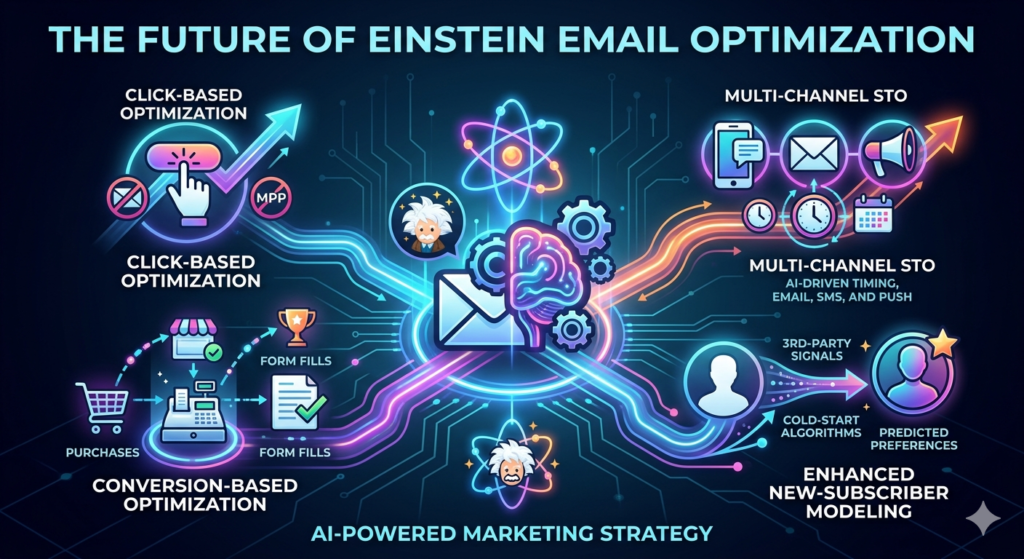
- Click-based optimization: Moving beyond open rates to optimize for click-through events, which are less susceptible to MPP inflation.
- Conversion-based optimization: Eventually, the model may incorporate downstream conversion data (purchases, form fills) to optimize not just for opens but for business outcomes.
- Multi-channel STO: Extending similar AI-driven timing optimization to SMS, push notifications, and other channels within the Marketing Cloud platform.
- Enhanced new-subscriber modeling: Improved cold-start algorithms that can make better predictions for subscribers with minimal historical data, potentially using third-party behavioral signals.
These advancements will only deepen the value proposition of einstein email optimization as a cornerstone of AI-powered marketing strategy.
Conclusion: Smarter Timing, Better Results
The evidence is clear: when it comes to email marketing, when you send is just as important as what you send. SFMC Einstein Send Time Optimization represents one of the most practical and immediately impactful applications of artificial intelligence in the marketing technology landscape today. By analyzing individual subscriber behavior, applying sophisticated machine learning models, and automating personalized delivery at scale, it solves a problem that has frustrated email marketers for decades.
Marketing cloud STO is not a magic wand — it requires solid historical data, thoughtful configuration, and an understanding of when it's the right tool for the job. But for brands with established email programs, engaged subscriber bases, and a commitment to data-driven marketing, it delivers measurable, meaningful improvements in engagement metrics and operational efficiency.
Actionable Insights for Marketers
Here's how to take action today:
- Audit your data readiness: Check whether your key subscriber segments have 90+ days of engagement history and sufficient list size for reliable STO predictions.
- Activate STO on your next newsletter or nurture campaign: Start with a low-risk, evergreen campaign to experience the feature and establish a performance baseline.
- Set up a holdout test: Measure the real lift Einstein STO delivers for your specific audience — don't rely on industry averages.
- Define your campaign taxonomy: Create a simple internal guide that categorizes campaigns by urgency and content type, specifying when STO should and shouldn't be used.
- Combine STO with Einstein Engagement Scoring: Build a full Einstein-powered email strategy that optimizes both audience targeting and send timing simultaneously.
- Educate your team: Make sure everyone involved in campaign execution understands both the power and the limitations of sfmc einstein send time optimization so it's deployed intelligently and consistently.
The brands that embrace AI-driven personalization — across content, segmentation, and timing — are building durable competitive advantages in the inbox. Einstein Send Time Optimization is one of the most accessible and actionable steps you can take toward that future, and the time to start is now.
About RizeX Labs
At RizeX Labs, we specialize in delivering advanced Salesforce Marketing Cloud solutions that help businesses optimize customer engagement and drive measurable results. Our expertise spans automation, personalization, and AI-driven marketing strategies, enabling organizations to move beyond traditional campaigns.
With deep experience in Salesforce tools like Einstein AI, Journey Builder, and Email Studio, we help brands deliver the right message to the right audience at the right time—maximizing conversions and customer satisfaction.
Internal Links:
- Salesforce Admin course page
- Salesforce Marketing Cloud vs Pardot: Which Is Right for You in 2026
- Salesforce Data Import Wizard vs Data Loader: Full Comparison (2024 Guide)
- SFMC Data Extensions vs Lists: What Every Marketer Should Know
- SFMC Email Content Builder: Best Practices & Templates 2026
- Salesforce Mobile App: Complete Admin Configuration Guide for Enterprise Deployment
- Salesforce Marketing Cloud Automation Studio: Complete Guide
External Links:
McKinsey Sales Growth Reports