
Introduction
Choosing the right Salesforce product is critical for maximizing your CRM investment and driving long-term business growth. When comparing Sales Cloud vs Financial Services Cloud, many businesses struggle to determine which Salesforce CRM platform best aligns with their industry and operational requirements.
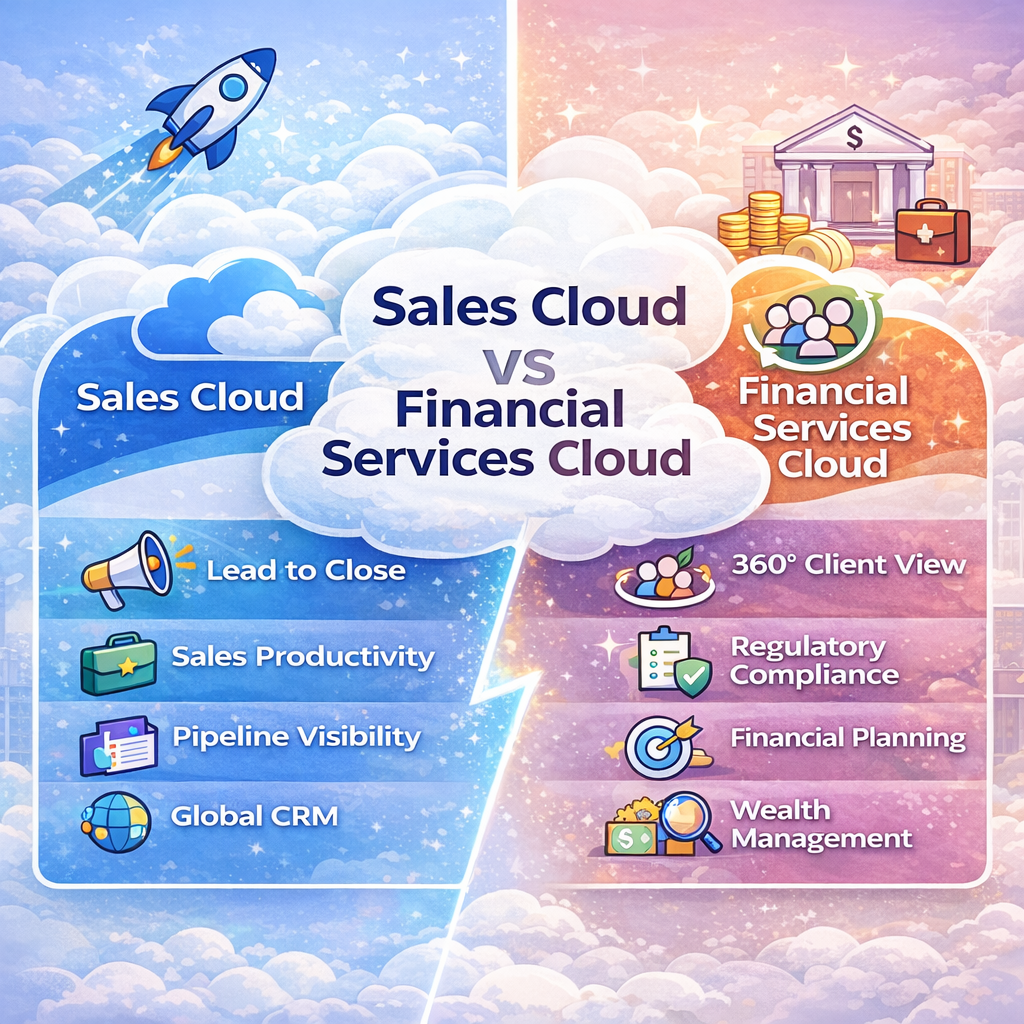
Two of the most widely used Salesforce CRM solutions are Sales Cloud and Financial Services Cloud (FSC). While both platforms are built on Salesforce, understanding the difference between Sales Cloud vs Financial Services Cloud is essential before implementation.
Understanding Sales Cloud vs Financial Services Cloud
Salesforce Sales Cloud is a robust CRM platform designed to help organizations manage leads, opportunities, pipelines, and customer relationships. It is ideal for businesses across multiple industries seeking a flexible and scalable CRM solution for sales management.
Financial Services Cloud (FSC) is a specialized industry-focused CRM built on top of Sales Cloud. FSC is specifically designed for financial institutions such as banks, mortgage lenders, insurance providers, credit unions, and wealth management firms. It extends the core CRM capabilities of Sales Cloud with financial-specific features, compliance tools, and relationship management functionality.
Understanding Sales Cloud vs Financial Services Cloud helps organizations choose the right CRM based on business goals, compliance needs, and industry-specific workflows.
Selecting the wrong CRM platform can result in implementation challenges, poor adoption, compliance risks, and inefficient business operations. However, choosing the right platform in the Sales Cloud vs Financial Services Cloud comparison can improve customer engagement, streamline operations, and maximize ROI.
Overview of Sales Cloud
What is Salesforce Sales Cloud?
Sales Cloud is Salesforce’s flagship CRM solution designed to empower sales teams by managing the complete sales lifecycle—from lead capture and opportunity tracking to closing deals and post-sale engagement.
As one of the most popular CRM platforms globally, Sales Cloud helps businesses across industries improve productivity, automate workflows, and build stronger customer relationships.
Sales Cloud provides organizations with a centralized CRM system where teams can:
- Manage leads and opportunities
- Track customer interactions
- Automate repetitive sales tasks
- Generate sales forecasts and reports
- Improve pipeline visibility
- Enhance collaboration across teams
In the Sales Cloud vs Financial Services Cloud comparison, Sales Cloud serves as the standard CRM platform for general sales processes, while FSC extends these CRM capabilities for financial institutions.
Because Sales Cloud is highly customizable, organizations can tailor this CRM platform to fit their unique sales methodology, operational workflow, and reporting requirements.
Key Features of Sales Cloud
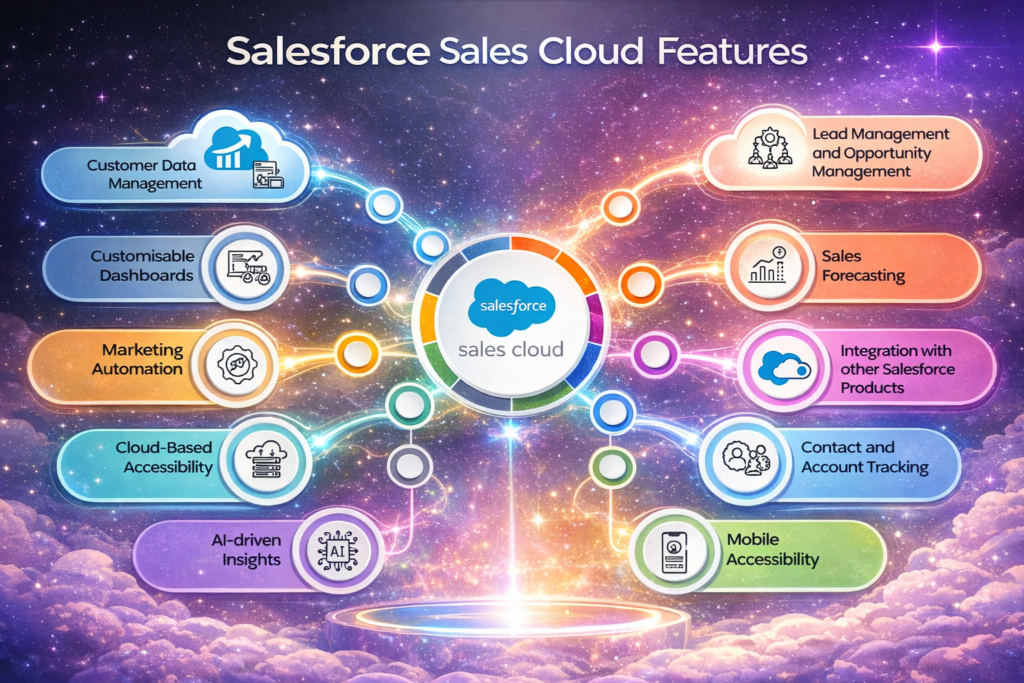
Lead Management
Lead management is the foundation of any successful sales operation, and Sales Cloud excels in this area:
- Multi-channel lead capture from websites, social media, email campaigns, trade shows, and partner referrals
- Automatic lead assignment based on territory, product expertise, or workload distribution
- Lead scoring and qualification to prioritize high-value prospects
- Lead nurturing workflows to keep prospects engaged throughout the buying journey
- Conversion tracking from lead to opportunity with complete audit trails
- Duplicate detection to maintain clean, accurate data
- Web-to-lead forms for seamless lead capture from digital channels
Opportunity Management
Once leads are qualified, Sales Cloud’s opportunity management features help teams close deals efficiently:
- Visual pipeline management with drag-and-drop functionality
- Deal stage customization to match your sales methodology
- Collaborative selling tools enabling team members to work together on complex deals
- Quote generation with product catalogs and pricing rules
- Competitor tracking to understand your competitive position
- Win/loss analysis to improve future sales strategies
- Document management for proposals, contracts, and supporting materials
Sales Automation
Automation is critical for sales productivity, and Sales Cloud offers extensive automation capabilities:
- Workflow automation to eliminate manual, repetitive tasks
- Email templates and mass emailing for consistent communication
- Task and activity management with automatic reminders and follow-ups
- Approval processes for discounts, contracts, and special terms
- Sales cadences to guide reps through proven engagement sequences
- Process Builder for complex, multi-step automated workflows
- Integration with email and calendar for seamless activity tracking
Sales Forecasting
Accurate forecasting is essential for business planning, and Sales Cloud provides robust forecasting tools:
- Predictive analytics powered by Einstein AI
- Collaborative forecasting where managers and reps align on projections
- Revenue forecasting by product, territory, or time period
- Quota management and tracking against targets
- Real-time reporting and dashboards for visibility into sales performance
- Trend analysis to identify patterns and adjust strategies
- What-if scenarios to model different outcomes
Additional Sales Cloud Features
- Mobile app for iOS and Android with full CRM access on the go
- Einstein AI for intelligent lead scoring, opportunity insights, and activity recommendations
- Territory management for optimal sales coverage
- Partner relationship management for channel sales
- CPQ (Configure, Price, Quote) integration for complex products
- Sales engagement tools for personalized outreach at scale
- Analytics and reporting with customizable dashboards
Use Cases for Sales Cloud
Sales Cloud serves a wide range of business scenarios:
- B2B sales management for companies selling to other businesses
- B2C sales operations for consumer-facing organizations
- Pipeline tracking and visibility across the entire sales organization
- Sales team collaboration on strategic accounts and complex deals
- Customer acquisition strategies with integrated marketing campaigns
- Customer retention and expansion through upsell and cross-sell tracking
- Quote and proposal generation with professional documentation
- Sales performance analytics to identify top performers and coaching opportunities
- Remote sales team management with mobile-first capabilities
- Channel and partner sales with partner portals and co-selling features
Industries Using Sales Cloud
Sales Cloud’s versatility makes it suitable for virtually any industry:
- Technology and software companies managing subscription sales and renewals
- Manufacturing with complex product catalogs and distributor networks
- Retail and e-commerce for both online and in-store sales tracking
- Healthcare for medical device sales, pharmaceutical sales, and patient acquisition
- Professional services including consulting, legal, and accounting firms
- Telecommunications managing consumer and enterprise sales
- Media and entertainment for advertising sales and subscription management
- Education for enrollment management and alumni relations
- Real estate for property listings and client management
- Automotive for dealership sales and service operations
Overview of Financial Services Cloud (FSC)
What is Salesforce Financial Services Cloud?
Salesforce FSC is an industry-specific solution built on the Sales Cloud platform, designed exclusively for financial services organizations. Released in 2015, FSC recognizes that financial services firms have unique requirements that generic CRM systems cannot adequately address.
FSC provides a complete, 360-degree view of clients, including their financial accounts, goals, relationships, and life events. It’s built around the concept of relationship-based selling and advising rather than transactional selling, which is fundamental to wealth management, banking, and insurance operations.
The platform enables financial advisors, relationship managers, and bankers to deliver personalized, holistic advice by understanding not just individual clients but entire households and their interconnected financial lives.
Key Features of Financial Services Cloud
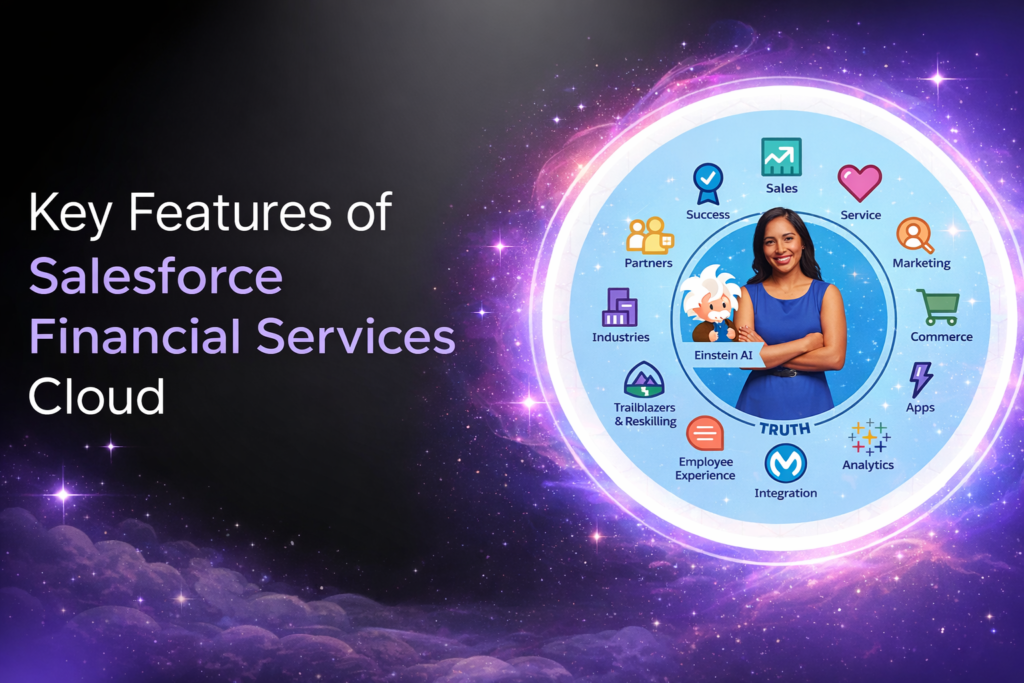
Financial Accounts
One of FSC’s most powerful features is its ability to manage all types of financial accounts:
- Comprehensive account aggregation including checking, savings, investment accounts, retirement accounts, loans, mortgages, credit cards, and insurance policies
- Account hierarchy visualization showing relationships between different accounts
- External account integration to pull data from core banking systems and third-party platforms
- Portfolio management with holdings, transactions, and performance tracking
- Account-level goals and objectives tied to specific financial products
- Balance and position tracking with historical data
- Beneficiary management for estate planning purposes
- Account alerts for significant changes or required actions
Household Model
The household concept is central to FSC and reflects how financial services firms actually work with clients:
- Family grouping that connects related individuals into household units
- Role-based relationships (primary account holder, spouse, dependent, trustee, etc.)
- Consolidated household view showing total assets, liabilities, and net worth
- Shared financial goals for retirement, education, major purchases, etc.
- Household-level planning for tax efficiency and estate planning
- Multi-generational wealth tracking for family offices and private banking
- Primary contact designation with delegation and authority management
- Household communication preferences for coordinated outreach
Relationship Mapping
Understanding complex relationships is critical in financial services:
- Visual relationship groups showing connections between clients
- Influence and referral tracking to identify centers of influence
- Connection strength indicators based on interaction frequency and type
- Professional relationships linking clients to attorneys, accountants, and other advisors
- Business relationships for corporate banking and commercial clients
- Referral management with source tracking and reward programs
- Social network analysis to identify expansion opportunities
- Relationship timelines showing the history of connections
Goal Tracking
Financial services relationships are fundamentally goal-oriented:
- Financial goal creation for retirement, education funding, wealth transfer, etc.
- Progress visualization with milestone tracking and projections
- Goal prioritization based on timeline and importance
- Funding strategies linking specific accounts to specific goals
- What-if scenarios for different market conditions or life changes
- Goal-based reporting for client reviews and meetings
- Automated goal reviews with alerts for off-track progress
- Multi-year planning with adjustable assumptions
Action Plans
Action Plans in FSC guide financial professionals through standardized processes:
- Templated workflows for common activities (new client onboarding, annual reviews, etc.)
- Task automation with scheduled activities and reminders
- Compliance checkpoints built into processes
- Progress tracking for complex, multi-step engagements
- Team collaboration on action plan execution
- Client-facing milestones for transparent progress communication
- Industry best practices codified into repeatable processes
Additional FSC Features
- Life events tracking for major changes like marriage, divorce, birth, death, retirement, job changes, and inheritance
- Referral management with source tracking and closed-loop follow-up
- Document management with e-signature integration for account opening and forms
- Financial needs analysis tools for identifying gaps and opportunities
- Compliance and regulatory features for audit trails and reporting
- Client engagement scores measuring relationship health
- Next best action recommendations powered by Einstein AI
- Insurance policy management with coverage tracking and renewal management
Use Cases for Financial Services Cloud
FSC is designed for specific financial services scenarios:
- Wealth and asset management for high-net-worth and ultra-high-net-worth clients
- Private banking with relationship-based service models
- Financial advisory services for comprehensive financial planning
- Retail banking customer engagement moving beyond transactional relationships
- Insurance policy lifecycle management from quote to renewal
- Mortgage and loan origination with application tracking
- Investment portfolio management across multiple asset classes
- Trust and estate services for multi-generational wealth transfer
- Credit union member engagement with personalized service
- Corporate banking for business client relationship management
Industries Using FSC
Financial Services Cloud is specifically designed for:
- Wealth management firms managing client portfolios and financial plans
- Private banks serving high-net-worth individuals and families
- Retail banks improving customer relationships and product adoption
- Credit unions enhancing member service and engagement
- Insurance companies for agent enablement and policy management
- Independent financial advisors building comprehensive client relationships
- Asset management companies with direct client relationships
- Mortgage lenders managing the loan origination process
- Family offices coordinating complex, multi-generational wealth
- Broker-dealers for advisor support and client management
Key Differences Between Sales Cloud and FSC
Understanding the FSC vs Sales Cloud distinctions is crucial for making the right platform choice. While FSC is built on Sales Cloud, the differences are substantial and significant.
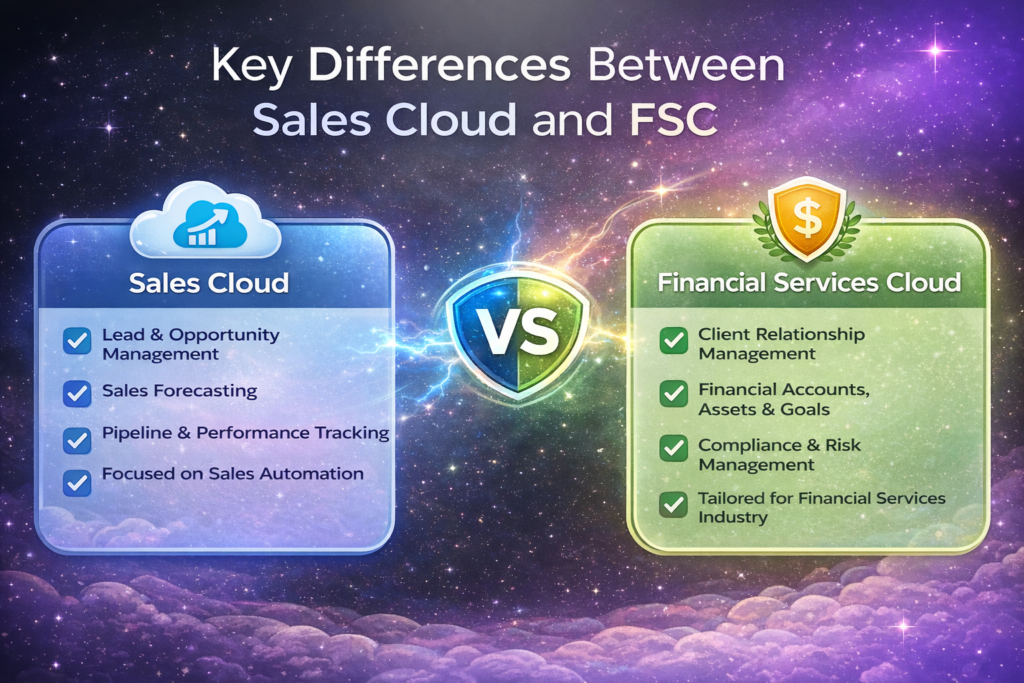
Data Model Comparison
Sales Cloud:
- Built around standard CRM objects: Leads, Accounts, Contacts, Opportunities, and Cases
- Product-centric data model focused on what you’re selling
- Generic business relationship structure with simple account hierarchies
- Flexible customization required to model complex relationships
- Opportunity-focused with pipeline and revenue emphasis
- Requires significant custom development for financial use cases
Financial Services Cloud:
- Includes standard objects plus specialized financial objects: Financial Accounts, Financial Goals, Households, Financial Holdings, Insurance Policies
- Relationship-centric data model focused on who you’re serving and their complete financial picture
- Pre-configured for financial industry with minimal customization needed
- Built-in financial data structures that understand assets, liabilities, and net worth
- Client-focused with relationship depth and household wealth emphasis
- Native understanding of financial services concepts and terminology
Target Users
Sales Cloud:
- Sales representatives focused on quota attainment
- Sales managers tracking team performance
- Marketing teams running campaigns and nurturing leads
- Sales operations analysts forecasting revenue
- Customer service teams (when combined with Service Cloud)
- Channel partners and distributors
FSC:
- Financial advisors building long-term client relationships
- Wealth managers handling complex portfolios
- Relationship managers in private banking
- Insurance agents managing policy lifecycles
- Mortgage loan officers tracking applications
- Bank branch managers serving retail customers
- Trust officers managing estate services
- Financial planners conducting holistic reviews
Industry Focus
Sales Cloud:
- Broad, cross-industry application suitable for virtually any business
- Generic sales processes that can be configured for specific needs
- Transactional sales orientation focused on closing deals
- Adaptable to any business model from simple to complex
- No built-in industry compliance or regulatory features
- Requires customization to match industry-specific requirements
FSC:
- Financial services exclusive with features that only make sense in this industry
- Industry-specific workflows for common financial services processes
- Relationship-based orientation focused on long-term client value
- Regulatory compliance built-in for common financial regulations
- Industry terminology and concepts native to the platform
- Best practices from leading financial institutions incorporated
Customization Level
Sales Cloud:
- Highly customizable starting from a flexible baseline
- Requires configuration for specialized industry needs
- Development-intensive for complex requirements
- More administrative overhead to achieve industry-specific functionality
- Greater flexibility but longer implementation timelines
- Extensive use of custom objects and fields necessary for financial services
FSC:
- Pre-configured for financial services with 60-70% of functionality out-of-the-box
- Industry best practices included reducing configuration time
- Less customization needed for standard financial workflows
- Faster time-to-value with accelerated implementations
- Focused customization on unique differentiators rather than basic functionality
- Standardized data model reduces long-term maintenance
Compliance and Security
Sales Cloud:
- Standard Salesforce security features including profiles, roles, and sharing rules
- Customizable compliance frameworks must be built from scratch
- Manual compliance setup required for industry regulations
- General data protection capabilities
- Audit trails require configuration
- No industry-specific compliance templates
FSC:
- Enhanced compliance features designed for financial regulations (FINRA, SEC, GDPR, etc.)
- Built-in audit trails for all client interactions and data changes
- Privacy controls for sensitive financial data with field-level encryption
- Regulatory reporting templates and frameworks
- Compliance-ready workflows with required documentation and approvals
- Third-party oversight features for broker-dealer supervision
- Data retention policies aligned with financial services requirements
Relationship Management
Sales Cloud:
- Account-based relationship management with simple hierarchies
- Contact roles on accounts and opportunities
- Partner relationship management for channel sales
- Limited visualization of complex relationship networks
- Relationship tracking requires customization
- Focus on business relationships rather than personal/family connections
FSC:
- Household-based relationship management as a core concept
- Complex family relationship mapping with multiple generations
- Relationship groups for centers of influence and referral networks
- Visual relationship mapping showing connections and influence
- Multi-generational wealth planning support
- Beneficiary and trustee relationships for estate planning
- Professional network tracking (attorneys, CPAs, etc.)
- Native understanding of family dynamics and financial dependencies
Pricing and Licensing
Sales Cloud:
- Lower base cost with multiple edition options (Essentials, Professional, Enterprise, Unlimited)
- Per-user, per-month pricing model
- More affordable entry point for small and mid-sized businesses
- Additional costs for advanced features (Einstein, CPQ, etc.)
- Predictable pricing with transparent tier structure
FSC:
- Higher investment as it includes Sales Cloud plus FSC-specific features
- Typically requires Enterprise or Unlimited edition
- Per-user, per-month pricing at premium levels
- Better ROI for financial services firms due to specialized functionality
- Additional costs for integrations with core banking and financial planning systems
- Enterprise-level investment suitable for mid-sized to large financial institutions
Feature Comparison Table
| Feature | Sales Cloud | Financial Services Cloud |
|---|---|---|
| Target Industry | Cross-industry | Financial Services only |
| Lead Management | ✓ Advanced | ✓ Yes (included) |
| Opportunity Tracking | ✓ Core functionality | ✓ Yes (included) |
| Financial Account Management | ✗ No (custom development required) | ✓ Native functionality |
| Household Management | ✗ No | ✓ Core feature |
| Relationship Groups | Limited (custom) | ✓ Advanced visualization |
| Financial Goal Tracking | ✗ No | ✓ Comprehensive |
| Life Events Tracking | ✗ No | ✓ Yes |
| Action Plans | Basic tasks | ✓ Industry-specific templates |
| Portfolio Management | ✗ No | ✓ Full portfolio tracking |
| Insurance Policy Management | ✗ No | ✓ Complete lifecycle |
| Compliance Features | Basic (customizable) | ✓ Enhanced for financial regulations |
| Referral Management | Limited | ✓ Comprehensive tracking |
| Document Management | Basic files | ✓ Financial documents + e-signature |
| Client Onboarding | Generic | ✓ Financial services-specific |
| Pricing | $25-$300/user/month | $300+/user/month |
| Implementation Time | 2-4 months (typical) | 4-8 months (typical) |
| Implementation Complexity | Moderate | Higher (specialized) |
| AI and Analytics | Einstein AI | Einstein AI + Financial insights |
| Mobile Access | ✓ Full mobile app | ✓ Optimized for advisors |
| Integration Ecosystem | Extensive AppExchange | Financial services-specific apps |
| Reporting | Standard + custom | Financial services dashboards |
| Data Model | Generic CRM | Financial services-optimized |
| User Adoption | Moderate learning curve | Steeper (more complex) |
| ROI Timeline | 6-12 months | 12-18 months |
When to Use Sales Cloud
Sales Cloud is the ideal choice when your organization meets these criteria:
Industry and Business Model
- You operate in non-financial industries such as technology, manufacturing, retail, healthcare, professional services, or media
- Your business model is transactional with discrete sales cycles and clear beginning/end points
- Product sales are your primary focus rather than long-term advisory relationships
- You don’t need financial account aggregation or household wealth management
Sales Process Requirements
- Your primary need is managing sales pipelines from lead to close
- Opportunity tracking and forecasting are your most important CRM functions
- You have a straightforward sales process without complex multi-generational relationship requirements
- Lead generation and conversion are top priorities for growth
- Quote-to-cash processes are important but don’t require financial services-specific features
Technical and Resource Considerations
- Budget constraints exist and you need a cost-effective CRM solution
- You have in-house development resources to customize the platform for your specific needs
- You need a flexible platform that can be adapted for various business models
- Implementation timeline is aggressive and you need rapid deployment
- Your IT team prefers building custom solutions over adopting industry-specific platforms
Organizational Factors
- Your sales team is familiar with standard CRM concepts (leads, opportunities, accounts)
- You’re a startup or SMB looking for scalable CRM functionality without enterprise complexity
- User adoption is a concern and you want an intuitive, straightforward interface
- Your sales methodology is unique and requires significant customization anyway
Example Scenario: Technology Company
A software-as-a-service (SaaS) company with 50 sales representatives needs to:
- Track inbound leads from website downloads and trial sign-ups
- Manage opportunities through a defined sales process (discovery, demo, proposal, negotiation, close)
- Forecast monthly recurring revenue (MRR) for investor reporting
- Collaborate on enterprise deals involving multiple stakeholders
- Integrate with marketing automation for lead nurturing
- Track renewals and expansion opportunities
Sales Cloud is perfect for this scenario because it provides all the necessary functionality for managing a technology sales operation without the complexity or cost of financial services-specific features. The company can configure Sales Cloud to match its sales methodology, integrate with its tech stack, and scale as the team grows.
When to Use Financial Services Cloud
Financial Services Cloud is the best option when your organization operates in these conditions:
Industry and Regulatory Environment
- You’re in the financial services industry including banking, wealth management, insurance, or financial planning
- Regulatory compliance is critical and you need built-in features for FINRA, SEC, or other financial regulations
- You need audit trails and documentation for all client interactions and advice
- Privacy and security of financial data is paramount and requires specialized controls
Client Relationship Complexity
- Complex client relationships need to be managed, including households, families, and multiple generations
- Relationship mapping across family members, business associates, and professional advisors is important
- You serve high-net-worth or ultra-high-net-worth clients with sophisticated financial situations
- Multi-generational wealth transfer is a core part of your service offering
- Beneficiary and trustee relationships must be tracked for estate planning
Service Delivery Model
- Financial account aggregation across multiple institutions is critical for your advisory services
- Goal-based planning is central to your client engagement strategy
- Portfolio management across multiple asset classes is a primary service
- Life event-based engagement drives your client communication and planning
- Holistic financial planning requires understanding all aspects of a client’s financial life
- Referral networks are a major source of new business and must be managed systematically
Technical Requirements
- Integration with core banking systems or financial planning software is necessary
- You need pre-built financial services functionality rather than building from scratch
- Faster time-to-value is important despite higher upfront costs
- Industry best practices should be built into the platform
- Specialized reporting for book of business, AUM, and client profitability is required
Organizational Capabilities
- You have experienced financial services professionals who understand industry-specific concepts
- You’re a mid-sized to large financial institution that can justify the investment
- Change management resources are available to drive adoption of a more complex platform
- Long-term client relationships are valued over short-term transactions
Example Scenario: Wealth Management Firm
A wealth management firm with 25 advisors serving 500 high-net-worth families needs to:
- Aggregate all client accounts from multiple custodians and banks
- View entire households including spouses, children, trusts, and foundations
- Track financial goals like retirement funding, college savings, and wealth transfer
- Map relationships between clients to identify referral opportunities
- Monitor life events that trigger planning needs (retirement, inheritance, marriage)
- Manage action plans for annual reviews, estate planning, and tax optimization
- Comply with regulatory requirements for supervision and documentation
- Generate household-level reports showing consolidated net worth and asset allocation
Financial Services Cloud is essential for this scenario because Sales Cloud would require extensive customization to replicate these capabilities. FSC provides out-of-the-box functionality that matches how wealth managers actually work with clients, reducing implementation time and ensuring compliance with industry regulations.
Benefits of Each Platform
Benefits of Sales Cloud
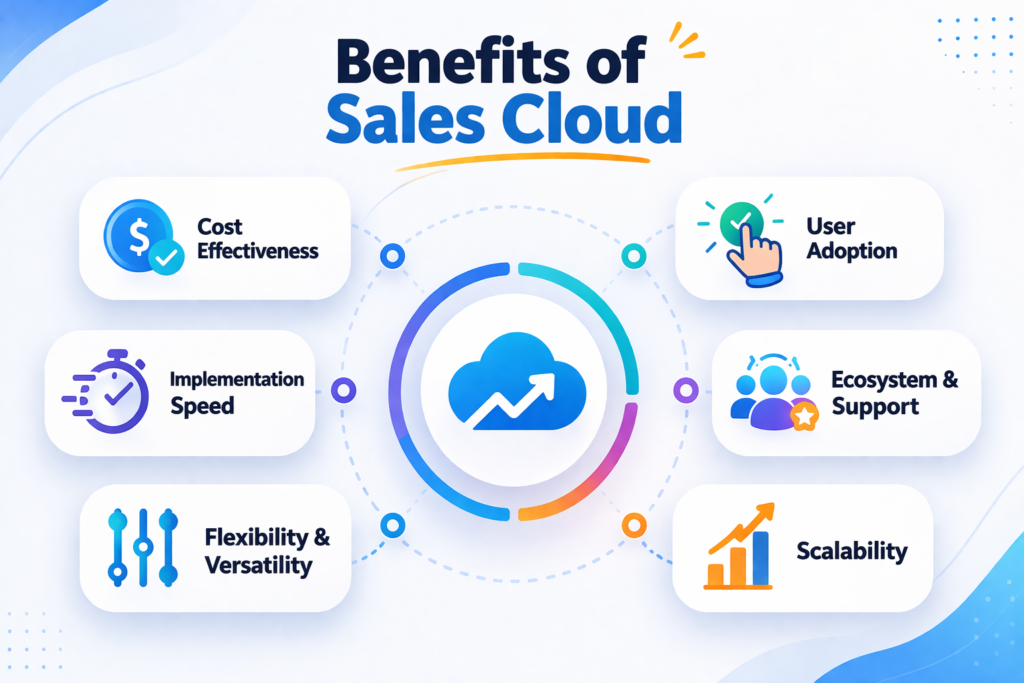
Cost Effectiveness
- Lower entry cost with editions starting at $25/user/month
- Predictable pricing with transparent tier structure
- No unnecessary features you won’t use if you’re not in financial services
- Faster ROI due to lower implementation costs
Implementation Speed
- Quick deployment with standard processes (2-4 months typical)
- Extensive documentation and training resources available
- Large ecosystem of implementation partners with experience
- Proven methodologies for rapid configuration
Flexibility and Versatility
- Broad applicability across virtually any industry or sales model
- Highly customizable to match unique business requirements
- Extensive AppExchange with thousands of pre-built integrations
- Future-proof if you expand into new industries or products
User Adoption
- Intuitive interface that’s easy for sales teams to learn
- Familiar CRM concepts (leads, accounts, opportunities) that translate across industries
- Mobile-first design for sales reps working in the field
- Gradual learning curve with progressive feature adoption
Ecosystem and Support
- Largest CRM community in the world with extensive resources
- Massive developer ecosystem for custom integrations
- Regular updates and innovation from Salesforce
- Extensive training through Trailhead and other resources
- Abundant talent pool of Salesforce administrators and developers
Scalability
- Grows with your business from small startup to global enterprise
- Add capabilities as needed (Service Cloud, Marketing Cloud, etc.)
- Support for complex organizations with multiple business units
- Global deployment with multi-currency and multi-language support
Benefits of Financial Services Cloud
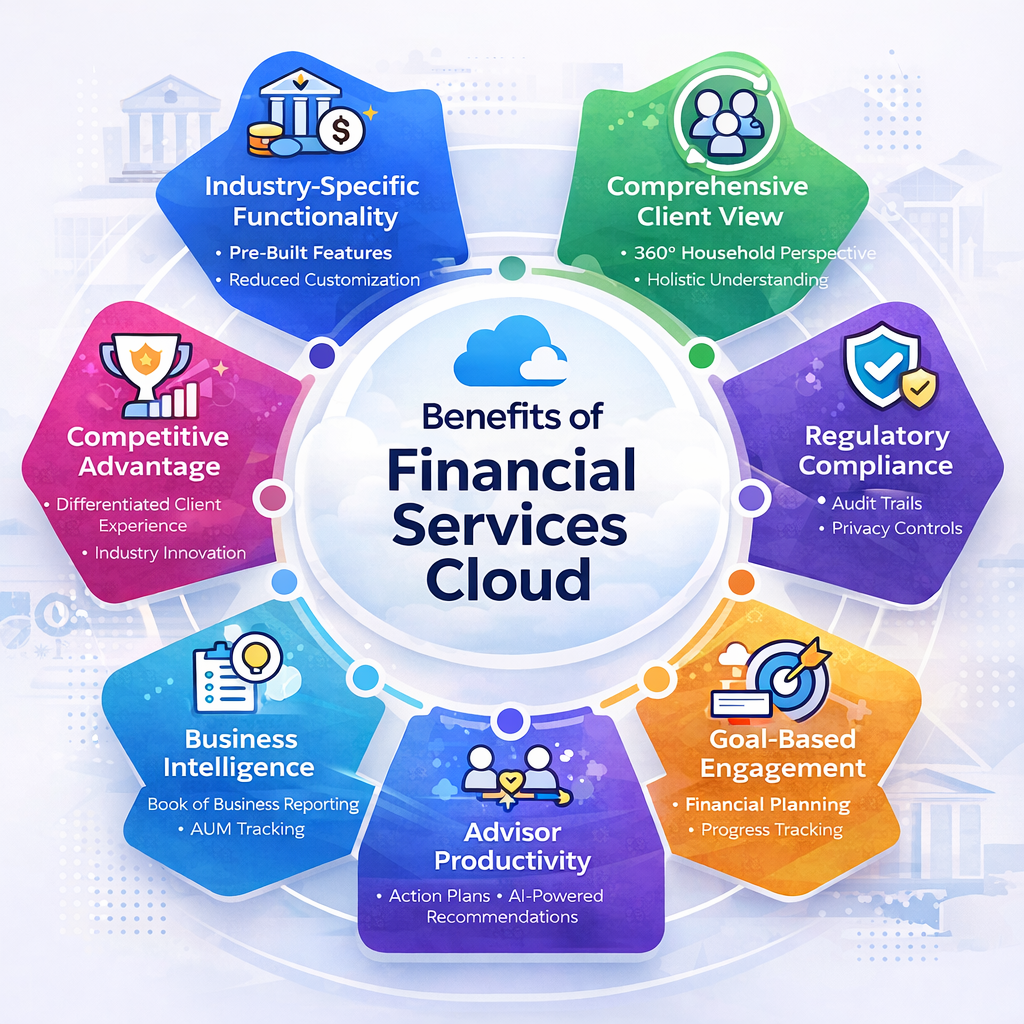
Industry-Specific Functionality
- Pre-built for financial services with 60-70% of features ready out-of-the-box
- Reduced customization time compared to adapting Sales Cloud
- Industry best practices incorporated from leading financial institutions
- Financial services terminology native to the platform
Comprehensive Client View
- 360-degree household perspective showing complete financial picture
- All accounts in one place regardless of where they’re held
- Relationship complexity handled natively without custom development
- Better client experience through holistic understanding
Regulatory Compliance
- Built-in compliance features for FINRA, SEC, and other regulations
- Audit trails for all client interactions automatically captured
- Privacy controls for sensitive financial information
- Regulatory reporting templates and frameworks included
- Reduced compliance risk through purpose-built features
Goal-Based Engagement
- Financial planning integration with goals and progress tracking
- Meaningful client conversations centered on what matters most
- Progress visualization that clients can understand
- Proactive planning triggered by life events and milestones
Relationship Management Excellence
- Household wealth management across multiple generations
- Referral tracking to identify and leverage centers of influence
- Professional network management including CPAs, attorneys, and other advisors
- Social intelligence about client connections and relationships
Advisor Productivity
- Action plans that guide advisors through standardized processes
- Next best action recommendations powered by AI
- Streamlined workflows for common activities (reviews, onboarding, etc.)
- Mobile optimization for advisors meeting with clients
Business Intelligence
- Book of business reporting by advisor, product, and household
- AUM tracking and trends with sophisticated analytics
- Client profitability analysis to focus on high-value relationships
- Retention metrics and client engagement scoring
- Referral source analysis to optimize marketing investments
Competitive Advantage
- Differentiated client experience compared to competitors using generic CRMs
- Faster implementation than building financial services features on Sales Cloud
- Industry credibility by using purpose-built platform
- Innovation specific to financial services industry trends
Conclusion
The choice between Sales Cloud vs Financial Services Cloud is fundamentally about industry fit and business requirements rather than which platform is “better.”
Choose Sales Cloud if:
✓ You operate outside the financial services sector in industries like technology, manufacturing, retail, healthcare, or professional services
✓ Your sales process is transactional with discrete opportunities rather than ongoing advisory relationships
✓ Lead generation and pipeline management are your primary CRM needs
✓ Cost efficiency is a critical factor and you need a lower-cost entry point
✓ Flexibility and customization are more important than industry-specific pre-built features
✓ You have development resources to configure the platform for your unique needs
✓ Quick implementation is a priority and you can’t invest 6+ months in deployment
✓ You’re a startup or growing business that needs to scale affordably
Choose Financial Services Cloud if:
✓ You’re in banking, wealth management, insurance, or financial advisory services
✓ Complex household relationships and multi-generational wealth are central to your business
✓ Financial account aggregation from multiple sources is critical for client service
✓ Goal-based financial planning drives your client engagement model
✓ Regulatory compliance requires specialized tracking, reporting, and audit trails
✓ Relationship mapping and referral management are key to business development
✓ Life event-based engagement aligns with your service delivery approach
✓ You’re a mid-sized to large financial institution that can justify the premium investment
✓ Time-to-value through pre-built functionality outweighs higher upfront costs
Key Takeaways
Both platforms leverage Salesforce’s powerful ecosystem, world-class security, and continuous innovation. The FSC vs Sales Cloud decision comes down to specialization versus versatility.
Financial Services Cloud includes all Sales Cloud capabilities plus extensive financial-specific features, making it the comprehensive choice for financial institutions despite the higher cost and complexity. The investment typically delivers strong ROI through:
- Improved client relationships and satisfaction
- Better regulatory compliance and reduced risk
- More efficient advisor workflows and productivity
- Enhanced business intelligence and decision-making
- Differentiated client experience versus competitors
Sales Cloud provides the perfect foundation for sales excellence across industries without unnecessary complexity or cost. It delivers value through:
- Faster implementation and user adoption
- Lower total cost of ownership
- Maximum flexibility for unique business models
- Broad applicability as you expand into new markets
- Extensive third-party integration options
Making Your Decision
Evaluate your choice based on these factors:
- Industry requirements – Are you subject to financial services regulations?
- Current processes – How do you manage client relationships today?
- Future growth plans – Where is your business headed in 3-5 years?
- Budget and resources – What can you realistically invest and maintain?
- User needs – What will make your advisors or sales reps most productive?
- Competitive positioning – How will this choice differentiate your firm?
Consider consulting with a Salesforce implementation partner who specializes in your industry. They can:
- Assess your current state and requirements
- Demonstrate platform capabilities with your use cases
- Provide accurate implementation estimates
- Share lessons learned from similar organizations
- Help you avoid common pitfalls
Final Recommendation
If you’re in financial services and serving clients with complex financial situations, households, and long-term planning needs, Financial Services Cloud is worth the investment. The specialized functionality will save you thousands of development hours and provide a platform that truly understands your business.
If you’re in any other industry or have straightforward sales processes, Sales Cloud offers everything you need without the financial services complexity. You’ll implement faster, spend less, and still get a world-class CRM platform.
The right CRM platform can transform your business, but only if it matches your actual needs. Take the time to thoroughly evaluate Salesforce FSC versus Sales Cloud based on your specific situation, and you’ll make a decision that drives growth and success for years to come.
Ready to transform your sales or financial advisory operations? Understanding these key differences between Sales Cloud and Financial Services Cloud is the first step toward selecting the CRM that will drive your business forward. Start with a clear assessment of your requirements, involve key stakeholders in the decision, and choose the platform that aligns with both your current needs and future vision.
About RizeX Labs
At RizeX Labs, we specialize in delivering advanced Salesforce solutions tailored to business and financial service organizations. Our expertise spans across Salesforce Sales Cloud, Financial Services Cloud (FSC), automation, CRM strategy, and end-to-end implementation.
We help businesses choose the right Salesforce platform based on their industry needs—whether it’s streamlining sales operations with Sales Cloud or transforming client relationship management in financial institutions with Financial Services Cloud.
Internal Linking Opportunities:
- Link to your Salesforce training page: https://rizexlabs.com/salesforce-admin-and-development-training
- Link to your FSC implementation/service page
- Link to your Sales Cloud customization blog
External Linking Opportunities:
- Salesforce official website: https://www.salesforce.com/
- Sales Cloud overview: https://www.salesforce.com/products/sales-cloud/overview/
- Financial Services Cloud overview: https://www.salesforce.com/products/financial-services-cloud/overview/
- Salesforce Help Documentation: https://help.salesforce.com/
- Salesforce AppExchange: https://appexchange.salesforce.com/
Quick Summary
Quick Summary
When comparing Sales Cloud vs Financial Service Cloud, it’s important to understand that both are powerful Salesforce CRM solutions built for different business requirements.
Sales Cloud is a general-purpose CRM platform designed to help businesses manage leads, opportunities, sales pipelines, customer interactions, and forecasting across multiple industries. It is ideal for organizations looking to improve sales productivity and streamline their sales processes.
Financial Services Cloud (FSC) is an industry-specific extension of Salesforce built specifically for financial institutions such as banks, mortgage lenders, insurance providers, and wealth management firms. FSC includes specialized data models, financial account management, household relationship mapping, compliance tools, and industry-focused automation not available in standard Sales Cloud.
In the Sales Cloud vs Financial Service Cloud comparison, the right choice depends on your business model. If your organization needs a flexible CRM for general sales operations, Sales Cloud is a strong fit. However, if you operate in the financial sector and require pre-built financial workflows, compliance-ready architecture, and relationship-based client management, FSC offers a more tailored and scalable solution.
Understanding the difference between Sales Cloud vs Financial Service Cloud helps businesses select the right Salesforce platform to maximize efficiency, improve customer relationships, and support long-term growth.
Quick Summary
When evaluating Sales Cloud vs Financial Services Cloud, the key distinction lies in industry focus and business requirements. Both platforms are powerful Salesforce CRM solutions, but they are designed for different use cases and organizational needs. Sales Cloud is Salesforce’s general-purpose CRM platform built to help businesses manage leads, opportunities, accounts, contacts, sales pipelines, forecasting, and customer engagement. It is highly flexible, cost-effective, and suitable for organizations across virtually any industry. Companies choose Sales Cloud when they need a scalable CRM to improve sales productivity and streamline standard sales operations. Financial Services Cloud (FSC) is an industry-specific extension of Sales Cloud created specifically for financial institutions such as banks, insurance providers, mortgage lenders, wealth management firms, and credit unions. FSC enhances the core CRM functionality of Sales Cloud with financial services data models, financial account management, householding, relationship mapping, compliance-ready workflows, and industry-specific automation. In the Sales Cloud vs Financial Services Cloud comparison, businesses should choose Sales Cloud if they need a flexible CRM for general sales management without financial industry requirements. However, organizations in the financial sector should consider FSC for its specialized tools and pre-built financial workflows that reduce customization efforts and accelerate implementation. Ultimately, understanding Sales Cloud vs Financial Services Cloud helps organizations select the right CRM platform to improve customer relationships, increase operational efficiency, ensure regulatory compliance, and maximize long-term Salesforce ROI.